
Our Nephrology Medical Billing services help practices manage complex renal care billing, accurate coding, payer requirements, and documentation standards. We optimize claims, reduce denials, and improve reimbursements through efficient revenue cycle management.

Think about how demanding nephrology practice really is. Your patients don’t come in once a year for a checkup; many of them are in your chair two or three times every single week for dialysis. Multiply that by hundreds of patients, each with their own payer, their own authorization requirements, their own documentation trail, and their own set of complex diagnoses across multiple CKD stages. And then as an nephrologist you realize that a single coding error on any one of those claims can cascade into delayed payments, denied claims, and compliance risk.
Whether you’re a nephrologist managing your own practice, an administrator at a dialysis center, or a kidney transplant program coordinator, this guide was written for you from our certified billing specialist.
Need support with your billing workflow? Explore our medical billing and revenue cycle services or request a free consultation.

Nephrology medical billing is the specialized process of coding, documenting, submitting, and managing insurance claims for kidney-related healthcare services provided by your practice. It covers everything from routine CKD management visits to recurring dialysis procedures, kidney biopsies, vascular access surgeries, and post-transplant care.
What makes your nephrology medical billing uniquely challenging compared to most other specialties is the combination of three factors happening simultaneously:
High procedure frequency: The average dialysis patient across the USA requires treatment three times per week, that’s approximately 156 claims per year for a single patient. Scale that across a practice of 200–500 dialysis patients, and you’re managing tens of thousands of claims annually, each with their own documentation requirements.
Chronic condition complexity: Nephrology patients don’t just have one diagnosis. A typical CKD patient also presents with hypertension, diabetes, anemia, secondary hyperparathyroidism, and cardiovascular disease, all of which must be accurately coded to support the medical necessity of the services rendered.
ESRD-specific payer rules. The CMS ESRD Program is one of the most comprehensively regulated reimbursement programs in U.S. healthcare. As an experienced nephrologist it is your responsibility that you have a deep understanding of how Medicare’s ESRD Monthly Capitation Payment (MCP) system works, and how to correctly code within it, is a niche skill that most general billers simply don’t possess. According to industry data, up to 70% of nephrology claim denials stem from coding errors and missing documentation.
Before we get into the technical details, it’s worth grounding this conversation in the clinical reality that drives the billing volume.
According to the National Kidney Foundation, approximately 37 million Americans live with chronic kidney disease, that’s 1 in 7 adults. The vast majority are undiagnosed. Of those diagnosed with CKD, a significant portion progress to End-Stage Renal Disease (ESRD), requiring dialysis or transplantation to survive, below are key data points that define the nephrology medical billing landscape in 2025:
It is clear that accurate CPT coding is the foundation of every successful nephrology claim. The codes span office visits, dialysis procedures, vascular access surgeries, kidney biopsies, and transplant services, each with its own documentation requirements and billing rules.
| CPT Code | Description | Clinical Context |
|---|---|---|
| 99213 | Established patient office visit — moderate complexity | Routine CKD follow-up, medication management |
| 99214 | Established patient office visit — high complexity | CKD progression review, multi-problem management |
| 99215 | Established patient office visit — highest complexity | Complex CKD, ESRD transition planning |
| 99221 | Initial hospital care — low complexity | New inpatient nephrology consult |
| 99222 | Initial hospital care — moderate complexity | Acute kidney injury, hospital admission |
| 99223 | Initial hospital care — high complexity | AKI requiring urgent dialysis, critical presentation |
| 99231–99233 | Subsequent hospital care | Daily nephrology inpatient rounding |
| 99291 | Critical care, first 30–74 minutes | Life-threatening AKI, hemodynamic instability |
| CPT Code | Description |
|---|---|
| 90935 | Hemodialysis procedure with single physician evaluation |
| 90937 | Hemodialysis procedure requiring repeated physician evaluations |
| 90945 | Home dialysis procedure — single evaluation |
| 90947 | Home dialysis procedure — multiple evaluations |
| 90970 | Daily ESRD-related services for patients ≥ 20 years (less than full month) |
| 90967 | Daily ESRD-related services for patients < 2 years (less than full month) |
| 90968 | Daily ESRD-related services for patients 2 to < 12 years (less than full month) |
| 90969 | Daily ESRD-related services for patients 12–19 years (less than full month) |
| 90999 | Unlisted dialysis procedure (requires narrative documentation) |
| CPT Code | Description | Visit Frequency |
|---|---|---|
| 99960 | ESRD-related services, age ≥ 20, 4+ visits/month | Full month, monthly |
| 99961 | ESRD-related services, age ≥ 20, 2–3 visits/month | Full month, monthly |
| 99962 | ESRD-related services, age ≥ 20, 1 visit/month | Full month, monthly |
| 99966 | Home hemodialysis — age ≥ 20 | Full month, monthly |
| 99989 | Dialysis patient training (physician-directed) | Per session |
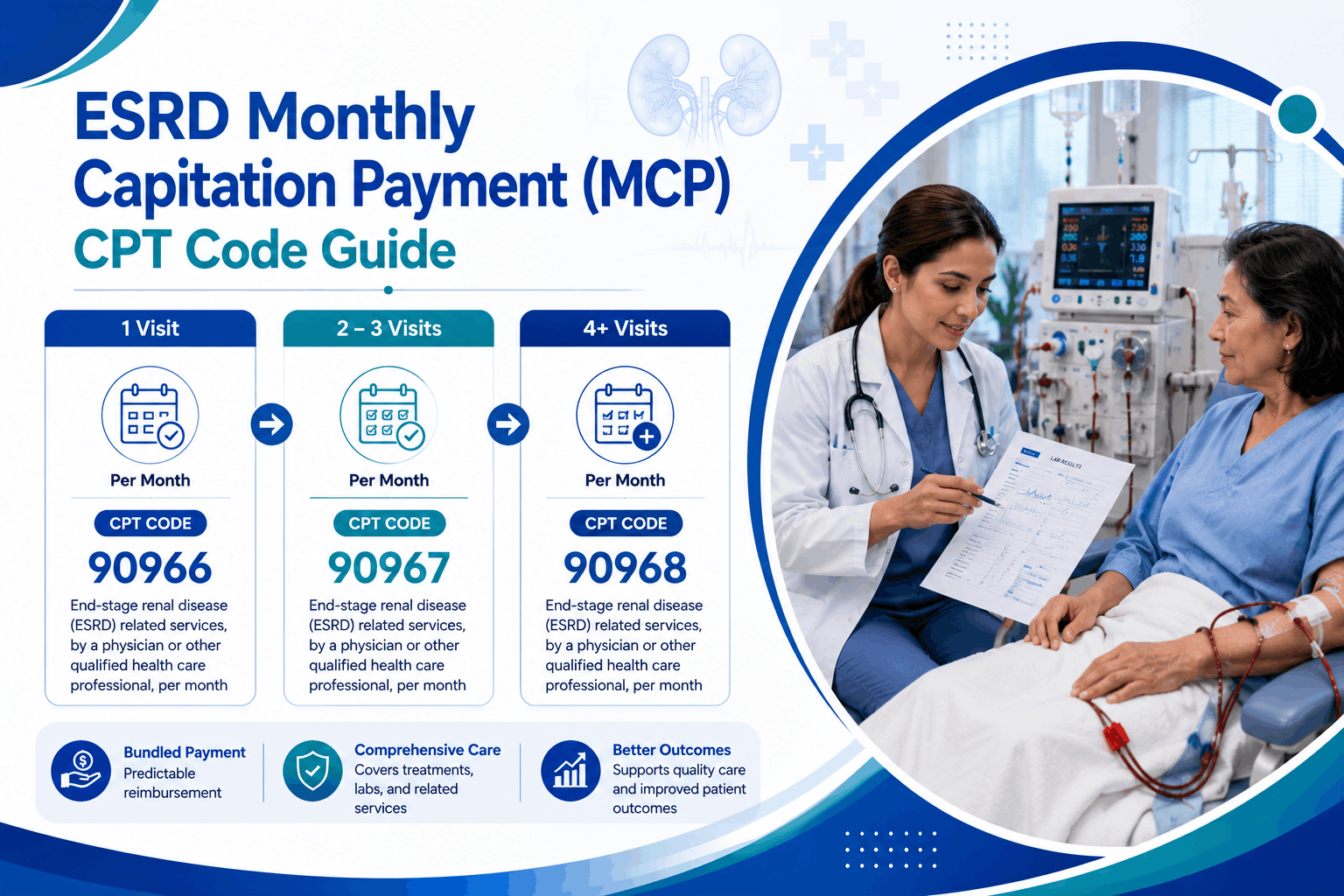
The ESRD Monthly Capitation Payment system is unique to nephrology and fundamentally different from the fee-for-service model most physicians are used to. Instead of billing per procedure or per visit, the physician bills a single monthly code that captures all ESRD-related care for that month, at a rate that depends on how many face-to-face patient visits were performed.
Under the MCP system, the nephrologist (or nephrology practice) bills one code per patient per month based on the number of physician-patient face-to-face visits performed during that calendar month:
| Monthly Face-to-Face Visits | CPT Code | Approximate Medicare Rate |
|---|---|---|
| 4 or more visits | 90960 | Highest tier |
| 2–3 visits | 90961 | Mid tier |
| 1 visit | 90962 | Lowest tier |
| Home hemodialysis (age ≥ 20) | 90966 | Monthly rate |
| Less than a full month | 90970 (age ≥ 20) | Per-day rate |
The MCP payment is designed to cover all ESRD-related physician services for the month, including:
Diagnosis coding in nephrology is multi-layered. CKD progresses through five stages, and the ICD-10 code must be updated as the patient’s condition changes. Missing a stage update, or failing to code the full complexity of a patient’s comorbidity profile, can result in underpayment or denial.
| ICD-10 Code | Description |
|---|---|
| N18.1 | Chronic kidney disease, Stage 1 |
| N18.2 | Chronic kidney disease, Stage 2 (mild) |
| N18.31 | Chronic kidney disease, Stage 3a |
| N18.32 | Chronic kidney disease, Stage 3b |
| N18.4 | Chronic kidney disease, Stage 4 (severe) |
| N18.5 | Chronic kidney disease, Stage 5 (pre-ESRD) |
| N18.6 | End-stage renal disease (ESRD) |
| N18.9 | Chronic kidney disease, unspecified |
| ICD-10 Code | Description |
|---|---|
| N17.0 | Acute kidney failure with tubular necrosis |
| N17.1 | Acute kidney failure with acute cortical necrosis |
| N17.9 | Acute kidney failure, unspecified |
| N04.x | Nephrotic syndrome (with various subtype codes) |
| N05.x | Unspecified nephritic syndrome |
| N13.x | Obstructive and reflux uropathy |
| N26.9 | Renal sclerosis, unspecified |
| Q61.x | Polycystic kidney disease |
| ICD-10 Code | Description |
|---|---|
| I12.9 | Hypertensive chronic kidney disease (CKD stage 1–4) |
| I13.10 | Hypertensive heart and CKD without heart failure |
| E11.65 | Type 2 diabetes with hyperglycemia and CKD |
| D64.9 | Anemia, unspecified (common CKD comorbidity) |
| E83.42 | Hypomagnesemia |
| N25.81 | Secondary hyperparathyroidism of renal origin |
| Z94.0 | Kidney transplant status |
| T86.10–T86.19 | Kidney transplant complications |
TIP: Never code CKD in isolation. Most CKD patients have hypertension, diabetes, or both as underlying causes. Using combination codes like I12.x (hypertensive CKD) or E11.65 (type 2 diabetes with CKD) is both more accurate and more complete than coding each condition separately, and it better reflects the medical complexity that supports E&M level selection and medical necessity.
One of the most practically important distinctions in nephrology medical billing services is the difference between hemodialysis and peritoneal dialysis billing. These are fundamentally different treatment modalities, and the coding, and the revenue cycle approach, differs significantly between them.
Hemodialysis is performed in a dialysis center (or at home) and typically occurs three times per week. For in-center hemodialysis, the physician billing is structured around the MCP system described above. For individual session billing (when less than a full month is rendered), per-day codes apply, and key hemodialysis billing rules are:
Peritoneal dialysis (PD), including Continuous Ambulatory Peritoneal Dialysis (CAPD) and Automated Peritoneal Dialysis (APD), is typically performed at home by the patient. Physician billing for PD management is covered under the MCP system, and additional PD-specific codes include:
| CPT Code | Description |
|---|---|
| 90945 | Dialysis procedure (home patient) — single evaluation |
| 90947 | Dialysis procedure (home patient) — multiple evaluations |
| 90989 | Dialysis training — patient or caregiver |
| 90993 | Dialysis training — continuation |
| 90997 | Hemoperfusion |
Medicare has placed increasing emphasis on home dialysis as a cost-effective alternative to in-center care. The CMS Kidney Care Choices (KCC) Model and the ESRD Treatment Choices (ETC) Model provide financial incentives for nephrologists who transition patients to home dialysis.
Practices investing in home dialysis programs should ensure their nephrology billing services partner understands both the standard MCP codes for home dialysis and the emerging payment model adjustments under these CMS innovation programs.
Kidney transplant billing is a subset of nephrology medical billing that deserves its own focused attention. It spans three distinct phases, each with unique CPT codes, documentation requirements, and payer considerations.
Before a kidney transplant can occur, the patient undergoes an extensive evaluation to determine surgical candidacy. Billable pre-transplant services include:
| Service | CPT Code(s) |
|---|---|
| Transplant evaluation E&M | 99213–99215 (appropriate complexity) |
| Kidney function testing | 82565 (creatinine), 82570 (creatinine clearance) |
| Biopsy (native or donor) | 50200 (percutaneous), 50205 (open) |
| Transplant immunology workup | Lab codes vary by test |
| CPT Code | Description |
|---|---|
| 50300 | Renal transplant — deceased donor (recipient) |
| 50320 | Donor nephrectomy — open |
| 50360 | Renal transplant without cadaver preparation |
| 50365 | Renal transplant with cadaver kidney preparation |
| 50370 | Removal of transplanted renal allograft |
| 50380 | Renal autotransplantation |
Post-transplant care is among the most coding-intensive phases of kidney transplant management. Transplant recipients require lifelong monitoring for rejection, infection, and transplant-related complications, and the key post-transplant coding considerations:
For dialysis patients, vascular access, the lifeline through which hemodialysis is performed is a critical and frequently billed service in nephrology medical billing. These procedures are always separately billable from dialysis management codes.
| CPT Code | Description |
|---|---|
| 36800 | Insertion of cannula for hemodialysis — vein to vein |
| 36810 | Insertion of cannula — arteriovenous, external |
| 36818 | Arteriovenous anastomosis — upper arm cephalic vein |
| 36819 | AV anastomosis — upper arm basilic vein transposition |
| 36820 | AV anastomosis — forearm vein |
| 36821 | AV anastomosis — direct, any site (AV fistula) |
| 36830 | Creation of AV graft for hemodialysis |
| 36831 | Thrombectomy of AV graft without revision |
| 36832 | Revision of AV graft, open, without thrombectomy |
| 36833 | Revision of AV graft, open, with thrombectomy |
| 36556 | Insertion of non-tunneled central venous catheter (≥ 5 years) |
| 36557 | Insertion of tunneled central venous catheter (≥ 5 years) |
TIP: Vascular access procedures performed at the time of a dialysis session are often incorrectly bundled with dialysis codes by billers unfamiliar with nephrology. These procedures are separately reimbursable under the correct CPT codes and should never be bundled with 90935 or 90937. Check the CMS NCCI edits for the specific edit pairs and modifier requirements that allow separate billing when procedures are performed at the same encounter.

According to our experience, and as an experienced nephrologist you know that strong documentation is the single most reliable defense against denials, audits, and compliance risk in your nephrology medical billing. Here’s exactly what payers like Medicare, Medicaid, and commercial insurers alike are expecting to see on every nephrology claim.
No discussion of nephrology medical billing is complete without a thorough understanding of the two dominant payers: Medicare and Medicaid. Together, they cover the majority of dialysis and ESRD patients in the United States.
CMS assigns a Status Indicator to every HCPCS/CPT code under OPPS that tells the hospital billing system how the service is paid. The most important status indicators:
Medicare provides special coverage for ESRD patients of any age, one of the few conditions for which Medicare eligibility is not age-based. Per CMS ESRD policy:
CMS assigns a Status Indicator to every HCPCS/CPT code under OPPS that tells the hospital billing system how the service is paid. The most important status indicators:
Medicaid plays a significant role in nephrology coverage, particularly for lower-income CKD patients who have not yet reached ESRD. Because Medicaid is administered state-by-state, rules and reimbursement rates vary considerably. Key considerations include:
The CMS ESRD Treatment Choices Model is a mandatory payment model affecting kidney care practices in selected geographic areas. Under ETC, nephrologists and dialysis facilities receive payment adjustments (positive or negative) based on their rates of home dialysis and transplant referral. Practices operating under ETC must understand how their billing practices interact with quality reporting under this model.
Even experienced nephrology billing teams make errors, often the same ones, year after year. Here are the most impactful mistakes we see in nephrology medical billing and how to prevent them.
Billing the Wrong MCP Tier: If your in-house team makes errors like billing 90960 (4+ visits) when physician documentation only supports 2–3 visits, or failing to bill the highest tier when it’s legitimately supported, both cost the practice money in different ways (compliance risk vs. lost revenue).
Missing Separately Billable Services: If your billing team is failing to bill vascular access procedures, acute care episodes, or non-ESRD-related services separately from the MCP bundle. These are real revenue that practices routinely leave on the table.
Incomplete CKD Stage Coding: You need to use N18.9 (CKD, unspecified) instead of the specific stage code. Payers increasingly require specificity, and audit trails demand it across the USA.
Not Updating Diagnoses as Conditions Progress: If your in-house team is continuing to bill N18.4 (Stage 4) after the patient transitions to N18.6 (ESRD). Stale diagnosis codes are a red flag for payer audits.
Incorrect Dialysis Modality Coding: Your team needs to use hemodialysis codes for peritoneal dialysis patients, or vice versa. The clinical documentation must match the modality code exactly.
Bundling Vascular Access Procedures with Dialysis: When your team is accurately applying dialysis CPT codes to encounters that also include separately billable access procedures, resulting in significant underpayment.
Skipping Modifier Use: If your in-house team is failing to apply appropriate modifiers (e.g., modifier -25 for a significant, separately identifiable E&M on the same day as a procedure) results in denials for legitimate services.
Denials are expensive for nephrologists across the nation. Not just because of the lost revenue on the denied claim, but because the administrative cost of working a denial is itself significant.
| Metric | Target (Industry Best Practice) | Red Flag Threshold |
|---|---|---|
| First-pass clean claim rate | ≥ 95% | < 90% |
| Initial denial rate | < 5% | > 10% |
| Days in Accounts Receivable | ≤ 35 days | > 45 days |
| Denial overturn rate (on appeal) | ≥ 60% | < 40% |
| Denial write-off rate | < 3% of gross charges | > 7% |
| Denial Type | Primary Cause | Recommended Solution |
|---|---|---|
| Medical necessity | Insufficient CKD documentation | Build standardized nephrology documentation templates |
| Authorization missing | ESRD admission/dialysis auth gap | Real-time auth verification at point of care |
| Incorrect MCP tier | Visit count documentation insufficient | Monthly physician visit audit before claim submission |
| Code bundling error | Vascular access bundled with dialysis | NCCI edit review on all nephrology claims |
| Timely filing | Claim submitted after payer deadline | Automated submission workflow with filing alerts |
| Wrong payer billed | Coordination of benefits error | Dual-eligibility verification at every encounter |
| Duplicate claim | Multi-provider same-day billing | Group practice billing protocol enforcement |
| Patient not eligible | Insurance lapsed or changed | Real-time eligibility verification system |
Tip: According to our experience any nephrology denial that involves a medical necessity argument, the most powerful appeal tool is a well-constructed Letter of Medical Necessity (LMN) written or co-signed by the treating nephrologist, not just the biller. Payers respond far better to physician-authored clinical narratives than to administrative appeal forms. Build a library of condition-specific LMN templates for your most common denial scenarios (dialysis initiation, home dialysis, transplant evaluation, etc.).
Authorization failures are one of the most avoidable sources of revenue loss in your practice nephrology billing, and one of the most frustrating, because the care was already delivered when the denial arrives.
The Dual-Eligibility Complexity: Many ESRD patients are dually eligible for Medicare and Medicaid. Understanding which payer is primary, and how benefits coordinate, is essential to avoiding claim submission errors. Medicare is almost always primary for ESRD patients once their coverage begins, even if Medicaid was the previous payer.
Medicare ESRD Coverage Waiting Period: New ESRD patients don’t receive Medicare coverage immediately. There’s typically a three-month waiting period (starting the month dialysis begins), during which the patient may be covered by Medicaid, employer-sponsored insurance, or a Medicare Advantage plan. Billing errors during this transition period are extremely common.
Medicare Advantage Plans and Nephrology: Patients enrolled in Medicare Advantage (Part C) plans must be billed through the MA plan, not traditional Medicare, even for ESRD-related services. MA plans often have additional authorization requirements and may have different coverage policies for specific nephrology services.
Tip: The American Society of Nephrology (ASN) and the Renal Physicians Association (RPA) both publish coding and compliance resources specifically for nephrology practices. These should be standard references for every member of your billing and coding team, not just occasional reading.
Let’s be direct about something; nephrology medical billing is not a general billing task. The MCP system, ESRD program rules, CKD staging, dialysis modality coding, vascular access procedures, transplant billing, and dual-eligibility management all require specialized knowledge that most general medical billers simply do not have.
The consequence of using a non-specialized billing team in nephrology isn’t just occasional errors. It’s systematic underperformance, lower clean claim rates, higher denial rates, missed revenue from unbilled separately-payable services, and compliance exposure from incorrect MCP tier billing.
| Factor | In-House Non-Specialized | Outsourced Specialist Partner |
|---|---|---|
| Nephrology coding expertise | Limited; requires ongoing training | Deep, current, specialty-specific |
| MCP tier accuracy | Inconsistent | Systematic, audited monthly |
| NCCI edit compliance | Reactive (after denials) | Proactive (before submission) |
| Denial management | Under-resourced | Dedicated team, structured workflow |
| CMS guideline updates | Delayed adoption | Real-time implementation |
| Vascular access billing | Frequently under-billed | Systematically captured |
| Compliance risk | Higher (knowledge gaps) | Lower (specialized oversight) |
| Cost | High (salary + training + turnover) | Predictable, performance-based |
Tip: When evaluating nephrology medical billing services partners, ask specifically about their experience with ESRD MCP billing, their process for tracking CKD stage updates, and how they handle vascular access separate billing. A partner who can answer these questions specifically, with examples from actual nephrology clients, is demonstrably more qualified than one who offers general billing capability. Ask for performance benchmarks from their existing nephrology accounts.
At House of Outsourcing, nephrology is one of our core specialty competencies. Our certified medical billing experts understand that kidney care billing isn’t just complex it’s unforgiving. Every missed MCP tier, every unbilled vascular access procedure, every authorization failure has a direct, measurable impact on your practice’s financial health.
Nephrology-Trained Coding Specialists: Our CPC certified coding team is trained specifically in nephrology CPT and ICD-10 coding, not cross-trained generalists. They understand the MCP system, CKD staging, ESRD program rules, vascular access procedure coding, and transplant billing from the ground up.
End-to-End Revenue Cycle Management: From insurance verification and prior authorization through claim submission, denial management, appeals, and patient billing, our experts manage your practice complete revenue cycle for your nephrology practice so your clinical team can focus on patient care.
MCP Audit and Optimization: Our experts perform perform monthly audits of your MCP visit documentation to ensure the highest supportable tier is being billed accurately and defensibly. This single service routinely recovers significant revenue for practices that have been under-billing their MCP tier.
Proactive Denial Prevention: We check your every nephrology claim against NCCI edits, MUE tables, and payer-specific policies before submission. Our first-pass clean claim target is ≥ 96%, consistently above the industry average.
Nephrology involves specialty-specific billing systems (particularly the ESRD MCP structure), high-frequency recurring procedures, complex comorbidity coding across five CKD stages, and procedure-intensive care that includes vascular access surgeries and transplant management. These elements require nephrology-specific coding expertise that goes well beyond general E&M billing.
NPs and PAs can bill for nephrology E&M services under their own NPI, but the MCP system requires that the billing physician personally perform the face-to-face visits that determine the MCP tier. Specific rules vary by payer and state.
During the three-month ESRD waiting period before Medicare coverage begins, patients may be covered by Medicaid, employer insurance, or a Medicare Advantage plan. Billing must be directed to the appropriate payer during this period. Medicare ESRD coverage starts on the first day of the fourth month of regular dialysis (with early start provisions for certain circumstances).
According to the OIG Work Plan, the most frequently audited nephrology billing areas include ESRD MCP tier accuracy (90960–90962), dialysis per-session billing, vascular access procedure billing, and post-transplant care during global periods.
At a minimum, quarterly. High-volume practices with large dialysis populations should consider monthly audits of MCP tier documentation and semi-annual comprehensive coding audits reviewed by an independent certified coder.
Medicare is almost always primary for ESRD patients once Medicare coverage begins. Medicaid typically covers cost-sharing (copays, deductibles) as secondary. Claims should be submitted to Medicare first, then crossed over to Medicaid through the automatic crossover process or submitted manually if crossover doesn’t occur.
Get a free assessment from our billing experts