
Our Psychiatry Medical Billing services help practices manage the complexities of behavioral health reimbursement, CPT coding, documentation requirements, and payer guidelines. We handle claim optimization, denial resolution, and revenue cycle management to improve collections, reduce administrative burdens, and support sustainable practice growth.
A complete roadmap for US psychiatrists, behavioral health practice managers, and mental health billing administrators.
| # | Section Title | Page Focus |
|---|---|---|
| 1 | What Is Psychiatry Medical Billing? | Overview, scope & revenue impact |
| 2 | Why Psychiatry Billing Is Uniquely Complex | Parity laws, behavioral health carve-outs, documentation demands |
| 3 | Key CPT Codes in Psychiatry Medical Billing | Diagnostic, psychotherapy, E/M, add-on codes |
| 4 | Psychiatry Medical Billing Services: Full Scope | End-to-end RCM service breakdown |
| 5 | ICD-10 Diagnosis Coding in Psychiatry Billing | DSM-5 to ICD-10-CM mapping |
| 6 | Medicare & Medicaid Rules for Psychiatry Billing Services | CMS, mental health parity, 190-day limit |
| 7 | Mental Health Parity & Billing Compliance | MHPAEA, parity audits, appeals |
| 8 | Psychotherapy vs. E/M Billing in Psychiatry | Standalone vs. add-on psychotherapy codes |
| 9 | Telehealth Psychiatry Billing Services | Telehealth CPT, POS codes, payer rules |
| 10 | Common Psychiatry Billing Denials & How to Fix Them | Denial management strategies |
| 11 | HIPAA & 42 CFR Part 2 Compliance in Psychiatry Billing | Substance use, confidentiality, billing rules |
| 12 | Psychiatry Billing for Different Practice Settings | Solo, group, CMHC, hospital, FQHC |
| 13 | KPIs Every Psychiatric Practice Should Track | Revenue analytics & benchmarks |
| 14 | Outsourced vs. In-House Psychiatry Medical Billing Services | Decision framework |
| 15 | FAQs: Psychiatry Billing Services | Top 10 questions answered |
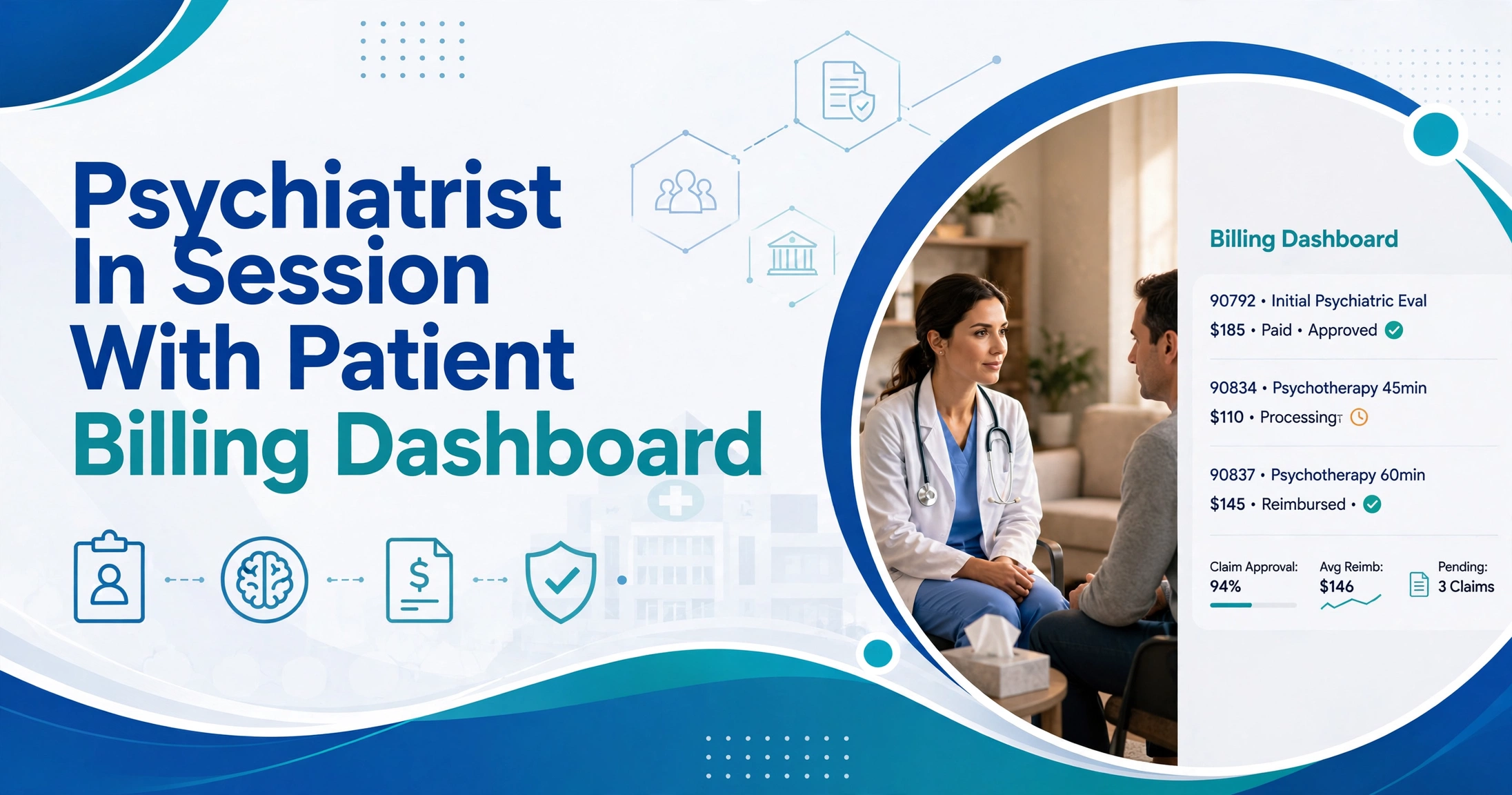
Psychiatry medical billing is the specialized process of coding, submitting, and collecting payment for psychiatric and behavioral health services delivered by psychiatrists, psychiatric nurse practitioners, and other qualified mental health providers across the United States. It covers everything from the initial diagnostic evaluation of a new patient to ongoing psychotherapy sessions, medication management visits, and complex inpatient psychiatric care.
In the USA, mental health disorders affect more than 1 in 5 American adults, according to the National Institute of Mental Health (NIMH), yet psychiatric practices consistently face some of the highest claim denial rates and lowest reimbursement rates among all medical specialties. The American Psychological Association reports that behavioral health claims are denied at rates 2 to 3 times higher than medical/surgical claims, largely due to payer practices that violate federal mental health parity laws.
Need support with your billing workflow? Explore our medical billing and revenue cycle services or request a free consultation.
If you’ve worked in psychiatric billing for more than a year, you already know it’s not like billing for a cardiology or orthopedic practice. The complexity is structural, regulatory, and payer-driven all at once. Here’s what makes psychiatry medical billing services a discipline that demands genuine specialization:
Mastering CPT code selection is the foundation of every successful psychiatry billing claim. The following tables break down all major CPT code families used in psychiatry medical billing services across US practices:
| CPT Code | Description | Time / Scope | Key Billing Notes |
|---|---|---|---|
| 90791 | Psychiatric diagnostic evaluation | 45–90 min; no medical services | Initial evaluation without prescribing; used by psychologists, LCSW, NPs, MDs |
| 90792 | Psychiatric diagnostic evaluation with medical services | 45–90 min; includes medical evaluation | Used by physicians and NPs/PAs when prescribing or medical assessment included; higher RVU than 90791 |
| 99202–99215 | Office/Outpatient E/M (New & Established) | Time or MDM based | Used for medication management visits WITHOUT psychotherapy; document using 2021 E/M guidelines |
| 99221–99223 | Initial Hospital Care | 30–70+ min per day | Inpatient psychiatric admission H&P and assessment |
| 99231–99233 | Subsequent Hospital Care | 15–55+ min per day | Daily inpatient rounds; level based on MDM or time |
| 99238–99239 | Hospital Discharge Management | 30 min / 31+ min | Document discharge planning, coordination, medication reconciliation |
| CPT Code | Description | Time | Key Billing Notes |
|---|---|---|---|
| 90832 | Psychotherapy, 30 min | 16–37 min | Standalone (non-physician) or add-on with E/M |
| 90834 | Psychotherapy, 45 min | 38–52 min | Most commonly billed individual therapy code |
| 90837 | Psychotherapy, 60 min | 53+ min | Highest-value individual therapy code; document session time |
| 90839 | Psychotherapy for crisis, 60 min | 30–74 min | For urgent/crisis mental health intervention; higher RVU |
| 90840 | Psychotherapy for crisis, each add'l 30 min | +30 min | Add-on to 90839; document total time |
| 90847 | Family psychotherapy with patient | 50 min | Patient present; document family members present |
| 90846 | Family psychotherapy without patient | 50 min | Patient NOT present; document who attended |
| 90853 | Group psychotherapy | Per session | Bill once per patient per group session; document group composition |
| 90785 | Interactive complexity add-on | N/A | Add-on to 90791/90792 or psychotherapy; use when communication is complicated by certain factors |
| E/M Base Code | + Add-On Code | Combined Description | Billing Rule |
|---|---|---|---|
| 99212–99215 | + 90833 | Medication mgmt + 30-min psychotherapy | Add-on; E/M and psychotherapy must be documented separately |
| 99212–99215 | + 90836 | Medication mgmt + 45-min psychotherapy | Add-on; document each service independently in the note |
| 99212–99215 | + 90838 | Medication mgmt + 60-min psychotherapy | Add-on; highest combined RVU in outpatient psychiatry billing |
| 99221–99223 | + 90833 | Inpatient E/M + 30-min psychotherapy | Add-on for inpatient psychiatry; document separately |
Tip: Psychotherapy Time Documentation |
In the USA the psychotherapy CPT codes (90832, 90834, 90837) are time-based; you must document the start and stop time, or the total face-to-face time of the session, in your clinical note. Without documented time, auditors and payers will downcode or deny the claim. |
When billing the combined E/M + psychotherapy add-on codes (e.g., 99214 + 90833), your note must contain two distinct sections: one documenting the E/M service (medical decision-making or time) and one documenting the psychotherapy service. A single combined narrative is insufficient. |
The 2021 AMA E/M guidelines apply to the E/M portion of psychiatry visits. Medical Decision Making (MDM) or total physician time can be used to select the E/M level — time includes reviewing records, ordering tests, and documentation, not just face-to-face time. |
A best-in-class psychiatry billing services partner like House of Outsourcing, delivers far more than claim submission. Here is what comprehensive psychiatry medical billing services should include across your full revenue cycle.
| Service Component | What It Includes | Why It Matters for Psychiatry |
|---|---|---|
| Charge Capture & Code Review | Session-by-session CPT code assignment, time verification, modifier review | Prevents time-code mismatches and missed add-on psychotherapy codes |
| Insurance Verification & Benefits | Mental health benefit verification, MBHO identification, session limits | Identifies carve-outs before billing the wrong payer |
| Credentialing with MBHOs | Enrollment with behavioral health carve-out organizations | Many denials stem from billing a payer where the psychiatrist isn't credentialed |
| Prior Authorization Management | IOP/PHP admission auth, ongoing session auth, inpatient admission auth | Auth failures are the #1 cause of inpatient and intensive-level denials |
| Claims Submission | Electronic CMS-1500 submission; UB-04 for facility billing | Rapid submission reduces AR days |
| Parity Compliance Review | MHPAEA parity analysis for repeated non-medical necessity denials | Recovers revenue that payers are illegally withholding |
| Denial Management | Root-cause analysis, appeal letters, parity appeals, peer-to-peer facilitation | Behavioral health denials have the highest appeal success rate when worked correctly |
| Payment Posting & Reconciliation | EOB posting, contractual adjustment review, underpayment identification | Identifies systematic underpayments by payer |
| Patient Billing & Collections | Statement generation, sliding scale documentation, self-pay follow-up | Psychiatry patients often have significant out-of-pocket costs |
| 42 CFR Part 2 Compliance | Substance use disorder billing handled under appropriate confidentiality rules | Protects practice from federal SUD confidentiality violations |
| Compliance Monitoring | OIG work plan monitoring, payer audit response, documentation review | Psychiatry is a focus area for payer and OIG audits |
| Reporting & Analytics | Monthly denial trends, payer performance, AR aging, collection rate dashboards | Data-driven revenue cycle management |
Accurate ICD-10-CM diagnosis coding in psychiatry billing is where DSM-5 clinical diagnoses translate into billable claims. Every psychiatric diagnosis must map to a specific ICD-10-CM code that supports medical necessity for the CPT codes billed. Here are the most frequently used diagnostic code families in psychiatry billing services:
| ICD-10-CM Code(s) | DSM-5 Diagnosis | Psychiatry Billing Context |
|---|---|---|
| F32.0–F32.9 | Major Depressive Disorder, single episode (mild/moderate/severe/unspecified) | Highest volume psychiatric diagnosis in outpatient billing; specify severity |
| F33.0–F33.9 | Major Depressive Disorder, recurrent | Distinguish from single episode; specify remission status for accurate coding |
| F41.1 | Generalized Anxiety Disorder | Second most common outpatient psychiatric diagnosis; pairs with CBT billing |
| F41.0 | Panic Disorder | Document presence/absence of agoraphobia for specificity |
| F40.10–F40.11 | Social Anxiety Disorder (Social Phobia) | Specify generalized vs. specific for coding accuracy |
| F43.10–F43.12 | Post-Traumatic Stress Disorder (PTSD) | Specify acute, chronic, or with delayed expression; critical for VA/Tricare billing |
| F31.x | Bipolar I Disorder (various specifiers) | Specify episode type (manic/depressed/mixed) and severity; impacts medical necessity |
| F31.81 | Bipolar II Disorder | Distinct code from Bipolar I; document current episode |
| F20.9 | Schizophrenia, unspecified | Use more specific codes (F20.0–F20.89) when episode type documented |
| F90.0–F90.9 | Attention-Deficit Hyperactivity Disorder | Specify presentation (predominantly inattentive/hyperactive/combined) |
| F10.x–F19.x | Substance Use Disorders (alcohol, opioid, stimulant, etc.) | 42 CFR Part 2 applies; severity coding (mild/moderate/severe) affects coverage |
| F50.01–F50.9 | Eating Disorders (Anorexia, Bulimia, Binge Eating) | Often require IOP/PHP level of care; prior auth almost always required |
| F84.0 | Autism Spectrum Disorder | Applied behavior analysis (ABA) billing has separate CPT set (97151–97158) |
| Z03.89 | Encounter for observation for other suspected mental health disorder | Diagnostic evaluation when no confirmed diagnosis yet |
Medicare and Medicaid are among the largest payers for psychiatric services in the United States, particularly for elderly, disabled, and lower-income populations. As a psychiatric you need to Understand their specific rules is non-negotiable for any psychiatry program.
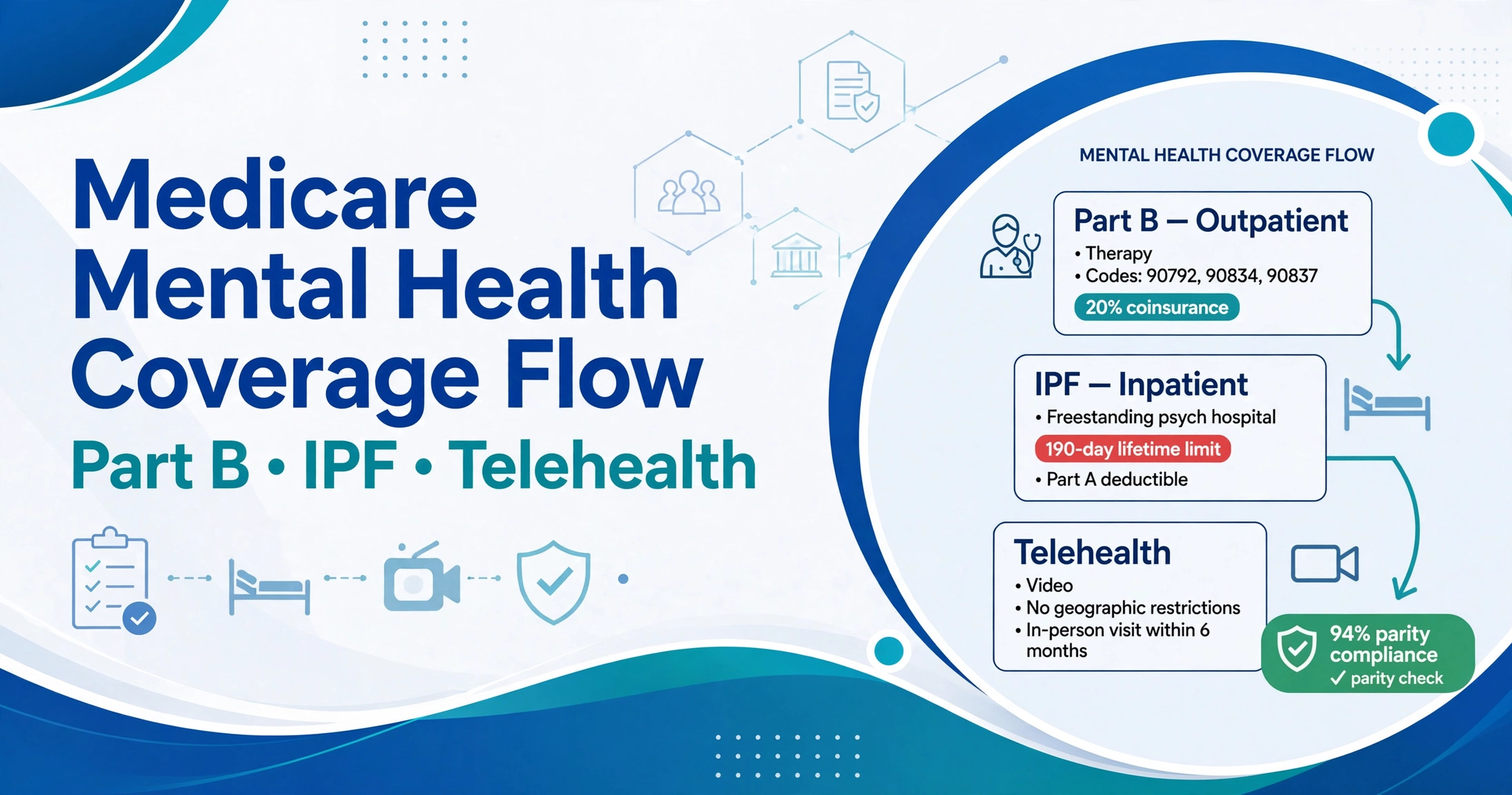
Medicare covers outpatient mental health services at 80% after deductible (same as other medical services since 2014 parity phased implementation).
The Medicare 190-day lifetime limit applies only to inpatient care in a freestanding Psychiatric Facility (IPF), it does not apply to general hospital psychiatric units or outpatient care.
Medicare Part B covers individual and group psychotherapy, psychiatric diagnostic evaluations, and E/M services for medication management.
Medicare does NOT cover custodial mental health care or services that are not medically necessary under its LCD policies.
Psychiatrists billing Medicare must use the CMS-1500 form and the appropriate place of service code.
The Inpatient Psychiatric Facility (IPF) Prospective Payment System governs Medicare payments to freestanding psychiatric hospitals, separate from the IPPS for general hospitals.
Medicaid mental health billing rules vary significantly by state, but all states must cover certain minimum mental health services. Key considerations for psychiatry billing services under Medicaid include.
Most states operate Medicaid behavioral health through managed care, identifying the MBHO or MCO for each patient before billing.
Community Mental Health Centers (CMHCs) have specific Medicaid billing rules and often use encounter-based or bundled rates.
Federally Qualified Health Centers (FQHCs) bill Medicaid under a Prospective Payment System (PPS) per-visit rate that includes behavioral health.
Medicaid prior authorization requirements for psychiatric services vary by state and by managed care plan.
Substance use disorder treatment billing under Medicaid is governed by both state rules and 42 CFR Part 2.
| Medicare / Medicaid Rule | Impact on Psychiatry Billing | Resource |
|---|---|---|
| Medicare 80/20 cost-sharing for mental health | Patient owes 20% coinsurance after deductible — same as medical | medicare.gov/coverage/mental-health-care |
| 190-day IPF lifetime limit | Only freestanding psychiatric hospitals; track patient's cumulative days | cms.gov/medicare/payment/prospective-payment-systems/inpatient-psychiatric-facility |
| IPF Prospective Payment System | Governs inpatient psychiatric facility Medicare payments | cms.gov/medicare/payment/prospective-payment-systems/inpatient-psychiatric-facility |
| Medicaid MBHO carve-outs | Route claims to MBHO, not state Medicaid, for behavioral health | medicaid.gov/state-overviews/index.html |
| FQHC PPS rate | Single encounter rate covers most psychiatric services at FQHCs | bphc.hrsa.gov/compliance/billing-coding |
Mental health parity is one of the most important — and most frequently violated — areas of insurance law affecting psychiatry billing. The Mental Health Parity and Addiction Equity Act (MHPAEA) of 2008, strengthened by the Affordable Care Act and the Consolidated Appropriations Act of 2023, requires that health plans offering mental health benefits do so at coverage levels no more restrictive than comparable medical/surgical benefits.
Applying session limits to psychotherapy that don’t exist for medical office visits.
Requiring prior authorization for psychiatric services when medical services don’t require it.
Using non-quantitative treatment limitations (NQTLs), such as more stringent medical necessity criteria for mental health claims.
Denying inpatient psychiatric care as ‘not medically necessary’ at rates far exceeding comparable medical denials.
Applying higher cost-sharing (copays, deductibles) to mental health services than to medical services.
One of the most critical and most commonly mishandled billing decisions in psychiatry is choosing between billing an E/M code alone, a psychotherapy code alone, or the combined E/M plus psychotherapy add-on. Getting this wrong costs revenue in both directions.
| Visit Type | Correct Billing Approach | Documentation Required | Who Can Bill |
|---|---|---|---|
| Medication management only — no psychotherapy | E/M code (99202–99215) based on MDM or time | History, assessment, prescribing decision, MDM or total time | Psychiatrist, NP, PA |
| Psychotherapy only — no prescribing | Psychotherapy code only (90832/90834/90837) | Diagnosis, goals, interventions, session time | Psychologist, LCSW, LPC, LMFT, MD, NP |
| Both medication management AND psychotherapy in same session | E/M code + psychotherapy add-on (90833/90836/90838) | TWO separate documentation sections: E/M section + psychotherapy section; document session time for therapy portion | Psychiatrist, psychiatric NP, PA (QHP) |
| Initial psychiatric evaluation — no prescribing | 90791 | Comprehensive psychiatric history, MSE, diagnosis, formulation, plan | Any qualified mental health provider |
| Initial psychiatric evaluation — with prescribing/medical | 90792 | Comprehensive history, MSE, medical history, medication review, Rx plan | Physicians, NPs, PAs only |
| Crisis psychotherapy | 90839 + 90840 if extended | Crisis description, interventions, disposition, total time documented | Any qualified provider |
Telehealth has permanently transformed psychiatric care delivery in the United States and psychiatry is one of the specialties where telehealth adoption is highest and most clinically validated. But billing for telehealth psychiatry services requires precise code and modifier selection that many practices still get wrong.
| Element | Rule / Code | Key Notes |
|---|---|---|
| CPT Codes Used | Same as in-person (90791, 90792, 90832–90837, 99202–99215, etc.) | Telehealth doesn't change the CPT code — it changes the place of service and modifiers |
| Place of Service (POS) Code | POS 02 (telehealth, not patient's home) or POS 10 (patient's home) | POS 10 introduced in 2022 for home-based telehealth; use correct POS for each encounter |
| Modifier 95 | Synchronous audio-video telehealth | Required by most payers to indicate real-time audio-video telehealth |
| Modifier GT | Interactive audio-video telehealth (Medicare) | Medicare-specific modifier for telehealth; some MACs still use GT alongside 95 |
| Audio-Only (Phone) Visits | 99441–99443 (telephone E/M) where covered | Medicare covers audio-only for certain psychiatric/mental health services; verify per payer |
| Originating Site | Medicare requires patient to be in an approved originating site for some telehealth | Post-PHE flexibilities extended through 2026 by Consolidated Appropriations Act |
| Interstate Licensure | Provider must be licensed in the state where the PATIENT is located | Telehealth across state lines requires licensure in patient's state; verify before billing |
Behavioral health claims have the highest denial rates in medicine, yet they also have some of the highest appeal success rates when worked correctly. Here are the denials that can hit your psychiatric practice hardest and the proven strategies to resolve and prevent them:
| Denial Type | Root Cause | Fix / Prevention Strategy |
|---|---|---|
| Non-Medical Necessity — Outpatient | Payer's medical necessity criteria stricter than evidence-based clinical standards (potential parity violation) | You need to appeal with clinical documentation; if pattern persists, file parity complaint; engage parity attorney |
| Prior Auth Not Obtained or Expired | Session count exceeded auth limit; inpatient admission auth missing | You need to track auth limits per payer per patient; set alerts 2 sessions before limit; obtain continued-stay auths proactively |
| Wrong Payer — MBHO Carve-Out | Claim sent to medical payer when behavioral health is carved out to an MBHO | You need to verify MBHO vs. medical plan at every insurance verification; update payer routing in billing system |
| Time Documentation Missing | Psychotherapy code billed without documented session time in clinical note | Mandate time documentation in EHR template; add start/stop time field to all therapy note templates |
| Incorrect E/M + Psychotherapy Combination | Add-on code billed without valid E/M base; non-physician billing add-on codes | Audit claim combinations monthly; restrict add-on CPTs to physician/QHP providers in billing system |
| Credentialing Denial | Provider not credentialed with MBHO or payer plan network | Complete MBHO credentialing before seeing insured patients; track credentialing status per payer in CRM |
| Timely Filing Exceeded | Claim submitted outside payer's filing window | Set 30-day submission alerts; behavioral health payers vary from 90 to 365 days timely filing |
| Telehealth Modifier Missing | Telehealth visit billed without modifier 95 or incorrect POS | Build modifier 95 + POS 02/10 into telehealth claim template; audit monthly |
| Group Therapy Over-Billing | 90853 billed multiple times per session per patient | Confirm billing system submits 90853 once per patient per date; train billing staff on group billing rules |
| Parity Violation Disguised as Medical Necessity Denial | Payer applies stricter criteria to psychiatric claims than medical — a federal violation | Compare denial rates across medical vs. behavioral claims; escalate systematic disparities as parity violations |
Your psychiatric practice operates under two overlapping confidentiality frameworks that create unique billing compliance obligations: HIPAA’s Privacy and Security Rules, and 42 CFR Part 2, which governs substance use disorder (SUD) records.
42 CFR Part 2 provides stronger confidentiality protections for SUD treatment records than HIPAA. Key billing implications include:
SUD diagnosis and treatment information cannot be disclosed to payers without patient-specific written consent even for billing purposes unless the patient has provided a compliant consent form.
The 2020 and 2024 revisions to 42 CFR Part 2 aligned some provisions with HIPAA, but SUD billing remains separately regulated.
Billing claims for SUD treatment cannot include information that would identify the patient as receiving SUD treatment without consent.
Practices offering both mental health and SUD treatment must maintain separate record systems or use segmentation to protect SUD records.
| Practice Setting | Billing Workflow | Key Psychiatry Billing Considerations |
|---|---|---|
| Solo Psychiatric Practice | Professional claims and payer follow-up | Verify provider enrollment, patient benefits, documentation and the services performed before submitting claims. |
| Psychiatric Group Practice | Individual and group provider billing | Check each clinician’s credentials, payer participation and rendering-provider information. |
| Community Mental Health Center | Program-specific professional or facility billing | Confirm the center’s enrollment type, covered services and applicable payer requirements. |
| Hospital-Based Psychiatry | Professional and facility billing, where applicable | Distinguish clinician services from facility charges and review documentation to avoid duplicate billing. |
| Federally Qualified Health Center | Health-center billing under applicable payer rules | Verify the payment method, eligible mental health practitioners and encounter requirements for the payer. |
| Telepsychiatry Practice | Remote psychiatric services | Verify patient location, clinician licensure, coverage, place of service and any required modifiers for the date of service. |
| Practice Setting | Billing Model | Key Pediatrics Billing Considerations |
|---|---|---|
| Private/Independent Pediatric Practice | CMS-1500; mix of Medicaid, CHIP, commercial | Highest billing complexity; most dependent on specialized pediatrics billing services |
| Pediatric Group Practice | CMS-1500; group NPI billing; provider credentialing per payer | Ensure all pediatricians are credentialed with Medicaid MCOs; group vs. individual NPI rules |
| Federally Qualified Health Center (FQHC) | Prospective Payment System (PPS) per-visit rate | FQHC PPS rate covers most services; supplemental billing rules apply for some vaccines/labs |
| Hospital-Based Pediatric Clinic | Professional billing (CMS-1500) + facility (UB-04) | Split billing between professional group and hospital; avoid duplicate billing |
| Pediatric Emergency Department | ED E/M codes 99281–99285; facility billing separate | Level assignment based on MDM; observation vs. inpatient admission rules |
| School-Based Health Center | Medicaid school-based billing; state-specific rules | Parental consent for billing required; EPSDT frequently applies |
| Telehealth Pediatrics | Standard CPT with GT/95 modifier; place of service 02/10 | Payer policies on pediatric telehealth vary; Medicaid telehealth coverage varies by state |
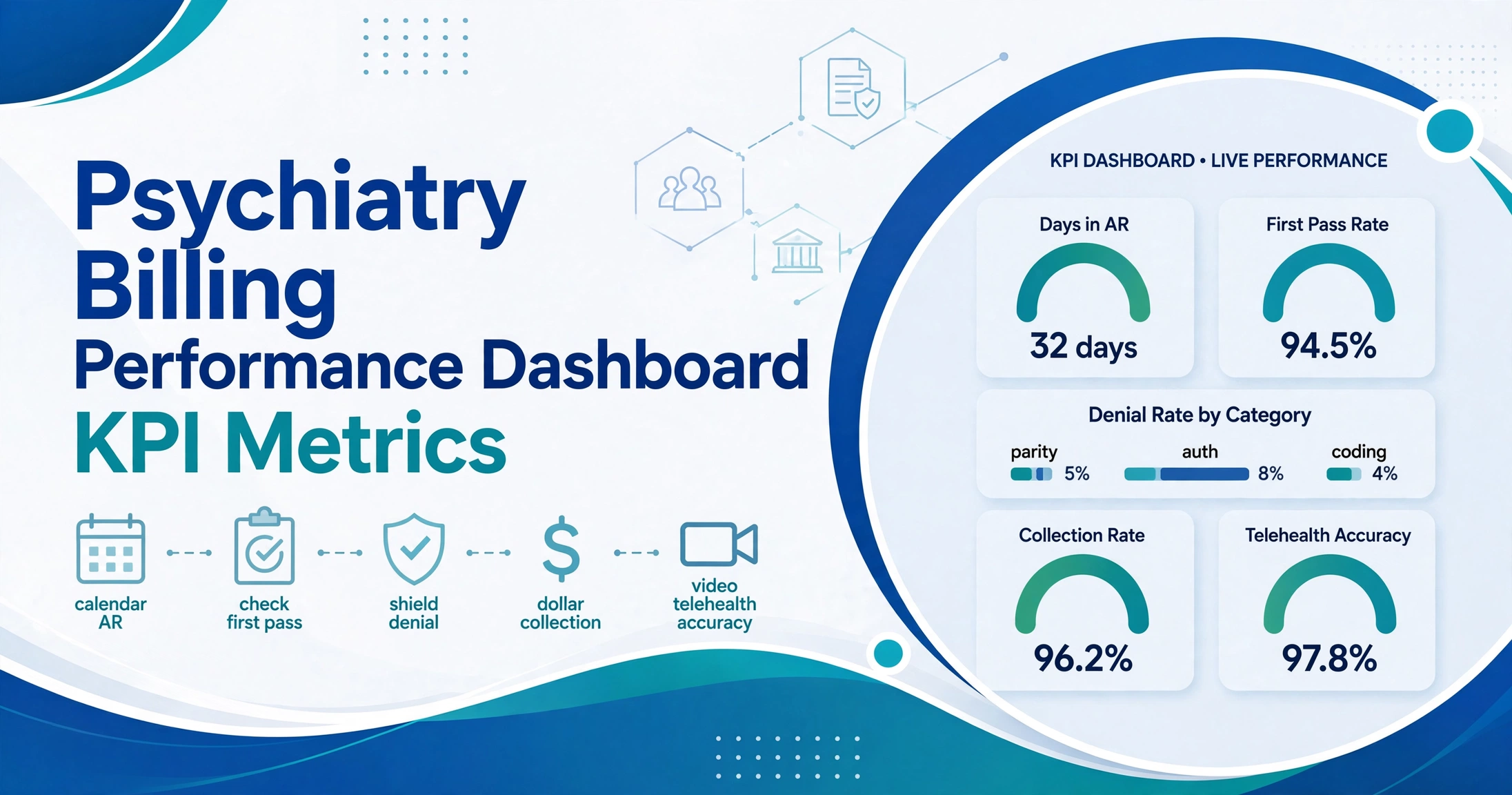
Your psychiatry billing performance management requires tracking metrics that are specific to behavioral health revenue cycle dynamics, including parity-related denial rates and authorization utilization. Here are the KPIs that matter most:
| KPI | Definition / Formula | Benchmark Target |
|---|---|---|
| Days in AR | Total AR balance ÷ Average daily charges | < 35 days |
| First Pass Resolution Rate | Claims paid on first submission ÷ Total claims submitted | > 94% |
| Overall Denial Rate | Denied claims ÷ Total claims submitted | < 6% |
| Medical Necessity Denial Rate | Med nec denials ÷ Total claims — compare to medical/surgical rate | < 3%; flag if >2x your medical denial rate (parity indicator) |
| Prior Auth Denial Rate | Auth denials ÷ Total claims — compare across specialties | < 2%; parity concern if behavioral health rate >> medical |
| Clean Claim Rate | Claims accepted without edits ÷ Total submitted | > 97% |
| Collection Rate | Collections ÷ Net adjusted charges | > 94% |
| Telehealth Claim Accuracy Rate | Telehealth claims billed correctly ÷ Total telehealth claims | > 98%; audit modifier 95 + POS code monthly |
| Charge Lag | Days from encounter to claim submission | < 48 hours |
| Parity Appeal Success Rate | Successful parity appeals ÷ Total parity appeals filed | Track and use as vendor performance indicator |
The decision between keeping your psychiatric billing in-house or partnering with a specialized psychiatry billing services company is one of the most consequential operational choices you need to make. Here is the honest, comprehensive comparison:
| Factor | In-House Billing | House of Outsourcing Psychiatry Billing Services |
|---|---|---|
| Startup Cost | High staff, EHR/PM setup, coder training, parity compliance infrastructure | Low percentage of collections or flat monthly fee; no hiring cost |
| Ongoing Cost | Salaries, benefits, PTO coverage, ongoing training on parity and 42 CFR Part 2 | Predictable % of revenue; no HR overhead for billing staff |
| MBHO / Parity Expertise | Requires staff who understand behavioral health carve-outs and parity law — rare | Specialized vendors maintain current MBHO credentialing and parity compliance knowledge |
| Psychotherapy Code Accuracy | Requires ongoing coder training on time-based coding and add-on rules | Psychiatry billing specialists handle 90832–90838, add-on codes as core competency |
| 42 CFR Part 2 Compliance | Requires specific staff training and record-segmentation protocols | Reputable vendors have 42 CFR Part 2 protocols built into their workflow |
| Parity Appeal Capability | Limited — most in-house billers lack parity law expertise | Best-in-class vendors file parity appeals and recover systematically denied revenue |
| Scalability | Difficult — hiring lags volume; staff turnover disrupts collections | Scales with your volume immediately; no revenue dip during staff transitions |
| Revenue Performance | Variable — billing gaps and parity non-compliance cost revenue | Consistent — performance tracked via SLA with transparent reporting |
| Best For | Large multi-site psychiatric groups with dedicated billing departments and compliance staff | Solo psychiatrists, small-medium groups, practices with high MBHO payer mix |
�� Pro Tip: Evaluating a Psychiatry Billing Services Vendor |
Ask specifically about their parity compliance capability can they identify potential parity violations in your denial data and file parity appeals? This is a differentiator that separates behavioral health specialists from generalist billers. |
Request their average first-pass resolution rate and collection rate for psychiatry-specific clients, not just overall. A 95% first-pass rate in primary care means little for your psychiatric billing environment. |
Verify they have experience with your specific payer mix: if 40% of your patients use Medicaid, ask how many state Medicaid and MBHO systems they actively bill. |
Ask how they handle 42 CFR Part 2 patient records in their workflow — a vendor without a clear answer is a compliance risk. |
Request references from psychiatric practices of similar size and payer mix. |
Accurate psychiatry billing requires staying current with evolving coding, documentation, and reimbursement requirements. These below trusted resources provide the latest guidance on CPT coding, Medicare policies, behavioral health regulations, and compliance standards to help youreduce denials and maintain accurate claims.
| Resource | Organization | URL |
|---|---|---|
| Coding and Billing Resources for Psychiatrists | American Psychiatric Association | psychiatry.org/psychiatrists/practice/practice-management/billing-and-coding |
| CMS Physician Fee Schedule Search | CMS (Medicare) | cms.gov/medicare/physician-fee-schedule/search |
| Medicare Mental Health Coverage | Medicare.gov | medicare.gov/coverage/mental-health-care |
| CMS Inpatient Psychiatric Facility PPS | CMS (Medicare) | cms.gov/medicare/payment/prospective-payment-systems/inpatient-psychiatric-facility |
| Mental Health Parity Resources | CMS | cms.gov/marketplace/private-health-insurance/mental-health-parity |
| DOL Mental Health Parity Information | Dept. of Labor (EBSA) | dol.gov/agencies/ebsa/laws-and-regulations/laws/mental-health-parity |
| CMS Telehealth Services Coverage | CMS (Medicare) | cms.gov/medicare/coverage/telehealth |
| Medicaid Telehealth Policies | Medicaid.gov | medicaid.gov/medicaid/benefits/telehealth/index.html |
| SAMHSA 42 CFR Part 2 FAQs | SAMHSA | samhsa.gov/about-us/who-we-are/laws-regulations/confidentiality-regulations-faqs |
| ICD-10-CM Official Guidelines | CMS / CDC | cms.gov/medicare/coding-billing/icd-10-codes/icd-10-cm-documentation |
| NCCI Policy Manual | CMS / NCCI | cms.gov/medicare/coding-billing/national-correct-coding-initiative-edits |
| OIG Work Plan | HHS Office of Inspector General | oig.hhs.gov/reports-and-publications/workplan/index.asp |
| HIPAA for Covered Entities | HHS Office for Civil Rights | hhs.gov/hipaa/index.html |
| MGMA DataDive Benchmarks | Medical Group Management Assoc. | mgma.com/data/benchmarking-data/mgma-datadive |
The most revenue-critical CPT codes in psychiatry billing are 90792 (psychiatric diagnostic evaluation with medical services used by physicians for initial evaluations with prescribing), 90837 (individual psychotherapy, 60 minutes highest-value standalone therapy code), and the combined E/M + add-on psychotherapy codes (e.g., 99214 + 90838 for a medication management visit with 60-minute psychotherapy). For group practices employing non-physician therapists, 90834 (45-minute psychotherapy) is typically the highest-volume code. Group therapy (90853) and crisis codes (90839) round out the most frequently billed psychiatry CPT codes in US practices
The Mental Health Parity and Addiction Equity Act (MHPAEA) requires that health insurance plans offering mental health benefits cannot impose more restrictive coverage limitations on those benefits than they apply to comparable medical/surgical benefits. In practice, this means payers cannot legally apply stricter prior authorization requirements, lower session limits, or higher non-medical necessity denial rates to psychiatric claims than to medical claims.
Telehealth psychiatry billing uses the same CPT codes as in-person visits but with additional elements: Place of Service code 10 (patient’s home) or 02 (other telehealth location), modifier 95 (synchronous audio-video), and documentation of the telehealth platform used and patient location. Medicare has extended telehealth mental health flexibilities through at least 2026, allowing psychiatrists to see Medicare patients via telehealth without originating site restrictions
Medicare imposes a 190-day lifetime limit on inpatient care in freestanding Inpatient Psychiatric Facilities (IPFs), facilities that are exclusively psychiatric, rather than general hospitals with psychiatric units. This limit does not apply to psychiatric units within general hospitals (which operate under IPPS), nor does it apply to outpatient psychiatric services, PHP, IOP, or any outpatient care. For patients approaching their 190-day limit, billing and case management teams must track cumulative inpatient psychiatric facility days across all Medicare claims. Exceeding the 190-day limit without a qualifying Medicare Advantage coverage exception will result in a denial. This rule does not apply to Medicaid or commercial insurance
At House of Outsourcing we provide end-to-end psychiatry medical billing services designed specifically for US psychiatric and behavioral health practices from solo psychiatrists to multi-site group practices and community mental health centers. Our psychiatry billing specialists understand the full complexity of psychotherapy time-based coding, MBHO carve-out routing, mental health parity compliance, telehealth billing, and 42 CFR Part 2 requirements. We consistently deliver first-pass resolution rates above 95%, proactive parity appeal filing, and transparent monthly reporting
Get a free assessment from our billing experts