
How your best billing practices, right coding , and by following accurate documentation standards help your practice maximize reimbursements while staying fully compliant with CMS guidelines.

Medicare mental health billing is no longer just about selecting CPT codes, it’s about aligning clinical care, documentation, telehealth rules, and reimbursement strategy into one system.
In 2026, behavioral health is one of the fastest-growing areas under Medicare, but it’s also one of the most audited and misunderstood. Mental health providers like your practice that fail to adapt don’t just lose money, they risk compliance exposure, recoupments, and long-term instability.
Need support with your billing workflow? Explore our medical billing and revenue cycle services or request a free consultation.
One of the most dangerous aspects of mental health billing is that errors often don’t result in outright denials, they result in systematic underpayment.
For example, if your practice consistently documents vaguely or selects lower CPT levels due to uncertainty, the practice may lose 10–30% revenue per visit without realizing it. Over hundreds of sessions, this becomes a major financial gap.
At the same time, patterns of inconsistency (like frequent use of higher-level codes without supporting documentation) can trigger payer analytics and audits.
Psychotherapy billing is built entirely on time thresholds, but most providers do not document time with enough precision. Medicare expects clear justification for selecting codes like 90834 vs 90837,not estimates, the issue is not just underdocumentation, it’s inconsistency. For example:
These patterns are easily flagged by Medicare’s data systems, so as a provider you need to avoid them for successful reimbursement.
Solution:
You need to use standardized documentation:
Telehealth has expanded access dramatically in the USA, but in 2026, Medicare is shifting focus from expansion to compliance enforcement.
Key realities:
Many providers across the nation believe documenting symptoms is enough. It’s not. Medicare requires clear proof that:
If your medical notes only describe patient conversations without showing clinical purpose, claims may be denied or recouped later.
This is especially critical for long-term therapy patients, where continued treatment must be justified over time.
Solution:
Every note should answer:
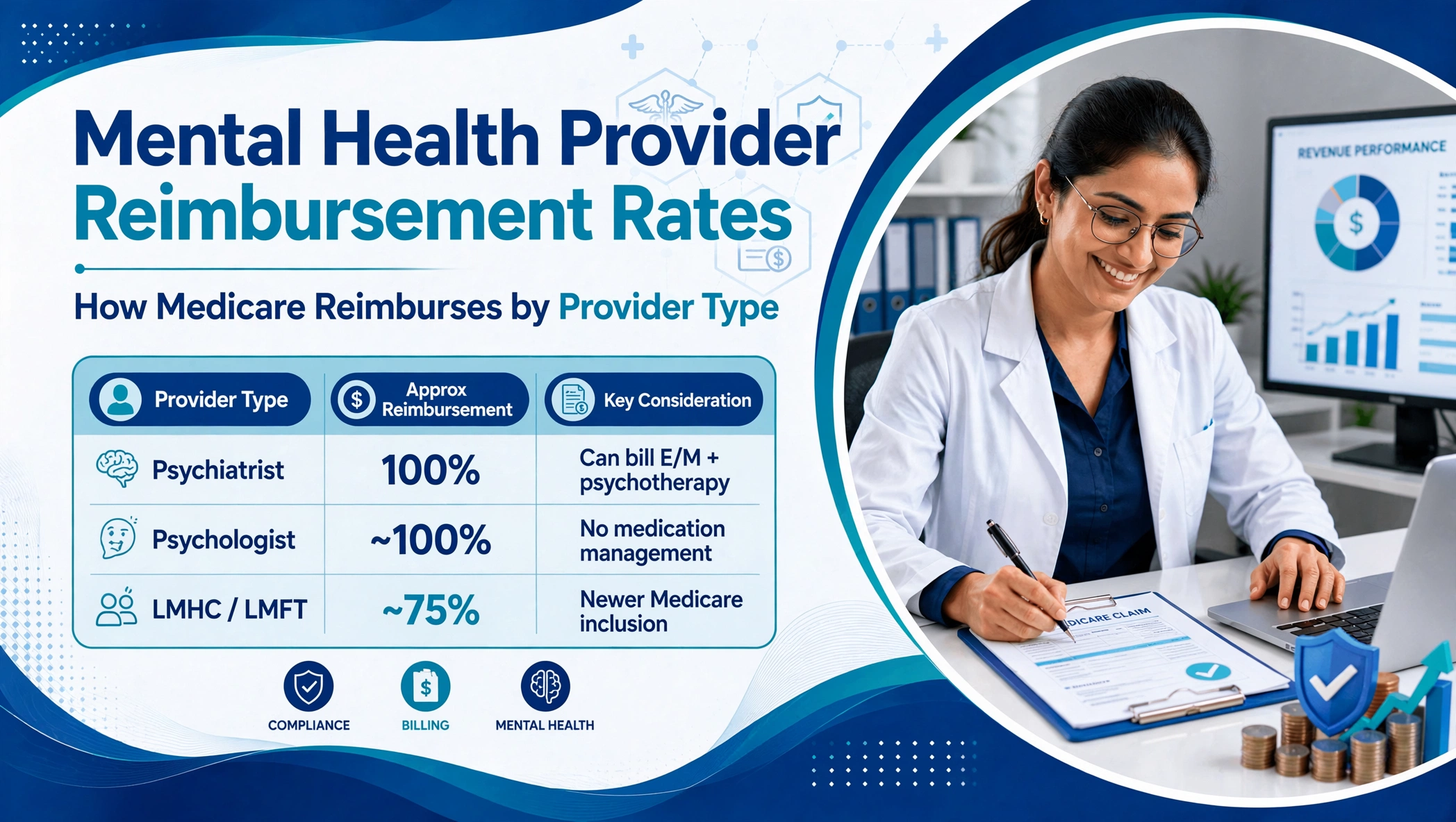
Medicare mental health billing varies significantly based on provider type:
If billing pathways are not optimized, practices may unintentionally reduce reimbursement.
Additionally, supervision and incident-to rules can impact how services are billed, but must be used cautiously to avoid compliance issues.
| Provider Type | Approx Reimbursement | Key Consideration |
|---|---|---|
| Psychiatrist | 100% | Can bill E/M + psychotherapy |
| Psychologist | ~100% | No medication management |
| LMHC / LMFT | ~75% | Newer Medicare inclusion |
Solution:
Align scheduling, provider roles, and billing strategy to maximize appropriate reimbursement levels.
Many practices in the USA focus only on basic psychotherapy, ignoring higher-value or additional services such as:
These services are often reimbursed at higher rates but require more structured documentation.
Solution:
Expand service utilization strategically:
Growth doesn’t always come from more patients, it comes from better service utilization.
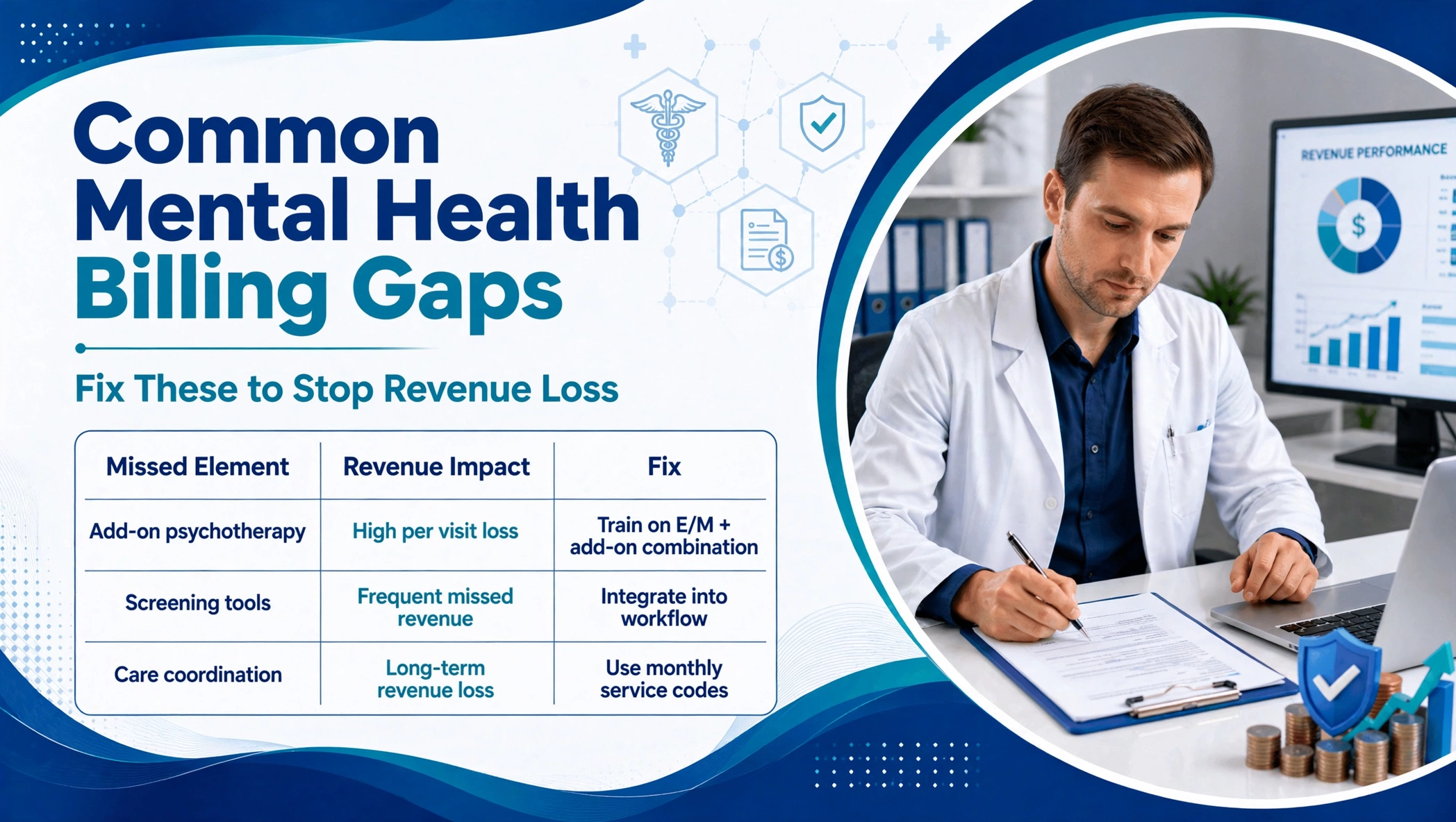
Add-on codes, like psychotherapy with E/M are frequently missed. This happens when providers and billers are not aligned.
For example:
This results in significant lost revenue per visit.
| Missed Element | Revenue Impact | Fix |
|---|---|---|
| Add-on psychotherapy | High per visit loss | Train on E/M + add-on combination |
| Screening tools | Frequent missed revenue | Integrate into workflow |
| Care coordination | Long-term revenue loss | Use monthly service codes |
Solution:
You need to build billing awareness into clinical workflows, not just back-end processes.
In previous years, denials were mostly due to coding mistakes. In 2026, they are increasingly due to:
This shift means traditional billing fixes are no longer enough.
Solution:
Introduce pre-bill documentation reviews, not just coding checks. The quality of notes now directly determines reimbursement success of your medical practice.
Mental health practices often operate on high volume but low margin per visit. This means inefficiency is extremely costly.If:
Solution:
You need to track key KPIs:
Without data, optimization is impossible.
Billing complexity has reached a level where outsourcing is no longer just about reducing workload, it’s about gaining expert-level compliance and optimization.
Our specialized billing teams understand:
Solution:
Outsourcing allows practices to:
Most practices operate reactively in fixing errors after they happen. But high-performing practices operate strategically:
Without strategy, even busy practices remain financially limited.
Solution:
Shift your mindset:
Audits are often seen as a compliance requirement, but they are also a powerful revenue tool.
They reveal:
In 2026, audits are not optional, they are a core part of financial strategy.
Solution:
Run structured quarterly audits with focus on:
Our team manages the billing process from start to finish, helping your practice improve collections while focusing on quality behavioral healthcare.
Get a free assessment from our billing experts