
Our Behavioral Health RCM services help practices strengthen revenue through accurate coding, eligibility verification, claims management, and denial prevention. We streamline behavioral health billing workflows to improve reimbursements, reduce payment delays, and support sustainable financial growth.
According to our two decade experienced behavioral health revenue cycle management is harder than almost any other specialty in US healthcare. Not slightly harder, fundamentally, structurally harder. And most practices aren’t billing at a level that reflects the real complexity of what they’re managing.
In the USA the national average denial rate for general medical billing is 5 to 8 percent. For behavioral health, it’s 11 to 16 percent. The average Days in AR for general medicine is 30 to 45 days, but for behavioral health, it’s 52 days in the USA. And approximately 65 percent of denied behavioral health claims are never appealed, which means practices are permanently writing off revenue that was legitimately theirs.
According to KFF research, 22 percent of mental health care coverage was denied in 2023. According to HRSA, over 120 million Americans live in mental health provider shortage areas. The demand for behavioral health services has never been higher, and the billing infrastructure that turns that care into sustainable revenue has never been more critical.
What makes behavioral health revenue cycle management uniquely difficult isn’t any single factor. It’s the combination: time-based CPT codes that require session-length documentation to the minute, behavioral health carve-out payers that operate completely separately from medical benefits, the Mental Health Parity and Addiction Equity Act (MHPAEA) compliance requirements, 42 CFR Part 2 confidentiality rules for SUD treatment, prior authorization requirements that can expire mid-treatment, and a documentation standard that goes far beyond what general medical billing requires.
Need support with your billing workflow? Explore our medical billing and revenue cycle services or request a free consultation.
Behavioral health revenue cycle management is the complete financial process of managing your patient billing, time-based CPT coding, insurance verification, prior authorization, claims submission, carve-out payer routing, denial management, MHPAEA compliance, and payment collection for mental health and substance use disorder treatment providers. It operates under a uniquely complex regulatory and payer framework that is fundamentally different from general medical billing.
The core distinction is that general medical billing is procedure-based and episodic, a patient comes in, something is done, a code is assigned. Behavioral health billing is session-based, time-dependent, and ongoing. The CPT code you bill is not determined by what you did, it’s determined by how long you did it, documented to the minute.
| Aspect | Behavioral Health RCM | General Medical RCM |
|---|---|---|
| Core billing model | Time-based, recurring session model | Procedure-based, episodic care model |
| Primary coding structure | CPT 90832/90834/90837 based on exact session duration | E/M or surgical codes based on complexity |
| Authorization frequency | Per-session or weekly block (IOP/PHP) | Pre-procedure; rarely recurring |
| Payer structure | BH carve-outs common (Optum BH, Carelon, Magellan, Evernorth) | Integrated medical benefits |
| Regulatory overlay | 42 CFR Part 2, MHPAEA, HIPAA | HIPAA primarily |
| Documentation scrutiny | Medical necessity narrative over time; treatment response | Diagnosis and physical findings |
| Denial rate benchmark | 11–16% average nationally | 5–8% average nationally |
| Days in AR benchmark | 52 days average | 30–45 days average |
| Denied claims never appealed | ~65% | Lower — higher per-claim value incentivizes appeal |
| Revenue leakage risk | High — 10–20% of collectible revenue | Moderate |
Time-based coding precision is where behavioral health billing diverges most sharply from every other specialty. The correct CPT code is determined by the documented duration of the session, not the type of service, not the diagnosis, and not what the clinician intended. According to the AMA CPT code system, selecting the wrong duration code is both a revenue issue and a compliance risk.
| CPT Code | Service | Session Duration | Key Rule |
|---|---|---|---|
| 90832 | Psychotherapy — short | 16–37 minutes | Document start and end time; duration governs code selection |
| 90834 | Psychotherapy — standard | 38–52 minutes | Most common mid-length session code; billed per documented duration |
| 90837 | Psychotherapy — extended | 53+ minutes | Highest-value individual therapy code; requires documented 53+ minutes |
| 90791 | Psychiatric diagnostic evaluation (no medical services) | 60–90 minutes typical | Initial assessment; no E/M billed same date |
| 90792 | Psychiatric diagnostic evaluation with medical services | 60–90 minutes typical | Physician/NP/PA only; E/M can be billed same date with modifier 25 |
| 90839 | Psychotherapy for crisis — first 30–74 min | 30–74 minutes | Crisis services; different documentation requirements |
| 90840 | Psychotherapy for crisis — each additional 30 min | Each 30 min add-on | Add-on to 90839 |
| CPT/Modifier | Description | When to Use | Revenue Impact |
|---|---|---|---|
| 90785 | Interactive complexity — add-on | When session involves mandated reporting, third-party involvement, guardian consent, or legally complex situations | Missed on 60–80% of eligible sessions; adds significant reimbursement per visit |
| 90833 | E/M + psychotherapy — psychotherapy add-on | When psychiatrist provides both E/M and psychotherapy in same visit | Bills alongside E/M code; requires separately documented services |
| 90836 | E/M + psychotherapy — 38–52 min add-on | Mid-length combined visit | Bills alongside E/M; time documentation required |
| 90838 | E/M + psychotherapy — 53+ min add-on | Extended combined visit | Bills alongside E/M; highest add-on value |
| Modifier 95 | Synchronous telehealth services | Audio-visual telehealth sessions | Required for proper telehealth claim processing |
| Modifier GT | Interactive audio and video telehealth | Alternative telehealth modifier (payer-specific) | Verify per payer — some still require GT over 95 |
| Modifier FQ | Audio-only telehealth (where covered) | When video not available; verify payer coverage | Coverage varies — always verify before billing |
| Modifier 25 | Separate E/M service same day as procedure | When E/M and diagnostic evaluation or procedure occur same day | Required to prevent bundling denial on combined-service days |
| CPT/HCPCS Code | Service | Key Billing Rule |
|---|---|---|
| 90847 | Family psychotherapy with patient present | Per session; document all participants and duration |
| 90846 | Family psychotherapy without patient present | Per session; document purpose and participants |
| 90849 | Multiple-family group psychotherapy | Per session; document group members |
| 90853 | Group psychotherapy | Per patient per session; each group member billed separately |
| 90863 | Pharmacologic management with psychotherapy | For MDs/NPs/PAs; document both components |
| H0015 | Intensive outpatient — per diem (IOP) | ONE unit per day regardless of hours; not per hour of service |
| H0018 | Short-term residential behavioral health | Per diem code; document clinical intensity |
| S9480 | Intensive outpatient — per diem (commercial) | Commercial alternative to H0015 — verify per payer |
| 99213–99215 | E/M visits (psychiatry/prescribers) | 2021 AMA E/M guidelines; MDM or total time based |
Tip: The 90785 Add-On Opportunity
Interactive complexity (90785) is an add-on code that can be billed alongside 90832, 90834, 90837, 90839, 90853, and combined E/M+psychotherapy codes when specific complicating factors are present: mandated reporting requirements, involvement of a third party (e.g., guardian, agency), management of maladaptive communication, or legally complex situations. Industry data shows this code is missed on 60–80% of eligible sessions. For a provider with 25 weekly sessions at a 40% eligibility rate, missing 90785 consistently costs $1,500–$2,500 per month in legitimate, billable revenue.
If you bill behavioral health services and you don’t fully understand carve-outs, you are almost certainly losing $3,000 to $5,000 per month in systematic billing errors, and you may not even know it.
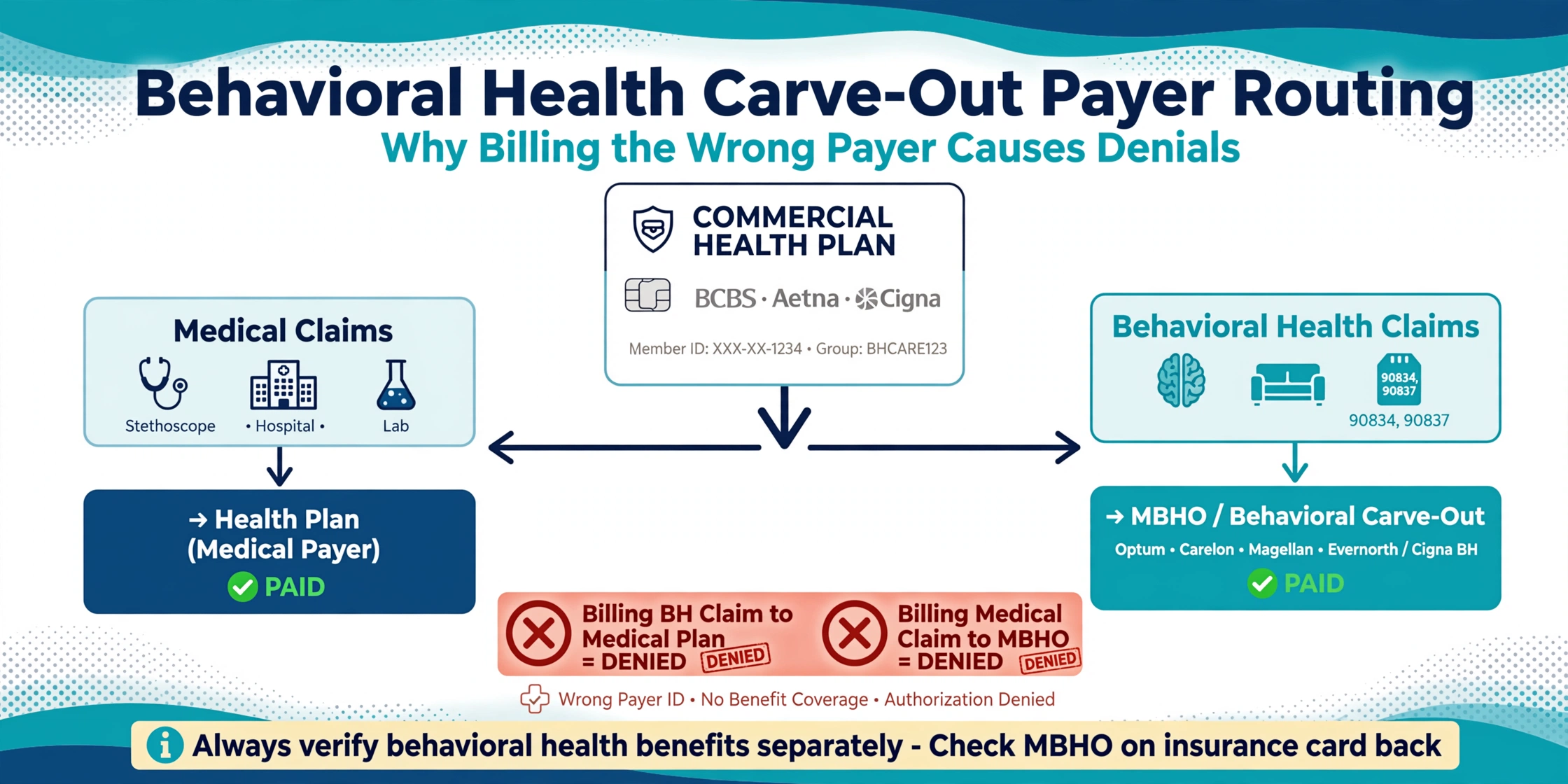
A behavioral health carve-out is a payer arrangement in which a health plan contracts with a separate managed behavioral health organization (MBHO) to administer mental health and substance use disorder benefits. When your patient has Anthem commercial for their medical benefits, their behavioral health benefits may actually be managed by Carelon Behavioral Health, a completely different payer with different claims addresses, different authorization requirements, different fee schedules, and different denial appeal processes.
| Commercial Health Plan | Common BH Carve-Out Organization | Claims Routing Impact |
|---|---|---|
| Anthem/BCBS (many plans) | Carelon Behavioral Health (formerly Beacon) | Medical claims go to Anthem; BH claims go to Carelon |
| UnitedHealthcare (many plans) | Optum Behavioral Health | Medical to UHC; BH to Optum BH portal and payer ID |
| Cigna (many plans) | Evernorth (formerly Cigna Behavioral Health) | Separate BH payer ID required for behavioral health |
| Aetna (many plans) | Aetna Behavioral Health / Meritain | Verify per plan — not all Aetna plans carve out |
| Various commercial plans | Magellan Health | Magellan-managed plans require separate enrollment and claims routing |
| Various commercial plans | MHNet Behavioral Health | Specialty MBHO requiring separate credentialing |
Tip: Carve-Out Identification at Every Intake
Inside your practice you need to build a two-step eligibility verification into every new patient intake: (1) Verify medical benefits with the health plan. (2) Specifically ask: ‘Are behavioral health benefits managed by this plan or a separate behavioral health organization?’ If carved out, get the MBHO name, provider relations phone number, and separate payer ID before the first session. Never assume that the medical insurance card tells you the full story for behavioral health claims
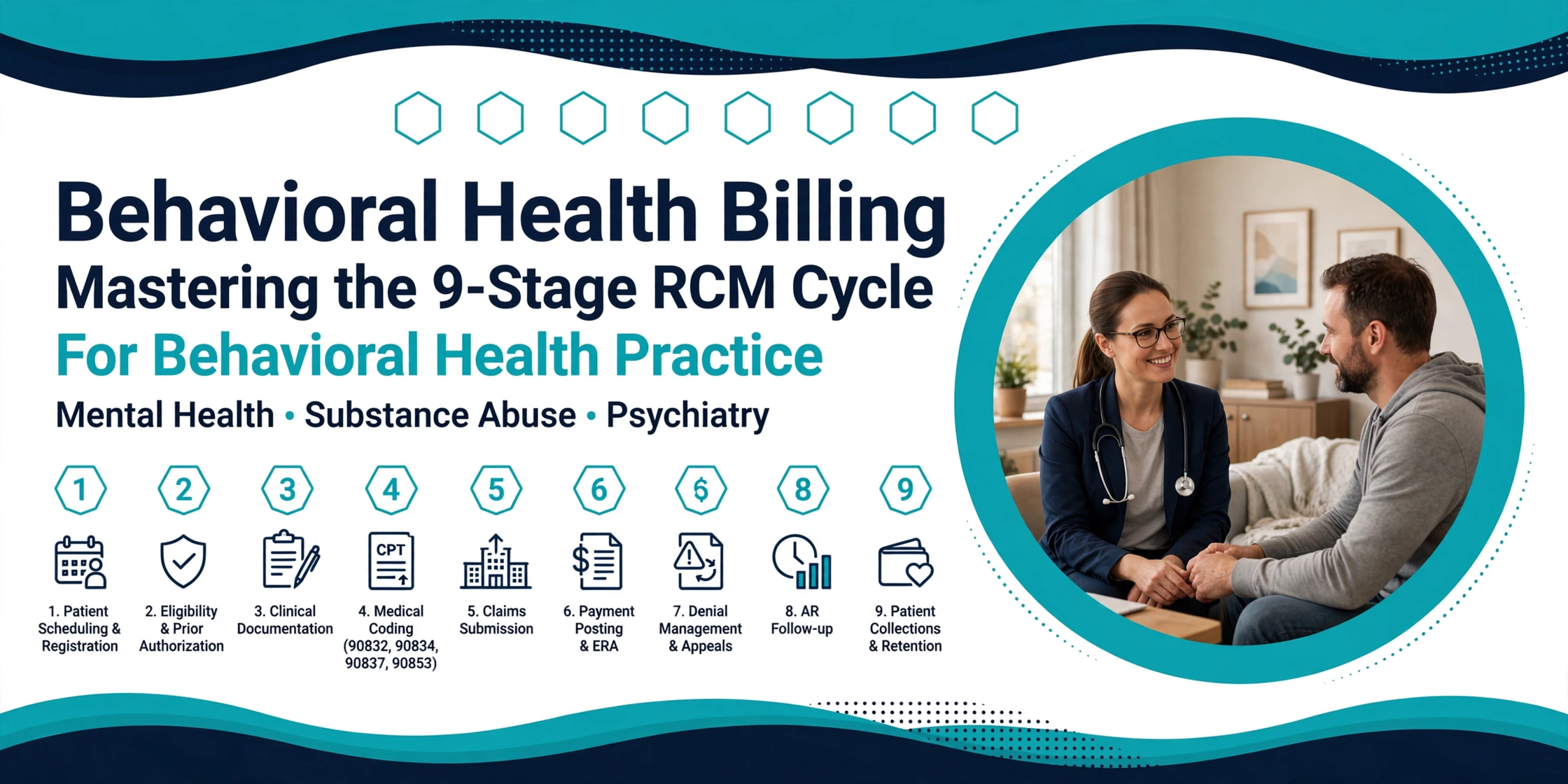
The behavioral health billing cycle doesn’t start when a claim is submitted. It starts before the patient ever walks through the door, and the decisions made in those early stages determine whether revenue flows cleanly or stalls at every step downstream.
| Stage | Timing Benchmark | BH-Specific Challenge | Revenue Impact If Failed |
|---|---|---|---|
| 1. Patient Scheduling | 5–7 days pre-visit | Carve-out identification; demographic accuracy | $1,500–$2,500/month from data errors |
| 2. Insurance Eligibility Verification | 48–72 hrs pre-visit | BH carve-out identification; session limits; auth requirements | $3,000–$5,000/month billing wrong payer |
| 3. Prior Authorization Management | 72+ hrs pre-visit | IOP requires concurrent review every 7–10 days | $4,000–$15,000+/month from expired/missing auth |
| 4. Patient Intake & Documentation | Within 24 hrs of visit | Medical necessity narrative; treatment response documentation | $2,000–$4,000/month recoupment risk |
| 5. Charge Capture & Coding | Same day as visit | Time-based code selection; 90785 add-on | $3,500–$6,000/month from undercoding + missed 90785 |
| 6. Claim Submission | Within 24–48 hrs | Carve-out routing; clearinghouse edits | $5,000–$8,000/month from stalled cash flow |
| 7. Payment Posting | 14–30 days post-visit | Underpayments hide in contracted rate variances | $1,000–$2,000/month undetected underpayments |
| 8. Denial Management | Within 72 hrs of remit | 65% of denials never appealed; MHPAEA leverage underused | 15–20% of gross revenue if denials unworked |
| 9. Patient Collections | Day of service through 30 days | High-deductible plans; sliding scale; no-shows | $2,500–$4,000/month in aged uncollectable balances |
Tip: MHPAEA Appeal Strategy
When your practice behavioral health claim is denied for medical necessity, ask: ‘Would this same criteria be applied to deny a comparable medical service?’ For example, if your payer denies continued authorization for weekly therapy citing ‘lack of improvement,’ ask whether they would deny continued chemotherapy on the same grounds. Document this comparison explicitly in your appeal letter. This MHPAEA-based framing dramatically increases appeal success rates and puts the payer on notice that their denial may constitute a parity violation
Intensive Outpatient Programs (IOP) and Partial Hospitalization Programs (PHP) represent the highest-revenue service levels in behavioral health, and some of the most complex billing in the specialty. Both CMS and SAMHSA provide specific guidance on coverage criteria, documentation requirements, and billing codes for these levels of care.
| Level of Care | Definition | Hours/Day | Primary CPT/HCPCS Codes | Revenue Codes (UB-04) | Key Auth Rule |
|---|---|---|---|---|---|
| Intensive Outpatient Program (IOP) | Structured programming 3+ hrs/day, 3+ days/week | 3+ hours/day | H0015 (per diem), S9480, 90837/90853 | 0905 (psych IOP), 0906 (SUD IOP) | Typically requires concurrent review every 7–10 days |
| Partial Hospitalization Program (PHP) | Day treatment 4–8 hrs/day, 5 days/week | 4–8 hours/day | CPT 90837/90853/90847 + PHP codes | 0912 (less intensive), 0913 (more intensive) | Higher clinical intensity must be documented for 0913 vs. 0912 |
| Residential Treatment | 24-hour structured treatment | 24 hours | H0018 (per diem), various | 1001 (per diem inpatient) | Most payers require active authorization; concurrent review ongoing |
| Standard Outpatient | Weekly or bi-weekly individual therapy | Per session | 90832/90834/90837 + add-ons | 0914 (individual), 0915 (group) | Commercial plans vary; Medicaid typically requires periodic auth |
Telehealth has become a permanent and significant service line in behavioral health, and billing it correctly requires understanding a specific set of modifiers, place of service codes, and payer policies. CMS telehealth guidance continues to evolve following the COVID-19 PHE flexibilities, with Congress extending many behavioral health telehealth provisions.
| Telehealth Element | Rule / Code | Notes |
|---|---|---|
| Synchronous audio-video | Modifier 95 | Standard telehealth modifier — most commercial and Medicare plans |
| Interactive audio-video (legacy) | Modifier GT | Some payers still require GT — verify per payer contract |
| Audio-only (where covered) | Modifier FQ | Coverage varies widely by payer — verify before billing; not universally covered |
| Place of Service — patient's home | POS 10 | Use when patient is at home for telehealth session |
| Place of Service — other than home | POS 02 | Use when patient is at another telehealth originating site |
| Medicare telehealth BH — 2023 expansion | Rural AND non-rural for mental health | Mental Health Access Improvement Act expanded telehealth coverage |
| Initial in-person visit requirement | Required for Medicare patients (post-2024) | Medicare requires in-person visit within 6 months of starting telehealth MH services; exception for rural areas |
| Same CPT codes apply | 90832/90834/90837 + modifiers | Telehealth doesn't change CPT code — duration still determines code selection |
| Documentation requirement | Must document audio-video communication platform used | HIPAA-compliant platform; document in progress note |
Tip: Telehealth Payer Verification Protocol
Behavioral health telehealth coverage varies significantly by payer in the USA, even for the same payer across different plan types. For every new patient, you need to verify
(1) Is telehealth covered for behavioral health services?
(2) Is audio-only covered?
(3) Which modifier does this payer require — 95 or GT?
(4) Is an in-person visit required before telehealth services begin?
(5) Are there visit limits for telehealth that differ from in-person? Build a payer-specific telehealth reference grid and update it quarterly
In behavioral health, clinical documentation is not just a clinical record, it is the justification for every dollar your practice collects. Your practice payers scrutinize behavioral health documentation more intensively than almost any other specialty, because mental health diagnoses and treatment necessity are inherently more subjective than physical conditions.
Current symptom presentation: Specific symptoms with severity, frequency, and functional impact. ‘Patient discussed anxiety’ is not adequate. ‘Patient reports panic attacks 3–4x weekly with avoidance of work situations, rated 7/10 severity, resulting in two missed workdays this week’ supports medical necessity.
Functional impairment level: How symptoms are affecting daily functioning, work, relationships, and quality of life.
Treatment response documentation: Progress or lack of progress toward treatment plan goals since last session. If progress is stalled, document why continued treatment is medically necessary.
Clinical reasoning for continued care: The clinician’s assessment of why ongoing treatment at this level and frequency is medically necessary for this patient.
Treatment plan alignment: How this session addresses the goals and interventions documented in the active treatment plan.
Session duration: Exact start and end time of the clinical encounter. This is not optional, it determines your CPT code.
Diagnostic code support: The progress note content must support the ICD-10 diagnosis codes on the claim. Coding F41.1 (generalized anxiety disorder) requires documented anxiety symptoms in the note.
As a behavioral health provider you deal with inconsistent insurance reimbursement rules, frequent authorization requirements, varying coverage limitations, and carve-out payers that operate completely separately from the medical benefit. Without specialty-specific knowledge of each major MBHO’s policies and portals, practices lose revenue at every stage.
As an experienced healthcare provider you know that the national average denial rate of 11 to 16 percent, more than double the general medical average, behavioral health practices face denials at every claim category. Incomplete or inconsistent clinical documentation is the leading cause of claim rejections, according to KFF 3% to 36%research. Most denials are preventable with the right documentation protocols.
For IOP/PHP programs, concurrent authorization review every 7 to 10 days creates an administrative burden that exceeds what most in-house billing teams can handle without systematic tools. A missed concurrent review is an immediate, permanent revenue loss, no appeal recourse, no grace period.
Unlike any other specialty, the behavioral health CPT code you bill depends on exact, documented session duration. This creates a continuous compliance and revenue risk across every session, especially when your practice under-document time or habitually select lower-value codes.
For SUD treatment providers, 42 CFR Part 2 requires specific patient consent before SUD treatment records can be used for billing purposes. Billing SUD treatment without the appropriate consent documentation is a federal compliance violation,, with criminal penalty exposure.
According to our experience even small billing mistakes can have a major impact on your behavioral health practice’s revenue and cash flow and the most common behavioral health revenue cycle management mistakes have a big effect on your revenue. These mistakes are costing your behavioral health practice tens of thousands of dollars annually.
Systematic downcoding (billing 90834 when 90837 is correct): Fear-based underbilling at $61,000/year per provider.
Missing the 90785 add-on on eligible sessions: Missed on 60–80% of eligible sessions; costs $1,500–$2,500/month per clinician.
Billing the wrong payer on carved-out plans: $3,000–$5,000/month in systematic carve-out errors that take 30–60 days to surface.
Missing prior authorization or letting it expire mid-treatment: 100% denial with no grace period; $15,000–$30,000/month for active IOP programs.
Not applying MHPAEA leverage in denial appeals: 65% of denied claims never appealed; MHPAEA appeals succeed at 1.6x the standard rate.
Billing H0015 per hour instead of per diem: Immediate denial; H0015 is one unit for the entire day, not one unit per hour.
Using generic ICD-10 codes without documentation support: F41.9 (anxiety disorder, unspecified) when documentation supports F41.0 (panic disorder) creates audit risk.
Ignoring underpayments on ERA reconciliation: $825/month per provider from systematic underpayment at $33/claim — visible only through rate auditing.
No card-on-file policy for patient collections: Practices collect 80–90% when collected at time of service; only 40–60% when billed afterward.
Failing to get 42 CFR Part 2 consent before billing SUD treatment: Federal compliance violation with criminal penalty exposure.
Understanding industry benchmarks helps behavioral health practices measure their financial performance and identify areas for improvement, below you can find latest behavioral health revenue cycle management statistics, including claim denial rates, reimbursement trends, and key revenue cycle metrics that impact long-term practice success.
| Metric | Industry Data | Source |
|---|---|---|
| National average BH claim denial rate | 11–16% | MGMA / KFF |
| National average general medical denial rate | 5–8% | MGMA |
| % of in-network mental health claims denied (2023) | 22% | KFF Health Benefits Survey 2023 |
| Average Days in AR — behavioral health | 52 days | Industry benchmarks |
| Average Days in AR — general medicine | 30–45 days | MGMA |
| % denied BH claims never appealed | ~65% | Change Healthcare Industry Report |
| Revenue uplift with optimized BH RCM | 10–20% more than general medical billing | Mental Health RCM industry analysis |
| Cost of a reworked denied claim | $25–$118 per claim | CAQH Research |
| MHPAEA appeal success rate multiplier | ~1.6x vs standard medical necessity appeals | BH billing specialist analysis |
| Clinicians not accepting new patients (psychologists) | 60% | HRSA Provider Shortage Report |
| Americans in mental health provider shortage areas | 120+ million | HRSA |
| Value-based care coverage projection (2027) | 90 million people | McKinsey Health Institute |
| Downcoding cost per provider (25 pts/week) | ~$61,000/year | Time-based coding revenue analysis |
| Missed 90785 cost per clinician/month | $1,500–$2,500/month | BH coding analysis |
Tracking the right performance metrics is essential for maintaining a healthy behavioral health revenue cycle, key behavioral health revenue cycle management KPIs that help you improve collections, reduce denials, speed up reimbursements, and strengthen your practice’s financial performance.
| KPI | What It Measures | Target for BH Practices |
|---|---|---|
| Clean Claim Rate | % of claims accepted on first submission | ≥95% |
| Denial Rate | % of submitted claims denied | <8% (industry avg 11–16%) |
| Days in Accounts Receivable | Average time from service to payment | <40 days (industry avg 52 days) |
| Net Collection Rate | % of collectible revenue actually collected | ≥93% (92–96% for specialized BH billing) |
| First Pass Resolution Rate | % of denials resolved on first appeal | ≥75% |
| Prior Auth Approval Rate | % of auth requests approved without appeal | ≥90% |
| No-Show Rate | % of scheduled appointments not kept | <15% (specialty-dependent) |
| Average Revenue per Session | Mean reimbursement per billed session | Benchmark against contracted rates |
| AR Aging > 90 Days | % of total AR outstanding over 90 days | <15% |
| Charge Lag | Days between session and claim submission | <3 days |
| Patient Collection Rate | % of patient responsibility collected | ≥80% (target at time of service) |
| Carve-Out Routing Accuracy | % of claims routed to correct payer first time | ≥99% |
The 42 CFR Part 2 regulations (updated 2024) impose strict confidentiality requirements on SUD treatment records that go beyond standard HIPAA protections. Billing SUD treatment requires specific patient consent before records can be submitted to insurers. Violations carry federal criminal penalties. Every SUD treatment provider must have 42 CFR Part 2-compliant consent forms and billing workflows.
The Mental Health Parity and Addiction Equity Act and its 2024 Final Rule require payers to apply equivalent coverage criteria to behavioral health and comparable medical/surgical services. Practices should understand their MHPAEA rights and incorporate parity-based appeals into their denial management workflow.
All behavioral health billing data is subject to HIPAA Privacy and Security Rules. Note that for SUD treatment records covered by 42 CFR Part 2, protections are stricter than standard HIPAA, both frameworks apply and the more restrictive standard governs.
The False Claims Act applies to behavioral health billing, including billing for sessions not rendered as documented, upcoding session duration, or billing for services not covered by a valid authorization. The OIG Work Plan regularly includes behavioral health billing as an audit focus, particularly for IOP/PHP programs, telehealth services, and E/M + psychotherapy combined billing.
CMS has expanded behavioral health integration (BHI) codes and services — including Collaborative Care Model (CoCM) and General BHI codes — that create new billing opportunities for practices integrating behavioral health into primary care settings. Reference CMS BHI guidance for current coverage rules.
Choosing between in-house and outsourced behavioral health revenue cycle management depends on your practice’s size, staffing, and financial goals. While in-house teams offer direct control, outsourced RCM services often improve claim accuracy, reduce denials, and help providers maximize reimbursements with specialized behavioral health billing expertise.
| Factor | In-House Behavioral Health Billing | Outsourced Behavioral Health Revenue Cycle Management Services |
|---|---|---|
| Specialty expertise | General billing staff rarely trained in BH-specific carve-out routing, 42 CFR Part 2, or MHPAEA appeals | Dedicated BH billing specialists with carve-out expertise, parity training, and SUD compliance knowledge |
| CPT code time-based accuracy | Dependent on clinician documentation and staff training; downcoding common | Systematic session duration verification and coding accuracy audits built into workflow |
| Carve-out routing accuracy | Frequently missed without BH-specific training; costs $3,000–$5,000/month | Carve-out identification at every intake; payer-specific routing protocols maintained |
| Prior auth management (IOP/PHP) | Resource-intensive; concurrent review often missed due to volume | Dedicated auth specialists with concurrent review calendars and expiration alert systems |
| MHPAEA appeal utilization | Rarely used; most BH denials appealed as standard medical necessity | Parity-based appeals standard; succeed at ~1.6x standard appeal rate |
| 42 CFR Part 2 compliance | Risk of non-compliance without specialty training | 42 CFR Part 2-compliant workflows and consent documentation standard |
| Denial management depth | 65% of denials go unworked due to bandwidth limits | Systematic denial resolution within 72 hours; all denials worked |
| Average net collection rate | Below industry benchmark due to specialty complexity | 92–96% NCR for specialized BH billing partners |
| Telehealth billing accuracy | Modifier errors and POS errors common without payer-specific telehealth training | Payer-specific telehealth protocol maintained and updated quarterly |
| Best for | Large health systems with dedicated BH billing specialists | Most behavioral health practices and programs of all sizes |
Behavioral health billing regulations and payer requirements change frequently, making reliable guidance is essential for your practice growth. These authoritative resources provide the latest CMS policies, CPT coding updates, compliance standards, and reimbursement information to help you maintain accurate billing and optimize revenue cycle performance.
| Resource | What It Covers | Link |
|---|---|---|
| CMS Physician Fee Schedule | Current reimbursement rates for BH CPT codes | cms.gov/medicare/physician-fee-schedule/search |
| CMS MHPAEA Fact Sheet | Mental Health Parity Act compliance guidance | cms.gov/cciio/programs-and-initiatives/other-insurance-protections/mhpaea_factsheet |
| CMS Behavioral Health Integration | BHI models, CoCM billing, and coverage guidance | cms.gov/medicare/coverage/behavioral-health-integration |
| SAMHSA 42 CFR Part 2 | SUD confidentiality regulations and FAQs | samhsa.gov/about-us/who-we-are/laws-regulations/confidentiality-regulations-faqs |
| SAMHSA Treatment Locator & Resources | Clinical and regulatory BH resources | samhsa.gov |
| KFF Health Benefits Survey | Insurance coverage and denial rate data | kff.org/health-costs |
| HRSA Shortage Areas | Mental health provider shortage area data | hrsa.gov/shortage-areas |
| OIG Work Plan | Current BH billing enforcement priorities | oig.hhs.gov/reports-and-publications/workplan |
| AMA CPT Code Resources | Official psychotherapy CPT code definitions | ama-assn.org/practice-management/cpt |
| AAPC Behavioral Health Coding | BH coding education and certification | aapc.com |
| HHS HIPAA Resources | Privacy and security for BH records | hhs.gov/hipaa |
| Medicaid.gov | State-specific Medicaid behavioral health coverage | medicaid.gov |
Behavioral health revenue cycle management is the complete financial process of managing your patient billing, time-based CPT coding, insurance verification, prior authorization, claims submission, carve-out payer routing, denial management, MHPAEA compliance, and payment collection for mental health and substance use disorder treatment providers.
The primary individual psychotherapy CPT codes you can use are: 90832 (16–37 minutes), 90834 (38–52 minutes), and 90837 (53+ minutes). Code selection is determined by documented session duration not type of service. The interactive complexity add-on (90785) can be billed alongside these codes when specific complicating factors are present. Your group therapy is billed using 90853, family therapy with patient present as 90847, and family therapy without patient as 90846.
A behavioral health carve-out is an arrangement where a health plan contracts with a separate managed behavioral health organization (MBHO) to administer mental health and substance use disorder benefits. Common MBHOs include Optum Behavioral Health, Carelon Behavioral Health, Magellan Health, and Evernorth. When benefits are carved out, behavioral health claims must be routed to the MBHO — not the medical health plan — for processing. Billing the wrong payer creates $3,000 to $5,000 in monthly billing errors that can take 30 to 60 days to surface.
The Mental Health Parity and Addiction Equity Act (MHPAEA) requires that health plans apply the same coverage criteria, treatment limitations, and prior authorization requirements to behavioral health services as they apply to comparable medical/surgical services. When a payer denies a behavioral health claim using criteria that would not be applied to an equivalent medical service, that constitutes a parity violation. Appeals citing MHPAEA violations succeed at approximately 1.6 times the rate of standard medical necessity appeals. The 2024 MHPAEA Final Rule strengthened parity protections significantly.
42 CFR Part 2 imposes confidentiality protections on substance use disorder treatment records that exceed standard HIPAA requirements. For SUD treatment providers, patient-specific consent is required before SUD treatment records can be disclosed for billing purposes. Billing SUD treatment without appropriate 42 CFR Part 2 consent is a federal compliance violation. The 2024 regulatory update aligned 42 CFR Part 2 more closely with HIPAA while retaining key SUD-specific protections.
Get a free assessment from our billing experts