
Applying proven billing strategies helps speed up reimbursements, minimize payment issues, and build a healthier financial future for your optometry practice.

Medicare optometry billing in 2026 is one of the most misunderstood areas in healthcare billing sector of the USA. Unlike other healthcare specialties, Medicare generally does not cover routine vision care, which creates confusion for both providers and patients in different states of the country.
However, Medicare does cover medically necessary eye services, making it essential for optometrists to clearly distinguish between routine vision services and medical eye care, you know this distinction directly affects billing, coding, and reimbursement.
Industry data shows that a significant portion of optometry claim denials are due to incorrect classification of services, making proper billing knowledge critical for maintaining revenue and compliance.
Need support with your billing workflow? Explore our medical billing and revenue cycle services or request a free consultation.
Medicare optometry billing refers to submitting claims for medically necessary eye care services provided to Medicare beneficiaries under Medicare Part B.
This includes diagnosis and treatment of eye conditions such as glaucoma, cataracts, macular degeneration, and diabetic retinopathy. Routine eye exams for glasses or contact lenses are typically not covered.
In simple terms, optometry billing under Medicare focuses on medical necessity, not routine vision care, making accurate coding and documentation essential.
Medicare coverage for optometry is limited but very specific. It only reimburses services that are considered medically necessary. It is necessary for you to understand what is covered, and what is not, is critical to avoid billing errors.
| Category | Covered Services | Non-Covered Services |
|---|---|---|
| Exams | Medical eye exams | Routine vision exams |
| Conditions | Glaucoma, cataracts | Refractive errors |
| Procedures | Cataract surgery follow-up | Eyeglass prescriptions |
| Tests | OCT, visual field testing | Contact lens fitting |
Billing non-covered services to Medicare will result in immediate claim denial.
CPT codes define the services provided and determine reimbursement. It is clear that choosing the correct CPT code is essential for accurate billing and compliance.
| CPT Code | Description | Use Case |
|---|---|---|
| 92004 | Comprehensive eye exam (new) | Medical exam |
| 92014 | Comprehensive exam (established) | Follow-up |
| 99213 | Office visit | Medical condition |
| 92134 | OCT scan | Retina evaluation |
| 92083 | Visual field test | Glaucoma |
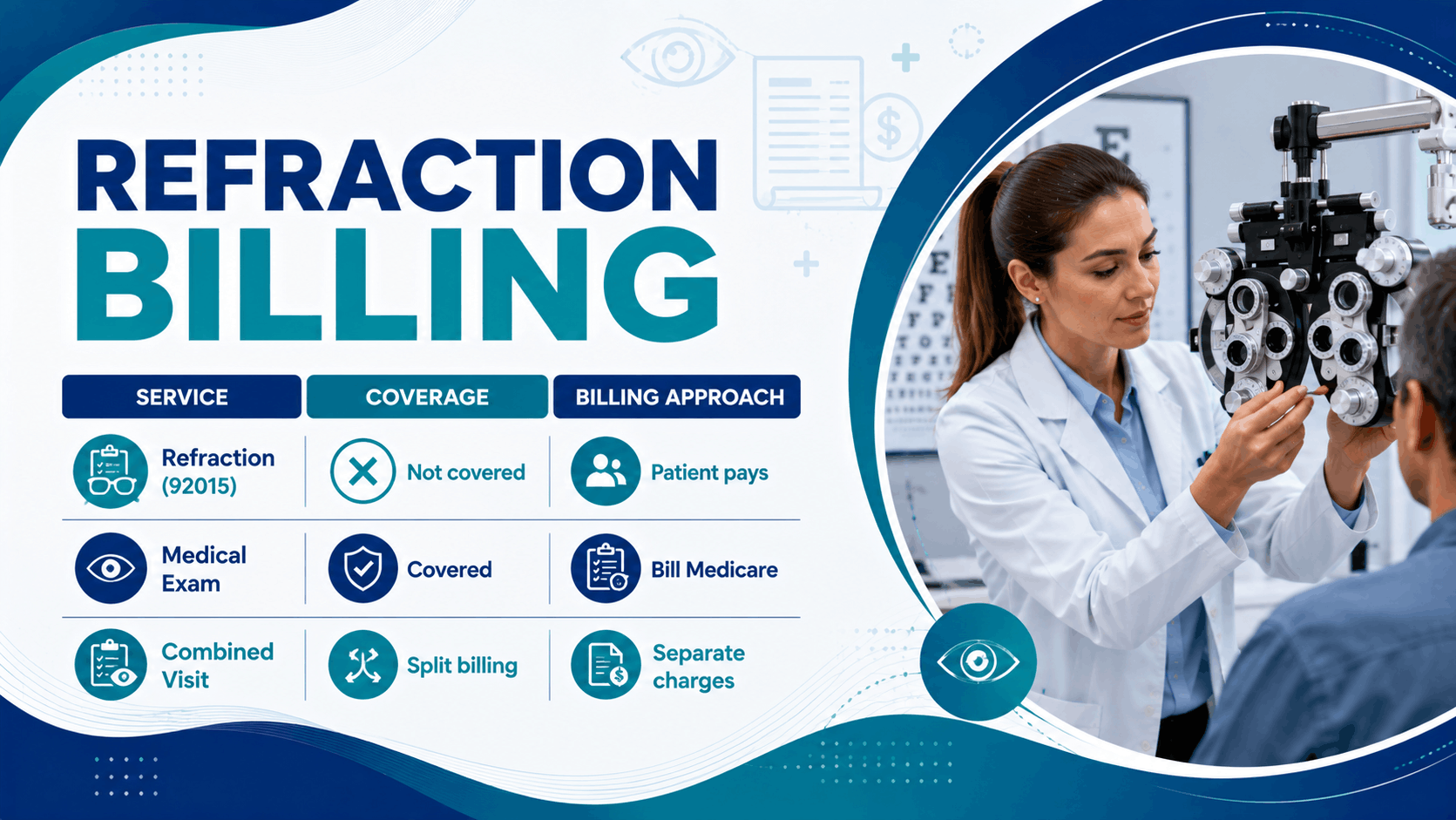
Refraction is one of the most commonly misunderstood services in optometry billing. Medicare considers refraction a routine vision service, which means it is not covered. As a provider you must clearly separate refraction from medical services to avoid compliance issues.
| Service | Coverage | Billing Approach |
|---|---|---|
| Refraction (92015) | Not covered | Patient pays |
| Medical Exam | Covered | Bill Medicare |
| Combined Visit | Split billing | Separate charges |

Modifiers are essential for providing additional details about services. Incorrect modifier usage can lead to claim denials or reduced payments.
| Modifier | Description | Use |
|---|---|---|
| 25 | Significant separate service | Same-day procedures |
| 59 | Distinct service | Avoid bundling |
| RT/LT | Right/Left eye | Eye-specific services |
| GA | Waiver of liability | Non-covered services |
Medicare has strict rules for optometry billing to ensure services are medically necessary and properly documented. Compliance is critical due to increased audit activity.
| Rule | Description | Impact |
|---|---|---|
| Medical Necessity | Must justify service | Prevents denial |
| Documentation | Must support diagnosis | Audit protection |
| Coverage Limits | Only medical services | Compliance |
| ABN Requirement | For non-covered services | Patient responsibility |
An ABN is required when providing services that Medicare is not expected to cover. This protects your optometry practice and the patient. As a provider you need to understand that without an ABN, you may not be able to collect payment from patients.
| Scenario | Requirement | Outcome |
|---|---|---|
| Refraction | Required | Patient pays |
| Routine exam | Required | Avoid denial |
| Non-covered test | Required | Compliance |
Documentation is essential for proving medical necessity and supporting claims. As a provider you know that incomplete documentation is a major cause of claim denials.
| Element | Description | Importance |
|---|---|---|
| Patient History | Symptoms & complaints | Supports diagnosis |
| Exam Findings | Clinical results | Required |
| Diagnosis | ICD-10 code | Justifies service |
| Treatment Plan | Next steps | Compliance |
Billing errors can significantly impact revenue and compliance. Most errors are preventable with proper training and systems.
| Error | Cause | Result |
|---|---|---|
| Billing Routine Exams | Misclassification | Denial |
| Missing ABN | Not obtained | Revenue loss |
| Incorrect CPT Code | Coding mistake | Underpayment |
| Poor Documentation | Incomplete notes | Audit risk |
Optometry billing must comply with federal laws governing healthcare billing. Your healthcare practice needs to follow these laws to ensure ethical and accurate billing practices.
| Law | Purpose | Risk |
|---|---|---|
| False Claims Act | Prevent fraud | Heavy fines |
| HIPAA | Protect patient data | Privacy issues |
| Stark Law | Referral restrictions | Compliance risk |
| Anti-Kickback Statute | No incentives | Legal penalties |
Data highlights the challenges and opportunities in optometry billing.You need to understand these trends to improve performance. These below insights emphasize the importance of accurate billing practices.
| Metric | Statistic | Meaning |
|---|---|---|
| Claim Denials | Common in optometry | Due to coverage confusion |
| Coding Errors | Up to 25–30% | Major issue |
| Revenue Loss | Thousands/month | Preventable |
| Audit Risk | Increasing | Compliance focus |
Medicare reimburses optometry services based on CPT codes and the Physician Fee Schedule. Understanding payment factors helps optimize revenue.
| Factor | Description | Impact |
|---|---|---|
| CPT Code | Service type | Payment base |
| Diagnosis | Medical necessity | Approval |
| Geographic Area | Location | Adjustment |
Outsourcing helps your optometry practice to manage complex billing requirements more effectively. It ensures accuracy and compliance.
| Benefit | Explanation | Outcome |
|---|---|---|
| Expertise | Optometry specialists | Fewer errors |
| Compliance | Updated knowledge | Audit protection |
| Efficiency | Faster claims | Better cash flow |
| Cost Savings | Reduced overhead | Higher profit |
At House of Outsourcing, we specialize in optometry billing with a focus on accuracy, compliance, and revenue optimization. We help practices reduce errors and improve reimbursements.
| Feature | Our Approach | Benefit |
|---|---|---|
| Expert Team | Optometry billing specialists | High accuracy |
| Compliance Focus | CMS-aligned | Audit protection |
| Denial Reduction | Proactive checks | Faster payments |
| Full Support | End-to-end billing | Seamless workflow |
Let our dedicated billing professionals manage your Medicare claims while your team delivers outstanding eye care services.
Get a free assessment from our billing experts