
Our Urgent Care Medical Billing services are designed to simplify complex billing processes, improve claim accuracy, and strengthen revenue performance. We help urgent care providers reduce denials, accelerate reimbursements, and maintain efficient revenue cycle operations.
Urgent care centers are one of the fastest-growing segments of US healthcare, and one of the most billing-intensive. With over 14,000 urgent care clinics operating across the country and patient volumes climbing year over year, getting urgent care billing services right is the difference between a thriving practice and a revenue cycle that bleeds money through denials, under-coding, and compliance gaps.
This guide was written by our billing specialists at House of Outsourcing specifically for US physicians, urgent care operators, practice managers, and revenue cycle professionals who want a definitive reference for urgent care billing in 2026. We cover everything from CPT code selection and E&M level determination to facility billing, payer-specific rules, denial management, and revenue optimization strategies.
Need support with your billing workflow? Explore our medical billing and revenue cycle services or request a free consultation.
�� Urgent Care Industry: Key 2025 Statistics |
• 14,000+ urgent care centers operating in the US as of 2025 (Urgent Care Association data) |
• Urgent care industry revenue: approximately $45 billion annually |
• Average urgent care denial rate: 10–16% — significantly higher than primary care (5–8%) |
• Top denial reason: incorrect E&M level selection or missing medical necessity documentation |
• Average urgent care visit reimbursement: $140–$180 (varies by payer and acuity level) |
• 89% of urgent care centers accept commercial insurance; 65%+ accept Medicare and Medicaid |
Urgent care medical billing is the process of coding, submitting, and collecting payment for clinical services provided at an urgent care center. Unlike emergency department billing which operates under a separate facility/professional dual-billing structure, urgent care billing can be structured as either professional-only billing (independent clinic) or dual professional + facility billing (hospital-based or health-system-owned urgent care).
The core challenge of urgent care billing is that urgent care occupies a gray zone in the payer world. It is not emergency care, but it is not standard primary care either. Different payers classify urgent care differently in the USA, which affects which CPT codes are reimbursable, what authorization is required, and how claims must be submitted.
| Billing Element | Urgent Care | Emergency Department | Primary Care Office |
|---|---|---|---|
| Place of Service Code | POS 20 (Urgent Care) | POS 23 (Emergency Room) | POS 11 (Office) |
| Typical CPT Codes | 99202–99215 + 99281–99285 | 99281–99285 (ED-specific) | 99202–99215 |
| Facility Fee | Sometimes (hospital-based) | Always (dual billing) | Rarely |
| Prior Authorization | Rarely required | Never for emergencies | Sometimes |
| After-hours codes | S9083, S9088 (payer-specific) | Not applicable | 99050–99060 |
| Observation Billing | Limited / payer-specific | Common | Not applicable |
| Self-pay volume | High (25–35% average) | Variable | Low–moderate |
Accurate CPT code selection is the single most impactful factor in urgent care billing services. Urgent care centers primarily use the outpatient E&M code set (99202–99215), with some centers in the USA also using emergency department codes depending on payer contracts and clinical scenarios.
| CPT Code | Patient Type | Medical Decision-Making | Typical Time | 2025 Medicare Rate (Approx.) |
|---|---|---|---|---|
| 99202 | New Patient | Straightforward | 15–29 min | $76–$110 |
| 99203 | New Patient | Low complexity | 30–44 min | $111–$153 |
| 99204 | New Patient | Moderate complexity | 45–59 min | $167–$214 |
| 99205 | New Patient | High complexity | 60–74 min | $211–$290 |
| 99211 | Established Patient | Minimal (staff only) | 5 min | $24–$35 |
| 99212 | Established Patient | Straightforward | 10–19 min | $58–$89 |
| 99213 | Established Patient | Low complexity | 20–29 min | $95–$128 |
| 99214 | Established Patient | Moderate complexity | 30–39 min | $135–$175 |
| 99215 | Established Patient | High complexity | 40–54 min | $172–$232 |
In the USA, some urgent care centers, particularly those owned by health systems or operating under hospital outpatient department (HOPD) licenses, may use ED E&M codes (99281–99285) under specific payer contracts. However, for standalone urgent care centers, use of ED codes can trigger audits if the facility is not licensed as an emergency department.
| CPT Code | ED Acuity Level | Problem Severity | Decision-Making |
|---|---|---|---|
| 99281 | Level 1 — Minor | Self-limited / minor problem | Straightforward |
| 99282 | Level 2 — Low | Low to moderate severity | Low complexity |
| 99283 | Level 3 — Moderate | Moderate severity | Moderate complexity |
| 99284 | Level 4 — Moderate-High | High severity, not life-threatening | Moderate complexity |
| 99285 | Level 5 — High | High severity, possibly life-threatening | High complexity |
| Code | Description | Notes |
|---|---|---|
| S9083 | Global fee, urgent care centers | Used by some commercial payers in lieu of E&M codes; verify payer policy |
| S9088 | Services provided in an urgent care center (list in addition to E&M) | Add-on for urgent care facility designation; payer-specific |
| 99050 | Services provided after hours (non-emergency, outside posted hours) | When clinic sees patients outside normal business hours |
| 99051 | Services provided in the evening, weekend, or holiday | Evening/weekend/holiday surcharge for established after-hours visits |
| 99060 | Services provided on an emergency basis, outside office | Rarely used in urgent care; document clinical necessity carefully |
| G0380–G0384 | Hospital observation codes (level 1–5) | Only if urgent care is hospital-based with observation services |
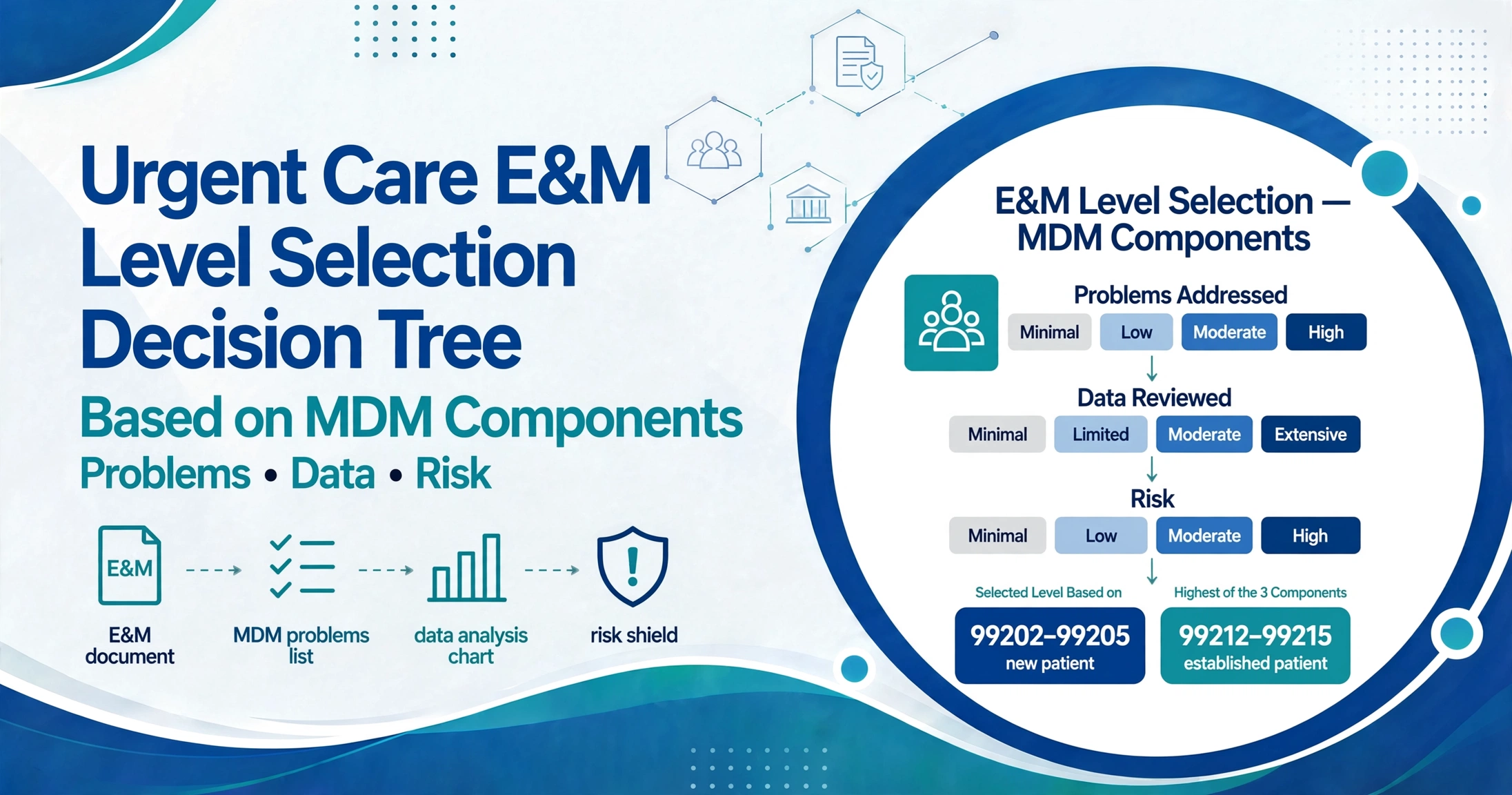
E&M level selection is where urgent care billing services succeed or fail. Over-coding creates audit and recoupment risk. Under-coding which is far more common, leaves significant revenue on the table. Since the 2021 AMA E&M guidelines overhaul (which CMS adopted), level selection is based on either Medical Decision-Making (MDM) or total clinician time.
| MDM Level | Problems (Column 1) | Data Reviewed (Column 2) | Risk (Column 3) | Code Supported |
|---|---|---|---|---|
| Straightforward | 1 self-limited/minor problem | Minimal/none | Minimal risk | 99202 / 99212 |
| Low complexity | 2+ self-limited problems OR 1 stable chronic illness | Limited (1 category) | Low risk (OTC drugs, minor procedures) | 99203 / 99213 |
| Moderate complexity | 1+ chronic illness with exacerbation OR new problem with uncertain prognosis | Moderate (2+ categories) | Moderate risk (prescription drugs, minor surgery) | 99204 / 99214 |
| High complexity | Severe exacerbation of chronic illness OR threat to life/bodily function | Extensive (3 categories) | High risk (drug therapy requiring monitoring, hospitalization) | 99205 / 99215 |
Correct Place of Service (POS) coding is essential in urgent care medical billing because it directly affects reimbursement rates and triggers payer-specific coverage rules. The wrong POS code on an urgent care claim is a top-5 denial reason across commercial payers.
| POS Code | Description | When Used in Urgent Care | Reimbursement Impact |
|---|---|---|---|
| POS 20 | Urgent Care Facility | Standard for standalone urgent care centers | Non-facility rate (higher) |
| POS 19 | Off Campus-Outpatient Hospital | Hospital-owned urgent care not on main campus | Facility/outpatient rate |
| POS 22 | On Campus-Outpatient Hospital | Hospital urgent care on main campus | Facility/outpatient rate |
| POS 23 | Emergency Room — Hospital | Only licensed ERs; DO NOT use for urgent care | ER-specific rate |
| POS 11 | Office | Sometimes used by payers for urgent care billing; verify payer policy | Non-facility rate |
Medicare patients represent a growing share of urgent care volume, particularly in state and cities with aging populations. As an experienced physician you need to understand Medicare urgent care billing rules is critical, Medicare is both a significant revenue source and the most heavily audited payer in US healthcare.
Medicare reimburses urgent care services under the Medicare Physician Fee Schedule (MPFS). According to CMS, urgent care centers are not a distinct Medicare provider type, they bill as physician practices using outpatient E&M codes. This means proper documentation, medical necessity, and correct coding standards all apply at the full Medicare scrutiny level.
Pro Tip |
Medicare Advantage plans are administered by private insurers and can impose authorization requirements that traditional Medicare doesn’t have. Before seeing a Medicare Advantage patient for urgent care services, verify both the MA plan’s coverage AND their specific urgent care authorization policy. A 5-minute verification prevents a $200+ denial. |
Medicaid urgent care billing varies significantly by state. Some states reimburse urgent care at near-commercial rates with minimal authorization requirements; others impose strict prior authorization, low fee schedules, or outright limits on urgent care utilization.
| State Program Type | Urgent Care Coverage | Auth Required | Key Billing Notes |
|---|---|---|---|
| Fee-for-service Medicaid | Covered in most states | Rarely | Submit to state Medicaid directly; use state-specific billing codes if required |
| Medicaid MCO (Managed Care Org) | Covered per MCO contract | Sometimes | Each MCO may have different fee schedules and authorization rules |
| CHIP (Children's Health Insurance) | Broadly covered | Rarely for urgent care | Urgent care visits generally covered without prior auth for children |
| Medicaid Expansion states | Broader coverage | Varies | ACA expansion populations covered for urgent care; check state rules |
| Limited Medicaid states | Restricted coverage | Often required | May require PCP referral or pre-authorization; ED may be default |
One of the most important strategic decisions in urgent care billing services is understanding when you are billing as a facility versus as a professional practice, and what each billing model means for your revenue cycle.
Most independent urgent care centers bill as professional practices. The clinic submits a CMS-1500 claim form (or 837P electronic equivalent) under the provider’s NPI. Reimbursement is based on the Medicare Physician Fee Schedule non-facility rate, which is typically higher than the facility rate because no separate facility fee is collected.
Hospital-based urgent care centers bill two separate claims: a professional claim (CMS-1500 / 837P) for the physician’s work, and a facility claim (UB-04 / 837I) for the facility overhead, supplies, and nursing. This model generates more revenue per visit but requires more complex billing infrastructure and payer contracting.
| Billing Element | Professional Billing (CMS-1500) | Facility Billing (UB-04) |
|---|---|---|
| Claim Form | CMS-1500 / 837P | UB-04 / 837I |
| Billing NPI | Individual provider NPI (Type 1) | Facility NPI (Type 2) |
| Revenue Codes | Not applicable | Required (e.g., 0450 — Urgent Care) |
| CPT Codes | Standard E&M + procedural codes | Mirrored with facility modifiers |
| Reimbursement Rate | Non-facility MPFS rate | APC/OPPS or payer facility rate |
| Who Bills | Physician practice or billing company | Hospital/facility billing team |
| Complexity | Moderate | High — requires facility coding expertise |
Beyond E&M codes, urgent care billing services generate significant revenue from procedures performed during the visit. Accurately billing these add-on services, wound care, X-rays, rapid diagnostic tests, IV infusions, is a major opportunity that many urgent care centers underutilize.
| Category | CPT Code | Description | Medicare Rate (Approx.) |
|---|---|---|---|
| Wound Care | 12001 | Simple repair, scalp/neck/ax/genitalia — 2.5 cm or less | $100–$135 |
| Wound Care | 12002 | Simple repair — 2.6 to 7.5 cm | $120–$155 |
| Wound Care | 97597 | Debridement, open wound — first 20 sq cm | $90–$120 |
| Splinting | 29125 | Application of short arm splint, static | $55–$75 |
| Splinting | 29515 | Application of short leg splint | $55–$75 |
| Radiology | 71046 | Chest X-ray, 2 views | $30–$45 (TC component) |
| Radiology | 73562 | X-ray knee, 3 views | $25–$40 (TC component) |
| Rapid Testing | 87804 | Influenza A+B rapid test | $19–$24 |
| Rapid Testing | 87880 | Streptococcus A rapid test | $16–$21 |
| Rapid Testing | 87811 | COVID-19 rapid antigen test | $20–$26 |
| IV Infusion | 96360 | IV infusion, initial, up to 1 hour | $125–$175 |
| IV Infusion | 96361 | IV infusion, additional hour | $30–$45 |
| EKG | 93000 | Electrocardiogram with interpretation | $17–$24 |
| Urinalysis | 81003 | Urinalysis, automated, without microscopy | $3–$5 |
Payer contracting is the upstream activity that determines how much your urgent care billing services can actually collect. Without favorable contracts, and without understanding what each payer requires before and during claim submission, even perfect billing will be under-reimbursed.
Urgent care visits are generally exempt from prior authorization requirements under most payer contracts, as the services are time-sensitive by nature. However, certain downstream services ordered during the urgent care visit imaging, specialist referrals, follow-up procedures, may require authorization.
Urgent care clinics face a higher-than-average denial rate because of the complexity of urgent care coding, the volume of new patients, and payer-specific policies that vary widely. Here are the most common denial categories and proven solutions from our experts.
| Denial Reason | Root Cause | Prevention Strategy |
|---|---|---|
| Incorrect E&M level / lacking documentation | MDM not documented to support billed code | Implement E&M audit templates in EHR; quarterly provider coding training |
| Wrong POS code | POS 11 or POS 23 used instead of POS 20 | Configure POS 20 as default in billing software for all urgent care claims |
| Service not covered / not medically necessary | Missing diagnosis or weak clinical justification | Link ICD-10 codes to specific symptoms and clinical findings, not just diagnoses |
| Patient not eligible / coverage lapsed | No pre-visit eligibility verification | Run real-time eligibility check on all patients at check-in |
| Coordination of benefits (COB) issue | Primary/secondary payer order incorrect | Verify COB at every visit; collect insurance card front and back |
| Bundled procedure denied | Add-on procedure not separately billable with E&M | Check CCI edits before submitting; apply -25 modifier when warranted |
| Missing or invalid modifier | No modifier -25 on E&M when same-day procedure billed | Audit all same-day E&M + procedure claims for modifier -25 |
| Timely filing exceeded | Claim submitted past payer's deadline | Set 30-day internal filing target; alert system for claims approaching deadline |
| Duplicate claim | Claim resubmitted without correction | Use corrected claim (frequency code 7) instead of duplicate submission |
| Workers' comp / auto billing error | Wrong payer billed or missing accident information | Separate WC/auto billing workflow with dedicated team or coordinator |
ICD-10-CM diagnosis coding in urgent care is particularly challenging because patients often present with symptoms not confirmed diagnoses. Urgent care providers in the USA frequently see patients before a definitive diagnosis has been established, which means coders must select symptom codes rather than definitive diagnosis codes in many cases.
| ICD-10 Category | Common Codes | Urgent Care Clinical Scenario |
|---|---|---|
| Respiratory | J06.9, J20.9, J18.9, J02.9 | Upper respiratory infection, acute bronchitis, pneumonia, strep throat |
| Musculoskeletal | M54.5, S93.401A, S62.001A | Low back pain, ankle sprain, wrist fracture |
| Genitourinary | N39.0, N30.00 | Urinary tract infection, cystitis |
| Dermatology | L02.01, L03.011, T14.0XXA | Abscess, cellulitis, laceration |
| ENT | H66.90, H10.9, J34.89 | Ear infection, conjunctivitis, nasal congestion |
| GI | R10.9, K29.70, K37 | Abdominal pain, gastritis, appendicitis workup |
| Cardiovascular | I10, R00.0, R07.9 | Hypertension, tachycardia, chest pain unspecified |
| Pediatric | J06.9, H66.90, R50.9 | URI, otitis media, fever without source |
Many urgent care centers are primary treatment sites for workplace injuries and occupational health services. Workers’ compensation (WC) billing is entirely separate from standard health insurance billing and requires a different process, different forms, and often different fee schedules.
As a provider you cannot submit a billable urgent care claim until your practice is credentialed and contracted with each payer. Urgent care credentialing has unique challenges, high provider turnover, and multi-site operations all create credentialing complexity that directly impacts billing.
. You need to enroll each provider with Medicare (Part B) using the PECOS system
Measuring the right metrics is the foundation of a high-performing urgent care revenue cycle. Without benchmarks, billing problems are invisible until they become financial crises. Here are the KPIs you should track monthly.
| KPI | Definition | Benchmark (High-Performing UC) | Action Threshold |
|---|---|---|---|
| Clean Claim Rate | % of claims paid on first submission | >95% | <90% — review process gaps |
| Denial Rate | % of claims denied by payer | <8% | >12% — trigger root cause audit |
| Days in A/R | Average days outstanding for unpaid claims | <35 days | >45 days — collections process review |
| First-Pass Resolution Rate | % of denials resolved on first appeal | >75% | <60% — review denial appeal quality |
| Net Collection Rate | Net collections / net charges after adjustments | >96% | <93% — systematic write-off review |
| Cost to Collect | Billing cost as % of net collections | <4% | >6% — staffing/outsourcing review |
| Average Reimbursement per Visit | Net collections / total visits | $145–$185 | Below $130 — E&M level audit |
| Procedure Capture Rate | % of visits with separately billable procedure | 35–50% | <25% — charge capture audit |
Urgent care centers of the USA that optimize their billing consistently outperform industry benchmarks on net collection rate, denial rate, and revenue per visit. Here are the proven strategies our billing team at House of Outsourcing deploys for our urgent care clients.
The single highest-ROI billing improvement for your urgent care center is real-time eligibility verification. Running an EDI 270/271 transaction at patient arrival, before the visit, it prevents coverage-related denials that account for 20–30% of all urgent care denials. Most practice management systems support this natively or via clearinghouse integration.
The most common urgent care billing opportunity is correcting systematic under-coding. A quarterly audit of E&M level distribution, looking at your ratio of 99213s to 99214s, for example against your payer mix and patient acuity can identify whether providers are consistently undercoding moderate complexity visits. Even a shift from 99213 to 99214 for 20% of established patient visits can add $30,000–$60,000 annually to a mid-volume urgent care center.
Charge capture for same-day procedures is a major revenue leak. When you perform wound care, an EKG, or a rapid test, that procedure must appear on the same claim as the E&M with modifier -25. Build a procedure capture prompt into your EHR encounter template so that providers select performed procedures before closing the note.
Most urgent care centers write off denials they could recover. A structured denial management workflow, categorizing denials by code, payer, and provider; tracking appeal submission and outcomes; and monitoring overturn rates, typically recovers an additional 3–7% of net revenue. For a center seeing 100 patients per day, that’s $150,000–$350,000 in annual revenue.
If your urgent care center is open evenings, weekends, or holidays, negotiate reimbursement for 99050 and 99051 add-on codes with commercial payers. These codes pay $25–$60 per applicable visit and are frequently omitted from urgent care contracts. Adding after-hours billing to your revenue cycle can generate significant incremental revenue with zero additional clinical work.
The most frequently used CPT codes in urgent care billing are the outpatient E&M codes: 99202–99205 for new patients and 99212–99215 for established patients. These are coded based on Medical Decision-Making (MDM) complexity or total time spent. In addition, procedure codes for wound repair (12001–12021), rapid diagnostic testing (87804, 87880, 87811), X-ray (71046, 73562), and IV infusion (96360) are commonly billed alongside E&M codes. Some hospital-based urgent care centers also use ED E&M codes (99281–99285) under specific licensing and contracting arrangements.
The correct Place of Service code for a standalone urgent care center is POS 20 (Urgent Care Facility). For hospital-owned urgent care not on the main campus, POS 19 (Off Campus-Outpatient Hospital) is used. For urgent care located on a hospital’s main campus, POS 22 (On Campus-Outpatient Hospital) applies. POS 23 (Emergency Room) should never be used for an urgent care center unless the facility is a licensed emergency department. Using the wrong POS code is one of the most common urgent care billing errors and a significant compliance risk.
Yes, Medicare covers urgent care visits. Urgent care centers are not a distinct Medicare provider type, so they bill Medicare as physician practices using outpatient E&M codes (99202–99215) with POS 20. All treating providers must be individually enrolled in Medicare. Medicare Advantage plans may impose additional prior authorization or referral requirements beyond traditional Medicare, so eligibility and coverage verification is essential before each visit. Medicare does not reimburse S9083 or S9088 urgent care facility codes standard E&M coding applies.
Modifier -25 (Significant, Separately Identifiable Evaluation and Management Service) is one of the most important modifiers in urgent care billing. It is appended to an E&M code when the provider performs a separately identifiable E&M service on the same day as a procedure. For example, if a patient presents to urgent care with a laceration, and the provider performs both a wound repair and a full E&M assessment, modifier -25 on the E&M code tells the payer that the E&M was a distinct service beyond what was necessary to perform the procedure. Without modifier -25, the E&M is bundled into the procedure payment and denied.
Urgent care billing and emergency department billing differ in several key ways. ED billing uses ED-specific E&M codes (99281–99285) and always involves dual billing — a facility claim (UB-04) for the hospital and a professional claim (CMS-1500) for the physician. Urgent care centers typically bill only a professional claim unless hospital-owned, use outpatient E&M codes (99202–99215), and use POS 20 rather than POS 23. ED visits are never subject to prior authorization; urgent care visits may be, depending on payer and the services ordered. Reimbursement structures and fee schedules also differ significantly.
Get a free assessment from our billing experts