
Our DOL Medical Billing services help healthcare providers to manage their workers’ compensation claims with accurate coding, documentation review, claim follow-up, and denial resolution. We streamline Department of Labor billing processes to improve reimbursements, reduce delays, and strengthen revenue cycle performance.
A comprehensive, research-based guide to DOL medical billing services for US healthcare providers treating federal workers, veterans, and occupationally injured patients:
| # | Section Title | Page Focus |
|---|---|---|
| 1 | What Is DOL Medical Billing? | Overview, federal programs, scope & revenue context |
| 2 | The Five Major DOL Billing Programs Explained | FECA/OWCP, EEOICPA, LHWCA, DCCA, Black Lung — deep comparison |
| 3 | FECA / OWCP Billing: The Core of DOL Medical Billing Services | Federal employees, claim process, authorization, fee schedule |
| 4 | EEOICPA Billing: Energy Employees & Radiation Exposure | DOE workers, Part B & Part E, qualifying conditions, billing rules |
| 5 | LHWCA & Longshore Billing Services | Maritime/harbor workers, DOL OWCP Division of Longshore & Harbor Workers |
| 6 | Black Lung Billing Services | Coal miners, Part B/C, Black Lung Clinics, CMS/DOL intersection |
| 7 | DOL OWCP Fee Schedules: How Payment Is Calculated | Medical fee schedules, RBRVS comparison, balance billing prohibition |
| 8 | CPT Codes & Procedure Billing in DOL Medical Billing | E/M, surgery, PT/OT, pharmacy, DME, behavioral health under OWCP |
| 9 | ICD-10 Coding in DOL Billing Services | Accepted condition coding, work-relatedness, causal relationship documentation |
| 10 | Authorization & Prior Approval in DOL Billing Services | CA-16, CA-20, EEOICPA prior auth, special authorization requirements |
| 11 | Electronic Billing & OWCP Portal (OWCP-4/CMS-1500) | Bill forms, OWCP web portal, clearinghouse, WCMBP submission |
| 12 | Common DOL Billing Denials & Appeals | Denial reasons, appeal process, OWCP hearing procedures |
| 13 | DOL Billing Compliance, Fraud & Audit Risks | False Claims Act, DOL OIG, provider debarment, compliance checklist |
| 14 | DOL Billing for Different Provider Types | Physicians, hospitals, PT/OT, pharmacy, behavioral health, DME |
| 15 | KPIs Every DOL Billing Practice Should Track | Revenue metrics specific to workers' compensation billing |
| 16 | Outsourced vs. In-House DOL Medical Billing Services | Decision framework for providers treating injured federal workers |
| 17 | FAQs: DOL Medical Billing Services | Top 10 research-based questions answered in depth |
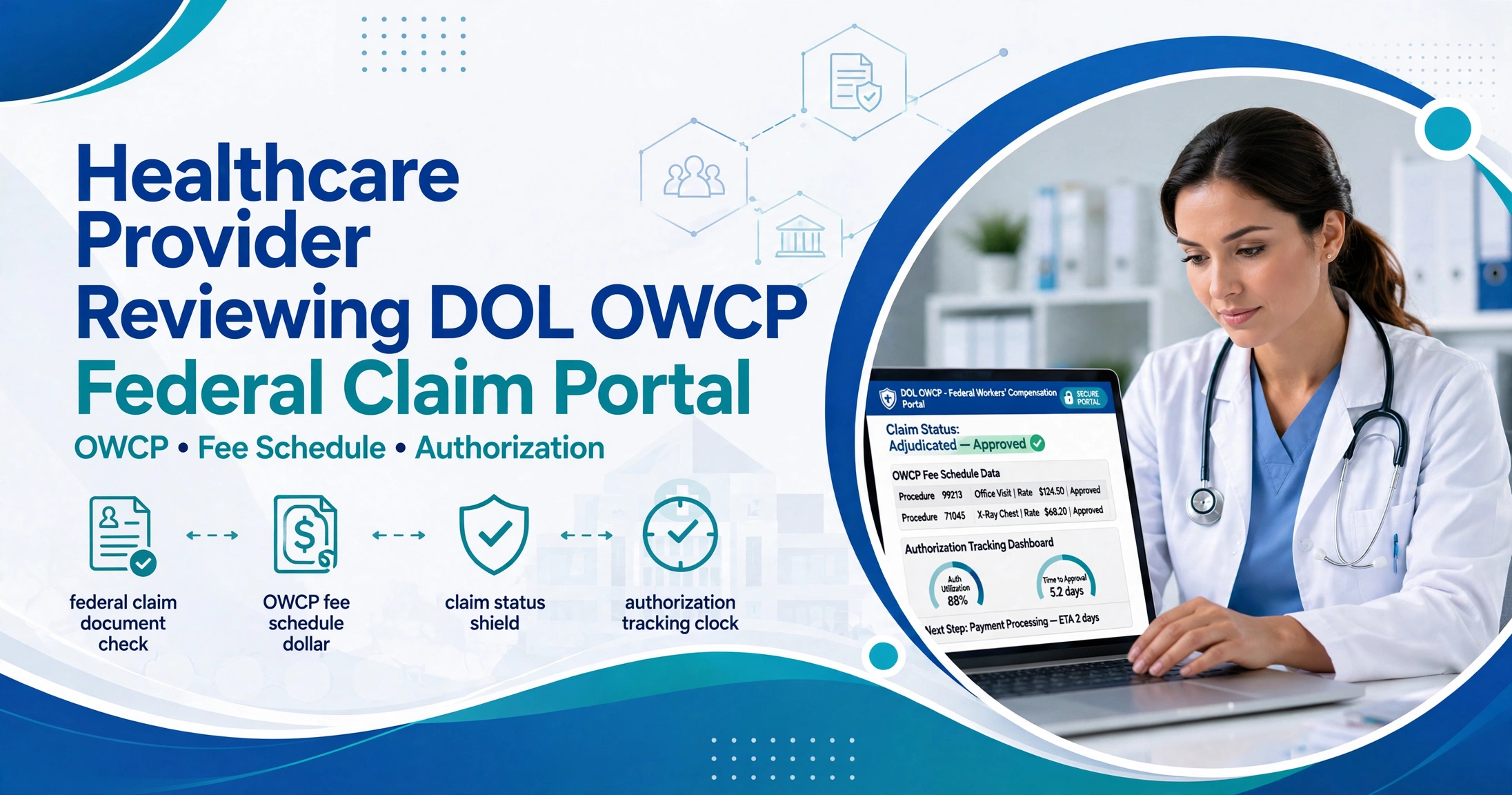
DOL medical billing Department of Labor medical billing refers to the specialized process of submitting, managing, and collecting payment for healthcare services provided to individuals covered under federal workers’ compensation and occupational illness programs administered by the US Department of Labor. Unlike Medicare, Medicaid, or commercial insurance billing, DOL billing operates under distinct federal statutes, federal fee schedules, federal authorization requirements, and federal adjudication processes that require a completely different billing expertise.
The US Department of Labor’s Office of Workers’ Compensation Programs (OWCP) administers four major disability compensation programs covering millions of federal workers, maritime employees, coal miners, and nuclear weapons workers. According to the Department of Labor, OWCP paid approximately $3.96 billion in medical benefits to injured workers and their providers in FY 2025, making DOL billing a significant revenue stream for any practice that serves federal employees, veterans, postal workers, energy workers, longshoremen, or coal miners.
In the USA healthcare providers who treat these populations face a billing environment unlike anything in standard commercial or government insurance billing. Prior authorization requirements, employer-specific claim numbers, injury-specific accepted condition restrictions, federal fee schedules that differ from Medicare, and multi-level appeal processes create a billing system that routinely defeats generalist billing teams.
⚠️ Why DOL Billing Demands Specialized Expertise |
According to the DOL OWCP Annual Report, the average denial rate for improperly submitted OWCP bills exceeds 35% compared to under 5% for well-managed commercial billing. The primary causes are incorrect bill form selection, missing authorization, billing for conditions not accepted on the claim, and fee schedule non-compliance. Providers with DOL-specialized billing recover these denials at rates above 70% when appealed correctly. |
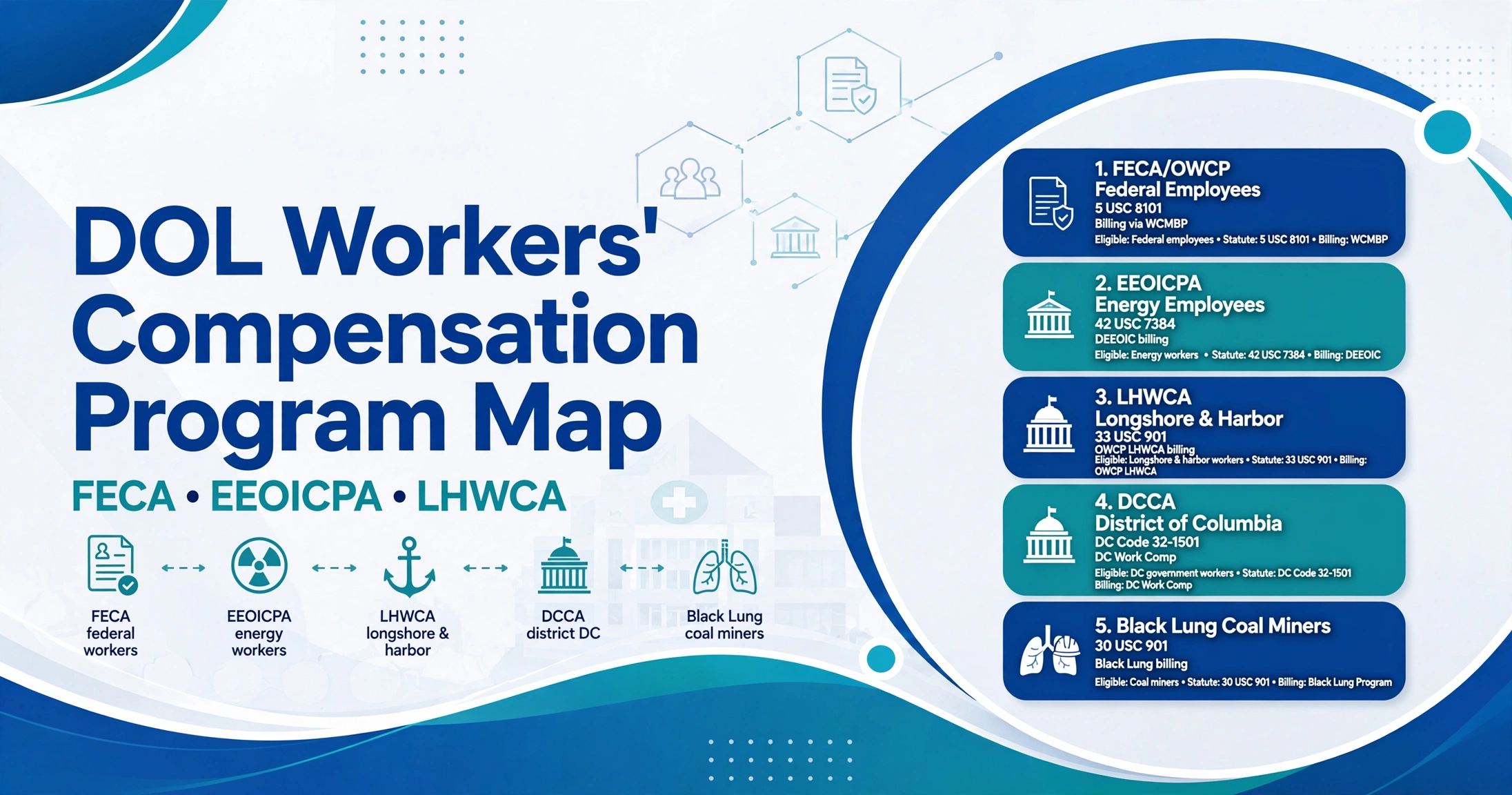
DOL medical billing encompasses five distinct federal compensation programs, each with its own authorizing statute, eligible population, billing rules, fee schedule, and adjudication process. It is important that you must understand which program applies to your patient is the first and most critical step in DOL billing.
| Program | Full Name | Governing Statute | Who Is Covered | Administering Division |
|---|---|---|---|---|
| FECA/OWCP | Federal Employees' Compensation Act | 5 U.S.C. Chapter 81 | Federal civilian employees injured on the job (postal workers, USPS, federal agencies, military civilians) | OWCP — Division of Federal Employees' Compensation (DFEC) |
| EEOICPA | Energy Employees Occupational Illness Compensation Program Act | 42 U.S.C. § 7384 | DOE nuclear weapons workers, uranium miners, contractors at nuclear sites exposed to radiation or beryllium | OWCP — Division of Energy Employees Occupational Illness Compensation (DEEOIC) |
| LHWCA | Longshore and Harbor Workers' Compensation Act | 33 U.S.C. § 901 et seq. | Maritime employees, harbor workers, shipbuilders, dock workers injured on navigable waters or adjoining areas | OWCP — Division of Longshore and Harbor Workers' Compensation (DLHWC) |
| DCCA | DC Workers' Compensation Act | D.C. Code § 32-1501 et seq. | Private sector employees in Washington, DC who are injured on the job | OWCP — Office of Workers' Compensation — DC office |
| Black Lung | Black Lung Benefits Act | 30 U.S.C. § 901 et seq. | Coal miners totally disabled by pneumoconiosis (black lung disease); dependent survivors | OWCP — Division of Coal Mine Workers' Compensation (DCMWC) |
| Program | Annual Medical Benefits Paid | Number of Claims (Active) | Key Medical Conditions Covered | Provider Payment Mechanism |
|---|---|---|---|---|
| FECA/OWCP | ~$3.1B annually (FY 2022) | ~140,000 active medical cases | Traumatic injuries, occupational disease, aggravation of pre-existing conditions | OWCP Medical Fee Schedule (MFS); RBRVS-based + adjustments |
| EEOICPA | ~$450M annually in medical benefits | ~27,000 active medical beneficiaries | Cancer (radiogenic), beryllium disease, silicosis, chronic beryllium disease | EEOICPA Medical Benefits — fee schedule aligned with OWCP |
| LHWCA | ~$300M annually | ~25,000 active cases | Traumatic maritime injuries, occupational disease | OWCP LHWCA fee schedule; state fee schedules in some jurisdictions |
| DCCA | ~$150M annually | ~8,000 active cases | DC workplace injuries — full spectrum | DC Workers' Comp fee schedule |
| Black Lung | ~$220M annually | ~25,000 active beneficiaries | Coal workers' pneumoconiosis; cor pulmonale; total disability from respiratory causes | Medicare-equivalent rates for Black Lung Clinics; OWCP fee schedule for others |
The Federal Employees’ Compensation Act (FECA) program, administered through OWCP’s Division of Federal Employees’ Compensation, is the largest and most frequently encountered DOL billing program for most US healthcare providers. It covers approximately 2.8 million federal civilian employees, including all US Postal Service workers, military civilians, and employees of virtually every federal department and agency.
Understanding the FECA claim lifecycle is essential to navigating OWCP billing correctly. Each step generates specific documentation requirements and billing eligibility windows:
| Claim Stage | Form/Document | Provider Role | Billing Implication |
|---|---|---|---|
| Injury reported by employee | CA-1 (Traumatic injury) or CA-2 (Occupational disease) | Treating provider may be notified; treatment may begin | No claim number yet — use CA-16 authorization if available |
| Emergency treatment (first 60 days) | CA-16 (Authorization for Examination/Treatment) | Employer issues CA-16; provider treats and bills without prior OWCP approval | CA-16 number goes on bill; valid for first 60 days without OWCP claim number |
| OWCP accepts the claim | OWCP issues claim number (format: XXX-XXX-XXXX) | Provider must register in OWCP billing system with claim number | All subsequent bills require OWCP claim number; bill directly to OWCP |
| Continuing treatment authorization | CA-20 (Attending Physician's Report) or OWCP Form 5 (Prior Authorization) | Treating physician completes CA-20; documents medical necessity | Authorization required before treatment beyond initial acute period |
| Referral/specialty authorization | OWCP prior authorization request (online portal or fax) | Treating physician requests authorization; OWCP approves/denies within 30 days | No payment without authorization for non-emergency specialty or procedure |
| Medical bill submission | OWCP-4 (Medical Bill) or CMS-1500 equivalent | Provider submits bill to OWCP fiscal agent (currently Conduent) | Must use OWCP fee schedule rates; balance billing prohibited |
| Payment/denial | Explanation of Medical Benefits (EOMB) | Provider receives EOMB with payment or denial reason code | Appeal denials within 30 days using OWCP reconsideration process |
Tip: Getting Paid Under OWCP Without Delays |
The single most common reason OWCP bills are denied is billing for a condition that is not accepted on the claim. OWCP only pays for medical treatment directly related to the accepted condition(s) on the claim, not all conditions the injured worker may have. Always verify the accepted conditions list before billing. The accepted conditions are listed in OWCP’s written notice of acceptance, and the treating physician’s CA-20 must document that treatment is for the accepted condition. |
You need to register in the OWCP Medical Bill Processing (WCMBP) web portal at owcpmed.dol.gov before submitting any claims. Providers must be enrolled in the OWCP billing system with their NPI and Tax ID. Claims submitted outside the portal or without proper enrollment will be rejected. |
Always document the connection between the treatment provided and the accepted condition on every bill and clinical note. OWCP reviewers are looking for this connection explicitly generic medical notes that don’t reference the work-related condition will generate medical necessity denials. |
The Energy Employees Occupational Illness Compensation Program Act (EEOICPA) compensates current and former Department of Energy (DOE) nuclear weapons workers and their survivors for occupational illnesses caused by exposure to radiation, beryllium, silica, and other toxic substances at covered DOE facilities. This program represents a specialized and financially significant billing opportunity for oncologists, pulmonologists, cardiologists, and other specialists who treat these patients.
| Program Part | Who Is Covered | Conditions Covered | Medical Benefits | Compensation Amount |
|---|---|---|---|---|
| EEOICPA Part B | DOE workers, atomic weapons employees, uranium miners/millers, ore transport workers | Specific radiogenic cancers; chronic beryllium disease; beryllium sensitivity; chronic silicosis | Full medical expenses for accepted condition | $150,000 lump sum + medical benefits |
| EEOICPA Part E | DOE contractor employees and subcontractors at covered facilities | Any illness caused by toxic substance exposure at covered facility (broader than Part B) | Full medical expenses for accepted condition | Variable impairment-based compensation up to $250,000 + medical |
| Combination (Part B + E) | Workers qualifying under both programs | Multiple accepted conditions under both parts | Medical covered under both accepted conditions | Compensation under both programs (non-duplicative) |
The Longshore and Harbor Workers’ Compensation Act (LHWCA) provides workers’ compensation benefits to maritime employees who are injured in the course of employment on navigable waters of the United States or in adjoining areas. The LHWCA also covers certain non-maritime employees through extensions including the Defense Base Act (covering overseas defense contractors), the Outer Continental Shelf Lands Act (offshore energy workers), and the Nonappropriated Fund Instrumentalities Act.
| LHWCA Coverage Category | Who Is Covered | Geographic Scope | Key Billing Difference from FECA |
|---|---|---|---|
| Core LHWCA | Longshore workers, harbor workers, shipbuilders, ship repairers, dock workers | On navigable US waters and adjoining land areas | Employer/insurer pays first; OWCP DLHWC adjudicates disputes; no direct OWCP billing in non-contested claims |
| Defense Base Act (DBA) | Civilian contractors and subcontractors working overseas on US defense projects | Outside the US on military bases and defense contracts | War risk coverage; OWCP oversight; insurer-based billing |
| Outer Continental Shelf Lands Act (OCSLA) | Workers on fixed platforms on the Outer Continental Shelf (offshore oil/gas) | US Outer Continental Shelf | Extends LHWCA to OCS workers; insurance company billing |
| Nonappropriated Fund (NAFI) | Civilian employees of military recreational/support activities | US and overseas NAFI facilities | Federal employees covered under NAFI extension of LHWCA |
In the Usa the Black Lung Benefits Act provides monthly cash payments and medical benefits to coal miners who are totally disabled by pneumoconiosis (black lung disease) arising from their coal mine employment, and to dependent survivors of miners who died from black lung. For healthcare providers, Black Lung billing is a specialized niche with distinct clinical documentation requirements, a unique intersection with Medicare billing, and federally designated Black Lung Clinics that provide comprehensive respiratory care.
Black Lung program medical benefits are unique among dol programs because of their complex interaction with Medicare. Understanding this relationship is critical to correct billing in your FQHC center.
Black Lung is the primary payer for all medical treatment related to the miner’s pneumoconiosis (coal workers’ pneumoconiosis, or CWP), Medicare is secondary.
The Black Lung program covers respiratory services for the treatment of pneumoconiosis regardless of Medicare coverage, it is not a secondary payer supplement.
When billing for Black Lung-related services, bill the Black Lung program first, then Medicare as secondary for any balance (if the patient is also a Medicare beneficiary)
For services NOT related to the miner’s black lung condition, bill Medicare (or other primary insurance) directly — Black Lung only covers CWP-related treatment
Black Lung Clinics receive enhanced federal funding and must provide comprehensive black lung services including: chest X-rays, pulmonary function testing, blood gases, and physician interpretation
| Service Type | Primary Payer | Secondary Payer | Billing Notes |
|---|---|---|---|
| Pneumoconiosis diagnosis & staging | Black Lung Program (OWCP DCMWC) | Medicare (if applicable) | ICD-10: J60 (Coal workers' pneumoconiosis); J62.8 (Pneumoconiosis, other); document mine employment history |
| Respiratory treatment (COPD, cor pulmonale related to CWP) | Black Lung Program | Medicare secondary | Document that condition is consequence of or related to CWP |
| Pulmonary function testing (PFTs) | Black Lung Program | Medicare secondary | Black Lung Clinics must use ILO Classification for chest X-rays |
| Non-respiratory conditions | Medicare (primary) | Commercial/supplemental | Black Lung does NOT cover non-respiratory conditions |
| Black Lung Clinic comprehensive evaluation | Federal grant-funded (Part C) | N/A for grant-covered services | Black Lung Clinics receive federal grants; services may be free to qualifying miners |
| Surgical treatment for CWP complications | Black Lung Program | Medicare secondary | Prior authorization typically required for inpatient procedures |
Understanding the OWCP Medical Fee Schedule is fundamental to DOL medical billing services. Unlike Medicare’s Physician Fee Schedule or commercial insurance contracted rates, OWCP uses its own federally established fee schedule that applies to all FECA-covered claims. The fee schedule is set by statute and regulation, and balance billing is explicitly prohibited.
The OWCP Medical Fee Schedule (MFS) is based on the Medicare Resource-Based Relative Value Scale (RBRVS) methodology but with distinct OWCP-specific conversion factors and adjustments. OWCP updates its fee schedule periodically but not necessarily on the same annual cycle as Medicare.
| Fee Schedule Component | OWCP Rule | Comparison to Medicare |
|---|---|---|
| Conversion Factor | OWCP-specific national conversion factor — higher than Medicare in most categories | OWCP CF is typically 110–125% of the Medicare CF depending on service type |
| Geographic Adjustment | Uses CMS Geographic Practice Cost Index (GPCI) locality adjustments | Same locality adjustments as Medicare PFS — locality rates apply to all OWCP services |
| Work RVU | Uses CMS work RVU values from the Medicare PFS | Same work RVUs as Medicare; no separate OWCP work RVU table |
| Practice Expense RVU | Uses CMS practice expense RVUs | Same as Medicare PFS |
| Malpractice RVU | Uses CMS malpractice RVUs | Same as Medicare PFS |
| Maximum Allowable Fee | MFS rate is the MAXIMUM — providers may not bill above this amount | Unlike Medicare assignment rules — OWCP has absolute balance billing prohibition |
| Surgical Global Periods | OWCP follows Medicare global period rules (0, 10, 90-day) | Same global period structure as Medicare; post-op visits bundled accordingly |
| Anesthesia | Anesthesia time units at OWCP-specific anesthesia conversion factor | Different from Medicare anesthesia billing; OWCP uses its own conversion factor |
Surgery billing under OWCP follows the same CPT framework as Medicare and commercial surgery billing, with critical OWCP-specific requirements:
All non-emergency surgical procedures require prior authorization from OWCP before the surgery is performed, you need to submit surgical authorization request with operative plan and medical necessity documentation.
Emergency surgery may proceed without prior authorization, but the provider must notify OWCP within 5 days and submit documentation establishing emergency necessity.
OWCP follows Medicare global surgery period rules, post-op care within the global period is bundled into the surgical fee and cannot be separately billed.
Multiple procedure reductions: OWCP follows Medicare’s multiple procedure payment reduction policy for endoscopy and add-on codes.
Assistant surgeon billing: OWCP covers assistant surgeons at 16% of the primary surgeon’s fee when medically necessary.
Co-surgeon billing: Two surgeons each billing 62.5% of the primary procedure — allowed when documented as medically necessary.
Tip: Prior Authorization for OWCP Surgery |
Authorization requests for OWCP surgery must be submitted to OWCP (not the employer) for FECA claims. Include: (1) the CPT codes for all planned procedures, (2) the diagnosis codes for the accepted condition(s), (3) the operative plan with clinical rationale, (4) conservative treatment failure documentation if applicable, and (5) the OWCP claim number. |
OWCP has 30 days to respond to a prior authorization request under federal regulations. If you have not received a response in 30 days, the request is deemed approved — but document your submission date and obtain written confirmation of the ‘deemed approved’ status before proceeding. |
Consultation codes (99241–99245 and 99251–99255) ARE covered by OWCP — unlike Medicare which discontinued them. Always document the requesting provider’s information and the reason for consultation when billing these codes to OWCP. |
ICD-10-CM coding in DOL billing services performs a specific legal function that goes beyond establishing medical necessity: it must demonstrate that the treatment being billed is for a condition that has been formally accepted on the worker’s claim. This accepted-condition requirement is the most critical — and most frequently misunderstood — element of DOL billing compliance.
OWCP only pays for medical treatment directly related to the specific conditions accepted on each individual claim. These accepted conditions are formally documented by OWCP in the written notice of acceptance. Billing for any condition NOT on the accepted conditions list even if clearly related to the injury, will be denied unless the treating physician requests and receives acceptance of the additional condition.
| Scenario | Billing Approach | ICD-10 Documentation Required |
|---|---|---|
| Treatment for accepted condition directly | Bill OWCP directly; use accepted condition ICD-10 code | Direct match to accepted condition; document in clinical note |
| Complication of accepted condition (not yet accepted separately) | Request OWCP to accept the complication; do not bill until accepted | Submit CA-20 requesting acceptance of complication; document causal relationship |
| Consequential condition (caused by accepted condition) | Request acceptance; submit medical evidence of causal relationship | Treating physician opinion on causal relationship required |
| Pre-existing condition aggravated by accepted injury | Request acceptance of aggravated condition; OWCP applies aggravation doctrine | Document baseline vs. current condition; physician opinion on aggravation required |
| Non-work-related condition in OWCP patient | Bill patient's personal insurance or Medicare — NOT OWCP | Do NOT use OWCP claim number; bill entirely separate from DOL claim |
| Second injury on a different body part (new OWCP claim) | Separate OWCP claim required; separate claim number | Original claim and new claim are billed separately; do not combine on one claim |
| ICD-10 Code | Diagnosis | DOL Billing Context |
|---|---|---|
| M54.5 / M54.4 | Low back pain / Thoracic back pain | Most common accepted condition in OWCP; document onset, mechanism, and work-relatedness |
| S13.x / S12.x | Cervical spine sprain/strain; Fracture cervical vertebra | Traumatic neck injuries in federal workers; document mechanism of injury |
| M75.1 / M75.0 | Rotator cuff tear; Adhesive capsulitis | Upper extremity conditions in OWCP; document occupational exposure and laterality |
| S82.x / S72.x | Fracture of lower leg; Fracture of femur | Traumatic orthopedic injuries; specify open vs. closed, displaced vs. non-displaced |
| F32.x / F41.1 | Major Depressive Disorder; Generalized Anxiety Disorder | Psychological conditions secondary to physical OWCP injuries; require separate acceptance |
| G54.2 / G54.3 | Cervical root disorders; Thoracic root disorders | Radiculopathy secondary to accepted spine condition; document nerve root level |
| J60 / J61 / J62.x | Coal workers' pneumoconiosis; Asbestosis; Silicosis | DOL Black Lung and EEOICPA conditions; ILO classification required for CWP |
| C34.x / C22.x | Lung cancer; Liver cancer | EEOICPA radiogenic cancers; document DOE facility history and radiation exposure type |
| Z57.1 / Z57.5 | Occupational exposure to radiation; Occupational noise | EEOICPA Z-codes for exposure documentation; supports accepted condition |
| T65.89XA–T65.89XS | Toxic effects of other specified substances | EEOICPA Part E — toxic substance exposure at DOE facilities |
Prior authorization in DOL billing is more formalized, more consequential, and more strictly enforced than in commercial insurance. Unlike commercial payers where a retroactive appeal often recovers denied unauthorized services, OWCP’s position is generally that unauthorized services are the provider’s financial responsibility, recovery after the fact is extremely difficult.
| Authorization Type | When Required | How to Obtain | Timeline & What Happens If Missed |
|---|---|---|---|
| CA-16 (Emergency Treatment) | First visit after work injury (first 60 days) | Issued by employer at time of injury — request from patient | If not obtained, bill OWCP retroactively with documentation of emergency/urgent nature |
| Initial OWCP Claim Acceptance | Before billing beyond CA-16 coverage | Employee files CA-1/CA-2; OWCP issues claim number | No claim number = no OWCP billing; may take 2-8 weeks for OWCP to process |
| Continuing Medical Care | For treatment beyond acute phase | CA-20 submitted by treating physician; OWCP reviews | Must be approved; retroactive authorization rarely granted for routine ongoing care |
| Specialty Referral/Consultation | Before referral to specialist | Submit referral request via OWCP portal or fax with clinical justification | Unauthorized consultations are denied and provider cannot bill patient |
| Elective Surgery | Before scheduling non-emergency surgery | Submit surgical auth request with CPT codes, ICD-10, operative plan | 30-day deemed approval if no response; must document submission date |
| Inpatient Hospitalization | Before admission for non-emergency | Submit admission request with DRG estimate and medical necessity | Emergency admissions authorized retroactively with documentation |
| Physical/Occupational Therapy | Before initiating PT/OT | Treatment plan submitted to OWCP or nurse case manager | Visit number limit specified in authorization; cannot exceed without re-authorization |
| DME/Orthotic/Prosthetic Devices | Before ordering items above $300 | Submit DME request with documentation of functional need | Unauthorized DME is provider and vendor's financial responsibility |
| Home Health Services | Before initiating home health | Submit home health plan to OWCP | Unauthorized home health is denied; retroactive recovery very rare |
✅ Authorization Best Practices for DOL Billing |
Maintain a dedicated OWCP authorization tracking log for every active DOL patient, record authorization numbers, dates, authorized CPT codes, and expiration dates. |
Submit all authorization requests electronically via the OWCP Medical Bill Processing portal (owcpmed.dol.gov), creating a documented submission record with timestamp. |
For surgical authorizations, submit at least 30 days before the planned surgery date, OWCP has 30 days to respond and rarely expedites. |
When OWCP assigns a nurse case manager to a patient, coordinate all authorization requests through the nurse case manager, they have direct OWCP access and can expedite approvals. |
If OWCP denies an authorization, request a formal second opinion evaluation, OWCP is required to arrange an independent medical examination before final denial of continuing care. |
Document ALL communication with OWCP staff in the patient’s billing file dates, names of OWCP representatives, and substance of conversations |
DOL billing denials have a different character from commercial insurance denials, many are rooted in accepted-condition restrictions, authorization failures, and fee schedule compliance issues. Here is the comprehensive denial and appeal guide for DOL medical billing.
| Denial Reason | Root Cause | Appeal/Fix Strategy |
|---|---|---|
| Condition not accepted on claim | Treatment billed for condition not formally accepted by OWCP | Treating physician submits medical opinion requesting OWCP to accept the condition; include supporting clinical evidence |
| No prior authorization | Service billed without required OWCP authorization | If emergency, submit retroactive justification; for elective services, obtain authorization before treatment and resubmit |
| Incorrect claim number | Wrong OWCP claim number on bill; claim number transposed | Verify correct claim number with patient and OWCP; resubmit with correct number |
| Provider not enrolled in WCMBP | NPI or Tax ID not registered in OWCP billing system | Complete WCMBP provider enrollment at owcpmed.dol.gov; resubmit once enrolled |
| Fee above OWCP MFS maximum | Billed charge exceeds OWCP fee schedule allowable | Reduce charges to MFS maximum and resubmit; balance billing patient is prohibited |
| Timely filing exceeded | Bill submitted more than 1 year after date of service | No appeal — timely filing denial is final; implement 30-day billing cycle going forward |
| Duplicate bill | Same bill submitted twice | Verify original claim payment status in WCMBP before resubmitting; mark as corrected bill if different |
| Employer dispute (LHWCA) | Employer contests work-relatedness under LHWCA | File LS-203 (Notice of Controversion); DLHWC schedules informal conference or formal hearing |
| Medical opinion disagreement | OWCP medical officer disagrees with treating physician's findings | Request second opinion examination; OWCP must arrange IME; treating physician's opinion given equal weight |
| Maximum medical improvement (MMI) | OWCP determines worker has reached MMI; stops authorizing treatment | Request formal reconsideration; submit evidence of continued medical necessity; appeal to OWCP Hearing Officer |
| EEOICPA condition not accepted | Treatment billed for condition not accepted under EEOICPA Part B or E | Submit medical evidence linking condition to toxic exposure; request DEEOIC district office review |
| Incorrect bill form | UB-04 submitted for professional services; CMS-1500 for facility | Resubmit on correct form: CMS-1500 for professional; UB-04 for facility |
DOL billing appeals follow a structured federal administrative process with specific deadlines and procedures.
Reconsideration: Within 30 days of OWCP denial, submit written reconsideration request to OWCP district office with supporting documentation.
OWCP Hearing Officer: If reconsideration is denied, request formal hearing before OWCP Hearing Officer within 30 days.
Employees’ Compensation Appeals Board (ECAB): Final administrative appeal; ECAB decisions are binding on OWCP.
Federal Court Review: Limited circumstances; ECAB decisions are rarely subject to federal court review under FECA.
EEOICPA Appeals: Separate process through DEEOIC district office → Final Adjudication Branch (FAB) → US District Court if needed
DOL medical billing is subject to strict federal oversight, and the consequences of non-compliance are significantly more severe than in commercial billing. The DOL Office of Inspector General (OIG) and the Department of Justice investigate DOL billing fraud with the same vigor applied to Medicare and Medicaid fraud.
| Federal Law | Applicability to DOL Billing | Potential Consequence |
|---|---|---|
| False Claims Act (31 U.S.C. § 3729) | Billing OWCP for services not rendered, not authorized, or not for accepted conditions | $13,000–$26,000 civil penalty per false claim + treble damages; criminal prosecution |
| Federal Criminal Code (18 U.S.C. § 1001) | False statements to federal agency in connection with OWCP claims | Up to 5 years federal imprisonment; fines |
| FECA Anti-Fraud Provisions (5 U.S.C. § 8148) | False claims under FECA specifically | Criminal prosecution; provider debarment from OWCP program |
| 20 C.F.R. § 10.801 (Balance Billing Prohibition) | Charging OWCP patients above fee schedule | Debarment from OWCP program; referral to DOL OIG |
| Program Exclusion (20 C.F.R. § 10.815) | OWCP can debar providers for billing violations | Loss of ability to treat any OWCP/FECA patient — permanent or temporary |
High-Risk DOL Billing Practices That Trigger Federal Investigations |
• Billing for conditions not accepted on the OWCP claim, a direct False Claims Act exposure if intentional |
• Billing OWCP for services not actually rendered or documented |
• Upcoding E/M visits beyond what documentation supports, OIG specifically audits OWCP outpatient E/M codes |
• Charging OWCP patients balance amounts above the OWCP fee schedule |
• Submitting prescriptions for controlled substances on OWCP claims without documented medical necessity for the accepted condition |
• Creating backdated or falsified medical records to support OWCP authorizations |
• Kickback arrangements with OWCP claimants or employers for patient referrals |
✅ DOL Billing Compliance Program Checklist |
• Designate a DOL/OWCP billing compliance officer responsible for monitoring regulatory updates and internal audits |
• Train all clinical and billing staff on accepted-condition restriction rules, the most common source of non-intentional OWCP billing violations |
• Conduct quarterly audits of OWCP claims comparing billed conditions to accepted conditions on each active claim |
• Implement a zero-balance-billing policy for all OWCP patients with automated PM system write-off codes for OWCP claim balances |
• Maintain copies of all OWCP authorizations, CA-16s, and claim acceptance letters in each patient’s billing file |
• Report suspected OWCP claimant fraud (injured workers working while receiving disability) to DOL OIG, providers are protected whistleblowers |
• Subscribe to DOL OWCP program bulletins and fee schedule updates, regulatory changes affect billing eligibility and rates |
DOL medical billing services apply differently depending on the type of provider submitting claims. Here is how key provider categories navigate the OWCP billing system:
| Provider Type | DOL/OWCP Billing Rules | Key Considerations |
|---|---|---|
| Primary Care Physicians | CMS-1500; OWCP MFS; primary treating physician role | As the treating physician of record, the PCP authorizes referrals, completes CA-20, and directs care plan — central role in OWCP billing |
| Orthopedic/Spine Surgeons | CMS-1500; surgical authorization required; OWCP global periods apply | Highest per-claim values in OWCP; surgical auth is mandatory; document work-relatedness in operative report |
| Physical Therapists (PT/OT) | CMS-1500 with therapy CPT codes; treatment plan auth required | OWCP visit limits strict; submit updated functional goals with re-authorization requests; document functional improvement objectively |
| Psychiatrists / Psychologists | CMS-1500; mental health conditions require separate acceptance; OWCP MH fee schedule | Psychological conditions secondary to physical injury require physician opinion on causal relationship before OWCP accepts |
| Hospitals (Inpatient) | UB-04; DRG-based payment for inpatient; OPPS for outpatient | Inpatient admission requires prior authorization; OWCP pays based on OWCP-specific DRG conversion (not Medicare IPPS rates directly) |
| Pharmacies | OWCP pharmaceutical fee schedule; OWCP requires NCPDP billing for pharmacy | Prescriptions must be for accepted condition; controlled substances require strong clinical documentation; PBM often intermediary |
| DME Suppliers | OWCP DME fee schedule; prior auth for items above $300 | DMEPOS-like accreditation may be required; document functional need and work-relationship of DME to accepted condition |
| Home Health Agencies | Medicare-equivalent rates; prior auth always required | OWCP nurse case manager typically coordinates home health; agencies must be OWCP-enrolled |
| Pain Management Specialists | CMS-1500; interventional procedures require auth; OWCP follows Medicare NCCI edits | High-audit-risk specialty for OWCP; document failed conservative treatment and accepted condition relationship for all interventional procedures |
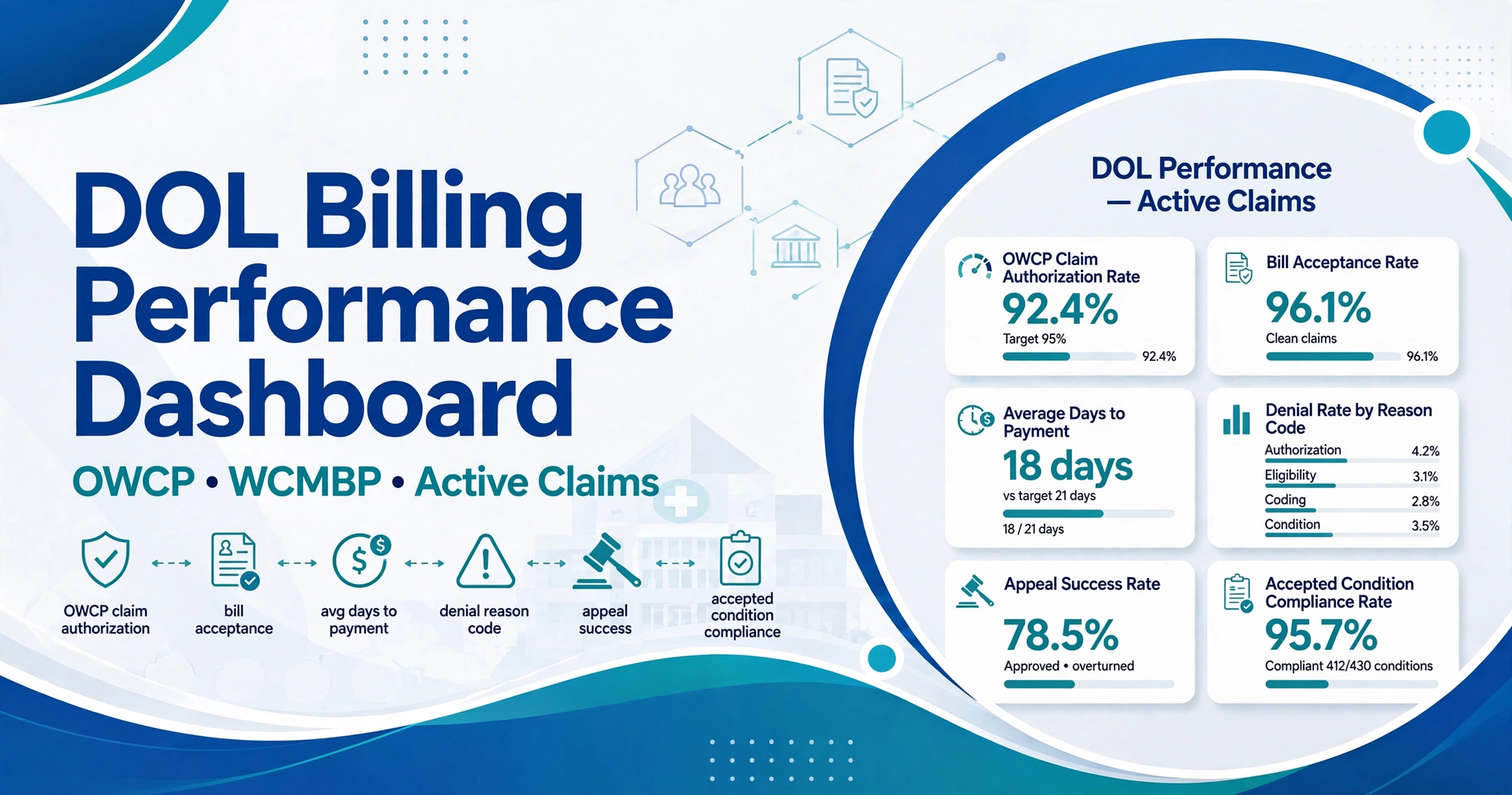
DOL billing performance management requires metrics that reflect the unique pre-authorization, accepted-condition, and federal fee schedule dynamics of workers’ compensation billing. Here are the KPIs most relevant to DOL medical billing services:
| KPI | Definition / Formula | DOL Benchmark Target |
|---|---|---|
| Authorization Capture Rate | Procedures performed with valid authorization ÷ Total procedures billed | > 99%; unauthorized services are financial loss — prevention is the only strategy |
| Accepted Condition Compliance Rate | Bills for accepted conditions ÷ Total OWCP bills submitted | 100% — any bill for a non-accepted condition is a compliance violation |
| First Pass Acceptance Rate | Bills accepted on first submission ÷ Total bills submitted to OWCP | > 90%; higher than commercial WC due to strict OWCP formatting requirements |
| Average Days to Payment | Date of payment − Date of bill submission | < 30 days; OWCP is statutorily required to pay clean bills within 30 days |
| Denial Rate by Reason | Denials by code ÷ Total bills — track separately: auth denials, condition denials, fee schedule | Overall < 10%; condition denials should be < 2%; auth denials should be < 3% |
| Appeal Success Rate | Successful appeals ÷ Total appeals filed | > 60%; OWCP appeal success rate is high when documentation is complete |
| Timely Filing Compliance | Bills submitted within 1 year ÷ Total billable encounters | 100% — timely filing denials under OWCP are not appealable |
| Balance Billing Occurrence | Patient bills above OWCP MFS ÷ Total OWCP patient accounts | 0% — any balance billing occurrence is a regulatory violation |
| CA-20 Completion Rate | CA-20 forms filed within required timeframe ÷ Total active OWCP cases | > 95%; CA-20 currency is required for ongoing authorization approval |
| OWCP Fee Schedule Variance | Billed charges vs. OWCP MFS maximum — average overage | Should be 0%; all charges must be at or below OWCP MFS maximum |
The complexity, compliance risk, and specialized knowledge required for DOL billing makes the outsource-vs.-in-house decision particularly consequential. Here is the complete comparison:
| Factor | In-House DOL Billing | Outsourced DOL Medical Billing Services |
|---|---|---|
| Startup Cost | High — OWCP portal setup, training, compliance program, authorization tracking system | Low — DOL billing vendor provides infrastructure; no training or portal setup cost |
| Ongoing Cost | Salaries, training on OWCP regulatory updates, compliance monitoring | Predictable % of collections; no HR overhead for specialized DOL billing staff |
| OWCP Fee Schedule Expertise | Requires staff to maintain current OWCP MFS rate tables and annual updates | DOL billing specialists maintain current fee schedule compliance as core function |
| Authorization Management | Requires dedicated auth tracking workflow and OWCP portal expertise | Authorization tracking and submission is typically included in DOL billing services |
| Accepted Condition Compliance | Requires billing staff to verify accepted conditions before every bill | DOL billing specialists verify accepted conditions as part of charge review workflow |
| Multi-Program Knowledge | FECA + EEOICPA + LHWCA + Black Lung requires deep multi-program expertise | Specialized DOL billing vendors handle all five programs across diverse patient populations |
| Appeal Management | OWCP appeal process requires specific federal administrative process knowledge | DOL billing specialists manage OWCP reconsideration, hearing requests, and ECAB appeals |
| Compliance Risk Management | In-house teams may miss regulatory updates; compliance risk managed internally | Vendors track DOL OIG bulletins, OWCP regulatory updates, and fee schedule changes proactively |
| Revenue Performance | Variable — DOL billing expertise is extremely scarce in the labor market | Consistent — DOL billing specialists achieve higher first-pass rates and appeal success rates |
| Best For | Large multi-site practices with dedicated DOL billing teams and compliance officers | Any practice treating federal workers, postal employees, miners, maritime workers, or DOE workers |
�� Pro Tip: Evaluating a DOL Medical Billing Services Vendor |
• Ask specifically which of the five DOL programs they support (FECA, EEOICPA, LHWCA, Black Lung, DCCA) — a vendor who only knows FECA will not serve an oncologist treating EEOICPA patients or a pulmonologist billing Black Lung. |
• Request their OWCP first-pass acceptance rate and their appeal success rate, these are the two most diagnostic metrics for DOL billing expertise. An average DOL billing vendor may have a 70% first-pass rate; a specialized vendor should be above 90%. |
• Ask how they track accepted conditions across your active OWCP patient panel, do they maintain an accepted-conditions database synchronized with OWCP claim acceptance letters? This is the most critical compliance function in DOL billing. |
• Verify they are enrolled and active in the OWCP WCMBP portal, providers cannot receive OWCP payment outside this system. |
• Ask for references from practices of similar specialty (orthopedics, occupational medicine, PT/OT, oncology) with similar DOL program patient mix. |
These are essential references for US DOL billing compliance, program rules, fee schedules, and appeals processes, will help you lot in your practice billing.
| Resource | Organization | URL |
|---|---|---|
| DOL Office of Workers' Compensation Programs | US Department of Labor | dol.gov/agencies/owcp |
| OWCP FECA Division (DFEC) | DOL OWCP | dol.gov/agencies/owcp/FECA |
| OWCP Medical Bill Processing Portal (WCMBP) | DOL OWCP / Conduent | owcpmed.dol.gov |
| OWCP District Office Directory | DOL OWCP | dol.gov/agencies/owcp/FECA/aboutowcp/districtoffices |
| EEOICPA Program | DOL OWCP / DEEOIC | dol.gov/agencies/owcp/energy |
| EEOICPA Medical Benefits for Physicians | DOL OWCP / DEEOIC | dol.gov/agencies/owcp/energy/regs/compliance/physicians |
| Division of Longshore & Harbor Workers' Compensation | DOL OWCP / DLHWC | dol.gov/agencies/owcp/dlhwc |
| Division of Coal Mine Workers' Compensation (Black Lung) | DOL OWCP / DCMWC | dol.gov/agencies/owcp/dcmwc |
| Employees' Compensation Appeals Board (ECAB) | DOL OWCP | dol.gov/agencies/owcp/FECA/ecab |
| DOL Office of Inspector General — Fraud Hotline | DOL OIG | oig.dol.gov/hotline.htm |
| CMS ICD-10-CM Official Guidelines | CMS / CDC | cms.gov/medicare/coding-billing/icd-10-codes/icd-10-cm-documentation |
| CMS NCCI Policy Manual | CMS / NCCI | cms.gov/medicare/coding-billing/national-correct-coding-initiative-edits |
| HRSA Black Lung Clinics Program | HRSA | hrsa.gov/grants/find-funding/hrsa-24-018 |
| DOL Annual Report to Congress (OWCP) | US Department of Labor | dol.gov/agencies/owcp/FECA/regs/compliance/DFECAFOHmain |
OWCP (Office of Workers’ Compensation Programs) billing covers federal civilian employees under the Federal Employees’ Compensation Act (FECA), not state workers’ compensation. Regular state workers’ compensation (e.g., California, Texas, New York WC) is governed by state law, administered by state agencies, and billed to private insurance carriers. OWCP is a federal program governed by federal statute (5 U.S.C. Chapter 81), administered by the US Department of Labor, paid from federal funds, and billed through the OWCP WCMBP portal. OWCP has its own federal fee schedule, its own authorization requirements (CA-16, CA-20, prior authorization), its own appeal process (OWCP district offices, OWCP Hearing Officers, Employees’ Compensation Appeals Board), and its own strict accepted-condition billing rules that have no equivalent in state workers’ compensation
The CA-16 (Authorization for Examination and/or Treatment) is the initial authorization document issued by the injured federal employee’s employing agency that authorizes a provider to treat the injured worker and bill OWCP for up to $1,500 in emergency treatment during the first 60 days after injury. It is critical for several reasons:
(1) It is your billing authorization in the absence of a formal OWCP claim number, which may take weeks to issue;
(2) It protects you from billing risk, without a CA-16 or claim number, you have no OWCP billing authority;
(3) It establishes the date of injury and the employing agency, which are required on all subsequent OWCP bills. Always request the CA-16 from the patient or their employing agency before beginning non-emergency treatment. If treatment is truly emergent and no CA-16 is available, document the emergency carefully and submit a retroactive authorization request to OWCP after treatment
OWCP’s accepted-condition requirement exists because FECA is a liability-based program, it compensates workers for conditions causally related to their federal employment, not for all their health conditions. When OWCP accepts a claim, it formally identifies the specific conditions that have been determined to be work-related. Only medical treatment for those conditions is covered. You learn what conditions are accepted from two sources:
(1) The written OWCP notice of acceptance sent to the claimant and treating physician when the claim is approved, this letter lists the accepted conditions; and
(2) The CA-20 (Attending Physician’s Report) process, where the treating physician can request acceptance of additional or consequential conditions. If you want to treat a condition that is not on the accepted list (even if clearly related), you must first request OWCP to accept the new condition with supporting medical evidence — then bill after acceptance. Billing for non-accepted conditions is the leading cause of OWCP billing denials and a primary False Claims Act risk
The OWCP Medical Fee Schedule (MFS) is based on the same RBRVS framework as Medicare using the same work RVUs, practice expense RVUs, and geographic adjustment factors but applies a different national conversion factor. OWCP’s conversion factor is typically 110–125% of Medicare’s conversion factor, resulting in reimbursement rates approximately 10–25% higher than Medicare for most services. However, unlike Medicare where you can accept assignment and still charge patients for non-covered services, OWCP has an absolute balance billing prohibition — you cannot charge the OWCP patient any amount above the OWCP fee schedule maximum, and you cannot bill the patient for any OWCP-covered service regardless of your usual charges. Consultation codes (99241–99245 and 99251–99255) are payable under OWCP — unlike Medicare, which eliminated them. Anesthesia billing uses OWCP-specific conversion factors. The fee schedule is updated periodically and providers should verify current rates at the OWCP WCMBP portal
Yes, but not to OWCP. If a patient has an active OWCP claim but presents with a condition unrelated to their accepted work injury (for example, a USPS mail carrier with an accepted knee injury who comes in for a sinus infection), the sinus infection treatment should be billed to the patient’s personal health insurance (Medicare, Medicaid, or commercial) — NOT to OWCP. Billing non-work-related conditions to OWCP is a False Claims Act violation. Always obtain the patient’s personal health insurance information separately from their OWCP claim information, and train your front desk and billing staff to distinguish between OWCP-covered conditions and non-covered conditions at each visit. Documentation in the clinical note should clearly indicate which conditions are being treated and on what billing basis
Black Lung is the primary payer for all medical treatment related to the miner’s coal workers’ pneumoconiosis (CWP) and related respiratory conditions. Medicare is SECONDARY for these patients when they are also Medicare beneficiaries. The correct billing sequence is: (1) Bill the Black Lung program first for all CWP-related treatment; (2) If the Black Lung program pays less than the Medicare rate or does not cover the full service, bill Medicare as secondary for the remaining balance; (3) For conditions NOT related to black lung (e.g., the miner’s diabetes, hypertension, or non-respiratory conditions), bill Medicare first and any supplement second. Billing Medicare as primary for black lung-related services while the patient has active Black Lung coverage is a Medicare billing error that creates an overpayment liability. Black Lung Clinics receive special federal grants and provide comprehensive black lung services — services provided under the grant may be free to qualifying miners
Get a free assessment from our billing experts