
Our Endocrinology RCM services help practices optimize revenue through specialized coding, documentation review, claim management, and denial prevention. We streamline complex billing processes to improve reimbursements, reduce errors, and support sustainable practice growth.
Dermatology revenue cycle management is far more demanding than most specialties because every patient encounter can involve a different combination of evaluation, procedures, pathology, medications, and payer rules in the USA. Even a minor documentation or coding error can delay your reimbursement, increase denials, or trigger compliance concerns that affect the financial health of your practice.
Unlike many medical specialties, dermatology combines medical, surgical, and cosmetic services under one revenue cycle. A single day may include office visits, lesion removals, biopsies, Mohs surgery, phototherapy, biologic therapies, and cosmetic treatments, each governed by unique CPT codes, modifiers, diagnosis requirements, global periods, and payer-specific coverage policies.
The consequences of getting billing wrong in dermatology are significant. Missed prior authorizations for biologics cost $1,000–$5,000 per denied claim. Modifier errors on multi-lesion excision visits cost $100–$400 per encounter. Misclassifying a medically necessary procedure as cosmetic or vice versa, creates both revenue loss and compliance exposure. And global period violations on Mohs-related closures and excisions trigger systematic underpayment that most practices never detect.
Need support with your billing workflow? Explore our medical billing and revenue cycle services or request a free consultation.
Endocrinology revenue cycle management is the end-to-end financial process of managing patient registration, insurance eligibility verification, prior authorization (particularly for CGM devices, insulin pumps, and specialty medications), multi-condition CPT and ICD-10 coding, HCPCS coding for durable medical equipment and drug administration, Chronic Care Management (CCM) billing, claims submission across a complex payer landscape, denial management, and payment collection for endocrinology practices. It is uniquely complex because endocrinologists in the USA routinely manage multiple chronic conditions per patient encounter, each requiring distinct, simultaneous coding and documentation.
The defining characteristic of endocrinology billing is this, while most specialties manage one primary problem per visit, endocrinologists routinely address two, three, or even four distinct clinical issues in a single appointment, each requiring its own ICD-10 code, each potentially requiring its own procedure or service code, and each needing to be documented in a way that supports both the clinical complexity and the E/M level selected.
| Endocrinology Service Line | Primary Billing Challenge | Revenue at Risk Without Specialty Billing |
|---|---|---|
| Type 1 and Type 2 Diabetes Management | Multi-code encounters; CGM prior auth; DSMES billing; CCM eligibility | CGM denials; missed CCM; undercoded E/M levels |
| Thyroid Disorders (Hypothyroid, Hyperthyroid, Nodules) | Ultrasound interpretation modifiers; FNA biopsy coding; post-thyroidectomy care | Missed imaging interpretation fees; FNA miscoding |
| Osteoporosis Management | DEXA scan coding; biologic (denosumab, romosozumab) PA; infusion coding | PA failures; infusion code errors |
| Adrenal Disorders | Rare condition ICD-10 specificity; specialized laboratory coding; dynamic function testing | Non-specific diagnosis codes trigger medical necessity denials |
| Pituitary Disorders | Complex laboratory panels; hormone stimulation testing; tumor-related coding | Panel bundling errors; stimulation test miscoding |
| Obesity and Metabolic Syndrome | Medical vs. behavioral obesity distinction; medication prior auth (GLP-1s) | GLP-1 PA failures; medical necessity documentation gaps |
| Polycystic Ovarian Syndrome (PCOS) | Multi-system coding; hormonal panel billing; fertility-related service exclusions | Fertility exclusion denials; incomplete multi-system coding |
| Pediatric Endocrinology | Growth hormone therapy coding; pediatric-specific ICD-10; developmental milestones | Growth hormone PA denials; age-specific coding errors |
Endocrinology billing draws from multiple CPT code families, E/M visits, diagnostic laboratory interpretations, procedure codes, infusion codes, and specialized testing codes. The AMA CPT code system combined with endocrinology-specific HCPCS codes and a highly detailed ICD-10 diagnosis library forms the billing foundation of every endocrinology practice.
| CPT Code | Service | MDM or Time Standard | Endocrinology Context |
|---|---|---|---|
| 99202 | New patient — low complexity | Straightforward MDM or 15-29 min | New patient initial consult — simple single-condition presentation |
| 99203 | New patient — moderate complexity | Low complexity MDM or 30-44 min | New patient with one or two chronic conditions |
| 99204 | New patient — moderate-high complexity | Moderate MDM or 45-59 min | New patient with multiple chronic conditions; diabetes + thyroid |
| 99205 | New patient — high complexity | High complexity MDM or 60-74 min | New complex patient; multiple uncontrolled conditions; new diagnosis workup |
| 99212 | Established patient — low complexity | Straightforward MDM or 10-19 min | Stable, well-controlled single condition; routine follow-up |
| 99213 | Established patient — moderate complexity | Low complexity MDM or 20-29 min | Established patient with two or more stable chronic conditions |
| 99214 | Established patient — moderate-high complexity | Moderate MDM or 30-39 min | Established patient; multiple conditions; medication adjustments; labs reviewed |
| 99215 | Established patient — high complexity | High complexity MDM or 40-54 min | Uncontrolled diabetes; multiple comorbidities; high-complexity decision making |
⚠️ Endocrinology Undercoding Alert: Studies show that endocrinologists systematically undercode their E/M visits billing 99213 for encounters that clearly document 99214-level MDM. For an endocrinologist seeing 20 patients per day, the difference between 99213 and 99214 is approximately $40-60 per encounter in Medicare reimbursement. That’s $800-1,200 per day, $4,000-6,000 per week, and $200,000-300,000 per year in uncaptured legitimate revenue from a single, fixable coding accuracy problem. The cure is accurate MDM documentation that reflects the actual clinical complexity of managing multiple chronic endocrine conditions simultaneously.
| Code | Description | Key Billing Rule |
|---|---|---|
| 99091 | Collection and interpretation of physiologic data (e.g., CGM) | Minimum 30 min of physician time per 30 days; patient consent required; not billable same month as 99457/99458 |
| 99457 | Remote therapeutic monitoring — physician — first 20 min | Monthly code; requires interactive communication with patient; physician or qualified non-physician practitioner |
| 99458 | Remote therapeutic monitoring — each additional 20 min | Add-on to 99457; document total time |
| 99490 | Chronic Care Management — first 20 min/month | Requires 2+ chronic conditions; care plan; patient consent; non-face-to-face time |
| 99491 | CCM — physician personally performs, first 30 min | Physician personally performed CCM time |
| 99439 | CCM — each additional 20 min | Add-on to 99490 for each additional 20-minute block |
| 98960 | Education and training — individual | Structured diabetes self-management education (DSME) — patient self-administered treatment |
| 98961 | Education and training — group (2-4 patients) | Group DSME; document all participants |
| 98962 | Education and training — group (5-8 patients) | Larger DSME group; document attendance |
| G0108 | DSMES — individual session | Medicare-specific DSME code for individual sessions |
| G0109 | DSMES — group session | Medicare-specific DSME code for group sessions (2+ patients) |
| G9752 | Hemoglobin A1c documented in medical record | Quality measure; not a billing code but required for MIPS/QPP reporting |
| 82947 | Glucose quantitative | Laboratory blood glucose measurement |
| 83036 | Hemoglobin A1c | HbA1c lab test; key diabetes management marker |
Tip: CCM Billing for Diabetes Patients
Chronic Care Management (CCM) is one of the most consistently underbilled revenue opportunities in endocrinology. Nearly every endocrinology practice in the USA has a large population of patients who qualify, patients with Type 1 or Type 2 diabetes plus at least one other chronic condition (hypertension, CKD, thyroid disorder, etc.). For each qualifying patient receiving 20+ minutes of CCM services per month, 99490 generates approximately $40-60 per month in Medicare reimbursement. For a practice with 200 qualifying patients, that is $8,000-12,000 in monthly recurring revenue that many practices currently bill at zero. CCM requires: a comprehensive care plan, patient consent, an enrolled care coordination staff member, and monthly time tracking.
| HCPCS Code | Description | Prior Auth? | Key Documentation |
|---|---|---|---|
| A9278 | External ambulatory insulin delivery system (CGM sensor supply) | Often yes — commercial plans | Documented diabetes diagnosis; physician order; patient meets CGM criteria |
| K0553 | Supply for external non-insulin drug delivery system (CGM receiver/display) | Often yes | Diabetes diagnosis; clinical indication for CGM monitoring |
| E0787 | External ambulatory infusion pump, insulin | Often yes | Insulin-dependent diabetes; documentation of inadequate control without pump |
| E2100 | Blood glucose monitor with integrated voice synthesizer | Payer-specific | Document visual impairment or other clinical necessity |
| A4230 | Infusion set — insulin pump (per set) | Usually no — supply code | Attached to E0787 claim; patient must have active pump authorization |
| A4226 | Calibration solution for glucose monitor (per vial) | No | Accessory supply; document device in use |
| A4253 | Blood glucose test strips — per 50 strips | No for Medicare; some commercial | Document testing frequency in diabetes management plan |
| S1034 | Artificial pancreas device system (closed-loop CGM/pump) | Yes — all payers | Documented Type 1 diabetes; prior failed conventional insulin therapy; physician attestation |
| CPT Code | Description | Key Billing Rule |
|---|---|---|
| 76536 | Ultrasound — soft tissue neck (thyroid, parathyroid) | Global code when practice owns equipment; modifier 26 for interpretation only |
| 76942 | Ultrasound guidance for needle placement | Bill separately when ultrasound guidance used for FNA; requires separate documentation |
| 10005 | FNA biopsy — first lesion, with ultrasound guidance | Thyroid nodule biopsy under ultrasound; document lesion size, location, needle passes |
| 10006 | FNA biopsy — each additional lesion, with ultrasound guidance | Add-on for each additional thyroid nodule biopsied in same session |
| 60200 | Excision of thyroid cyst or adenoma | Surgical procedure; 90-day global period |
| 84436 | Thyroxine (T4) total | Thyroid laboratory code — total T4 |
| 84480 | T3 total (triiodothyronine) | Thyroid laboratory code |
| 84443 | Thyroid-stimulating hormone (TSH) assay | Most common thyroid lab; key monitoring code |
| 86376 | Microsomal antibodies (anti-TPO) | Autoimmune thyroid disease marker |
| 86200 | CCP antibody | Endocrine autoimmune panel component |
| 78013 | Thyroid imaging with function study | Nuclear medicine; requires facility billing for technical component |
| 78015 | Thyroid carcinoma metastasis imaging | Post-thyroidectomy cancer surveillance imaging |
| Code | Description | Key Billing Rule |
|---|---|---|
| 77080 | DXA scan — axial skeleton (hip, spine) | Most common bone density code; modifier 26 for interpretation; verify PA requirements |
| 77085 | DXA scan — axial with vertebral fracture assessment (VFA) | Includes VFA component; higher reimbursement than 77080 alone |
| 77081 | DXA scan — appendicular skeleton (wrist, heel, hand) | Peripheral measurement; lower reimbursement |
| 96365 | IV infusion — up to 1 hour (initial) | Used for zoledronic acid (Reclast) infusions; document drug, dose, clinical indication |
| 96366 | IV infusion — each additional hour | Add-on to 96365 |
| J3489 | Zoledronic acid (Reclast) — per mg | HCPCS drug code for bisphosphonate infusion; bill units based on mg administered |
| J0897 | Denosumab (Prolia) — per 60mg | HCPCS for denosumab injection; PA required by most plans; document osteoporosis criteria |
| J3110 | Romosozumab (Evenity) — per mg | HCPCS for romosozumab; PA required; document bone density and fracture history |
| 20610 | Arthrocentesis — major joint | Used for joint injections in endocrinology context; fluoroscopy guidance coded separately |
| Code | Description | Notes |
|---|---|---|
| J3490 | Unclassified drug (NOC) — for new GLP-1 agents without specific J-code | Some GLP-1 agents still use J3490 while awaiting assigned HCPCS codes; require explicit box 19 narrative details |
| J0475 | Injection, baclofen, 10 mg | Muscle relaxant; not a metabolic/GLP-1 code tier; requires JW/JZ wastage tracking if single-dose vial format used |
| 96372 | Therapeutic injection — subcutaneous or intramuscular | Administration code for injectable GLP-1 agonists given in office; cannot be billed for patient self-administration |
| S5550 | Insulin — 5 units | Self-administered; not typically office-billed but relevant for HCPCS compliance |
| Z68.30–Z68.39 | BMI coding — adult (30–39.9 kg/m2 range) | Required supporting diagnosis for obesity medication management billing to validate metabolic risk severity |
| E11.65 | Type 2 diabetes with hyperglycemia | Most specific diabetes + metabolic code pair for GLP-1 medical necessity |
| E66.01 | Morbid obesity due to excess calories | Specific obesity diagnosis code for weight management billing |
| E66.9 | Obesity unspecified | Less specific; use only when documentation doesn't support more specific coding |
In endocrinology more than any other outpatient specialty, ICD-10 code specificity directly determines whether a claim is paid. Using generic, unspecified codes when more specific codes are supported by documentation is one of the leading causes of medical necessity denials in endocrinology. The ICD-10 system for endocrine disorders is highly granular and for good reason.
| ICD-10 Code | Description | Key Specificity Rule |
|---|---|---|
| E10.65 | Type 1 diabetes with hyperglycemia | Specify type 1 vs type 2 — never use E11 for Type 1 patients |
| E10.641 | Type 1 diabetes with hypoglycemia with coma | Document hypoglycemic episodes; specify coma vs. without coma |
| E10.649 | Type 1 diabetes with hypoglycemia without coma | Document hypoglycemic episodes explicitly in encounter note |
| E10.10 | Type 1 diabetes with ketoacidosis without coma | DKA — specify with or without coma |
| E10.40 | Type 1 diabetes with diabetic neuropathy, unspecified | Specify type of neuropathy if documented |
| E11.65 | Type 2 diabetes with hyperglycemia | Most common diabetes code; document blood glucose and A1C values |
| E11.649 | Type 2 diabetes with hypoglycemia without coma | Document hypoglycemia events in chart |
| E11.40 | Type 2 diabetes with diabetic neuropathy, unspecified | Specify peripheral neuropathy (E11.40), autonomic (E11.43), etc. |
| E11.9 | Type 2 diabetes without complications | Use only when truly no complications; many T2D patients have complications |
| E13.9 | Other specified diabetes (MODY, secondary diabetes) | For MODY, pancreatogenic diabetes, secondary diabetes — not types 1 or 2 |
| Z79.4 | Long-term use of insulin | Required as secondary code for Type 2 patients using insulin |
| Z79.84 | Long-term use of oral hypoglycemic drugs | Required as secondary code for patients on oral agents |
Tip: Always Code the Manifestations
Diabetes with complications requires coding both the diabetes code AND the manifestation code. For example, Type 2 diabetes with CKD Stage 3: E11.65 (T2DM with hyperglycemia) + N18.3 (CKD, Stage 3). Type 2 diabetes with diabetic retinopathy: E11.311 (T2DM with unspecified diabetic retinopathy with macular edema) — or the more specific retinopathy code. Failing to code manifestations means your documentation tells a richer clinical story than your billing does, which both reduces medical necessity defensibility and undercodes the complexity of the encounter
| ICD-10 Code | Description | Specificity Note |
|---|---|---|
| E03.9 | Hypothyroidism, unspecified | Avoid when possible; use E03.0 (congenital), E03.1 (due to surgery), E03.8 (other specified) |
| E05.00 | Thyrotoxicosis (Graves disease) without thyrotoxic crisis | Specify with or without thyrotoxic crisis |
| E05.10 | Toxic single thyroid nodule without thyrotoxic crisis | Nodule type matters — toxic vs. non-toxic |
| E04.1 | Nontoxic single thyroid nodule | Benign nodule; pair with ultrasound documentation |
| E04.2 | Nontoxic multinodular goiter | Multiple nodules without hyperthyroid function |
| D34 | Benign neoplasm of thyroid gland | Use when biopsy confirms benign; not for suspected malignancy |
| C73 | Malignant neoplasm of thyroid gland | Post-biopsy confirmed thyroid cancer |
| E21.0 | Primary hyperparathyroidism | Document PTH and calcium levels to support specificity |
| E27.1 | Primary adrenocortical insufficiency (Addison's disease) | Rare; document ACTH stimulation test results |
| E24.0 | Pituitary-dependent Cushing disease | Distinguish from adrenal Cushing (E24.0 vs. E24.8) |
| E22.0 | Acromegaly and pituitary gigantism | Document IGF-1 and GH suppression test results |
| E23.0 | Hypopituitarism | Multiple hormone deficiency; code each deficient hormone |
| ICD-10 Code | Description | Key Rule |
|---|---|---|
| M81.0 | Age-related osteoporosis without fracture | Primary osteoporosis; most common in postmenopausal women |
| M80.00XA | Age-related osteoporosis with current pathological fracture | Specify site and laterality when fracture is present |
| M85.80 | Disorder of bone density and structure, unspecified | Use when bone density abnormality doesn't meet osteoporosis criteria |
| M83.0 | Puerperal osteomalacia | Postpartum bone softening disorder |
| E55.9 | Vitamin D deficiency, unspecified | Very common secondary diagnosis in osteoporosis and metabolic bone disease |
| M83.9 | Adult osteomalacia, unspecified | Bone softening due to vitamin D/phosphate metabolism disorder |
Diabetes Self-Management Education and Support (DSMES) services are covered by Medicare, Medicaid, and most commercial payers, yet they are consistently underbilled by endocrinology practices, even practices that provide these services routinely. The ADA Standards of Medical Care in Diabetes strongly supports DSMES as essential diabetes care and CMS covers it with clear billing codes and criteria.
| Service | Medicare Code | Commercial Code | Coverage Criteria | Key Documentation |
|---|---|---|---|---|
| DSMES — initial 10 hours (individual or group) | G0108 (individual), G0109 (group) | 98960 (individual), 98961/98962 (group) | Referring physician order; Type 1 or Type 2 diabetes diagnosis; ADA-recognized program | Referral documentation; program accreditation; attendance record; individual learning plan |
| DSMES — follow-up hours (annual 2 hours) | G0108 / G0109 | 98960-98962 | Annual follow-up; same qualifying criteria | Updated learning plan; progress toward self-management goals |
| Medical Nutrition Therapy (MNT) — initial | 97802 | 97802 | Physician referral; diabetes or renal disease | Dietitian credentials; nutrition assessment; care plan; patient goals |
| MNT — follow-up individual | 97803 | 97803 | Same qualifying criteria | Progress documentation; care plan updates |
| MNT — group | 97804 | 97804 | Two or more patients in group | Group attendance documented |
Chronic Care Management is one of the most significant yet most underutilized revenue opportunities for your endocrinology practice. CMS introduced CCM specifically because practices like endocrinology with large populations of patients managing multiple chronic conditions over years or decades, provide substantial non-face-to-face care coordination that had previously been uncompensated.
| CCM Code | Description | Requirements | 2026 Medicare Rate (Approx.) |
|---|---|---|---|
| 99490 | CCM — clinical staff, first 20 min/month | 2+ chronic conditions; care plan; patient consent; non-face-to-face services | $42–$58/month per patient |
| 99439 | CCM — additional 20 min/month | Add-on to 99490; document cumulative time | $37–$48/month additional |
| 99491 | CCM — physician personally performs, first 30 min | MD/DO personally provides CCM services (not delegated to clinical staff) | $82–$100/month |
| 99487 | Complex CCM — first 60 min/month | High complexity MDM in addition to CCM requirements; 60+ min of clinical staff time | $144.29 (National baseline) |
| 99489 | Complex CCM — each additional 30 min | Add-on to 99487 | $78.16 additional (National baseline) |
| CCM Requirement | What It Means in Practice |
|---|---|
| 2+ Chronic Conditions | Diabetes + any of: hypertension, CKD, thyroid disease, obesity, dyslipidemia, neuropathy — nearly all endocrinology patients qualify |
| Expected to last 12+ months | All diabetes patients; most thyroid patients; all osteoporosis patients |
| Places patient at significant risk | Diabetes with complications; uncontrolled thyroid; osteoporosis with fracture risk — easily documented |
| Comprehensive Care Plan | Documented, patient-centered plan addressing all active chronic conditions — updated at least annually |
| Patient Consent | Written or verbal consent; must be documented in chart; can be obtained at any visit |
| Enhanced Access | 24/7 access to care team via phone, portal, or other means — most practices already offer this |
| Care Coordination | Non-face-to-face coordination: medication refills, lab result follow-up, specialist communication, patient education calls |
| Monthly Time Tracking | Document who provided what CCM services and for how long each month |
Tip: CCM Implementation Roadmap
To bill CCM for the first time:
(1) Identify all patients with 2+ qualifying chronic conditions in your active patient panel.
(2) You need to create or update a comprehensive care plan for each qualifying patient.
(3) Obtain patient consent, this can be done at the next scheduled office visit.
(4) Designate a care coordination staff member.
(5) Implement a monthly time tracking system (even a simple spreadsheet works initially).
(6) Submit 99490 each month for qualifying patients who received 20+ minutes of CCM services. For a practice with 300 qualifying patients billed at $50/patient/month, CCM generates $180,000 in annual recurring revenue from care coordination activities your team is likely already providing.
Remote patient monitoring for endocrinology, especially Continuous Glucose Monitor (CGM) data collection and interpretation, is one of the fastest-growing revenue streams in the specialty. CMS significantly expanded coverage for remote physiologic monitoring, and CMS guidance on RPM provides the framework for billing these services.
| CPT Code | Service | Time/Volume Requirement | Endocrinology Application | 2026 Medicare Rate |
|---|---|---|---|---|
| 99453 | RPM setup and patient education — per episode of care | Initial setup only; one-time per device type per patient | CGM device setup and training; insulin pump initiation | $21.71 (National average) |
| 99454 | Remote monitoring device supply — per 30 days | 16–30 days of readings per 30-day period | CGM sensor supply billing; requires 16+ days of data streams | $52.11/month |
| 99457 | RPM — physician review, first 11–20 min/month | Interactive communication with patient required; updated 11-min minimum threshold | Monthly CGM data review with clinician call or secure portal message | $51.77/month |
| 99458 | RPM — each additional 10 min/month | Add-on to 99457; updated to 10-minute reporting increments | Extended CGM review conversations and complex titration tracking | $41.42/month additional |
| 99091 | Collection/interpretation of physiologic data | 30 min of physician time per 30 days | CGM pattern analysis; trend review; retrospective insulin adjustment documentation | ~$69.06/month |
Patient Scheduling and Condition Identification: At scheduling, your billing team members need to identify all active chronic conditions being managed (diabetes, thyroid, osteoporosis, etc.). Pre-load the encounter for multi-condition documentation. For new patients, confirm all prior records, laboratory results, and specialist notes are available before the appointment.
Insurance Eligibility Verification: It is main responsibility of your billing team to verify active coverage, copay, deductible status, and coverage for endocrinology-specific services: CGM benefit, DSMES coverage, CCM eligibility, DXA scan coverage, infusion benefit (for bisphosphonates, biologics), and prior authorization requirements for all planned services.
Prior Authorization Management: For CGM devices, insulin pumps, GLP-1 agents, biologics (denosumab, romosozumab), and specialty medications, you need to submit PA requests with complete clinical documentation. Track PA approval, renewal dates, approved quantities, and step therapy compliance.
Multi-Condition Clinical Documentation: Document each condition managed during the visit individually. For each chronic condition, document, current status (controlled vs. uncontrolled), relevant labs reviewed, medication adjustments made, and clinical reasoning. This documentation drives both the E/M level and the medical necessity for each associated service code.
E/M Level Selection: You need to select the E/M code based on MDM (or time if time-based billing). With multiple chronic conditions being managed simultaneously, most endocrinology established patient visits meet 99214 or 99215 MDM criteria, document the number of conditions, the data reviewed, and the management risk to support the selected level.
Procedure and Service Charge Capture: Capture all separately billable services: CGM data interpretation (99091 or 99457), DSMES services (G0108), in-office procedures (thyroid ultrasound, FNA biopsy), infusions (zoledronic acid, denosumab), and device administration (insulin pump initiation). Link each service to the appropriate ICD-10 diagnosis code.
CCM and RPM Monthly Billing: At month-end, you need to review the active CCM and RPM patient lists. Document monthly CCM time and services for each patient. Verify RPM: 16+ days of CGM data for 99454; 20+ minutes of physician interaction for 99457. Submit monthly CCM and RPM claims within the billing cycle.
HCPCS Drug and Device Coding: For all medication and device administrations, use the correct HCPCS code with accurate units. You need to verify current J-code and K-code assignments for GLP-1 agents, CGM supplies, and infusion drugs, these change more frequently than CPT codes.
Claims Scrubbing: Pre-submission edit checks: ICD-10 specificity for diabetes codes, Z79.4 or Z79.84 secondary codes when applicable, PA number on CGM and specialty drug claims, RPM overlap restrictions (99091 vs. 99457), DSMES referral documentation verified, modifier 26 on imaging interpretations.
Claims Submission: Submit electronically within each payer’s timely filing window. Medicare: 12 months. Commercial payers: typically 90-180 days.
Payment Posting and Reconciliation: Your team needs to post payments and reconcile against contracted rates. For CGM devices, verify DME vs. professional claims routing. For infusions, reconcile drug HCPCS payments against buy-and-bill drug costs.
Denial Management: Categorize by denial type: CGM PA, medical necessity, ICD-10 specificity, CCM overlap, DSMES referral missing, timely filing. Appeal with specific clinical documentation. Refer to ADA and AACE guidelines for medical necessity appeals on specialty medications.
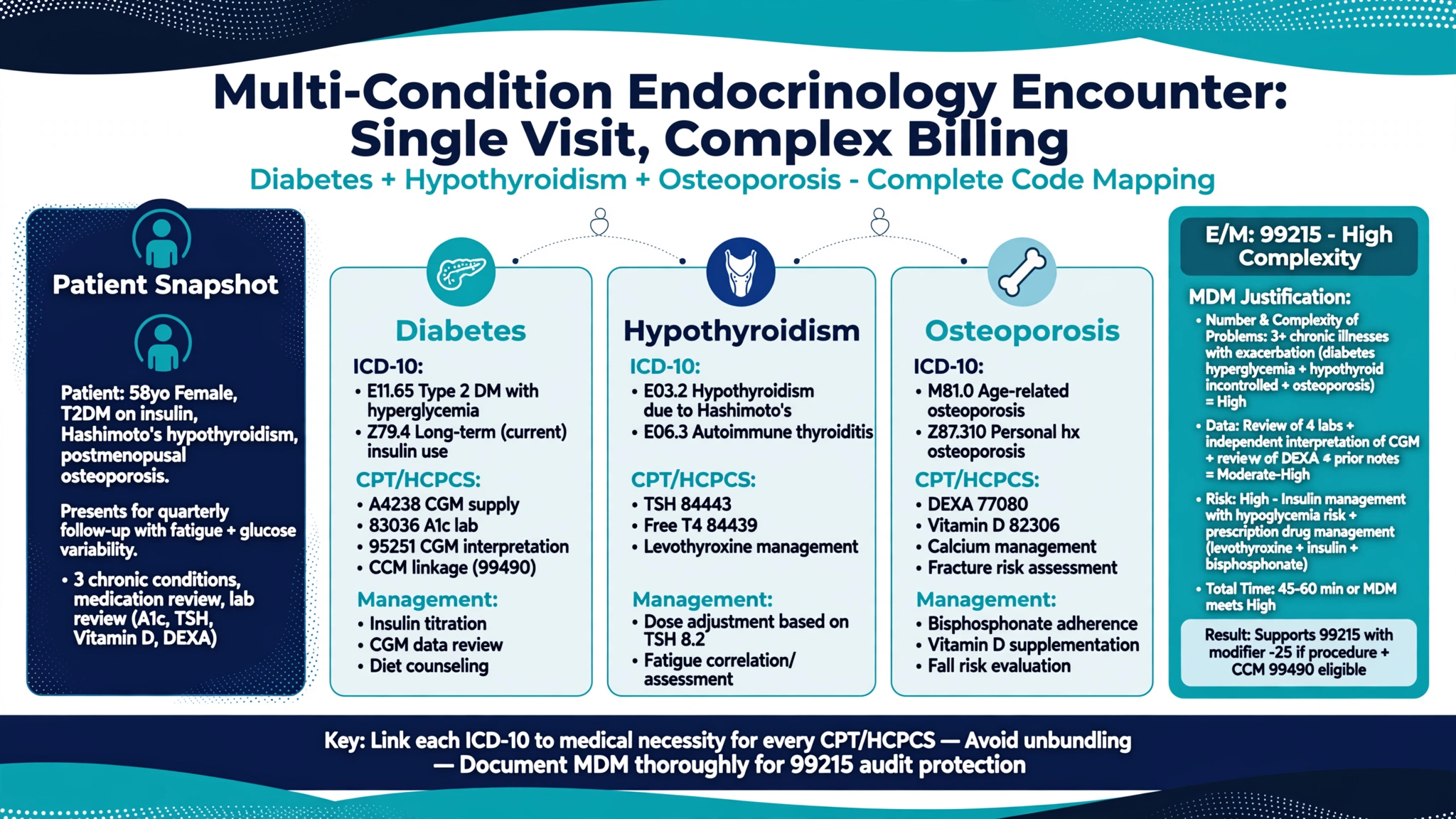
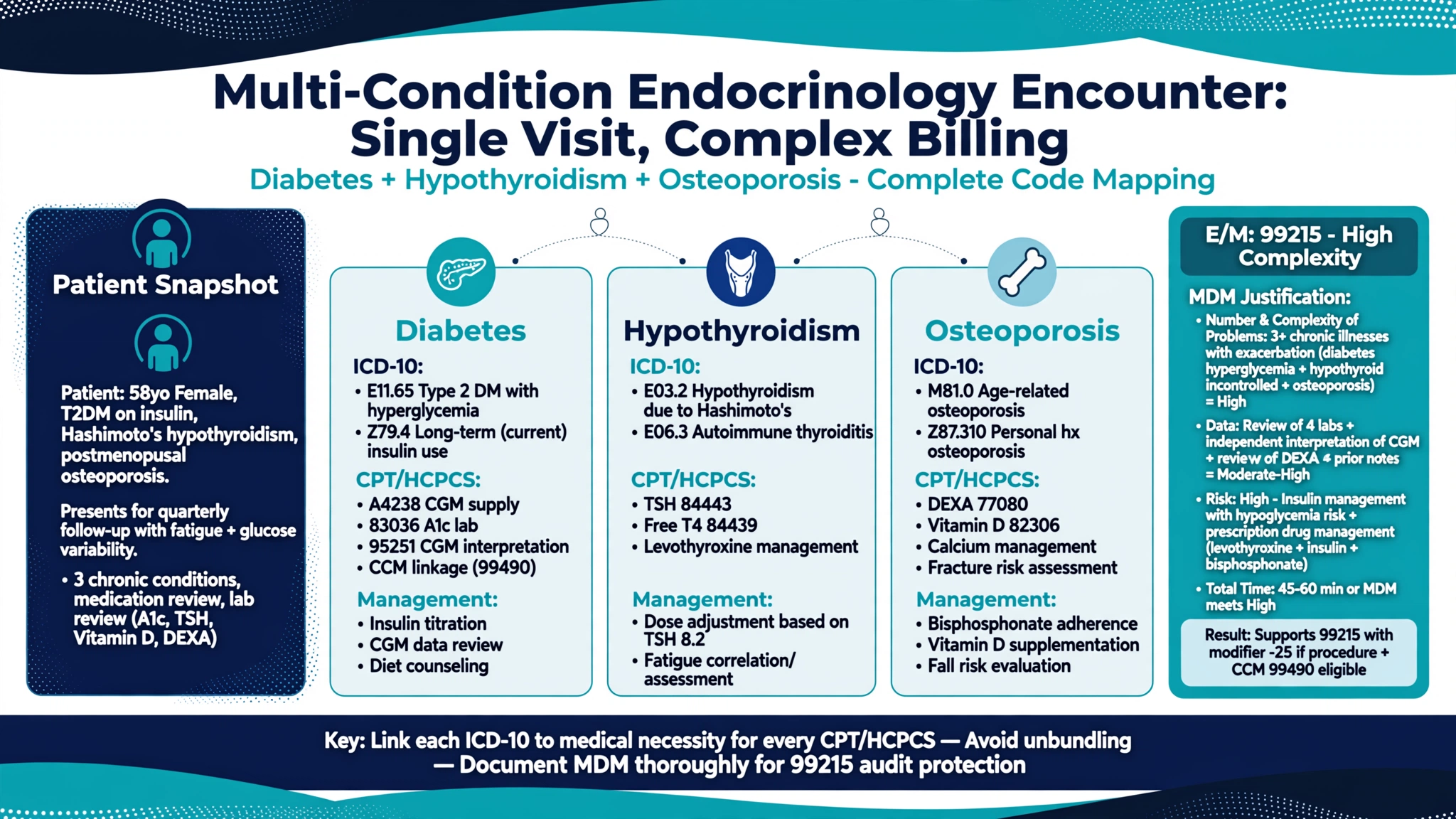
Endocrinology’s core clinical value is managing multiple hormone-related conditions simultaneously. Its core billing challenge is the same thing. Coding a visit where a physician manages diabetes, hypothyroidism, and osteoporosis simultaneously, with separate clinical decisions for each requires perfect documentation of each condition and its management, plus accurate linking of each service to the right diagnosis codes.
Prior authorization for CGM devices and insulin pumps is required by most commercial payers and has specific clinical criteria that must be documented. Insurance criteria often require documented hypoglycemic episodes, HbA1c values above a specific threshold, or failure of conventional monitoring. Missing or incomplete PA documentation is the most common reason CGM claims are denied.
Using E11.9 (Type 2 diabetes without complications) when the patient actually has documented neuropathy, retinopathy, nephropathy, or other complications is one of the most common and costliest documentation-billing mismatches in endocrinology. The more specific diabetes complication codes are both more clinically accurate and more defensible on medical necessity review.
Most endocrinology practices already perform the activities that qualify for CCM and RPM billing, care plan coordination, CGM data review, lab result follow-up, medication management between visits. The challenge is not providing the services; it’s systematically capturing and billing for them. Many practices leave $100,000–$500,000 annually in CCM and RPM revenue unbilled from care they’re already delivering.
Diabetes self-management education billing requires different codes for Medicare (G0108, G0109) versus commercial payers (98960-98962), a physician referral, ADA program accreditation or equivalent, and documentation of individualized learning plans. Practices that don’t manage these distinctions carefully receive denials — and patients lose access to funded education services.
For infusion therapies, zoledronic acid, denosumab, and others, endocrinology practices that administer drugs in office must navigate buy-and-bill: purchasing the drug, storing it per requirements, billing the HCPCS code with accurate units, and managing the cost-plus-margin that makes in-office infusion financially viable. Inaccurate unit billing or miscoding the drug HCPCS creates both revenue problems and compliance exposure.
Common endocrinology revenue cycle management mistakes include inaccurate coding, incomplete documentation, missed prior authorizations, and billing errors for chronic care and diagnostic services. Addressing these issues helps reduce claim denials, improve reimbursement, and strengthen overall practice revenue.
Using E11.9 when diabetes complications are documented: The most common ICD-10 error in endocrinology; costs medical necessity defensibility and undercodes clinical complexity.
Not coding Z79.4 or Z79.84 as secondary codes: Long-term insulin and oral hypoglycemic drug use must be coded as secondary diagnoses; missing these secondary codes triggers medical necessity alerts on payer audits.
Undercoding E/M from 99214 to 99213 habitually: The most financially costly systematic error in endocrinology; costs $200,000-300,000 per physician annually for a busy practice.
Not billing CCM for qualifying patients: Leaving $100,000-500,000 annually in legitimate recurring revenue unbilled for care already being delivered.
Billing 99091 and 99457 in the same month for the same patient: RPM billing overlap restriction; creates compliance exposure and denial.
Using G0108 for commercial payers instead of 98960: Medicare-specific codes used on commercial claims trigger automatic denials.
Missing modifier 26 when interpreting thyroid ultrasound from a hospital-owned machine: Billing the global code when only the professional component was provided by the endocrinologist.
Submitting CGM claims without PA number or clinical documentation: Automatic denial; PA number must appear on the claim and documentation must be submitted with appeal when denied.
Not coding all conditions managed in the visit: Only coding the primary condition when secondary conditions were also actively managed undercodes the visit and misses supporting diagnosis codes for separately billed services.
Incorrect HCPCS drug units for infusion drugs: Bisphosphonate and biologic HCPCS codes are billed in specific unit increments; billing the wrong number of units creates both under-billing and compliance exposure.
Current CMS and Medicare endocrinology billing guidelines require accurate documentation, proper CPT and ICD-10-CM coding, medical necessity, and compliance with coverage policies for endocrine services. Following these requirements helps reduce claim denials, improve reimbursement accuracy, and maintain regulatory compliance.
| Endocrinology Service | CMS/Medicare Coverage Rule (2026) |
|---|---|
| E/M visits (99202–99215) | Covered; 2021 AMA E/M guidelines apply (MDM or time-based); documentation must support level billed |
| DSMES (G0108/G0109) | Covered; requires physician referral; ADA-recognized or accredited program; 10 initial hours + 2 annual follow-up hours |
| CCM (99490–99491, 99439) | Covered; 2+ chronic conditions; comprehensive care plan; patient consent; monthly non-face-to-face coordination |
| RPM (99453, 99454, 99457–99458) | Covered; 16+ days of data per month for 99454; interactive communication required for 99457 |
| CGM devices (A9278, K0553) | Covered under DME Part B for patients meeting criteria; prescription and documentation of medical necessity required |
| Insulin pumps (E0787) | Covered under DME Part B for insulin-dependent diabetes meeting criteria; PA and documentation required |
| DXA scan (77080) | Covered for osteoporosis screening; frequency limits apply (typically every 24 months for Medicare) |
| Thyroid ultrasound (76536) | Covered with documented clinical indication; modifier 26 for interpretation only |
| FNA biopsy with ultrasound (10005–10006) | Covered with clinical indication for thyroid nodule evaluation |
| Bisphosphonate infusion (96365 + J3489) | Covered; requires documented osteoporosis diagnosis; verify frequency limits |
| Denosumab (J0897) | Covered for osteoporosis; PA may be required by Medicare Advantage plans |
| GLP-1 agents | Medicare Part D (not Part B) for most GLP-1 agents used for diabetes; Part B coverage for obesity-specific approval is payer-specific |
Common endocrinology revenue cycle management mistakes include inaccurate coding for your patients, incomplete documentation of patients, missed prior authorizations, and billing errors for chronic care and diagnostic services. Addressing these issues helps reduce claim denials, improve reimbursement, and strengthen overall practice revenue.
| Metric | Industry Data | Source |
|---|---|---|
| Americans with diabetes | 38.4 million (11.6% of US population) | CDC Diabetes Statistics 2024 |
| Americans with prediabetes | 96+ million | CDC |
| Annual cost of diagnosed diabetes in the US | $413 billion (direct medical + indirect) | ADA Economic Impact Study |
| Complex coding — % of total denials in endocrinology | 42% | Project data / industry benchmarks |
| Insurance eligibility issues — % of denials | 28% | Project data |
| Medical necessity denials — % | 19% | Project data |
| Patient collection challenges — % | 15% | Project data |
| Pre-authorization failures — % | 11% | Project data |
| Target clean claim rate | ≥95% | AAPC Best Practices |
| Estimated underbilled CCM revenue per practice | $100,000–$500,000+/year | Endocrinology billing analysis |
| E/M undercoding revenue loss per physician (99213 vs. 99214) | $200,000–$300,000+/year | Endocrinology coding analysis |
| Cost of a reworked denied claim | $25–$118 per claim | CAQH Research |
Tracking key performance metrics of your practice enables you to measure revenue cycle efficiency and identify opportunities for financial improvement. Monitoring KPIs such as clean claim rate, denial rate, days in accounts receivable, first-pass claim acceptance, and net collection rate supports stronger reimbursement and long-term practice growth.
| KPI | What It Measures | Target for Endocrinology Practices |
|---|---|---|
| Clean Claim Rate | % of claims accepted on first submission | ≥95% |
| Denial Rate | % of submitted claims denied | <8% |
| E/M Level Distribution | % breakdown of 99212–99215 for established patients | Should show majority 99214–99215 for multi-condition endocrinology practice |
| CGM PA Approval Rate | % of CGM prior auth requests approved first submission | ≥85% |
| CCM Patient Enrollment Rate | % of qualifying patients enrolled in CCM billing | Target 70%+ of qualifying patient panel |
| Days in Accounts Receivable | Average time from service to payment | <35 days |
| Net Collection Rate | % of collectible revenue actually collected | ≥96% |
| ICD-10 Specificity Rate | % of diabetes claims with specific (non-E11.9) codes | ≥90% — with E11.9 used only when truly no complications |
| RPM 16-Day Compliance Rate | % of 99454 claims where patient had 16+ days of data | ≥98% — submit only compliant months |
| DSMES Referral Completion Rate | % of eligible patients referred and enrolled in DSMES | Track as access and billing metric |
| AR Aging > 90 Days | % of total AR outstanding over 90 days | <15% |
| Patient Collection Rate at Time of Service | % of patient responsibility collected at visit | ≥80% |
A proactive denial management strategy helps you recover revenue and prevent recurring claim issues. Regular denial analysis by your team, accurate coding, complete documentation, timely appeals, and effective prior authorization management can significantly improve reimbursement and reduce payment delays.
| Denial Category | Root Cause in Endocrinology | Prevention Strategy |
|---|---|---|
| CGM prior authorization | Insufficient clinical documentation; criteria not met as submitted | CGM-specific PA checklist with ADA criteria; include HbA1c, hypoglycemia history, physician attestation |
| Medical necessity — multi-condition visit | Documentation supports only one condition; others not clearly managed | Multi-condition documentation template; require each condition to have documented assessment and plan |
| ICD-10 non-specificity | E11.9 when complications documented; incomplete diabetes coding | Quarterly ICD-10 audit; coders trained on diabetes manifestation codes |
| CCM billing issues | Monthly time not documented; consent missing; care plan not on file | CCM management software; monthly compliance checklist; consent at first CCM enrollment |
| RPM overlap (99091 + 99457) | Both billed same month for same patient | RPM billing rules built into billing system; pre-submission overlap check |
| DSMES referral missing | G0108/G0109 submitted without physician referral | DSMES order workflow requiring signed referral before billing |
| Infusion drug HCPCS error | Wrong J-code or wrong unit count for bisphosphonate/biologic | Current HCPCS reference updated quarterly; unit calculation verified per drug |
| Missing Z79.4/Z79.84 | Secondary insulin/oral agent codes absent | Charge entry system auto-prompt for Z79 codes when E11/E10 codes present |
| Imaging modifier 26 missing | Global code billed when only interpretation performed | Ownership determination at practice level; modifier protocol for all imaging interpretations |
| GLP-1 prior authorization | Step therapy not documented; medical necessity criteria not met | GLP-1 PA template with step therapy documentation; ADA/AACE guidelines cited in appeal |
The False Claims Act applies to endocrinology billing. Common compliance risks include, billing CCM without documented time and required elements (care plan, consent, coordination services), billing RPM codes without the required number of patient-days of data, billing CGM supply codes without a valid prescription and documented medical necessity, and upcoding E/M levels without supporting MDM documentation. Civil penalties up to $27,018 per claim plus treble damages apply.
The OIG Work Plan monitors CCM and RPM billing as audit targets, given rapid growth in these code categories since CMS introduced them. Practices should ensure CCM billing is supported by monthly time documentation, comprehensive care plans, and documented patient consent. RPM billing requires actual device data meeting the 16-day threshold.
CGM data transmitted remotely and patient health information used for CCM and RPM billing must be handled in compliance with HIPAA Privacy and Security Rules. CGM monitoring platforms and care coordination tools must be HIPAA-compliant and covered by Business Associate Agreements.
Choosing between in-house and outsourced endocrinology revenue cycle management depends on your practice’s staffing, expertise, and financial goals. While in-house teams provide direct control, outsourced specialists often improve billing accuracy, reduce denials, and optimize reimbursement through specialty-focused RCM expertise.
| Factor | In-House Endocrinology Billing | Outsourced Endocrinology Revenue Cycle Management Services |
|---|---|---|
| Multi-condition coding expertise | General billing staff rarely trained in simultaneous multi-condition endocrinology coding | Certified endocrinology billing specialists with diabetes, thyroid, and metabolic disease expertise |
| ICD-10 specificity (diabetes codes) | E11.9 over-reliance common without specialty training | Diabetes specificity protocol; Z79.4/Z79.84 compliance built into coding workflow |
| CCM billing implementation | Often never implemented due to workflow complexity | Turnkey CCM billing workflow; patient enrollment tracking; monthly billing compliance |
| RPM/CGM data billing | Frequently underbilled or overbilled due to overlap rules | RPM billing protocol with 16-day compliance check and overlap restriction enforcement |
| DSMES payer-specific coding | Medicare vs. commercial code confusion common | Payer-specific DSMES code mapping maintained and updated |
| CGM prior authorization | High denial rate without specialty PA protocol | CGM-specific PA checklist; ADA criteria documentation; structured appeal workflow |
| Buy-and-bill drug management | Complex without specialty training; unit errors common | HCPCS drug code accuracy protocol; unit calculation verification per drug per claim |
| Denial management | ~65% of denials never worked | Systematic denial resolution within 72 hours; ADA/AACE guideline-based appeals |
| Revenue from CCM/RPM | Often $0 despite qualifying patient panel | $100,000–$500,000+ annual recovery for practices with qualifying patients |
| Best for | Large academic endocrinology programs with dedicated specialty billing staff | Most endocrinology practices and diabetes care centers of all sizes |
At House of Outsourcing, we understand that endocrinology billing is not general medical billing. It requires expertise in multi-condition ICD-10 coding, CGM and insulin pump prior authorization, CCM and RPM billing compliance, DSMES payer-specific code management, and the buy-and-bill drug administration revenue model. Our endocrinology revenue cycle management services are built specifically around how endocrinology practices actually operate.
Certified Endocrinology Billing Specialists: AAPC-credentialed coders with specific expertise in diabetes, thyroid, osteoporosis, and metabolic disease billing, including the full ICD-10 diabetes complication code library and endocrine HCPCS drug codes.
Multi-Condition Coding Protocol: Every endocrinology encounter goes through a multi-condition documentation review, by verifying that all conditions managed are coded, all complications are captured at the appropriate ICD-10 specificity, and the E/M level reflects the full clinical complexity of the visit.
ICD-10 Diabetes Specificity Compliance: Our coding team enforces diabetes complication code specificity on every claim, eliminating E11.9 under-coding and ensuring Z79.4/Z79.84 secondary codes are applied consistently.
CCM Billing Implementation: We implement and manage end-to-end CCM billing for your qualifying patient panel, from initial patient enrollment and care plan documentation through monthly time tracking and claim submission.
RPM and CGM Data Billing: Our RPM billing protocol verifies 16-day data compliance for 99454, manages the 99091/99457 overlap restriction, and maximizes legitimate remote monitoring revenue for your CGM patient population.
CGM Prior Authorization Management: Dedicated PA specialists handle CGM and insulin pump authorizations with ADA-criteria documentation, tracking PA approvals and renewals and filing structured appeals for every denied CGM claim.
DSMES Payer-Specific Code Mapping: We maintain current payer-specific DSMES code protocols — Medicare G-codes for Medicare patients, 98960-98962 for commercial patients, eliminating one of the most common DSMES denial causes.
Buy-and-Bill Drug Management: Our HCPCS drug billing protocol verifies current J-codes, calculates correct units per administration, and manages the bisphosphonate and biologic infusion billing that generates significant revenue for in-office infusion programs.
Dedicated Endocrinology Account Manager: One experienced specialist who knows your practice, your patient population, and your payer mix — accountable to your financial results every month.
Referring to trusted industry resources helps you stay updated on Medicare policies, coding changes, documentation standards, and payer requirements. The following authoritative references support accurate billing, regulatory compliance, and more effective revenue cycle management.
| Resource | What It Covers | Link |
|---|---|---|
| CMS Physician Fee Schedule | Endocrinology CPT reimbursement rates and relative value units (RVUs) | cms.gov/medicare/physician-fee-schedule/search |
| CMS DSMES Coverage | Diabetes self-management education coverage guidance, accredited program parameters, and initial vs. follow-up hours | cdc.gov/diabetes-toolkit/php/dsmes-support/medicare-reimbursement-guidelines.html |
| CMS CCM Billing Guidance | Chronic Care Management billing requirements, time tracking rules, and practitioner eligibility (MLN909188) | cms.gov/outreach-and-education/medicare-learning-network-mln/mlnproducts/mln-publications-items/icn909188 |
| CMS DME MAC Resources | CGM and insulin pump Medicare Part B DME coverage criteria, receiver durability mandates, and supply allowances | medicare.gov/coverage/continuous-glucose-monitors |
| ADA Standards of Medical Care | Authoritative clinical diabetes algorithms and diagnostic thresholds required for medical necessity appeals | diabetesjournals.org |
| AACE Clinical Practice Guidelines | Endocrinology clinical recommendations and diagnostic algorithms supporting complex disease protocols | pro.aace.com |
| OIG Work Plan | CCM, RPM, and advanced telehealth technology enforcement priorities and compliance auditing targets | oig.hhs.gov/reports-and-publications/workplan |
| CDC Diabetes Statistics | US diabetes prevalence, prediabetes updates, and target population health metrics | cdc.gov/diabetes/data |
| AMA CPT Code Resources | Official CPT code definitions, nonphysician QHP terminology updates, and quarterly modifiers | ama-assn.org/practice-management/cpt |
| AAPC Endocrinology Coding | Specialty endocrinology coding educational guidelines and professional training portals | aapc.com |
| MGMA DataDive | Endocrinology practice management benchmarking, days in AR, and operational expense metrics | mgma.com/data |
| HHS HIPAA Resources | Privacy and security compliance rules governing remote physiologic and therapeutic monitoring data | hhs.gov/hipaa |
Endocrinology revenue cycle management is the complete financial process of managing patient billing, multi-condition CPT and ICD-10 coding, CGM and insulin pump prior authorization, Chronic Care Management (CCM) billing, Diabetes Self-Management Education (DSMES) billing, Remote Patient Monitoring (RPM) billing, infusion drug HCPCS coding, insurance eligibility verification, claim submission, denial management, and payment collection for endocrinology practices.
Core endocrinology CPT codes include: E/M visit codes 99212-99215 (established patients) and 99202-99205 (new patients), Chronic Care Management 99490/99439/99491, Remote Patient Monitoring 99453/99454/99457/99458, CGM data interpretation 99091, DSMES Medicare G0108/G0109 and commercial 98960-98962, thyroid ultrasound 76536, FNA biopsy 10005/10006, DXA bone density 77080/77085, and infusion codes 96365-96366 for bisphosphonates and biologics.
The most important diabetes coding principle is specificity, use the most specific code supported by your documentation. E10 codes for Type 1 diabetes, E11 codes for Type 2 diabetes, E13 for other specified types. Always specify whether complications are present and code them separately: neuropathy (E11.40 series), nephropathy (E11.65 + N18.x), retinopathy (E11.311 series). Code Z79.4 (long-term insulin use) as a secondary diagnosis for Type 2 patients on insulin. Avoid E11.9 (Type 2 diabetes without complications) when the chart documents complications.
CCM billing requires: at least two chronic conditions expected to last 12 or more months, a comprehensive written care plan, patient consent, 20 or more minutes of non-face-to-face care coordination services per month by clinical staff, and 24/7 patient access to care. The primary CCM code 99490 generates approximately $40-60 per patient per month in Medicare reimbursement. Nearly all diabetes patients managed by an endocrinologist qualify for CCM — making it a significant recurring revenue stream for practices that implement the required documentation infrastructure.
Prior authorization for CGM devices is required by most commercial payers and has specific clinical criteria. Typically required, documented Type 1 or Type 2 diabetes diagnosis, documented insulin use (usually multiple daily injections or insulin pump therapy), HbA1c above a plan-specific threshold, documented history of hypoglycemia, and physician attestation of medical necessity. Medicare Part B covers CGM under DME for insulin-treated patients; Medicare Advantage plans may have additional requirements. Always verify individual plan criteria before prescribing a specific CGM device.
Get a free assessment from our billing experts