
Following the latest Medicare requirements helps your practice receive faster payments, reduce rework, and strengthen financial performance.

In 2026, Medicare is using more advanced claim validation systems, which means even minor billing errors are instantly flagged by the Medicare billing system. When your practice claim is denied, it doesn’t just delay your payment, it increases administrative costs and reduces overall revenue efficiency.
More importantly, repeated inaccuracies can trigger audits for your medical practice. Medicare and oversight bodies are increasingly focused on billing patterns, especially for non-physician practitioners. Improper billing, especially around incident-to services can lead to repayment demands or penalties.
Medicare claims are highly sensitive to coding accuracy. A missing modifier or incorrect CPT code can push a claim into rejection or manual review, slowing payments significantly.
What makes this worse is the compounding effect. When errors become routine, they create a backlog of unpaid claims, increasing accounts receivable (AR) days and reducing cash flow predictability.
Need support with your billing workflow? Explore our medical billing and revenue cycle services or request a free consultation.
Medicare requires that every billed service be fully supported by documentation. If your notes don’t clearly justify the service, Medicare can deny or downcode the claim, even if the service was legitimately performed.
In 2026, documentation expectations are stricter, especially for services involving shared care or supervision. For example, incident-to billing requires clear evidence that the physician initiated and remained involved in the care plan .
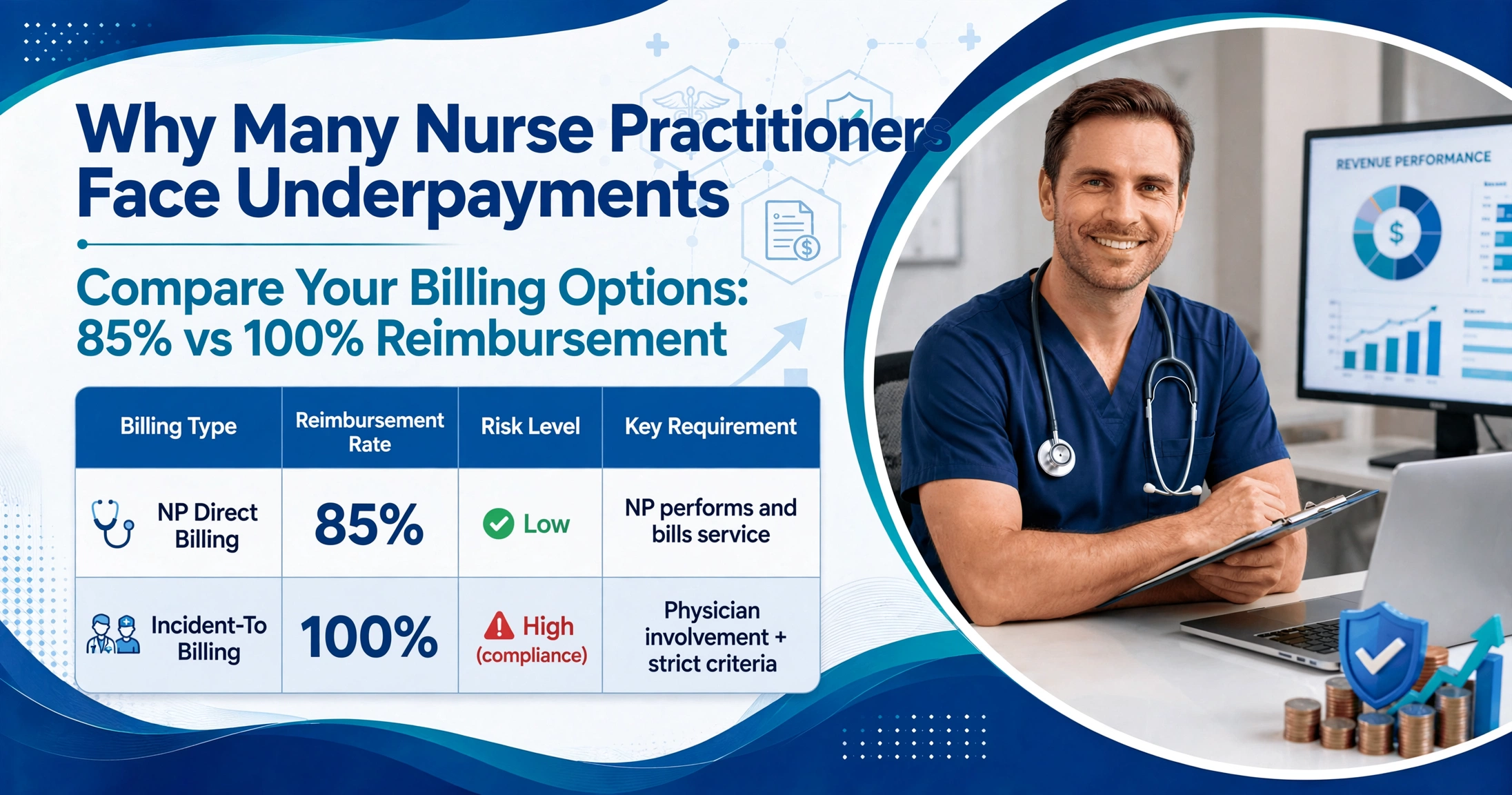
According to our two decades billing experience, one of the most overlooked issues in NP billing is underpayment. By default, Medicare reimburses nurse practitioners at 85% of the physician fee schedule when billing under their own NPI .
However, when billed correctly under incident-to, reimbursement can reach 100% of the physician rate, but only if all requirements are met.
| Billing Type | Reimbursement Rate | Risk Level | Key Requirement |
|---|---|---|---|
| NP Direct Billing | ~85% | Low | NP performs and bills service |
| Incident-To Billing | 100% | High (compliance) | Physician involvement + strict criteria |
Incident-to-billing is often misunderstood. While it offers higher reimbursement, it comes with strict rules:
If any condition is missed, the claim becomes non-compliant—even if paid initially.
Solution: Use a decision framework:
| Scenario | Bill Type |
|---|---|
| New patient or new problem | NP billing |
| Follow-up under physician plan | Incident-to |
| Physician not available | NP billing |
This reduces both compliance risk and denial rates.
Medicare billing is becoming more complex due to:
For example, 2026 updates allow more flexibility in supervision (including virtual presence in some cases), but this also adds confusion about when rules apply .
Solution: You need to stay proactive, not reactive. Subscribe to CMS updates, attend billing training, and ensure your billing team tracks regulatory changes continuously.
Modifiers are critical in Medicare billing, yet they are one of the most common sources of revenue leakage. Missing a modifier doesn’t always cause denial, it often results in reduced payment without warning, this makes it a silent loss problem for your practice.
Solution:
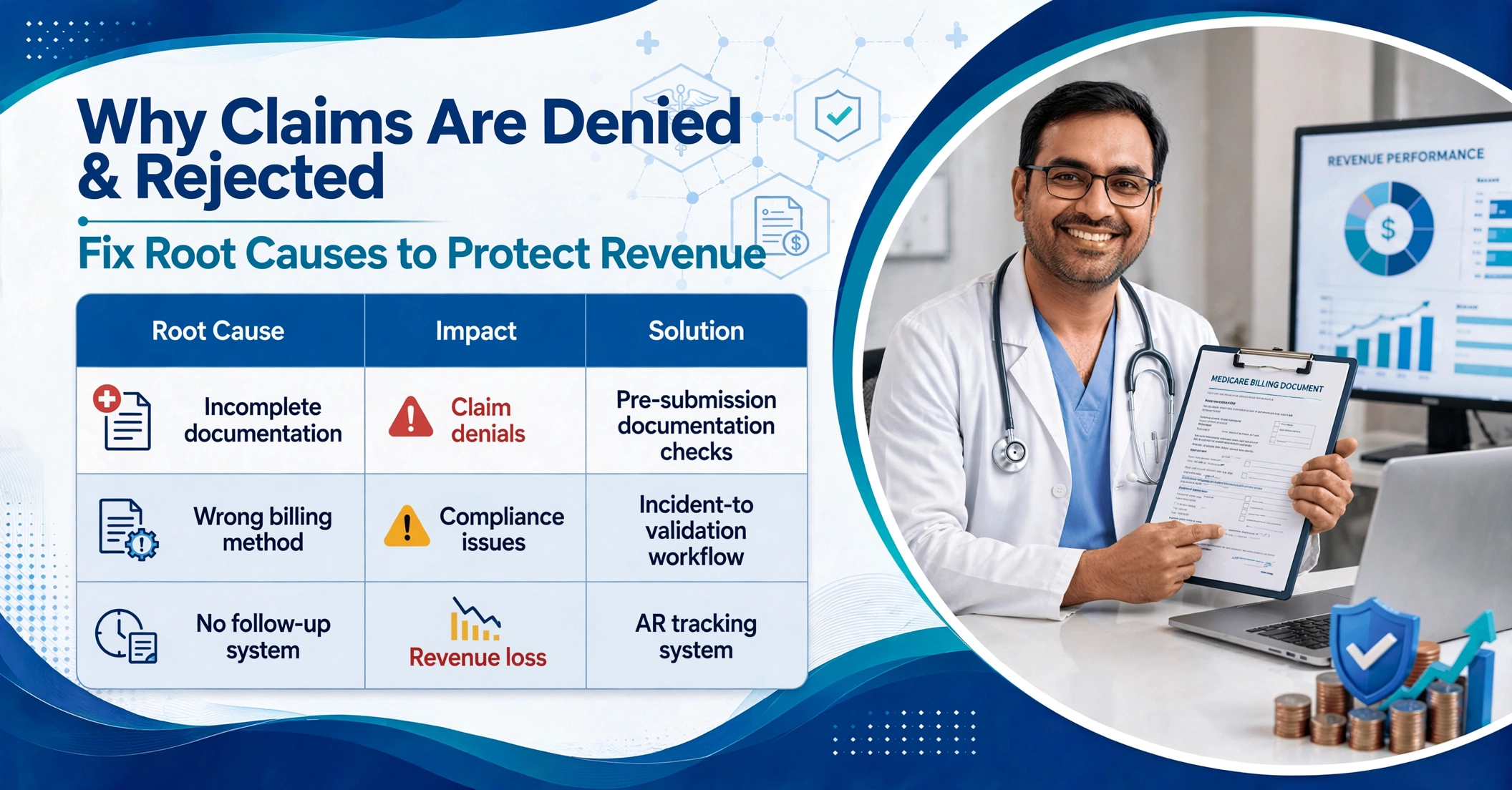
Denials are rising because Medicare is focusing more on accuracy, documentation, and compliance patterns. Many practices still rely on outdated workflows, which increases error rates, here’s a clearer breakdown:
| Root Cause | Impact | Solution |
|---|---|---|
| Incomplete documentation | Claim denials | Pre-submission documentation checks |
| Wrong billing method | Compliance issues | Incident-to validation workflow |
| No follow-up system | Revenue loss | AR tracking system |
A slow or outdated billing system directly impacts how quickly you get paid. Delays in claim submission, lack of automation, and manual errors all increase turnaround time.
Solution: Invest in systems that offer:
Managing billing in-house is becoming harder due to:
Outsourcing provides access to specialists who already understand complex billing rules, including incident-to and compliance requirements, by outsourcing you can:
As an experienced nurse practitioner you know that without expertise, billing errors become repetitive, and dangerous. Medicare tracks patterns, not just individual claims. Repeated mistakes can signal non-compliance, so you need to build a system, not just a team.
In 2026, waiting for problems is a costly strategy. Proactive audits help identify:
They also ensure compliance with Medicare’s strict documentation and supervision rules, so you need to conduct quarterly audits and benchmark:
By handling billing, payment follow-up, and payer communication, we reduce administrative pressure so your providers can spend more time with patients.
Get a free assessment from our billing experts