
Our dermatology medical billing services are designed to simplify complex billing challenges, improve claim accuracy, and protect your practice revenue. From evaluation and management visits to surgical procedures and specialty treatments, we ensure every service is properly coded, submitted, and optimized for timely reimbursement.

Dermatology is one of the busiest and most complex medical specialties in the US. A single day may include skin biopsies, lesion removals, biologic injections, and cosmetic procedures. Each service has its own CPT code, documentation requirements, modifiers, and insurance billing rules, making accurate coding and billing essential.
Even small billing mistakes can lead to claim denials, delayed payments, and lost revenue. Over time, these issues can reduce the profitability of even the busiest dermatology practices.
According to the American Academy of Dermatology (AAD), skin conditions affect more than 85 million Americans, making dermatology one of the most in-demand specialties in the country. That patient volume is an opportunity, but only if your dermatology medical billing services are running clean, compliant, and optimized.
Need support with your billing workflow? Explore our medical billing and revenue cycle services or request a free consultation.
Dermatology medical billing is the end-to-end process of translating your dermatology patient encounters and procedures into accurate insurance claims, submitting those claims to payers of USA, and collecting appropriate reimbursement for your services while maintaining full compliance with CMS regulations, payer-specific policies, and documentation standards.
What sets dermatology medical billing apart from general medical billing is the sheer variety of service types a single practice handles daily:
Each category has its own coding logic, documentation requirements, and payer rules. And the line between what’s medically covered and what’s cosmetic, and therefore patient-pay runs right through the middle of most dermatology practices.
According to CMS, dermatology is consistently among the top specialties reviewed for billing compliance, particularly around lesion destruction codes, biopsy upcoding, and the inappropriate use of modifier -25.
Before diving into specific codes and rules, it’s worth understanding why dermatology medical billing is harder than it looks, because that context shapes everything else.
A single dermatology appointment in your practice might involve an E/M service, a biopsy of one lesion, destruction of three actinic keratoses, and shave removal of a sebaceous cyst. As a dermatologist you know that every procedure needs its own code, and their interactions through NCCI bundling edits must be managed carefully.
Many dermatology procedures sit on the border between medically necessary and cosmetic. The same laser treatment might be medically billable for one diagnosis and purely cosmetic for another.
The AMA updates CPT codes annually. You are an experienced dermatologist and you know that dermatology has seen significant code changes in recent years, particularly the 2023 restructuring of skin biopsy codes. Practices using outdated codes are leaving money on the table or triggering denials.
Dermatology is one of the specialties most scrutinized for modifier -25 overuse. Payers closely track practices that append modifier -25 to every E/M service performed alongside a procedure, looking for patterns of abuse.
Because cosmetic procedures are self-pay and medically necessary procedures are insurance-covered, there’s ongoing payer scrutiny to ensure dermatology practices aren’t misclassifying cosmetic services as medical ones to capture insurance reimbursement.
Let’s get specific. Here are the core CPT code categories your dermatology medical billing team works with every single day.
| CPT Code | Description | Setting |
|---|---|---|
| 99202–99205 | New patient office visit | Office/outpatient |
| 99211–99215 | Established patient office visit | Office/outpatient |
| 99221–99223 | Initial hospital care | Inpatient |
| 99231–99233 | Subsequent hospital care | Inpatient |
| 99242–99245 | Office consultation (where payer allows) | Office |
E/M codes in dermatology are driven by Medical Decision Making (MDM) or total time since the 2021 AMA revisions. Documentation must clearly support the level selected, especially when modifier -25 is used alongside a procedure code.
| CPT Code | Description |
|---|---|
| 96900 | Actinotherapy (ultraviolet light) |
| 96910 | Photochemotherapy — tar and UVB (Goeckerman) or petrolatum and UVB |
| 96912 | Photochemotherapy — psoralen and UVA (PUVA) |
| 96913 | Photochemotherapy — psoralen and UVA for large body surface area |
| 96920 | Laser treatment for inflammatory skin disease — small area (<250 cm²) |
| 96921 | Laser treatment — medium area (250–500 cm²) |
| 96922 | Laser treatment — large area (>500 cm²) |
Skin biopsy billing was completely restructured in 2019, and many dermatology practices are still making errors based on the old code set. If your billing team is still using CPT 11100 and 11101, it’s time for a serious update.
| CPT Code | Technique | Description |
|---|---|---|
| 11102 | Tangential | Biopsy first lesion (shave, scoop, curette technique) |
| 11103 | Tangential | Each additional lesion (add-on) |
| 11104 | Punch | First lesion |
| 11105 | Punch | Each additional lesion (add-on) |
| 11106 | Incisional | First lesion |
| 11107 | Incisional | Each additional lesion (add-on) |
The Critical Difference: Unlike the old 11100/11101 system, the new biopsy codes are technique-specific. You must select the code that matches the actual biopsy technique documented in the clinical note, not just the most convenient or highest-reimbursing option.
💡 Tip #1: Document the Biopsy Technique Explicitly. Physicians must write in their procedure note whether the biopsy was performed by tangential (shave/curette), punch, or incisional technique. Without that specific language, your coder has no defensible basis for the code selected, and your claim is vulnerable in audit. Make technique documentation a mandatory field in your EHR biopsy template.
| Clinical Scenario | Correct Coding |
|---|---|
| Punch biopsy of 1 lesion | 11104 |
| Punch biopsy of 3 lesions | 11104 + 11105 x2 |
| Shave biopsy of 1 lesion | 11102 |
| Incisional biopsy of 1 lesion + shave biopsy of 2nd | 11106 + 11103 |
| E/M visit with significant separate evaluation + punch biopsy | E/M (99213 with modifier 25) + 11104 |
Excision coding in dermatology is driven by two variables, the nature of the lesion (benign vs. malignant) and the size of the excision (measured as the lesion diameter plus the narrowest margin, in centimeters). Getting either variable wrong changes the CPT code, and the reimbursement.
| CPT Code | Body Location | Excised Diameter |
|---|---|---|
| 11400 | Trunk, arms, legs | 0.5 cm or less |
| 11401 | Trunk, arms, legs | 0.6–1.0 cm |
| 11402 | Trunk, arms, legs | 1.1–2.0 cm |
| 11403 | Trunk, arms, legs | 2.1–3.0 cm |
| 11404 | Trunk, arms, legs | 3.1–4.0 cm |
| 11406 | Trunk, arms, legs | Over 4.0 cm |
| 11420–11426 | Scalp, neck, hands, feet, genitalia | Same size gradations |
| 11440–11446 | Face, ears, eyelids, nose, lips | Same size gradations |
| CPT Code | Body Location | Excised Diameter |
|---|---|---|
| 11600 | Trunk, arms, legs | 0.5 cm or less |
| 11601 | Trunk, arms, legs | 0.6–1.0 cm |
| 11602 | Trunk, arms, legs | 1.1–2.0 cm |
| 11603 | Trunk, arms, legs | 2.1–3.0 cm |
| 11604 | Trunk, arms, legs | 3.1–4.0 cm |
| 11606 | Trunk, arms, legs | Over 4.0 cm |
| 11620–11626 | Scalp, neck, hands, feet, genitalia | Same size gradations |
| 11640–11646 | Face, ears, eyelids, nose, lips | Same size gradations |
The Measurement Rule: The excised diameter is the measurement of the lesion itself plus the narrowest surgical margin required for clinical clearance. This must be documented in the operative note — not just the lesion size, but the entire excised specimen diameter including margins.
💡 Tip #2: Always Document the Full Excision Diameter, Not Just the Lesion Size. A dermatologist who removes a 0.8 cm lesion with 0.3 cm margins on all sides has an excision diameter of 1.4 cm — which codes at 11401 (0.6–1.0 cm) if only the lesion is documented, but correctly at 11402 (1.1–2.0 cm) when margins are included. That’s one code difference per excision, multiplied across hundreds of excisions a year, equals significant undercoding.
Destruction billing in dermatology medical billing services covers cryotherapy, electrodesiccation, laser ablation, and other methods. The key variables here are: the type of lesion (premalignant, benign, warts, condyloma, or malignant) and the number of lesions destroyed.
| CPT Code | Description |
|---|---|
| 17000 | Destruction of premalignant lesion — first lesion |
| 17003 | Each additional lesion, 2nd–14th (list separately for each) |
| 17004 | Destruction of 15 or more premalignant lesions |
Important: 17004 is a standalone code for 15 or more lesions, it replaces 17000 + multiple units of 17003 and is actually higher reimbursing than accumulating individual lesion codes. Do not bill 17000 + 17003 x14 when 17004 applies.
| CPT Code | Description |
|---|---|
| 17110 | Destruction of benign lesions other than skin tags or condylomata — up to 14 lesions |
| 17111 | Destruction of benign lesions — 15 or more lesions |
| CPT Code | Description |
|---|---|
| 17000 | Also used for warts when premalignant context applies |
| 17110 | Flat warts, molluscum, milia — benign lesion destruction |
| 54050–54065 | Destruction of penile lesions (including condyloma) |
| 56501–56515 | Destruction of vulvar lesions |
Mohs micrographic surgery is one of the most technically complex, and highest-reimbursing procedures in dermatology medical billing. It’s also one of the most audited, because payers know it’s a high-value service and they scrutinize the documentation carefully.
| CPT Code | Description |
|---|---|
| 17311 | Mohs micrographic surgery — first stage, up to 5 tissue blocks — head, neck, hands, feet, genitalia, face |
| 17312 | Mohs — each additional stage, up to 5 blocks (add-on) — same body areas |
| 17313 | Mohs — first stage, up to 5 blocks — trunk, arms, legs |
| 17314 | Mohs — each additional stage, up to 5 blocks — trunk, arms, legs (add-on) |
| 17315 | Mohs — each additional block, beyond 5 per stage (add-on) |
Mohs surgery is unique because the same physician acts simultaneously as surgeon, pathologist, and reconstructive surgeon. This means:
Each stage is billed separately. Each block beyond five per stage adds CPT 17315. And reconstruction, whether layered closure, flap, or graft is billed separately with the appropriate repair or plastic surgery code.
| Repair Type | CPT Code Range |
|---|---|
| Simple repair | 12001–12021 |
| Intermediate repair | 12031–12057 |
| Complex repair | 13100–13160 |
| Adjacent tissue transfer (flap) | 14000–14302 |
| Skin graft (split-thickness) | 15100–15121 |
| Skin graft (full-thickness) | 15200–15261 |
💡 Tip #3: Document Every Mohs Stage with a Map and Block Count. Medicare and commercial payers expect Mohs claims to be accompanied by a tissue map showing each stage, the orientation of the specimen, the number of blocks per stage, and the margin clearance status. A Mohs report without a clearly documented tissue map is one of the fastest audit triggers in dermatology medical billing services. Make the tissue map a non-negotiable part of every Mohs operative report.
Diagnosis codes are the medical necessity backbone of every dermatology claim. Without the right ICD-10 code, at the right specificity level, even a perfectly selected CPT code can be denied.
| ICD-10 Code | Condition | Billing Note |
|---|---|---|
| L57.0 | Actinic keratosis | Drives 17000/17003/17004 destruction codes |
| L70.0 | Acne vulgaris | Common E/M diagnosis |
| L70.1 | Acne conglobata | More severe acne subtype |
| L40.0 | Psoriasis vulgaris | Drives phototherapy and biologic codes |
| L40.1 | Generalized pustular psoriasis | Higher severity designation |
| L30.9 | Dermatitis, unspecified | Try to specify type when possible |
| L20.9 | Atopic dermatitis, unspecified | Drives biologic administration |
| L82.1 | Other seborrheic keratosis | Benign; not covered for destruction by most payers |
| C44.91 | Squamous cell carcinoma of skin, unspecified | Drives malignant excision codes |
| C44.01 | Basal cell carcinoma — skin of lip | Location-specific BCC; drives Mohs |
| C44.311 | Basal cell carcinoma — skin of nose | High-risk area for Mohs |
| C44.711 | BCC — skin of lower limb | Trunk/extremity Mohs |
| D04.9 | Carcinoma in situ of skin, unspecified | Pre-invasive melanoma analog |
| C43.9 | Malignant melanoma of skin, unspecified | Drives wide local excision |
| L73.2 | Hidradenitis suppurativa | Drives surgical and biologic billing |
| B07.0 | Plantar wart | Benign lesion destruction |
| B07.8 | Other viral warts | Common wart destruction |
| L84 | Corns and callosities | Foot-related skin conditions |
| L60.0 | Ingrowing nail | Drives nail procedure codes |
| L98.9 | Disorder of skin, unspecified | Use only when no specific code is available |
💡 Tip #4: Avoid Unspecified Skin Cancer Codes When a Site-Specific Code Exists. Skin cancer ICD-10 codes are anatomically specific, payers expect you to code to the exact site documented. Using C44.91 (unspecified site) when the clinical note says “left cheek” is a missed opportunity for specificity that can trigger a medical necessity review. Code to the site, it protects the claim and reflects the actual clinical documentation.
Beyond CPT codes, dermatology medical billing frequently uses HCPCS Level II codes for supplies, medications, and specific services not captured in the CPT system.
| HCPCS Code | Description | When Used |
|---|---|---|
| J0129 | Abatacept injection (per mg) | Biologic for severe psoriasis |
| J0222 | Ado-trastuzumab emtansine | Oncology adjunct |
| J0717 | Certolizumab injection (per mg) | Biologic for psoriasis/hidradenitis |
| J0881 | Darbepoetin alfa injection | Selected dermatology oncology use |
| J1745 | Infliximab injection (per 10 mg) | Biologic; psoriasis, hidradenitis |
| J3301 | Triamcinolone acetonide injection (per 10 mg) | Intralesional corticosteroid |
| J0882 | Dupilumab injection (Dupixent) | Atopic dermatitis biologic |
| A4550 | Surgical tray | When used for specific surgical procedures |
| G0127 | Trimming of dystrophic nails — any number | Medicare-specific nail service |
| G2012 | Brief communication technology-based service | Teledermatology virtual check-in |
| J7311 | Fluorouracil solution for injection | Topical agent in some treatment protocols |
It is our experience that modifiers are where dermatology medical billing services live or die. The wrong modifier, or a missing one can turn a clean claim into a denial, an audit trigger, or a compliance violation.
| Modifier | Name | Correct Use in Dermatology |
|---|---|---|
| 25 | Separate E/M Service | E/M service on the same day as a procedure that is significant and separately identifiable |
| 59 | Distinct Procedural Service | Separate procedure not normally reported with another — used to bypass NCCI edits |
| XS | Separate Structure | Preferred over 59 in many payer systems; procedure on different structure/site |
| XE | Separate Encounter | Same procedure performed at a different session same day |
| 51 | Multiple Procedures | Multiple procedures same visit; indicates appropriate fee reduction applies |
| 24 | Unrelated E/M During Post-op Period | E/M for unrelated condition during global/post-op period of a prior procedure |
| 58 | Staged or Related Procedure | Procedure planned prospectively at time of original procedure |
| 79 | Unrelated Procedure During Post-op | Unrelated procedure performed during post-op period |
| 76 | Repeat Procedure Same Physician | Same procedure repeated on same day |
| LT / RT | Left / Right Side | Laterality indicator — required for bilateral body sites |
| 22 | Increased Procedural Services | Substantial additional work beyond what code normally describes (requires documentation) |
| 52 | Reduced Services | Service partially performed |
| GY | Statutory Exclusion | Item not covered by Medicare (cosmetic services billed for transparency) |
According to our experience modifier -25 is the most used and most abused modifier in dermatology medical billing. Here’s the correct standard:
💡 Tip #5: Build a Modifier -25 Audit Trigger Into Your Monthly Review. Pull every claim where modifier -25 was billed alongside a procedure code and review a sample of supporting documentation. You can ask does the E/M note contain a clinical decision-making rationale that is truly separate from the procedure? If the same few sentences appear repeatedly across different patients, you have a documentation and compliance problem. Fix it before a payer audit does it for you.
This is the biggest gray zone in all of dermatology medical billing, and navigating it incorrectly in either direction has real consequences.
| Service Type | Insurance Billed? | Patient Billed? | Documentation Required |
|---|---|---|---|
| Medically necessary procedure | Yes | For cost-share only | Clinical indication, medical necessity |
| Cosmetic procedure | No | Full amount | ABN for Medicare; clear patient financial policy |
| Procedure that could be either | Depends on indication | Balance after insurance (if covered) | Distinguish indication clearly in documentation |
| Procedure | Medical Indication (Covered) | Cosmetic (Not Covered) |
|---|---|---|
| Chemical peel | Actinic keratosis, photodamage | Anti-aging, cosmetic improvement |
| Laser resurfacing | Acne scars, post-surgical scars | Cosmetic skin rejuvenation |
| Botox injection | Hyperhidrosis (CPT 64650/64653) | Cosmetic facial lines |
| Dermabrasion | Scar revision, keratosis | Cosmetic skin smoothing |
| Excision of skin lesion | Malignant or symptomatic lesion | "I don't like the look of it" |
| Cryotherapy | Actinic keratosis, verified warts | Cosmetic seborrheic keratoses |
Medicare is a dominant payer in dermatology given the age-related prevalence of skin cancer, actinic keratoses, and chronic skin conditions in the 65+ population. Getting Medicare rules right is non-negotiable.
Per CMS Medicare guidelines, Medicare Part B covers dermatology services that are medically necessary, including:
Medicare does not cover routine preventive skin examinations. A full-body skin check is only reimbursable under Medicare when performed in the context of a medically necessary evaluation of a documented skin condition or high-risk diagnosis (e.g., personal history of melanoma, atopic dermatitis management, etc.).
Medicaid coverage for dermatology services varies significantly by state. Generally:
Our decades of medical billing experience shows that clean dermatology medical billing starts with clean documentation. Your practice every claim rests on the clinical note, and when that note has gaps, errors, or vague language, the billing team has no solid ground to stand on.
| Documentation Element | Required | Notes |
|---|---|---|
| Lesion description | Yes | Location, size, morphology, clinical appearance |
| Pre-procedure diagnosis | Yes | Must support the ICD-10 code selected |
| Procedure performed | Yes | Match to CPT code exactly |
| Technique used | Yes | Especially critical for biopsies (tangential/punch/incisional) |
| Lesion/excision measurement | Yes | Full diameter including margins for excisions |
| Anatomical location | Yes | Body site drives code selection and reimbursement |
| Number of lesions treated | Yes | Determines add-on codes for biopsy and destruction |
| Pathology submission | When applicable | Required for biopsies — note specimen sent |
| Physician attestation | Yes | Signature/authentication of the procedure note |
According to our past experience we want to share with you that when payers audit your dermatology practice claims, they’re specifically looking for:
Teledermatology is one of the fastest-growing areas in dermatology medical billing in the USA, accelerated by the COVID-19 pandemic and now solidified as a standard service modality for many practices.
| Code | Description | Notes |
|---|---|---|
| 99202–99215 | E/M codes — used for synchronous video visits | Document patient location and video platform used |
| 99421 | Online digital evaluation — 5–10 minutes | Asynchronous patient-initiated messaging |
| 99422 | Online digital evaluation — 11–20 minutes | Patient portal or messaging platform |
| 99423 | Online digital evaluation — over 21 minutes | Documentation must reflect time |
| G2010 | Remote evaluation of patient-submitted photos/video | Store-and-forward dermatology model |
| G2012 | Brief check-in communication by telephone/video | 5–10 minute virtual check-in |
| G2252 | Extended brief check-in — 11–20 minutes | Longer virtual check-in |
A growing practice model in dermatology is store-and-forward telemedicine, where a patient submits photographs of a skin concern through a patient portal, and the dermatologist reviews and responds asynchronously. This model is billed using G2010 or, in some states, synchronous video visit codes depending on payer policies.
Coverage for store-and-forward teledermatology varies significantly by payer and state. Always verify:
It is important for the growth of your medical practice that you have complete knowledge where denials come from is as valuable as knowing how to code correctly. In dermatology medical billing, the denial patterns are consistent and preventable.
| Denial Reason | Root Cause | Fix |
|---|---|---|
| Wrong biopsy code (pre-2019 codes still used) | Outdated code set; 11100/11101 submitted | Update code set; mandatory 11102–11107 training |
| Modifier -25 not supported | E/M not separately documented | Strengthen E/M note documentation; separate from procedure note |
| Cosmetic service billed as medical | Diagnosis doesn't support medical necessity | ICD-10 must match the documented clinical indication |
| Excision size not documented | Physician didn't document margins | Implement excision measurement field in procedure template |
| Seborrheic keratosis billed as premalignant | 17000 used with L82.x diagnosis | Match destruction code to lesion type; not interchangeable |
| Missing Mohs tissue map | Incomplete operative documentation | Mohs map required on every stage documentation |
| Biologic J-code missing PA | Prior authorization not obtained | Biologic PA workflow required before administration |
| Bundling error | Procedures that should be bundled billed separately | Review NCCI edits for dermatology code pairs |
| Untimely filing | Claim submitted past payer deadline | Automate submission and monitor filing windows |
| Wrong place of service | Office vs. facility rate mismatch | Verify POS code matches service location |
| Upcoding E/M level | Documentation doesn't support high-level MDM | E/M level must be supported by documented MDM or time |
| No ABN for cosmetic service — Medicare patient | Non-covered service billed without ABN | Issue ABN before cosmetic service; collect from patient |
As an experienced dermatologist you know that effective dermatology medical billing services don’t operate in a silo, they’re part of a complete revenue cycle that starts when a patient calls to schedule and ends when the last dollar is collected.
| KPI | Benchmark Target | Why It Matters in Dermatology |
|---|---|---|
| Clean Claim Rate | ≥ 95% | High procedure volume makes error rates expensive |
| First Pass Acceptance Rate | ≥ 95% | Dermatology multi-procedure visits need clean scrubbing |
| Days in AR | < 30 days | Busy practices should not sit on unpaid claims |
| Denial Rate | < 5% | Dermatology industry average often runs 10–14% |
| Collection Rate | ≥ 97% of net collectibles | High patient self-pay portion makes this critical |
| Cosmetic vs. Medical Revenue Ratio | Tracked monthly | Identify practice revenue mix and payer dependency |
| Appeal Success Rate | ≥ 70% | Dermatology denials are often successfully reversed |
| Modifier -25 Utilization Rate | Audited quarterly | Excessive rates trigger payer reviews |
| Coding Accuracy Rate | ≥ 98% | One excision code error = meaningful revenue loss |
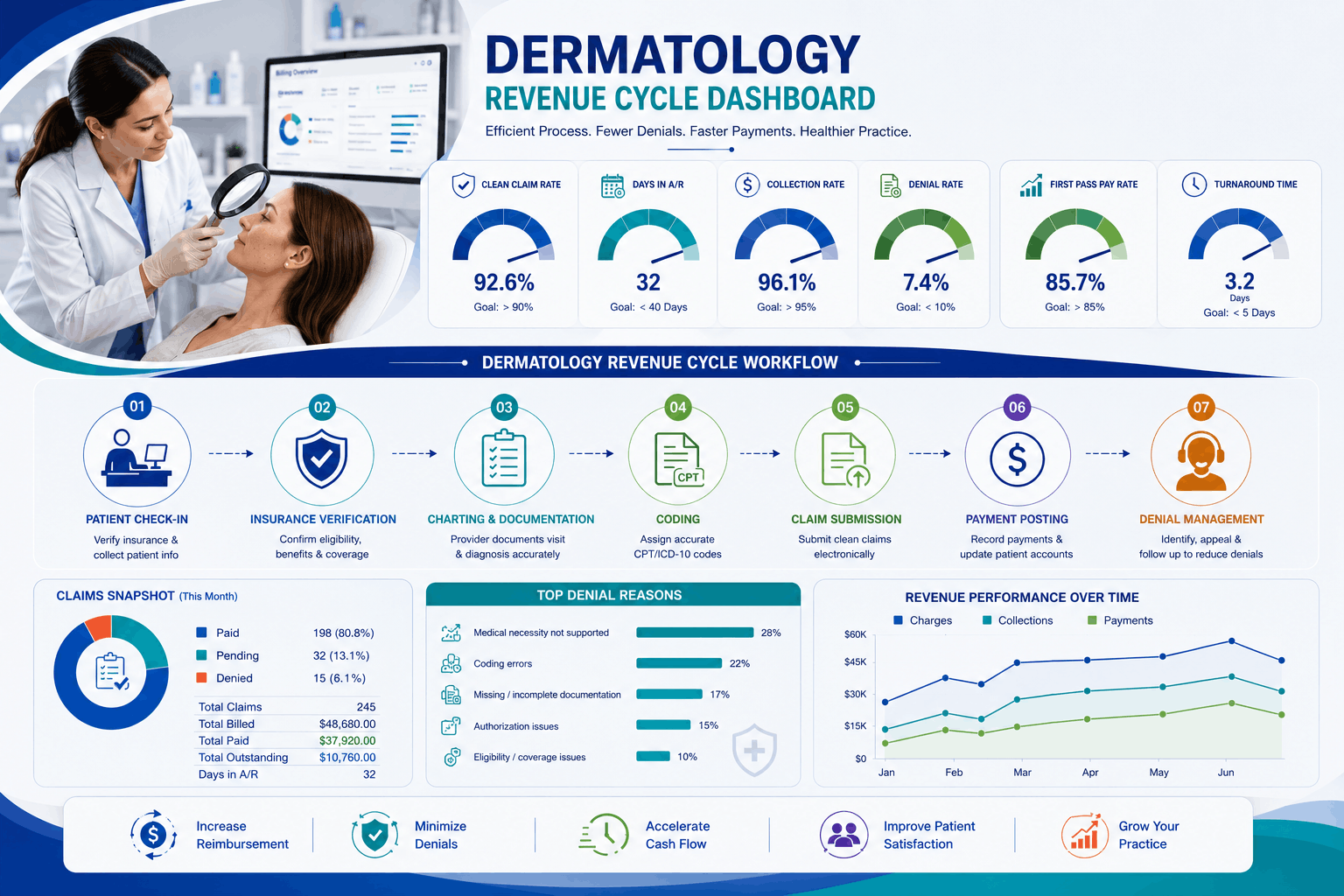
| RCM Phase | Key Activities | Dermatology-Specific Considerations |
|---|---|---|
| Scheduling | Insurance capture, visit type classification | Distinguish medical vs. cosmetic at booking |
| Pre-Visit | Eligibility verify, PA for biologics | PA for biologics confirmed before appointment |
| Encounter | Documentation, charge capture | Lesion count, biopsy technique, excision size captured |
| Coding | CPT/ICD-10 selection, modifier assignment | Destruction count, malignant vs. benign, modifier -25 review |
| Claim Submission | Scrubbing, submission, timely filing | NCCI edit check for multi-procedure visits |
| Payment Posting | ERA/EOB reconciliation | Separate medical vs. cosmetic payment streams |
| Denial Management | Appeal filing, documentation support | Most denials are documentation-fixable |
| Patient Collections | Cosmetic balance, cost-share, statements | Cosmetic patients often full-pay at time of service |
| Analytics | Payer scorecards, code utilization reports | Modifier -25 rate trending, destruction code patterns |
Dermatology medical billing is one of the most procedure-dense, modifier-sensitive, and compliance-intensive billing environments in US healthcare. Managing it with a general billing team, or with in-house staff who are stretched thin means you’re almost certainly leaving revenue on the table while carrying risk you don’t realize is there.
At House of Outsourcing, we built our dermatology medical billing services around the specific realities of US dermatology practices. Our team includes certified professional coders with dermatology specialty expertise, prior authorization specialists who understand the biologic and high-value procedure PA landscape, and compliance analysts who know exactly what triggers a payer audit and exactly how to prevent one
| Factor | In-House Billing | House of Outsourcing |
|---|---|---|
| Dermatology coding expertise | Generalist team, often not derm-certified | Dermatology-trained, CPC-certified coders |
| Biopsy code updates (post-2019) | Often inconsistent | Current; 11102–11107 applied correctly |
| Modifier -25 compliance | Frequently over-applied | Audited quarterly; documentation-matched |
| Mohs billing | Often coded by non-specialist | Full Mohs stage/block/reconstruction expertise |
| Biologic PA management | Resource-intensive; often delayed | Dedicated PA team; systematic workflow |
| Cosmetic/medical segregation | Often blurred; compliance risk | Clean separation; ABN workflow established |
| Denial management | Often written off | Systematic appeal on every denial |
| Cost structure | Salary + benefits + training + software | Transparent % of collections |
| Scalability | Limited by headcount | Scales with patient volume |
When your dermatology practice is growing, the last thing you want is billing complexity creating a ceiling on your revenue. House of Outsourcing removes that ceiling.
These codes were retired in 2019. They were replaced by technique-specific biopsy codes: 11102/11103 (tangential), 11104/11105 (punch), and 11106/11107 (incisional). Using the old codes results in automatic claim denial. The correct code is selected based on the documented biopsy technique.
Modifier -25 is appropriate when a significant, separately identifiable E/M service is provided on the same day as a procedure, and the E/M has its own documented medical decision-making that goes beyond the pre-procedure assessment. The E/M documentation must be distinct from the procedure note and must stand on its own clinical merit.
No. Seborrheic keratosis removal is considered cosmetic under Medicare and is not a covered benefit. You must issue an ABN before performing the service if a Medicare patient requests it, and you bill the patient directly. Billing Medicare with an actinic keratosis diagnosis when the lesion is actually a seborrheic keratosis is a fraudulent claim.
Mohs surgery is billed by stage and body location. CPT 17311/17312 applies to the head, neck, hands, feet, and genitalia; 17313/17314 to the trunk and extremities. Each stage beyond the first uses the add-on codes (17312 or 17314). Each block beyond five per stage uses CPT 17315. Reconstruction is billed separately.
Biologic injection billing requires: (1) a valid HCPCS J-code matching the specific biologic administered, (2) documented dosage in the clinical note, (3) prior authorization number from the payer, and (4) an administration code (typically 96372 for subcutaneous injection). Missing any of these elements typically results in denial.
Medicare covers synchronous video visits using standard E/M codes. Store-and-forward teledermatology (asynchronous image submission) is covered in certain demonstration states and by some Medicare Advantage plans, but is not universally covered under traditional Medicare. Coverage continues to evolve; verify current CMS policy for your region.
Stay current and compliant with these authoritative dermatology billing resources:
Get a free assessment from our billing experts