
Our Dermatology RCM services help practices maximize revenue through accurate coding, documentation compliance, claim optimization, and denial management. We simplify dermatology billing workflows to improve reimbursements, reduce administrative challenges, and support consistent practice growth.

Dermatology revenue cycle management is far more demanding than most specialties because every patient encounter can involve a different combination of evaluation, procedures, pathology, medications, and payer rules in the USA. Even a minor documentation or coding error can delay your reimbursement, increase denials, or trigger compliance concerns that affect the financial health of your practice.
Unlike many medical specialties, dermatology combines medical, surgical, and cosmetic services under one revenue cycle. A single day may include office visits, lesion removals, biopsies, Mohs surgery, phototherapy, biologic therapies, and cosmetic treatments, each governed by unique CPT codes, modifiers, diagnosis requirements, global periods, and payer-specific coverage policies.
The consequences of getting billing wrong in dermatology are significant. Missed prior authorizations for biologics cost $1,000–$5,000 per denied claim. Modifier errors on multi-lesion excision visits cost $100–$400 per encounter. Misclassifying a medically necessary procedure as cosmetic or vice versa, creates both revenue loss and compliance exposure. And global period violations on Mohs-related closures and excisions trigger systematic underpayment that most practices never detect.
Need support with your billing workflow? Explore our medical billing and revenue cycle services or request a free consultation.
Dermatology revenue cycle management is the end-to-end financial process of managing your patient billing, insurance eligibility verification, prior authorization (especially for biologics), medical vs. cosmetic service differentiation, procedure-specific CPT coding, modifier compliance, Mohs surgery charge capture, global period management, claim submission, denial management, cosmetic self-pay collections, and payment optimization for your practice. It is uniquely complex due to the specialty’s simultaneous operation of insurance-based medical billing and cash-based cosmetic billing under a single practice roof.
| Service Channel | Payer | Key Billing Framework | Revenue Challenge |
|---|---|---|---|
| Medical dermatology | Insurance + Medicare + Medicaid | CPT codes, ICD-10, medical necessity, prior auth | High denial rates; modifier complexity; global periods |
| Surgical dermatology | Insurance + Medicare | Procedure-specific CPT, modifier 59/25/51, global periods | Multi-lesion coding; Mohs complexity; bundling edits |
| Mohs micrographic surgery | Insurance + Medicare | Specialized Mohs CPT codes 17311–17315; repair codes | Multi-stage billing; closure coding; pathology integration |
| Cosmetic dermatology | Self-pay / patient direct | No insurance billing; cash collection; financing | Patient collections; financial counseling; no-show management |
| Teledermatology | Insurance (expanded coverage) | Modifier 95; POS 10/02; payer-specific coverage | Payer variability; modifier accuracy; store-and-forward rules |
| Biologic therapy | Insurance + Medicare + Prior Auth | HCPCS drug codes; specialty pharmacy coordination | Prior auth burden; step therapy; PA renewal management |
The AMA CPT code system defines distinct code families for each dermatology service line. Getting the right code for the right service, and the right modifier combination is where dermatology billing separates high performers from practices that consistently leave money on the table.
| CPT Code | Description | Key Billing Rule | Common Error |
|---|---|---|---|
| 11102 | Tangential biopsy — single lesion | First lesion; each additional is +11103 | Billing 11102 for each lesion instead of using add-on +11103 |
| +11103 | Tangential biopsy — each additional | Add-on to 11102; list separately | Forgetting add-on = lost revenue on multi-lesion visits |
| 11104 | Punch biopsy — single lesion | First lesion; each additional is +11105 | Apply correct biopsy type based on technique used |
| +11105 | Punch biopsy — each additional | Add-on to 11104; list separately | Same error pattern as tangential — add-on often missed |
| 11106 | Incisional biopsy — single lesion | First lesion; each additional is +11107 | Most complex biopsy; requires documented indication |
| +11107 | Incisional biopsy — each additional | Add-on to 11106; list separately | Document technique in operative note |
Tip: Multi-Lesion Biopsy Coding
On high-volume dermatology days, multiple biopsies are common. Always use the primary code (11102, 11104, or 11106) for the first lesion of each type, then the corresponding add-on code (+11103, +11105, or +11107) for each additional lesion of the same type. If different biopsy techniques are used (e.g., one punch and one tangential), both primary codes can be billed, with modifier 59 on the second to indicate distinct procedural services. Missing add-on codes on a 5-lesion biopsy visit can cost $150–$300 in lost revenue per encounter
| CPT Code | Description | Key Billing Rule |
|---|---|---|
| 11200 | Skin tags — removal up to 15 lesions | Counts total lesions removed; covers first 15 |
| +11201 | Skin tags — each additional 10 lesions | Add-on to 11200 for each additional 10 lesions beyond first 15 |
| 17000 | Destruction of premalignant lesions — first lesion | Actinic keratoses (AK); first AK destroyed |
| +17003 | Destruction of premalignant — 2nd through 14th lesion | Add-on to 17000; counted per lesion |
| 17004 | Destruction of premalignant — 15 or more lesions | Use instead of 17000 + 17003 when 15+ lesions destroyed in single session |
| 17106 | Destruction of cutaneous vascular proliferative lesion — <10 sq cm | Port wine stain, hemangioma; document size |
| 17107 | Destruction of cutaneous vascular proliferative lesion — 10–50 sq cm | Document exact size |
| 17108 | Destruction of cutaneous vascular proliferative lesion — >50 sq cm | Document exact size; higher reimbursement |
| 17110 | Destruction of flat warts, molluscum, milia — up to 14 lesions | Benign lesion destruction; flat lesions |
| 17111 | Destruction of flat warts, molluscum, milia — 15 or more lesions | Higher threshold version |
| CPT Code Range | Description | Key Coding Factor | Documentation Required |
|---|---|---|---|
| 11400–11406 | Excision benign lesion — trunk, arms, legs | Size of lesion + margins (diameter in cm) | Specimen size; anatomical site; clinical indication |
| 11420–11426 | Excision benign lesion — scalp, neck, hands, feet, genitalia | Site-specific; higher RVU than 11400 series | Document exact anatomical site |
| 11440–11446 | Excision benign lesion — face, ears, eyelids, nose, lips | Highest RVU benign excision codes | Facial site documentation; functional vs. cosmetic distinction |
| 11600–11606 | Excision malignant lesion — trunk, arms, legs | Size including margins; malignant ICD-10 required | Pathology report confirming malignancy; margins documented |
| 11620–11626 | Excision malignant lesion — scalp, neck, hands, feet, genitalia | Site-specific higher codes | Anatomical site + malignant diagnosis required |
| 11640–11646 | Excision malignant lesion — face, ears, eyelids, nose, lips | Highest RVU malignant excision codes | Facial site + malignant diagnosis + pathology required |
| CPT Code | Description | Stage Counting Rule | Key Documentation |
|---|---|---|---|
| 17311 | Mohs surgery — head, neck, hands, feet, genitalia — first stage, up to 5 tissue blocks | One unit per stage; multiple stages billed separately | Patient consent; tumor site; block map; histology review; surgeon attestation |
| +17312 | Mohs — each additional stage after first (head, neck, hands, feet, genitalia) | Add-on to 17311; each additional stage is one unit of 17312 | Stage-by-stage block map; clear margins documented at each stage |
| 17313 | Mohs — trunk, arms, legs — first stage, up to 5 tissue blocks | Same rules as 17311 but lower RVU for trunk/extremity sites | Tumor map; blocks; histology; site documentation |
| +17314 | Mohs — each additional stage (trunk, arms, legs) | Add-on to 17313 | Stage documentation; margins at each stage |
| +17315 | Mohs — each additional block (when >5 blocks per stage) | Add-on to 17311 or 17313; per block beyond 5 | Block count per stage documented; rare but high-value |
| CPT Code Range | Description | Length Measurement | Global Period |
|---|---|---|---|
| 12001–12007 | Simple repair — scalp, neck, axillae, external genitalia, trunk, extremities | Length in cm; codes increase by size | 10 days |
| 12011–12018 | Simple repair — face, ears, eyelids, nose, lips, mucous membranes | Site-specific; higher RVU for facial locations | 10 days |
| 12031–12037 | Intermediate repair — same scalp/neck/axillae/trunk/extremities sites | Requires layer closure or contaminated wound | 10 days |
| 12041–12047 | Intermediate repair — face, ears, eyelids, nose, lips | Higher RVU intermediate; facial sites | 10 days |
| 13100–13102 | Complex repair — trunk, arms, legs | Add-on +13101/+13102 for additional cm | 10 days |
| 13120–13122 | Complex repair — scalp, arms, legs | Complex with length add-ons | 10 days |
| 13131–13133 | Complex repair — forehead, cheeks, chin, mouth, neck, axillae, genitalia | High-value facial/neck complex repair | 10 days |
| 13150–13153 | Complex repair — eyelids, nose, ears, lips | Highest RVU complex repair; per cm pricing | 10 days |
| 14000–14350 | Adjacent tissue transfer/flap — by location and sq cm | Area in sq cm; location drives code selection | 90 days |
| 15100–15261 | Split/full thickness skin graft — by location and sq cm | Area in sq cm; graft type and site determine code | 90 days |
Tip: Additive Repair Length Rule
When multiple wounds at the same complexity level (e.g., all simple) and same anatomical site grouping (e.g., all trunk) are repaired in the same session, their lengths are added together to select the appropriate code. For example: three simple trunk repairs of 1.5 cm, 2.0 cm, and 1.8 cm = 5.3 cm total → bill 12004 (simple repair, 2.6–7.5 cm, trunk). Do NOT bill three separate simple repair codes. However, repairs at different complexity levels (simple vs. intermediate) or different anatomical site groupings are billed separately. Misapplying the additive rule is one of the most common repair coding errors in dermatology
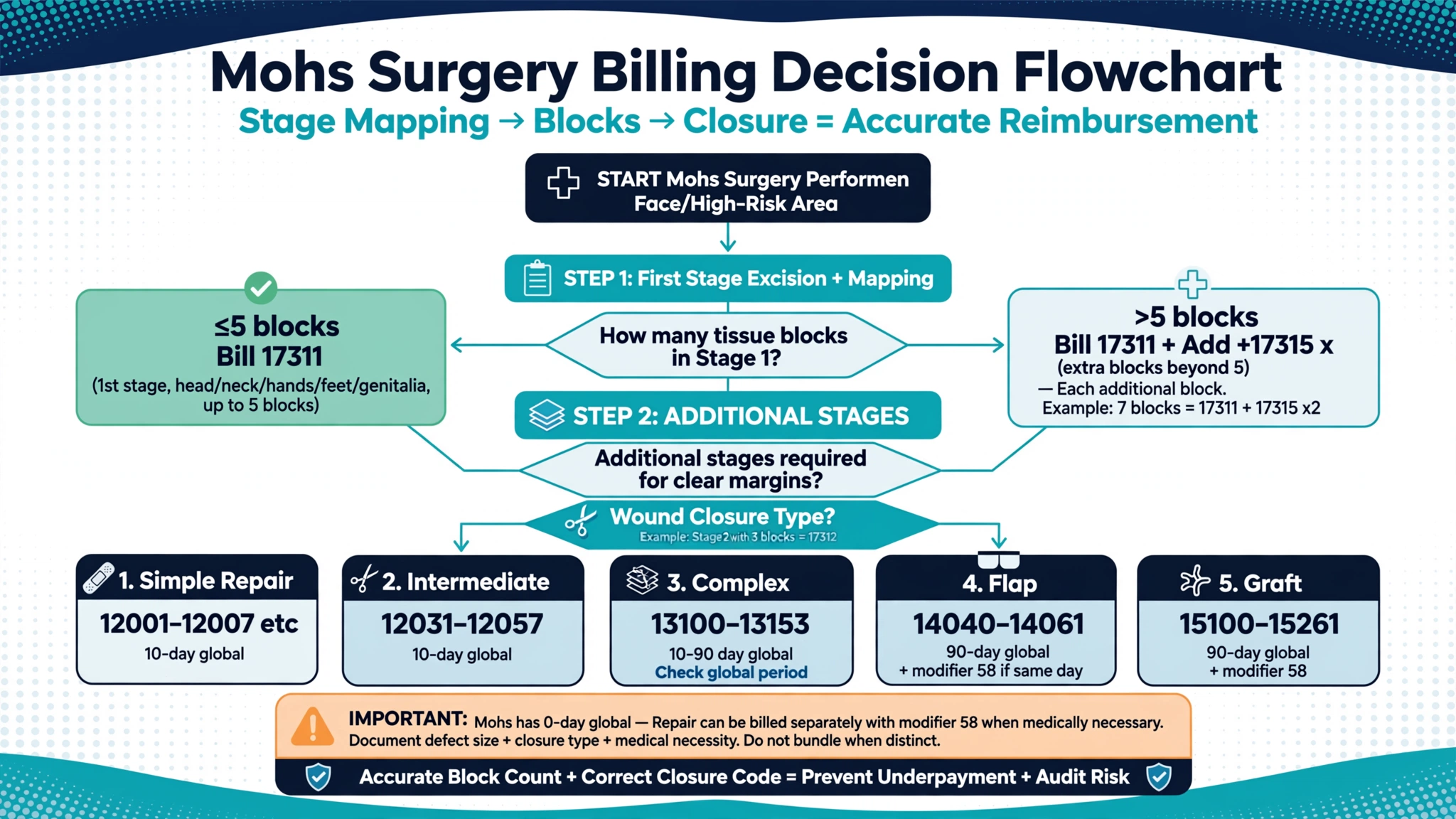
Mohs surgery billing is the most specialized and highest-value coding in dermatology. Because Mohs is a combined surgical and pathological procedure performed by a single surgeon who simultaneously acts as the histopathologist, the billing framework is unique.
| Mohs Stage / Element | CPT Code | Units Per Session | Key Rule |
|---|---|---|---|
| First stage — head, neck, hands, feet, genitalia (≤5 blocks) | 17311 | 1 unit | One unit regardless of tumor size; stage = one tissue removal + histology review |
| Each additional stage — head/neck/hands/feet/genitalia | 17312 | 1 unit per stage | Each additional stage = one additional unit; no limit on stages |
| First stage — trunk, arms, legs (≤5 blocks) | 17313 | 1 unit | Same rules as 17311 but lower RVU; site determines code |
| Each additional stage — trunk, arms, legs | +17314 | 1 unit per stage | Add-on for each additional stage |
| Each additional block beyond 5 in any stage | +17315 | 1 unit per additional block | If stage has 7 blocks, bill +17315 × 2 (for blocks 6 and 7) |
| Wound repair after Mohs — simple | 12001–12018 | 1 unit by length/site | Bill separately; 0-day global for Mohs itself; 10-day global for repair |
| Wound repair — intermediate | 12031–12047 | 1 unit by length/site | Document layered closure; same separate billing rule |
| Wound repair — flap/tissue transfer | 14000–14350 | 1 unit by sq cm/site | 90-day global; document flap design and execution |
| Wound repair — skin graft | 15100–15261 | 1 unit by sq cm/type | 90-day global; document graft type (split vs. full) and site |
| Pathology — separate pathologist billing | 88302–88305 | Per specimen | If different pathologist reads specimens, they bill separately; Mohs surgeon doesn't bill additional path codes |
The most foundational and most frequently muddled billing distinction in dermatology is whether a service is medically necessary or cosmetic. This single determination drives everything, which payer receives the claim, how the service is documented, who pays, and what your compliance exposure looks like.
| Service | Medical (Insurance Billed) | Cosmetic (Self-Pay) | Key Determination Factor |
|---|---|---|---|
| Acne treatment | Yes — inflammatory/cystic acne with functional/medical impact | Routine acne without medical necessity | Severity, functional impact, diagnosis |
| Skin lesion removal — benign | Yes — when lesion is symptomatic, infected, or functionally impaired | No — when purely aesthetic (patient dislikes it) | Clinical indication + documentation |
| Skin lesion removal — malignant | Always medical — basal cell, SCC, melanoma | Never cosmetic | Pathology confirmation |
| Botox / neurotoxin injection | Medical — for hyperhidrosis, migraines (payer-specific) | Cosmetic — anti-aging, wrinkle reduction | Clinical indication determines billing channel |
| Chemical peel | Medical — actinic keratoses, certain conditions | Cosmetic — skin rejuvenation, texture | Medical necessity documentation or self-pay |
| Laser resurfacing | Medical — scar revision, functional impairment | Cosmetic — aesthetic improvement | Functional vs. aesthetic purpose |
| Filler injections | Medical — facial reconstruction post-trauma/surgery (rare) | Cosmetic — volume restoration, aesthetics | Almost always cosmetic; very limited medical coverage |
| Phototherapy (PUVA, NB-UVB) | Medical — psoriasis, eczema, vitiligo, CTCL | Never cosmetic for these conditions | ICD-10 diagnosis drives medical necessity |
| Biologic therapy (dupilumab, etc.) | Medical — severe atopic dermatitis, psoriasis, etc. | Never cosmetic for covered conditions | PA + documented failure of conventional therapy |
| Tattoo removal | Generally cosmetic — not covered | Self-pay typically | Exception: medical removal for identity/safety in rare cases |
Biologics have transformed the treatment of severe psoriasis, atopic dermatitis, and other inflammatory skin conditions, and they represent a growing, high-value revenue stream for your dermatology practice. But biologic billing is also among the most complex and highest-risk in the specialty. Prior authorization is nearly universal, step therapy requirements are strict, and drug costs exceeding $20,000 to $50,000 per year per patient make payer scrutiny intense.
| Biologic Drug | HCPCS Code | Condition | PA Requirement | Administration CPT |
|---|---|---|---|---|
| Dupilumab (Dupixent) | J0173 | Atopic dermatitis, prurigo nodularis, other | Required — all payers; step therapy | 96372 (subcut injection) |
| Secukinumab (Cosentyx) | J3357 | Psoriasis, PsA | Required — all payers | 96372 (subcut injection) |
| Ixekizumab (Taltz) | J3358 | Psoriasis, PsA | Required — all payers | 96372 (subcut injection) |
| Guselkumab (Tremfya) | J0804 | Plaque psoriasis | Required — all payers | 96372 (subcut injection) |
| Risankizumab (Skyrizi) | J0222 / J3590 | Psoriasis, PsA, CD | Required — all payers | 96372 (subcut injection) |
| Spesolimab (Spevigo) | J3590 (NOC) | Generalized pustular psoriasis | Required | 96413 (IV infusion) |
| Omalizumab (Xolair) | J2357 | Chronic urticaria | Required — most payers | 96372 (subcut injection) |
| Nemolizumab (Nemluvio) | J3590 (NOC) / assigned | Prurigo nodularis, atopic dermatitis | Required | 96372 (subcut injection) |
Tip: Biologic PA Management Protocol
For every biologic, you need to maintain a dedicated PA tracking log with, drug name, payer, authorization number, approval date, expiration date, approved units per frequency, and required renewal timeline. Biologics PAs typically expire every 6 to 12 months. An expired PA means a denied claim for a drug that may cost thousands per injection. Set calendar alerts at 30 days and 7 days before PA expiration. When a biologic PA is denied, use the AAD step therapy advocacy resources and appeal citing the specific clinical criteria met for the prescribed agent.
Modifier usage in dermatology is where billing errors concentrate especially in multi-procedure encounters and surgical cases with global periods. The wrong modifier or a missing modifier on a high-volume dermatology day costs $50 to $500 per encounter. Multiplied across hundreds of daily encounters, the annual impact is significant.
| Modifier | Meaning | When to Use in Dermatology | Revenue Impact of Error |
|---|---|---|---|
| 25 | Significant, separately identifiable E/M same day as procedure | When dermatologist performs E/M AND a procedure (biopsy, excision) on same day; E/M must be documented as distinct from pre-procedure assessment | Missing 25 = E/M bundled into procedure payment; consistent revenue leak |
| 59 | Distinct procedural service | When billing multiple procedures that would normally be bundled; e.g., biopsy and destruction on same day for different lesions | Missing 59 = secondary procedure bundled; revenue lost on multi-procedure days |
| 51 | Multiple procedures | Second/subsequent surgical procedures in same session (not add-on codes) | Incorrect vs. 59 use creates bundling errors; know when each applies |
| 57 | Decision for major surgery — E/M same day or day before | E/M that directly results in decision to perform a major procedure (90-day global) | Missing 57 on pre-surgical E/M = E/M denied as included in global |
| 24 | Unrelated E/M during global period | When patient presents with new/unrelated problem during post-op global period | Required to get paid for unrelated care in global period; missing = denial |
| 58 | Staged/related procedure during global period | When planned second-stage procedure occurs during 90-day global period | Mohs to flap closure when flap is delayed; staged approach common in skin cancer |
| 79 | Unrelated procedure during global period | Procedure unrelated to the original surgery performed during global period | Required for unrelated surgical procedure within 90-day post-op window |
| 78 | Related complication return to OR during global period | Return to OR for complication of original procedure | Documents return for complication; not separately paid at full rate |
| GY | Non-covered service billed to Medicare | Cosmetic services billed to Medicare so Medicare can deny and patient can be billed | Incorrect use creates compliance risk; only for services patient knows aren't covered |
| 22 | Increased procedural services | When dermatology procedure was substantially more complex than typical | Requires operative report and documentation of why increased; payer approval often needed |
Patient Scheduling & Medical vs. Cosmetic Identification: It is your billing team’s responsibility to identify at scheduling whether the visit is medical (insurance billing) or cosmetic (self-pay). For cosmetic visits, initiate the financial counseling and pre-payment collection workflow.
Insurance Eligibility Verification: You need to verify patients active coverage, deductible status, copay/coinsurance, and prior authorization requirements 48–72 hours before every appointment. Confirm that the specific planned procedure (biopsy, excision, phototherapy) is covered under the patient’s plan.
Prior Authorization Management: For biologics, phototherapy series, and some procedures: submit PA requests with complete clinical documentation well in advance. Track authorization numbers, expiration dates, and approved quantities. For biologics, build 30-day and 7-day expiration alerts.
Medical Necessity Documentation: At the time of service, document the specific clinical indication for every procedure. For skin lesions: size, location, characteristics, symptoms, and clinical impression. For biopsies: why biopsy is indicated over watchful waiting. For malignant excisions: margin requirements based on lesion type and size.
Charge Capture Procedures: At charge entry, count documented lesions for add-on code application. You need to verify excision size includes surgical margins. Confirm Mohs stage count and block count from the operative record. Select the correct repair code based on technique and total wound length.
Medical vs. Cosmetic Service Separation: Before claim submission, you must verify that every charge on the claim is either (a) medically necessary with supporting documentation and diagnosis, or (b) handled as self-pay. No cosmetic service should be submitted to insurance with a medical diagnosis code.
Global Period Compliance Check: Before submitting any E/M or procedure claim, verify whether the patient has an open global period from a recent surgery. If yes, confirm whether the service is: included in the global (don’t bill separately), unrelated (needs modifier 24 or 79), or staged (needs modifier 58).
Claims Scrubbing: Run pre-submission edits checking: modifier 25 on same-day E/M + procedure, modifier 59 on potentially bundled procedures, global period conflicts, PA number presence on biologic claims, and ICD-10 diagnosis specificity.
Claim Submission: Your team must submit electronically within each payer’s timely filing window. Medicare: 12 months from date of service. Document submission dates and track confirmation from clearinghouse.
Payment Posting: Post payer payments and reconcile against contracted rates. Flag underpayments. For cosmetic self-pay, reconcile against patient receipts.
Denial Management: Categorize denials by type and root cause. Appeal medical necessity denials with clinical documentation. Appeal modifier denials with NCCI analysis. Appeal biologic PA denials citing AAD guidelines and step therapy criteria.
The simultaneous operation of insurance-based medical billing and self-pay cosmetic billing under one practice roof creates confusion at every stage like scheduling, documentation, charge capture, and collections. When the distinction is unclear or inconsistently applied, both revenue and compliance suffer.
High-volume lesion removal days require consistent application of primary codes for the first lesion and add-on codes for each subsequent lesion. When your practice habitually bill only the primary code, either from habit or time pressure, systematically underbill every multi-lesion encounter.
Mohs billing requires accurate stage and block counting, correct site identification for code selection, separate billing for closure procedures, and careful global period management. Errors in any of these elements produce either compliance exposure (overbilling stages) or revenue loss (missing closure codes or confusing global periods).
Post-operative global periods of 10 days (minor procedures) and 90 days (major procedures like flaps and grafts) create a compliance framework that must be actively managed. Billing separately for services included in a global period results in overpayment and audit exposure. Missing the modifiers needed to bill separately for unrelated services results in revenue loss.
According to the AAD, prior authorization burdens for dermatology biologics have increased substantially. Managing your PA submissions, tracking approvals and expirations, navigating step therapy requirements, and pursuing appeals for denied PAs requires dedicated resources that many in-house billing teams cannot consistently provide.
Excision codes are selected based on total excised diameter lesion plus margins — not lesion size alone. Repair codes require additive length calculation when multiple wounds at the same complexity and site grouping are repaired. These measurement-dependent coding rules require consistent staff training and documentation protocols.
Even small mistakes in your dermatology billing can lead to claim denials, delayed payments, and lost revenue. Common issues include incorrect coding, missing modifiers, incomplete documentation, prior authorization errors, and misclassifying medical versus cosmetic services.
Not using add-on codes for multi-lesion procedures: Billing only 17000 without +17003 for multiple AK destructions; missing +11103 for multiple biopsies. Cost: $50–$200 per multi-lesion encounter.
Measuring excision size from lesion only — not including margins: Systematically under-codes every excision claim; especially costly for malignant excisions with larger required margins.
Missing modifier 25 on same-day E/M + procedure encounters: E/M bundled into the procedure payment; lost $80–$200 per qualifying encounter.
Incorrect Mohs stage counting: Under-counting stages (revenue loss) or documenting stages that didn’t occur (compliance violation).
Billing Mohs repair codes without separating from Mohs codes: Closure after Mohs is a separate billable service; missing closure codes is one of the highest single-encounter revenue losses in dermatology.
Missing modifier 59 on multi-procedure same-day encounters: Biopsy and AK destruction on same day without modifier 59 results in bundling and denial of one service.
Billing a global period E/M without modifier 24 or 79: Service included in the global, denied by payer, and creates recoupment risk if paid inadvertently.
Submitting cosmetic services to insurance with medical diagnosis codes — Insurance fraud; compliance risk that can result in exclusion, fines, and investigation.
Not tracking biologic PA expiration dates — Expired PA = 100% denial on a $3,000–$5,000 drug claim; preventable with automated tracking.
Non-specific ICD-10 coding — L30.9 (dermatitis, unspecified) when documentation supports L20.89 (other atopic dermatitis) or more specific code reduces medical necessity defensibility.
Tip: Weekly Multi-Procedure Encounter Audit
Every week, you need to pull a sample of 10 encounters from your highest-volume procedure days and review the charge slip against the documentation.
Verify:
(1) Were add-on codes applied for every additional lesion?
(2) Was modifier 25 applied when E/M and a procedure were both performed?
(3) Does the excision code match the documented size including margins?
(4) Were any services in a global period billed separately without the correct modifier? This 30-minute weekly audit catches the most common and most costly dermatology coding errors before they become patterns.
Current CMS and Medicare dermatology billing guidelines emphasize accurate documentation, medical necessity, correct CPT and ICD-10-CM coding, and proper modifier usage. Staying compliant with these requirements helps reduce claim denials, avoid audits, and ensure timely reimbursement for covered dermatology services.
| Dermatology Service | CMS/Medicare Coverage Rule (2026) |
|---|---|
| Skin biopsies (11102–11107) | Covered with medical necessity; documentation of clinical indication required; add-on codes covered when multiple lesions biopsied |
| Excision — benign lesions | Covered only when medically necessary — symptomatic, infected, or functionally impaired; purely cosmetic benign lesion removal not covered |
| Excision — malignant lesions | Always covered; pathology confirmation required for malignant ICD-10 code; margins must be documented |
| Mohs surgery (17311–17315) | Covered; appropriate for skin cancers where tissue preservation is critical; documentation of tumor type, location, and stage-by-stage mapping required |
| Destruction of AKs (17000–17004) | Covered as preventive/treatment for premalignant lesions; medical necessity documentation required |
| Phototherapy (96900, 96910–96913) | Covered for psoriasis, atopic dermatitis, vitiligo, CTCL with medical necessity; prior auth required by most plans |
| Biologic therapy | Covered for FDA-approved indications; prior auth universally required; step therapy requirements by most payers |
| Cosmetic procedures | NOT covered by Medicare; patient billed directly; modifier GY may be required if billing Medicare to establish non-coverage |
| Teledermatology | Covered with current CMS telehealth extensions; modifier 95 + POS 10/02; store-and-forward: verify per MAC |
| E/M visits (99202–99215) | Covered using 2021 AMA E/M guidelines (MDM or total time); when performed same day as procedure, requires modifier 25 with separate documentation |
Your dermatology practice continuously grows reimbursement challenges as payer requirements, documentation standards, and procedural complexity increase. Monitoring industry statistics help you identify financial risks, and implement strategies that improve collections and reduce claim denials.
| Metric | Industry Data | Source |
|---|---|---|
| Americans visiting dermatologists annually | ~80 million visits | AAD / CDC |
| Skin cancer diagnoses annually in the US | ~5.4 million (NMSC); 100,000+ melanoma | AAD / Skin Cancer Foundation |
| Target clean claim rate | ≥95% | AAPC Best Practices |
| Typical dermatology denial rate | 10–15% for complex procedure-heavy practices | Industry benchmarks |
| Revenue per dermatologist — avg annual | $450,000–$600,000+ | MGMA Dermatology Data |
| Biologic annual drug cost (severe psoriasis/AD) | $20,000–$50,000+ per patient | Pharmaceutical pricing data |
| Revenue loss per missed add-on code (multi-lesion) | $50–$200 per encounter | Dermatology billing analysis |
| Revenue loss per missed modifier 25 (E/M + procedure) | $80–$200 per encounter | Dermatology billing analysis |
| Revenue loss per missed Mohs closure code | $200–$800+ per Mohs case | Mohs billing analysis |
| Global period violation rate in dermatology | Higher than most specialties due to repair code complexity | OIG audit data |
| Cost of a reworked denied claim | $25–$118 per claim | CAQH Research |
| % of denied claims never reworked | ~65% | MGMA / Change Healthcare |
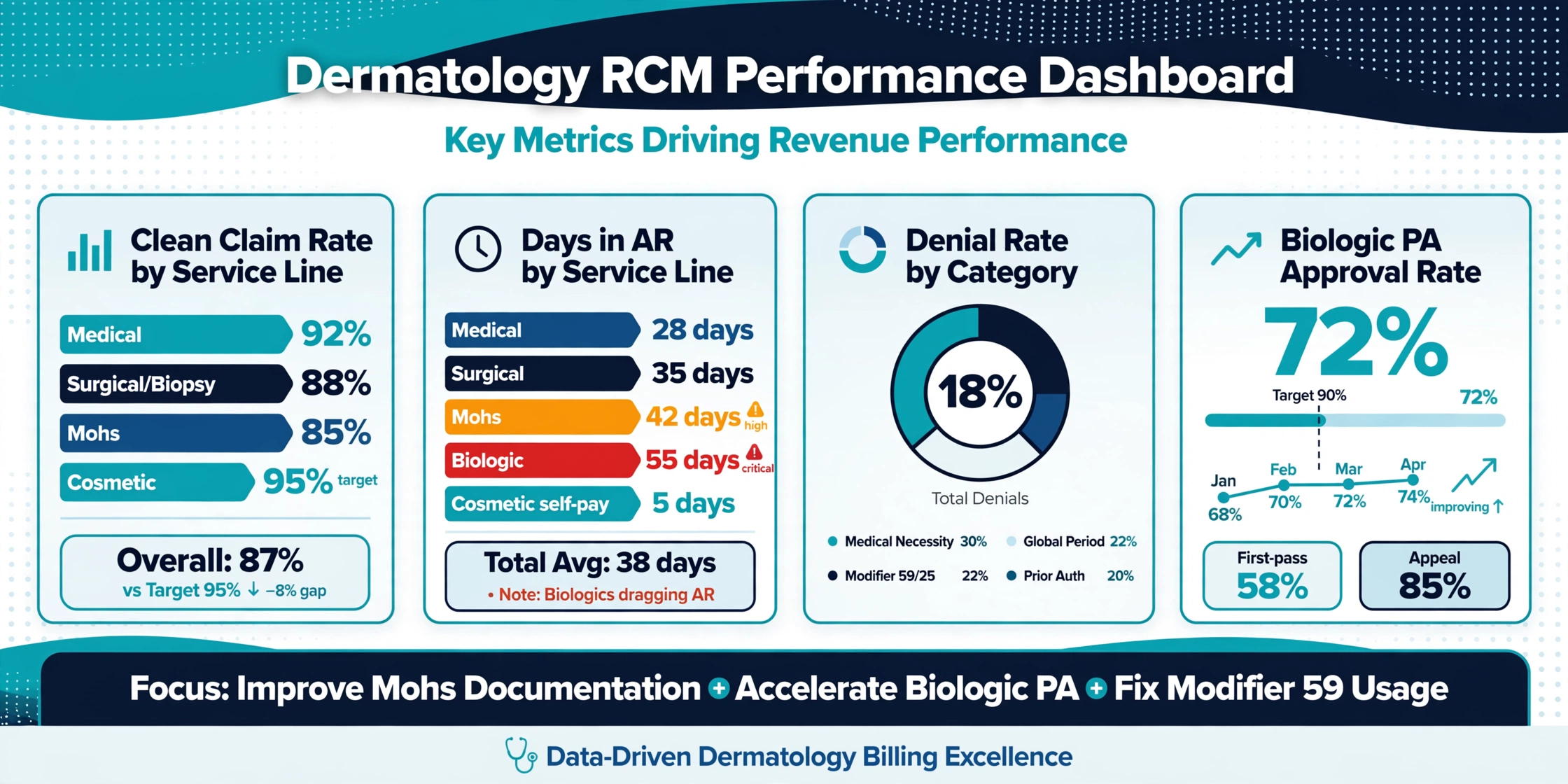
Key performance metrics help to evaluate the efficiency and financial health of your revenue cycle. Tracking KPIs such as clean claim rate, denial rate, days in accounts receivable, first-pass acceptance rate, and net collection rate enables continuous improvement and stronger reimbursement outcomes.
| KPI | What It Measures | Target for Dermatology Practices |
|---|---|---|
| Clean Claim Rate | % of claims accepted on first submission | ≥95% |
| Denial Rate — Medical/Surgical | % of medical dermatology claims denied | <8% |
| Add-On Code Capture Rate | % of multi-lesion encounters where all add-on codes are applied | ≥99% — critical for revenue integrity |
| Modifier Accuracy Rate | % of same-day E/M + procedure claims with correct modifier 25 | ≥99% |
| Global Period Compliance Rate | % of global period encounters correctly handled | 100% — compliance requirement |
| Biologic PA Approval Rate | % of biologic PAs approved on first submission | ≥85% |
| Days in AR — Medical Dermatology | Average time from service to payment | <35 days |
| Cosmetic Collection Rate | % of cosmetic services collected before procedure | ≥95% |
| Net Collection Rate | % of collectible revenue actually collected | ≥96% |
| First Pass Resolution Rate | % of denials resolved on first appeal | ≥75% |
| AR Aging > 90 Days | % of total AR outstanding over 90 days | <15% |
| Charge Lag | Days from service to claim submission | <3 days |
An effective denial management strategy helps you recover lost revenue and prevent recurring billing issues. Regular claim audits, accurate coding, timely appeals, and ongoing analysis of denial trends can significantly improve reimbursement rates and overall revenue cycle performance.
| Denial Category | Common Root Cause in Dermatology | Prevention Strategy |
|---|---|---|
| Medical necessity | Documentation doesn't support procedure indication; cosmetic vs. medical ambiguity | Procedure-specific documentation templates; medical necessity language in every note |
| Missing modifier 25 | E/M and procedure same day without modifier | Pre-submission check for same-day E/M + procedure encounters |
| Global period conflict | Service billed separately within post-op global without required modifier | Global period tracking in practice management system; alert when patient in active global period |
| Prior authorization | Biologic or phototherapy claim without current PA | Dedicated PA tracking system; automated expiration alerts |
| Add-on code missing | Multi-lesion procedure billed only with primary code | Charge capture workflow requiring add-on code review when multiple lesions documented |
| Excision code mismatch | Excision size coded from lesion alone, not including margins | Documentation training on measuring total excised diameter; coding audit quarterly |
| Bundling error — multi-procedure | Same-day biopsy + destruction without modifier 59 | Pre-submission NCCI edit check; modifier 59 decision workflow |
| ICD-10 specificity | Non-specific diagnosis code doesn't support medical necessity | ICD-10 specificity training; code selection from documented findings |
The False Claims Act applies directly to your practice dermatology billing. Common compliance risks for your practice are, billing cosmetic procedures with medical diagnosis codes, up-coding excision sizes, billing Mohs stages that weren’t performed, and billing E/M visits during global periods without required modifiers. Civil penalties up to $27,018 per claim plus treble damages apply.
The OIG Work Plan historically includes dermatology-specific audit targets, Mohs surgery utilization, high-volume biopsy practices, and cosmetic vs. medical procedure billing accuracy. Practices with high volumes of Mohs procedures or biopsies relative to their patient population
The No Surprises Act requires good-faith cost estimates for self-pay and uninsured patients for non-emergency scheduled services. Cosmetic dermatology practices with significant self-pay volumes must provide compliant cost estimates. For services where insurance coverage is uncertain (some hybrid cases), proactive cost estimate disclosure is a best practice that also reduces patient billing disputes.
All dermatology billing data, including clinical photos used for medical necessity documentation, must be handled in compliance with HIPAA Privacy and Security Rules. Clinical photos are part of the medical record and are protected health information.
Biologic prescriptions that bypass documented step therapy requirements create both PA denial risk and, if payment is obtained fraudulently, compliance exposure. Document every step therapy treatment attempt, medication name, dates, dosage, and documented treatment failure, before submitting a biologic PA. Reference AAD step therapy position for current AAD advocacy and clinical guidance.
Choosing between in-house and outsourced dermatology revenue cycle management depends on your resources, expertise, and growth goals. While in-house teams offer direct oversight, outsourced RCM providers often deliver specialized billing knowledge, lower denial rates, and improved financial performance.
| Factor | In-House Dermatology Billing | Outsourced Dermatology Revenue Cycle Management Services |
|---|---|---|
| Specialty coding expertise | Requires dermatology-specific training — Mohs, excision sizing, add-on codes, global periods | Certified dermatology billing specialists with Mohs, excision, and multi-procedure coding mastery |
| Add-on code capture | Often missed — costly on high-volume lesion days | Systematic add-on code review built into every multi-lesion charge entry workflow |
| Modifier 25 compliance | Frequently missed on same-day E/M + procedure encounters | Pre-submission modifier 25 check on every same-day E/M + procedure encounter |
| Excision size measurement | Often calculated from lesion only — not including margins | Documentation training and coding audit protocol for margin-inclusive size measurement |
| Mohs surgery billing | Complex stage counting and closure billing often error-prone | Dedicated Mohs billing protocol; stage/block reconciliation; closure code audit |
| Global period management | Often manually tracked; errors frequent when volume is high | Global period tracking in billing system; automated alerts for post-op period encounters |
| Biologic PA management | Resource-intensive; expiration often missed | Dedicated PA specialist; automated expiration alerts; step therapy documentation review |
| Cosmetic vs. medical compliance | Risk of incorrect insurance billing for cosmetic services without specialty training | Medical vs. cosmetic service classification protocol; pre-submission compliance review |
| Denial management | Reactive; ~65% of denials never worked | Systematic denial resolution within 72 hours; all denials worked |
| Best for | Large academic/health system dermatology with dedicated specialty billing team | Most dermatology practices and Mohs surgery centers of all sizes |
At House of Outsourcing, we understand that dermatology billing isn’t general medical billing. Mohs surgery, multi-lesion procedures, biologic prior authorizations, global period management, and the medical-vs-cosmetic distinction require specialist expertise that generalist billing teams simply don’t have. Our dermatology revenue cycle management services are built specifically around how dermatology practices actually work.
Certified Dermatology Billing Specialists: Our AAPC-credentialed coders with specific expertise in dermatology CPT codes, Mohs surgery billing (17311–17315), excision size measurement, add-on code application, and repair code complexity.
Mohs Surgery Billing Protocol: Your practice every Mohs case goes through our stage and block count verification, closure code review, and global period compliance check before submission, catching the billing errors most practices never detect.
Add-On Code Capture System: Our systematic multi-lesion charge review on every procedure day ensures that every qualifying add-on code is captured, eliminating the most consistent revenue leak in high-volume dermatology practices.
Modifier 25 Compliance Protocol: Pre-submission review on every same-day E/M + procedure encounter confirms modifier 25 is correctly applied and separately documented.
Excision Size Documentation Training: We provide documentation protocols and quarterly audits ensuring excision codes are selected based on total excised diameter including margins — not lesion size alone.
Biologic PA Management: Our dedicated PA specialists handle your biologic authorization end-to-end submission, step therapy documentation, tracking, expiration alerts, and appeals citing AAD clinical guidelines.
Medical vs. Cosmetic Compliance Review: Pre-submission compliance check on every claim ensures no cosmetic service is inadvertently submitted to insurance with a medical diagnosis code.
Global Period Tracking: Automated global period tracking in our billing workflow prevents both over-billing (services included in global) and under-billing (unrelated services that should be billed with modifiers 24/79).
Dedicated Dermatology Account Manager: One specialist who knows your practice, your procedure mix, and your payer contracts — accountable to your financial results every month.
Using trusted industry resources helps stay current with evolving billing regulations, coding updates, Medicare policies, and payer requirements. The following authoritative references provide reliable guidance to improve compliance, coding accuracy, reimbursement, and overall revenue cycle management.
| Resource | What It Covers | Link |
|---|---|---|
| CMS Physician Fee Schedule | Current dermatology CPT reimbursement rates | cms.gov/medicare/physician-fee-schedule/search |
| AAD Coding & Reimbursement | Dermatology-specific coding guidance and advocacy | aad.org/member/practice/coding |
| CMS LCD Search | Local Coverage Determinations for dermatology procedures | cms.gov/medicare-coverage-database/search.aspx |
| AAD Step Therapy Position | Biologic step therapy advocacy and clinical guidance | aad.org/member/practice/advocacy/step-therapy |
| OIG Work Plan | Dermatology billing enforcement priorities | oig.hhs.gov/reports-and-publications/workplan |
| CMS NCCI Policy Manual | Bundling and modifier rules for dermatology codes | cms.gov/medicare/coding-billing/national-correct-coding-initiative-edits |
| AMA CPT Code Resources | Official CPT code definitions and annual updates | ama-assn.org/practice-management/cpt |
| Skin Cancer Foundation | Clinical background supporting medical necessity for skin cancer treatment | skincancer.org |
| MGMA DataDive | Dermatology practice management benchmarking | mgma.com/data |
| AAPC Dermatology Coding | Specialty coding education and certification | aapc.com |
| HHS HIPAA Resources | Privacy and security compliance | hhs.gov/hipaa |
| CMS No Surprises Act | Good-faith estimate requirements | cms.gov/nosurprises |
Dermatology revenue cycle management is the complete financial process of managing your patient registration, insurance eligibility, prior authorization, medical vs. cosmetic service differentiation, procedure-specific CPT coding, modifier compliance, Mohs surgery billing, global period management, claim submission, denial management, and payment collection for your dermatology practice.
Mohs surgery billing uses CPT 17311 (head/neck/hands/feet/genitalia, first stage) or 17313 (trunk/arms/legs, first stage). Each additional stage is billed with add-on +17312 or +17314. When more than 5 tissue blocks are processed in a single stage, +17315 is added per block beyond 5. The Mohs procedure itself has a 0-day global period.
Medical dermatology services (treating skin disease, removing suspicious or symptomatic lesions, phototherapy for psoriasis, biologic therapy) are billed to insurance with supporting ICD-10 diagnosis codes and medical necessity documentation. Cosmetic dermatology services (Botox for aesthetics, fillers, cosmetic laser, elective lesion removal without medical indication) are self-pay, billed directly to the patient, not to insurance.
Skin excision CPT codes are selected based on:
(1) whether the lesion is benign or malignant (different code families),
(2) the anatomical site (trunk/arms/legs vs. scalp/neck vs. face/ears/eyelids), and
(3) the total excised diameter, which is the clinical diameter of the lesion PLUS the required surgical margins. The total excised diameter, not just the lesion size determines the correct code.
Global periods define a post-operative window during which routine post-op care is included in the surgery payment. Minor dermatology procedures (excisions, biopsies) have 10-day global periods; major procedures (flaps, grafts) have 90-day global periods. Mohs surgery codes have a 0-day global period. During the global period, routine post-op visits cannot be billed separately. However, visits for unrelated conditions (modifier 24 on E/M, modifier 79 on procedures) and staged procedures (modifier 58) can be billed with the correct modifier. Billing separately within a global period without the correct modifier creates recoupment exposure.
Get a free assessment from our billing experts