
Understand the essential CPT coding, documentation, and Medicare billing rules required for successful claim processing.

Radiation therapy billing under Medicare is one of the most complex areas in the medical billing system of the USA. With multiple service components (technical + professional), high-cost treatments, strict documentation rules, and evolving payment models, even small errors can lead to significant revenue loss or compliance risks.
Below is a deep dive into the real problems radiation oncology practices face, and how to solve them effectively in 2026.
Radiation therapy involves expensive procedures like IMRT, IGRT, SBRT, and brachytherapy. A single denied claim here isn’t a minor issue, it can mean thousands of dollars lost per case.
Medicare closely scrutinizes these services because of their cost and complexity. Errors like incorrect CPT coding, missing documentation, or mismatched treatment plans can instantly trigger denials.
Solution:
As a practice owner you need to adopt a zero-error mindset for high-value claims. Pre-bill audits, physics documentation checks, and treatment plan validation should be standard before submission.
Need support with your billing workflow? Explore our medical billing and revenue cycle services or request a free consultation.
Unlike routine services, your practice radiation therapy billing depends on multi-step workflows, consultation, simulation, planning, delivery, and management. If even one step is incorrectly documented or coded, the entire claim can be delayed.
For example, missing documentation for medical necessity or incorrect fraction reporting can push claims into manual review.
Solution:
As a successful practice owner you need to ensure every stage of treatment is properly documented and coded in sequence, and your billing teams must align closely with clinical workflows.
Radiation therapy is heavily audited because of its cost. Medicare requires clear proof that:
Incomplete documentation, especially in IMRT or SBRT can lead to denials or post-payment audits.
Solution:
As a successful physician your documentation should clearly connect:
Think of it as telling a complete clinical story that justifies every billed service.
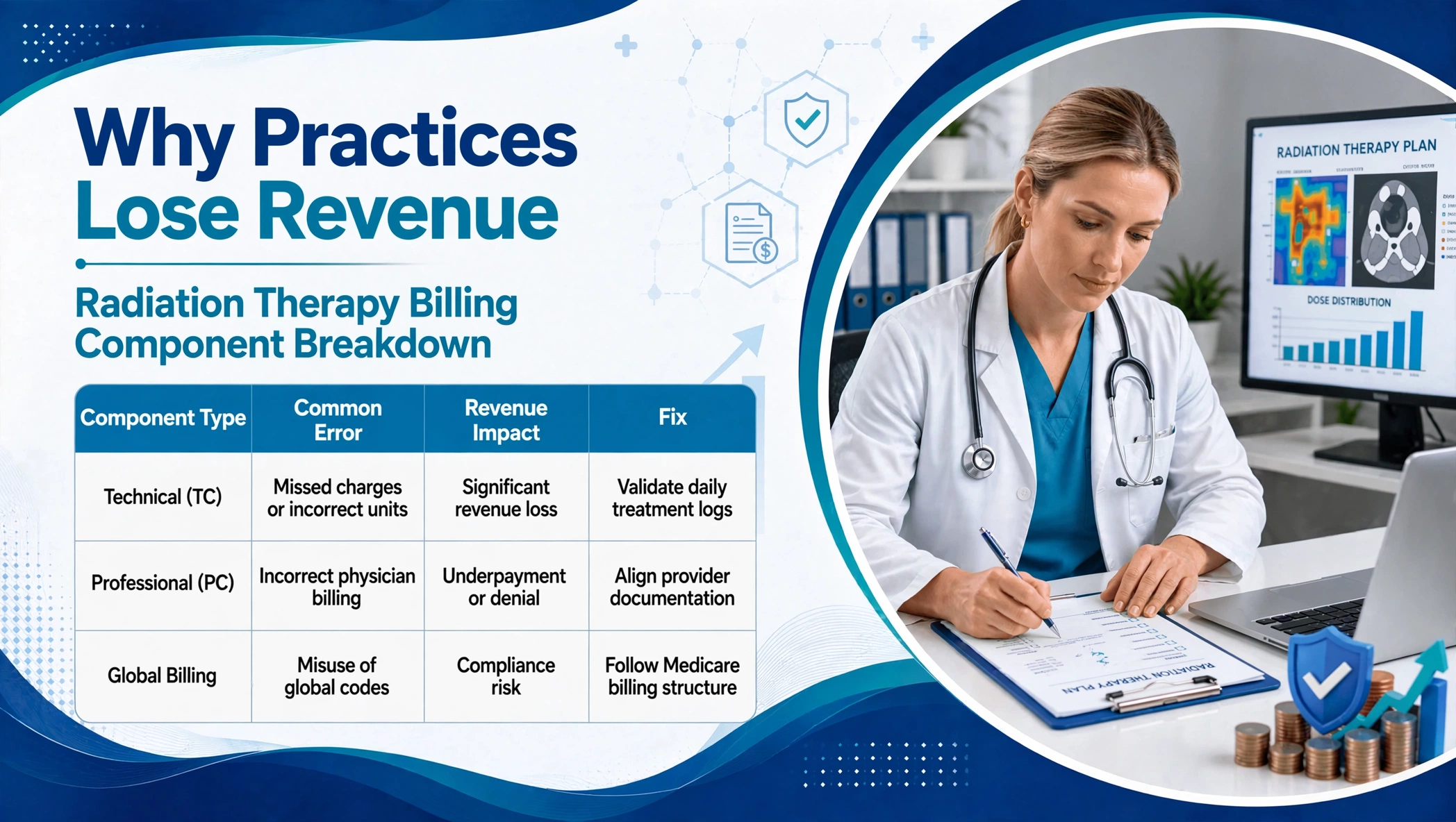
Radiation therapy billing is divided into:
Many practices either:
| Component Type | Common Error | Revenue Impact | Fix |
|---|---|---|---|
| Technical (TC) | Missed charges or incorrect units | Significant revenue loss | Validate daily treatment logs |
| Professional (PC) | Incorrect physician billing | Underpayment or denial | Align provider documentation |
| Global Billing | Misuse of global codes | Compliance risk | Follow Medicare billing structure |
Solution:
As an experienced physician you need to separate and validate both components clearly. Reconcile treatment logs with billing daily.
Advanced radiation therapies have highly specific CPT codes, and Medicare expects strict adherence, and most common issues include:
These errors can lead to audits or recoupments.
Solution:
Ensure coding matches:
Regular coder training on oncology-specific codes is essential.
Radiation oncology is shifting toward value-based payment models, including the Radiation Oncology (RO) Model introduced by CMS.
This means:
Solution:
Your medical practice need to adapt by:
Radiation therapy involves multiple billable events, simulation, dosimetry, treatment delivery, weekly management, etc. Missing even one can reduce total reimbursement significantly.
This often happens due to:
Solution:
You need to implement automated charge capture linked to treatment systems. Cross-check daily treatments with billing entries.
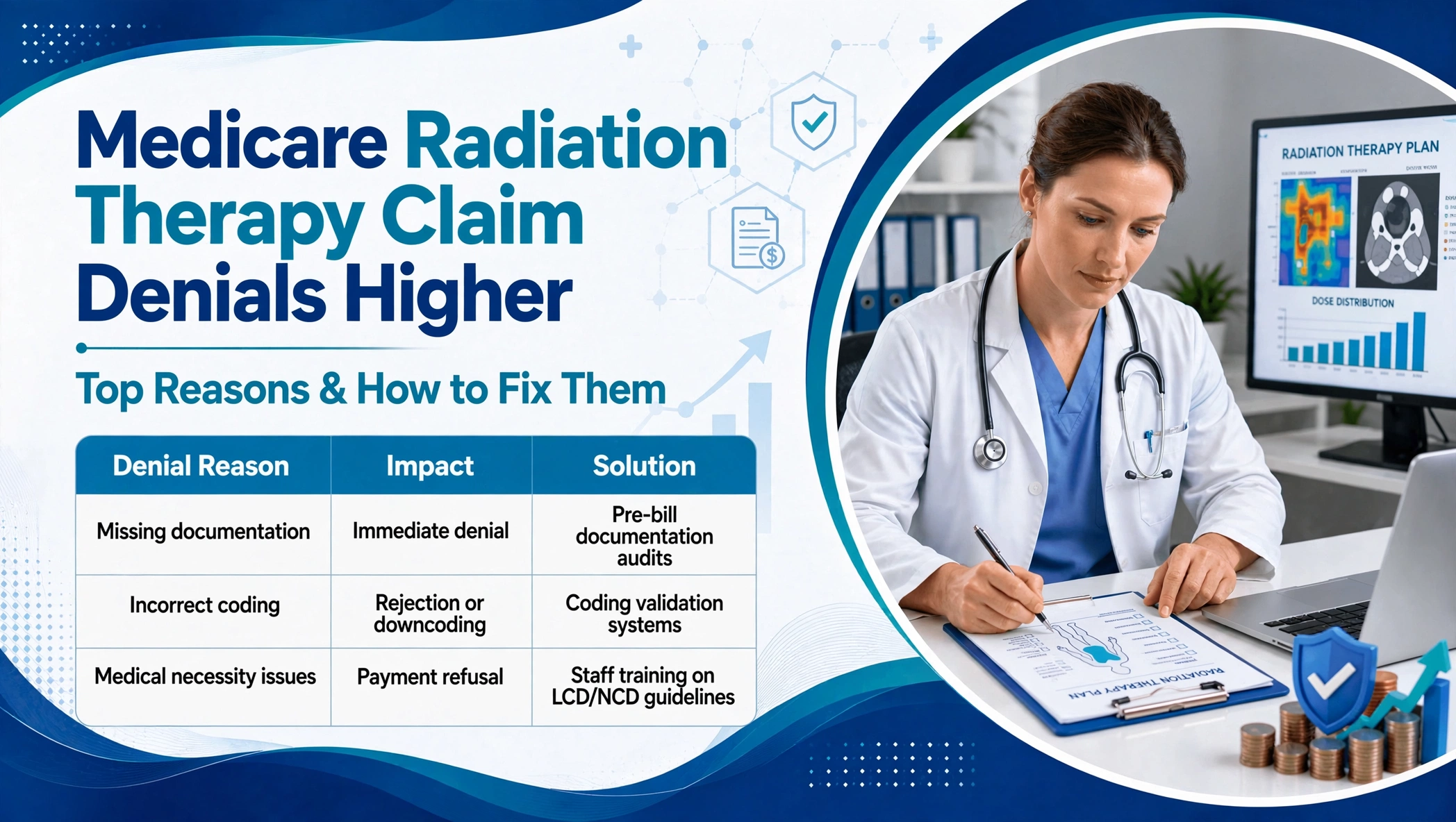
Radiation therapy claims are more likely to be denied because they are:
| Denial Reason | Impact | Solution |
|---|---|---|
| Missing documentation | Immediate denial | Pre-bill documentation audits |
| Incorrect coding | Rejection or downcoding | Coding validation systems |
| Medical necessity issues | Payment refusal | Strong clinical justification |
Solution:
You need to standardize workflows and implement multi-level claim review before submission.
Radiation therapy requires integration between:
If these systems are not connected, errors increase and billing slows down.
Solution:
You need to use integrated systems that:
Radiation therapy billing requires specialized expertise that many in-house teams lack. Keeping up with CPT changes, Medicare rules, and documentation requirements is challenging.
Outsourcing provides access to:
Solution:
By outsourcing your billing can significantly reduce denials and improve revenue cycle efficiency.
Radiation therapy errors are expensive. A single mistake in your practice coding or documentation can result in thousands of dollars lost.vWithout expertise, these errors become repetitive and harder to detect.
Solution:
You need to invest in specialized training or partner with experts who understand radiation oncology billing deeply.
Because of the complexity, many revenue leaks go unnoticed in radiation therapy practices.
Audits can uncover:
Solution:
As a practice owner you need to conduct quarterly audits focusing on:
Our end-to-end billing support minimizes administrative burdens, strengthens reimbursement performance, and gives your team more time to care for patients.
Get a free assessment from our billing experts