
You need to follow proven Medicare billing strategies to streamline claim submission, reduce administrative workload, and keep your practice financially successful.

Medicare billing in 2026 is no longer just a routine administrative task for your healthcare practice, it’s a very highly regulated, compliance-driven process that directly impacts your practice’s financial health in any state of the USA. With constant CMS updates, complicated audits, and evolving reimbursement models, your healthcare practice be more accurate than ever.
Industry data shows that 5–10% of Medicare claims are denied, and nearly 30% contain coding or billing errors, made by the practice billing and coding team. That’s not just a compliance issue, it’s a serious revenue problem for healthcare practice of any specialty.
Now for your healthcare practice, it is important for you that mastering Medicare billing responsibilities means faster payments, fewer denials, and long-term financial stability of your healthcare practice.
Need support with your billing workflow? Explore our medical billing and revenue cycle services or request a free consultation.
Medicare billing is the process of submitting claims to Medicare for reimbursement of healthcare services provided by your healthcare practice to eligible patients. The Medicare billing process involves translating clinical care into standardized codes and ensuring those codes meet Medicare billing guidelines for your healthcare practice.
The Medicare billing process includes coding (CPT, ICD-10, HCPCS), documentation, claim submission, and follow-up. It is important for your healthcare practice that every Medicare billing step must be accurate to avoid delays.
In simple words we can say that Medicare billing is how you will get paid, but it’s also how your practice stays compliant by following important factor accuracy.
As a healthcare provider, understanding the different parts of Medicare is crucial because each has its own billing rules, coverage, and reimbursement rules in different states for different specialties. Each part impacts how your healthcare services are billed and paid.
| Medicare Part | Coverage | Billing & Reimbursement | Key Notes for Providers |
|---|---|---|---|
| Part A | Inpatient hospital, SNF, hospice, limited home health | Institutional billing (UB-04); reimbursed via DRG (hospitals) and per diem (SNF/hospice) | Requires admission criteria validation; highly audited; accurate documentation is critical for payment |
| Part B | Physician services, outpatient care, preventive services, DME | Professional billing (CMS-1500); reimbursed via Medicare Physician Fee Schedule (MPFS) | Most billing volume; requires correct CPT/HCPCS codes, modifiers, and NPI accuracy to avoid denials |
| Part C (Medicare Advantage) | Private plans covering Part A & B (often extras like dental/vision) | Plan-specific billing; paid via capitated or negotiated rates | Prior authorizations required; rules vary by payer; contract compliance is essential |
| Part D | Prescription drug coverage | Pharmacy claims (NCPDP); formulary-based reimbursement | Requires formulary checks, tier pricing, and prior auths; not billed through medical claims |
The Medicare billing process follows a structured workflow, and each step must be handled correctly by our billing team for your practice to ensure timely reimbursement. It is clear that even minor mistakes at any stage can delay payments or lead to denials.
| Step | Process Description | Billing Focus | Risk if Done Incorrectly |
|---|---|---|---|
| Patient Registration | Collect patient demographics, Medicare ID, and provider details | Data accuracy & completeness | Incorrect patient data leads to claim rejection or eligibility issues |
| Insurance Verification | Verify Medicare eligibility, coverage type (Part A/B/C), and benefits | Eligibility confirmation & coordination of benefits | Billing wrong payer or inactive coverage causes denials |
| Coding | Assign accurate CPT, ICD-10, and HCPCS codes based on documentation | Coding precision & compliance | Incorrect coding results in claim denials, underpayment, or audits |
| Claim Submission | Submit claims electronically (CMS-1500 or UB-04) to Medicare or MAC | Clean claim submission | Errors or missing data delay processing or cause rejections |
| Adjudication | Medicare reviews claim for medical necessity, coverage, and compliance | Policy compliance & documentation support | Non-compliance leads to denials, audits, or reduced payments |
| Payment Posting | Record payments, adjustments, and patient responsibility | Financial accuracy & reconciliation | posting causes revenue leakage and reporting issues |
Coding is the backbone of Medicare billing for your healthcare. These code sets define what services were provided to patients and determine how much as a provider you get paid. Your team must have good knowledge of CPT coding, because incorrect coding is one of the biggest causes of claim denials.
| Code Type | Purpose in Billing | Example | Key Notes for Providers |
|---|---|---|---|
| ICD-10 | Identifies patient diagnosis and medical necessity | E11.9 (Type 2 diabetes without complications) | Must support medical necessity; incorrect or missing diagnosis leads to denials or audits |
| CPT | Describes medical procedures and services performed | 99213 (Established patient office visit) | Drives reimbursement; requires correct modifiers and documentation to avoid underpayment or rejection |
| HCPCS (Level II) | Covers supplies, equipment, and non-physician services | A0428 (Ambulance service) | Essential for billing DME, ambulance, and drugs; errors can delay payments or cause compliance issues |
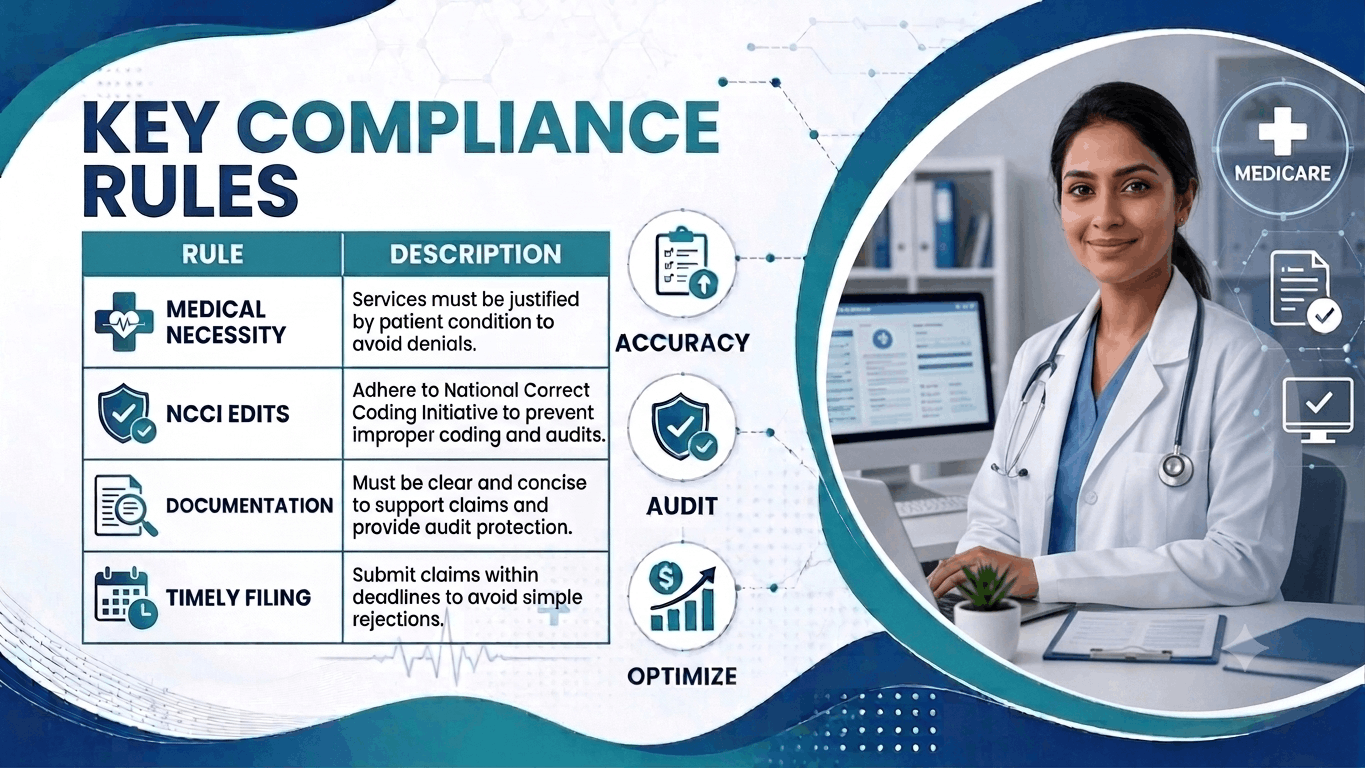
Medicare billing is governed by complicated and complex rules designed to ensure accuracy and prevent fraud. In 2026, compliance requirements are more important and complex than ever. As a healthcare provider you must ensure every claim meets CMS guidelines before submission.
| Rule | Description | Impact |
|---|---|---|
| Medical Necessity | Services must be justified | Prevents denials |
| Documentation | Must support claims | Audit protection |
| NCCI Edits | Prevent improper coding | Compliance |
| Timely Filing | Submit within deadlines | Avoid rejections |
Medicare reimbursement is based on structured payment systems like the Physician Fee Schedule (PFS) and DRG (Diagnosis-Related Groups). Understanding how payments are calculated helps providers optimize revenue.
| Component | Description | Impact |
|---|---|---|
| RVU | Value of service | Determines payment |
| Conversion Factor | Dollar multiplier | Updated yearly |
| Geographic Index | Location adjustment | Payment variation |
Billing errors are one of the biggest challenges providers like your healthcare specialty face. Most errors are preventable but can lead to significant financial loss of your practice. You need to understand these issues, it will help your practice improve accuracy.
| Error | Root Cause | Impact on Practice | How to Avoid It |
|---|---|---|---|
| Incorrect Coding | Lack of coding expertise or outdated knowledge | Claim denials, audits, revenue loss | Use certified coders, regular training, and coding audits |
| Missing Documentation | Incomplete or unclear clinical records | Payment delays or outright denials | Ensure complete documentation that supports medical necessity |
| Modifier Errors | Incorrect or missing modifiers on CPT codes | Underpayment or claim rejection | Apply correct modifiers and review payer-specific guidelines |
| Duplicate Billing | System errors or repeated claim submission | Claim rejection or compliance flags | Use billing software checks and track claim status before resubmission |
In the USA medical claim denials are a major revenue challenge for healthcare providers. Many denials are preventable with proper processes. Timely identification and correction are key to recovering revenue.
| Denial Reason | Root Cause | Impact on Revenue | Best Solution |
|---|---|---|---|
| Eligibility Issues | Patient coverage inactive or incorrect Medicare plan selection | Immediate claim denial and delayed payment | Verify eligibility and benefits before each visit (real-time checks) |
| Coding Errors | Incorrect CPT, ICD-10, or HCPCS codes; mismatch with documentation | Denials, underpayment, or audit risk | Conduct coding reviews, use certified coders, and ensure documentation supports codes |
| Missing Information | Incomplete patient data, provider details, or required fields in claim | Claim rejection or processing delays | Submit clean claims with all required fields and attachments |
| Authorization Issues | Prior authorization not obtained (common in Medicare Advantage plans) | Denial or non-payment for services | Obtain pre-authorization and follow payer-specific requirements |
Medicare billing is heavily regulated under federal laws designed to prevent fraud and abuse for all healthcare specialties including your. As a practice owner you need to understand these laws for compliance, because violations can result in audits, penalties, or legal action against your practice.
| Law | Purpose | Risk |
|---|---|---|
| False Claims Act | Prevent fraud | Heavy fines |
| Anti-Kickback Statute | No incentives | Legal penalties |
| Stark Law | Referral restrictions | Compliance risk |
| HIPAA | Data protection | Privacy violations |
Data highlights how billing errors affect your healthcare practice financially and operationally. It is clear that even small inefficiencies can lead to major losses over time.
| Metric | Industry Data | What It Means | Impact on Your Practice |
|---|---|---|---|
| Claim Denial Rate | ~5%–10% of total claims | A significant portion of claims are not paid on first submission | Delayed cash flow and increased administrative workload |
| Coding-Related Errors | ~20%–30% of denials | Coding mistakes are one of the top denial drivers | Revenue loss, rework, and higher audit risk |
| Preventable Denials | ~85%–90% | Most denials can be avoided with proper processes | Major opportunity to improve revenue with better workflows |
| Revenue Loss per Provider | $5,000–$15,000+/month (varies by size) | Small inefficiencies accumulate into large financial losses | Reduced profitability and operational inefficiency |
Outsourcing has become a strategic choice for your healthcare practice to improve efficiency and reduce costs. At House of Outsourcing we provide access to expert-level support without overhead.
| Factor | In-House Billing | Outsourced Billing | Impact on Your Practice |
|---|---|---|---|
| Cost | High overhead (salaries, training, software) | Lower operational cost with scalable pricing | Reduced expenses and better ROI |
| Expertise | Limited team knowledge; depends on staff experience | Access to certified billing & coding specialists | Fewer errors, better compliance, higher reimbursements |
| Efficiency | Slower processes due to workload and limited resources | Streamlined workflows with dedicated teams | Faster claim submission and quicker payments |
| Accuracy | Variable; prone to human error and turnover issues | Consistent, audit-driven accuracy | Lower denial rates and improved revenue cycle |
| Scalability | Difficult to scale with practice growth | Easily scalable with business needs | Supports expansion without additional hiring |
| Compliance | Risk of outdated knowledge on CMS rules | Up-to-date with Medicare regulations and payer changes | Reduced audit risk and regulatory issues |
Medicare billing for different healthcare specialties comes with several challenges due to its complexity and regulatory nature. Addressing these challenges proactively improves outcomes.
| Challenge | Root Cause | Impact on Practice | Effective Solution |
|---|---|---|---|
| Frequent Rule Changes | Ongoing CMS updates and policy revisions | Confusion, billing errors, and compliance risks | Continuous staff training and regular updates on Medicare guidelines |
| High Denial Rates | Coding errors, missing information, eligibility issues | Revenue delays and increased rework | Implement strong front-end verification and coding review processes |
| Compliance Pressure | Strict audits (RAC, MAC) and regulatory requirements | Risk of penalties, recoupments, and audits | Conduct internal audits and maintain complete, accurate documentation |
| Staff Limitations | Lack of experienced billing and coding professionals | Inefficiency, errors, and slower claim processing | Outsource to experienced billing teams or invest in staff training |

At House of Outsourcing, we provide expert Medicare billing solutions designed to reduce errors, improve compliance, and maximize revenue. Our certified Medicare billing team will act as an extension of your team, ensuring your practice Medicare billing process runs smoothly.
| Feature | Our Approach | Result for Your Practice | Business Impact |
|---|---|---|---|
| Expert Team | Certified Medicare billing & coding professionals with multi-specialty experience | High accuracy and fewer coding errors | Reduced denials and improved reimbursement rates |
| Compliance Focus | Experts follow CMS guidelines and perform regular internal audits | Full regulatory compliance and audit readiness | Lower risk of penalties, recoupments, and legal issues |
| Denial Reduction | Proactive eligibility checks, coding validation, and claim scrubbing | Cleaner claims and faster approvals | Improved cash flow and reduced rework costs |
| End-to-End Support | Complete RCM services from patient registration to payment posting | Seamless billing workflow with minimal gaps | Increased efficiency and staff productivity |
| Advanced Technology | Use of modern billing software and real-time reporting tools | Better tracking, transparency, and error detection | Data-driven decisions and optimized revenue cycle |
| Scalable Services | Flexible solutions tailored to practice size and specialty | Easy adaptation to growth and changing needs | Long-term cost savings and operational flexibility |
Medicare billing is complex, but with our right knowledge and support, it becomes manageable and highly profitable for your healthcare practice.
Practices that invest in accurate billing systems and acquire our expert support are better positioned to reduce denials, improve cash flow, and stay compliant in 2026 and beyond.
Let our experts handle billing complexities while your providers concentrate on delivering exceptional healthcare.
Get a free assessment from our billing experts