
Discover the latest Medicare telehealth billing guidelines, CPT coding practices, and documentation standards that improve claim accuracy and compliance.

Telehealth has become a permanent and essential part of healthcare delivery across the nation in 2026. What started as a temporary solution has now evolved into a core service model for many providers across specialties for patients of all ages.
However, while telehealth increases accessibility and convenience, billing for it has become more complex due to many reasons. The Medicare largest healthcare insurance has introduced specific rules, modifiers, and documentation requirements that providers must follow carefully before providing telehealth services to their patients in all states of the USA in 2026.
Recent data suggests that telehealth-related billing errors contribute to a growing number of claim denials, especially due to incorrect modifiers and place-of-service (POS) codes. This makes understanding telehealth billing not just helpful, but necessary for maintaining consistent revenue for your healthcare practice. Medicare Telehealth Billing Services
Need support with your billing workflow? Explore our medical billing and revenue cycle services or request a free consultation.
Medicare telehealth billing refers to the process of submitting claims for healthcare services delivered remotely using communication technologies such as video or audio by your practice to Medicare members.
It includes services like virtual consultations, remote monitoring, and follow-up visits conducted outside of traditional clinical settings. Your Healthcare practice needs to meet Medicare’s criteria to be reimbursed.
In simple terms, telehealth billing ensures that your healthcare practice is properly reimbursed for care delivered remotely, while staying compliant with Medicare’s evolving guidelines.
Medicare covers a variety of telehealth services across the USA to facilitate its members , but each type has its own billing requirements and limitations so make this process more trustworthy and easy for patients and providers. Understanding these categories helps your healthcare practice to bill correctly and avoid unnecessary denials.
| Category | Description | Example |
|---|---|---|
| Live Video Visits | Real-time interaction | Virtual consultation |
| Audio-Only Services | Telephone-based care | Follow-up calls |
| Remote Patient Monitoring (RPM) | Device-based monitoring | Chronic care tracking |
| E-Visits | Patient portal communication | Online check-ins |
Medicare requires from your side that your each service must meet specific criteria, including documentation and patient eligibility, to qualify for reimbursement without delays. Free Telehealth Billing Audit
As a healthcare provider you know that CPT codes are essential for telehealth billing because they define the service you have provided and determine reimbursement. You need to use the correct CPT code for the service you have provided, by using incorrect CPT codes is one of the most common reasons your telehealth claims get denied by Medicare.
| CPT/HCPCS Code | Service Description | Use Case | Key Billing Notes for Providers |
|---|---|---|---|
| 99213 | Established patient office/outpatient visit (E/M) | Video consultation for routine follow-ups | Must be real-time audio-video; append modifier 95 (or payer-required) and correct POS (02 or 10) |
| 99441 | Telephone E/M service (5–10 minutes) | Audio-only consultation when video is not available | Time-based; patient-initiated; not related to recent visit (within 7 days) |
| 99457 | Remote physiologic monitoring (first 20 minutes) | Managing chronic conditions via remote data (e.g., BP, glucose) | Requires interactive communication and documented time; device data must be collected and reviewed |
| G0425 | Telehealth consultation (initial, typically inpatient/ED, 30 min) | Specialist consult via telehealth | Time-based HCPCS code; must meet telehealth eligibility and documentation requirements |
| G2012 | Virtual check-in (brief communication, 5–10 min) | Quick follow-up to decide if visit is needed | Short communication (phone/video); cannot be related to recent E/M service |
| 99458 | Remote monitoring (each additional 20 minutes) | Ongoing remote care beyond initial 20 minutes | Add-on code to 99457; requires cumulative time tracking and documentation |
In the US healthcare system the telehealth modifiers are important in telehealth billing because they indicate how the service was delivered to patients by your healthcare practice. It is clear that incorrect or missing modifiers can result in immediate claim denials from Medicare, so you need to use modifiers accurately.
| Modifier | Description | When to Use |
|---|---|---|
| 95 | Synchronous telehealth service | Live video |
| GT | Interactive audio/video | Medicare-specific |
| FQ | Audio-only service | Telephone visits |
| FR | Supervisory telehealth | Resident supervision |
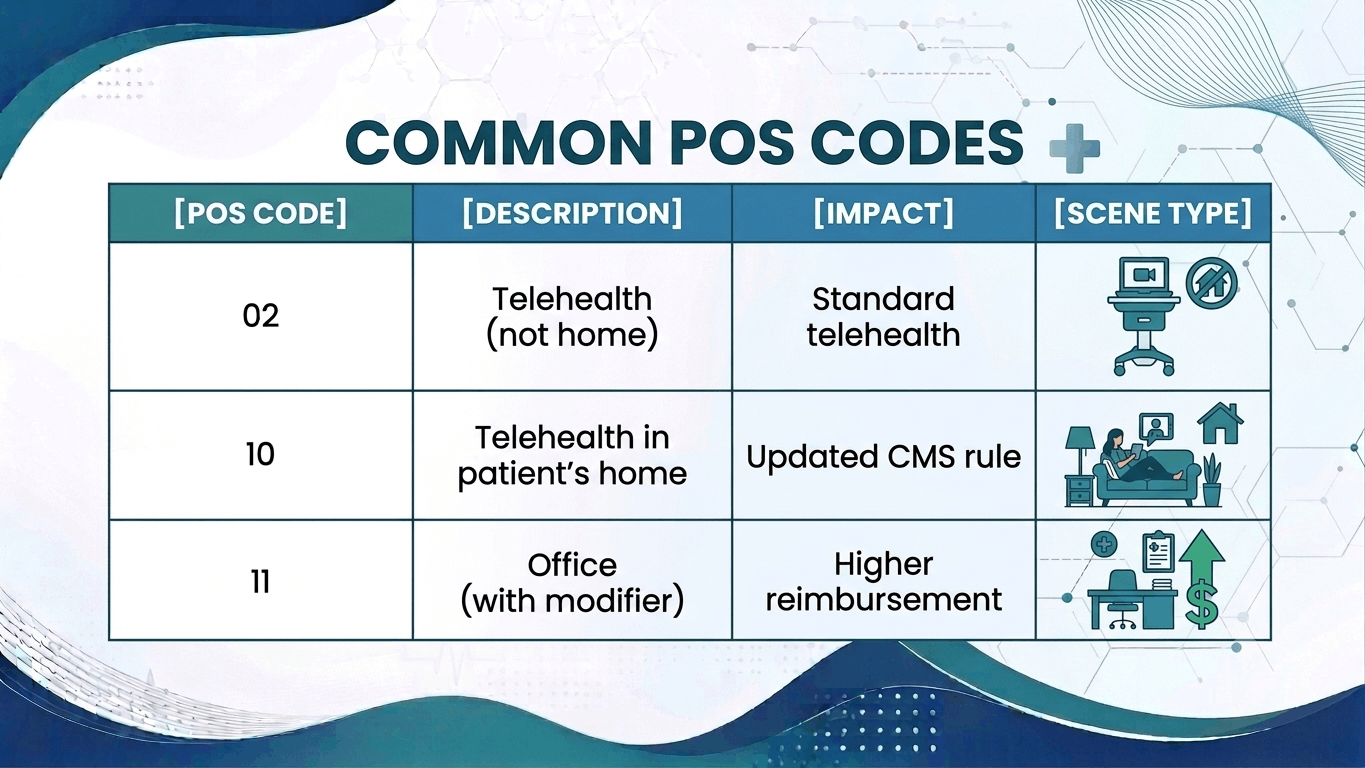
The POS codes tell Medicare where the service was delivered, which affects reimbursement rates by Medicare. It is important for your healthcare practice to use the right place of service by using the wrong telehealth POS code by your healthcare practice can lead to underpayment or denial. When you choose the correct POS code you will get maximum reimbursement.
| POS Code | Description | Impact |
|---|---|---|
| 02 | Telehealth (not home) | Standard telehealth |
| 10 | Telehealth in patient’s home | Updated CMS rule |
| 11 | Office (with modifier) | Higher reimbursement |

Medicare has established strict rules for telehealth billing to ensure proper use and prevent fraud across the nation. As a healthcare provider you must stay updated, as telehealth regulations continue to evolve. You need to understand it, becuase failure to follow these rules can lead to claim denials or compliance issues.
| Rule | Description | Impact |
|---|---|---|
| Patient Eligibility | Must meet criteria | Prevents denials |
| Documentation | Must support service | Audit protection |
| Approved Services | Only covered services | Compliance |
| Technology Requirements | Secure communication | HIPAA compliance |
Medicare telehealth billing requires precise use of HCPCS codes, correct modifiers, and updated place-of-service guidelines to ensure full reimbursement. Using accurate, CMS-aligned coding reduces denials, supports compliance, and helps providers capture every dollar for virtual care services delivered in 2026.
CPT code.
| HCPCS Code | Description | Usage in Telehealth |
|---|---|---|
| G0425 | Telehealth consultation, emergency department or initial inpatient, typically 30 minutes | Used for ED telehealth consults |
| G0426 | Telehealth consultation, emergency department or initial inpatient, typically 50 minutes | Moderate complexity consults |
| G0427 | Telehealth consultation, emergency department or initial inpatient, typically 70 minutes | High complexity consults |
| G0406 | Follow-up inpatient telehealth consult, typically 15 minutes | Short follow-up visits |
| G0407 | Follow-up inpatient telehealth consult, typically 25 minutes | Standard follow-up |
| G0408 | Follow-up inpatient telehealth consult, typically 35 minutes | Extended follow-up |
| G2010 | Remote evaluation of recorded video/images | Store-and-forward telehealth |
| G2012 | Brief communication technology-based service (virtual check-in) | 5–10 min virtual check |
| G2250 | Remote assessment of recorded video/images by non-physician | Used by qualified providers |
| G2251 | Brief virtual communication by non-physician (5–10 min) | Quick virtual interaction |
| G2252 | Extended virtual check-in (11–20 min) | Longer virtual communication |
As a healthcare provider you know that documentation is one of the most critical aspects of telehealth billing in the USA. Without proper documentation, even correctly coded claims can be denied.
| Element | Description | Importance |
|---|---|---|
| Patient Consent | Agreement for telehealth | Mandatory |
| Service Details | Type and duration | Accuracy |
| Provider Notes | Clinical documentation | Compliance |
| Technology Used | Video/audio method | Verification |
Accurate modifier usage is essential in Medicare telehealth billing to correctly identify how services are delivered and avoid costly claim rejections. Applying the correct modifier alongside proper place-of-service codes ensures compliance with CMS guidelines and maximizes reimbursement for virtual care services.
| Modifier | Description | Usage in Telehealth |
|---|---|---|
| 95 | Synchronous telemedicine service rendered via real-time interactive audio and video | Most commonly used for live video telehealth services |
| GT | Via interactive audio and video telecommunications systems | Used in specific payer cases (less common for Medicare) |
| GQ | Via asynchronous telecommunications system | Used for store-and-forward telehealth (limited Medicare use) |
| FQ | Service furnished using audio-only communication technology | Used when service is provided via audio-only (when allowed by Medicare) |
| FR | Service furnished via real-time interactive audio-only communication | Used for specific audio-only telehealth scenarios |
| CR | Catastrophe/disaster related | Used during public health emergencies when applicable |
| CS | Cost-sharing waived for COVID-19 related services | Applied when Medicare waives patient cost-sharing |
In the USA Medicare telehealth reimbursement depends on multiple factors, including CPT codes, modifiers, and POS codes used by your practice. It helps your practice to understand how payments are calculated and helps providers avoid underpayments. As a provider you need to understand that in many cases, telehealth services are reimbursed at similar rates to in-person visits if billed correctly.
| Factor | Description | Impact |
|---|---|---|
| CPT Code | Defines service | Payment base |
| Modifier | Indicates delivery method | Adjusts payment |
| POS Code | Location of service | Affects rate |
Telehealth billing errors are increasingly common due to changing regulations and lack of awareness. Many of these errors are preventable by healthcare practices by following rules. When you fix these errors can significantly improve your practice reimbursement rates.
| Error | Cause | Result |
|---|---|---|
| Missing Modifier | Incorrect billing | Denial |
| Wrong POS Code | Lack of knowledge | Underpayment |
| Incorrect CPT Code | Coding error | Rejection |
| Poor Documentation | Incomplete notes | Audit risk |
Telehealth billing is governed by several federal laws that ensure ethical and compliant practices. As an healthcare provider you must be aware of these regulations to avoid penalties from Medicare. Compliance with these laws is essential for long-term success of your healthcare practice.
| Law / Regulation | Purpose in Telehealth | Risk if Violated | Key Compliance Actions for Providers |
|---|---|---|---|
| HIPAA (Health Insurance Portability and Accountability Act) | Protects patient data during virtual visits and electronic communication | Data breaches, privacy violations, and financial penalties | Use secure, HIPAA-compliant telehealth platforms and safeguard patient information |
| False Claims Act (FCA) | Prevents fraudulent billing, including billing for services not properly delivered via telehealth | Heavy fines, legal action, and exclusion from Medicare | Bill only for services actually provided; ensure accurate coding and documentation |
| Stark Law | Restricts physician self-referrals for designated health services, including telehealth-related services | Denials, fines, and compliance violations | Avoid financial relationships that influence referrals; follow strict referral rules |
| Anti-Kickback Statute (AKS) | Prohibits offering incentives in exchange for patient referrals or telehealth services | Criminal penalties, fines, and imprisonment | Do not offer or accept payments, gifts, or incentives tied to referrals |
Telehealth continues to grow rapidly across the nation, but so do the challenges associated with billing. As a healthcare practice owner you need to understand industry trends that help you adapt and improve. The below insights highlight the importance of accurate telehealth billing.
| Metric | Statistic | Meaning |
|---|---|---|
| Telehealth Usage | Increased significantly since 2020 | Long-term adoption |
| Claim Denials | Rising due to errors | Revenue risk |
| Billing Errors | Up to 25–30% | Major issue |
| Revenue Loss | Thousands/month | Due to mistakes |
Outsourcing telehealth billing allows your practice team to focus on patient care while our experts handle complex billing requirements. It is especially useful for managing compliance and reducing errors. Telehealth Billing Outsourcing Experts
| Benefit | Explanation | Outcome |
|---|---|---|
| Expertise | Telehealth specialists | Fewer errors |
| Compliance | Updated knowledge | Audit protection |
| Efficiency | Faster claims | Better cash flow |
| Cost Savings | Reduced overhead | Higher profit |
As a practice owner you know that technology plays a central role in telehealth billing by enabling accurate documentation and efficient claim processing. However, it must be used correctly by your practice to avoid errors. Our specialist team combines technology with expert oversight to deliver the best results for your healthcare practice.
| Tool | Function | Benefit |
|---|---|---|
| Telehealth Platforms | Virtual care delivery | Convenience |
| EHR Systems | Patient records | Accuracy |
| Billing Software | Claim submission | Speed |
| AI Tools | Error detection | Reduced denials |
At House of Outsourcing, we are specialized in managing the complexities of Medicare telehealth billing with precision and compliance. We help your healthcare practice to reduce errors, improve reimbursements, and streamline your billing processes. We ensure your telehealth services are billed correctly, efficiently and on time.
| Feature | Our Approach | Benefit |
|---|---|---|
| Expert Team | Telehealth billing specialists | High accuracy |
| Compliance Focus | CMS-aligned processes | Audit protection |
| Denial Reduction | Proactive checks | Faster payments |
| Full Support | End-to-end services | Seamless workflow |
From eligibility verification to payment posting, we streamline your telehealth revenue cycle to improve cash flow and reduce billing challenges.
Get a free assessment from our billing experts