
Our Ophthalmology Medical Billing services help practices manage complex eye care procedures, specialty-specific coding, documentation requirements, and payer guidelines. We handle the complete revenue cycle through accurate claim submission, authorization management, denial resolution, and A/R follow-up to improve reimbursements, reduce revenue loss, and support long-term practice growth.


If you operate an ophthalmology practice in the United States, you already know that medical billing for eye care is unlike billing in any other specialty. No other field in American healthcare requires practitioners to navigate two entirely separate and sometimes competing sets of billing codes, eye-specific CPT codes and Evaluation and Management (E/M) codes, simultaneously, while also managing vision insurance versus medical insurance distinctions, frequency edit limitations, Local Coverage Determinations (LCDs) that vary by state, and one of the highest rates of coding-related claim denials in all of outpatient medicine.
There are approximately 18,000 practicing ophthalmologists in the United States, serving tens of millions of patients annually. Common conditions including cataracts (the leading cause of preventable blindness worldwide), glaucoma (affecting over 3 million Americans), age-related macular degeneration (AMD), diabetic retinopathy (affecting 7.7 million Americans with diabetes), and dry eye disease generate an enormous volume of claims, each requiring precise coding that most general medical billing teams are simply not equipped to handle correctly.
Need support with your billing workflow? Explore our medical billing and revenue cycle services or request a free consultation.
Ophthalmology medical billing is the specialized process of converting eye care services, office visits, diagnostic tests, surgical procedures, and injections, into standardized CPT, ICD-10, and HCPCS codes, and submitting those codes to Medicare, Medicaid, vision insurance plans, and commercial medical insurers for reimbursement.
What makes your ophthalmology billing fundamentally different from other specialties is the dual-code environment. Ophthalmologists are the only physicians in the United States who regularly choose between two entirely separate and legitimate sets of office visit codes for the same types of encounters: ophthalmology-specific eye codes (CPT 92002–92014) and standard Evaluation and Management codes (CPT 99202–99215). The decision of which set to use is not arbitrary, it depends on the specific nature of your patient visit, the payer’s requirements, and what is documented in the medical record.
�� Key Ophthalmology Billing Statistics
�� 18,000+ practicing ophthalmologists in the United States (AAO data)
�� 3 million+ Americans affected by glaucoma; leading cause of irreversible blindness (NEI)
�� 7.7 million Americans have diabetic retinopathy, a major driver of ophthalmology billing volume (NEI)
�� Cataracts affect more than 24 million Americans age 40+ (Prevent Blindness)
�� Intravitreal injection (anti-VEGF) billing is among the highest-volume procedure categories in Medicare Part B
�� Ophthalmology has one of the highest per-visit documentation and coding complexity levels in outpatient medicine
No aspect of ophthalmology medical billing generates more confusion, or more denials, than the choice between eye codes and E/M codes. This decision is unique to ophthalmology, and getting it wrong systematically is one of the most common reasons your eye care practice leave significant revenue on the table or attracts payer audits.
Eye codes are used exclusively for visits where the purpose is vision-related, where the ophthalmologist is evaluating the patient’s visual system without a medical history, physical examination outside the eye, or complex medical decision-making that extends beyond the ocular system. These codes require documentation of at least three of the 12 defined eye examination elements.The 12 eye examination elements that must be documented for eye code visits are:
| Eye Examination Element | Significance for Code Selection |
|---|---|
| Visual acuity (with or without correction) | Required baseline for virtually every eye visit |
| External examination (lids, lashes, lacrimal) | Documents adnexal health |
| Ocular motility (extraocular movements) | Essential for strabismus, diplopia, and neurological assessment |
| Pupils and iris (reactivity, shape, RAPD) | Critical for neurological and retinal disease assessment |
| Visual fields (confrontation or formal) | Required for glaucoma management documentation |
| Intraocular pressure measurement | Mandatory for glaucoma suspects and confirmed patients |
| Anterior segment (slit lamp — cornea, AC, lens) | Documents cataract, corneal disease, uveitis |
| Vitreous (anterior vitreous) | Relevant for retinal disease assessment |
| Retina and vessels (fundus examination) | Essential for AMD, diabetic retinopathy, optic nerve |
| Optic nerve head and cup-to-disc ratio | Critical for glaucoma documentation |
| Conjunctiva and sclera | Documents conjunctivitis, episcleritis, pterygium |
| Dilation status | Must document whether pupils were dilated and why/why not |
| CPT Code | Patient Type | Level of Service | Key Documentation Requirement |
|---|---|---|---|
| 92002 | New patient | Intermediate ophthalmological service | History + exam with medical decision making; new or existing condition not requiring additional workup |
| 92004 | New patient | Comprehensive ophthalmological service | Initiation of diagnostic and treatment program; multiple diagnoses or management options |
| 92012 | Established patient | Intermediate ophthalmological service | Evaluation of existing condition with history and exam; one or more visits |
| 92014 | Established patient | Comprehensive ophthalmological service | General medical observation, initiation of diagnostic/treatment program; 3+ of 12 exam elements |
E/M codes are appropriate in ophthalmology when the visit includes a medical component beyond purely ophthalmological assessment. This typically means: the patient has a systemic condition driving the eye visit (like diabetes causing diabetic retinopathy), the physician is managing a complex multi-system condition with ocular manifestations, there is significant medical decision-making involved in the treatment plan, or the visit involves a medical history and examination that extends beyond the 12 ophthalmological elements.
| E/M Code | Patient Type | MDM Level | Typical Ophthalmology Example |
|---|---|---|---|
| 99202 | New patient | Straightforward | New patient with seasonal allergic conjunctivitis — simple diagnosis, OTC treatment |
| 99203 | New patient | Low complexity | New patient dry eye evaluation with lifestyle modifications recommended |
| 99204 | New patient | Moderate complexity | New patient with suspected glaucoma — multiple tests ordered, medication initiation |
| 99205 | New patient | High complexity | New patient with severe uveitis requiring systemic workup and immunosuppressive therapy |
| 99212 | Established patient | Straightforward | Quick follow-up for stable blepharitis — no medication changes |
| 99213 | Established patient | Low complexity | Stable glaucoma follow-up — IOP check, no treatment changes |
| 99214 | Established patient | Moderate complexity | Glaucoma with uncontrolled IOP — medication change, referral consideration |
| 99215 | Established patient | High complexity | Diabetic macular edema with systemic disease coordination, injection planning |
Tip #1 — The Eye Code vs. E/M Decision Framework
The single most useful rule for choosing between eye codes and E/M codes in ophthalmology:
ASK: Does this visit involve a medical element (history, physical, MDM) beyond purely ophthalmological exam?
YES → Consider E/M codes (99202–99215)
NO / VISION ONLY → Use Eye codes (92002–92014)
Never mix both for the same encounter without a separately identifiable medical service.
When both are billed on the same day for the same patient, Modifier -25 is required on the
E/M code — and BOTH services must be separately documented with distinct clinical rationale.
Payers scrutinize this combination heavily. Document the E/M service as though the eye exam
did not happen — it must stand completely on its own to withstand audit.
Ophthalmology CPT codes cover five major categories, office visit codes, diagnostic testing, surgical procedures, injections, and ancillary services..
| CPT Code | Diagnostic Test | Key Billing Rule |
|---|---|---|
| 92015 | Refraction — determination of refractive state | Medicare does NOT cover; bill to vision insurance or patient; highly contested billing area |
| 92025 | Computerized corneal topography | Covered for keratoconus, pre-surgical planning; requires ICD-10 medical justification |
| 92082 | Visual field examination, intermediate | Glaucoma monitoring; covered with glaucoma ICD-10; document threshold values |
| 92083 | Visual field examination, extended (threshold) | Humphrey visual field; most common for glaucoma management |
| 92132 | Scanning computerized ophthalmic diagnostic imaging (anterior segment) — OCT | Cornea, anterior chamber; requires medical diagnosis supporting medical necessity |
| 92133 | SCODI (posterior segment) — optic nerve OCT | Glaucoma; pairs with H40 ICD-10 codes; document progression analysis |
| 92134 | SCODI (posterior segment) — retina OCT | AMD, diabetic macular edema, ERM; document lesion characteristics |
| 92225 | Ophthalmoscopy, extended, with retinal drawing — initial | First retinal exam with drawing; not billable every visit |
| 92226 | Ophthalmoscopy, extended — subsequent | Follow-up with retinal drawing; frequency limits apply |
| 92235 | Fluorescein angiography with interpretation and report | Retinal vascular disease; AMD; requires fluorescein dye; document indication |
| 92240 | Indocyanine green angiography | Choroidal disease; often paired with fluorescein; same-day billing rules apply |
| 92250 | Fundus photography with interpretation and report | AMD, diabetic retinopathy monitoring; document each eye separately with laterality |
| 92260 | Ophthalmodynamometry | Carotid disease assessment; relatively uncommon |
| 92270 | Electro-oculography with interpretation and report | Retinal pigment epithelium assessment |
| 92283 | Color vision examination | Occupational, inherited color deficiency; not routinely covered |
| 92285 | External ocular photography with interpretation | Documentation of external conditions; eyelid, surface |
| 76514 | A-scan ultrasound biometry | Pre-cataract surgical planning; always required before IOL implant |
| CPT Code | Surgical Procedure | Key Billing Note |
|---|---|---|
| 66984 | Extracapsular cataract extraction (ECCE) with IOL — complex or mature | Standard cataract extraction; 90-day global period |
| 66982 | ECCE with IOL — complex (e.g., posterior capsule defect, mature cataract) | Higher complexity; requires documentation of complicating factors |
| 66985 | Insertion of IOL secondary (separate procedure) | IOL implant after prior aphakia; requires specific documentation |
| 66986 | Exchange of IOL | Malpositioned or dysfunctional IOL replacement |
| 67516 | Suprachoroidal space injection (NEW 2024) | New code for drug delivery to suprachoroidal space; specific J-code required |
| 67028 | Intravitreal injection of pharmacologic agent | Highest-volume surgical code in ophthalmology; anti-VEGF (Avastin, Lucentis, Eylea) |
| 67210 | Photocoagulation, retinal (laser) — one or more sessions | Retinal tears, lattice degeneration; laser treatment |
| 67228 | Photocoagulation, panretinal — one or more sessions | Diabetic retinopathy; proliferative PDR; PRP laser |
| 67036 | Vitrectomy, pars plana, anterior approach | Vitreous hemorrhage, ERM, vitreous floaters |
| 67041 | Vitrectomy with epiretinal membrane stripping | ERM peeling; same as 67036 base + add-on |
| 67042 | Vitrectomy with focal/grid photocoagulation | DME with vitrectomy; combined code |
| 66170 | Trabeculectomy ab externo | Glaucoma filtering surgery; 90-day global period |
| 66174 | Transluminal dilation of aqueous outflow canal | Minimally invasive glaucoma surgery (MIGS) — canal-based |
| 66175 | Transluminal dilation with stent | MIGS with stent implantation (e.g., iStent) |
| 65820 | Goniotomy | Congenital glaucoma; pediatric glaucoma procedure |
| 67900 | Repair of brow ptosis (supraciliary approach) | Oculoplastics; functional blepharoplasty — must meet medical necessity criteria |
| 67901 | Repair of blepharoptosis — frontalis muscle technique | Ptosis repair; document functional visual field obstruction for coverage |
| 15820 | Blepharoplasty, lower eyelid | Lower lid; cosmetic unless documented functional impairment |
| 15823 | Blepharoplasty, upper eyelid with excessive skin and/or fat | Upper lid; most require visual field documentation for insurance coverage |
ICD-10 diagnosis code selection is critical in ophthalmology billing for two reasons: first, the correct code tells the payer what condition is being treated and whether the service is medically necessary; second, the ICD-10 code determines whether the claim goes to medical insurance or vision insurance. Using a routine vision ICD-10 code (like Z01.00 for routine eye exam) on a medical claim is a guaranteed denial. Using a medical diagnosis code for a routine refraction visit can trigger fraud allegations.
| ICD-10 Code | Condition | Insurance Type | Billing Notes |
|---|---|---|---|
| H26.9 | Cataract, unspecified | Medical | Specify type: H25 (age-related), H26 (other); laterality codes required |
| H25.11 | Age-related nuclear cataract, right eye | Medical | Most specific code for adult nuclear cataract; use H25.12 for left |
| H40.1130 | Primary open-angle glaucoma, bilateral, stage unspecified | Medical | Specify stage (0–4); bilateral if both eyes affected |
| H40.10X0 | Open-angle glaucoma, unspecified | Medical | Less specific; use more detailed stage codes when documented |
| H35.30 | Unspecified macular degeneration | Medical | Use H35.31 (dry AMD) or H35.32 (wet AMD) for greater specificity |
| H35.3130 | Dry AMD, right eye, stage unspecified | Medical | Specify stage (early/intermediate/advanced) and laterality |
| H35.3210 | Exudative AMD (wet), right eye | Medical | Requires laterality; paired with anti-VEGF injection billing |
| H36.039 | Proliferative diabetic retinopathy, unspecified eye | Medical | Always also code underlying diabetes (E11.9 for Type 2) |
| H36.011 | Nonproliferative diabetic retinopathy, mild, right eye | Medical | Stage matters for treatment planning; specify NPDR stage |
| H35.81 | Retinal edema | Medical | Macular edema from any cause; specify underlying etiology |
| H04.123 | Dry eye syndrome, bilateral | Medical | Evidentiary ICD-10 for dry eye disease management |
| H50.00 | Esotropia, unspecified | Medical | Strabismus; specify type (eso/exo/hyper/hypo) |
| H52.13 | Myopia, bilateral | Vision | Routine refractive error — bill to vision insurance, not medical |
| H52.4 | Presbyopia | Vision | Age-related near vision loss — vision insurance |
| Z01.00 | Encounter for examination of eyes — without abnormal findings | Vision | Routine eye exam — vision insurance only; never on medical claim |
| H10.13 | Acute atopic conjunctivitis, bilateral | Medical | Allergic conjunctivitis with acute presentation — medical |
| H16.9 | Keratitis, unspecified | Medical | Corneal inflammation — always medical insurance |
| H20.9 | Unspecified iridocyclitis (uveitis) | Medical | Uveitis — medical; often requires systemic workup coding |
Tip #2 — Always Dual-Code Diabetic Eye Disease
When billing for diabetic retinopathy or diabetic macular edema, you must code BOTH
the eye condition AND the underlying diabetes. Failing to include the diabetes code
alongside the retinopathy code is one of the most common ophthalmology ICD-10 errors:
Correct: H36.011 (Nonproliferative diabetic retinopathy, right eye) + E11.9 (Type 2 diabetes)
Incorrect: H36.011 alone without the diabetes ICD-10 code
Medicare and commercial payers use this dual-coding to assess medical necessity for
anti-VEGF injections, fluorescein angiography, and OCT imaging in diabetic patients.
Missing the diabetes code triggers medical necessity denials for all related services
Modifier misuse is the number one reason for claim denials in ophthalmology billing. Unlike most specialties that use a handful of standard modifiers, ophthalmology has a unique set of laterality modifiers for specific eyes and specific eyelids that are required on virtually every claim. Missing or misapplying these modifiers is one of the fastest ways to generate automatic denials across hundreds of claims.
| Modifier | Description | When Required | Example Use |
|---|---|---|---|
| RT | Right side / right eye | Required for all unilateral right-eye procedures and most right-eye diagnoses | Intravitreal injection right eye: 67028-RT |
| LT | Left side / left eye | Required for all unilateral left-eye procedures and most left-eye diagnoses | Cataract surgery left eye: 66984-LT |
| E1 | Upper left eyelid | Oculoplastic procedures on upper left eyelid | Upper left blepharoplasty: 15823-E1 |
| E2 | Lower left eyelid | Oculoplastic procedures on lower left eyelid | Lower left lid repair: 67900-E2 |
| E3 | Upper right eyelid | Oculoplastic procedures on upper right eyelid | Upper right blepharoplasty: 15823-E3 |
| E4 | Lower right eyelid | Oculoplastic procedures on lower right eyelid | Lower right lid repair: 67900-E4 |
| Modifier | Name | When to Use in Ophthalmology | Most Common Mistake |
|---|---|---|---|
| -25 | Separate Identifiable E/M | When an E/M is performed on same day as eye code or procedure — must be genuinely separate | Using -25 without separate documentation of the E/M service |
| -51 | Multiple Procedures | Bilateral eye procedures in same session (e.g., bilateral cataract surgery same-day) | Forgetting -51 when performing bilateral procedures |
| -55 | Postoperative Management Only | Optometrist or different physician manages post-op care after cataract | Not using -55 during co-management for post-op global period |
| -54 | Surgical Care Only | Surgeon provides only the operative component; postop managed elsewhere | Not using -54 when referring postop care to co-managing doctor |
| -58 | Staged / Related Procedure | Second eye cataract performed within the first eye's 90-day global period | Omitting -58 on second-eye cataract leads to automatic denial |
| -59 | Distinct Procedural Service | Clinically separate procedures on same day not normally billed together | Overusing -59 as a catch-all without clinical documentation |
| -24 | Unrelated E/M During Postop | E/M service for unrelated condition during 90-day surgical global period | Not appending -24 to E/M visits during cataract global period |
| -79 | Unrelated Procedure During Postop | Performing a different surgical procedure during the global period of another | Billing second-eye cataract without -79 or -58 |
| -95 | Telehealth (Audio-Video) | Synchronous telemedicine visits using traditional E/M or eye codes | Using outdated GT modifier when payer requires -95 |
| GY | Non-covered service — statutory exclusion | Refraction (92015) when billed to Medicare — must append GY | Not appending GY when billing refraction to Medicare |
Cataract surgery is the most commonly performed surgical procedure in the United States, with approximately 4 million procedures performed annually. It is also the most complex billing scenario in ophthalmology, involving global period management, co-management rules, premium IOL coding, bilateral surgery sequencing, and the most heavily audited modifier combinations in eye care billing.
CPT 66984 (standard extracapsular cataract extraction with IOL) carries a 90-day global surgical period. This means the preoperative visit on the day before surgery, the surgery itself, and all routine postoperative care for 90 days are bundled into a single payment. During this window, you cannot separately bill for routine follow-up visits unless you use modifiers to indicate an unrelated condition (-24) or a separate staged procedure (-58, -79).
| Billing Scenario | CPT Code | Required Modifier | Notes |
|---|---|---|---|
| First-eye cataract, surgeon provides all care | 66984 | RT or LT | Standard global billing; includes all postop visits |
| Second-eye cataract within 90 days of first | 66984 | LT or RT + -58 | MANDATORY -58 modifier; otherwise automatic denial |
| Surgeon does surgery only; optometrist does postop | 66984 + 99213 postop | Surgeon: -54 | OD: -55 | Co-management split; both bill for separate components |
| Complex cataract — posterior capsule rupture, mature/intumescent | 66982 instead of 66984 | RT or LT | Higher complexity code; document complicating factor explicitly |
| IOL exchange (dysfunctional or malpositioned lens) | 66986 | RT or LT | Secondary procedure; requires documentation of IOL failure reason |
| Routine postop visit within 90-day global period (by operating surgeon) | No separate visit billing | N/A — bundled | Cannot bill separately; bundled in global payment |
| Unrelated E/M visit during 90-day global period | 99213 or appropriate E/M | -24 | Must document that visit is completely unrelated to cataract |
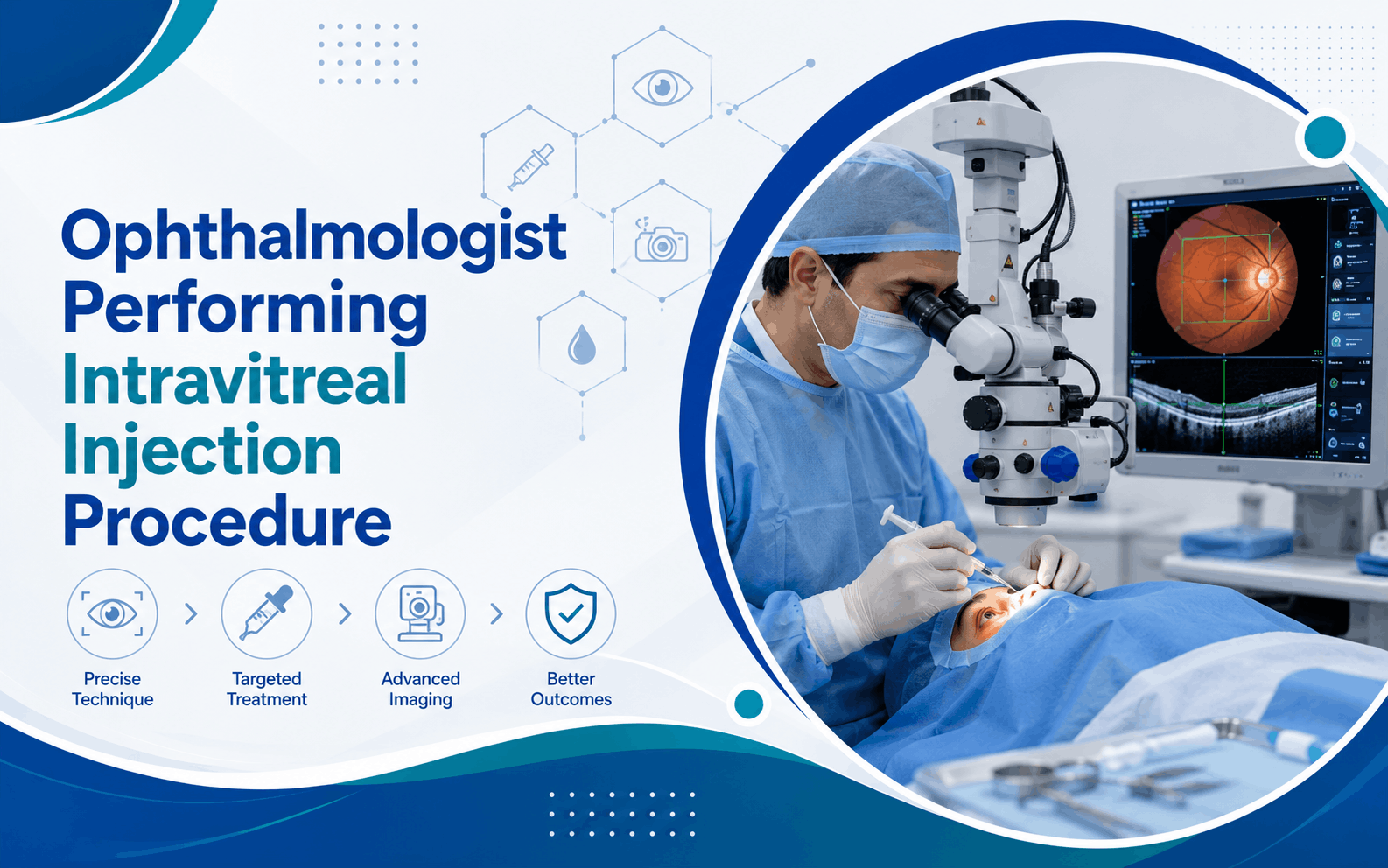
Intravitreal injection of anti-VEGF agents (CPT 67028) has become the highest-volume surgical procedure in ophthalmology by number of Medicare claims. Drugs like Avastin (bevacizumab), Lucentis (ranibizumab), Eylea (aflibercept), Vabysmo (faricimab), and Beovu (brolucizumab) are administered monthly or every few months for wet AMD, diabetic macular edema, and retinal vein occlusion.
| Component | Code | Description | Key Billing Rule |
|---|---|---|---|
| Injection procedure | 67028 | Intravitreal injection of pharmacologic agent | Bill once per eye per session; add RT or LT modifier |
| Avastin (bevacizumab) | J9035 | Bevacizumab, 10 mg | Off-label for AMD; not FDA-approved for this indication; coverage varies by payer |
| Lucentis (ranibizumab) | J2778 | Ranibizumab, 0.1 mg | FDA-approved for AMD, DME, RVO; bill per 0.1 mg administered |
| Eylea (aflibercept) | J0178 | Aflibercept, 1 mg | FDA-approved for AMD, DME, RVO; bill per 1 mg |
| Vabysmo (faricimab) | J0180 | Faricimab-svoa, 1 mg | Newest anti-VEGF; FDA-approved 2022; bill per 1 mg administered |
| Beovu (brolucizumab) | J0179 | Brolucizumab-dbll, 1 mg | AMD; bill per 1 mg |
| Triamcinolone (Kenalog) | J3301 | Triamcinolone acetonide, 10 mg | Used for DME, uveitis; bill per 10 mg |
| Ozurdex (dexamethasone implant) | J7312 | Dexamethasone intravitreal implant, 0.1 mg | Sustained-release implant; separate PA often required |
| Drug wastage | J-code with JW | Discarded portion of single-use vial | Document wastage amount; attach JW modifier to wasted-drug line item |
Glaucoma is a chronic, progressive disease requiring ongoing monitoring, serial diagnostic testing, medication management, and eventually surgical intervention. From a billing perspective, it is the most coding-intensive condition in general ophthalmology because each visit typically involves multiple separately billable diagnostic services, visual field testing, OCT of the optic nerve, IOP measurement, and clinical examination, alongside the visit code itself.
| Service | CPT Code | Billing Rule | ICD-10 Required |
|---|---|---|---|
| Office visit for glaucoma management | 99213–99215 or 92012/92014 | Choose E/M or eye code based on complexity; not both for same service | H40.1130 (primary OAG bilateral) or appropriate H40 code |
| Threshold visual field (Humphrey) | 92083 | Bill per eye with laterality; frequency limits apply (typically 1–2x/year per payer) | H40.xx (glaucoma codes) |
| OCT optic nerve / RNFL analysis | 92133 | Bill per eye with RT/LT; document baseline and progression analysis | H40.xx |
| Gonioscopy (angle exam) | 92020 | Anterior angle assessment; bill with office visit; separate service | H40.xx |
| IOP check visit (tonometry only) | 92100 | Serial tonometry at a single visit; not a complete exam code | H40.xx |
| Trabeculectomy (filtering surgery) | 66170 | 90-day global period; includes all postop care | H40.1130 or H40.1131–H40.1134 (staged) |
| MIGS — iStent, Hydrus, KDB | 66174, 66175, 65820 | MIGS procedure codes; often done simultaneously with cataract — use -51 modifier | H40.xx |
| Selective laser trabeculoplasty (SLT) | 65855 | Laser procedure; global period applies; document energy settings | H40.xx |
| Bleb revision (postop trabeculectomy) | 66220 | Bleb revision within global period requires modifier -78 | H40.xx + T85.09 for complication |

One of the most consequential decisions in ophthalmology billing services is determining which insurance to bill for each service, vision insurance or medical insurance. Billing the wrong one is not just a denial risk, it is a compliance risk. Systematically billing medical insurance for routine vision services, or vice versa, can constitute fraudulent billing.
| Service Type | Bill to Vision Insurance | Bill to Medical Insurance | Both? |
|---|---|---|---|
| Routine annual eye exam (no medical finding) | Yes — Z01.00 | No | No — vision only |
| Refraction (CPT 92015) | Yes — if vision plan covers it | No — Medicare expressly excludes refraction | Patient pays if no vision coverage |
| Cataract evaluation and surgery | No | Yes — H25/H26 ICD-10 codes | No — medical only |
| Glaucoma exam and treatment | No | Yes — H40 series | No — medical only |
| Diabetic retinopathy exam | No | Yes — H36.xx + E11.9 | No — medical only |
| AMD monitoring and treatment | No | Yes — H35.3x | No — medical only |
| Dry eye disease management | No | Yes — H04.12x | No — medical only |
| Contact lens fitting for medical condition (keratoconus) | No | Yes — H18.6x | No — medical only |
| New glasses after cataract surgery | Yes — if routine prescription | Medicare Advantage may cover post-cataract spectacles | Can be split if mixed |
| Routine contact lens fitting | Yes | No | No — vision only |
According to our two decades medical billing experience, ophthalmology practices are among the most actively audited medical specialties by CMS, MAC contractors, and the OIG. The combination of high procedure volumes (particularly intravitreal injections), multiple diagnostic test codes billable per visit, complex global period rules for cataract surgery, and the vision vs. medical insurance distinction creates numerous opportunities for billing errors, and numerous triggers for payer scrutiny.
| Audit Area | What Auditors Look For | Prevention Strategy |
|---|---|---|
| Intravitreal injection drug billing | Drug code units not matching administered dose; wastage not documented; JW modifier missing | Document injection details in real-time; match J-code units to dose administered |
| Cataract co-management | Non-patient-initiated referrals; missing -54/-55 modifiers; financial arrangements with optometrists | Written co-management agreements; patient-initiated documentation; clear modifier compliance |
| E/M upcoding | 99215 used for high percentage of visits without supporting MDM documentation | MDM documentation training; quarterly coding audit of E/M distribution |
| Premium IOL unbundling | Charging separately for services included in the global cataract payment | Clear fee schedules; documented ABN for premium upgrades |
| Visual field + OCT same-day billing | Both tests billed same day without documented medical necessity for each | Document clinical rationale for each test in physician's note |
| Second-eye cataract without -58 | Second cataract billed within 90-day global of first without -58 modifier | Pre-submission claim scrubbing rule for bilateral cataract cases |
| Refraction to medical insurance | 92015 billed to Medicare or medical insurance without GY modifier | GY modifier policy; refraction fee disclosure process |
The strongest ophthalmology revenue cycle starts with tracking the right KPIs, including clean claim rate, denial rate, days in A/R, and first-pass claim acceptance. Monitoring these metrics regularly helps identify billing gaps, improve reimbursement speed, and increase overall practice profitability.
| KPI | Industry Benchmark | Why It Matters in Ophthalmology |
|---|---|---|
| First-Pass Claim Acceptance Rate | ≥ 95% | Eye code / E/M code errors and missing modifiers drag this well below average in many practices |
| Net Collection Rate | ≥ 95% | With high volumes of vision-only patients, net collection rate gaps indicate uncollected patient balances |
| Days in Accounts Receivable | < 35 days | Intravitreal injection drug costs mean slow AR has an outsized cash flow impact in retina practices |
| Denial Rate | < 5% | Average ophthalmology practices run 12–18% denial rates; frequency edit violations are a major driver |
| Refraction Collection Rate | > 90% | Refraction billing to patients requires active collection processes distinct from insurance billing |
| Cataract Global Period Compliance | 100% modifier accuracy | -58 and -54/-55 modifier errors are among the most expensive, most preventable cataract billing mistakes |
| LCD Compliance Rate | > 98% | Any pattern of LCD violations triggers MAC review; track by service and diagnosis code combination |
More ophthalmology practices across the USA are outsourcing medical billing to reduce claim denials, improve reimbursement accuracy, and keep up with complex payer and coding requirements. Outsourcing gives physicians more time to focus on patient care while experienced billing specialists optimize revenue, ensure compliance, and accelerate cash flow.
| Performance Metric | In-House Average | After Outsourcing to Specialist | Improvement |
|---|---|---|---|
| Initial Denial Rate | 15–22% | 3–6% | ~75% reduction |
| First-Pass Clean Claim Rate | 78–85% | 94–97% | +12–18 percentage points |
| Days in Accounts Receivable | 45–60 days | 28–38 days | 30–40% improvement |
| Net Collection Rate | 85–91% | 95–98% | +7–13 percentage points |
| Modifier Error Rate | 8–15% of claims | < 1% | Near elimination |
| LCD Compliance Rate | 70–80% | > 98% | Systematic compliance |
Get a free assessment from our billing experts