
Our Pathology Medical Billing services help laboratories and pathology practices navigate complex coding, payer requirements, and professional and technical component billing. We manage claims from accurate submission through denial resolution and A/R follow-up, helping reduce revenue leakage, accelerate reimbursements, and strengthen financial performance.

| # | Section Title | Page Focus |
|---|---|---|
| 1 | What Is Pathology Medical Billing? | Overview & fundamentals |
| 2 | Why Pathology Billing Is Uniquely Complex | Challenges & compliance |
| 3 | Key Pathology CPT Codes for Billing | Code reference table |
| 4 | Pathology Medical Billing Services: What to Expect | Service breakdown |
| 5 | ICD-10 Coding in Pathology Billing | Diagnosis codes |
| 6 | Medicare & Medicaid Billing Rules for Pathologists | CMS guidelines |
| 7 | TC vs. PC Billing in Pathology | Technical/Professional components |
| 8 | Common Pathology Billing Denials & How to Fix Them | Denial management |
| 9 | HIPAA Compliance in Pathology Medical Billing | Regulatory compliance |
| 10 | Pathology Billing for Different Practice Settings | Solo, group, hospital |
| 11 | Technology & Software in Pathology Billing Services | LIS/EHR/billing tools |
| 12 | Metrics & KPIs Every Pathology Practice Should Track | Revenue analytics |
| 13 | Outsourced vs. In-House Pathology Billing Services | Decision framework |
| 14 | Future Trends in Pathology Medical Billing | 2025 & beyond |
| 15 | FAQs: Pathology Billing Services | Top 10 questions answered |

Pathology medical billing is one of the most complex areas of healthcare billing. In the USA whether you operate a pathology lab, an independent pathology practice, or a hospital-based pathology department, accurate billing is necessary for your growth. Even one coding error can lead to your claim denials, delayed payments, or compliance issues. That’s why using reliable pathology medical billing services from the start is important for maintaining steady revenue and reducing billing risks for your medical practice.
According to the American Pathology Foundation, pathologists provide diagnoses for approximately 70% of all clinical decisions made in healthcare. Yet pathology billing remains underfunded, under-documented, and frequently mishandled by billing teams who don’t specialize in this field. The result? Millions of dollars in lost revenue annually across pathology practices nationwide.
Our guide provides complete detail specifically for US-based pathologists, lab directors, practice managers, and healthcare administrators who want to understand the full landscape of pathology billing.
According to our two decades billing experience the pathology billing isn’t like billing for a physician office visit. The complexity is real, and it comes from multiple directions at once. Here’s what makes our pathology medical billing services a specialized craft:
DIn your pathology billing dual component billing (Technical Component and Professional Component) requires separate modifiers and payer rules, so we need to completely understand them for payments.
Your practice need specimen-based coding means one patient encounter can generate dozens of separate billable units
You need to use accurate codes, multiple CPT code families surgical pathology, cytopathology, immunohistochemistry, molecular pathology each with distinct rules, and have a big impact on your revenue.
Medicare’s Clinical Laboratory Fee Schedule (CLFS) governs lab tests separately from the Physician Fee Schedule, as an pathologist you need to understand it.
In the USA payer-specific policies vary dramatically across commercial insurers, Medicare Advantage plans, and Medicaid managed care organizations
Prior authorization requirements for advanced molecular testing are increasingly enforced
PAMA (Protecting Access to Medicare Act) price compression continues to impact reimbursement rates
According to our experience our accurate CPT coding is the foundation of any effective pathology medical billing strategy. The following table summarizes the major CPT code families used in pathology billing services across US practices:
| CPT Code Range | Category | Description | Typical Setting |
|---|---|---|---|
| 88300–88309 | Surgical Pathology | Gross and microscopic examination of surgical specimens (Level I–VI) | Hospital/Independent Lab |
| 88321–88325 | Consultation (Pathology) | Review of slides and consultations on referred material | Reference Lab |
| 88331–88334 | Intraoperative Consultation | Frozen section and touch prep during surgery | Hospital Pathology |
| 88104–88160 | Cytopathology | Pap smears, fine needle aspirations, non-gynecologic cytology | All Settings |
| 88342–88344 | Immunohistochemistry (IHC) | Per-antibody staining for tumor classification | Oncology/Hospital |
| 88360–88361 | Morphometric Analysis | Computer-assisted quantitative analysis of tissue | Academic/Hospital |
| 81200–81408 | Molecular Pathology (Tier 1 & 2) | Genetic and molecular testing panels | Reference/Specialty Lab |
| 86000–86849 | Immunology | Antibody assays, serology testing | Clinical Lab |
| 85000–85999 | Hematology | Blood counts, coagulation studies | Clinical Lab |
| 80047–80081 | Metabolic Panels | Basic and comprehensive metabolic testing | Clinical Lab |
Tip: Surgical Pathology Level Assignment |
The most common pathology billing error involves incorrect level assignment for 88300–88309 codes. Level I (88300) is gross examination only; Level VI (88309) covers the most complex multi-organ resections. Always tie your level selection to documented gross description and microscopic findings. |
You need to use your LIS (Laboratory Information System) to auto-suggest CPT levels based on specimen type, but always have a pathologist or certified coder validate the final assignment. |
Over-coding surgical pathology levels is a top OIG audit target. Under-coding leaves revenue on the table. Neither is acceptable. |
When you partner with our professional pathology billing services company, you should receive far more than just claim submission. A comprehensive pathology billing service covers the entire revenue cycle, from the moment a specimen is received through final payment posting and appeals.
| Service Component | What It Includes | Why It Matters |
|---|---|---|
| Charge Capture | Specimen-by-specimen CPT code assignment, modifier review, fee schedule mapping | Prevents under-billing and upcoding exposure |
| Claims Submission | Electronic claims to payers via clearinghouse, real-time eligibility verification | Accelerates payment, reduces rejections |
| Prior Authorization | Pre-auth for molecular tests, IHC panels, and high-value procedures | Prevents denials for advanced testing |
| Denial Management | Root-cause analysis, appeal letters, payer follow-up | Recovers denied revenue |
| Payment Posting | EOB reconciliation, contractual adjustment posting, patient balance allocation | Accurate AR tracking |
| Patient Billing | Statement generation, self-pay follow-up, payment plan management | Improves patient collections |
| Compliance Review | OIG Workplan monitoring, LCD/NCD review, audit readiness | Reduces compliance risk |
| Reporting & Analytics | Monthly KPI dashboards, denial trending, payer performance reports | Data-driven decisions |
ICD-10-CM diagnosis codes in your practice pathology billing serve a critical purpose, they justify medical necessity. Without the correct diagnosis code linked to your CPT codes, even perfectly coded surgical pathology claims will be denied or downcoded.
| ICD-10 Code | Description | Common Pathology Context |
|---|---|---|
| C18.x–C20 | Malignant neoplasm of colon, rectosigmoid, rectum | Colorectal biopsy/resection pathology |
| C50.x | Malignant neoplasm of breast | Breast core biopsy, excision, mastectomy |
| C34.x | Malignant neoplasm of bronchus and lung | Pulmonary wedge resection, VATS specimens |
| D05.x | Carcinoma in situ of breast | DCIS diagnosis on excisional biopsy |
| N40.0–N40.3 | Benign prostatic hyperplasia | Prostate needle core biopsy |
| K57.x | Diverticular disease of intestine | Colon resection specimens |
| R85.x–R87.x | Abnormal cytology findings | Pap smears, FNA cytology |
| Z12.x | Encounter for screening neoplasm | Screening colonoscopy biopsies |
As a pathologist you know Medicare is the dominant payer for many pathology practices, particularly those serving hospital outpatient departments, SNFs, and older patient populations. You need to understand CMS’s specific rules for pathology billing is essential to protecting your revenue.
| Medicare Payment System | Applies To | Key Resource |
|---|---|---|
| Clinical Laboratory Fee Schedule (CLFS) | Lab tests (80000s, 86000s, 81000s) | cms.gov/medicare/payment/clinical-laboratory-fee-schedule |
| Physician Fee Schedule (PFS) | Pathologist professional services (88xxx) | cms.gov/medicare/physician-fee-schedule |
| Outpatient Prospective Payment (OPPS) | Hospital outpatient lab (packaged services) | cms.gov/medicare/payment/prospective-payment-systems |
| PAMA (Protecting Access to Medicare Act) | CLFS rate-setting via private payer data | cms.gov/medicare/payment/clinical-laboratory-fee-schedule/pama |
As an experienced pathologist you know that one of the most misunderstood aspects of pathology medical billing is the Technical Component (TC) and Professional Component (PC) split, and getting it wrong can mean both overbilling and underbilling simultaneously.
| Component | Modifier | Who Bills It | What It Covers | Billed On |
|---|---|---|---|---|
| Technical Component | -TC | Hospital or independent lab | Equipment, supplies, lab personnel, overhead | UB-04 (facility) or CMS-1500 |
| Professional Component | -26 | Pathologist (physician) | Interpretation, report, medical decision-making | CMS-1500 |
| Global Service | No modifier | Independent pathologist who owns lab | Both TC and PC together | CMS-1500 |
Tip: Avoiding TC/PC Billing Errors |
Hospital-employed pathologists typically cannot bill the TC, that belongs to the hospital. Billing TC when employed is a false claims exposure. |
Independent pathologists who both own and staff their lab bill globally (no modifier). If they use a hospital’s equipment, they bill only -26. |
Always document your employment/independent contractor arrangement in writing, as payers and OIG auditors look for alignment between billing status and contractual arrangement. |
Medicare Administrative Contractors (MACs) have specific policies on TC/PC splitting — verify with your MAC before changing billing patterns. |
You know that denial management is where your pathology practice lose the most recoverable revenue. According to the Medical Group Management Association (MGMA), practices that actively work denials recover 63% more revenue than those that don’t. Here are the most common pathology billing denials and their solutions for your understanding.
| Denial Reason | Root Cause | Fix / Prevention Strategy |
|---|---|---|
| Medical Necessity Denial | Missing or incorrect ICD-10; no clinical indication on requisition | You need to mandate clinical indication on all requisitions; map CPT to supporting ICD-10 automatically in LIS |
| Bundling/Unbundling Error | Multiple CPT codes that CMS bundles via NCCI edits | Your team must run all claims through NCCI edit checker before submission; check CCI tables monthly |
| Missing/Invalid NPI | Referring provider NPI not on claim; pathologist NPI not enrolled | Verify NPI in NPPES before claim; update payer rosters when providers change |
| Duplicate Claim | Same CPT/date/patient submitted twice | Implement claim scrubbing rules; track original claim numbers in billing software |
| Timely Filing Exceeded | Claim submitted outside payer's filing deadline | Track payer-specific deadlines; set 45-day submission alerts in billing system |
| Prior Auth Not Obtained | Molecular/IHC test required PA that wasn't obtained | Build PA requirement triggers into LIS/order entry for all applicable CPTs |
| LCD Non-Coverage | Service performed doesn't meet Local Coverage Determination criteria | Review applicable LCDs before testing; issue ABN when coverage uncertain |
| Incorrect Modifier | -TC on professional-only bill; -26 on global billing | Audit modifier assignment monthly; train billers on TC/PC rules by practice setting |
Every pathology billing service you use for your practice, whether in-house or outsourced must operate within HIPAA’s Privacy and Security Rules. Pathology labs are covered entities, and billing vendors are business associates under HIPAA.
✅ HIPAA Compliance Checklist for Pathology Billing |
All billing vendors must sign a Business Associate Agreement (BAA). PHI transmitted for billing must use encrypted, HIPAA-compliant channels. Your billing staff must need to complete annual HIPAA training. Access to patient data must follow minimum necessary standards. Breach notification procedures must be in place and tested. |
.
Pathology billing rules and workflows vary depending on whether you’re in a private independent lab, a hospital department, an academic medical center, or a reference laboratory. It is important for your practice growth to understand these distinctions to set up your pathology billing correctly.
| Practice Setting | Billing Model | Key Considerations |
|---|---|---|
| Independent/Private Pathology Group | Global billing (TC + PC) on CMS-1500 | Own equipment; full revenue capture; highest billing complexity |
| Hospital-Employed Pathologist | PC only (-26 modifier); hospital bills TC | Salary/employment arrangement; RVU-based compensation; hospital owns billing for TC |
| Academic Medical Center | Split billing — faculty bill PC; institution bills TC | Teaching physician rules apply; resident supervision documentation required |
| Reference Laboratory | TC only for send-out testing; PC for interpretations | Requisition completeness critical; multi-state licensure may be required |
| Telepathology | PC (-26) billed by interpreting pathologist | Payer policies on telepathology vary; document platform and location |
According to our two decades of billing experience, the right technology stack is the backbone of an efficient pathology billing operation. From your Laboratory Information System (LIS) to your billing clearinghouse, each component must integrate cleanly to avoid revenue leakage.
| Technology Layer | Purpose | Examples / Resources |
|---|---|---|
| Laboratory Information System (LIS) | Specimen tracking, CPT code suggestion, report generation | Sunquest, Cerner PathNet, Epic Beaker, Soft Computer |
| Practice Management/Billing Software | Claims creation, payer submission, payment posting, denial tracking | AdvancedMD, Kareo, athenahealth, Waystar |
| Clearinghouse | Electronic claim transmission, real-time eligibility, ERA processing | Change Healthcare, Availity, Office Ally |
| Coding Encoder | CPT/ICD-10 reference, NCCI edits, LCD lookup | Optum360 EncoderPro, TruCode, 3M CodeFinder |
| Analytics/BI Tool | Revenue dashboards, denial trends, payer performance | Power BI, Tableau, built-in billing software reports |
Tip: LIS-to-Billing Integration |
• The biggest source of charge capture errors in pathology is the gap between the LIS and billing system. Ensure your LIS exports completed CPT codes (not just specimen types) and that the mapping table is reviewed quarterly. |
• Implement automated charge posting where your LIS triggers a charge in the billing system upon pathologist sign-out, this eliminates the manual charge entry step and reduces lag. |
• Track your ‘charge lag’ metric (time from specimen sign-out to claim submission). Industry benchmark is under 48 hours for lab claims. |
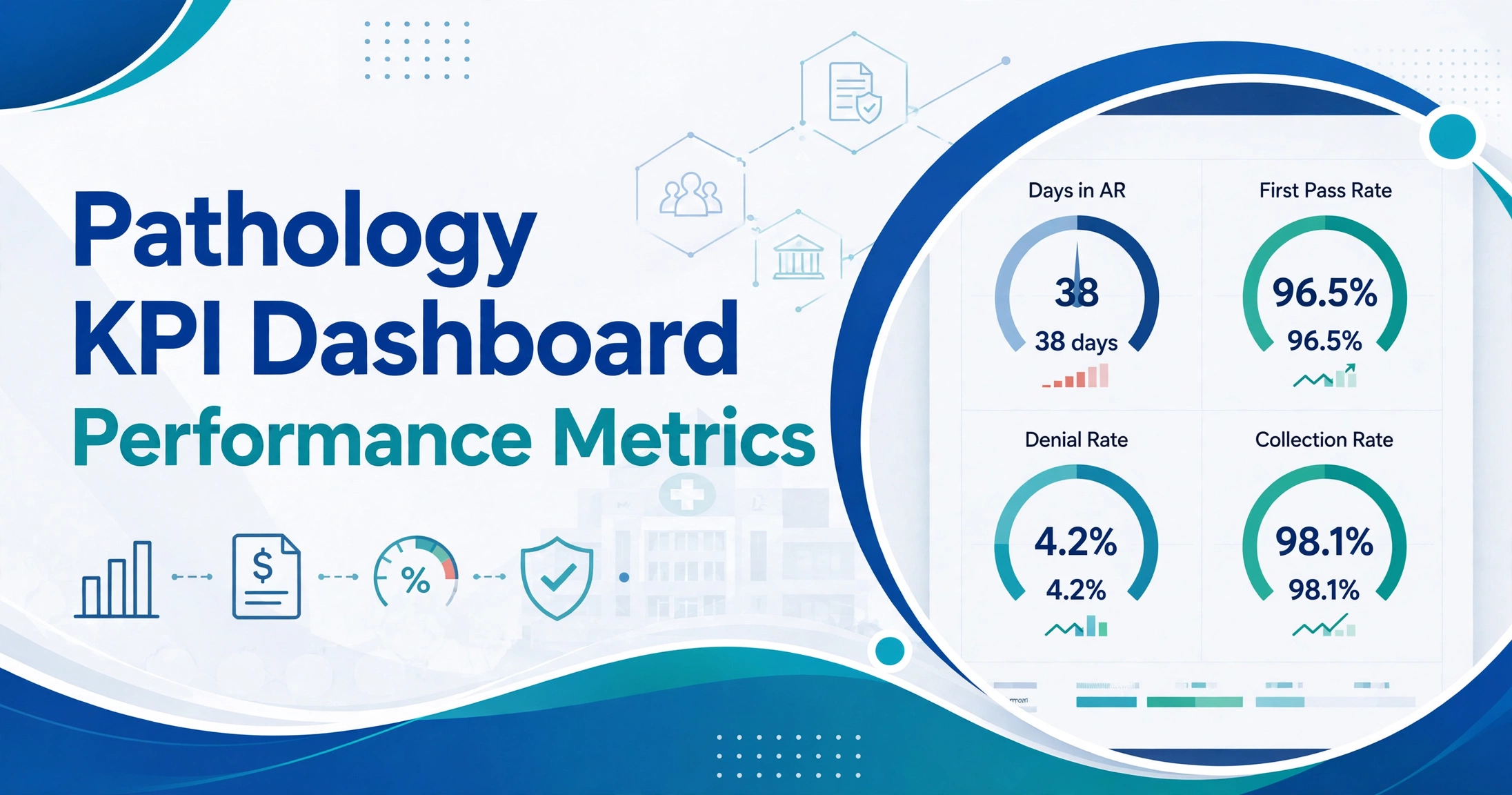
It is clear that you can’t improve what you don’t measure. Effective pathology medical billing services rely on data-driven performance management. Here are the essential KPIs for your pathology medical billing:
| KPI | Formula / Definition | Benchmark Target |
|---|---|---|
| Days in AR | Total AR ÷ (Charges per day) | < 35 days |
| First Pass Resolution Rate | Claims paid on first submission ÷ Total claims | > 95% |
| Denial Rate | Denied claims ÷ Total claims submitted | < 5% |
| Clean Claim Rate | Claims accepted without edits ÷ Total claims submitted | > 98% |
| Collection Rate | Collections ÷ Net adjusted charges | > 95% |
| Cost to Collect | Total billing cost ÷ Total collections | 3–6% for outsourced billing |
| Charge Lag | Days from sign-out to claim submission | < 48 hours |
| Underpayment Rate | Claims paid below contracted rate ÷ Total paid claims | < 2% |
One of the most consequential decisions a pathologist can make is whether to manage billing in-house or partner with a professional pathology billing services company. Here’s a comprehensive comparison to help you decide:
| Factor | In-House Billing | Outsourced Billing Services |
|---|---|---|
| Startup Cost | High — staff, software, training, compliance setup | Low — typically percentage of collections or flat fee |
| Ongoing Cost | Salaries, benefits, software licenses, coding updates | Predictable % of revenue; no HR overhead |
| Expertise Level | Dependent on staff turnover and training investment | Dedicated pathology billing specialists with current training |
| Scalability | Difficult — hiring lags volume spikes | Scales immediately with volume |
| Compliance Monitoring | Requires internal audit program | Often included; specialists track OIG, PAMA, LCD updates |
| Technology Access | Must purchase and maintain | Vendor provides up-to-date tools |
| Revenue Performance | Variable — staff turnover creates dips | Consistent — accountability via SLA and reporting |
| Best For | Large hospital systems with dedicated billing departments | Independent labs, private groups, growing practices |
�� Pro Tip: Evaluating a Pathology Billing Services Vendor |
You need to ask specifically about your pathology billing team’s credentials are there CAC-certified coders (AHIMA) or CPC-certified coders (AAPC) with pathology experience on staff? |
Request a sample monthly reporting package before signing. You should see denial breakdown by reason code, AR aging by payer, and collection rate trend at minimum. |
Verify they use NCCI edits and LCD lookups in their workflow, not just a generic claim scrubber. |
Insist on a BAA and ask for their last HIPAA security assessment or SOC 2 report. |
Is Your Pathology Practice Leaving Revenue on the Table?
House of Outsourcing delivers specialized pathology medical billing services that maximize reimbursements, eliminate denials, and keep you 100% compliant — so you can focus on diagnostics, not billing battles.
�� Contact House of Outsourcing Today → www.houseofoutsourcing.com
The pathology billing landscape is evolving rapidly. Practices that anticipate these changes will be positioned to protect and grow their revenue. Here’s what’s shaping the future of pathology medical billing services:
AI-Powered Coding Assistance: Artificial intelligence tools are beginning to auto-suggest CPT codes from pathology report text, reducing human error and coding time significantly
PAMA Price Compression Continues: Medicare CLFS rates will continue to adjust based on private payer rate reporting, practices must monitor PAMA cycles to anticipate reimbursement changes
Expansion of Molecular Pathology Billing: As genomic testing becomes standard of care in oncology, molecular pathology CPT codes (81200–81408) will represent a larger share of pathology revenue and a larger compliance target
Value-Based Contracts: Some integrated health systems are moving pathology toward quality and outcomes-based payment arrangements pathology billing services must adapt to capture quality metrics
Interoperability Mandates: CMS interoperability rules require improved data exchange between labs, EHRs, and payers, expect better automated prior auth and real-time claim adjudication
Telehealth and Digital Pathology Expansion: Remote pathology interpretation is growing; billing for digital slide review requires understanding of evolving payer policies and jurisdiction-specific rules
These are the most common questions US pathologists, lab directors, and practice managers ask about pathology billing. We’ve answered each one with the depth your revenue cycle deserves.
The most frequently used CPT codes in pathology billing are the surgical pathology codes 88305 (Level IV — the workhorse of surgical pathology), 88342 for immunohistochemistry per antibody, and 88175 for ThinPrep Pap smears in cytopathology. Molecular pathology codes in the 81200–81408 range are growing rapidly due to genomic oncology testing. The specific codes your practice bills most will depend on your specialty mix — gastrointestinal, oncology, gynecologic, and dermatopathology each have dominant CPT families
Pathology billing differs in several fundamental ways. First, billing is specimen-driven, not encounter-driven — one patient visit can generate 10 separately billable specimens. Second, pathology has a unique two-component billing structure (Technical and Professional) that requires modifier discipline. Third, pathologists bill under two fee schedules simultaneously: the Physician Fee Schedule for professional services and the Clinical Laboratory Fee Schedule for laboratory testing. These layers of complexity don’t exist in most other specialties
G3002 and G3003, introduced by CMS in January 2023, represent the most significant new billing opportunity for pain management practices in years. These HCPCS codes allow pain physicians to bill for the monthly chronic pain management services they were already providing, care plan management, pain assessment, medication review, care coordination, but previously had no way to capture in a billing code.
Medicare reimburses pathology services through two main payment systems. Laboratory tests (CPT codes in the 80000s, 81000s, and 86000s) are paid under the Clinical Laboratory Fee Schedule (CLFS), which was significantly restructured under PAMA (Protecting Access to Medicare Act) to align rates with private payer payments. Pathologist professional services (88xxx codes) are paid under the Physician Fee Schedule based on RVU values. For current rates, consult the CMS Fee Schedule search tools. Medicare Advantage plans may use different rates — always verify with each plan
The top five denial reasons in pathology billing are: (1) Medical necessity denials due to missing or incorrect ICD-10 codes, (2) NCCI bundling edits flagging incompatible CPT code combinations, (3) Missing prior authorization for molecular or IHC testing, (4) Incorrect TC/PC modifier usage, and (5) Timely filing violations. Each of these has a systematic fix — the key is tracking denial reason codes in your billing system so you can identify patterns and address root causes rather than fixing claims one at a time
Traditional Medicare does not require prior authorization for most standard pathology tests, but Medicare Advantage plans and commercial insurers increasingly require pre-authorization for advanced molecular testing, large IHC panels, and high-cost genetic assays. The prior authorization requirements are payer-specific and change frequently. The best practice is to build a PA requirement trigger into your LIS order entry system that flags tests requiring authorization before the specimen is processed. Retroactive authorizations are increasingly difficult to obtain, so prevention is critical
The highest compliance risks in pathology billing include: upcoding surgical pathology levels (the OIG specifically targets 88305 vs. lower-level codes), improper unbundling of IHC stains, billing for tests not actually performed or interpreted, missing ABNs for non-covered services, and STARK/Anti-Kickback issues related to lab referral arrangements. The OIG Work Plan lists active pathology billing focus areas annually. Every pathology practice should conduct an internal billing compliance audit at least once per year
For most independent pathology groups and growing labs, outsourcing pathology billing services to a specialized vendor delivers better financial performance at lower total cost than in-house billing. The key advantage is access to pathology-specific coders and compliance specialists without the overhead of hiring, training, and retaining them as employees. The risk is vendor dependency and data security — which is why vetting vendors rigorously (BAA, security posture, references, pathology-specific experience) is essential. Large academic medical centers and health system-based pathology departments often have sufficient volume and infrastructure for in-house billing, but even they frequently benefit from outsourced coding audits
Strong pathology billing documentation includes: (1) Complete requisition with ordering provider NPI, patient demographics, and clinical indication; (2) Gross description that supports the CPT level assigned (especially for 88300–88309); (3) Microscopic description with diagnostic findings; (4) Final diagnosis with ICD-10-mappable language; (5) Documentation of additional procedures performed (special stains, IHC, frozen sections); and (6) Pathologist signature and sign-out date. For cytopathology, the Bethesda System terminology for gynecologic cytology is required for Pap test coding. Deficient reports are the single largest driver of pathology billing compliance risk
House of Outsourcing provides end-to-end pathology medical billing services tailored to US pathology practices — from solo pathologists to multi-site lab networks. Our pathology billing team includes certified coders with specialty expertise in surgical pathology, cytopathology, immunohistochemistry, and molecular testing. We handle charge capture, claims submission, prior authorization, denial management, compliance monitoring, and custom reporting. Our clients consistently achieve first-pass resolution rates above 96% and collection rates above 97%. If your pathology practice is struggling with high denial rates, slow AR, or compliance concerns, contact House of Outsourcing today for a free pathology billing assessment. Visit www.houseofoutsourcing.com or call us to speak with a pathology billing specialist
We’ve compiled the most important external resources for US pathology billing compliance and coding accuracy. Bookmark these for your team:
| Resource | Organization | URL / Access |
|---|---|---|
| Clinical Laboratory Fee Schedule | CMS (Medicare) | cms.gov/medicare/payment/clinical-laboratory-fee-schedule |
| Physician Fee Schedule Search | CMS (Medicare) | cms.gov/medicare/physician-fee-schedule/search |
| NCCI Policy Manual | CMS / NCCI | cms.gov/medicare/coding-billing/national-correct-coding-initiative-edits |
| ICD-10-CM Official Guidelines | CMS / CDC | cms.gov/medicare/coding-billing/icd-10-codes/icd-10-cm-documentation |
| OIG Work Plan | HHS Office of Inspector General | oig.hhs.gov/reports-and-publications/workplan/index.asp |
| HIPAA Compliance Resources | HHS Office for Civil Rights | hhs.gov/hipaa/index.html |
| CPT Code Information | American Medical Association | ama-assn.org/practice-management/cpt |
| CAP Economic Affairs | College of American Pathologists | cap.org/advocacy/economic-affairs |
| MGMA Benchmarking Data | Medical Group Management Assoc. | mgma.com/data/benchmarking-data/mgma-datadive |
| State Medicaid Overviews | Medicaid.gov | medicaid.gov/state-overviews/index.html |
Get a free assessment from our billing experts