
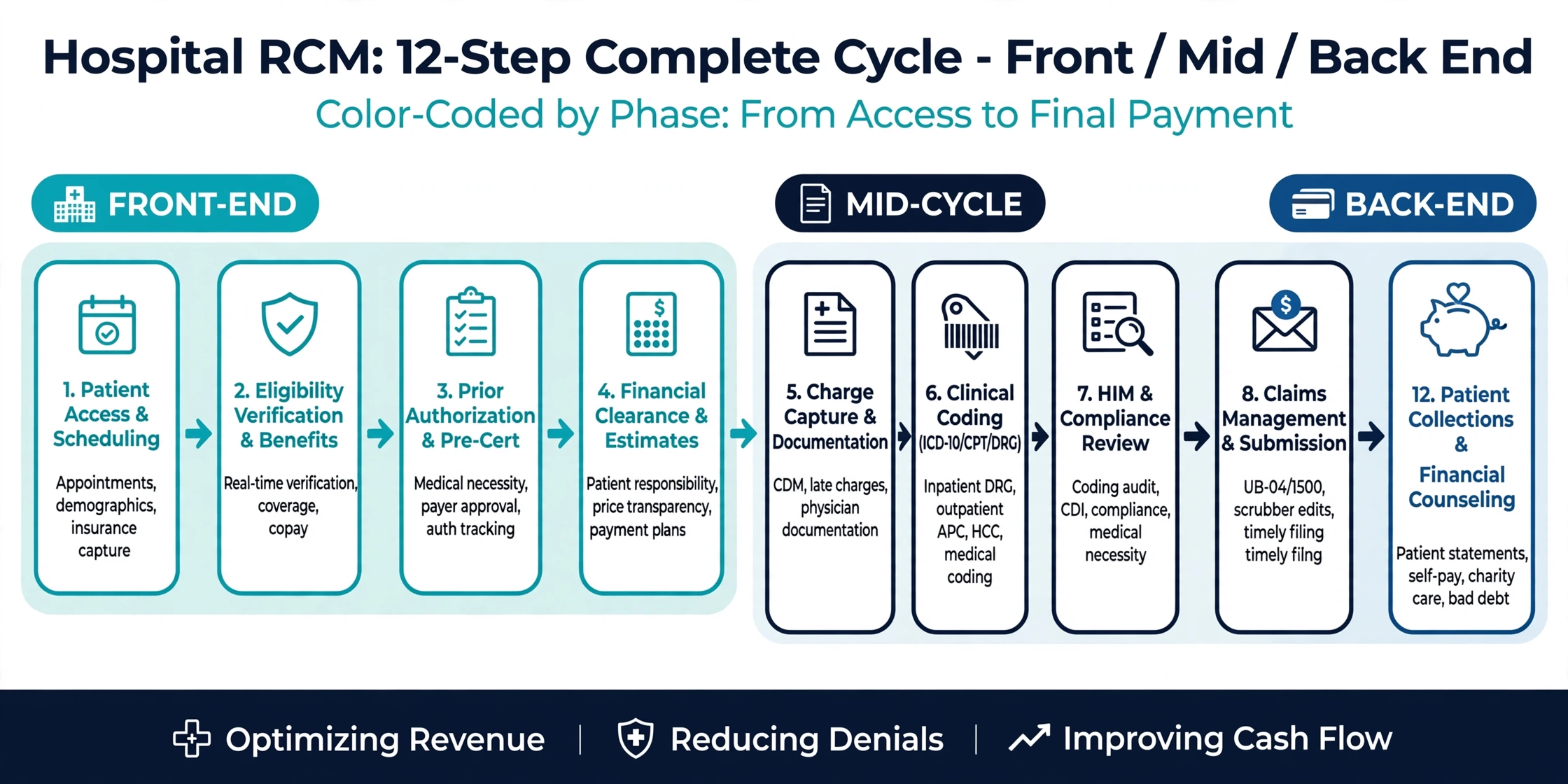
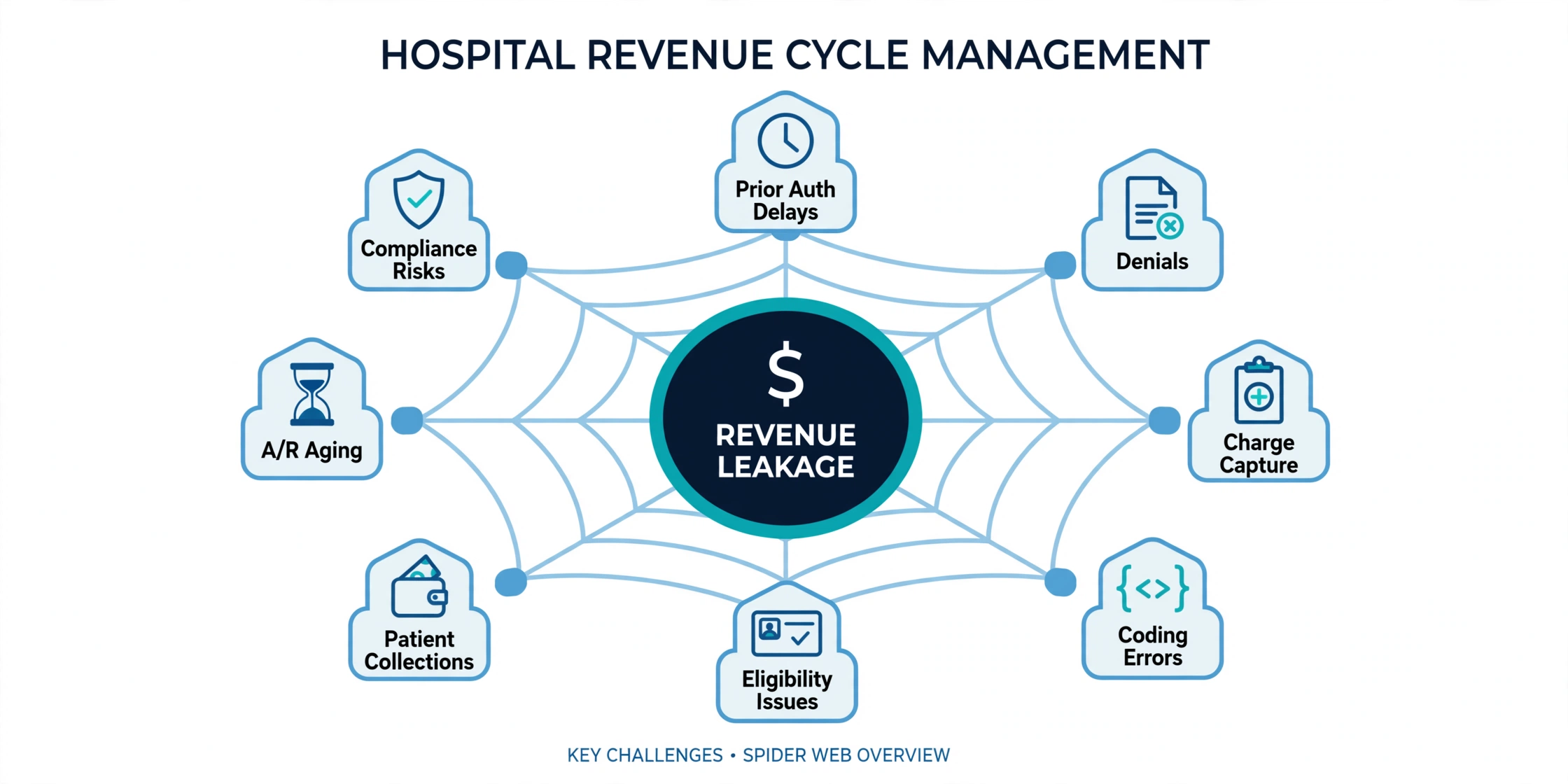
Our Hospital RCM services help healthcare organizations optimize revenue through accurate coding, claims management, compliance support, and denial prevention. We streamline complex hospital billing workflows to improve reimbursements, reduce revenue leakage, and support long-term financial performance.

Prior authorization can look like a simple question: “Does the payer approve this service before we provide it?” In practice, it is much more complicated in reality.
A successful prior authorization process may require eligibility verification, benefit review, payer-specific research, accurate CPT/HCPCS and ICD-10-CM information, medical-necessity documentation, clinical records, timely submission, persistent follow-up, authorization tracking, and, most importantly making sure the approval actually matches the service that is eventually performed and billed to the insurance.
That is why prior authorization should not be treated as an isolated front-office task. It is a critical connection point between patient access, clinical care, medical billing, and revenue cycle management.
At House of Outsourcing, we help healthcare organizations manage prior authorization and other revenue-cycle processes with a structured approach designed to reduce avoidable administrative delays and authorization-related claim problems.
This guide walks providers and practice administrators through the prior authorization process, from the moment a service is ordered to the point where an authorized service is correctly reflected on the claim.
Prior authorization is the process of obtaining approval from a patient’s health insurance plan before certain medications, procedures, treatments, diagnostic tests, or other healthcare services are provided by your practice, clinic or hospital. The process typically involves verifying coverage requirements, confirming medical necessity, submitting supporting clinical documentation, and receiving the payer’s authorization decision.
At House of Outsourcing, we provide prior authorization support tailored to your practice, services, and payer requirements. Our team helps verify authorization requirements, prepare and submit requests, track pending cases, follow up with payers, and address authorization-related issues to help reduce administrative workload and prevent avoidable treatment or reimbursement delays.
Prior authorization, often called PA, preauthorization, pre-certification, or preapproval, is a payer process used to determine whether certain services, procedures, medications, equipment, or treatments meet applicable coverage requirements before they are provided.
The exact terminology and process can vary by payer and health plan. A payer may review factors such as:
Prior authorization happens before the claim, but mistakes made during this stage often appear later as billing problems. Imagine that your practice performs an expensive procedure. The patient’s insurance is active and the procedure is covered, but the plan required prior authorization and no authorization was obtained.
The clinical service has already been delivered. Staff time and resources have already been used. Now the claim may face an authorization-related denial. That is why we encourage providers to think of PA as a revenue protection checkpoint, not simply an insurance formality. A well-managed authorization workflow can help practices:
There is no universal list that applies to every insurance plan. However, prior authorization is frequently associated with higher-cost, specialized, recurring, or clinically controlled services.
| Service Category | Common Examples | Typical Authorization Concern | What Providers Should Check |
|---|---|---|---|
| Advanced Imaging | MRI, CT, PET | Medical necessity | CPT, diagnosis, site |
| Therapy | PT, OT, speech therapy | Visit/unit limits | Visits, units, authorization period |
| Surgical Services | Inpatient/outpatient procedures | Clinical criteria | Procedure, surgeon, facility |
| Specialty Medications | Infusions, injectable drugs | Formulary and clinical criteria | Drug, dose, route, frequency |
| DME | Equipment and supplies | Coverage criteria | HCPCS, quantity, diagnosis |
| Behavioral Health | Certain treatment programs | Medical necessity | Service, frequency, provider |
| ABA Therapy | Assessments and treatment | Units and treatment plan | CPT, units, dates |
| Home Health | Skilled services | Eligibility/clinical criteria | Frequency and certification |
Before asking whether a service requires authorization, make sure you are working with the correct coverage information. Eligibility verification should establish important details such as:
This is one of the most important steps in the entire workflow. Depending on the payer, requirements may be checked through:
Before providing a service, verify the patient’s active coverage, whether prior authorization is required, the specific procedure or service codes involved, medical necessity criteria, required clinical documentation, approved provider and facility, service dates, and any visit or treatment limits. Confirm the authorization number, effective and expiration dates, approved units or sessions, and payer-specific conditions to help prevent authorization-related denials and reimbursement delays.
| Verification Point | Question | What to Record |
|---|---|---|
| Eligibility | Is coverage active? | Effective dates |
| Benefit | Is the service covered? | Benefit information |
| Authorization | Is PA required? | Requirement and source |
| Procedure | Which code requires PA? | CPT/HCPCS |
| Diagnosis | Does the diagnosis support the request? | ICD-10-CM |
| Provider | Are network restrictions applicable? | NPI/network status |
| Facility | Is a particular site required? | Approved location |
| Visits/Units | Are limits applicable? | Allowed quantity |
| Referral | Is a separate referral required? | Referral details |
| Contact | Who confirmed the information? | Reference number/date |
Starting an authorization without the necessary information often creates avoidable back-and-forth. Before submission, gather:
An authorization request can be administratively complete but clinically weak. Payers reviewing medical necessity may want to understand. What condition does the patient have? Why is this particular service needed? What has already been tried? Why is the requested level, frequency, or duration appropriate?
| Documentation | Purpose | Common Problem |
|---|---|---|
| Physician Order | Establishes requested service | Missing or outdated order |
| Progress Notes | Demonstrates current condition | Insufficient detail |
| Diagnostic Results | Provides objective evidence | Results not attached |
| Treatment History | Shows previous interventions | Prior treatment undocumented |
| Medication History | Supports medication criteria | Failed therapies omitted |
| Plan of Care | Defines goals and treatment | Frequency/duration unclear |
| Specialist Notes | Supports complex requests | Missing consultation records |
A structured workflow helps prevent requests from disappearing into phone calls, portal queues, spreadsheets, or staff inboxes.
You need to confirm the requested service, diagnosis, ordering provider, rendering provider, and anticipated date of service.
You need to confirm active coverage and applicable benefit information.
You need to check the patient’s specific payer and plan.
Review CPT/HCPCS, diagnosis codes, units, frequency, and place of service.
Collect the records necessary to demonstrate medical necessity.
Use the payer’s required submission channel.
Record submission date, reference number, requested services, and current status.
Do not assume that submission equals approval.
Provide requested records promptly.
Document whether the request was approved, partially approved, denied, canceled, or otherwise resolved.
The fastest authorization is often the one that does not need to be corrected. Before clicking submit, verify:
Do not submit duplicate requests simply because the first request has not yet been decided. Duplicate submissions can create confusion unless the payer specifically directs you to resubmit.
The prior authorization lifecycle typically moves from requirement verification and request submission to payer review, approval, denial, or a request for additional information. Each authorization should be tracked through resolution, with approved services, dates, units, authorization numbers, and expiration details documented accurately to help prevent scheduling issues, missed requirements, and authorization-related claim denials. Submitting the request is only the beginning.
| Status | What It Generally Means | Provider Action |
|---|---|---|
| Submitted | Request received | Document and track |
| Pending | Review is underway | Monitor status |
| Additional Information Requested | More records are needed | Respond promptly |
| Clinical Review | Clinical criteria are being evaluated | Prepare supporting evidence |
| Peer-to-Peer Available | Provider discussion may be offered | Review criteria and records |
| Approved | Request authorized | Verify approval details |
| Partially Approved | Only some services/units approved | Review differences |
| Denied | Request not authorized | Review denial and next steps |
| Expired | Authorization period ended | Determine reauthorization needs |
Approved is not enough information. Once authorization is issued, you need to verify:
One of the biggest gaps in PA management occurs after approval. The authorization team gets the approval. The patient receives treatment. Then billing submits a claim without reconciling what was actually authorized.
| Claim Element | Verification | Potential Problem |
|---|---|---|
| Patient | Correct member | Wrong authorization |
| Procedure | Authorized CPT/HCPCS | Service mismatch |
| Provider | Correct rendering provider | Provider mismatch |
| Facility | Approved site | Site-of-service issue |
| DOS | Within approved dates | Expired authorization |
| Units | Within approved quantity | Excess units |
| Authorization Number | Added when required | Processing issue |
Traditional Medicare and Medicare Advantage should not be treated as if they have identical authorization processes. Certain services under Original Medicare may be subject to specific prior authorization or related review programs. Medicare Advantage organizations may maintain their own authorization requirements within applicable federal rules. Practices should therefore determine:
Medicaid authorization is particularly important to verify at the state, program, and health-plan level. A patient may receive coverage through:
Requirements can differ significantly. Providers should verify:
Commercial insurance introduces another layer of variation. Aetna, Cigna, UnitedHealthcare, Humana, Blue Cross Blue Shield plans, and other insurers may have different requirements and requirements can vary even among products offered by the same insurer.
| Coverage Type | Primary Verification Focus | Possible Variation |
|---|---|---|
| Original Medicare | Applicable CMS requirements | Service/program |
| Medicare Advantage | Member's MA plan | Plan/network |
| Medicaid FFS | State Medicaid program | State/service |
| Managed Medicaid | MCO requirements | Plan/network |
| Commercial | Specific benefit plan | Product/employer/network |
Therapy practices have an additional challenge, authorization utilization. A payer may authorize a specific number of visits or units over a defined period. That means your practice should track not just whether authorization exists, but:
Behavioral health and ABA authorization workflows may involve treatment plans, assessments, clinical goals, frequency, duration, units, and periodic continued-care reviews.
For ABA providers in particular, authorization tracking may need to operate at the code and unit level. Your medical practice should establish a process for monitoring authorized services against actual utilization and initiate continued-care or reauthorization workflows according to payer requirements.
Medication authorization can be especially complex because coverage may fall under either a pharmacy benefit or medical benefit. Important questions include:
Surgical authorization should be checked across the entire planned episode, and you need to verify:
Advanced imaging such as MRI, CT, and PET services is commonly associated with utilization management. The authorization request may need to establish:
Most PA problems are not mysterious. They frequently come down to missing, inconsistent, inaccurate, or insufficient information.
| Problem | Possible Impact | Corrective Action |
|---|---|---|
| Missing Records | Processing delay | Submit complete documentation |
| Wrong CPT/HCPCS | Denial/mismatch | Validate requested service |
| Weak Medical Necessity Support | Clinical denial | Provide relevant evidence |
| Inactive Coverage | Request/claim problem | Verify eligibility |
| Out-of-Network Provider | Coverage problem | Verify network status |
| Missing Prerequisite | Clinical denial | Review payer criteria |
| Expired Authorization | Claim denial risk | Track authorization dates |
| Excess Units | Partial/nonpayment risk | Monitor utilization |
A denial should trigger investigation, not automatic resubmission.First you need to determine the reason, and was the request denied because:
Next, determine the appropriate payer pathway, which may include correction, reconsideration, peer-to-peer review, or a formal appeal, and always pay attention to payer-specific deadlines.
When a peer-to-peer discussion is available, the treating provider should be prepared. Before the discussion, organize:
An effective appeal should respond to the actual denial reason. A typical appeal packet may contain:
Expedited review should be used when the request meets the payer’s applicable criteria for urgent handling. Do not label every upcoming appointment “urgent” simply to obtain a faster decision.
When expedited review is appropriate, clearly document the clinical circumstances supporting urgency and follow the payer’s required process.
Recurring treatment introduces a different risk: the initial authorization may be correct, but it eventually expires. Practices should monitor:
Authorization should not depend on someone’s memory. At minimum, a centralized tracker should contain:
| KPI | What It Tells You | Why It Matters |
|---|---|---|
| Approval Rate | Percentage approved | Overall PA performance |
| First-Pass Approval Rate | Requests approved without rework | Submission quality |
| Turnaround Time | Time to payer decision | Scheduling efficiency |
| Pending PA Volume | Unresolved requests | Backlog |
| PA Denial Rate | Percentage denied | Workflow/clinical issues |
| Reauthorization Timeliness | Renewals started/completed on time | Continuity |
| PA-Related Claim Denials | Claims affected by authorization | Revenue-cycle impact |
Every authorization should leave a clear documentation trail. Keep applicable records such as:
Good records help billing teams understand what happened months after the original request and can support follow-up when a payer later questions authorization.
A reliable PA workflow should follow several basic principles:
Before care is delivered from your medical practice, you need to confirm that prior authorization is approved, active, and matches the scheduled service, provider, diagnosis, procedure, and date of service. A final verification helps identify authorization gaps early and reduces preventable denials, delays, and unexpected patient financial responsibility.
| Question | Check |
|---|---|
| Is the patient's insurance active? | ☐ |
| Is the requested service covered? | ☐ |
| Was the PA requirement checked? | ☐ |
| Was authorization obtained when required? | ☐ |
| Does the approved service match the planned service? | ☐ |
| Is the provider approved/in-network as required? | ☐ |
| Is the facility/site correct? | ☐ |
| Is the authorization valid on the scheduled date? | ☐ |
| Are sufficient visits/units available? | ☐ |
| Is the authorization documented for billing? | ☐ |
Prior authorization becomes difficult when the volume of requests grows faster than the administrative capacity of the practice. Warning signs may include:
Noj authorization generally indicates that the payer has reviewed the request under applicable requirements, but the eventual claim may still be subject to eligibility, benefits, coding, medical necessity, claim-processing rules, and other coverage conditions.
No, eligibility confirms coverage status. Prior authorization addresses payer requirements for a particular service or treatment.
Not necessarily. Some plans may require a referral, prior authorization, both, or neither.
This depends on the clinical circumstances, payer requirements, applicable law, and the provider’s policies. For non-emergency services, practices should understand the potential coverage and financial consequences before proceeding without required authorization.
Services performed outside an approved authorization period may not be covered under that authorization. Verify whether an extension or new authorization is required.
Retroactive authorization policies vary. Never assume a payer will approve a request after the service has already been performed.
Check with the payer. An authorization for one code should not automatically be assumed to cover a different procedure.
Many adverse authorization determinations have reconsideration, peer-to-peer, or appeal pathways, but the available process and deadlines depend on the payer, plan, and circumstances.
Follow-up frequency should reflect the payer’s stated turnaround time, the scheduled date of service, urgency, and current request status.
Responsibility may sit with front-office staff, authorization specialists, clinical teams, centralized RCM teams, or an outsourced partner. What matters most is having clear ownership and accountability.
Get a free assessment from our billing experts