
Our geriatrics RCM services help practices improve revenue accuracy through specialized coding, documentation review, denial prevention, and efficient claims management. We streamline billing workflows to maximize reimbursements, reduce administrative burdens, and support long-term financial growth.

Introduction
If you run a geriatric medicine practice in the USA, you already know the financial reality; your patients are among the most complex in all of healthcare, yet reimbursement structures often feel like they were designed for simpler cases. Geriatrics revenue cycle management is not just about submitting claims it is about capturing every dollar of reimbursement you have rightfully earned from a patient population that generates multiple billable services per visit and across the entire care continuum.
Geriatrics revenue cycle management (geriatrics RCM) is the comprehensive, end-to-end process of managing the financial operations of your geriatric medicine practice. It spans everything from patient eligibility verification and insurance enrollment, through accurate medical coding and claims submission, all the way to payment posting, denial management, and financial reporting.
Unlike a general primary care practice, a geriatric practice is almost entirely dependent on Medicare as its primary payer. That means geriatrics RCM is, in many ways, Medicare billing management and Medicare has some of the most detailed documentation and coding requirements in the entire healthcare system. The four primary revenue streams in a geriatric practice are:
Need support with your billing workflow? Explore our medical billing and revenue cycle services or request a free consultation.
If you have ever tried to apply a generic RCM approach to a geriatric practice, you have probably felt the pain of missed revenue and unexpected denials from insurance companies. Geriatrics RCM is genuinely different, and here is why:
Most geriatric practices bill Medicare for 85% to 95% of their patient encounters. This makes every update to the Medicare Physician Fee Schedule (MPFS), published each November, effective January 1 — a major financial event for your practice. Geriatrics RCM teams must monitor the MPFS conversion factor changes 60 to 90 days before they take effect.
The most financially productive geriatric practices do not rely solely on office visit codes. They capture revenue from AWVs, CCM, TCM, and ACP, codes that require consistent internal workflows, dedicated care coordinators, and meticulous documentation. Missing these codes is money left on the table.
Geriatric patients typically present with five or more chronic conditions simultaneously. That complexity creates incredible coding opportunities, but also significant coding risk. A single visit may justify an extensive E/M code, CCM initiation, and a referral to a specialist, all of which must be correctly documented and coded.
Geriatric practices participating in MIPS (Merit-based Incentive Payment System) or ACO models have Medicare payment adjustments of up to +/- 9% based on quality reporting performance. Fortunately, geriatric-specific quality measures — fall prevention, dementia care planning, advance care planning, medication management — align naturally with the work geriatricians already do.
Tip #1: Enroll every eligible geriatric patient in MIPS-aligned quality reporting for fall prevention and advance care planning. These measures are natural extensions of geriatric care you are doing the work anyway. Capturing the data earns you positive MIPS payment adjustments of 2% to 4% on total Medicare revenue.
Effective geriatrics revenue cycle management services rest on these core components, each of which must be optimized individually and managed as a coordinated whole:
| RCM Component | Why It Matters in Geriatrics |
|---|---|
| Patient Registration & Eligibility | Medicare eligibility, Part B versus Medicare Advantage parsing, and secondary/supplemental crossover plan verification on every visit to avoid back-end co-insurance leaks. |
| Prior Authorization | DME (wheelchairs, oxygen), specialist referrals, home health services, and skilled nursing facility (SNF) tracking require intensive, upfront prior authorizations. |
| Medical Coding (ICD-10 / CPT) | Complex multi-condition coding (polypharmacy, cognitive drop, frailty) requires specialty expertise to accurately map Hierarchical Condition Category (HCC) risk adjustment scores. |
| AWV Scheduling & Capture | Proactive outreach workflows to hit the 60–80% annual completion benchmarks for Medicare Annual Wellness Visits (G0438/G0439). |
| CCM Enrollment & Documentation | Systematic logging of non-face-to-face care coordinator time (minimum 20-minute threshold per calendar month) paired with active, signed patient consent forms. |
| TCM Billing | Strict tracking of post-discharge metrics: interactive contact within 2 business days and a face-to-face clinic visit within 7 or 14 calendar days depending on medical complexity. |
| Claims Submission & Scrubbing | Ensuring the first-pass clean claim acceptance rate hits the 95%+ target by running claims through specific Medicare Local Coverage Determination (LCD) edit filters. |
| Payment Posting & Reconciliation | Meticulous Medicare Electronic Remittance Advice (ERA) reconciliation, automated balance transfers to secondary insurers, and patient liability coordination. |
| Denial Management | Geriatric claims are highly scrutinized; denials must be catalogued and appealed within 72 hours using specific medical necessity clinical definitions. |
| Reporting & Analytics | Tracking core metrics (such as days in AR, undercoding distribution curves, and charge lag) to keep finger-on-the-pulse operational control over geriatric revenue lines. |
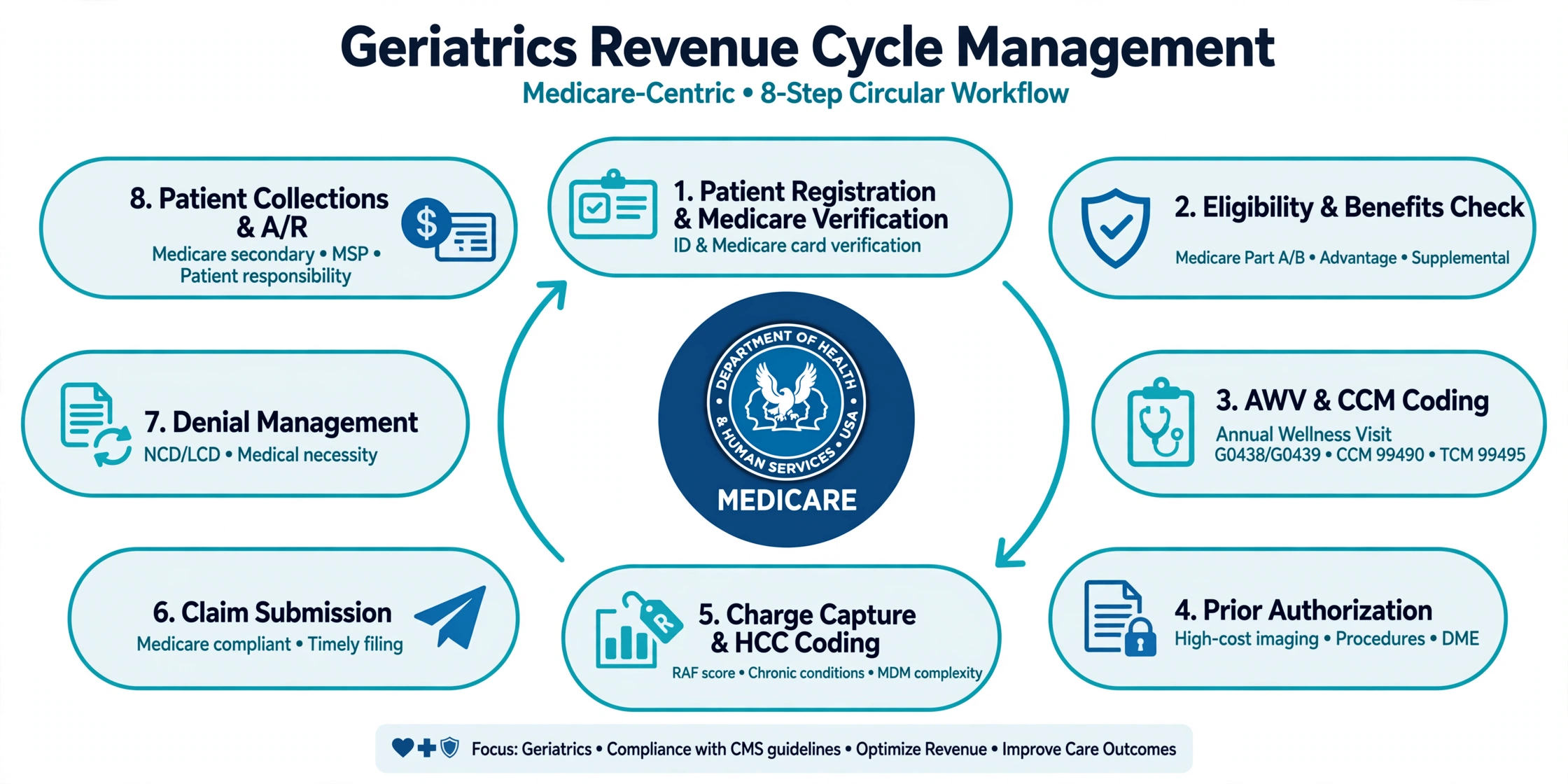
At House of Outsourcing, our specialists manage the geriatrics revenue cycle from patient eligibility verification and accurate coding to clean claim submission, payment posting, denial management, and A/R follow-up. Our step-by-step approach helps you reduce billing errors, prevent reimbursement delays, and maintain a healthier cash flow while staying focused on delivering quality care to aging patients, below you can find our rcm our workflow.
Our experts collect complete demographic and insurance information at every visit of your practice patient. We verify Medicare Part A and Part B enrollment, secondary payer status (Medigap, Medicaid, employer plan), and confirm the patient’s primary care provider designation for care coordination billing.
We run real-time eligibility checks against Medicare and all supplemental plans before every encounter. Confirm deductible status, copay requirements, and any Medicare Advantage plan prior authorization requirements.
For durable medical equipment (DME), specialist referrals, skilled nursing facility (SNF) transfers, and home health orders, obtain prior authorization before services are rendered. Medicare Advantage plans have significantly more prior auth requirements than traditional Medicare fee-for-service.
Code every encounter to the highest specificity supported by documentation. Use the correct E/M level based on medical decision-making (MDM) or total time. Capture AWV (G0438, G0439), CCM (99490, 99491, 99487), TCM (99495, 99496), and ACP (99497, 99498) codes when applicable.
We submit claims electronically within 24–48 hours of the encounter. Run pre-submission claim scrubs to catch errors before they become denials. Target a first-pass claim acceptance rate of 95% or higher.
Our experts post Medicare payments within 48 hours of receipt. Reconcile every Medicare Remittance Advice (MRA) against expected reimbursement. Identify underpayments and flag them for appeal. Bill secondary payers immediately after Medicare adjudicates.
Work all denials within 72 hours of receipt. Categorize denials by root cause (documentation, coding, eligibility, timely filing). Track denial rate by payer, by code, and by provider. Target a denial rate below 5%.
Generate monthly KPI reports tracking AWV completion rate, CCM enrollment rate, TCM capture rate, revenue per patient per year, Days in AR, and first-pass acceptance rate. Use data to identify revenue leakage and optimization opportunities.
Tip #2: Set up ADT (Admission, Discharge, Transfer) feeds from all local hospitals. When a geriatric patient is discharged, your team should receive an automatic notification within hours not days. This is the single most effective way to improve TCM capture rates, which should be 60–75% of all hospital discharges.
Staying current with CMS and Medicare billing guidelines is non-negotiable for your geriatric practice. Here are the most important regulatory guideposts:
The 2025 MPFS conversion factor and RVU values affect every service a geriatric practice bills. The E/M code revaluation that took effect in 2021 brought significant payment increases for complex office visits a change that disproportionately benefits geriatricians who routinely bill 99213–99215 for high-complexity patients.
AWVs are distinct from preventive visits and require a Health Risk Assessment (HRA), review of functional ability, safety screening, and cognitive impairment detection. Initial AWVs are billed G0438; subsequent AWVs are billed G0439. The current reimbursement is approximately $130 per subsequent AWV.
CCM (99490) requires at least 20 minutes of clinical staff time per calendar month for patients with two or more chronic conditions. Documentation must capture the care plan, coordination activities, and time. Patients must provide written informed consent. The average reimbursement is approximately $45 per month for 99490.
TCM codes require the provider to make interactive patient contact within 2 business days of discharge and complete a face-to-face visit within 7 days (99496 – high complexity, $215 average) or 14 days (99495 – moderate complexity, $168 average). The face-to-face visit may not be billed separately.
ACP (99497 for first 30 minutes; 99498 for each additional 30 minutes) is separately billable on the same day as AWV or office visits. Documentation must reflect voluntary, informed discussion about the patient’s wishes for future medical care.
⚖️ Compliance Alert
The Office of Inspector General (OIG) has identified geriatric CCM billing as a target area for audit focus. You need to ensure that every CCM claim is supported by a documented care plan, recorded monthly time logs, and patient consent forms. OIG Work Plan reference: https://oig.hhs.gov/reports-and-publications/workplan/
Geriatric practices face billing challenges that are more complex than nearly any other specialty. Here are the most common ones and what they cost if left unaddressed:
Many geriatric practices have AWV completion rates below 50%, when the benchmark is 60–80%. At $130 per AWV, a 1,000-patient practice leaving AWV completion at 50% instead of 70% loses $26,000 in annual revenue.
Despite 60–80% of geriatric patients qualifying for CCM, most practices enroll fewer than 15% in year one. The biggest barriers are patient cost-sharing concerns and staff time for consent workflows both of which can be systematically addressed.
TCM codes are time-sensitive. Missing the 2-day contact window or the 7/14-day face-to-face visit window results in lost revenue that cannot be recovered. Practices without ADT feeds miss TCM opportunities on 25–40% of eligible discharges.
Medicare Advantage (MA) plans increasingly deviate from traditional Medicare fee-for-service rules. Prior authorization requirements, different coverage policies, and plan-specific documentation requirements create denial risk if your billing team is not MA-plan-literate.
Medicare denials for geriatric claims frequently cite insufficient documentation of medical necessity especially for home health orders, DME prescriptions, and specialist referrals. Physicians must document why the service is medically necessary, not just what was ordered.
Tip #3: Implement a ‘documentation checkpoint’ at the end of every geriatric encounter. Before the provider closes the chart, a brief checklist should prompt: Was an AWV indicated? Was CCM discussed? Was a hospitalization in the last 30 days documented for TCM? Was ACP discussed? This 60-second check can recover thousands in missed revenue per month
These are the most frequently occurring geriatrics RCM coding errors, based on CMS audit findings, AAPC coding guidance, and AHIMA coding best practices, that cause financial loss for your medical practice.
Upcoding E/M levels without MDM documentation support: Billing 99215 when documentation only supports 99214 cpt code.
Billing AWV same-day as a preventive visit: These are distinct services with different content requirements for patients.
Missing G codes for AWV: Billing 99381–99397 (preventive) instead of G0438/G0439 (AWV)
Billing CCM without documented patient consent: A guaranteed denial and audit trigger
Billing TCM face-to-face as a separate E/M: The TCM code includes the face-to-face visit
Incomplete ICD-10 coding: Failing to code all chronic conditions to the highest specificity
Missing modifier -25: Required when billing a separately identifiable E/M on the same day as a procedure
Denial management is one of the most impactful levers in geriatrics revenue cycle management. Industry data shows that 65% of denied claims are never reworked and resubmitted representing pure revenue loss for practices that do not have a disciplined denial management process.
Every denial should be categorized by root cause: documentation insufficient, incorrect code, timely filing, eligibility issue, prior authorization missing, or duplicate claim. Only when you know the root cause can you fix the upstream process that caused the denial.
Medicare has strict timely filing deadlines for appeals, 120 days from the initial denial for a redetermination. Working denials within 72 hours gives your team time to gather documentation, code corrections, or payer contacts before deadlines become a problem.
If CCM claims are denied more frequently by a specific Medicare Advantage plan, that is a payer policy issue requiring a policy document review. If AWV claims are routinely denied for documentation, that is a provider education issue. Segmenting denial data reveals actionable patterns.
Medicare redetermination appeals have a reversal rate of approximately 45–60% for practices that submit well-documented appeals. Leaving denied claims unappealed is the equivalent of giving money back to Medicare voluntarily.
Pro Insight
Build a denial appeal letter library specific to geriatrics: AWV denial appeal templates, CCM consent documentation templates, TCM timing exception appeals, and medical necessity letters for home health orders. Standardized templates reduce appeal preparation time from hours to minutes.
The difference between a financially thriving geriatric practice and one that is barely keeping pace often comes down to how well they optimize all four revenue streams simultaneously. Here is the optimization roadmap:
Set an AWV completion rate target of 70% of your Medicare panel. Use automated patient outreach (phone, text, patient portal) to schedule AWVs proactively. Train front desk staff to identify AWV-eligible patients at check-in. At $130 per AWV and 1,000 Medicare patients, moving from 50% to 70% completion adds $26,000 annually.
Year 1 target: enroll 15–25% of eligible patients. Year 3 target: 30–40%. At $45/month with 200 enrolled patients, CCM generates $108,000 in annual recurring revenue. Hire or designate a CCM coordinator whose sole responsibility is enrollment, documentation, and monthly care coordination calls.
Target a TCM capture rate of 60–75% of all hospital discharges. This requires an ADT feed, a designated discharge notification workflow, and a provider who can make interactive contact within 2 business days. At $220 per TCM claim and 10 discharges per month at 70% capture, this generates $18,480 annually vs. $13,200 at 50%.
Advance Care Planning (99497, 99498) is one of the most under-billed services in geriatric medicine. It can be billed on the same day as an AWV or office visit when a separate, voluntary discussion about the patient’s care preferences occurs. Documentation should note the length of the discussion and that it was voluntary.
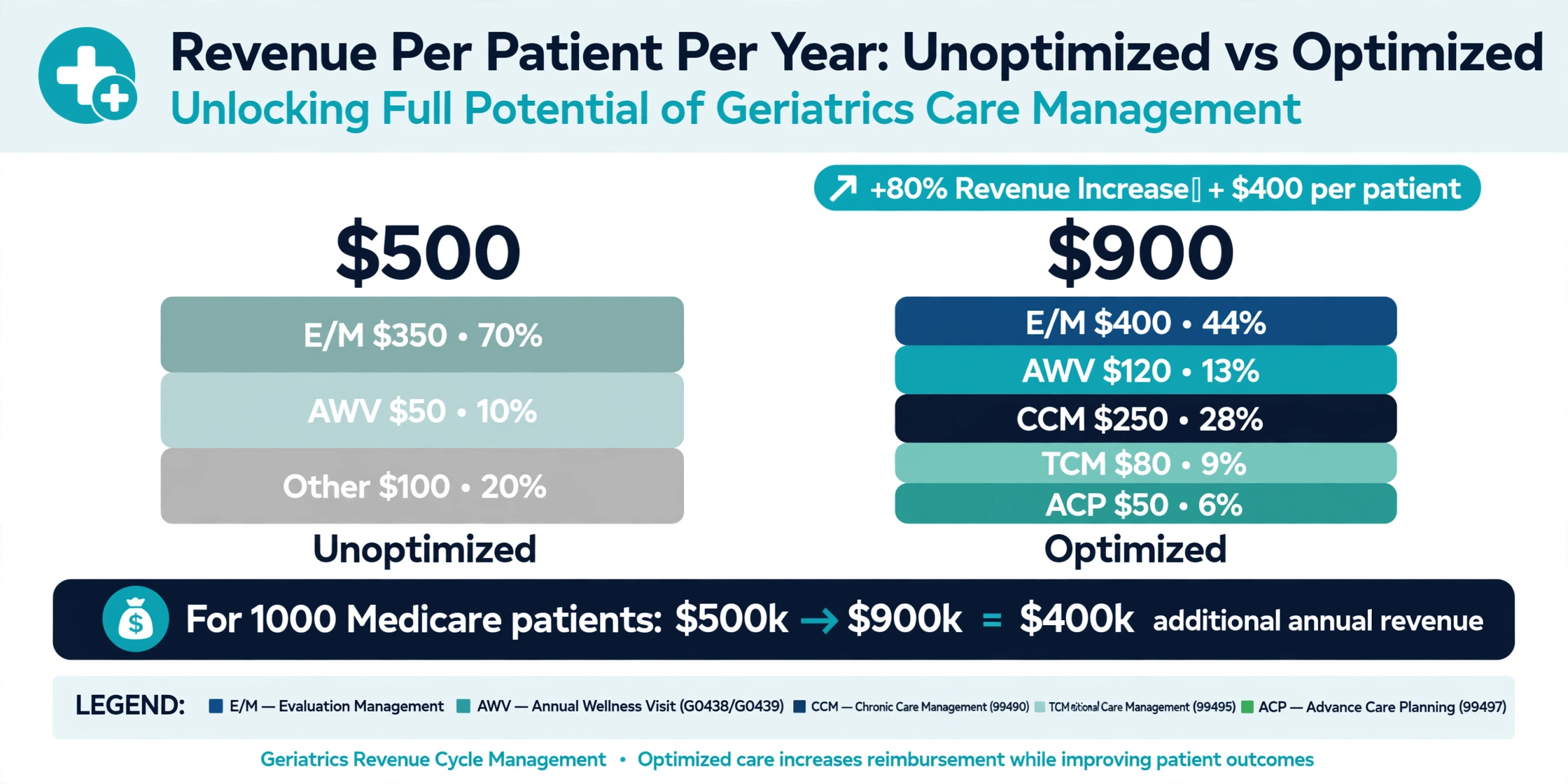
At House of Outsourcing, we track critical geriatrics RCM metrics such as clean claim rate, denial rate, days in A/R, net collection rate, and first-pass resolution to uncover revenue gaps early. High-performing revenue cycles generally target 95%+ clean claims, denial rates below 5%, A/R under 30–40 days, and net collections of 95–96% or higher, helping geriatric practices maintain predictable cash flow and stronger financial performance.
| KPI Metric | Industry Benchmark | Action if Below Target |
|---|---|---|
| AWV Completion Rate | 60–80% of Medicare panel | Implement proactive scheduling & patient outreach |
| CCM Enrollment Rate | 15–25% eligible (Year 1) | Hire dedicated CCM coordinator; streamline consent |
| TCM Capture Rate | 60–75% of discharges | Install ADT feed; discharge notification workflow |
| Revenue Per Patient/Year | $800–$1,200 | Optimize all four revenue streams simultaneously |
| Non-Encounter Revenue % | 30–40% of total | Expand CCM, TCM, AWV, and ACP billing |
| First-Pass Acceptance Rate | 95%+ | Implement pre-submission claim scrubbing |
| Denial Rate | < 5% | Root-cause analysis; coder education |
| Days in Accounts Receivable | < 40 days | Accelerate denial follow-up; patient collections |
| MIPS Quality Score | 80+ out of 100 | Report geriatric-specific quality measures |
| MIPS Revenue Adjustment | +2% to +4% | Participate in quality reporting programs |
| Statistic | Data | Source |
|---|---|---|
| Average claim denial rate (all specialties) | ~8–10% | MGMA |
| Claims never reworked after denial | 65% | AMA / MGMA |
| Medicare Advantage penetration (65+ population) | ~51% | CMS 2025 Enrollment Data |
| MIPS max payment adjustment | +/- 9% | CMS QPP |
| CCM avg monthly reimbursement (99490) | ~$45/month | CMS MPFS 2025 |
| AWV subsequent visit reimbursement (G0439) | ~$130 | CMS MPFS 2025 |
| TCM high-complexity reimbursement (99496) | ~$215 | CMS MPFS 2025 |
| Geriatric patients with 5+ chronic conditions | >65% | CDC / CMS Chronic Conditions Data |
More geriatric practices are turning to professional geriatrics revenue cycle management services because the complexity of Medicare billing combined with the growing volume of non-encounter codes has simply outpaced what most in-house billing teams can handle. Here is what outsourcing delivers:
Specialty expertise: Billers and coders who know the difference between G0438 and G0439, understand CCM documentation requirements, and can navigate Medicare Advantage plan policies.
Higher AWV capture rates: Proactive outreach workflows and scheduling protocols that systematically close the AWV gap.
CCM revenue activation: End-to-end CCM program management including consent, care plan, monthly coordination, and billing.
Faster denial resolution: Dedicated denial management teams working Medicare appeals within 72 hours.
Real-time reporting: Monthly KPI dashboards tracking every revenue stream, denial category, and collection rate.
Compliance protection: Ongoing coding audits aligned with OIG Work Plan priorities and CMS documentation requirements.
Scalability: Grow your patient panel without proportionally growing your billing overhead.
Managing geriatrics RCM in-house can require significant investment in specialized billing staff, training, technology, compliance, and continuous payer follow-up. By outsourcing to House of Outsourcing, your geriatric practice gain dedicated RCM expertise, streamlined claim management, stronger denial follow-up, and scalable support, helping reduce administrative workload, control operational costs, and improve revenue performance.
| Factor | In-House RCM | Outsourced Geriatrics Billing to House of Outsourcing |
|---|---|---|
| Specialty Coding Expertise | Generalist billers; high training cost | Dedicated geriatrics and Medicare coders |
| AWV / CCM / TCM Workflows | Often underdeveloped or manual | Systematic, optimized workflows |
| Staffing Costs | Salaries + benefits + training + turnover | Fixed monthly fee; no HR burden |
| Denial Management | Often backlogged; low appeal rates | Dedicated team; faster resolution |
| MIPS/QPP Reporting | Complex; high error risk | Built-in quality reporting support |
| Technology & Software | Practice-funded; often outdated | Industry-leading RCM technology included |
| Scalability | Hire-to-grow; slow and expensive | Scales immediately with practice growth |
| Compliance Monitoring | Reactive; audit risk | Proactive OIG-aligned coding audits |
| Revenue Per Patient/Year | $400–$600 (unoptimized) | $800–$1,200 (fully optimized) |
| Typical ROI | Baseline performance | 20–40% revenue increase common |
Compliance is not optional in geriatrics RCM. The OIG, CMS, and MAC contractors actively audit geriatric billing, particularly for CCM, AWV, and TCM claims. Your compliance framework should include:
Written compliance plan aligned with OIG Compliance Program Guidance
Regular coding audits at least quarterly for high-risk codes (CCM, AWV, TCM)
HIPAA-compliant billing workflows and BAA agreements with all third-party vendors
Medicare Conditions of Participation (CoP) documentation standards
Anti-kickback statute awareness for any care coordination partnerships
Geriatrics RCM can suffer from missed eligibility checks, inaccurate coding, incomplete documentation, authorization gaps, delayed claim submission, and weak denial follow-up. At House of Outsourcing, we address these common revenue leaks through accurate workflows, proactive claim monitoring, and consistent A/R management, helping geriatric practices reduce denials and secure timely reimbursements.
Tip #3: You need to perform a quarterly coding audit on your top 5 most-billed CPT codes. Focus on 99214, 99215, G0439 (AWV), 99490 (CCM), and 99495/99496 (TCM). Identify documentation gaps before a payer or OIG auditor does.
Tip #4: You need to create a geriatrics-specific denial letter library with templated appeals for the most common denial reasons: CCM documentation, AWV coding, TCM timing. A well-written appeal reversal is worth 100% of the original claim value.
Tip #5: You need to review your Medicare Advantage contracts annually. Compare contracted rates against Medicare fee-for-service rates for your highest-volume codes. MA plans sometimes reimburse below Medicare rates for geriatric-specific codes — and you may have leverage to renegotiate.
At House of Outsourcing, we specialize in geriatrics revenue cycle management services built specifically for the unique demands of geriatric medicine practices across the United States. We understand that your practice is not just billing for office visits, you are managing a complex portfolio of Medicare codes, care coordination programs, and value-based payment requirements that demand specialty expertise.
Certified geriatric billing specialists: Our team includes CPC-certified coders (AAPC) and AHIMA-credentialed coding professionals with deep geriatric medicine expertise
Complete AWV program management: We track, schedule, document, and bill every AWV opportunity in your Medicare panel
CCM program activation: End-to-end CCM implementation consent, care plan, monthly coordination, billing, and reporting
TCM capture optimization: ADT feed setup, discharge notification workflows, and same-day TCM billing
Medicare Advantage navigation: Plan-specific prior authorization management and appeal support
Transparent monthly reporting: KPI dashboards covering all six geriatric revenue benchmarks, updated monthly
OIG-aligned compliance audits: Quarterly coding audits targeting high-risk geriatric codes before regulators do
Dedicated account managers: A single point of contact who knows your practice, your providers, and your payer mix
Geriatrics revenue cycle management is the end-to-end process of managing billing, coding, claims submission, payment posting, denial management, and reimbursement optimization for geriatric medicine practices. It focuses heavily on Medicare reimbursement, care coordination codes (CCM, TCM, ACP), and Annual Wellness Visit capture.
Geriatrics RCM is unique because of near-total Medicare dependence (85–95% of revenue), a high volume of non-encounter billing codes (AWV, CCM, TCM, ACP), complex multi-condition patient populations requiring precise ICD-10 coding, and MIPS/value-based payment program exposure. These factors require specialty-specific billing expertise that general RCM teams often lack.
The most common errors include: upcoding E/M levels without MDM documentation support, billing AWV with incorrect G codes, missing CCM patient consent, billing TCM face-to-face visits as separate E/M visits, incomplete ICD-10 coding for chronic conditions, and missing modifier -25 on procedure-plus-E/M-same-day claims.
Emergency surgery (appendectomy, perforation repair, incarcerated hernia) generally does not require prior authorization under EMTALA and medical necessity exemptions. Elective procedures typically requiring PA include: cholecystectomy, elective hernia repair, bariatric surgery, elective bowel resection, thyroid surgery, and breast cancer surgery. Bariatric surgery has the most intensive PA requirements: BMI documentation, 6-month medically supervised weight loss program, dietary counseling, psychological evaluation, and comorbidity documentation. Traditional Medicare generally does not require PA for most surgical procedures, but Medicare Advantage plans frequently do.
Get a free assessment from our billing experts