
Hematology RCM guidelines improve revenue accuracy through specialized coding, compliance, denial prevention, and efficient claims management. A strong RCM approach helps practices maximize reimbursements, reduce challenges, and maintain financial stability.

If you operate a hematology practice in the United States, you already understand that the financial stakes are unlike almost any other medical specialty. A single infusion session can involve tens of thousands of dollars in high-cost specialty drugs, multiple chemotherapy administration codes, complex prior authorization requirements, and a payer mix that can shift payment from reliable to unpredictable in a single plan-year. Hematology revenue cycle management is not just billing it is the financial backbone of a practice where getting even one claim wrong can mean losing thousands of dollars on a single patient encounter.
Need support with your billing workflow? Explore our medical billing and revenue cycle services or request a free consultation.
Hematology revenue cycle management (hematology RCM) is the end-to-end process of managing the financial operations of a hematology practice from patient registration and insurance eligibility verification through medical coding, prior authorization, claims submission, payment posting, denial management, and financial reporting.
What makes your hematology RCM categorically different from most specialties is the dual revenue stream structure, your hematology practice must simultaneously optimize professional services billing (E/M visits, procedure codes) and drug administration billing (buy-and-bill drug reimbursement, J-codes, administration CPT codes). Each stream has its own coding rules, documentation requirements, payer policies, and denial patterns.
Hematology practices that try to run their billing like a primary care or general internal medicine practice quickly discover that the financial model simply does not translate. Here is what makes hematology RCM genuinely unique.
In the buy-and-bill model, the practice purchases specialty drugs often at a cost of $5,000 to $50,000 per treatment cycle from a wholesaler or distributor, administers them to the patient, and then bills Medicare or commercial payers for reimbursement. Medicare reimburses at Average Sales Price (ASP) plus 6% (effectively ASP + 4.3% after sequestration). The margin between acquisition cost and ASP reimbursement is the drug margin, and it must be tracked monthly for every drug product in your formulary.
Every specialty drug administered must be reported using the correct HCPCS J-code, with accurate units reflecting the exact dosage administered. Incorrect J-code units are one of the most common and costly hematology billing errors; undercoding loses revenue, overcoding creates audit and fraud risk. CMS publishes quarterly ASP updates that affect what you will be reimbursed for every J-code on your formulary.
A typical hematology chemotherapy session involves not one but three to five billable administration codes per visit, one initial infusion code (96413), add-on codes for each additional hour (96415), sequential infusion codes for each additional drug (96417), and potentially hydration codes (96360) when hydration runs independently for 31 or more minutes. Missing any of these add-on codes is pure revenue loss.
Virtually every specialty hematology drug requires prior authorization and many require step therapy documentation showing that cheaper alternatives were tried first. Medicare Advantage plans and commercial payers have made prior auth increasingly burdensome, with clinical pathways, peer-to-peer reviews, and frequent mid-treatment re-authorizations.
Patient coinsurance on a $10,000 hematology drug is $2,000 per cycle for Medicare patients (20% Part B coinsurance). Without copay assistance program enrollment for every eligible patient, bad debt from unaffordable patient balances becomes a practice-level financial problem.
Tip #1: Track drug margin for every individual drug product monthly, not annually, not quarterly. CMS publishes new ASP rates every quarter, and your acquisition costs can shift with every wholesaler contract cycle. If a drug margin turns negative, the practice is losing money on every dose administered. That is unsustainable and must trigger an immediate switch to specialty pharmacy delivery for that drug.
Effective hematology revenue cycle management services are built on these core components, each of which must function precisely, because in hematology, every component failure has amplified financial consequences due to the high dollar value of each claim.
| RCM Component | Why It Matters in Hematology |
|---|---|
| Patient Registration & Demographics | Accurate data prevents claim rejections on high-dollar drug claims |
| Insurance Eligibility & Benefits Verification | Confirm Part B drug coverage, MA plan drug policies, and coinsurance before infusion |
| Prior Authorization Management | Every specialty drug requires auth; missing auth = 100% denial on $10,000+ claims |
| Drug Inventory & Buy-and-Bill Management | Track acquisition cost vs. ASP reimbursement monthly per drug |
| J-Code & Administration CPT Coding | Correct J-code, accurate units, complete add-on code capture |
| Waste Billing (JW Modifier) | Bill wasted drug units with JW modifier to recover discarded amounts |
| Claims Submission & Scrubbing | Pre-submission scrubs catch J-code errors before they reach payers |
| Payment Posting & Drug Reconciliation | Reconcile ASP reimbursement against expected rates; flag underpayments |
| Denial Management | Drug claim denials require specialized appeals; 65% of denials are never appealed |
| Copay Assistance Enrollment | Enroll 90%+ of eligible patients in manufacturer assistance programs |
| Reporting & KPI Analytics | Track drug margin, infusion revenue per session, AR days, collection rates |
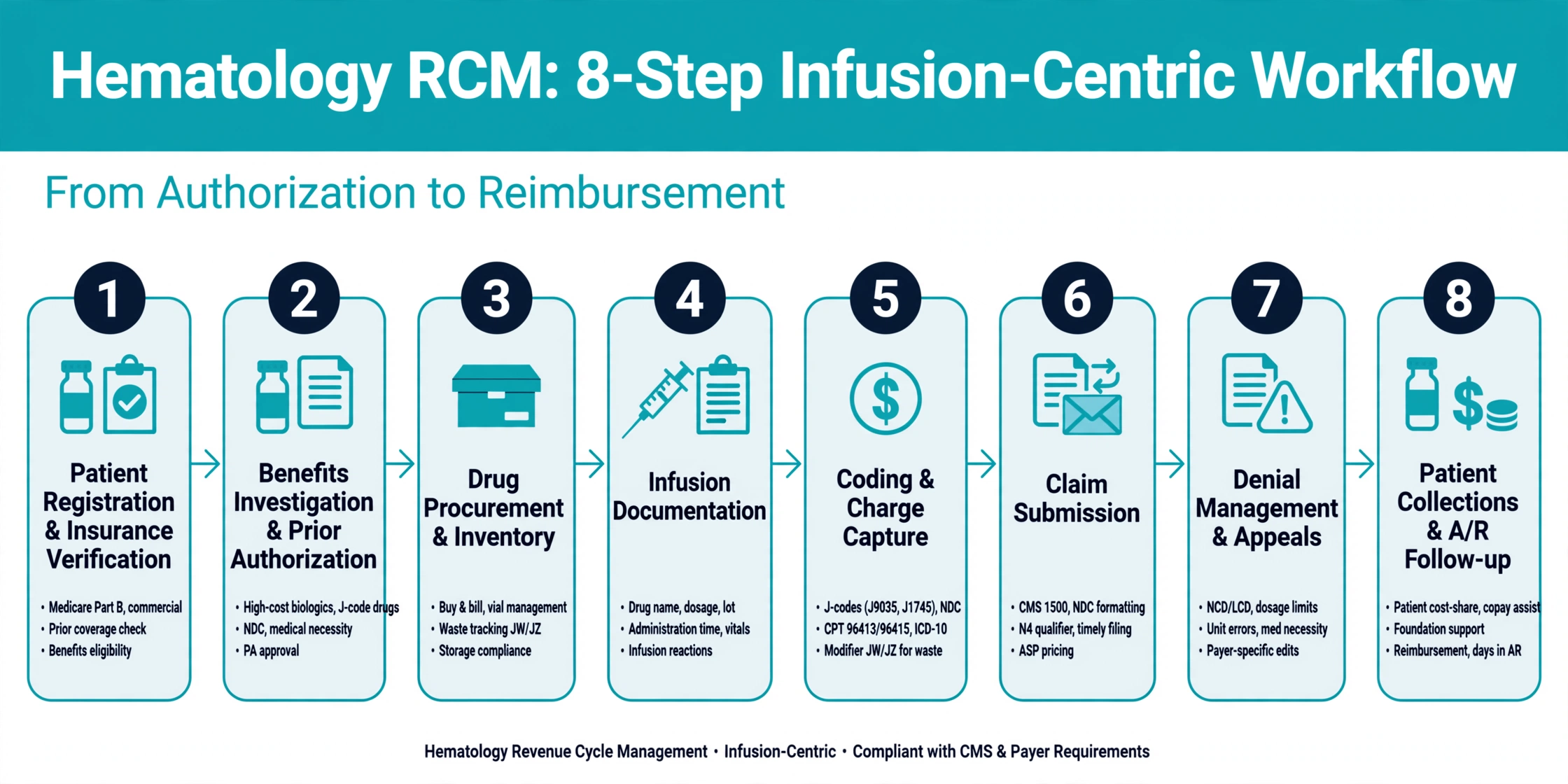
At House of Outsourcing, our hematology RCM process begins with insurance verification and prior authorization, followed by accurate documentation, specialty-specific coding, clean claim submission, and payment posting. We continuously manage denials, payer follow-ups, and outstanding A/R to minimize reimbursement delays and help hematology practices maintain consistent, predictable revenue.
�� [IMAGE PLACEMENT: Infographic – Linear 8-step flowchart of Hematology RCM process, with drug vial and billing icons at each stage] |
Your team needs to collect complete, verified demographic and insurance information before the first encounter. For hematology, this means confirming Medicare Part B drug coverage (not just Part A or Part D), identifying all secondary payers, and flagging any Medicare Advantage plan enrollments that have different drug coverage rules than traditional Medicare fee-for-service.
It is the main responsibility of your PA experts to run real-time eligibility checks before every infusion appointment. They need to verify that the planned drug is covered under the patient’s current benefit structure, confirm the coinsurance rate (typically 20% for Medicare Part B drugs), verify any deductible remaining, and check whether the patient’s Medicare Advantage plan has coverage rules that differ from traditional Medicare.
Your PA experts must submit prior authorization requests for every specialty drug before treatment begins. Include the treating diagnosis (ICD-10), the drug name and J-code, the planned dosage and treatment cycles, and any step therapy documentation the payer requires. Track authorization expiration dates and initiate re-authorization 30 days before expiration to prevent mid-treatment coverage gaps.
Before administration, document the exact dose prepared and administered. This is the foundation for accurate J-code billing. If drug waste occurs (prepared dose exceeds administered dose), document the wasted amount separately for JW modifier billing. Accurate dosage documentation is the single most important driver of J-code billing accuracy.
Code every hematology encounter to maximum specificity. Select the correct J-code and calculate units accurately (each J-code unit corresponds to a specific drug quantity defined by CMS). Code all administration CPT codes: 96413 (initial infusion), 96415 (each additional hour), 96417 (sequential drug), 96360 (hydration, if independent), and modifier -25 for any separately identifiable E/M on the same day.
Submit claims within 24–48 hours of the infusion encounter. Run pre-submission claim scrubs specifically configured for hematology: J-code unit validation, administration code sequencing checks, prior authorization number verification, and modifier application review. Target a first-pass claim acceptance rate of 95% or higher.
Post payments within 48 hours of receipt. For drug claims, reconcile Medicare reimbursement against the current quarter’s published ASP rate. If Medicare paid less than ASP + 6% (before sequestration adjustment), investigate whether an incorrect J-code or unit count triggered a different fee schedule rate.
Work all hematology denials within 72 hours of receipt. Drug claim denials — particularly those citing missing prior authorization, incorrect J-code, or unsupported medical necessity — require specialized appeals with clinical documentation. Target denial rate below 5% and appeal every appealable denial.
Tip #2: Build a prior authorization tracking calendar for every patient on an active treatment regimen. Each authorization should have a built-in 30-day re-authorization trigger date. Missing an authorization expiration mid-treatment is one of the costliest and most avoidable denial patterns in hematology a $15,000 drug claim denied for expired authorization is fully preventable
Hematology billing is governed by some of the most frequently updated CMS policies in healthcare. Here are the key regulatory guideposts every hematology practice must track:
Medicare reimburses physician-administered drugs at Average Sales Price (ASP) plus 6%, effectively ASP plus 4.3% after the 2% sequestration reduction currently in effect. CMS publishes new ASP rates quarterly (effective January, April, July, October). Every hematology practice must update its fee schedule within days of each quarterly ASP publication to ensure accurate charge capture and financial modeling.
Every physician-administered drug must be reported using the correct HCPCS Level II J-code. J-code units are drug-specific and defined in the CMS HCPCS code set. CMS updates J-codes annually (effective January 1) and sometimes adds or modifies codes quarterly for new drugs. Practices must verify J-code validity and unit definitions before billing any newly approved hematology drug.
CMS requires reporting of drug waste using modifier JW (drug amount discarded). Beginning January 2023, CMS also introduced modifier JZ (zero waste) to confirm that no drug was wasted when single-dose vials were used completely. Both modifiers are required on applicable claims billing without them on waste-generating drugs is a compliance gap.
Medicare Advantage plans increasingly apply non-coverage policies, prior authorization requirements, and step therapy requirements that deviate substantially from traditional Medicare fee-for-service drug policies. Hematology practices with high Medicare Advantage patient populations must maintain payer-specific drug coverage matrices updated at least annually.
Hematology practices participating in MIPS (Merit-based Incentive Payment System) face payment adjustments of up to +/- 9% on Medicare payments. Hematology-relevant quality measures include: breast cancer screening (relevant for oncology-hematology overlap), medication reconciliation, care plan documentation, and pain assessment. Positive MIPS adjustments represent meaningful revenue recovery on high-volume Medicare billing.
Hematology practices face billing challenges that are financially amplified by the high dollar value of every claim. Here are the most impactful challenges — and what they cost if left unmanaged:
Prior authorization denials on specialty hematology drugs represent some of the highest-dollar individual claim losses in any medical specialty. A denial on a $20,000 rituximab or $30,000 ibrutinib claim is not a billing inconvenience, it is a practice cash flow crisis if it happens repeatedly. Without a systematic prior auth tracking workflow, these denials are preventable but never prevented.
Multi-drug chemotherapy regimens generate 3 to 5 administration codes per session, but many practices capture only 1 to 2. Each missed add-on code (96415, 96417) represents lost revenue of $50 to $200 per occurrence. Across hundreds of infusion sessions per year, incomplete administration code capture costs hematology practices tens of thousands of dollars annually.
J-code unit errors billing too few or too many units for the actual drug dose administered are among the most common hematology billing errors and among the most scrutinized by CMS auditors. Undercoding costs revenue; overcoding creates fraud and abuse risk. Accurate unit calculation requires knowing the J-code unit definition (e.g., J9310 = 100 mg of rituximab; a 700 mg dose = 7 units) and applying it to the documented administered dose.
The CMS ASP update lags the market by approximately 2 quarters. During periods of rapid drug price increases (or when a biosimilar enters the market and drops the reference ASP), practices can find themselves purchasing drugs at prices that exceed the current ASP reimbursement rate, creating a negative drug margin per dose. Without quarterly margin monitoring, practices can sustain negative margins for 6 months before detecting the problem.
20% Medicare Part B coinsurance on a $10,000 drug cycle is $2,000 per treatment, often recurring monthly. For patients without supplemental insurance or copay assistance enrollment, this becomes uncollectable bad debt. For practices treating many Medicare-primary patients on ongoing hematology regimens, unmanaged patient cost-sharing is a significant revenue leak.
Medicare Advantage plans frequently require step therapy, mandating that patients try and fail a lower-cost drug before the practice can obtain authorization for the clinically preferred agent. These delays can interrupt treatment timelines and create billing gaps that disrupt practice cash flow.
Tip #3: Implement a dedicated copay assistance coordinator role, or assign this function explicitly to your financial counseling staff. Track copay assistance enrollment for every patient on a specialty drug regimen. The target is 90% or higher enrollment of eligible patients. Manufacturer copay assistance programs typically cover $5,000 to $25,000 in annual patient cost-sharing, protecting both the patient’s access to treatment and the practice’s collections.
Based on CMS audit findings, AAPC coding guidance, and AHIMA coding best practices, these are the most frequent and costly hematology RCM coding errors:
In hematology, denial management is not a back-office clean-up function it is a front-line revenue protection strategy. When a single denied claim can represent $20,000 in drug reimbursement, every denied claim demands immediate, expert attention.
Your hematology pratice denials fall into two distinct categories with different root causes and different appeals processes: drug claim denials (J-code issues, prior auth, medical necessity) and professional service denials (E/M documentation, coding errors, modifier issues). Tracking them separately enables targeted process improvement.
Drug claim denials for medical necessity require physician-authored appeal letters with clinical rationale, published treatment guidelines (NCCN guidelines are widely accepted by payers), and patient history supporting the choice of drug. Never submit a drug denial appeal with billing documentation alone.
Prior authorization denials are different from clinical denials they are administrative failures with administrative fixes. An auth denial typically means the authorization was missing, expired, or obtained for the wrong drug or diagnosis. Each should trigger an immediate workflow audit: where did the prior auth process break down?
When a payer denies a hematology drug claim on medical necessity grounds, the treating hematologist’s most powerful appeal tool is a peer-to-peer review directly with the payer’s medical director. Peer-to-peer reviews in hematology/oncology have high reversal rates because treating physicians can cite specific disease markers, genetic mutations, and treatment resistance patterns that documentation alone does not convey.
The difference between a financially thriving hematology practice and one that struggles with cash flow is not patient volume, it is revenue cycle discipline across all three revenue streams. Here is the optimization roadmap.
Calculate drug margin monthly for every product in your formulary: payer reimbursement (ASP + 6% for Medicare; contract rate for commercial) minus acquisition cost equals drug margin. Any drug with a negative margin requires immediate action; either renegotiate the acquisition contract, switch to specialty pharmacy for that drug, or reassess the payer contract for that drug. For a hematology practice administering $2 million in drug costs annually, a 3% improvement in average drug margin adds $60,000 to the bottom line.
Audit your administration code capture rate quarterly. Calculate the average number of administration codes billed per multi-drug infusion session. The benchmark is 3 to 5 codes per multi-drug chemotherapy session. If you are averaging below 2.5, conduct a documentation review to identify whether start/stop times for each drug and each infusion hour are being captured in the clinical record. Missing documentation is always the root cause of missed administration codes.
Every practice that uses partial vials should be billing JW modifier for drug waste. Calculate your current waste billing capture rate: how many claims include the JW modifier versus how many infusion sessions involved partial vial use? A 10% gap in waste billing on a drug costing $3,000 per vial translates to recoverable revenue that is currently being discarded along with the waste.
Target 90% or higher copay assistance enrollment for every patient on a specialty drug regimen. Work with your practice’s financial counselor or a dedicated copay assistance coordinator to enroll patients at the start of treatment — before the first bill arrives. Most major hematology drug manufacturers (AbbVie, AstraZeneca, Genentech, Johnson & Johnson) maintain patient assistance and copay support programs with annual benefit caps of $5,000 to $25,000.
Effective hematology RCM requires close monitoring of clean claim rates, denials, days in A/R, net collections, and first-pass resolution to identify revenue leakage early. Industry benchmarks commonly aim for 95%+ clean claims, denial rates below 5%, A/R under 30–40 days, and net collection rates of 95–96% or higher, giving hematology practices clear targets for stronger financial performance and more predictable cash flow.
| KPI Metric | Industry Benchmark | Action if Below Target |
|---|---|---|
| Drug margin (per product) | Positive for each drug | Switch negative-margin drugs to specialty pharmacy |
| Revenue per chemo session | $2,000–$8,000 | Audit admin code capture and J-code unit accuracy |
| Admin codes per multi-drug session | 3–5 codes | Review infusion start/stop time documentation |
| Drug claim AR days | 25–35 days | Verify auth numbers and J-code accuracy on all open claims |
| E/M claim AR days | < 28 days | Accelerate denial follow-up; improve coding turnaround |
| Drug collection rate | 97%+ | Investigate payer reimbursement discrepancies immediately |
| E/M net collection rate | 95%+ | Audit coding accuracy; appeal all underpayments |
| Copay assistance enrollment rate | 90%+ of eligible patients | Assign dedicated financial counselor for enrollment |
| Prior auth denial rate | < 3% of drug claims | Implement auth tracking calendar; initiate earlier |
| First-pass claim acceptance rate | 95%+ | Implement pre-submission J-code and auth scrubbing |
| Overall denial rate | < 5% | Root-cause analysis; coding education; auth workflow |
| Statistic | Data | Source |
|---|---|---|
| Drug revenue as % of hematology practice revenue | 50–70% | MGMA / Practice data |
| Medicare drug reimbursement rate | ASP + 6% (ASP + 4.3% post-sequestration) | CMS MPFS |
| Revenue per chemo session (benchmark) | $2,000–$8,000 | Industry benchmark |
| Revenue per non-chemo infusion (iron, IVIG) | $500–$2,000 | Industry benchmark |
| Denied claims never reworked (all specialties) | 65% | AMA / MGMA |
| Typical copay assistance annual benefit cap | $5,000–$25,000 | Manufacturer programs |
| MIPS maximum payment adjustment | +/- 9% | CMS QPP 2025 |
| Average claim denial rate (all specialties) | 8–10% | MGMA |
| Medicare Advantage penetration (65+ population) | ~51% | CMS 2025 Enrollment Data |
In-house hematology RCM provides direct control but requires experienced billing staff, continuous training, technology, and dedicated resources to manage complex claims, denials, and payer requirements. Outsourcing to House of Outsourcing gives your hematology practice access to specialized RCM expertise, scalable workflows, and focused A/R management while reducing administrative burden and allowing clinical teams to concentrate on patient care.
| Factor | In-House RCM | Outsourced Hematology RCM Services |
|---|---|---|
| J-Code Expertise | General billers; frequent unit errors | Dedicated hematology/oncology J-code specialists |
| ASP Update Management | Often missed; fee schedules lag | Quarterly ASP updates applied automatically |
| Administration Code Capture | Often incomplete; missed add-ons | Systematic infusion code audit every session |
| Prior Auth Tracking | Manual; high miss rate | Automated calendar; 30-day renewal triggers |
| Drug Margin Monitoring | Rarely performed in-house | Monthly drug margin analysis per product |
| Denial Management | Backlogged; clinical appeals rare | 72-hour turnaround; NCCN-guided clinical appeals |
| Copay Assistance Enrollment | Inconsistent; dependent on staff knowledge | Systematic; target 90%+ eligible patient enrollment |
| Staffing Costs | Salary + benefits + training + turnover | Fixed fee; no HR burden |
| Compliance Monitoring | Reactive; audit-triggered | Proactive OIG-aligned quarterly coding audits |
| Drug Collection Rate | Often 90–93% (leakage from unit errors) | 97%+ target with reconciliation protocols |
Tip #3: You need to conduct a quarterly infusion code capture audit. Pull a random sample of 20 multi-drug chemotherapy sessions and verify that every billable administration code was captured: initial (96413), each additional hour (96415), each sequential drug (96417), and independent hydration (96360). Calculate your average codes per session. If it is below 3.0, you have a documentation training gap that is costing the practice real money every single day.
Tip #4: You need to build a drug-specific J-code reference card for every drug your practice regularly administers including the J-code, the unit definition (what one billing unit equals in mg or mcg), the current quarter’s ASP reimbursement, and your acquisition cost per unit. Post it at every nursing station and update it within 5 days of each quarterly CMS ASP publication
Tip #5: Never abandon a denied drug claim without at least one formal appeal. The average reversal rate for well-documented hematology drug claim appeals, particularly those involving medical necessity for an evidence-based treatment exceeds 40%. Given that a single denied drug claim may represent $10,000 to $30,000, an appeal that takes 2 hours to prepare and wins has an extraordinary return on investment
At House of Outsourcing, we deliver hematology revenue cycle management services built specifically for the financial complexity of hematology and hematology-oncology practices across the United States. We understand that your practice is not running a standard billing operation, you are managing a sophisticated dual revenue stream of professional services and high-dollar drug reimbursement, where every error is amplified by the dollar value of every claim.
Certified hematology/oncology billing specialists: CPC-certified coders (AAPC) and AHIMA-credentialed professionals with deep J-code and infusion billing expertise
Quarterly ASP update management: Fee schedules updated within days of each CMS ASP publication never billing off outdated rates
Complete administration code capture: Session-by-session auditing to ensure every add-on code (96415, 96417, 96360) is captured
Drug margin monitoring: Monthly per-product drug margin analysis with alerts for negative-margin situations
Prior authorization management: End-to-end auth tracking, 30-day renewal calendars, and peer-to-peer review coordination
JW/JZ modifier compliance: Full drug waste billing compliance aligned with current CMS modifier requirements
Clinical denial appeals: NCCN-guided appeal letters for medical necessity denials; peer-to-peer review coordination
Transparent monthly KPI reporting: Drug margin by product, infusion revenue per session, auth denial rates, collection rates all in one dashboard
OIG-aligned compliance audits: Quarterly audits targeting J-code accuracy, JW/JZ compliance, and administration code documentation
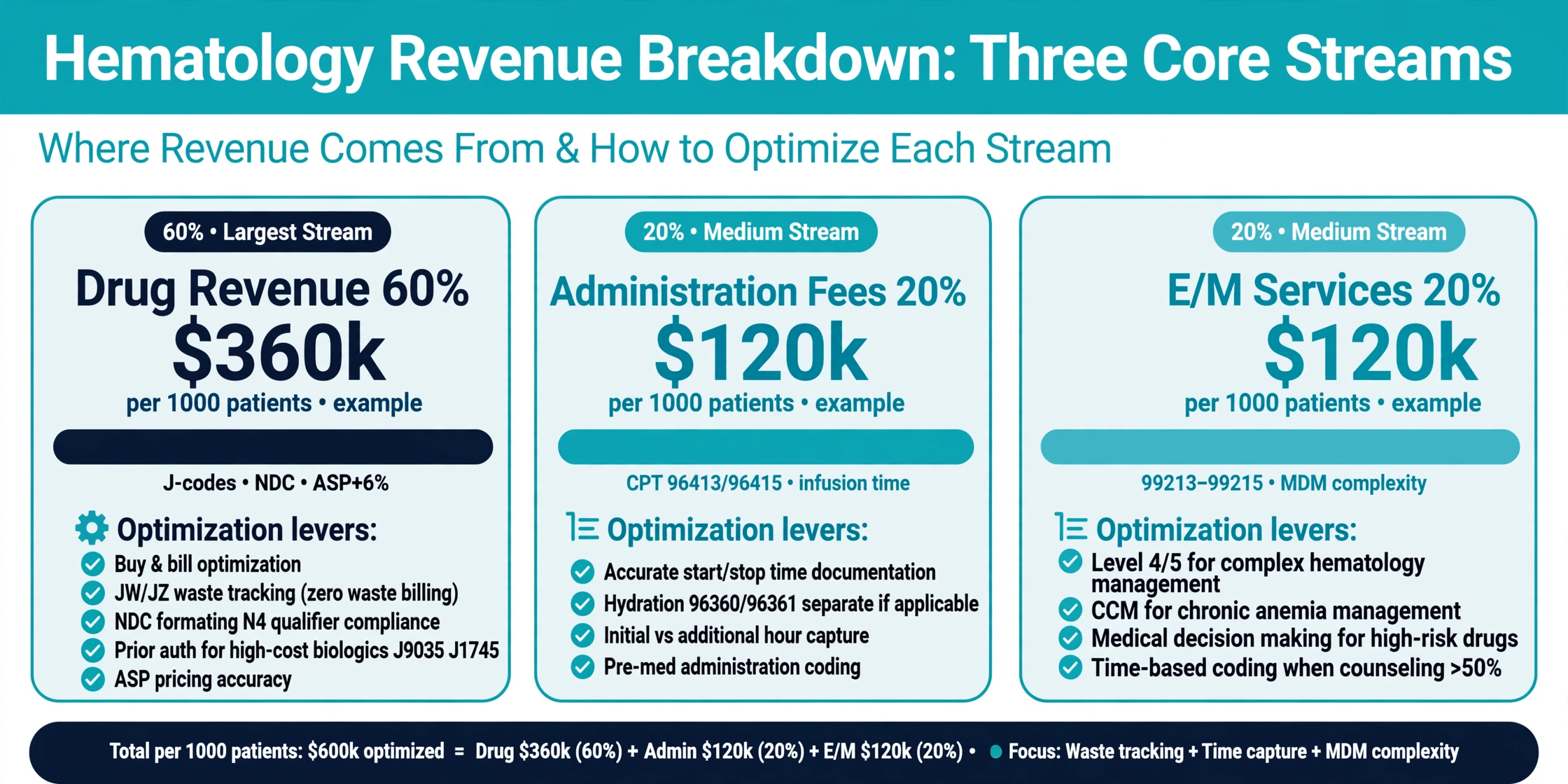
Hematology revenue cycle management is the end-to-end process of managing billing, coding, drug reimbursement (buy-and-bill), prior authorization, claims submission, payment posting, denial management, and revenue optimization for hematology practices. It manages three revenue streams: drug reimbursement (50–70% of revenue), drug administration fees (15–25%), and E/M services (15–25%).
Hematology RCM is unique because drug revenue (buy-and-bill) represents 50–70% of total practice revenue, requiring simultaneous management of J-code accuracy, quarterly ASP updates, drug margin monitoring, prior authorization for every specialty drug, JW/JZ modifier compliance, multi-code infusion session billing, and copay assistance enrollment — complexity that no other specialty combines at this dollar scale.
The most common and costly hematology billing errors are: incorrect J-code unit calculation, missing JW modifier on drug waste, missing JZ modifier on zero-waste vials, incomplete administration add-on code capture (96415, 96417), billing hydration (96360) without independent run documentation, using outdated J-codes, and missing modifier -25 on same-day E/M visits.
Buy-and-bill is the drug reimbursement model in which the hematology practice purchases specialty drugs directly from a wholesaler, administers them to the patient, and bills Medicare or commercial payers for the drug cost plus an administration fee. Medicare reimburses physician-administered drugs at ASP + 6% (effectively ASP + 4.3% after sequestration). The margin between the practice’s acquisition cost and the ASP reimbursement is the drug margin the most critical financial metric in hematology RCM.
CMS reimburses Medicare Part B physician-administered drugs at Average Sales Price (ASP) plus 6%. ASP is calculated from drug manufacturers’ sales data and updated quarterly by CMS. The quarterly ASP update schedule (effective January, April, July, October) means hematology practices must update their fee schedules four times per year to maintain accurate charge capture and financial modeling.
The JW modifier identifies drug amounts discarded from single-dose vials when the administered dose is less than the full vial. CMS requires the JW modifier on claims for drugs where waste occurs, with the wasted quantity billed separately. Beginning January 2023, CMS also requires the JZ modifier on claims for zero-waste situations (entire single-dose vial was used). Both modifiers are mandatory compliance requirements in hematology billing.
Get a free assessment from our billing experts