
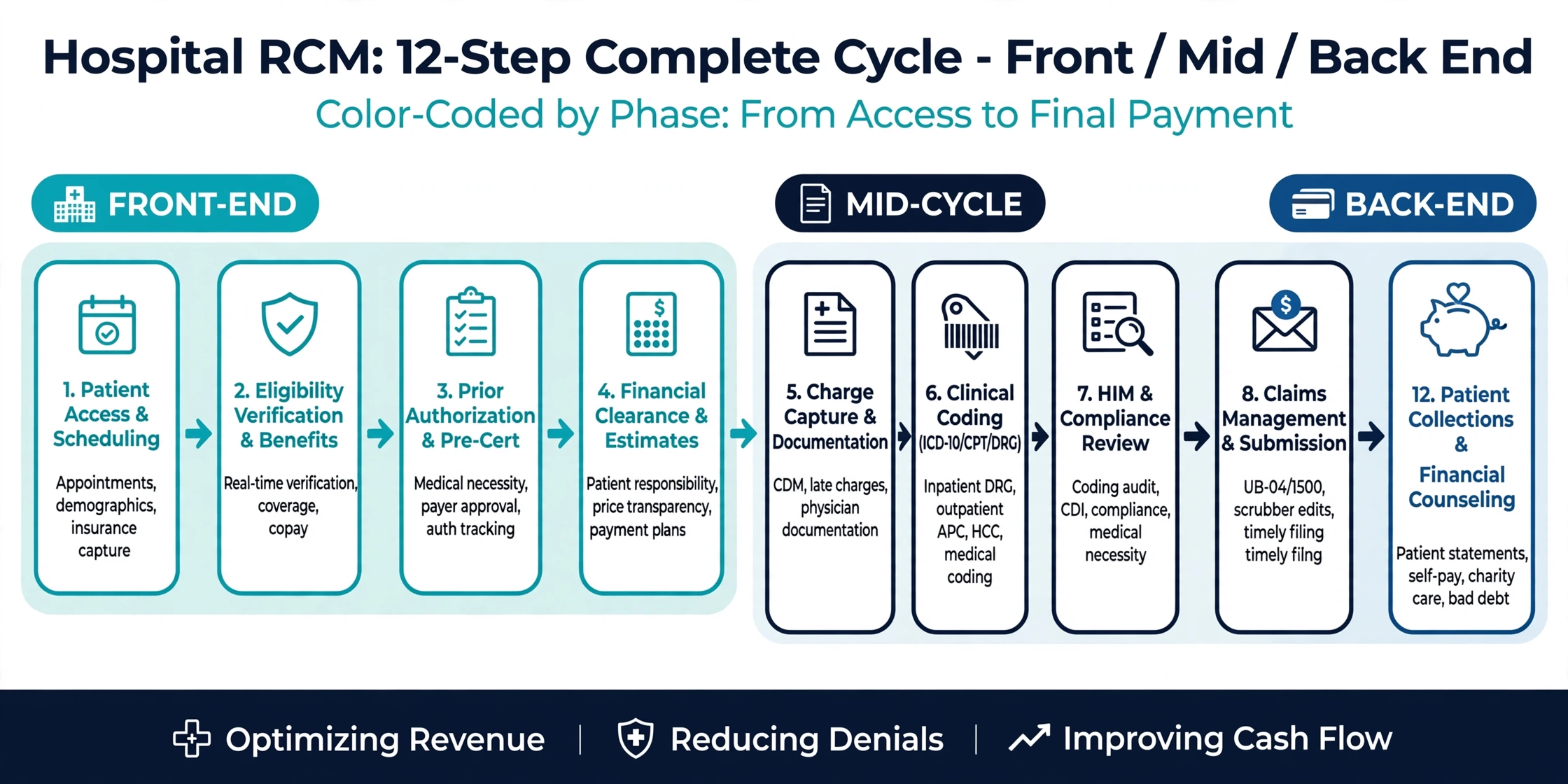
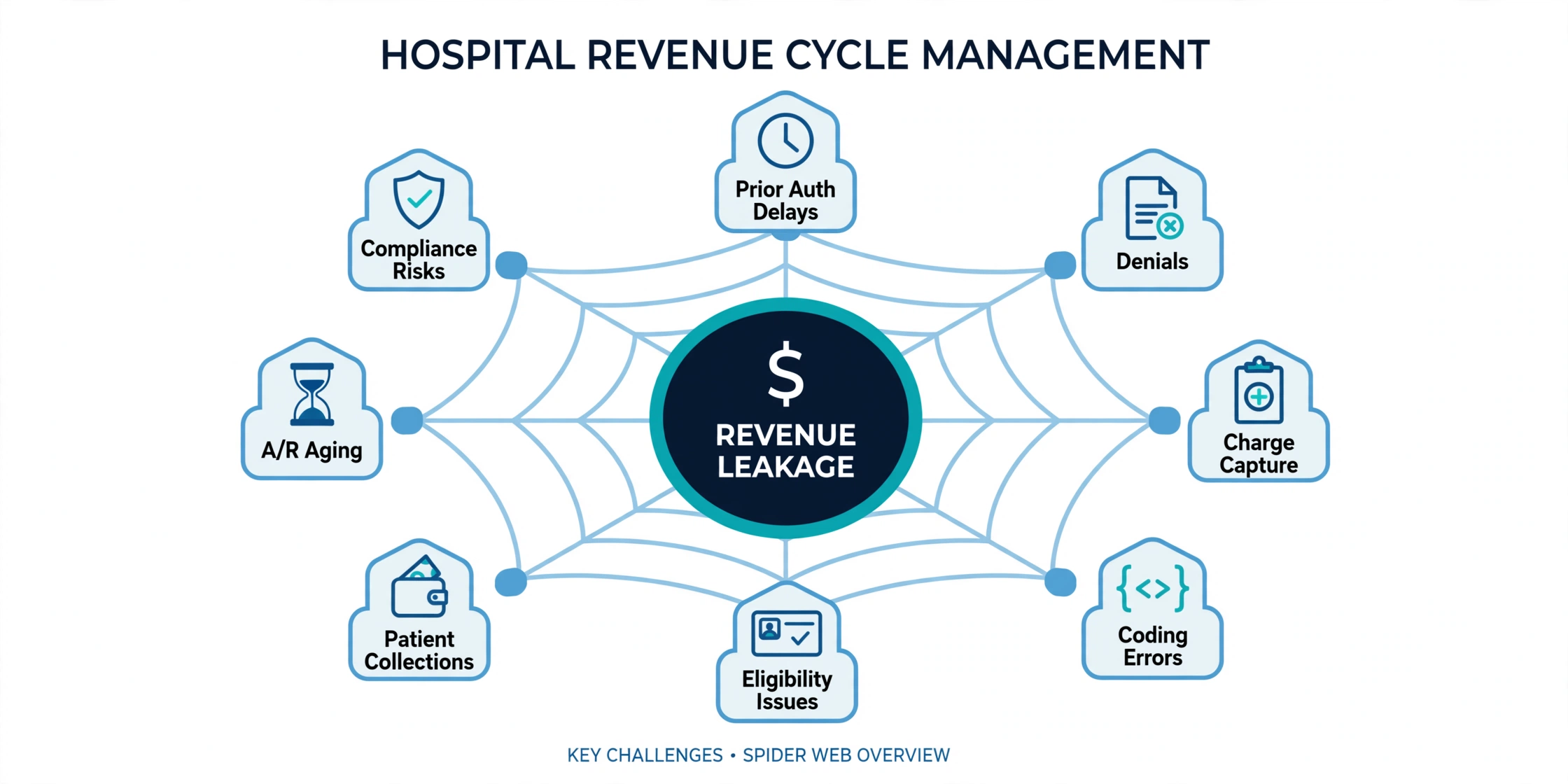
Our Hospital RCM services help healthcare organizations optimize revenue through accurate coding, claims management, compliance support, and denial prevention. We streamline complex hospital billing workflows to improve reimbursements, reduce revenue leakage, and support long-term financial performance.

Ambetter isn’t a standard commercial or Medicare plan — it’s Centene’s ACA Health Insurance Marketplace product, sold state by state under local brand names like Ambetter from Magnolia Health or Ambetter from NH Healthy Families. That structure brings a verification risk most other payers don’t carry: a member can show active coverage today and still have that coverage terminated retroactively next month if their premium goes unpaid.
This guide walks your team through what makes Ambetter eligibility verification different, how the ACA’s premium grace period actually works, and what to check before assuming a claim is safe.
Ambetter eligibility verification confirms that a patient’s Marketplace plan is active, in good standing on premium payments, and applicable for the specific date they’re being seen. Because Ambetter plans are purchased individually through the Health Insurance Marketplace rather than provided through an employer, premium payment status plays a much bigger role in eligibility than it does with most commercial payers.
An active-looking Ambetter card doesn’t guarantee the visit will be paid. The member could be behind on premiums and sitting in a grace period, the provider could be out of network for that specific state plan, or the service could require prior authorization under the plan’s HMO-style structure.
Eligibility vs. premium status: Eligibility confirms the plan exists and is enrolled. Premium status confirms whether payments are current — and with Ambetter, this second check is just as important as the first.
Eligibility vs. prior authorization: These remain separate checks even for Marketplace plans. Confirming a member is active never confirms Ambetter has pre-approved a specific service.
Ambetter’s grace period structure creates a real financial exposure that doesn’t exist with most other payers. A member can appear “eligible” during the first month of missed premium payments while the underlying policy is already at risk of retroactive termination two months later.
Confirming premium status before the visit — not just active/inactive status — lets your team make an informed decision about collecting payment upfront rather than assuming the claim will pay months down the line. This single habit protects your practice from providing services that later become the patient’s full financial responsibility.
Verifying eligibility also matters more around Open Enrollment, since Marketplace plan changes, new APTC subsidy amounts, and even a member switching from one Ambetter state plan to another can all shift coverage details from one plan year to the next.
Collect the patient’s full legal name, date of birth, and current address, along with their Ambetter member ID and group number exactly as printed on the card. Confirm which state-specific Ambetter brand applies, since the plan name printed on the card (for example, “Ambetter from Magnolia Health” or “Ambetter of North Carolina”) determines which provider portal and contact number your team should use.
You’ll also need to confirm whether the patient receives Advance Premium Tax Credits (APTCs), since this materially changes how the grace period and claims payment timeline work. Finally, confirm the planned date and type of service, since Ambetter plans commonly apply referral and prior authorization rules similar to an HMO.
Beyond basic active/inactive status, an Ambetter eligibility check should return the member’s current standing: Active (in good standing), Delinquent Premium (in the grace period but claims still processing), or Past Due Premium/Suspended (claims at risk of denial).
Your team should also pull the Premium Paid Through Date, which shows the latest date premiums have actually been paid, and the Claims Paid Through Date, which shows the last date of service that will be considered for payment under current standing. Anything scheduled after the Claims Paid Through Date carries real payment risk until the member’s premium status is resolved.
Network status, referral requirements, and prior authorization needs should be confirmed just as they would with any other payer, since Ambetter plans frequently use narrower, HMO-style networks that require in-network referrals for specialty care.
Use our complete Ambetter eligibility verification checklist to confirm your patient’s active coverage, plan type, effective dates, network status, benefits, deductibles, copays, coinsurance, and service-specific requirements before care. We help you verify these details upfront so you can prevent eligibility errors, reduce avoidable denials, and improve patient cost estimates.
| Verification Item | What to Check | Why It Matters | Action Required |
|---|---|---|---|
| Coverage status | Active, Delinquent Premium, or Past Due/Suspended | Determines whether claims will process or pend | Confirm before scheduling and at check-in |
| State-specific plan brand | Exact Ambetter entity on the card | Determines correct portal and provider service line | Match card to correct state brand |
| APTC status | Does the member receive a subsidy | Changes grace period length and claims timeline | Confirm via portal or IVR |
| Premium Paid Through Date | Latest date premium is confirmed paid | Shows how current the member's account is | Pull on every eligibility check |
| Claims Paid Through Date | Last date of service considered for payment | Services after this date carry payment risk | Compare against scheduled DOS |
| Network status | In-network vs. out-of-network | Ambetter plans often use narrow, HMO-style networks | Verify provider AND facility |
| Referral requirement | PCP/specialist referral on file | Common requirement under Ambetter's HMO structure | Confirm before specialist visits |
| Prior authorization | Required for specific services | Missing auth is a common denial cause | Confirm before scheduling |
Collect accurate patient information. Confirm name, date of birth, member ID, and the exact state-specific Ambetter plan name from the card.
Confirm the correct portal and contact line. Since Ambetter operates under different state brands, verify eligibility through the correct regional Ambetter Secure Provider Portal, Availity Essentials, or the state-specific provider services line.
Check coverage status. Look for Active, Delinquent Premium, or Past Due Premium/Suspended status rather than a simple active/inactive flag.
Confirm APTC status. This determines whether the member is in a 3-month grace period (APTC recipients) or a 30-day grace period (non-APTC members).
Step 5: Pull the Premium Paid Through Date and Claims Paid Through Date. These two dates tell you exactly how current the account is and whether the scheduled service falls in a safe payment window.
Confirm network participation. Check both the rendering provider and facility, since Ambetter’s narrower networks make out-of-network mistakes more costly for the patient.
Verify referral and authorization requirements. Confirm whether a referral or prior authorization is needed for the specific service.
Decide on upfront collection. If the member is in a suspended or past-due status, consider collecting payment in full at time of service, consistent with Ambetter’s own guidance to providers.
Document the verification result. Record the date, method, status, and both key dates — this protects your practice if a claim is later disputed.
This is the single most important thing to understand about Ambetter eligibility. Under the ACA, members receiving Advance Premium Tax Credits get a three-month grace period before their policy can be terminated for nonpayment, while members not receiving APTCs get a standard 30-day grace period with no claims paid during that first month of nonpayment.
For APTC recipients, the first month of nonpayment still results in claims being paid normally, even though the member’s eligibility check will flag them as delinquent. In months two and three, the member moves into a suspended status, and claims submitted during that window may be pended or denied depending on whether the premium is eventually paid.
If the full premium isn’t paid by the end of the grace period, Ambetter terminates the policy retroactively to the last date premiums were actually paid — meaning services rendered during the grace period can become the patient’s full financial responsibility after the fact. This is exactly why checking premium status, not just active/inactive coverage, needs to be a standard part of every Ambetter verification.
We help you understand how Ambetter premium grace periods can differ based on a patient’s Advance Premium Tax Credit (APTC) status and premium payment history. You can use this timeline to identify potential coverage risks before service and determine when additional eligibility or payment-status verification may be needed.
| Grace Period Stage | APTC Members | Non-APTC Members |
|---|---|---|
| Month 1 of nonpayment | Eligibility shows delinquent; claims still paid | 30-day grace period; claims not paid during this month |
| Months 2–3 of nonpayment | Member shown as suspended; claims may pend or deny | Grace period has typically ended; coverage may already be terminated |
| End of grace period, premium unpaid | Policy terminated retroactively to last paid date | Policy terminated at end of 30-day period |
| Premium paid before grace period ends | Member returns to good standing; pended claims released | Member returns to good standing; pended claims released |
We compare Ambetter eligibility verification methods so you can determine the most effective way to confirm active coverage, plan benefits, cost-sharing, and service-specific requirements. This comparison helps you choose a reliable verification workflow while reducing manual errors, coverage uncertainties, and eligibility-related claim denials.
| Verification Method | Best Use | Information Available | Advantages | Potential Limitations |
|---|---|---|---|---|
| Ambetter Secure Provider Portal | Daily standard checks | Coverage status, premium dates, benefits | Detailed, state-specific | Requires separate registration per state plan |
| Availity Essentials | Multipayer daily checks | Coverage, benefits, network status | One login across multiple payers | May not surface every state-specific nuance |
| 24/7 IVR line | Quick status checks | Basic eligibility by member ID and month of service | Available anytime, no portal login needed | Limited detail compared to the full portal |
| Provider Services phone line | Complex or unclear cases | Full account and premium status detail | Human clarification available | Longer hold times, business hours only |
This is the core lesson with Ambetter. A member can show as technically “active” or simply not flagged as terminated, while actually sitting in month two or three of a suspended grace period where claims are being pended rather than paid outright.
Beyond premium status, Ambetter’s narrower networks mean out-of-network care carries more risk than it might under a broader commercial PPO, and HMO-style referral requirements are common for specialist visits. Treat the coverage status field, the Premium Paid Through Date, and the Claims Paid Through Date as three separate pieces of information that all need to be reviewed together, not one flag that tells the whole story.
We help you identify common Ambetter eligibility problems, including inactive coverage, grace-period status, incorrect member details, network mismatches, and benefit discrepancies. You can resolve these issues before providing services to reduce eligibility-related denials, unexpected patient costs, and reimbursement delays.
| Eligibility Problem | What It Means | Claim/Revenue Risk | Recommended Solution |
|---|---|---|---|
| Member in suspended status | In month 2 or 3 of an APTC grace period | Claim may pend or deny pending premium payment | Confirm status before service; consider collecting payment upfront |
| Retroactive termination | Premium never paid by end of grace period | Claim denied after the fact, even if paid before | Verify Premium Paid Through Date on every visit |
| Wrong state plan identified | Confused with a different state's Ambetter brand | Verification pulled from wrong portal/contact | Match the exact brand name on the card |
| Incorrect member ID | Data entry or outdated card | Eligibility check fails or returns wrong plan | Re-verify against the physical insurance card |
| Provider out of network | Not contracted under that state's Ambetter network | Higher patient cost or denial | Confirm network status per specific state plan |
| Missing referral | HMO-style referral not obtained | Denial for specialist visit | Confirm referral before scheduling |
| Missing authorization | Prior approval not obtained | Automatic denial for the service | Confirm auth requirement before the visit |
Ambetter Marketplace plans commonly come in metal tiers (Bronze, Silver, Gold), and cost-sharing structures differ significantly between them — a Bronze plan typically carries a higher deductible and lower premium, while Gold plans shift more cost into the premium and less into point-of-service costs.
Confirm the specific tier along with deductible remaining, copay by service type, and coinsurance percentage before the visit. Out-of-pocket maximums reset at the start of each plan year, which for Marketplace plans typically follows the calendar year tied to Open Enrollment.
We help you verify Ambetter patient financial responsibility by confirming deductibles, copays, coinsurance, out-of-pocket balances, and applicable benefit limits before services are provided. You can use these details to estimate patient costs accurately, improve upfront collections, and minimize billing disputes after claim processing.
| Cost-Sharing Element | What to Verify | Example Scenario | Why Providers Need It |
|---|---|---|---|
| Metal tier | Bronze, Silver, or Gold plan | Bronze plan with a high deductible, low premium | Sets expectations for patient cost exposure |
| Deductible | Amount and remaining balance | Patient has met $500 of $3,000 deductible | Determines what's collected at visit |
| Copay/coinsurance | Service-specific amount or percentage | $40 PCP copay vs. 30% coinsurance on specialist visit | Needed for accurate patient estimates |
| Premium/claims status | Good standing vs. grace period | Member is in month 2 of suspended status | Determines collection strategy before service |
Eligibility should be checked at scheduling and again close to the date of service, since premium status can change from delinquent to suspended within the same billing cycle. This is a meaningfully shorter reverification window than most commercial plans need, given how quickly Ambetter grace period status can shift.
Reverification is especially important right after Open Enrollment, when members may have switched plans, changed metal tiers, or moved between Ambetter state brands, and before any recurring treatment plan where premium status should be reconfirmed at each visit rather than assumed from the last one.
Most preventable Ambetter denials come down to one of two things: not catching a suspended premium status before the visit, or missing a referral/authorization requirement under the plan’s HMO structure. Both are catchable at the front desk with a verification process built specifically around Ambetter’s grace period rules.
Documenting the coverage status, Premium Paid Through Date, and Claims Paid Through Date at every check gives your billing team a clear record to work from if a claim comes back pended or denied for nonpayment.
We compare in-house and outsourced Ambetter eligibility verification to help you evaluate staffing needs, verification accuracy, turnaround time, and administrative workload. You can choose the right approach to confirm coverage consistently, reduce eligibility-related denials, and keep your team focused on patient care and revenue cycle priorities.
| Area | In-House Team | Outsourced Team | Provider Consideration |
|---|---|---|---|
| Grace period tracking | Often overlooked beyond basic active/inactive check | Built-in process for premium and claims-paid-through dates | Fewer denials from missed suspended status |
| State-brand familiarity | Confusion across different Ambetter state entities | Trained across the multi-state Ambetter structure | Fewer misrouted verification attempts |
| Reverification frequency | Inconsistent, especially for scheduled or recurring visits | Standardized shorter reverification cycle | Catches status changes before service |
| Documentation | Varies by staff member | Standardized across every check | Stronger support if a claim is disputed |
House of Outsourcing verifies Ambetter eligibility with the grace period structure built directly into our process — checking not just active/inactive status but premium standing, the Premium Paid Through Date, and the Claims Paid Through Date on every patient before their visit. Our team understands that Ambetter’s state-by-state branding means the right portal and provider service line has to match the exact plan on the patient’s card.
We also confirm network status, referral requirements, and prior authorization needs specific to Ambetter’s HMO-style plan structure, and document every verification with reference numbers your billing team can rely on if a claim is later pended or denied for nonpayment.
Through the Ambetter Secure Provider Portal, Availity Essentials, the 24/7 IVR line, or a call to Provider Services — always using the resources for the specific state-branded Ambetter plan on the patient’s card.
Members receiving Advance Premium Tax Credits get a three-month grace period before termination, with claims paid in month one and pended in months two and three. Members without APTCs get a 30-day grace period with no claims paid during that month.
No. A member can appear active or delinquent-but-processing while actually approaching retroactive termination if premiums remain unpaid through the end of the grace period.
The Premium Paid Through Date shows the last date premiums are confirmed paid. The Claims Paid Through Date shows the last date of service that will be considered for payment under the member’s current standing — both should be checked on every verification.
Yes. Ambetter’s own guidance allows providers to collect full billed charges from members not in good standing on premium payments, with the option to submit a claim later if the member returns to good standing.
More frequently than most commercial plans — ideally at scheduling and again close to the date of service, since premium and grace period status can shift within the same billing cycle.
Yes, and given the added complexity of grace periods and state-specific branding, many practices outsource this specifically to avoid the revenue risk of an unnoticed suspended status.
Get a free assessment from our billing experts