
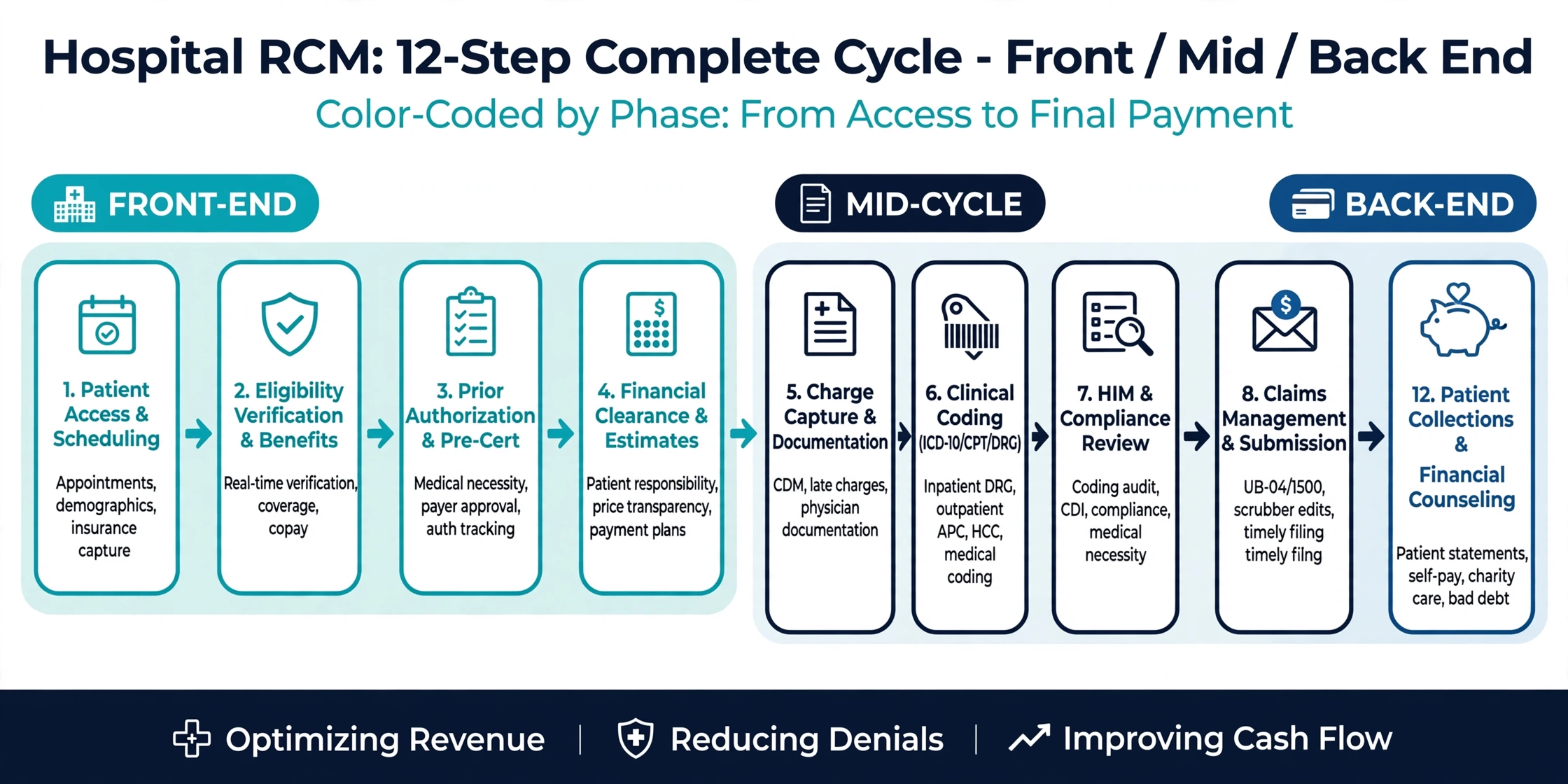
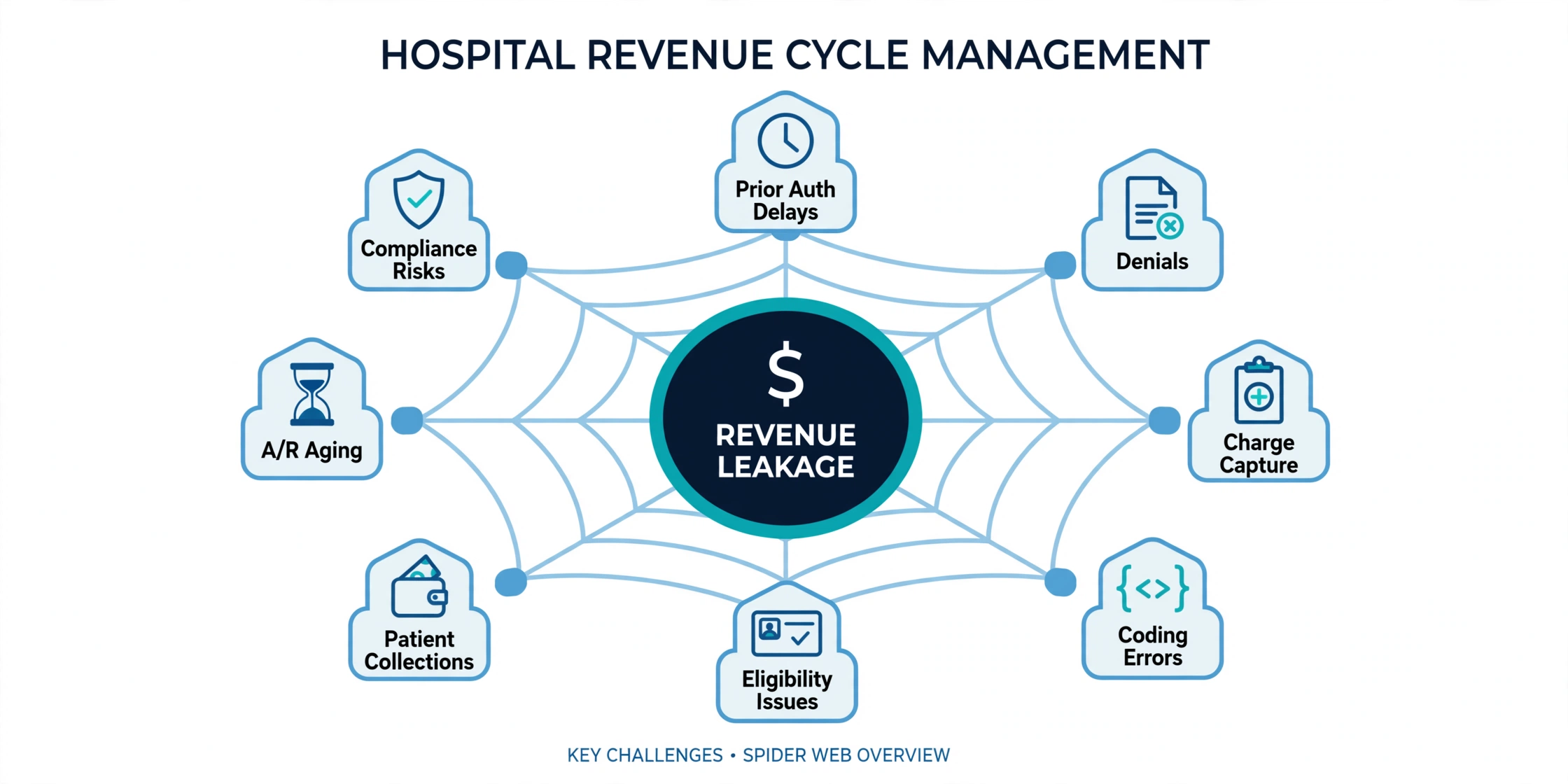
Our Hospital RCM services help healthcare organizations optimize revenue through accurate coding, claims management, compliance support, and denial prevention. We streamline complex hospital billing workflows to improve reimbursements, reduce revenue leakage, and support long-term financial performance.
Eligibility verification is the process of confirming that a patient’s Anthem coverage is active and applicable before any service is delivered. It goes beyond a simple yes-or-no check — it tells your team what’s actually payable, what isn’t, and what the patient will owe.
Many practices stop at confirming “active” status, but that single data point rarely tells the full story. Understanding how eligibility differs from benefits verification, and how both relate to prior authorization, sets the foundation for a clean revenue cycle from the very first patient interaction.
Skipping or rushing eligibility checks is one of the most common — and most preventable — causes of claim denials. When Anthem coverage is confirmed ahead of the visit, your team can catch problems before they turn into rework, rejected claims, or awkward billing conversations with patients.
Early verification also gives your front office the chance to disclose financial responsibility upfront, which improves collections and strengthens patient trust. In short, a few extra minutes spent verifying coverage protects hours of downstream cleanup.
Accurate eligibility verification starts with accurate intake. If a name is misspelled or a member ID is transposed, the entire verification result becomes unreliable, regardless of how thorough the rest of the process is.
Your registration staff should consistently capture the patient’s legal name, date of birth, subscriber ID, group number, and relationship to the subscriber, along with details of both primary and secondary insurance if applicable, and the planned date and type of service.
Once patient details are collected, your team needs to validate a specific set of data points directly with Anthem — not just whether the policy is active, but what it actually covers and under what conditions.
This includes effective and termination dates, plan type, network participation, deductible status, copay and coinsurance amounts, out-of-pocket maximums, benefit exclusions, and whether referrals or prior authorization apply. As payers like Aetna note, electronic eligibility responses typically return active coverage status alongside deductible, copay, coinsurance, and coordination-of-benefits data — the same principle applies to Anthem’s electronic responses.
Use this Anthem eligibility verification checklist to confirm member demographics, date-of-service coverage, plan and network status, service-specific benefits, deductibles, copays, coinsurance, and applicable authorization requirements. We help you validate these details before care so you can identify coverage or benefit issues early and reduce eligibility-related claim denials.
| Verification Item | What to Check | Why It Matters | Action Required |
|---|---|---|---|
| Coverage status | Active/inactive on date of service | Confirms service will be payable | Verify before every visit |
| Effective/termination dates | Start and end of coverage | Prevents lapsed-coverage denials | Cross-check against DOS |
| Plan/product type | HMO, PPO, EPO, POS | Determines network and referral rules | Identify exact plan name |
| Network status | In-network vs. out-of-network | Impacts reimbursement and patient cost | Confirm provider and facility |
| Deductible | Individual/family, met/remaining | Affects patient responsibility | Document current balance |
| Copay/coinsurance | Amount by service type | Needed for accurate patient estimate | Confirm per CPT category |
| Benefit limitations | Visit caps, exclusions | Avoids non-covered service denials | Match against planned service |
| Authorization/referral | Required or not | Prevents authorization-related denials | Confirm before scheduling |
| COB status | Primary/secondary payer order | Prevents COB-related denials | Verify with both payers |
Following a consistent, repeatable sequence removes guesswork from the verification process and ensures nothing gets missed, regardless of who on your team is handling the check.
The workflow generally runs: collect accurate patient information, validate the member ID, confirm coverage for the specific date of service, identify the exact plan, confirm network participation, verify service-specific benefits, review cost-sharing, check authorization or referral needs, verify COB, and document the outcome.
Electronic eligibility checks run on a standardized HIPAA transaction pair: the 270 inquiry sent by the provider, and the 271 response returned by the payer. Understanding this exchange helps your team interpret automated results with more confidence.
The 271 response typically returns coverage status, effective dates, benefit details, and cost-sharing figures, delivered through your clearinghouse or practice-management system. For Medicare Fee-for-Service specifically, CMS’s HETS system accepts HIPAA-compliant 270 inquiries and returns real-time 271 responses — a useful benchmark for how electronic verification is expected to function across payers.
We compare Anthem eligibility verification methods so you can understand how each option supports coverage, benefit, network, and patient responsibility checks before service. You can use this comparison to select an efficient verification workflow, improve data accuracy, reduce manual follow-up, and prevent eligibility-related claim issues.
| Verification Method | Best Use | Information Available | Advantages | Potential Limitations |
|---|---|---|---|---|
| Payer portal | Routine daily checks | Coverage, benefits, plan details | Fast, self-service | Portal downtime, incomplete data |
| 270/271 transaction | High-volume automated checks | Standardized coverage/benefit data | Real-time, scalable | May lack plan-specific nuance |
| Clearinghouse | Batch or integrated workflows | Aggregated payer responses | Works across multiple payers | Dependent on clearinghouse accuracy |
| Phone verification | Complex or unclear cases | Representative-confirmed details | Personalized answers | Time-consuming, hold times |
| Automated verification | Recurring/scheduled patients | Standard eligibility fields | Reduces manual workload | Limited for complex benefits |
| Manual payer rep verification | High-cost or ambiguous services | Detailed, case-specific answers | Highest accuracy for edge cases | Slowest, resource-intensive |
An eligibility response is only useful if your team knows how to read it correctly. A response can look “clean” at first glance while still containing details that change the entire billing outcome.
Pay close attention to coverage status, plan name, effective dates, service type, deductible figures, copay and coinsurance, out-of-pocket totals, network indicators, benefit limitations, and any authorization or referral flags before assuming a service is fully covered.
One of the most costly misunderstandings in eligibility verification is treating “active” as synonymous with “covered.” Anthem, like most payers, applies service-specific exclusions, frequency limits, and medical necessity rules that active status alone won’t reveal.
Before assuming a claim will be paid, your team should check for benefit maximums, network restrictions, and whether prior authorization is required for that specific procedure or specialty.
We help you identify frequent Anthem eligibility problems, including inactive coverage, member-data mismatches, plan changes, network discrepancies, and incomplete benefit information. You can address these issues before service by rechecking eligibility data, validating payer responses, and confirming unclear coverage details to reduce denials and billing delays.
| Eligibility Problem | What It Means | Claim/Revenue Risk | Recommended Solution |
|---|---|---|---|
| Inactive coverage | Policy terminated or not yet active | Denied claim | Reverify before scheduling |
| Incorrect member ID | Wrong or mistyped ID number | Rejected eligibility request | Confirm against insurance card |
| Wrong payer identified | Patient has a different plan | Claim sent to wrong payer | Re-verify payer and plan |
| Coverage terminated | Policy ended before DOS | Full claim denial | Check termination date pre-visit |
| Provider out of network | No network agreement | Reduced or denied reimbursement | Confirm network status in advance |
| Incorrect COB | Wrong primary/secondary order | Delayed or denied payment | Verify COB with both payers |
| Missing authorization | Required auth not obtained | Authorization denial | Confirm auth requirement early |
| Benefit exclusion | Service not covered under plan | Non-covered denial | Check service-specific benefits |
| Deductible not met | Patient owes full/partial cost | Unexpected patient balance | Communicate estimate pre-visit |
| Incorrect plan selected | Wrong product type on file | Claim processing errors | Confirm exact plan name |
Cost-sharing details determine what the patient will actually owe, and getting these numbers wrong creates friction at check-out and in collections. Individual and family deductibles often differ, so confirming which applies matters.
Your team should also distinguish between deductible met versus remaining, copay by service category, coinsurance percentages, and how in-network versus out-of-network responsibility changes the final estimate communicated to the patient.
We help you verify patient financial responsibility by confirming deductibles, copays, coinsurance, out-of-pocket balances, and applicable benefit limitations before services are provided. You can use these details to communicate expected costs clearly, improve upfront collections, and reduce billing disputes after claim processing.
| Cost-Sharing Element | What to Verify | Example Scenario | Why Providers Need It |
|---|---|---|---|
| Deductible | Amount met vs. remaining | $500 remaining before coverage kicks in | Sets accurate patient estimate |
| Copay | Fixed amount per visit type | $30 for specialist visit | Collected at time of service |
| Coinsurance | Percentage owed after deductible | 20% coinsurance on imaging | Impacts high-cost service estimates |
| Out-of-pocket max | Remaining limit for the year | $200 left before max is reached | Determines when costs stop |
| Network status | In vs. out-of-network cost difference | Higher coinsurance out-of-network | Prevents billing surprises |
Network participation isn’t always uniform across a provider group — a facility can be in-network while a specific rendering provider isn’t, or vice versa. Anthem’s plan-specific networks make this distinction especially important to confirm case by case.
Your team should verify participation at the provider, facility, and location level, and check whether the specific plan carries referral or network restrictions that would affect reimbursement.
Different plan structures carry different rules around referrals, networks, and authorization, so identifying the exact plan — not just the payer name — is essential to accurate verification.
Common plan types to distinguish include HMO, PPO, EPO, POS, Medicare, Medicare Advantage, Medicaid, Managed Medicaid, employer-sponsored plans, and Marketplace/Exchange products, each of which may carry Anthem-specific variations.
We help you verify the patient’s plan type and its specific requirements, including network rules, referral conditions, benefit limitations, and authorization requirements before services are scheduled. You can confirm these details upfront to follow the correct billing pathway, prevent coverage errors, and reduce avoidable claim denials.
| Plan Type | Network Requirement | Referral Risk | Authorization Consideration | Verification Priority |
|---|---|---|---|---|
| HMO | Strict in-network only | High | Often required | Critical |
| PPO | Flexible, in/out-of-network | Low | Sometimes required | High |
| EPO | In-network only, no referrals | Low | Sometimes required | High |
| POS | Hybrid, referral-dependent | Medium | Sometimes required | Medium |
| Medicare Advantage | Plan-specific network | Medium | Often required | Critical |
| Managed Medicaid | Strict network | High | Often required | Critical |
Authorization requirements are easy to miss when eligibility is treated as a separate step from utilization management. Building the two into a single workflow reduces the risk of delivering a service that later gets denied for lack of approval.
During verification, your team should identify which services require authorization, confirm who is responsible for obtaining it, note effective dates, approved units or visits, and flag anything unclear for follow-up before the appointment.
Referral rules vary significantly by plan type and specialty, and an expired or missing referral can trigger a denial even when coverage itself is active.
Items to confirm include whether a PCP or specialist referral is required, HMO-specific rules, referral validity dates, the number of approved visits, and any restrictions tied to the rendering provider.
When a patient has more than one insurance plan, determining which one pays first is critical to avoiding processing delays. Outdated COB records are a surprisingly common source of denials.
Your team should confirm primary versus secondary status, watch for Medicare secondary payer scenarios, account for multiple commercial plans or Medicaid as secondary coverage, and understand how patient responsibility shifts when COB information is incorrect.
We help you verify primary and secondary coverage by confirming each payer’s active status, effective dates, benefit details, and correct coordination of benefits before claim submission. You can establish the proper billing order upfront to prevent COB-related denials, incorrect patient balances, and unnecessary reimbursement delays.
| Scenario | Likely Verification Issue | What Staff Should Confirm | Recommended Action |
|---|---|---|---|
| Two commercial plans | Unclear primary/secondary order | Birthday rule or employer coverage | Confirm order with both payers |
| Medicare + commercial | Medicare secondary payer rules | Which plan pays first | Apply MSP questionnaire |
| Medicaid as secondary | Medicaid always pays last | Primary payer processed first | Bill primary before Medicaid |
| Outdated COB on file | Old insurance still listed as primary | Current active coverage | Update COB before billing |
Benefits often vary by service category, so a general eligibility check isn’t enough for specialties with unique coverage rules. Each service line deserves its own verification pass.
This applies across office visits, specialist visits, behavioral health, physical therapy, occupational therapy, speech therapy, ABA therapy, diagnostic imaging, laboratory services, surgery, DME, home health, and telehealth — each carrying its own authorization, frequency, and network considerations under Anthem plans.
We help you verify benefits by service category so you can confirm coverage levels, patient cost-sharing, visit or frequency limits, and service-specific requirements before care is provided. You can use these details to identify coverage restrictions early, estimate patient responsibility accurately, and reduce benefit-related claim denials.
| Service Category | Benefits to Verify | Common Limitation | Authorization/Referral Check | Provider Risk |
|---|---|---|---|---|
| Behavioral health | Session limits, copay | Visit caps per year | Often required | Denial if cap exceeded |
| Physical therapy | Visit limits, coinsurance | Frequency limits | Often required | Non-covered visits |
| Diagnostic imaging | Coverage, network | Pre-cert for advanced imaging | Frequently required | Authorization denial |
| DME | Coverage, rental vs. purchase | Quantity limits | Often required | Non-covered equipment |
| Telehealth | Covered modality, copay | Platform/provider restrictions | Sometimes required | Reimbursement reduction |
Even experienced staff fall into predictable patterns that create downstream denials. Recognizing these errors is the first step to preventing them.
Frequent mistakes include verifying eligibility too early, failing to reverify before the date of service, checking only active/inactive status, overlooking service-specific benefits, missing plan changes, entering incorrect demographics, skipping network checks, missing COB updates, failing to document verification, and assuming authorization is confirmed simply because coverage is active.
We help you identify eligibility verification errors that can lead to claim denials, delayed payments, incorrect patient balances, and additional administrative rework. You can address these issues before service to protect reimbursement, reduce avoidable A/R, and maintain a more consistent revenue cycle.
| Staff Error | Possible Consequence | Revenue-Cycle Impact | Prevention Strategy |
|---|---|---|---|
| Checked too early | Coverage changes before DOS | Late-stage denial | Reverify closer to visit |
| Only checked active status | Missed exclusions | Non-covered denial | Full benefit verification |
| Incorrect demographics | Rejected eligibility request | Processing delay | Cross-check insurance card |
| Missed authorization | Service delivered without approval | Authorization denial | Confirm auth during verification |
| No documentation | No record of what was verified | Difficulty appealing denials | Standardized documentation log |
New and returning patients require slightly different verification approaches. First-time patients need a complete benefit workup, while returning patients need a focused check for anything that’s changed since their last visit.
Key triggers for returning patients include insurance changes, the start of a new benefit year, new employer coverage, adjusted deductibles or benefits, and updated insurance cards.
Eligibility isn’t a one-time task — coverage can change between scheduling and the actual appointment. Establishing clear reverification checkpoints keeps your data current.
Recommended checkpoints include at the time of scheduling, shortly before the appointment, on the date of service itself, after any known insurance change, at the start of a new benefit year, and before high-cost or recurring treatments.
We help you build a practical Anthem verification timeline that covers eligibility checks before scheduling, pre-service benefit confirmation, and final verification close to the date of care. You can follow this workflow to catch coverage changes early, confirm current patient responsibility, and reduce last-minute eligibility issues and claim delays.
| Verification Stage | Timing | What to Check | Staff Action | Risk Prevented |
|---|---|---|---|---|
| At scheduling | Initial contact | Basic eligibility | Confirm coverage exists | Wasted scheduling effort |
| Before appointment | 24–72 hours prior | Full benefits | Detailed verification | Day-of surprises |
| Date of service | Day of visit | Real-time status | Final confirmation | Coverage lapses |
| After insurance change | As reported | Updated plan details | Full reverification | Claim mismatches |
| New benefit year | January or plan renewal | Reset deductibles/limits | Annual re-check | Outdated benefit assumptions |
High-cost procedures carry greater financial risk if verification is incomplete, making a more detailed review worthwhile before scheduling.
For these cases, confirm detailed benefits, authorization status, network participation, benefit maximums, deductible and coinsurance exposure, and prepare a clear financial estimate for the patient, backed by documented reference numbers.
Many of the most common denial categories trace directly back to gaps in front-end verification. Strengthening this step is one of the highest-leverage ways to reduce denials overall.
Verification helps prevent denials tied to inactive coverage, non-covered services, COB mismatches, missing authorization, network issues, incorrect patient information, and plan mismatches — all before a claim is ever submitted.
We help you recognize common denial scenarios and connect each risk with the right pre-service verification action, from confirming active coverage and network status to checking benefits, referrals, and authorization requirements. You can resolve these issues before claim submission to reduce preventable denials, rework, and reimbursement delays.
| Denial Scenario | Root Cause | What Should Have Been Verified | Corrective Action | Preventive Action |
|---|---|---|---|---|
| Inactive coverage denial | Coverage lapsed before DOS | Effective/termination dates | Appeal with updated info | Reverify closer to DOS |
| Non-covered service | Service excluded from plan | Benefit details | Adjust billing or appeal | Verify service-specific benefits |
| COB denial | Wrong payer billed first | Primary/secondary order | Rebill correct payer order | Confirm COB each visit |
| Authorization denial | No prior approval obtained | Authorization requirement | Retroactive auth request | Confirm auth before service |
A verification isn’t complete until it’s documented in a way that can be referenced or defended later, especially during an appeal.
Strong documentation includes the date and time of verification, method used, representative name if applicable, reference number, coverage dates, confirmed benefits, patient responsibility, authorization or referral details, and any electronic response records or staff notes.
When the payer portal doesn’t match what the patient reports, resolving the discrepancy before billing prevents avoidable denials.
Steps include rechecking demographics, validating the insurance card, contacting the payer directly, asking the patient about recent coverage changes, checking for an alternate plan, documenting the conflict, and holding nonurgent billing actions until the issue is resolved.
Medicare-affiliated coverage introduces its own verification nuances, particularly around Anthem’s Medicare Advantage offerings.
Key areas include understanding the interplay between Part A and Part B, verifying Medicare Advantage details directly with Anthem, using HETS for FFS 270/271 checks, confirming Medicare entitlement dates, and applying Medicare secondary payer rules where applicable. CMS is explicit that HETS applies to Medicare Fee-for-Service eligibility only, and that Medicare Advantage eligibility must be verified with the applicable plan directly — which for Anthem members means checking directly with Anthem’s Medicare Advantage systems.
Medicaid verification is inherently state-specific, and Anthem’s Medicaid products vary by state program, making a one-size-fits-all workflow impractical.
Your process should account for differences between Medicaid and Managed Medicaid, use the applicable state Medicaid portal, confirm eligibility effective dates, identify plan assignment and managed care organization, and adjust reverification frequency based on state requirements.
While the core verification steps stay consistent, each commercial payer has its own portal quirks, response formats, and network structures worth understanding.
This section can be expanded with payer-specific subsections for Anthem/Elevance, Cigna, Aetna, UnitedHealthcare, other Blue Cross Blue Shield plans, Humana, Kaiser Permanente, Molina Healthcare, Centene plans, and regional payers relevant to your practice’s footprint.
We compare Medicare, Medicaid, and commercial insurance verification so you can understand the differences in eligibility, benefit structures, network rules, cost-sharing, and payer-specific requirements. You can use these distinctions to apply the correct verification workflow, identify coverage limitations early, and reduce preventable billing and claim errors.
| Area | Medicare | Medicaid | Commercial Insurance | Key Provider Consideration |
|---|---|---|---|---|
| Verification method | HETS 270/271 | State portal | Payer portal/270-271 | Different systems per payer type |
| Network rules | FFS: none; MA: plan-specific | State/MCO-specific | Plan-specific | Confirm MA/MCO separately |
| Reverification frequency | Annually / per event | Frequent, state-dependent | Per benefit year | Build payer-specific cadence |
| Authorization complexity | Moderate | Often high | Varies by plan | Track per payer |
A clearly mapped workflow keeps every team member aligned on who does what and when, reducing gaps between scheduling and service delivery.
A typical flow looks like: Patient Scheduled → Insurance Information Collected → Eligibility Checked → Benefits Verified → Network Confirmed → Authorization/Referral Checked → Patient Responsibility Identified → Verification Documented → Patient Informed.
We help you define who is responsible for each eligibility verification task, from collecting patient information and checking coverage to confirming benefits, authorization requirements, and financial responsibility. You can use this responsibility matrix to create clear ownership, prevent missed verification steps, and keep your pre-service workflow consistent.
| Task | Front Desk | Eligibility Team | Billing Team | Authorization Team | When Completed |
|---|---|---|---|---|---|
| Collect patient info | ✔ | At scheduling | |||
| Verify active coverage | ✔ | Before appointment | |||
| Confirm benefits | ✔ | Before appointment | |||
| Check authorization | ✔ | Before service | |||
| Document verification | ✔ | ✔ | Throughout process |
When eligibility is verified thoroughly, patients experience fewer billing surprises and clearer expectations — which builds trust in the practice.
Benefits include fewer unexpected bills, greater financial transparency, earlier identification of coverage problems, clearer communication of patient responsibility, and smoother appointment-day interactions overall.
We help you strengthen eligibility verification so your practice can reduce preventable denials, limit rework, improve upfront collections, and maintain cleaner claims from the start. You can turn accurate pre-service verification into better cash flow, lower administrative costs, and a more predictable revenue cycle.
| Benefit | Operational Impact | Financial Impact | Patient Impact |
|---|---|---|---|
| Fewer denials | Less rework for billing team | Faster reimbursement | Fewer billing disputes |
| Accurate estimates | Smoother check-out process | Higher point-of-service collections | Reduced billing surprises |
| Documented verification | Easier appeals process | Recovered revenue on disputed claims | Increased trust in practice |
Consistent quality control keeps eligibility verification accurate as patient volume and payer complexity grow over time.
Core components include daily verification queues, unverified-patient reports, exception management, periodic verification and documentation audits, denial feedback loops, ongoing staff training, and regularly updated payer-specific SOPs.
Tracking the right metrics helps practices identify where verification breakdowns are occurring and measure improvement over time.
Metrics worth monitoring include the percentage of scheduled patients verified, verification completion rate before the date of service, eligibility-related and COB-related denial rates, registration error rate, authorization-related front-end issues, turnaround time, and unverified account volume.
We help you track key eligibility verification KPIs, including verification completion rates, response accuracy, turnaround time, eligibility-related denials, and unresolved coverage issues. You can use these metrics to identify workflow gaps, measure team performance, and improve the financial impact of your pre-service verification process.
| KPI | What It Measures | Why It Matters | Improvement Action |
|---|---|---|---|
| % patients verified | Coverage of verification process | Identifies gaps in workflow | Expand verification queue capacity |
| Denial rate (eligibility) | Front-end verification accuracy | Direct revenue impact | Targeted staff retraining |
| Verification turnaround | Speed of process completion | Impacts scheduling efficiency | Automate routine checks |
| Unverified account volume | Backlog size | Signals resource strain | Reassign or outsource overflow |
As patient volume and payer complexity grow, many practices reach a point where in-house verification alone can’t keep pace.
Common triggers include high patient volume, limited front-desk staffing, rising eligibility-related denials, multiple payer contracts, multi-location operations, specialty-specific benefit complexity, staff turnover, and a growing verification backlog.
Choosing between in-house and outsourced verification depends on staffing capacity, payer expertise, and how much workflow consistency your practice can maintain internally.
Key comparison points include staffing and training requirements, depth of payer expertise, scalability during volume spikes, quality control processes, workflow consistency, overall cost, and coverage continuity during staff absences.
We compare in-house and outsourced eligibility verification so you can evaluate staffing costs, verification accuracy, turnaround time, payer follow-up, and administrative workload. You can choose the right model for your practice to improve pre-service accuracy, reduce eligibility-related denials, and maintain a more efficient revenue cycle.
| Area | In-House Team | Outsourced Team | Provider Consideration |
|---|---|---|---|
| Staffing | Requires hiring/training | Ready-made expertise | Faster ramp-up with outsourcing |
| Payer expertise | Limited to internal experience | Broad, multi-payer experience | Fewer errors on complex plans |
| Scalability | Constrained by headcount | Flexible capacity | Easier to handle volume swings |
| Cost | Fixed salary/benefits cost | Variable, usage-based cost | Depends on practice size |
| Coverage during absence | Gaps during turnover/leave | Continuous coverage | Reduces backlog risk |
House of Outsourcing provides end-to-end eligibility and benefits verification tailored to payer-specific workflows, including Anthem’s plan structures and documentation requirements.
Our support spans Medicare and Medicaid verification, commercial payer checks, patient responsibility confirmation, network status review, authorization and referral identification, COB verification, and thorough documentation that integrates directly with your existing billing workflows.
House of Outsourcing brings more than a decade and a half of hands-on experience in eligibility and revenue cycle operations across a wide range of specialties and payer types.
Our team understands payer-specific workflows in depth, handles complex benefit verification with precision, and supports front-end revenue-cycle operations through quality-focused, scalable processes built for growing healthcare organizations.
Providers choose House of Outsourcing because our verification team combines payer-specific expertise with consistent documentation standards and a genuine focus on preventing denials before they happen.
We reduce administrative workload for internal staff, support broader revenue-cycle goals, and scale alongside your organization as patient volume and payer complexity increase.
Before every appointment, confirm: Is coverage active? Is it valid for the date of service? Is the provider in-network? Is the requested service covered? What is the deductible, copay, and coinsurance? What out-of-pocket amount remains?
Also confirm: Is prior authorization required? Is a referral needed? Are there benefit limits? Is COB accurate? And finally, has the entire verification been properly documented?
Anthem eligibility can be verified through the payer portal, a 270/271 electronic transaction, a clearinghouse, or by phone with a representative, depending on the complexity of the case.
At minimum, at scheduling and again shortly before the date of service, with additional checks after any known insurance change or at the start of a new benefit year.
Patient demographics, subscriber ID, group number, insurance card details, and the planned date and type of service.
No, active coverage doesn’t guarantee that a specific service is covered, so benefit-level details must also be verified.
Through the payer portal, electronic eligibility response, or direct confirmation with an Anthem representative.
Authorization requirements should be confirmed as part of the same verification process, using the payer portal or by contacting Anthem directly.
Nonurgent services should be held until the discrepancy is resolved, and the conflict should be documented for follow-up.
Yes, returning patients should be reverified for any insurance, benefit, or demographic changes since their last visit.
By confirming primary versus secondary order with both payers and updating COB records accordingly.
Yes, many practices outsource eligibility verification to reduce administrative burden and improve accuracy at scale.
Get a free assessment from our billing experts