
Our cardiology medical billing services help practices optimize reimbursements, reduce claim denials, and manage complex cardiology coding requirements with accuracy. We handle the complete revenue cycle, from claims submission to denial resolution, ensuring efficient billing processes and improved financial performance.

We know that the heart never stops working, and neither does the complexity of cardiology medical billing. From the moment a cardiologist interprets a 12-lead ECG to the time a cath lab submits charges for a complex PCI with multi-vessel stenting, every cardiovascular service carries unique CPT codes, documentation standards, modifier requirements, and payer-specific billing policies. In cardiology medical billing, even the smallest coding or documentation error can lead to denials, delayed reimbursements, or significant revenue loss, making accuracy and compliance absolutely critical.
In the USA you know as a cardiologist that cardiology is one of the highest-revenue specialty. The cardiovascular CPT code range 92920 through 93799 spans routine diagnostics, interventional procedures, electrophysiology studies, device implants, remote monitoring programs, and cardiac rehabilitation. Each category carries its own billing rules. And because cardiology procedures command premium reimbursement rates, they attract equally premium audit attention from Medicare, Medicaid, and commercial payers.
Our specialists have written this guide for cardiologists, cardiovascular surgeons, electrophysiologists, cardiology billing specialists, and revenue cycle leaders who need a comprehensive, current, and practical playbook for cardiology medical billing services.
According to data from 2023–2024 all-payer claims, cardiovascular services represent one of the highest-volume and highest-value claim categories in US healthcare. The ten most frequently billed cardiology CPT codes alone led by 93010 (ECG interpretation), 93306 (complete echocardiography), and remote monitoring codes, account for the majority of cardiovascular billing claims nationally. What elevates cardiology billing complexity above most other specialties?
Multi-component procedures: A single catheterization encounter may legitimately involve a right heart cath, left heart cath, coronary angiography, ventriculography, and hemodynamic measurements, each with its own CPT code and documentation requirement, and each subject to NCCI bundling edits that determine which combinations are separately billable.
Technical vs. professional component split billing: Modifiers 26 (professional component) and TC (technical component) are essential in cardiology because many diagnostic services, echocardiography, stress tests, Holter monitoring, are split between the physician who interprets and the facility or lab that performs the technical work.
Interventional coding precision: Coronary artery modifiers (LD for left anterior descending, LC for left circumflex, RC for right coronary) must be applied to PCI codes to identify exactly which vessel was treated. Omitting these modifiers causes claim rejection or denial for high-value procedures.
Strict prior authorization requirements: Stress echocardiography, nuclear imaging, CT/MRI cardiac studies, EP ablations, device implants, and many catheterization procedures require pre-authorization from payers. Missing PA is the single most common cause of cardiology claim denials.
Remote monitoring complexity: The 2021 restructuring of extended cardiac monitoring CPT codes created an entirely new billing framework for remote telemetry and ambulatory monitoring, one that many practices still haven’t fully implemented correctly.
�� Cardiology Billing by the Numbers Why Precision Matters
The AMA’s cardiology CPT code range (92920–93799) encompasses every cardiovascular procedure and service from a routine ECG to a complex biventricular ICD implant. Cardiology billing services require mastery of this range, organized by service category, with specific documentation requirements that drive code selection.
| Service Category | CPT Code Range | Primary Services | Billing Complexity |
|---|---|---|---|
| Electrocardiography (ECG/EKG) | 93000–93042 | 12-lead ECG, rhythm strips, signal-averaged ECG | Low — but component split (26/TC) must be precise |
| Ambulatory Monitoring | 93224–93229, 93241–93248 | Holter, event monitor, mobile cardiac telemetry | Medium — 2021 restructuring changed code sets significantly |
| Echocardiography | 93303–93352 | TTE, TEE, stress echo, congenital echo | High — complete vs. limited; Doppler; color flow all affect code |
| Cardiac Stress Testing | 93015–93018 | Exercise stress, pharmacological stress, imaging | Medium — who supervises and who interprets drives code selection |
| Cardiac Catheterization | 93451–93462 | Right heart, left heart, combined, hemodynamics | Very High — multiple add-ons; NCCI edits; vessel-level coding |
| Interventional Cardiology | 92920–92975 | PCI, PTCA, stent, atherectomy, valvuloplasty | Very High — vessel modifiers LD/LC/RC; add-on bundles |
| Electrophysiology (EP) | 93600–93660 | EP studies, ablation, cardioversion, pacemaker | Highest — multi-component; global periods; device-specific codes |
| Device Implant & Management | 33200–33275 | Pacemaker, ICD, CRT implant, revision, extraction | Very High — global periods; upgrade vs. new implant distinction |
| Remote Cardiac Monitoring | 93279–93299 | Device interrogation, programming, telemetry | Medium — 90-day period rules; interrogation vs. programming distinction |
| Cardiac Rehabilitation | 93797–93798 | Supervised exercise, physician supervision | Low-Medium — session count documentation; PA often required |
| E/M Visits (Cardiology) | 99202–99215, 99221–99233 | Office visits, hospital visits, consultations | Medium — MDM vs. time; split visits; concurrent care rules |
The electrocardiogram is the most frequently performed and most frequently billed cardiovascular test in the United States. Despite its apparent simplicity, ECG billing contains component-splitting rules that, if misapplied, generate systematic underpayment or compliance risk.
| CPT Code | Service Description | When to Use | Split Billing Rule |
|---|---|---|---|
| 93000 | ECG, routine with at least 12 leads — with interpretation and report | When the SAME physician performs, supervises, and interprets the ECG in a global service (office setting) | Global — no modifier needed when one provider does all |
| 93005 | ECG — tracing only (technical component) | When the practice provides the tracing but NOT the interpretation — or billing the technical component separately | Use TC modifier OR bill 93005 directly for technical only |
| 93010 | ECG — interpretation and report only | When the cardiologist interprets a tracing performed elsewhere or interprets remotely | Most billed cardiology CPT nationally; use when no technical component |
| 93040 | Rhythm ECG — one to three leads, with interpretation | Single-lead or limited rhythm strip with interpretation | Distinct from 12-lead ECG; do not use for complete 12-lead studies |
| 93041 | Rhythm ECG — one to three leads, tracing only | Technical component of rhythm strip only | Pairs with 93042 for physician interpretation |
| 93042 | Rhythm ECG — interpretation and report | Professional component only for rhythm strip | Split billing of rhythm strip — less common; verify payer acceptance |
⚠️ The Most Common ECG Billing Error Using 93000 When 93010 Is Correct
In a hospital outpatient or shared service setting, the facility bills for the technical component (tracing, paper, equipment) and the cardiologist bills only for the professional component (interpretation and report). Billing 93000 (global ECG) when the facility already billed the technical component creates duplicate billing, a compliance violation. Use 93010 for physician interpretation only in all settings where the technical component is separately billed.
Tip #1: Audit Your ECG Billing Setting Every Quarter
The correct ECG CPT code depends on where the service is provided and who does each component. In your office with your own ECG machine, interpreting yourself: 93000 (global). In the hospital interpreting an ECG run by the hospital’s department: 93010 (professional only). If your practice owns the equipment but a cardiologist elsewhere reads it: your practice bills 93005 (technical), the reading physician bills 93010. Run a quarterly audit of ECG claims to verify that the right code is being used for each patient care setting; this single check prevents both underpayment and compliance violations
Echocardiography is the highest-volume and, according to industry data, the most denial-prone diagnostic category in cardiology billing services. CPT 93306 (complete transthoracic echo) is the single most billed cardiology diagnostic code, with Medicare reimbursement around $188 nationally and commercial payers typically paying 120–160% of Medicare rates. The financial stakes of getting echo billing right are significant.
| CPT Code | Service | Key Requirements | Common Error |
|---|---|---|---|
| 93306 | Echo, transthoracic — complete with spectral AND color flow Doppler | 2D imaging + M-mode + spectral Doppler + color flow Doppler; complete study of all cardiac structures | Billing 93306 when color flow Doppler not performed — should be 93307 |
| 93307 | Echo, transthoracic — complete without Doppler | 2D + M-mode only; no Doppler component performed | Using 93307 when any Doppler was performed — should be 93306 |
| 93308 | Echo follow-up or limited — transthoracic | Limited study evaluating specific question; NOT a complete study | Using follow-up code when full study is warranted — underbilling |
| 93303 | Echo, congenital heart disease — complete | For patients with known or suspected congenital heart disease | Using adult echo codes for congenital patients — incorrect CPT family |
| 93304 | Echo, congenital heart disease — follow up or limited | Limited/follow-up in congenital patient | Document the congenital diagnosis that justifies the congenital code family |
| 93312 | TEE — probe placement and image acquisition | Transesophageal echo; physician must document probe placement | Billing TEE when only TTE was performed — overstatement of service |
| 93315 | TEE — congenital heart disease | TEE in congenital patient — specific code family required | Using adult TEE codes for congenital patients |
| 93318 | TEE — for monitoring purposes during non-cardiac surgery | Monitoring TEE; distinct from diagnostic TEE | Confusing monitoring TEE with diagnostic TEE — different clinical scenarios |
| 93350 | Stress echo — complete, real-time 2D imaging | Exercise or pharmacological stress WITH echocardiography imaging | Missing the stress component documentation — must document both stress and echo |
| 93351 | Stress echo — with contrast | Contrast agent used during stress echo; higher complexity | Document contrast agent type, clinical justification for contrast use |
| 93320 | Doppler echo — pulsed wave and/or continuous wave | Add-on Doppler; billed with 93307 when adding Doppler to a limited echo | Billing as standalone rather than add-on |
| 93325 | Doppler echo — color flow velocity mapping | Color flow add-on; used with 93307 | Do not bill with 93306 which already includes color flow |
The Complete vs. Limited Echo Decision How Documentation Drives CPT Selection
A ‘complete’ echocardiogram (93306) requires documentation of:
(1) 2D real-time imaging;
(2) M-mode recording;
(3) spectral Doppler;
(4) color flow Doppler, applied to all required cardiac structures. If any component is missing from either the study OR the report, the claim defaults to limited echo (93308). Train providers that the echo report must explicitly document each required element, incomplete reports cost $50–$80 per study in underpayment and create audit risk when upgraded codes are billed.
Stress test coding is one of the most frequently misapplied areas of cardiology medical billing, not because the rules are unclear, but because the provider roles during the test are fluid and often not clearly documented. The CPT selection for cardiac stress testing depends entirely on who supervised the test, who performed the tracing, and who interpreted the results and whether nuclear imaging was involved.
| CPT Code | Service | Who Bills It | Key Documentation |
|---|---|---|---|
| 93015 | Cardiovascular stress test — complete (tracing + supervision + interpretation) | Single provider who performs ALL components | Document that the same physician supervised, acquired, and interpreted — all in one note |
| 93016 | Physician supervision of cardiovascular stress test only | The supervising physician — another provider runs the tracing and interprets | Document supervision presence; cannot bill if absent from the suite |
| 93017 | Tracing only (no interpretation by this provider) | The facility or technical staff — no physician interpretation component | Used by entity doing technical acquisition only; no interpretation billed |
| 93018 | Interpretation and report only | The reading cardiologist who interprets but did NOT supervise | Requires a written interpretation report; do not bill if supervising provider also interprets |
| 93350 | Stress echocardiography — with echocardiography | Cardiologist performing stress echo — complete service | Echo images at rest AND during/after stress; document both components fully |
| 93015 + 93350 | Combined stress ECG + stress echo | Not typically combined — typically stress echo code includes ECG component | Verify payer rules; many consider this bundled; do NOT bill both without payer confirmation |
�� Nuclear Cardiac Imaging Adds Another Billing Layer and Prior Authorization
When nuclear myocardial perfusion imaging (MPI) accompanies stress testing, add codes 78451–78454 (SPECT MPI) or 78491–78492 (PET MPI). These codes require separate documentation of image acquisition and interpretation. Importantly, nuclear cardiac imaging almost universally requires prior authorization from commercial payers and Medicare Advantage plans. Submitting without PA results in claim denial. Build PA tracking for all stress echo and nuclear stress test orders into your scheduling workflow.

Cardiac catheterization is the highest-value procedure category in cardiology medical billing, and the one that generates the most audit scrutiny. Cath lab claims trigger review because they carry high reimbursement values, involve multiple add-on codes, and require vessel-level documentation specificity that many practices still get wrong. One missing detail in the cath report can cost a practice thousands of dollars per case.
| CPT Code | Service | What's Included | Key Documentation |
|---|---|---|---|
| 93451 | Right heart catheterization | Measurement of pressures in right heart chambers and pulmonary artery | Document access site, catheter position, all pressure measurements, oxygen saturation data |
| 93452 | Left heart catheterization with coronary angiography | LHC + coronary angiography — most common cath code | Document access site, ventriculography findings, all coronary vessels visualized |
| 93453 | Combined right and left heart catheterization | Right + left heart + coronary angiography in same session | Document that both right and left heart work was performed; justify combined study |
| 93454 | Coronary angiography — no left heart catheterization | Coronary angiography only without LHC component | Document that ventriculography was NOT performed and why |
| 93455 | Coronary angiography + bypass graft imaging | Post-CABG patient; includes native and graft vessel angiography | Document all grafts visualized; specify graft type (arterial vs. venous) |
| 93456 | Right heart cath + coronary angiography | Right heart + coronary visualization, no left heart | Document right heart pressures + coronary visualization; explain why no LHC |
| 93458 | Left heart cath + coronary angiography + LV gram | Standard LHC with ventriculography + coronary angiography | Document all components; LV gram images must be in the record |
| 93461 | Left and right heart cath + coronary + bypass graft | Most comprehensive — all components in post-CABG patient | Document every element; justify comprehensive study in clinical notes |
| Add-On CPT | Service | Base Code Required | Billing Rule |
|---|---|---|---|
| +93462 | Left heart catheterization with transseptal puncture | Paired with 93451 or 93453 | Document technique; not separately billable without base LHC or RHC |
| +93463 | Pharmacological agent administration during cath | Any cath base code | Document the agent, dose, and clinical rationale in the cath report |
| +93464 | Physiological exercise during cath | Any cath base code | Document the exercise protocol and hemodynamic data collected |
| +93568 | Pulmonary angiography during cath | 93451 or combined cath | Document pulmonary arterial visualization; clinical indication required |
�� Cath Report Documentation That Survives Audit Every Time
Every cardiac catheterization report must include:
(1) Access site (radial vs. femoral);
(2) All chambers entered and catheters used;
(3) All pressure measurements with specific values;
(4) Oxygen saturation data if right heart;
(5) Ventriculography findings (if performed, or explicit note that it was not performed);
(6) All coronary vessels and grafts visualized with findings;
(7) Hemodynamic data;
(8) Final impression and plan. Missing any of these elements creates audit vulnerability for one of your highest-value claim categories
Interventional cardiology procedures PCI, stent placement, atherectomy, valvuloplasty, and EP ablation are the highest-value services in cardiovascular medicine and the most complex to bill accurately. Interventional cardiology billing services require mastery of coronary vessel modifiers, add-on code logic, NCCI bundling rules, and procedure-specific documentation requirements that determine whether a six-figure revenue stream pays out correctly or generates systematic denials.
| CPT Code | Service | Vessel Modifier Required | Critical Rule |
|---|---|---|---|
| 92920 | Percutaneous transluminal coronary angioplasty (PTCA) — single vessel | LD, LC, or RC | Base PCI code; document vessel, technique, pre/post images |
| 92921 | PTCA — each additional vessel | LD, LC, or RC (different vessel) | Add-on to 92920; each additional native vessel treated billed separately |
| 92928 | Percutaneous transcatheter placement of intracoronary stent(s) — single vessel | LD, LC, or RC | Most billed interventional code; document stent type, size, and final result |
| 92929 | Stent placement — each additional vessel | LD, LC, or RC (different vessel) | Add-on to 92928; one code per additional vessel, not per stent |
| 92933 | Coronary atherectomy — single vessel | LD, LC, or RC | Document atherectomy device used and pre/post angiographic findings |
| 92934 | Coronary atherectomy — each additional vessel | LD, LC, or RC (different vessel) | Add-on to 92933 |
| 92937 | PCI in previously placed coronary stent — single vessel | LD, LC, or RC | In-stent restenosis treatment; document prior stent in clinical notes |
| 92938 | PCI in previously placed stent — each additional vessel | LD, LC, or RC (different vessel) | Add-on to 92937 |
| 92941 | PCI during acute MI — single vessel | LD, LC, or RC | Primary PCI in STEMI; document time from first medical contact and symptom onset |
| 92943 | PCI — chronic total occlusion — single vessel | LD, LC, or RC | CTO PCI; document complete occlusion and antegrade/retrograde technique |
| 92944 | PCI — chronic total occlusion — each additional vessel | LD, LC, or RC (different vessel) | Add-on to 92943 |
| Modifier | Vessel Treated | When to Apply | Billing Rule |
|---|---|---|---|
| LD | Left anterior descending artery (LAD) | When PCI/stent/atherectomy is performed in the LAD or its major branches | Required for all interventional codes involving LAD territory |
| LC | Left circumflex artery (LCx) | When intervention performed in the circumflex or its obtuse marginal branches | Required for all interventional codes involving LCx territory |
| RC | Right coronary artery (R RCA) | When intervention performed in the RCA, PDA, or posterior branches | Required for all interventional codes involving RCA territory |
⚠️ Never Bill Interventional Codes Without Vessel Modifiers Claims Will Reject
CMS and commercial payers will reject PCI, stent, and atherectomy claims that do not include the appropriate vessel modifier (LD, LC, or RC). These modifiers are not optional they are required data elements that identify exactly which coronary vessel was treated. Additionally, each vessel is billed once per session regardless of how many stents were placed. Do not bill separate codes per stent, bill one stent code per vessel treated, with additional vessel add-on codes for each additional vessel
Tip #3: Map Your Cath Lab’s Top 10 Procedure Combinations and NCCI Edit Them All
Interventional cardiology billing involves more NCCI bundling edits than almost any other specialty. Many code combinations that seem separately billable are actually bundled, and billing them together results in denial or recoupment. Take your top 10 most frequently billed cath/PCI combinations and run each one through the CMS NCCI edit tool (available at cms.gov). Identify which combinations require a Modifier 59 for separate billing and which are non-separately billable. Build these rules into your charge master so the correct code combinations go out automatically on every claim.
In cardiology billing services, modifiers are not administrative formalities; they are revenue-determining data elements. The right modifier on a cardiology claim can be the difference between full payment, partial payment, and outright denial. Here is the complete cardiology modifier reference that every billing team must know:
| Modifier | Name | Cardiology Application | Revenue Impact |
|---|---|---|---|
| 26 | Professional Component | Bill physician's interpretation/reading for echo, stress test, Holter — when facility bills technical component separately | Essential for split-service settings; missing 26 = duplicate billing risk |
| TC | Technical Component | Bill the facility/lab for equipment, acquisition, and technical staff — when another provider does interpretation | Facility or lab bills TC; physician bills 26; never bill global when split |
| 25 | Significant, Separately Identifiable E/M | When E/M visit is truly distinct from a cardiology procedure on the same day — documented independently | Tighter scrutiny in 2025–2026; document the distinct E/M reason in the note |
| 59 | Distinct Procedural Service | When billing two procedures that would otherwise be bundled but are genuinely distinct | Must have documentation proving services are distinct; NCCI edit override |
| LD | Left Anterior Descending | Required on all PCI/stent/atherectomy codes for LAD territory intervention | Without LD: claim rejects for all LAD territory interventions |
| LC | Left Circumflex | Required on all interventional codes for LCx territory | Without LC: claim rejects for all LCx territory interventions |
| RC | Right Coronary | Required on all interventional codes for RCA territory | Without RC: claim rejects for all RCA territory interventions |
| QW | CLIA-Waived Test | For POC tests performed under CLIA waiver | Required for waived tests; missing QW = non-payment for POC tests |
| GQ | Via Interactive Telecommunications | For asynchronous telemedicine cardiac services | Required for store-and-forward telehealth ECG interpretation |
| GT | Via Interactive Audio and Video | For synchronous telemedicine cardiology visits | Some payers still require GT; others accept 95; verify per payer |
| 52 | Reduced Services | When a procedure is substantially less than typically required | Document the reason for reduction; prevents overbilling allegations |
| 78 | Unplanned Return to OR | For repeat procedure in postoperative period — different condition | Documents that return was unrelated to the global period — enables separate billing |
| 79 | Unrelated Procedure in Global Period | For unrelated new procedure during another procedure's global period | Allows billing for genuinely new, unrelated cardiac procedure during prior global period |
Every cardiology claim lives or dies on the strength of its ICD-10 diagnosis linkage. The diagnosis code tells the payer why the service was provided, and if the code is vague, missing, or clinically inconsistent with the procedure, the claim is denied for medical necessity. Here’s a comprehensive ICD-10 reference organized by cardiovascular condition category:
| ICD-10 Code | Condition | Cardiology Billing Relevance |
|---|---|---|
| I25.10 | Atherosclerotic heart disease of native coronary artery without angina pectoris | Primary justification for diagnostic cath, coronary angiography |
| I25.110 | Atherosclerotic heart disease — with unstable angina | Justifies urgent cath, PCI — document symptom onset and timeline |
| I25.700 | Atherosclerosis of coronary artery bypass graft — without angina | Post-CABG patient — justifies bypass graft imaging (CPT 93455) |
| I21.09 | ST elevation MI — involving other coronary artery | Acute STEMI — justifies primary PCI (CPT 92941); document onset time |
| I21.4 | Non-ST elevation MI (NSTEMI) | NSTEMI — justifies urgent catheterization |
| I20.0 | Unstable angina | High-risk ACS — medical necessity for expedited cath evaluation |
| I20.9 | Angina pectoris, unspecified | Use with specificity when possible; stable angina — justifies elective cath |
| ICD-10 Code | Condition | Documentation Requirement |
|---|---|---|
| I50.20 | Unspecified systolic heart failure | Avoid — specify acute, chronic, or acute-on-chronic when documented |
| I50.21 | Acute systolic CHF | Hospitalization HF — justifies echo (93306), right heart cath (93451) |
| I50.22 | Chronic systolic CHF | Outpatient follow-up — justifies echo monitoring, medication management |
| I50.30 | Unspecified diastolic HF | Use when diastolic type documented but severity not specified |
| I42.0 | Dilated cardiomyopathy | ICD implant justification; echo monitoring |
| I42.1 | Obstructive hypertrophic cardiomyopathy | TAVR evaluation; outflow tract gradient documentation required |
| I42.9 | Cardiomyopathy, unspecified | Use only when specific type unknown — document workup plan |
| ICD-10 Code | Condition | Key Billing Use |
|---|---|---|
| I48.0 | Paroxysmal atrial fibrillation | Holter/monitoring justification; EP study; ablation (93656) |
| I48.11 | Longstanding persistent AF | More intensive monitoring; cardioversion (92960); ablation candidacy |
| I49.3 | Ventricular premature depolarization (PVCs) | Ambulatory monitor justification; EP evaluation |
| I47.2 | Ventricular tachycardia | ICD implant justification; EP study; ablation |
| I44.2 | AV block — complete (third degree) | Permanent pacemaker implant justification |
| I34.0 | Nonrheumatic mitral valve regurgitation | Echo monitoring; surgical/TAVR/MitraClip evaluation |
| I35.0 | Nonrheumatic aortic stenosis | Echo surveillance; TAVR evaluation workup |
| I35.1 | Aortic insufficiency | Echo monitoring; surgical planning |
| R07.9 | Chest pain, unspecified | Use as presenting symptom code paired with more specific diagnosis |
| R00.0 | Tachycardia, unspecified | Use for initial evaluation — refine with specific arrhythmia once confirmed |
| Z87.39 | Personal history of other cardiovascular disease | Secondary code; relevant for monitoring and prevention billing |
| Z82.49 | Family history of ischemic heart disease | Risk stratification; preventive cardiology visits |
�� The Medical Necessity Documentation Rule Every Cardiologist Must Follow
CMS and commercial payers evaluate cardiology claims for medical necessity by assessing whether the ICD-10 diagnosis code logically justifies the CPT procedure billed. A cardiac catheterization (93452) must be linked to a diagnosis that clinically warrants invasive coronary evaluation. An echocardiogram (93306) must link to a diagnosis associated with cardiac structural assessment. ‘Rule out’ diagnoses should be coded as the actual presenting symptom, not as confirmed disease. Document the clinical indication for each study explicitly in the ordering note and in the report.
Prior authorization is the single most common source of cardiology billing denials in the United States. The procedures most likely to require PA, stress echocardiography, nuclear imaging, CT/MRI cardiac studies, electrophysiology ablations, device implants, and some catheterization procedures, are also the procedures that generate the most revenue. Missing PA on these services means the revenue disappears even if everything else is coded correctly.
| Cardiology Service | PA Required? | Who Requires It | Documentation Needed for PA |
|---|---|---|---|
| Routine 12-lead ECG | No | Most payers | N/A — generally no PA |
| Standard echocardiography (93306) | Often No (first time); Yes for follow-up | Commercial — payer-specific | Clinical indication; ordering diagnosis; prior echo results if follow-up |
| Stress echocardiography (93350) | Yes — most payers | Commercial, Medicare Advantage | Symptoms, indication, failed conservative management |
| Nuclear myocardial perfusion imaging | Yes — almost universal | Commercial, Medicare Advantage, some Medicaid | Positive or inconclusive stress test; symptoms; prior imaging results |
| Cardiac CT (coronary CTA) | Yes — most payers | Commercial, Medicare Advantage | Non-invasive alternative to cath; risk stratification documentation |
| Cardiac MRI | Yes — most payers | Commercial, Medicare Advantage | Specific clinical indication (cardiomyopathy eval, viability, etc.) |
| Diagnostic cardiac catheterization | Yes — commercial payers | Most commercial plans, Medicare Advantage | Non-invasive testing results; symptoms; clinical indication |
| PCI/stent placement | Yes — if elective | Commercial; emergency PCI may be exempt | Cath findings; vessel lesion severity; clinical symptoms |
| EP study + ablation | Yes — almost universal | Commercial, Medicare Advantage | Documented arrhythmia; failed medical therapy; Holter/monitor results |
| Pacemaker / ICD implant | Yes — almost universal | Commercial, Medicare Advantage | Qualifying arrhythmia documentation; LVEF for ICD; failed medications |
| Cardiac rehabilitation (93797) | Yes — most payers | Commercial, Medicare (12 sessions standard; 24 extended) | Qualifying cardiac event or intervention within 12 months |
✅ Build a Cardiology PA Tracking System That Prevents Every Authorization Gap
Implement a PA tracking workflow with these components:
(1) PA required list by procedure and payer, updated quarterly.
(2) PA request submission 5–10 business days before elective procedures.
(3) Authorization number, approved dates, and visit count entered into the scheduling system before the appointment is confirmed.
(4) Alert when approved visits are nearing exhaustion.
(5) Automatic flag when a procedure is booked that requires PA but none is on file. This system eliminates the most expensive and preventable revenue loss in cardiology billing
TIip #4: Create a Payer-Specific PA Grid for Your Top 20 Cardiology Procedures
Every commercial payer has a different list of cardiology procedures requiring prior authorization and these lists change annually, often without notice. Create and maintain a grid showing your top 20 cardiology services cross-referenced against your top 5 commercial payers. Mark each cell: ‘Always PA,’ ‘No PA,’ or ‘Verify.’ Review this grid quarterly by calling each payer’s provider services line. A 2-hour quarterly review of this grid prevents hundreds of authorization-related denials annually
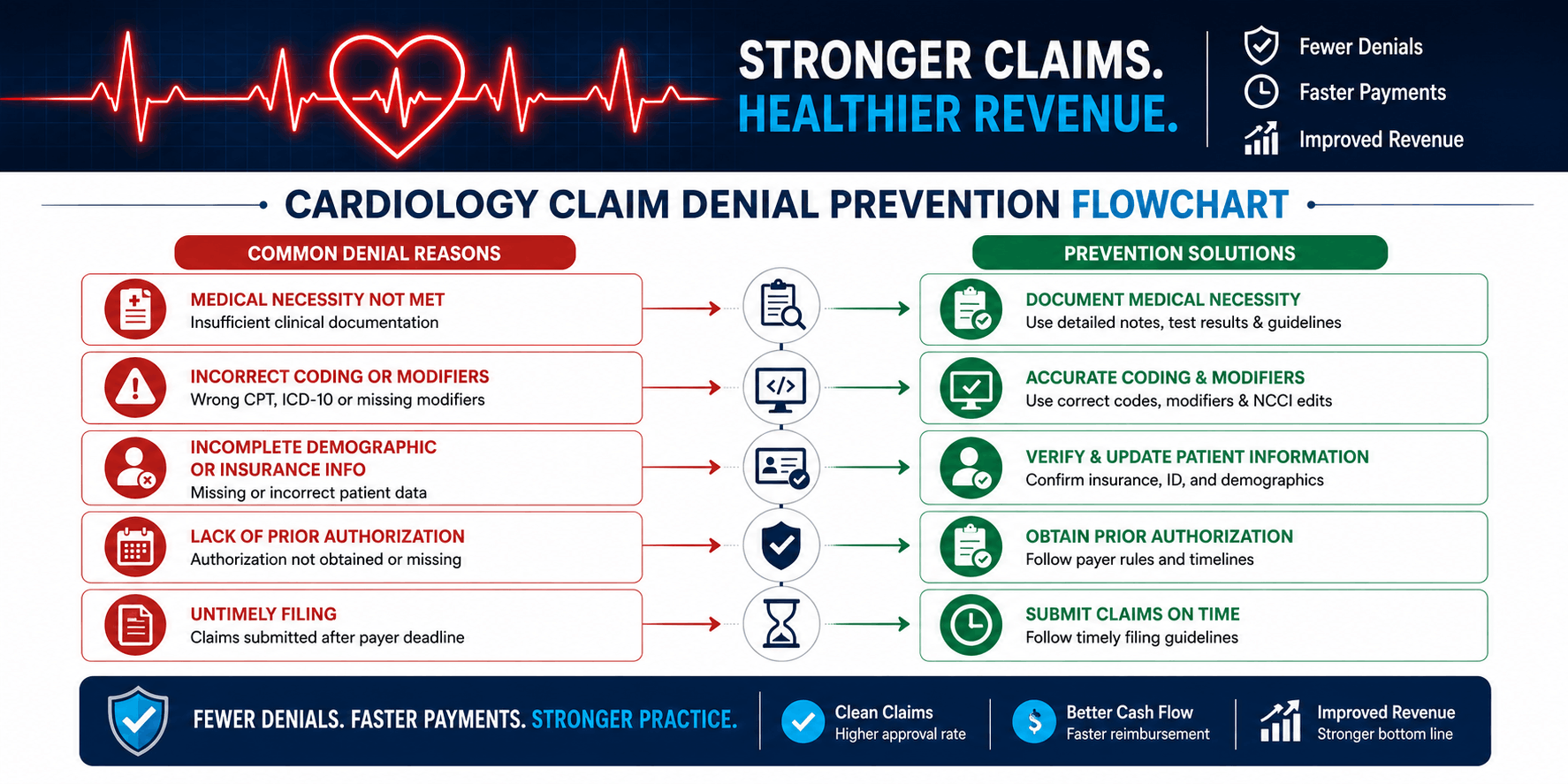
Denial management separates thriving cardiology practices from struggling ones. Every unworked denial is a write-off. Every recurring denial pattern is a systemic revenue leak. Here are the denial scenarios that cost cardiology billing services the most revenue, with the specific fixes that eliminate them:
| Denial Reason | Financial Impact | Root Cause | Proven Fix |
|---|---|---|---|
| Missing prior authorization | High — full claim denied | PA not obtained before procedure; PA expired | PA tracking workflow; schedule confirmation only after PA received |
| Wrong modifier (no LD/LC/RC) | High — interventional claims rejected | Vessel modifier not applied to PCI/stent codes | Build modifier rules into charge master; PCI codes auto-trigger vessel modifier prompt |
| Medical necessity denied (echo, stress test) | Medium-High — diagnostic claims denied | ICD-10 doesn't support the procedure; vague ordering diagnosis | Link specific ICD-10 to each ordered test; strengthen ordering documentation |
| Modifier 25 not supported | Medium — E/M payment denied | E/M note doesn't document distinct service separate from the procedure | Separate E/M documentation from procedure note; document distinct clinical decision |
| Component billing error (26/TC) | Medium — overbilling or underbilling | Wrong global/component code for the care setting | Setting-specific billing rules in charge master; quarterly audit by setting |
| Complete vs. limited echo mismatch | Medium — 93306 denied; downgraded to 93308 | Echo report missing required Doppler documentation | Echo report template with required fields; physician education on complete echo requirements |
| Deleted monitoring codes used | Medium — automatic rejection | Old 93268–93272 codes still in charge master | Update charge master; replace deleted codes with 93241–93248 series |
| Cath report missing vessel detail | High — cath claim denied or under-reimbursed | Report lacks specific vessel findings, access site, or hemodynamic data | Structured cath report template with required documentation fields |
| Stress test role documentation missing | Medium — 93015 billed but supervision not documented | Who supervised vs. interpreted not clearly recorded | Provider-specific attestation in stress test report; clarify role in every report |
| Timely filing exceeded | High — permanent revenue loss | Claim not submitted within payer's window | Automated claim submission; daily aging reports; filing deadline alerts per payer |
| NCCI edit violation — unbundled cath codes | High — one code denied as included in another | Add-on codes billed without required base code; bundled services billed separately | NCCI edit check in PM system; quarterly bundling audit of top cath combinations |
Remote cardiac device monitoring is one of the fastest-growing revenue opportunities in cardiology billing services, and one of the most systematically underbilled. With millions of patients implanted with pacemakers, ICDs, and CRT devices, and the rapid expansion of wearable cardiac monitors, the billing codes for device monitoring represent a substantial and recurring revenue stream that most practices are not capturing fully.
| CPT Code | Device Type | Service | Billing Period |
|---|---|---|---|
| 93279 | Single/dual chamber pacemaker — programming device evaluation | In-person interrogation AND programming | Per encounter |
| 93280 | Biventricular pacemaker — programming device evaluation | CRT-P device — full programming evaluation | Per encounter |
| 93281 | Single/dual/biventricular ICD — programming device evaluation | ICD + any pacing — full interrogation and programming | Per encounter |
| 93288 | Single/dual chamber pacemaker — remote device interrogation | Remote (non-in-person) pacemaker monitoring and analysis | Per 90-day period — one bill per 90 days regardless of transmissions |
| 93289 | Biventricular pacemaker — remote interrogation | CRT-P remote monitoring | Per 90-day period |
| 93290 | ICD — remote interrogation | Remote ICD monitoring and analysis | Per 90-day period |
| 93291 | Single/dual/biventricular pacemaker or ICD — in-person interrogation (no programming) | Interrogation without programming changes | Per encounter — document findings and reason no programming needed |
| 93294 | Pacemaker — remote monitoring, up to 90 days | Includes physician analysis; up to 90-day period | Bill once per 90-day period; do not bill per transmission |
| 93295 | ICD — remote monitoring, up to 90 days | ICD remote analysis; includes physician review | Bill once per 90-day period |
| 93296 | Implantable loop recorder (ILR) — remote monitoring up to 30 days | ILR/ICM device monitoring | Bill per 30-day period |
�� The 90-Day Billing Period Rule — The Most Commonly Violated Device Monitoring Rule
Remote device monitoring codes 93294 and 93295 are billed once per 90-day period, not per transmission, not per month, not per physician review session. Many practices systematically overbill by billing these codes more frequently than the allowed 90-day window. This is one of the active OIG audit targets for cardiology practices. Implement a 90-day tracking system in your PM software that prevents duplicate billing within the same 90-day period for each patient’s device type.
The Office of Inspector General (OIG) consistently identifies cardiology as one of the highest-risk billing specialties in its annual Work Plan. RAC (Recovery Audit Contractor) reviews of cardiovascular services recover tens of millions of dollars annually from cardiology practices. Understanding the specific audit triggers in cardiology billing services is the first step to preventing them:
Echocardiography frequency violations: Medicare has coverage policies limiting echocardiography to specific clinical indications. Repeat echos billed more frequently than clinically justified, or without appropriate medical necessity documentation are a top RAC audit target.
Remote device monitoring 90-day period overbilling: Billing 93294/93295 more than once per 90-day period per patient is a systematic compliance violation actively reviewed by OIG.
Stress test component billing errors: Billing 93015 (complete) when the supervision and interpretation were performed by different providers, or billing components that weren’t actually rendered generates recoupment demands.
PCI vessel modifier omission or misapplication: Applying the wrong vessel modifier (LD/LC/RC) to an interventional procedure misrepresents the service and creates billing integrity concerns.
Cath lab global billing violations: Attempting to bill globally for procedures performed in a hospital setting where the facility bills the technical component constitutes duplicate billing.
Modifier 25 overuse: E/M services billed with Modifier 25 alongside procedures where the E/M is not genuinely distinct and separately documented.
Unbundling NCCI-paired codes: Billing code pairs that CMS has determined are inherently bundled using Modifier 59 to override NCCI edits without documented justification
✅ Your Cardiology Compliance Calendar Quarterly Audit Checklist
Q1: Audit 20 echo claims verify complete vs. limited distinction and Doppler documentation.
Q2: Audit 90-day remote device monitoring billing verify one bill per patient per 90-day period.
Q3: Review all PCI/stent claims for correct vessel modifier application and NCCI compliance. Q4: Audit Modifier 25 usage verify E/M distinctness documentation for all same-day procedure encounters. Annual: Full review of E/M level distribution, flag unusual spikes in 99215 or 99205 billing relative to patient acuity. A structured quarterly compliance calendar is your practice’s strongest defense against OIG and RAC audit findings
Cardiology groups face this decision with more financial consequence than most specialties, because the per-claim value is higher, the coding complexity is greater, and the cost of systematic errors is correspondingly larger. Here’s an honest assessment:
Need support with your billing workflow? Explore our medical billing and revenue cycle services or request a free consultation.
| Factor | In-House Cardiology Billing | House of Outsourcing Cardiology Billing Services |
|---|---|---|
| Specialty-specific expertise | Requires ongoing training on cath codes, vessel modifiers, echo documentation, device monitoring rules | Our dedicated cardiology billing specialists already trained on current rules |
| Interventional coding precision | PCI vessel modifiers, NCCI edits, and add-on logic frequently misapplied without specialty focus | Decision-based coding workflow built for cardiology-specific procedure combinations |
| Echocardiography billing accuracy | Complete vs. limited distinction errors common; 26/TC split billing errors frequent | Echo-specific documentation review protocols; setting-specific component billing rules |
| PA management depth | PA tracking often reactive — missed authorizations discovered after denial | Proactive PA tracking built into scheduling; PA obtained before every procedure |
| Remote device monitoring compliance | 90-day period violations common without automated billing controls | Automated 90-day tracking prevents overbilling; compliance built into billing workflow |
| Medicare and NCCI compliance | Bundling violations and deleted code usage common without dedicated compliance focus | Active NCCI edit monitoring; deleted code management; annual charge master updates |
| Denial management capacity | Reactive; limited bandwidth for complex cardiology appeals | Dedicated AR team; cardiologist-level understanding of appeal documentation requirements |
| Average collection rate | 62–75% for in-house cardiology billing (industry average) | 85–96%+ with experienced cardiology billing partner |
| Commercial contract optimization | Typically not reviewed — accepting whatever payer proposes | Contract review identifies underpayment; commercial rates benchmarked against Medicare |
| Compliance protection | Higher risk — systematic coding errors often discovered only during audits | Quarterly internal audits prevent audit findings before they reach OIG or RAC stage |
Get a free assessment from our billing experts