
Our cardiovascular medical billing services help you manage complex coding, claims, and reimbursement challenges with precision and efficiency. We handle cardiology-specific billing requirements, reduce denials, and optimize revenue cycles to ensure providers receive accurate and timely payments.

As an experienced cardiovascular healthcare specialist you know that medical billing sits at the intersection of clinical complexity and administrative precision. And let’s be real, cardiology is one of the most challenging specialties to bill correctly from your an in-house clinic team. You’re dealing with high-value procedures, split-billing scenarios, global periods, technical and professional component splits, a cath lab that runs on its own billing universe, and payer rules that seem to change every quarter.
Heart disease remains the leading cause of death in the United States, affecting roughly 1 in 5 Americans according to the Centers for Disease Control and Prevention (CDC). That volume of patients translates into enormous billing activity, and enormous risk if your coding and documentation processes aren’t airtight.
Whether you’re a cardiologist trying to understand why your revenue cycle is underperforming, a practice manager hunting down the source of your denial spike, or a billing specialist who wants to sharpen their cardiovascular coding skills, our guide will provide you with the solution. We’re going to cover every major element of cardiovascular medical billing: from CPT codes for EKGs, echos, stress tests, and cath lab to ICD-10 alignment, modifier strategy, Medicare requirements, and compliance best practices.
Cardiovascular medical billing is the process of accurately coding, submitting, and collecting reimbursement for the full spectrum of cardiology and cardiovascular services from a simple office EKG to complex cardiac catheterization procedures performed in the cath lab.
Unlike many other medical specialties, cardiovascular medical billing requires an understanding of several overlapping billing concepts that most general billers don’t encounter:
Here’s the core challenge with cardiovascular medical billing services, the same clinical procedure, say, a stress echocardiogram, can be coded completely differently depending on who performed each component, where the service was provided, and what level of physician involvement was documented.
That’s not a minor variation. It’s the difference between a clean claim and a denied claim. Or between appropriate billing and a fraud allegation, you need to consider these layers of complexity unique to cardiovascular medical billing of your medical practice.
The cardiovascular CPT code set is extensive. Let’s organize the most critical codes by service category, because that’s how your practice billing teams need to think about them.
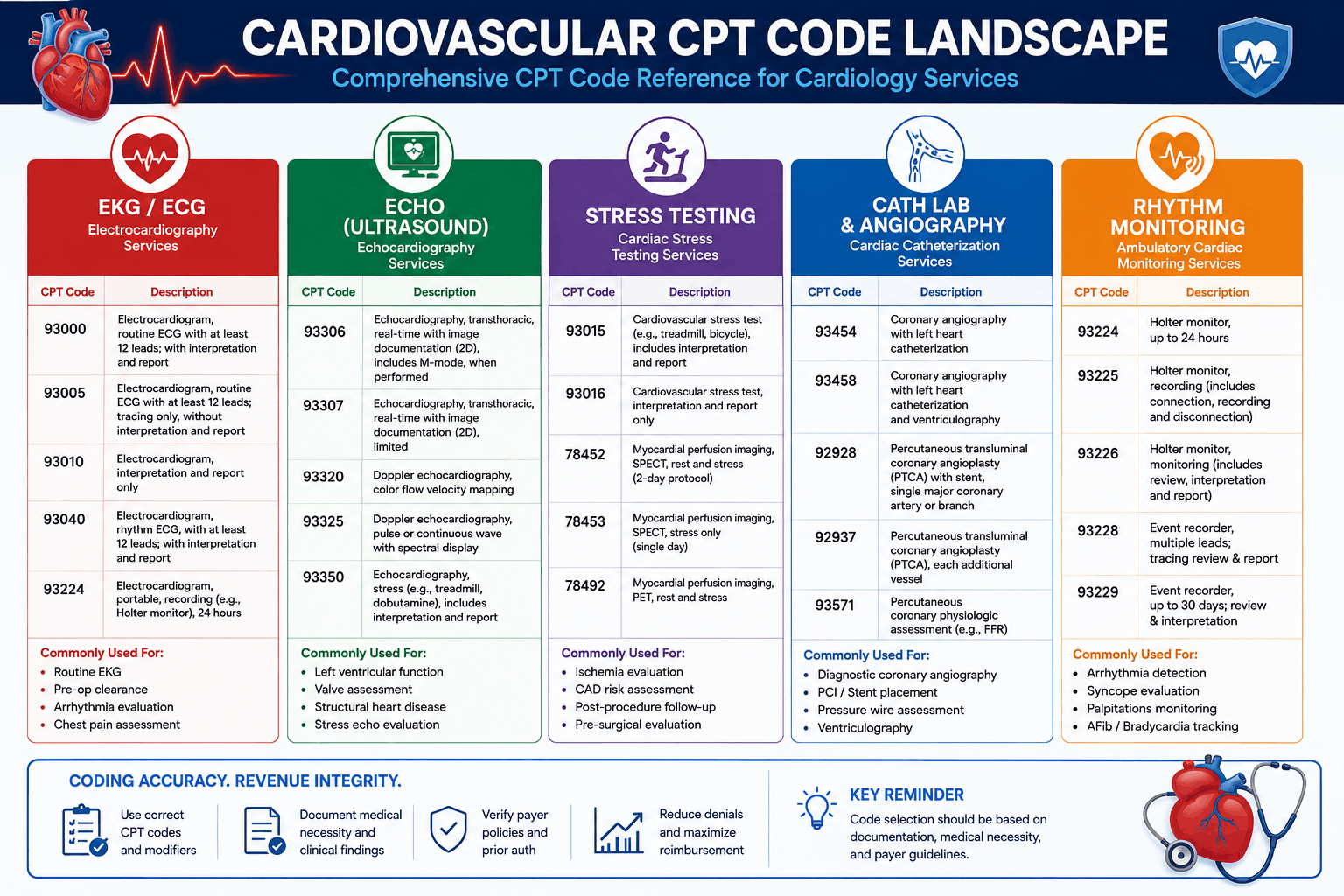
| CPT Code | Description | Notes |
|---|---|---|
| 93000 | ECG, routine, with at least 12 leads — with interpretation and report | Global code (technical + professional) |
| 93005 | ECG — tracing only, without interpretation | Technical component only |
| 93010 | ECG — interpretation and report only | Professional component only |
| 93040 | Rhythm E CG, 1–3 leads, with interpretation | Short tracing with report |
| 93041 | Rhythm ECG — tracing only | Technical component |
| 93042 | Rhythm ECG — interpretation and report only | Professional component |
💡 Tip #1: Avoid Billing 93000 When You Should Bill 93005 or 93010 Separately. If the technical component (tracing) and the professional component (interpretation) are performed by different entities — for example, the tracing is done at a hospital and interpreted by your office cardiologist — you must bill each component separately using 93005 and 93010. Billing 93000 (global) in this scenario is a common error that results in either overpayment or underpayment, depending on who’s billing.
| CPT Code | Description |
|---|---|
| 99202–99205 | New patient office visit (outpatient) |
| 99211–99215 | Established patient office visit |
| 99221–99223 | Initial hospital inpatient care |
| 99231–99233 | Subsequent hospital inpatient care |
| 99238–99239 | Hospital discharge day management |
| 99242–99245 | Office consultation (where payer allows) |
Echocardiography billing is one of the highest-value and highest-risk areas in all of cardiovascular medical billing services. Echo codes look simple on the surface, but they hide sharp distinctions that can completely change which CPT code applies.
| CPT Code | Description |
|---|---|
| 99202–99205 | New patient office visit (outpatient) |
| 99211–99215 | Established patient office visit |
| 99221–99223 | Initial hospital inpatient care |
| 99231–99233 | Subsequent hospital inpatient care |
| 99238–99239 | Hospital discharge day management |
| 99242–99245 | Office consultation (where payer allows) |
The Single Most Important Echo Billing Rule: A complete echo (93306) requires documentation of all standard cardiac views, spectral Doppler, and color flow Doppler. If any of these elements are missing from the report, you cannot bill 93306 you must downcode to 93307 (complete without Doppler) or 93308 (limited). Billing 93306 when documentation only supports 93307 is one of the most common errors found in cardiovascular billing audits.
💡 Tip #2: Use a Structured Echo Report Template. Work with your cardiologists to implement a standardized echocardiography report template that explicitly documents all required elements views obtained, Doppler performed, color flow assessment, and any limitations. When the documentation is structured, coding becomes straightforward and defensible. This one workflow change dramatically reduces echo coding errors.
Stress test coding is another area where precision in cardiovascular medical billing determines whether your claim gets paid, or gets denied, audited, and recouped.
| CPT Code | Description | Notes |
|---|---|---|
| 93015 | Cardiovascular stress test — complete | Tracing, supervision, AND interpretation — global |
| 93016 | Cardiovascular stress test — supervision only | Physician present; no interpretation |
| 93017 | Cardiovascular stress test — tracing only | Technical component |
| 93018 | Cardiovascular stress test — interpretation and report only | Professional component |
When selecting the right stress test code, your billing team needs to answer three questions from the documentation:
When the same physician performs all three functions in their own office, bill 93015 (global). When different entities handle different components, split the billing accordingly using 93016, 93017, and 93018.
Nuclear myocardial perfusion imaging adds another layer to stress test billing:
| CPT Code | Description |
|---|---|
| 78451 | Myocardial perfusion imaging — SPECT, single study, rest or stress |
| 78452 | Myocardial perfusion imaging — SPECT, multiple studies (rest AND stress) |
| 78453 | Myocardial perfusion imaging — planar, single study |
| 78454 | Myocardial perfusion imaging — planar, multiple studies |
| 78469 | Myocardial perfusion imaging — 3D (PET) |
Cath lab billing is where cardiovascular medical billing gets most intense, and most lucrative when done correctly. Catheterization codes carry high reimbursement values, which means they also carry the highest audit scrutiny.
| CPT Code | Description |
|---|---|
| 93451 | Right heart catheterization — all chambers |
| 93453 | Combined right and left heart catheterization |
| 93456 | Right heart cath + left heart cath via retrograde |
| CPT Code | Description |
|---|---|
| 93454 | Coronary angiography — all coronary vessels, without left heart cath |
| 93455 | Coronary angiography — all coronary vessels, with left heart cath via retrograde |
| 93457 | Coronary angiography + bypass graft imaging, without left heart cath |
| 93459 | Coronary angiography + left heart cath + bypass grafts |
| 93460 | Right and left heart cath + coronary angiography |
| 93461 | Right and left heart cath + coronary angiography + bypass grafts |
| CPT Code | Description | Type |
|---|---|---|
| 92920 | PCI — single major coronary vessel or branch | Base code |
| 92921 | PCI — each additional branch | Add-on |
| 92924 | PCI with atherectomy — single vessel | Base code |
| 92925 | PCI with atherectomy — each additional vessel | Add-on |
| 92928 | PCI with stent placement — single vessel | Base code |
| 92929 | PCI with stent — each additional vessel | Add-on |
| 92933 | PCI with atherectomy + stent — single vessel | Base code |
| 92934 | PCI with atherectomy + stent — each additional vessel | Add-on |
Rhythm monitoring represents a significant revenue stream for cardiology practices, and a frequent source of billing errors because of the technical/professional component split.
| CPT Code | Description | Notes |
|---|---|---|
| 93224 | Holter monitoring — up to 48 hours — recording, scanning, and interpretation | Global code |
| 93225 | Holter — recording only (TC) | Technical component |
| 93226 | Holter — scanning only | Mid-level technical function |
| 93227 | Holter — interpretation and report only (26) | Professional component |
| 93228 | Extended Holter — up to 48 hours — global | Newer combined code |
| 93229 | Extended Holter — interpretation only | Professional component for extended monitoring |
| CPT Code | Description |
|---|---|
| 93268 | Patient-activated event transmitter — 30-day monitoring, global |
| 93270 | Patient-activated event monitor — recording only |
| 93271 | Patient-activated event monitor — monitoring and analysis |
| 93272 | Patient-activated event monitor — interpretation and report only |
💡 Tip #3: Track Who Does What in Rhythm Monitoring. The most common Holter billing error is billing the global code (93224) when the technical and professional components are actually split between the device company (technical) and your cardiologist (interpretation only). If a third-party monitoring service handles the recording and scanning, bill only 93227 (interpretation and report). Billing 93224 in this scenario is a clear overpayment that auditors identify quickly.
Diagnosis coding is the foundation of medical necessity in cardiovascular medical billing. Without the right ICD-10 codes, and the right level of specificity, payers have grounds to deny any procedure code regardless of how cleanly it’s been selected.
| ICD-10 Code | Description | Billing Note |
|---|---|---|
| I10 | Essential (primary) hypertension | Add I11.x if hypertensive heart disease is documented |
| I25.10 | Atherosclerotic heart disease — native coronary artery, unspecified angina | Commonly triggers stress test and cath |
| I25.110 | Atherosclerotic heart disease with unstable angina | Higher acuity — document carefully |
| I48.0 | Paroxysmal atrial fibrillation | Drives EP studies and rhythm monitoring |
| I48.11 | Longstanding persistent atrial fibrillation | Specific A-fib type required by many payers |
| I48.19 | Other persistent atrial fibrillation | Use when longstanding not documented |
| I48.20 | Chronic atrial fibrillation, unspecified | Avoid if more specific type is documented |
| I50.20 | Unspecified systolic heart failure | Avoid — specify stage when documented |
| I50.21 | Acute systolic heart failure | High acuity; document timeline |
| I50.22 | Chronic systolic heart failure | Common; drives echo medical necessity |
| I50.30 | Unspecified diastolic heart failure | Specify when possible |
| I50.32 | Chronic diastolic heart failure | Drives follow-up echo billing |
| I35.0 | Aortic stenosis | Drives echo and cath medical necessity |
| I34.0 | Mitral regurgitation | Drives echo; specify severity in documentation |
| I47.1 | Supraventricular tachycardia | Drives EP study and monitor billing |
| I49.01 | Ventricular fibrillation | High-acuity arrhythmia |
| I49.02 | Ventricular flutter | High-acuity arrhythmia |
| R07.9 | Chest pain, unspecified | Use as symptom code when diagnosis not yet established |
| R00.0 | Tachycardia, unspecified | Symptom code — drives monitor or echo |
| Z82.49 | Family history of ischemic heart disease | Secondary code — supports preventive work-up |
Modifiers in cardiovascular medical billing aren’t just administrative details, they’re the mechanism by which you communicate critical billing context to payers. Using the wrong modifier (or missing one entirely) is one of the leading causes of cardiovascular claim denial.
| Modifier | Name | When to Use in Cardiology |
|---|---|---|
| 26 | Professional Component | Physician interpretation only no technical component performed by same entity |
| TC | Technical Component | Equipment, supplies, and technical staff only no physician interpretation billed here |
| 25 | Separate E/M Service | Significant, separately identifiable E/M on same day as a procedure (e.g., office visit + EKG) |
| 59 | Distinct Procedural Service | Separate, distinct procedure not normally reported together — bypasses NCCI bundling edits |
| 76 | Repeat Procedure by Same Physician | Same procedure performed again on the same day by the same provider |
| 77 | Repeat Procedure by Different Physician | Same procedure repeated by a different provider |
| LT / RT | Left Side / Right Side | Laterality for procedures performed on one side |
| 52 | Reduced Services | Procedure partially performed; not a full service |
| 53 | Discontinued Procedure | Procedure started but discontinued for clinical reason |
| 57 | Decision for Surgery | E/M service on day before or day of major surgery that was the basis for the surgical decision |
| QW | CLIA-Waived Test | Required for certain point-of-care tests in office setting |
It is important for your medical practice that you have complete understanding when to bill globally (no modifier) vs. split-component (TC and 26) is fundamental to cardiovascular medical billing services.
| Scenario | Correct Billing Approach |
|---|---|
| Your office owns the equipment AND your cardiologist interprets | Bill global (no modifier) |
| Hospital/facility owns equipment; your cardiologist interprets from office | Bill 26 (interpretation only) |
| Your office provides tracing; outside cardiologist interprets | Bill TC only |
| Same-day office visit + EKG interpretation | E/M with modifier 25 + 93010 |
💡 Tip: Never Bill Global When the Technical Component Is Hospital-Based. This is one of the single most common compliance violations in cardiovascular medical billing. When your cardiologist reads an echo, stress test, or EKG that was technically performed at a hospital or facility, you bill only modifier 26 for the professional component. Billing the global code results in double-billing the technical component, which Medicare considers an overpayment, and which RAC auditors actively target.
Medicare is the dominant payer for most cardiology practices given the age demographics of heart disease patients. Understanding CMS rules isn’t optional, it’s the foundation of compliant cardiovascular medical billing.
According to CMS Medicare Benefit Policy Manual, Chapter 15 and related Local Coverage Determinations (LCDs), Medicare covers cardiovascular services when:
| Service | Medicare Coverage | Key Documentation Requirement |
|---|---|---|
| EKG (93000) | Covered | Clinical indication must be documented |
| Complete TTE (93306) | Covered | All views + Doppler + color flow documented |
| Limited Echo (93308) | Covered | Specific clinical question must be stated |
| Treadmill Stress Test (93015) | Covered | Chest pain, syncope, arrhythmia, or known CAD |
| Nuclear Stress (78452) | Covered, often needs PA | Symptom-based or high-risk indication |
| Holter Monitor (93224) | Covered | Documented symptoms: palpitations, syncope, etc. |
| Cardiac Catheterization (93454–93461) | Covered | Significant CAD indication; surgical decision documentation |
| PCI (92928) | Covered | Active ischemia, hemodynamic instability, or significant stenosis |
| Stress Echo (93350/93351) | Covered, often needs PA | Intermediate-risk chest pain; suspected CAD |
| Implantable loop recorder | Covered | Unexplained syncope or palpitations |
When you have reason to believe Medicare may deny a service, for example, a repeat echo within 12 months without a change in clinical status, you must issue an ABN before providing the service. Failure to issue an ABN means you cannot bill the patient if Medicare denies the claim.
As a cardiologist you know that in cardiology, your documentation is your revenue. The most technically correct CPT code in the world cannot survive an audit if the clinical notes don’t support it. This is the core reality of cardiovascular medical billing services.
| Documentation Element | Required | Details |
|---|---|---|
| Chief complaint | Yes | Presenting symptom or monitoring indication |
| History of Present Illness (HPI) | Yes | Onset, duration, associated symptoms, prior workup |
| Physical examination | Yes | Relevant cardiovascular findings |
| Clinical indication for testing | Yes | Clear medical necessity statement |
| Procedure performed | Yes | Specific service rendered |
| Findings | Yes | Results specific to the test/procedure |
| Impression/Diagnosis | Yes | Final diagnosis or differential supported by findings |
| Plan | Yes | Next steps, follow-up, medications |
| Physician signature | Yes | Authentication of the note |
| Time (for time-based billing) | When applicable | Start/stop time or total time documented |
For Echocardiography: All cardiac views must be explicitly listed. Doppler findings must be reported. Color flow assessment must be documented. Any limitations (poor acoustic window, patient body habitus) should be noted.
For Stress Testing: Supervising physician must be identified. Baseline and peak heart rate/blood pressure must be recorded. Reason for termination must be stated. Interpretation must address the clinical question.
For Cardiac Catheterization: Access site and approach must be specified. Each vessel studied must be named. Hemodynamic measurements must be tabulated. Imaging modality must be documented. Percentage stenosis for each vessel must be reported.
For Holter/Event Monitors: The clinical indication must be stated. Symptoms prompting the monitoring order must be documented. The interpretation report must address whether the monitored rhythm correlates with symptoms.
According to experience and industry stats, prior authorization (PA) has become a major administrative burden in cardiovascular medical billing, and a significant source of revenue leakage when not managed proactively.
The following cardiovascular services most commonly require prior authorization from commercial payers and some Medicare Advantage plans:
Verify at Scheduling: When a patient is scheduled for any high-value cardiovascular test or procedure, check PA requirements for their specific plan immediately.
Submit with Strong Clinical Documentation: PA approvals in cardiology hinge on documented clinical indications. Submitting the ordering physician’s note, relevant EKG or prior study results, and a clear statement of the clinical question improves first-pass approval rates.
Track Authorization Details: Log the authorization number, approved service(s), approved dates, and approved facility. Mismatch between authorization and claim is a common denial trigger.
Handle Peer-to-Peer Review When Denied: When PA is denied, escalate to a peer-to-peer review between your cardiologist and the payer’s medical reviewer. Physician-to-physician conversations on cardiology cases have significantly higher reversal rates than paper appeals.
Appeal Systematically: Every PA denial should be appealed. Commercial payer PA denial appeal rates are high when proper clinical documentation is submitted.
💡 Tip: Build a PA Turnaround Tracker. Maintain a real-time log of all submitted PA requests with timestamps. Track the average turnaround time by payer. Identify which payers are slowest, and build buffer time into your scheduling workflow to prevent patients from arriving for procedures without active authorizations in place.
Denials in cardiovascular medical billing follow predictable patterns. Knowing where they come from is the first step to preventing them.
| Denial Category | Specific Cause | Prevention Strategy |
|---|---|---|
| Medical necessity | Echo billed without documented clinical indication | Ensure ordering physician documents specific indication in referral/order |
| Component billing error | Global code billed when TC was done at facility | Implement facility vs. office billing workflow audit |
| Missing modifier | E/M + EKG without modifier 25 | Add modifier 25 audit to claim scrubbing rules |
| Prior authorization | High-value imaging done without PA | Implement mandatory PA check at scheduling |
| Bundling error | 93306 + 93320 billed when Doppler is included in complete echo | Review NCCI edits for cardiovascular code pairs |
| Upcoding | 93306 billed when documentation supports only 93307 | Implement echo report review checklist |
| Untimely filing | Claim submitted past payer's timely filing window | Automate claim submission and monitor deadlines |
| Duplicate claim | Same service billed twice (common in component billing) | Scrubber checks for duplicate TC/26 pairs |
| Place of service error | Facility rates billed at non-facility rate or vice versa | Verify POS code matches where service was rendered |
| Eligibility | Patient's coverage lapsed; wrong plan billed | Verify eligibility before every encounter |
| Cath lab documentation | Missing vessel details or access site in cath report | Standardize cath report template |
| Supervision level | Stress test supervision not documented | Add supervision documentation field to stress test report |
Cardiology has been on the OIG’s radar for decades. High-dollar procedures, complex coding, and the volume of Medicare patients make cardiovascular medical billing services one of the most scrutinized billing environments in US healthcare.
According to the OIG Work Plan and historical audit findings, these cardiovascular services face the highest audit risk:
A functional compliance program for cardiovascular medical billing services includes:
Internal Audit Schedule:
Coder Credentialing:
Payer LCD Review:
Cardiovascular medical billing is one component of your practice’s entire revenue cycle, but it’s the most complex component. High-performing cardiovascular practices manage their revenue cycle with the same rigor they apply to clinical care.
| KPI | Benchmark Target | Why It Matters in Cardiology |
|---|---|---|
| Clean Claim Rate | ≥ 95% | High-value codes must pass on first submission |
| Days in AR | < 30 days | Cath and echo procedures should not sit unpaid |
| Denial Rate | < 5% | Cardiology average is often 8–12% — room to improve |
| First Pass Acceptance Rate | ≥ 95% | Reduces rework and delays |
| Collection Rate | ≥ 97% of net collectible | High reimbursements make undercollection very costly |
| PA Approval Rate | ≥ 90% | Strong clinical documentation drives this number |
| AR > 90 Days | < 15% of total AR | Aging AR in cardiology = denials not being worked |
| Appeal Success Rate | ≥ 70% | Cardiology appeals often succeed with clinical support |
| Coding Accuracy Rate | ≥ 98% | One wrong code on a cath claim is a large loss |
The cardiovascular revenue cycle begins when a patient schedules an appointment and continues through insurance verification, prior authorization, clinical documentation, medical coding, claim submission, payment posting, denial management, patient collections, and performance analytics. Because cardiology involves complex procedures, high-value claims, and strict payer requirements, every phase must be managed accurately to minimize denials, accelerate reimbursement, and maximize practice revenue.
| Phase | Key Activities | Cardiovascular-Specific Considerations |
|---|---|---|
| Patient Scheduling | Insurance capture, PA initiation | Identify high-PA procedures at booking |
| Pre-Encounter | Eligibility verify, PA confirmation | Confirm authorization before cath/echo day |
| Clinical Encounter | Documentation, charge capture | Every cath report element must be present |
| Coding | CPT/ICD-10 selection, modifier assignment | TC/26 split decisions made here |
| Claim Submission | Scrubbing, submission, timely filing | High-dollar claims need expedited submission |
| Payment Posting | ERA/EOB reconciliation | Identify component billing underpayments |
| Denial Management | Appeal filing, peer-to-peer review | Cardiologist involvement in peer-to-peer appeals |
| Patient Collections | Statements, balance collection | High deductibles common in cardiology patients |
| Analytics | Denial trending, payer scorecards | Identify payer-specific patterns in cardiology |
Cardiovascular medical billing demands a level of specialty expertise that most general billing teams, even very competent ones simply don’t have. The TC/26 split decisions, the echo documentation checklists, the cath lab code selection, the nuclear imaging prior authorization workflows these are not general billing skills. They’re cardiovascular billing skills, and they take years to develop.
At House of Outsourcing, we’ve built our cardiovascular medical billing services around the specific complexities of US cardiology practices. Our team includes certified cardiovascular coders, prior authorization specialists, denial management experts, and revenue cycle analysts who know this specialty from the inside out.
| Factor | In-House Billing | House of Outsourcing |
|---|---|---|
| Cardiology-specific coding expertise | Rarely specialized | Certified, experienced cardiovascular coders |
| TC/26 component billing management | Often handled incorrectly | Structured workflow per service type |
| Prior authorization management | Resource-intensive | Dedicated PA team |
| Echo/cath documentation review | Inconsistent | Systematic pre-submission review |
| Denial appeal rate | Often < 50% | ≥ 70% target with cardiologist support |
| NCCI compliance | Often outdated | Updated quarterly |
| Transparent cost structure | Hidden in overhead | Performance-based % of collections |
| Scalability | Limited by headcount | Scales with procedure volume |
93306 is a complete transthoracic echocardiogram that includes spectral doppler and color flow doppler. 93307 is a complete echo without doppler. The clinical report must explicitly document which elements were performed. Billing 93306 without Doppler documentation is one of the most common cardiovascular billing errors.
Use modifier 25 on the E/M code when a significant, separately identifiable evaluation and management service was provided on the same day as a cardiovascular procedure (like an EKG interpretation or echo). The E/M must be documented as a distinct service with its own medical necessity — not just the pre-procedure assessment.
Yes, Medicare covers stress echocardiography when it is medically necessary based on documented symptoms (chest pain, dyspnea, palpitations) or established indications (known or suspected CAD, valvular disease, cardiomyopathy). Many Medicare Advantage plans require prior authorization for stress echo.
Your cardiologist bills only the professional component using CPT 93306 with modifier 26 (interpretation and report). The hospital bills the technical component (TC). Billing the global code (93306 without modifier) in this scenario would be an overpayment and a compliance violation.
The cath report must document: the access site (femoral, radial), vessels catheterized, hemodynamic measurements, imaging modalities used (fluoroscopy, intravascular imaging), percentage stenosis for each vessel, any interventions performed, and physician signature. Missing any of these elements can result in claim denial or downcoding.
Billing the global echo or stress test code when the technical and professional components are split between a facility and a physician’s office. This results in double-billing the technical component — which CMS considers an overpayment and which Recovery Audit Contractors (RACs) actively target.
Get a free assessment from our billing experts