
Our Family Practice Medical Billing services help practices manage coding requirements, documentation standards, payer regulations, and everyday billing complexities. We streamline claims, reduce denials, and improve reimbursements through efficient revenue cycle management.

If you run a family medicine practice in the USA and you already know no two days look alike. One morning you are treating a newborn; by afternoon you are managing a 75-year-old diabetic patient’s care plan. That diversity is exactly what makes your family practice billing so uniquely challenging and so easy to get wrong.
In the USA family practice billing services require deep knowledge and a wide spectrum of CPT codes, insurance rules, payer-specific policies, and compliance requirements that span every age group and condition. A single miscoded visit or a missed modifier can mean a denied claim, a delayed payment, or worse a Medicare audit.
We have written this guide specifically for US-based family physicians, practice managers, and healthcare administrators who want a clear, actionable, and up-to-date resource on family medicine billing services. We will cover everything CPT codes, E/M guidelines, modifiers, preventive care billing, telehealth and denial management best practices.
Family practice medical billing is the process of translating the wide range of healthcare services provided by family physicians into standardized medical codes and submitting those claims to payers Medicare, Medicaid, or private insurers for reimbursement.
What makes our family practice billing services different from, say, cardiology medical billing or nephrology medical billing is the sheer breadth of services involved. A cardiologist focuses on a defined set of procedures and codes. A family physician like you might see a sick child, perform a preventive wellness exam, manage a diabetic adult, and counsel a geriatric patient all in the same afternoon
| Billing Factor | Family Practice Billing | Other Specialties (e.g., Cardiology, Nephrology) |
|---|---|---|
| Patient Age Range | All ages (newborn to 90+) | Usually adults or specific groups |
| Visit Types | Preventive, acute, chronic, pediatric | Specialty-specific procedures |
| Common CPT Codes | 99381–99397, 99213–99215, 90460 | Specialty-specific code sets |
| Modifier Complexity | Moderate (−25, −59, −EP) | Varies (often lower volume) |
| Billing Complexity | High diversity, moderate complexity | Deep complexity in narrow scope |
| Audit Risk | Moderate (preventive bundling, vaccine codes) | High for procedure-heavy specialties |
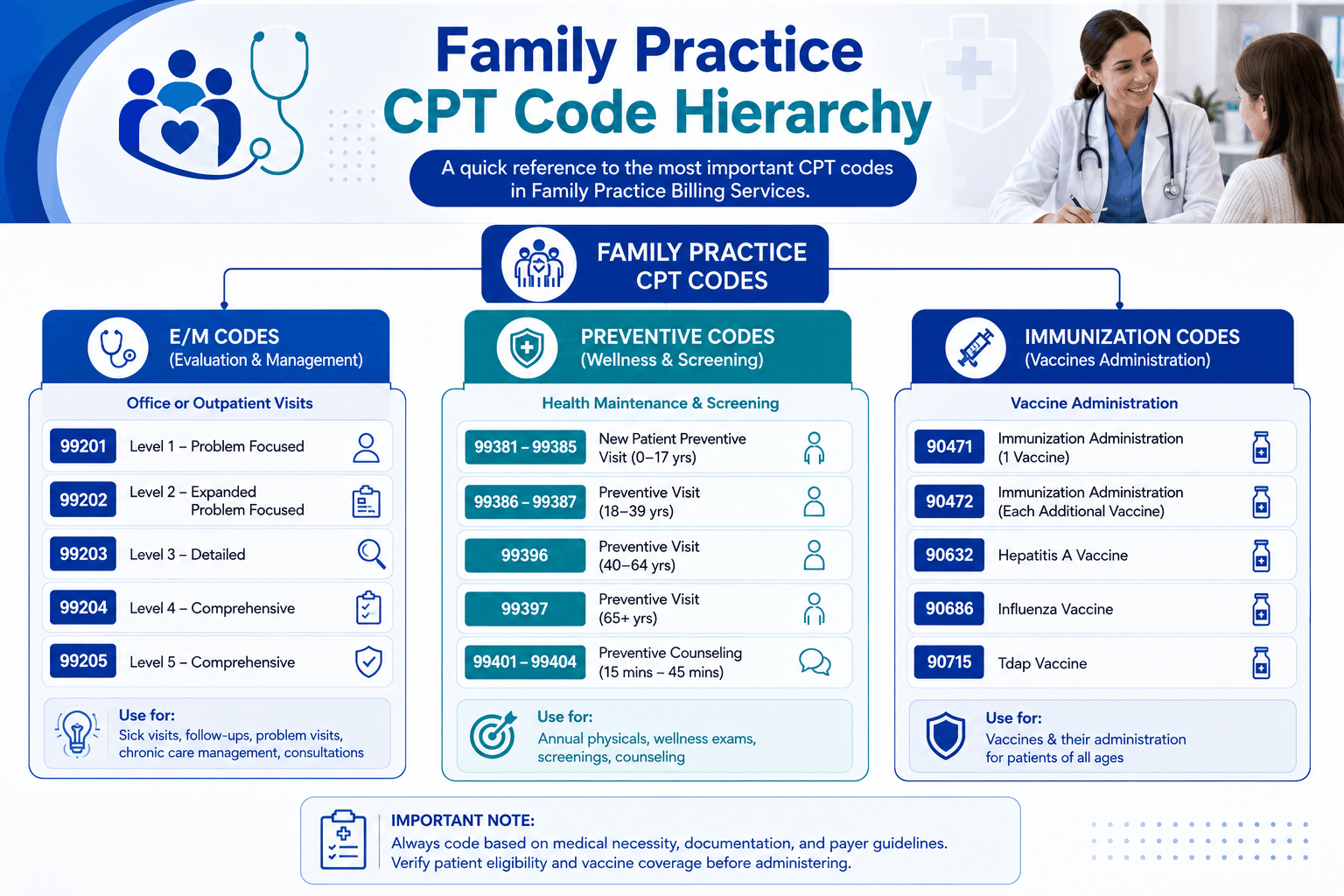
Getting CPT codes right is the single most important step in family medicine billing. As a healthcare physician you know that wrong codes mean denied claims, reduced reimbursement, or compliance risk. Let’s break them down by category.
E/M codes are the backbone of your family practice billing. Since the AMA’s 2021 E/M revisions confirmed and expanded through 2025, documentation is now driven by Medical Decision Making (MDM) or total physician time, not the old history/exam framework.
| CPT Code | Visit Type | MDM Level | Typical Use in Family Practice |
|---|---|---|---|
| 99202 | New Patient | Straightforward | Minor illness, single condition |
| 99203 | New Patient | Low | Acute self-limiting condition |
| 99204 | New Patient | Moderate | New chronic condition + workup |
| 99205 | New Patient | High | Multiple complex conditions |
| 99212 | Established Pt. | Straightforward | Prescription refill, minor f/u |
| 99213 | Established Pt. | Low | Acute illness, self-limiting |
| 99214 | Established Pt. | Moderate | Chronic disease management (DM, HTN) |
| 99215 | Established Pt. | High | High-complexity multi-system cases |
�� Pro Tip: The 2025 E/M Documentation Rule
Since 2021, you no longer need to document a complete history and physical exam to justify a high-level E/M code. Medical Decision Making (MDM) or total time spent is all that’s required. Many family practices are still over-documenting unnecessarily, which wastes your time without improving reimbursement. Train your staff on the new MDM framework to work smarter.
Preventive visit codes are among the most used, and most often miscoded in family medicine billing. These codes vary by patient age and whether the patient is new or established.
| CPT Code | Service Description | Patient Type / Age |
|---|---|---|
| 99381 | Initial preventive visit | New patient, under age 1 |
| 99382–99387 | Initial preventive visit | New patient, ages 1–64+ |
| 99391 | Periodic preventive visit | Established, under age 1 |
| 99392–99397 | Periodic preventive visit | Established, ages 1–64+ |
| G0438 | Annual Wellness Visit (AWV) | New Medicare patient |
| G0439 | Subsequent AWV | Established Medicare patient |
Immunization billing is one of the most detail-dependent areas in family practice billing services. You need both the vaccine product code (90xxx) and the administration code (90460 or 90471).
�� Tip: Modifier −25 with Vaccine Visits
If a patient receives a vaccine and you provide a separately identifiable E/M service on the same day, such as treating an ear infection at the same visit you must append modifier −25 to the E/M code. Without it, the claim will bundle and you will lose reimbursement. This is one of the most common missed revenue opportunities in family medicine billing.
As a healthcare provider you know that modifiers are two-digit codes appended to CPT codes that tell the payer something important about the service that it was distinct, separate, done in a special setting, or provided under specific circumstances.
| Modifier | Name | When to Use in Family Practice Billing |
|---|---|---|
| −25 | Significant, Separately Identifiable E/M | Same-day E/M + procedure (e.g., office visit + vaccine, or preventive + acute care visit) |
| −59 | Distinct Procedural Service | Two procedures that are normally bundled but were performed separately and are clinically distinct |
| −EP | Essential Health Benefit — EPSDT (Medicaid) | Pediatric preventive care under Medicaid; required on preventive codes for eligible children |
| −95 | Synchronous Telemedicine | Real-time audio/video telehealth visits; append to standard E/M codes |
| −GT | Via Interactive Audio and Video | Used by some payers (check payer-specific rules) for telehealth visits |
| −32 | Mandated Service | Services required by third parties (e.g., employer or insurance mandates) |
| −33 | Preventive Service | ACA-mandated preventive services with zero patient cost-sharing |
�� Tip: The −25 Modifier Is Not a Free Pass
Modifier −25 is frequently misused. It only applies when the E/M service is significant and separately identifiable from the procedure performed on the same day. You must document the medical necessity of the E/M separately in other words, the note must clearly show that the office visit was not just ‘pre-procedure preparation.’ Payers are actively auditing −25 usage in family medicine practices.
Here is a fact that surprises you: According to CMS data, family practices are leaving 20–40% of eligible Chronic Care Management (CCM) revenue on the table simply by not billing for it correctly, or not billing for it at all.
CCM codes allow you to bill for the non-face-to-face time your care team spends coordinating care for patients with two or more chronic conditions. This is one of the most powerful and underutilized tools in family practice billing services.
| CPT Code | Description | Monthly Minimum Requirement |
|---|---|---|
| 99490 | CCM — standard | 20+ minutes non-face-to-face care/month |
| 99491 | CCM — complex, physician-led | 30+ minutes, physician/QHP directs care |
| 99487 | Complex CCM | 60+ minutes, substantial revision of care plan |
| 99489 | Complex CCM add-on | Each additional 30 minutes beyond 99487 |
We want to inform you that an effective family medicine billing service does not start at claim submission, they start the moment a patient picks up the phone to schedule an appointment. Here is how a clean revenue cycle should flow in a family practice.
One of the most financially damaging mistakes in your family medicine billing is improperly bundling a preventive visit with a problem-focused office visit. This is also one of CMS’s most-audited areas in primary care.
Here is the rule, when a patient comes in for their annual wellness exam and you also address a separate, distinct medical problem during that same visit, you can and should bill both. But you must do it correctly.
Bill the preventive code (e.g., 99395 for an established patient, ages 18–39)
�� Tip: Z-Codes Are Your Best Friend in Preventive Billing
Always use the correct Z-code as the primary diagnosis for preventive visits. For example: Z00.00 (Encounter for general adult medical examination without abnormal findings) or Z00.01 (with abnormal findings). Linking the wrong diagnosis to a preventive code is a fast track to denial. Check the full ICD-10-CM Z00 category at: icd10data.com
Telehealth transformed family medicine during and after the COVID-19 pandemic, and many of the flexibilities introduced then have been extended through 2025. But billing for telehealth visits incorrectly remains a significant source of denials and compliance risk.
| Telehealth Element | Medicare (2025) | Commercial Payers |
|---|---|---|
| Eligible Services | E/M, CCM, behavioral health, and more | Varies by state and plan — verify before billing |
| Modifier Required | −95 (synchronous audio/video) | −95 or −GT depending on payer |
| Place of Service (POS) | POS 02 (telehealth facility) or POS 10 (patient home) | POS varies — check payer policy |
| Audio-Only Visits | Allowed for certain services with HCPCS G2250/G2251 | Often not covered — verify plan-by-plan |
| New Patient Telehealth | Permitted under 2025 extended waivers | Varies; some require in-person first |
According to our two decades of billing experience, every denial is a signal not just a lost claim. If you are seeing the same denial reason repeat month after month, you have a systemic problem in your medical practice, that will keep bleeding revenue until it is fixed. Here are the most common denial triggers in family medicine billing and exactly what to do about them.
| Denial Reason | Root Cause | Fix |
|---|---|---|
| CO-4: Modifier Inconsistency | −25 applied without separate E/M documentation | Document E/M and procedure separately; review modifier policy |
| CO-11: Diagnosis Inconsistent with Procedure | Wrong ICD-10 linked to preventive or procedure code | Train coders on Z-code usage; implement charge-capture audits |
| CO-97: Service Included in Primary Procedure | Vaccine administration bundled with wellness visit E/M | Apply −25 modifier correctly; appeal with documentation |
| CO-16: Missing/Invalid Claim Information | Incomplete demographics or provider NPI issues | Strengthen front-end registration and eligibility workflows |
| CO-50: Not Deemed Medical Necessity | E/M level not supported by documentation | Educate physicians on MDM-based E/M documentation guidelines |
| PR-1: Deductible Not Met | Patient cost-sharing issue (not a payer error) | Collect at point of service; send patient statements promptly |
| CO-22: Coordination of Benefits | Primary vs. secondary payer not established | Verify COB at registration; re-sequence billing order |
| CO-109: Not Covered by Plan | Service not covered by patient's specific plan | Pre-verify coverage for non-standard services; get prior auth |
�� Tip: Track Denials by Category Monthly
As a practice owner it is your responsibility to build a denial tracking dashboard, even a simple spreadsheet, that captures every denial by reason code, payer, service type, and provider. Review it at the end of each month. If any single denial reason accounts for more than 10% of your total denials, that is your highest-priority training and process fix. The goal: a total denial rate below 5% and a clean claim rate above 95%.
A significant portion of most family practices’ patient panels are Medicare or Medicaid beneficiaries. These programs have specific, and strictly enforced, billing rules that differ from commercial payers.
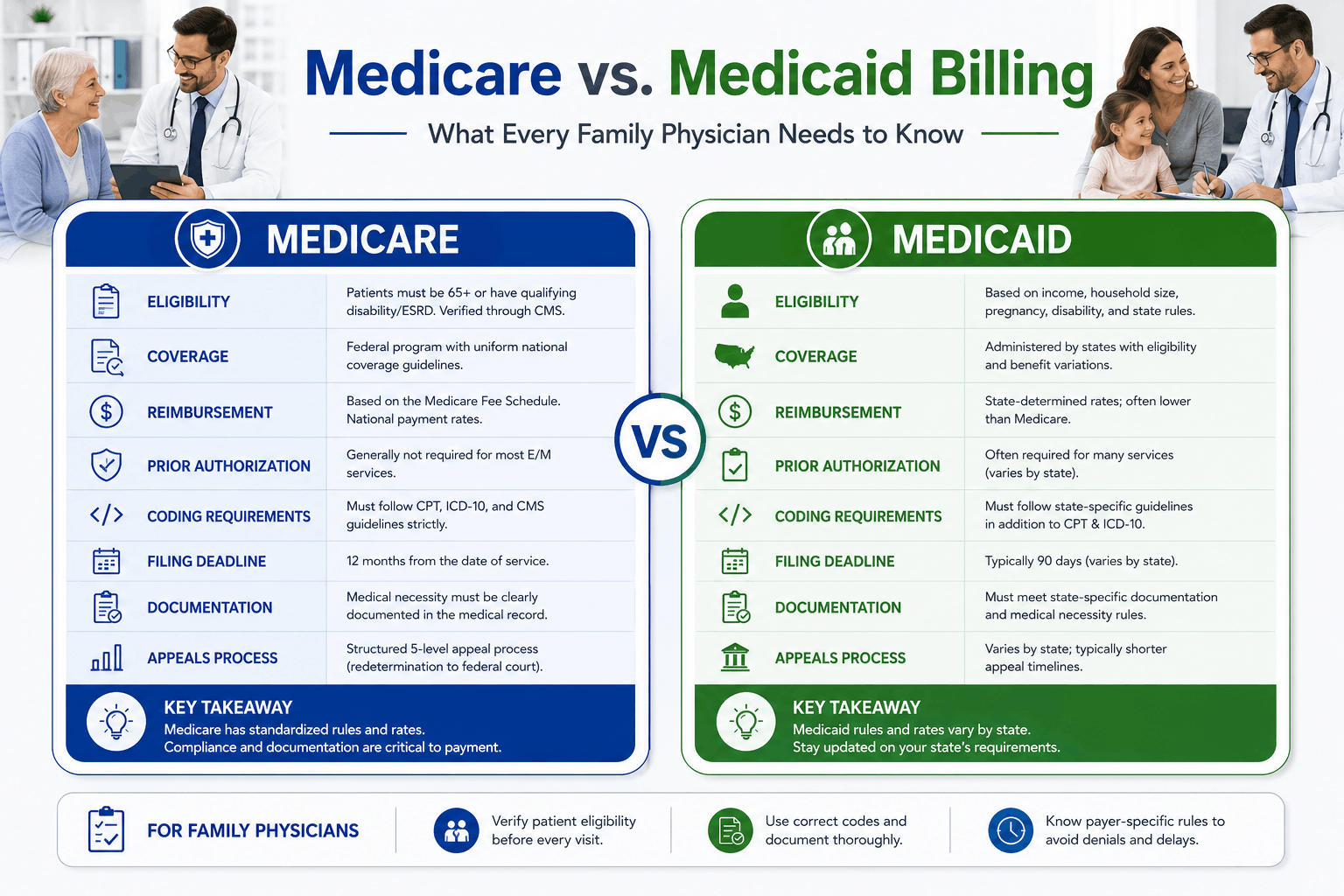
According to our experience it is clear that in family practice billing, your documentation is your defense. The best coder in the world cannot save a claim that is not supported by the clinical record. Conversely, even the best clinical care goes unpaid when documentation is incomplete.
Under the 2025 AMA E/M guidelines, the level of service is determined by either Medical Decision Making (MDM) or total time. Your notes must clearly reflect one of these two elements.
| E/M Level | MDM Complexity | Problems Addressed | Minimum Time (Office) |
|---|---|---|---|
| 99213 | Low | 1–2 self-limited problems | 20–29 minutes |
| 99214 | Moderate | 1+ chronic illness with exacerbation | 30–39 minutes |
| 99215 | High | Severe or threat to life/function | 40–54 minutes |
| 99417 (add-on) | N/A (time-based) | Used with 99215 when time exceeds 54 min | Each additional 15 min |
Even experienced family medicine billing teams make mistakes across the USA. The difference between your practice that loses revenue and those that do not come down to whether they have systems to catch errors before they become denials.
�� Tip: Implement a Monthly Internal Billing Audit
Randomly pull 10–15 charts per month, compare the documentation to the codes billed, and check modifier usage and diagnosis linkage. This simple exercise — done consistently — will identify training gaps before they become denial patterns or audit triggers. Aim to review across different payers and provider types in your practice.
One of the most strategic decisions, as a family medicine practice owner you need to make is whether to manage billing internally or partner with a specialized family practice billing services company. Here is an important comparison for your understanding.
| Factor | In-House Billing | Outsourced Family Medicine Billing Services |
|---|---|---|
| Cost | Fixed staff salary + benefits + software | Percentage of collections (typically 4–9%) |
| Expertise | Limited to in-house training | Dedicated specialists with multi-payer experience |
| Claim First-Pass Rate | Varies widely (often 80–88%) | 85–97% with specialized partners |
| Denial Management | Often reactive and inconsistent | Proactive tracking, systematic appeals |
| Compliance Updates | Team must self-educate on changes | Provider handles CMS/AMA updates |
| Scalability | Limited by staff capacity | Scales with practice growth easily |
| Revenue Recovery | Slower, dependent on staff workload | Faster turnaround, specialized follow-up |
| Reporting & Analytics | Basic EHR reporting | Advanced KPI dashboards and revenue insights |
You cannot improve what you do not measure. These are the revenue cycle metrics that matter most for family practice billing performance across the USA.
| KPI | Benchmark Target | What It Tells You |
|---|---|---|
| Clean Claim Rate | > 95% | % of claims that pass without error on first submission |
| Denial Rate | < 5% | % of claims denied; higher = workflow or coding problem |
| Days in A/R | < 35 days | Average time from service to payment receipt |
| Net Collection Rate | > 95% | % of collectible revenue actually collected |
| First-Pass Resolution Rate | > 90% | % of denials resolved without re-work on first appeal |
| A/R > 90 Days | < 15% of total A/R | % of unpaid claims aging past 90 days (higher = problem) |
| Cost to Collect | 4–9% of collections | Total billing cost as % of revenue collected |
| Patient Collection Rate | > 80% | % of patient-responsible balances collected |
We want to make it clear for your knowledge that these terms are used interchangeably. Both refer to the medical billing and revenue cycle management processes specific to family medicine or family practice physicians. The scope includes E/M coding, preventive care, immunization billing, chronic care management, and more.
Most outsourced family medicine billing services charge between 4–9% of monthly collections, depending on practice volume, specialty complexity, and service scope. This percentage-based model means the billing partner’s incentive is aligned with maximizing your revenue, they earn more only when you do.
According to our experience the most frequently billed codes in family practice are: 99213 and 99214 (established patient E/M), 99392–99397 (preventive care), G0439 (Medicare AWV), 90460/90471 (vaccine administration), and 99490 (chronic care management). The exact mix varies significantly by practice demographics and payer mix.
The most effective denial reduction strategies for your medical practice are, front-end eligibility verification, modifier −25 training for same-day combined visits, correct ICD-10 to CPT code linking, timely claims submission, and monthly internal audits. Partnering with a specialized family practice billing services company also typically reduces denial rates significantly.
Yes, as long as your billing partner signs a Business Associate Agreement (BAA) and follows HIPAA-required safeguards for PHI handling, storage, and transmission. Always confirm your billing service’s HIPAA compliance program before engaging them.
Need support with your billing workflow? Explore our medical billing and revenue cycle services or request a free consultation.
Get a free assessment from our billing experts