
Our Internal Medicine Medical Billing services help practices manage complex coding requirements, documentation standards, and payer regulations. We streamline claims, reduce denials, and improve reimbursements through efficient revenue cycle management.

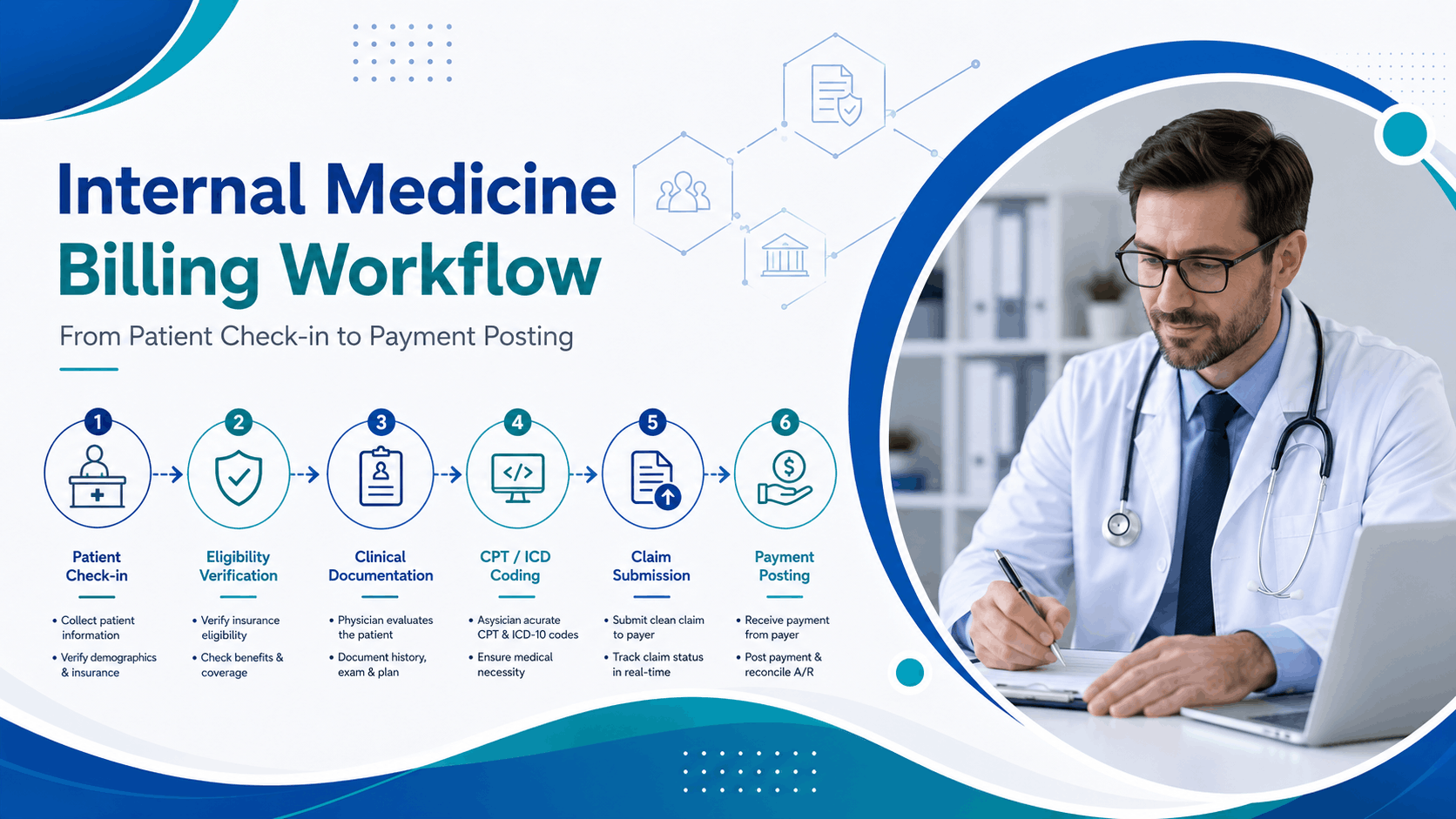
Internal medicine medical billing is the process of translating the clinical services provided by internists into standardized codes CPT, ICD-10, and HCPCS, and accurately submitting those coded claims to Medicare, Medicaid, or private commercial insurers for reimbursement.
We know that as experienced internists you are specialized in diagnosing and managing adult diseases, often complex, chronic, and multi-system. This means you billing involves:
According to our experience a lot of physicians in the USA assume that because internal medicine is technically a primary care specialty, the billing is similar to family practice. It is not, and confusing the two is one of the most costly mistakes your medical practice is making, here is a side-by-side look for your understanding.
| Billing Factor | Internal Medicine | Family Practice / General Primary Care |
|---|---|---|
| Patient Demographic | Adults (18+), predominantly Medicare age | All ages — newborns to seniors |
| Common E/M Codes | 99214, 99215 (high complexity MDM) | 99213, 99214 (moderate complexity) |
| Chronic Care Billing | High volume — CCM (99490), TCM (99495–99496) | Underutilized — often missed |
| Medicare Interactions | Frequent — AWV (G0438/G0439), CCM, HCC coding | Moderate |
| Risk Adjustment | Heavy — HCC coding critical | Minimal |
| Audit Risk | High — complex MDM invites scrutiny | Moderate |
| Preventive Coding | AWV, G-codes, age-specific screenings | Broad preventive range (99381–99397) |
| Inpatient Coding | Hospital observation, discharge codes | Limited |
It is important for your medical practice growth that you have a deep understanding how internal medicine billing works from end to end is essential for identifying where revenue leaks happen. Here is the complete workflow:
Before the patient even walks through the door, your team should verify:
This is where billing success or failure is actually determined. Your SOAP notes must:
Here is a comprehensive reference table of the most commonly used CPT codes in internal medicine medical billing:
| CPT Code | Service Description | Key Billing Rule |
|---|---|---|
| 99213 | Established patient — low MDM (10–19 min) | Suitable for straightforward follow-ups; 1 chronic stable condition |
| 99214 | Established patient — moderate MDM (30–39 min) | Requires 2+ chronic conditions with med review or test ordering |
| 99215 | Established patient — high MDM (40–54 min) | Severe exacerbation, 3+ chronic conditions; high audit risk without strong documentation |
| 99205 | New patient — high complexity MDM (60–74 min) | Initial visit for complex new patient; document thoroughly |
| 99417 | Prolonged services (add-on to 99215) | Bill for each additional 15 minutes beyond 99215's threshold |
| G0438 | Initial Annual Wellness Visit (Medicare) | Requires health risk assessment, cognitive screening, prevention plan |
| G0439 | Subsequent Annual Wellness Visit (Medicare) | Cannot be billed same day as routine physical exam |
| 99490 | Chronic Care Management — 20+ min/month | 2+ chronic conditions; requires written patient consent |
| 99487 | Complex CCM — 60+ min/month | Complex care plan; two or more chronic conditions |
| 99495 | Transitional Care Management — moderate complexity | 7-day follow-up call + 14-day office visit post-discharge |
| 99496 | Transitional Care Management — high complexity | 7-day follow-up call + 7-day office visit post-discharge |
| 99453 | Remote Patient Monitoring — setup | Initial device setup for chronic conditions |
| 99457 | Remote Patient Monitoring — 20 min/month | Monthly management of RPM data |
| 93000 | Electrocardiogram (ECG) | Include interpretation in documentation |
| 94010 | Spirometry | Required for COPD/asthma management documentation |
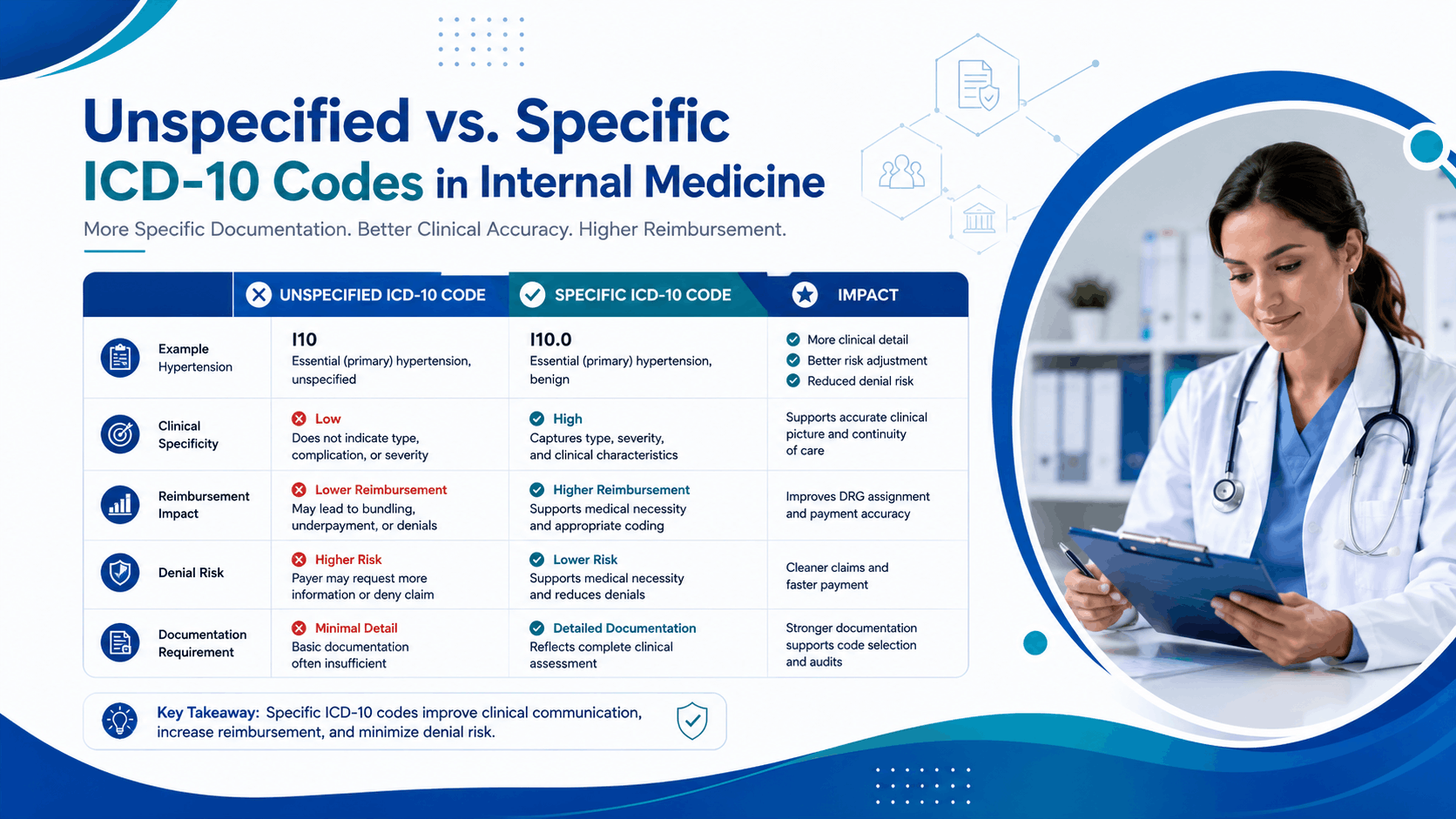
Specificity is everything in internal medicine medical billing. If your medical practice is using unspecified ICD-10 codes is one of the top triggers for your practice claim denials. Here are the most critical codes and how to use them correctly:
| Condition | Avoid (Unspecified) | Use Instead (Specific) | Why It Matters |
|---|---|---|---|
| Hypertension | — | I10 (Essential hypertension) | Primary HTN — always use I10 unless secondary is documented |
| Type 2 Diabetes | E11.9 (unspecified) | E11.65 (with hyperglycemia) or E11.22 (with CKD) | Specificity supports higher MDM and CCM eligibility |
| COPD | J44.9 (unspecified) | J44.1 (with acute exacerbation) | Exacerbation changes treatment plan and justifies higher E/M |
| Heart Failure | I50.9 (unspecified) | I50.22 (systolic, chronic) or I50.32 (diastolic) | Systolic vs diastolic distinction is required for accurate coding |
| CKD | N18.9 (unspecified) | N18.3 (Stage 3) or N18.4 (Stage 4) | Stage directly affects risk adjustment and CCM eligibility |
| Hypothyroidism | E03.9 (unspecified) | E03.2 (drug-induced) or E03.1 (congenital) | Specify cause when documented |
| Depression | F32.9 (unspecified) | F32.1 (moderate) or F32.2 (severe) | Severity impacts MDM complexity level |
| Atrial Fibrillation | I48.91 (unspecified) | I48.0 (paroxysmal) or I48.11 (persistent) | Payer policies differ based on AF type |
As an experienced physician you know that modifiers are the fine print of internal medicine billing, and incorrect modifier use is one of the leading causes of both denials and audit risk for your medical practice.
| Modifier | When to Use | Common Mistake to Avoid |
|---|---|---|
| -25 | Billing a separate, significant E/M service on the same day as a procedure | Using -25 without documenting that the E/M was truly separate from the procedure |
| -59 | Distinct procedural services (separate anatomical site or session) | Applying -59 when the services are actually bundled per NCCI edits |
| -95 | Real-time synchronous telehealth visit | Using -95 for asynchronous (store-and-forward) telehealth — those require -GQ |
| -GA | Medicare ABN on file for potentially non-covered services | Billing -GA without a signed Advance Beneficiary Notice on file |
| -33 | Preventive services with waived cost-sharing (ACA-mandated) | Applying -33 to diagnostic services, which are not covered under this modifier |
| -24 | Unrelated E/M during a post-operative global period | Failing to explicitly document that the visit is unrelated to the surgery |
| -57 | E/M visit that results in the decision to perform surgery | Using -57 for minor procedures — it applies only to major surgical decisions |
Chronic care management is arguably the single biggest missed revenue opportunity in internal medicine medical billing. And yet, most practices either don’t bill it at all or bill it inconsistently, here is complete detail what you need to know:
| CCM Code | Time Requirement | Service Type | 2025 Medicare Reimbursement (Approx.) |
|---|---|---|---|
| 99490 | 20+ min/month | Non-face-to-face care coordination | ~$62–$68/month |
| 99491 | 30+ min/month — physician time | Physician-directed CCM | ~$84–$92/month |
| 99487 | 60+ min/month | Complex CCM — revised care plan | ~$130–$140/month |
| 99489 | Each additional 30 min | Add-on to 99487 | ~$68–$75/month |
Telehealth has permanently changed internal medicine medical billing since the COVID-19 Public Health Emergency. Even with the expiration of many emergency flexibilities, significant telehealth provisions have been extended through 2026 under the Consolidated Appropriations Act.
| Telehealth Service | CPT Code | Required Modifier | Medicare Coverage |
|---|---|---|---|
| Office visit — est. patient, moderate MDM | 99214 | -95 | Yes |
| Office visit — est. patient, high MDM | 99215 | -95 | Yes |
| Phone E/M — 5–10 minutes | 99441 | None (audio-only) | Yes (extended through 2026) |
| Phone E/M — 11–20 minutes | 99442 | None (audio-only) | Yes |
| CCM — non-face-to-face | 99490 | N/A | Yes |
The Medicare Annual Wellness Visit is one of the most impactful, and most commonly miscoded services in internal medicine billing.
| Factor | Annual Wellness Visit (AWV) | Routine Physical Exam |
|---|---|---|
| Coverage | 100% covered by Medicare (no cost-sharing) | Not covered by original Medicare |
| CPT/HCPCS Code | G0438 (initial) / G0439 (subsequent) | 99395–99397 (for commercial payers) |
| Components Required | Health Risk Assessment, cognitive screen, personalized prevention plan, vitals, medication review | Comprehensive head-to-toe physical |
| Can Bill Same Day as E/M? | Yes, with Modifier -25 on E/M | N/A |
| Can Bill Same Day as Routine Physical? | No — cannot bill AWV and physical exam together | N/A |
As an experienced physician you know that internal medicine medical billing is hard especially in the USA. Here are the most common challenges you practice can face, and why they happen inside your medical practice.
As a physician if you have documented “diabetes” or “heart failure” without clinical specificity. Coders assign I50.9 or E11.9, and the payer either denies or downcodes the claim.
As an experienced internist you need to consistently bill 99213 or 99214 when the documentation clearly supports 99215. This is not conservative billing, it is leaving money on the table AND creating a compliance inconsistency.
If you practice treating chronic disease patients without billing for the non-face-to-face coordination they are already doing. Patient consent is never obtained, care plans are not formal, and CCM revenue goes uncaptured.
If you are using the wrong modifier (-GT vs -95) or wrong Place of Service code creates claims that are technically deficient, it will lead to denials even when the service itself was appropriate.
Complex internal medicine services like stress tests, echocardiograms, and specialty referrals often require prior authorization. Billing without authorization leads to predictable denials.
MDM documentation is incomplete — no total time logged, no decision complexity documented, no medication reconciliation noted. This makes it impossible to defend a high-level E/M code under audit.

Here are the proven, actionable strategies that top-performing internal medicine practices using across the USA, you can use these strategies to increase your practice revenue.
Use a Code Scrubber Before Every Submission: You can guide your billing team that a claims scrubber catches CPT-ICD-10 mismatches, missing modifiers, and NCCI edit conflicts before they ever reach the payer. This single step can reduce front-end denials by 30–40%.
Conduct Monthly Chart Audits: Financial growth requires from your side that you need to pull a random sample of 20–30 charts per month and compare documentation to the codes billed.
Train Clinical Staff on MDM Documentation: The 2026 E/M guidelines are MDM-driven. Your physicians need to know that they must document (a) the number and complexity of problems addressed, (b) the amount and complexity of data reviewed, and (c) the risk of complications. Without all three, you cannot defend a 99215.
Implement a CCM Workflow: It is your responsibility as practice owner that you need to assign a dedicated care coordinator, get written patient consent, build a formal care plan in your EHR, track non-face-to-face time monthly, and bill 99490 every month for eligible patients.
Appeal Every Denial Within Payer Deadlines: According to CMS data, a significant percentage of denied Medicare claims that are appealed are ultimately paid. Most practices abandon denials after the first attempt. Do not.
Internal medicine is a high-scrutiny specialty. The OIG’s annual Work Plan consistently flags internal medicine for:
| Compliance Area | What to Verify | Resource |
|---|---|---|
| E/M documentation | Does the note support the MDM level billed? | CMS E/M Guidelines 2024 |
| CCM consent | Is signed patient consent on file before billing 99490? | CMS CCM Fact Sheet |
| Modifier -25 | Is the E/M truly separate and identifiable from the procedure? | AMA CPT Guidelines |
| Telehealth POS | Is POS 02 or POS 10 used correctly? | CMS Telehealth |
| HCC diagnosis | Is every chronic condition coded at every encounter? | CMS Risk Adjustment |
| Timely filing | Are claims submitted within payer deadlines (90–180 days)? | Payer-specific contracts |
| NCCI edits | Are all procedure pairs checked for bundling conflicts? | CMS NCCI Edits |
The right technology makes your internal medicine billing dramatically more efficient and accurate. Here is what leading practices use:
| Software | Best For | Key Features |
|---|---|---|
| AdvancedMD | Mid-size practices | MDM-driven E/M coding prompts, modifier alerts |
| Kareo | Small to mid-size practices | Real-time eligibility, claim scrubbing, denial tracking |
| eClinicalWorks | CCM-heavy practices | TCM/CCM time tracking, care plan templates |
| DrChrono | Medicare-heavy patient panels | AWV compliance modules, telehealth integration |
| Athenahealth | Revenue optimization | Analytics dashboards, denial pattern reporting |
| Epic | Large health systems | Comprehensive RCM integration, HCC coding prompts |
By outsourcing internal medicine billing allows you and staff to spend less time dealing with coding errors, denied claims, and payer follow-ups. Our dedicated billing team helps to improve claim accuracy, reduce administrative workload, and accelerate reimbursements while keeping your practice compliant.
With expert internal medicine billing services, you gain access to our certified coders, proactive denial management, and continuous monitoring of Medicare and commercial payer updates. This leads your medical practice to healthier cash flow, fewer billing headaches, and more time to focus on delivering quality patient care. Here is what the data shows about outsourced internal medicine billing services across the USA.
At House of Outsourcing, we specialize in internal medicine medical billing services for physician practices, multi-specialty groups, and independent internists across the United States. We understand your clinical complexity that drives your billing, because we have built our entire team around it.
Need support with your billing workflow? Explore our medical billing and revenue cycle services or request a free consultation.
Get a free assessment from our billing experts