
Our billing specialists help your practice submit compliant virtual care claims, reduce reimbursement delays, and maximize payments for every eligible telehealth visit.

TRICARE telemedicine billing in 2026 has become a core component of healthcare delivery, not just a temporary convenience. Virtual health services in the USA are now permanently integrated into TRICARE, covering primary care, behavioral health, urgent care, and even specialty services across the USA.
However, billing for telemedicine is more complex than most providers expect. It requires alignment between provider eligibility, service type, technology standards, documentation, and payer-specific rules. If any one of these elements is missing, claims can be delayed, reduced, or denied.
Need support with your billing workflow? Explore our medical billing and revenue cycle services or request a free consultation.
TRICARE defines telemedicine as secure, real-time communication (usually video or approved audio) between provider and patient for medically necessary care.
This means not all virtual interactions qualify for reimbursement. For example, TRICARE does not cover text-only consultations, and services must meet strict clinical and technological standards to be considered valid telemedicine.
Why this matters:
If your service doesn’t meet TRICARE’s definition, it won’t be paid, even if it benefits the patient. Always confirm eligibility before billing.
TRICARE has significantly expanded telemedicine access to support military families, especially those in remote or frequently relocating environments. Services like mental health, chronic care management, and urgent care are now widely available virtually.
But with this expansion comes tighter oversight. TRICARE now focuses heavily on medical necessity, service appropriateness, and compliance with telehealth rules, making billing accuracy more important than ever.
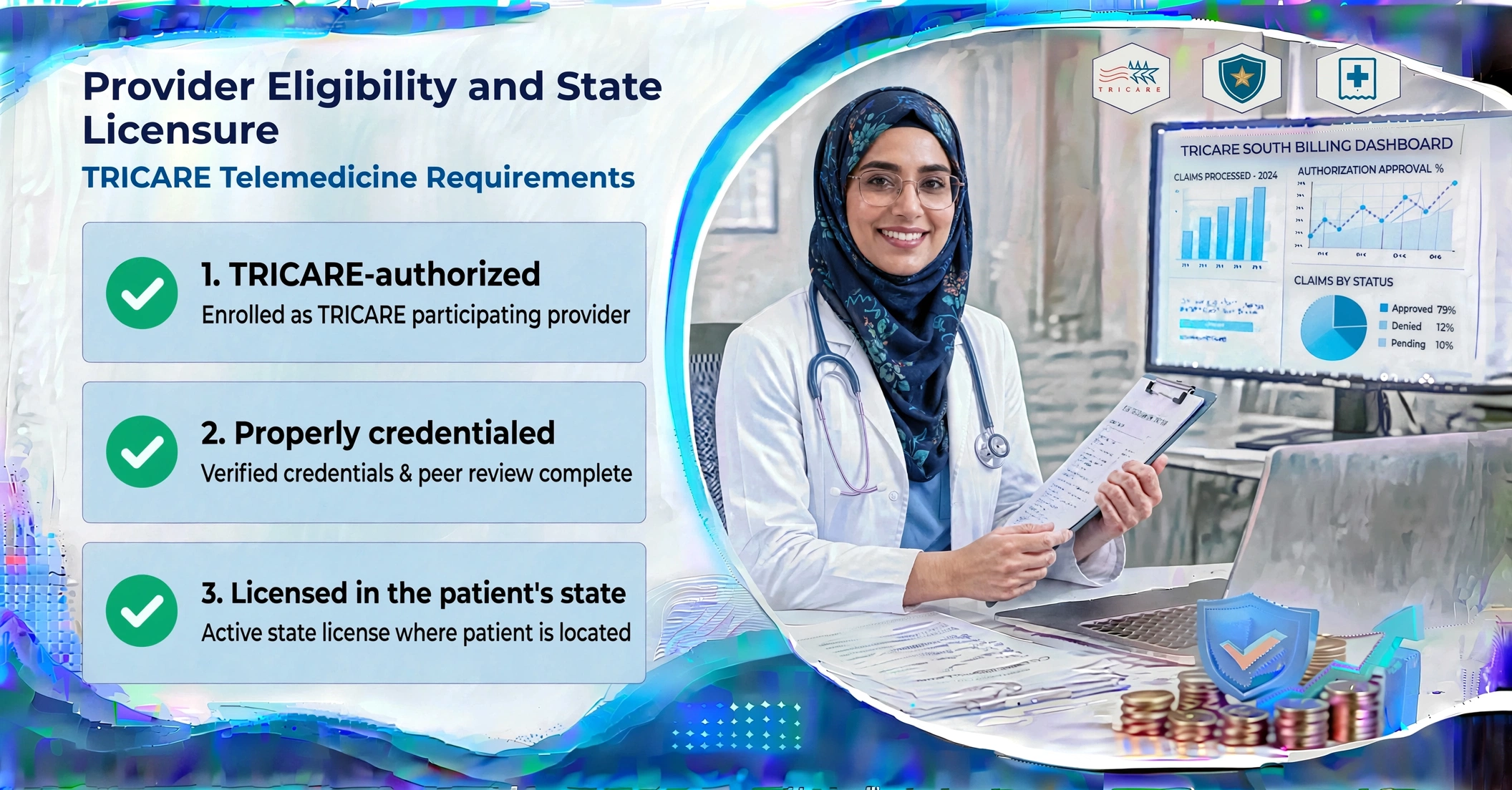
To bill TRICARE for telemedicine, you must be:
This is especially important because telemedicine often crosses state lines. If the provider is not licensed where the patient is located, the claim will likely be denied.
TRICARE requires telemedicine services to be delivered through secure, HIPAA-compliant platforms with real-time interaction capabilities.
Using non-compliant tools, even unintentionally can invalidate the service from a billing perspective. This includes issues like lack of encryption, insecure connections, or non-approved communication methods.
Telemedicine billing requires precise use of:
For TRICARE, providers are often required to bill the POS based on where the provider is located (e.g., office POS 11) rather than just using telehealth-specific POS codes.
TRICARE requires that telemedicine services be both:
Documentation must clearly show:
Without this, even your practice correctly coded claims may be denied.
Telemedicine does not eliminate TRICARE’s referral and authorization requirements. For example, active-duty service members and TRICARE Prime patients often still need PCM referrals and prior approvals, even for virtual care.
TRICARE requires documentation of:
This ensures compliance with licensure laws and billing rules. In some cases, even international regulations may apply for overseas telemedicine services.
Telemedicine denials are rising due to stricter compliance checks. The most common causes include:
| Denial Cause | Real Impact | Prevention Strategy |
|---|---|---|
| Incorrect coding | Claim rejection | Standardize coding protocols |
| Missing documentation | Payment delays/denials | Complete clinical notes |
| No authorization | Full denial | Verify before service |
Eligibility errors, often due to outdated DEERS information, are a major cause of claim denials in TRICARE telemedicine billing.
Because telemedicine allows quick access to care, providers may skip verification steps, leading to billing issues later.

Telemedicine introduces new operational challenges, including:
If these workflows are not aligned, claims may be delayed, increasing accounts receivable (AR) days and reducing revenue.
Although TRICARE aligns with Medicare in many ways, telemedicine rules differ in:
Assuming all telehealth systems are the same can lead to costly billing errors.
Telemedicine billing combines multiple layers:
Many in-house teams struggle to manage all of these simultaneously.
Telemedicine is more than a service, it’s a growth opportunity. But without a structured billing strategy, providers:
Telemedicine errors often go unnoticed because claims may still be paid, but incorrectly or partially. Over time, this leads to significant revenue leakage.
Audits help identify:
Stay compliant with the latest TRICARE telemedicine billing guidelines by learning covered virtual services, CPT and HCPCS coding, GT and 95 modifier requirements, place of service reporting, documentation standards, claims submission, reimbursement policies, and best practices to reduce denials and maximize payments.
Get a free assessment from our billing experts