
Learn proven billing strategies that improve compliance, streamline claim processing, and strengthen your practice’s overall financial performance.

In 2026, strict compliance with TRICARE billing guidelines is no longer optional, it’s essential for financial stability. Accurate coding, proper documentation, and completely following of payer-specific rules significantly reduce your practice claim denials and costly rework. When practices follow TRICARE’s evolving policies, they experience faster reimbursements, improved clean claim rates, and fewer disruptions in cash flow.
TRICARE’s billing requirements are highly detailed, and even small errors in your billing such as incorrect modifiers, missing authorizations, or outdated coding can lead to rejections or underpayments. By maintaining precision and staying updated with policy changes, you can avoid revenue leakage and ensure every service rendered is appropriately reimbursed.
Understanding TRICARE allowable charges is where accurate billing really begins for healthcare practices of different specialties. These are the maximum amounts TRICARE agrees to pay for specific services, and if you don’t align your charges correctly, your healthcare practice risks underpayment or denials. When you clearly understand these limits, you can bill confidently, avoid guesswork, and ensure every claim reflects the correct reimbursement expectations.
Need support with your billing workflow? Explore our medical billing and revenue cycle services or request a free consultation.
With TRICARE, your provider status isn’t just administrative, it directly shapes how much you get paid and what your patients owe. Network and participating providers agree to TRICARE’s allowable charges, which means claims are processed more smoothly and reimbursements are predictable. In return, patients benefit from lower out-of-pocket costs, making your services more accessible and reducing billing disputes.
On the other hand, nonparticipating providers have more flexibility in what they charge, but that often leads to higher patient liability and slower, more complex reimbursement. Patients may have to pay upfront and seek partial reimbursement themselves, which can create confusion and dissatisfaction. Simply put, your provider type influences everything from cash flow stability to patient experience, making it a critical factor in both financial performance and trust. TRICARE divides providers into:
Each category has different billing rights and reimbursement rules. Network providers must accept negotiated rates, while nonparticipating providers can charge slightly above allowable limits.
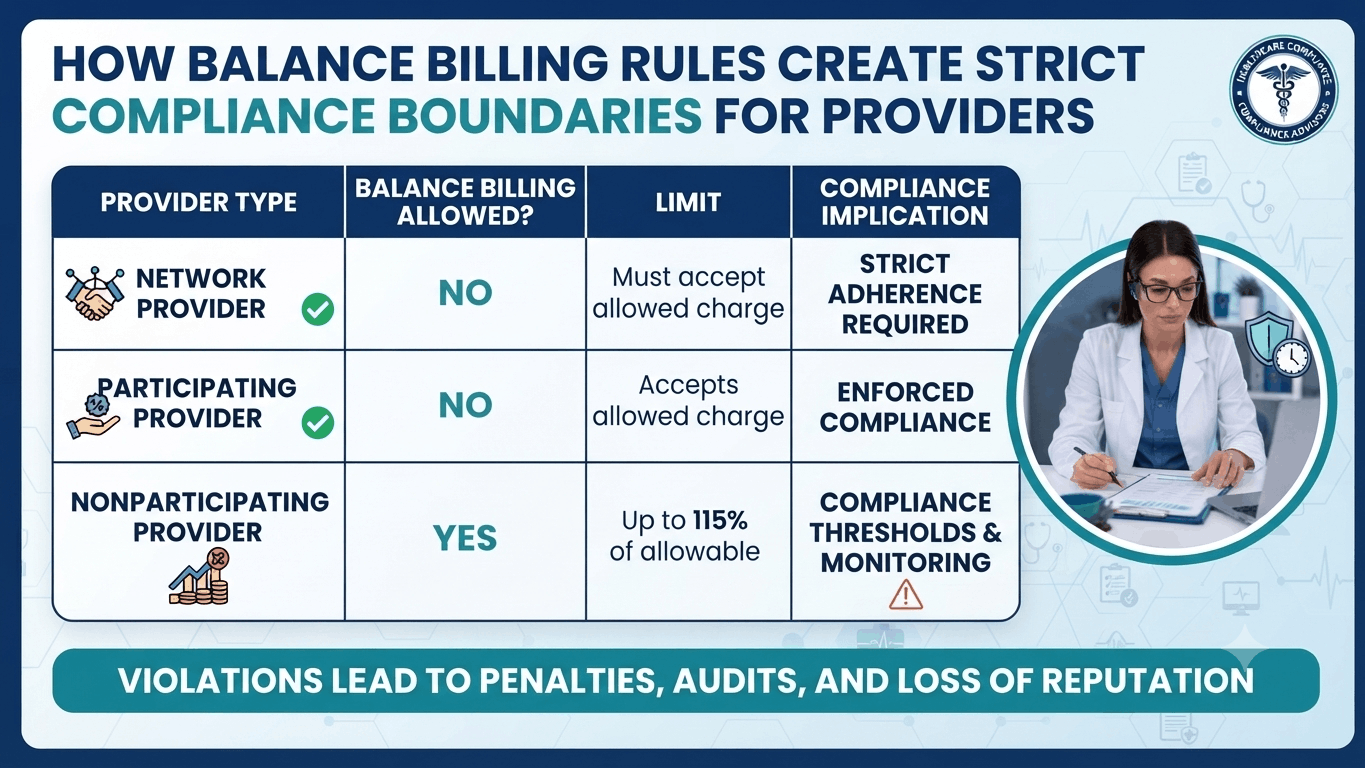
Importantly, only nonparticipating providers can balance bill—and even then, only up to 15% above allowable charges.
When you’re billing under TRICARE, the difference between a smooth payment and a denial often comes down to choosing the right CPT code with the right documentation. At House of Outsourcing, our certified CPC coders always guide providers to focus on the codes that actually drive revenue, and we explain them in a way that’s easy to apply in daily practice.
| CPT Code | Description | What It Means for You (Simple Explanation) |
|---|---|---|
| 99213 | Established patient visit (moderate) | This is your most frequently used code. Use it when the visit is straightforward but still requires clinical judgment—don’t under-document or you’ll lose revenue. |
| 99214 | Established patient visit (high complexity) | If you’re managing multiple conditions or adjusting treatment, this is likely the right code. Many providers undercode here—don’t leave money on the table. |
| 99203 | New patient visit (moderate) | When you’re seeing a patient for the first time with a clear issue, this fits well. Make sure your history and exam are properly documented. |
| 99204 | New patient visit (detailed/high) | Use this when the case is more complex. If you’re spending more time and decision-making is deeper, this code reflects your real work. |
| 99285 | Emergency department visit (high severity) | Critical for ER billing. If the case involves serious risk, this code ensures maximum appropriate reimbursement. |
| 99396 | Preventive visit (adult established patient) | Annual checkups fall here. It’s often overlooked, but great for consistent, clean reimbursements when billed correctly. |
| 99441 | Telephone E/M service | Perfect for short clinical calls. With virtual care growing, this code helps you capture revenue you might otherwise miss. |
As a provider you know that balance billing is one of the most tightly regulated aspects of TRICARE. You cannot bill patients beyond allowed limits except in very specific cases. If violated, providers may face compliance actions or penalties.
| Provider Type | Balance Billing Allowed? | Limit |
|---|---|---|
| Network Provider | No | Must accept allowed charge |
| Participating Provider | No | Accepts allowed charge |
| Nonparticipating Provider | Yes | Up to 115% of allowable |
For beneficiaries with TRICARE For Life, billing follows a coordinated approach where Medicare serves as the primary payer and TRICARE acts as secondary. Medicare processes and pays its portion first, after which TRICARE may cover some or all of the remaining allowable costs. However, patients are still responsible for applicable deductibles, coinsurance, and any services not covered under either program. For beneficiaries with TRICARE For Life (TFL), Medicare acts as the primary payer and TRICARE becomes secondary. In these cases:
When working with TRICARE, HCPCS codes are where many claims either get paid smoothly or get denied fast, especially for drugs, supplies, and transport. At House of Outsourcing, our expert team simplifies this by focusing on the HCPCS codes that truly impact reimbursement and showing you how to use them correctly in real scenarios.
| HCPCS Code | Description | What It Means for You (Simple Explanation) |
|---|---|---|
| J3490 | Unclassified drugs | Use this when no specific J-code exists. But be careful—always include detailed documentation and drug description, or TRICARE may deny it. |
| J1100 | Injection, dexamethasone sodium phosphate | A commonly used steroid injection. Make sure your dosage units are accurate, as errors here often lead to underpayment. |
| J1885 | Injection, ketorolac tromethamine | Frequently used for pain management. Document the medical necessity clearly, especially in urgent care or ER settings. |
| A0427 | ALS emergency ambulance service | Used in emergency transport. Ensure proper condition documentation, or claims can be downgraded or denied. |
| A0425 | Ground mileage (per mile) | Always billed with transport codes. Missing mileage details? That’s a direct revenue loss. |
| E0114 | Crutches (underarm, adjustable) | Common DME item. You must include proof of medical need and delivery documentation for approval. |
| A4550 | Surgical trays | Often bundled, but when separately billable, it adds value. Just confirm TRICARE bundling rules before submitting. |
TRICARE requires timely and accurate claim submission, often handled by regional contractors. Errors in claim format, coding, or missing data can delay payment significantly.
Network providers typically submit claims directly, while non-network providers may require patient involvement.
Deeper Insight:
Unlike some payers, TRICARE relies heavily on contractor-based processing systems, making accuracy essential.
Solution:
Use standardized claim submission processes and verify all required fields before submission.
When billing under TRICARE, modifiers are not optional—they’re the difference between full payment, partial payment, or outright denial. At House of Outsourcing, we often see clean claims turn into denials simply because the right modifier wasn’t used—or wasn’t supported with documentation.
| Modifier | Description | What It Means for You (Simple Explanation) |
|---|---|---|
| -25 | Significant, separately identifiable E/M service | Use this when you perform a procedure and an E/M visit on the same day. If documented correctly, you get paid for both—otherwise, one gets denied. |
| -59 | Distinct procedural service | This helps you show that two procedures are separate and not bundled. Without it, TRICARE may combine them and reduce payment. |
| -26 | Professional component | Use this when you’re billing only for the physician’s interpretation, not the equipment. Common in radiology. |
| -TC | Technical component | Opposite of -26. This is for the equipment/facility portion. Make sure you don’t mix these up—it directly affects payment split. |
| -50 | Bilateral procedure | If a procedure is done on both sides (like both limbs), this modifier ensures you’re paid appropriately for both. |
| -76 | Repeat procedure (same provider) | Use this when you repeat the same procedure on the same day. Without it, TRICARE may think it’s a duplicate and deny it. |
| -95 | Telehealth service | Essential for virtual visits. This tells TRICARE the service was done remotely—missing it can lead to outright rejection. |
Cost-shares, deductibles, and catastrophic caps play a critical role in determining what patients ultimately owe under TRICARE, making them essential to accurate billing. Patient responsibility isn’t fixed, it varies based on the plan type (Prime, Select, or TFL), the beneficiary category, and the type of service provided. Understanding these variables helps practices calculate precise patient balances, avoid billing errors, and ensure transparency, ultimately improving collections and patient satisfaction. TRICARE billing must account for patient responsibility, which varies based on:
For example, TRICARE For Life has a catastrophic cap of $3,000 annually, after which patients pay nothing for covered services.
Deeper Insight:
Incorrect patient billing leads to disputes, delays, and compliance issues.
Solution:
Verify patient eligibility and cost-sharing details before billing.
Unlike Medicare, TRICARE places strong emphasis on:
Claims may be denied if:
Solution:
Implement front-end verification processes before services are rendered.
TRICARE costs including premiums, copayments, and cost-shares are updated annually based on healthcare trends and federal adjustments. This means billing teams must stay updated to avoid incorrect patient billing.
Deeper Insight:
Billing errors often occur not due to coding—but due to outdated cost assumptions.
Solution:
Regularly update billing systems with current TRICARE cost structures.
Inefficient TRICARE billing workflows often lead to delayed claim submissions, slower payments, and increased administrative workload across providers, contractors, and patients.
By streamlining processes with automation and standardized systems, practices can reduce delays, improve efficiency, and accelerate reimbursements. TRICARE billing involves coordination between:
If workflows are not optimized, delays occur in:
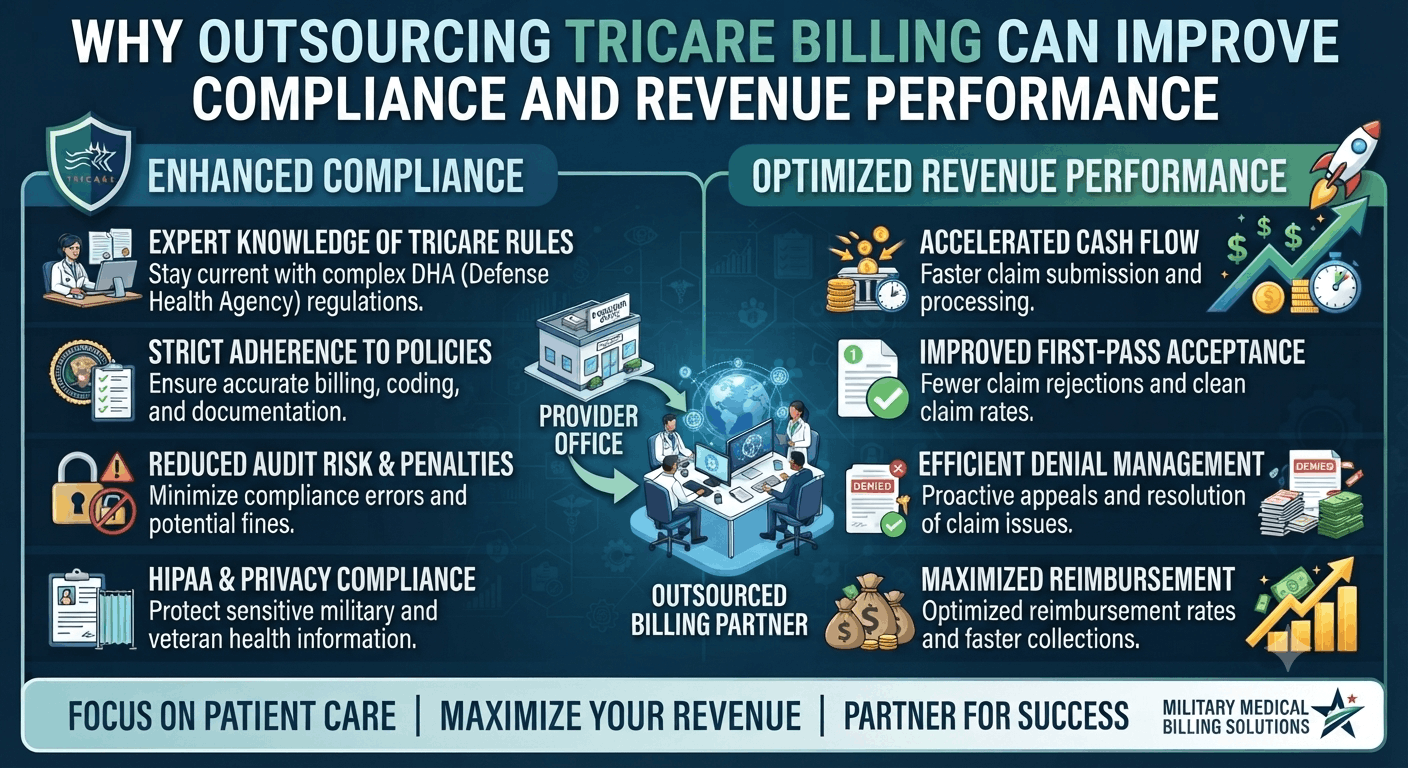
Outsourcing TRICARE billing gives practices access to experts who understand DoD regulations, Medicare-aligned reimbursements, and contractor-specific requirements.
This specialized support improves compliance, reduces costly errors, and ultimately strengthens revenue performance without overburdening internal teams.
TRICARE billing requires deep knowledge of:
Proactive audits are essential for success with TRICARE billing, as they help uncover overbilling risks, underpayments, and hidden compliance gaps before they turn into costly issues. With TRICARE’s strict regulatory framework, regular audits protect both your revenue and your practice from legal exposure.
At House of Outsourcing, we emphasize continuous monitoring and internal audit strategies to keep billing accurate, compliant, and optimized. By tracking trends and correcting issues early, practices can maintain financial stability and confidently understanding complex TRICARE requirements. Audits help identify:
Master TRICARE claims billing with the latest 2026 guidelines covering provider eligibility, CPT and HCPCS coding, claims submission, referrals and authorizations, documentation requirements, reimbursement policies, timely filing rules, and compliance strategies to reduce denials and maximize revenue.
Get a free assessment from our billing experts