Learn how by following the latest Medicare billing rules helps your health center reduce denials, maintain compliance, and receive faster reimbursements.
Medicare FQHC billing is built on the Prospective Payment System (PPS), which pays a fixed rate per qualifying visit instead of reimbursing each service separately. This means your entire revenue depends on whether a visit qualifies, not how many services you provide.
The real challenge is not billing more codes, but ensuring that every eligible encounter is captured, documented, and billed correctly. Many FQHCs unknowingly lose revenue simply because visits are not structured to meet PPS requirements.
Need support with your billing workflow? Explore our medical billing and revenue cycle services or request a free consultation.
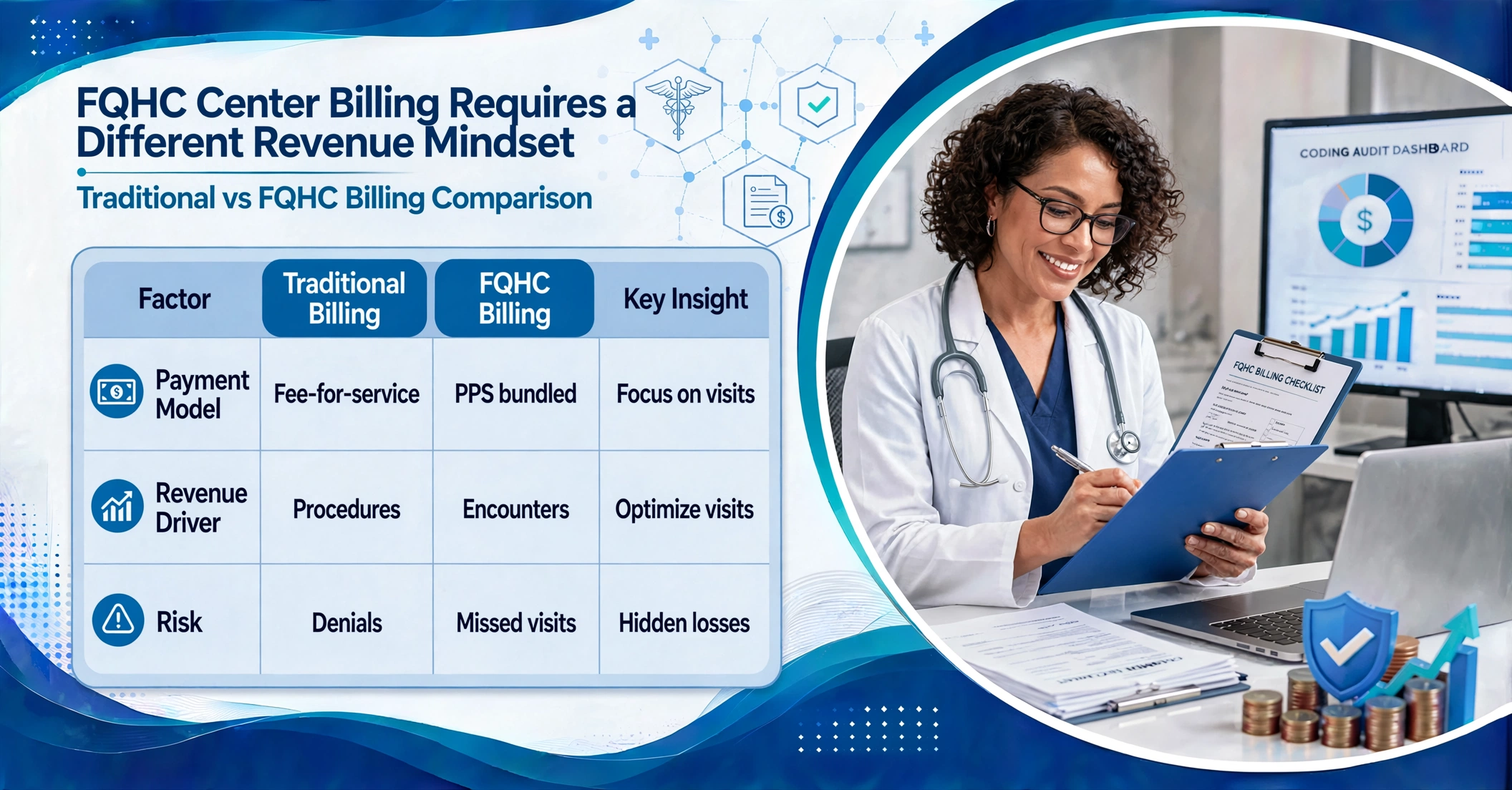
Unlike traditional healthcare practices of the USA, where revenue grows with volume of procedures, FQHCs must think in terms of visit optimization. You are not paid for doing more, you are paid for doing the right visit the right way. This shift requires operational alignment between front desk, providers, and billing teams. When workflows are disconnected, FQHCs experience silent revenue leakage without even seeing claim denials.
| Factor | Traditional Billing | FQHC Billing | Key Insight |
|---|---|---|---|
| Payment Model | Fee-for-service | PPS bundled | Focus on visits |
| Revenue Driver | Procedures | Encounters | Optimize visits |
| Risk | Denials | Missed visits | Hidden losses |
A common misconception is that every patient interaction generates revenue, but under Medicare, only face-to-face encounters with qualified providers count. For example, a nurse-only visit or administrative interaction may consume resources but generate no reimbursement. This is where operational awareness becomes critical.
| Visit Type | Qualifies | Why It Matters |
|---|---|---|
| Physician/NP Visit | Yes | Generates PPS payment |
| Behavioral Health | Yes | Can qualify separately |
| Nurse Visit | Often No | No direct revenue |
| Phone/Follow-up | No | Resource drain |
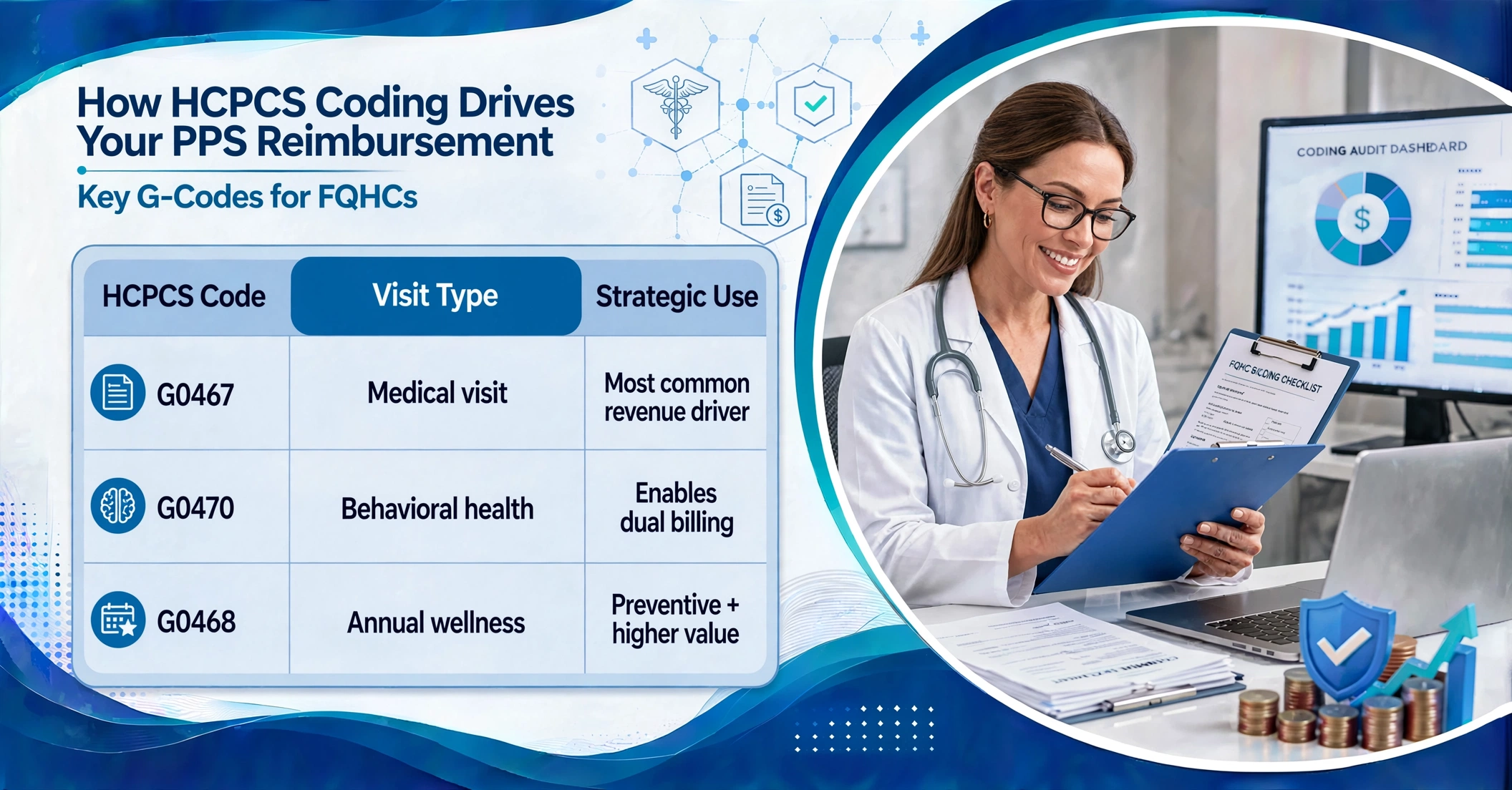
FQHC billing relies heavily on HCPCS “G-codes”, which act as triggers for PPS payments. Unlike CPT coding, the goal here is not granularity, but accuracy in selecting the correct visit category. Even though payment is bundled, incorrect HCPCS coding can delay claims or misclassify visits.
| HCPCS Code | Visit Type | Strategic Use |
|---|---|---|
| G0467 | Medical visit | Most common revenue driver |
| G0470 | Behavioral health | Enables dual billing |
| G0468 | Annual wellness | Preventive + higher value |
One of the most misunderstood areas in FQHC billing is the “one visit per day” rule. Many centers assume they can only bill once per patient per day, but this is not entirely true.
Medicare allows separate payments for medical and behavioral health visits on the same day, if properly documented and performed by different providers.
This creates a major revenue opportunity, but only if scheduling, documentation, and billing teams are aligned. Otherwise, FQHCs unintentionally leave money on the table.
| Scenario | Allowed | Revenue Impact |
|---|---|---|
| Medical + Behavioral | Yes | Double PPS payment |
| Two Medical Visits | No | One payment only |
| Poor Documentation | No | Missed opportunity |
Unlike most healthcare settings, FQHC reimbursement is influenced by annual cost reports submitted to Medicare. These reports help determine adjustments and validate operational expenses. If your cost report is inaccurate, you’re not just risking compliance, you’re potentially lowering your future reimbursement rates.
FQHCs that treat cost reporting as a financial strategy rather than a compliance task tend to perform significantly better over time. This is where finance and billing teams must collaborate closely.
A common myth is that since PPS is bundled, documentation is less important, but in reality, it’s even more critical.
Documentation is what proves that a visit qualifies for payment. Without clear notes showing a face-to-face encounter, provider involvement, and medical necessity, claims can still be denied or audited.
Strong documentation also protects against HRSA and CMS audits, which are becoming more frequent in FQHC settings.
| Documentation Element | Why It Matters | Risk if Weak |
|---|---|---|
| Face-to-Face Proof | Qualifies visit | Denial |
| Provider Signature | Validates service | Rejection |
| Diagnosis Coding | Supports necessity | Audit risk |
Behavioral health is one of the most underutilized revenue streams in FQHC center. Medicare allows separate PPS payments for behavioral health visits, even on the same day as medical visits. This means FQHCs can effectively double revenue per patient encounter when services are structured correctly.
However, this requires intentional integration of behavioral health into clinical workflows, not just offering the service, but scheduling and documenting it properly.
Annual Wellness Visits (AWVs) are often overlooked, but they offer both financial and clinical benefits. These visits not only generate PPS payments but also improve patient engagement, reduce long-term costs, and align with value-based care models.
FQHCs that actively promote preventive visits tend to see higher patient retention and more stable revenue streams.
Most revenue loss in FQHCs doesn’t come from denials, it comes from missed opportunities.
These include non-qualified visits, incorrect scheduling, and failure to bill dual services.
| Leakage Area | Real Cause | Practical Fix |
|---|---|---|
| Missed PPS Visits | Staff unaware | Training |
| Same-Day Errors | Poor coordination | Workflow alignment |
| Coding Gaps | Incomplete claims | Audit systems |
An efficient billing system starts long before claim submission. It begins at patient registration and continues through documentation and coding. FQHCs that standardize workflows see fewer errors and faster reimbursements.
The most successful centers use checklists, automation, and real-time eligibility verification to ensure every visit is clean before submission.
Compliance in FQHC billing is often viewed as a burden, but in reality, it’s a revenue protection strategy. Non-compliance leads to audits, recoupments, and penalties, while strong compliance ensures consistent and predictable income.
Organizations that invest in compliance training and internal audits typically outperform those that only react to issues after they occur.
One of the biggest advantages of the PPS model is that revenue growth does not always require more patients. Instead, FQHCs can increase revenue by:
FQHC billing is evolving toward integrated, value-based care. Medicare is expanding support for telehealth, behavioral health, and care coordination services.
Centers that adapt early by investing in technology, training, and workflow optimization will be better positioned to succeed.
We manage encounter billing, claim follow-up, and payment reconciliation so your staff can spend more time serving patients and less time handling paperwork.
Get a free assessment from our billing experts