
Our Family Practice RCM services help practices enhance revenue through accurate coding, eligibility checks, claim management, and denial prevention. We simplify billing workflows to improve reimbursements, reduce administrative burdens, and support long-term financial stability.

Family medicine is the front door of the US healthcare system. With over 1 billion office visits annually in primary care settings, family physicians in the USA see more patients than any other specialty. But that volume comes with a billing challenge that’s easy to underestimate, family practice billing involves the widest variety of services of any medical specialty like preventive care, acute sick visits, chronic disease management, minor procedures, behavioral health integration, telehealth, Medicare wellness visits, care coordination, and more all in a single practice, often in a single day.
The financial stakes are real. According to MGMA 2024 data, 40% of family medicine clinics experienced reimbursement delays due to changing insurance policies. The average claim denial rate across US practices was 12% in 2024, but family medicine often sees higher rates due to preventive vs. sick visit confusion, prior authorization failures, and the annual physical/well visit coding complexities that remain among the most misunderstood rules in all of outpatient billing.
Family practices that track and manage denials recover up to 35% more revenue compared to those that don’t. Practices using analytics-driven RCM reduced claim denials by 18% just by spotting trends early. And practices that implemented text-based payment reminders saw a 30% increase in patient collections. These numbers, drawn from project data, tell a consistent story: the financial opportunity in family practice RCM is substantial, and most of it is recoverable with the right systems.
Need support with your billing workflow? Explore our medical billing and revenue cycle services or request a free consultation.
Family practice revenue cycle management is the end-to-end financial process of managing patient registration, insurance eligibility verification, preventive vs. diagnostic service differentiation, E/M level coding (99202-99215), Medicare Annual Wellness Visit billing (G0438/G0439), Chronic Care Management (CCM), Transitional Care Management (TCM), preventive care CPT coding, minor procedure charge capture, prior authorization, claims submission across a broad payer mix, denial management, and patient collections for family medicine practices.
The complexity of family practice billing is not a single high-value procedure or a single complicated payer rule. It is the sheer breadth of what family physicians do, and the corresponding breadth of billing rules that govern how each service is coded, documented, and paid. Here is what the average family practice day looks like from a billing perspective:
| Service Type | Example CPT/Code | Primary Billing Challenge |
|---|---|---|
| New patient E/M | 99202–99205 | Accurate MDM documentation; correct complexity level selection |
| Established patient E/M | 99212–99215 | Most undercoded area in family medicine; MDM documentation required |
| Annual Physical (non-Medicare) | 99395–99397 (preventive E/M) | Billing preventive + sick visit together correctly with modifier 25 |
| Medicare Annual Wellness Visit | G0438 (initial), G0439 (subsequent) | AWV vs. physical visit distinction; AWV elements must be completed |
| Chronic Care Management | 99490/99439/99491 | CCM time documentation; care plan; patient consent |
| Transitional Care Management | 99495/99496 | Post-discharge 2-day contact; face-to-face within 7 or 14 days |
| Behavioral Health Integration | G0512, 99484, 99492-99494 | CoCM vs. BHI billing; time and care team documentation |
| Immunizations | 90471–90474 + vaccine codes | Administration code + vaccine code; VIS documentation |
| Minor procedures | 11200, 17000-17004, 36415 | Modifier 25 when E/M billed same day; procedure documentation |
| Telehealth visits | 99212–99215 + modifier 95 | POS 10/02; payer-specific coverage verification |
| Prolonged services | G2212, 99417 | Time documentation; only when MDM exceeds highest level threshold |
| MIPS quality reporting | Various | Quality measure documentation tied to reimbursement adjustments |
Evaluation and Management codes are the revenue engine of your family practice, accounting for 60–75% of total practice revenue. Accurate E/M level selection under the 2021 AMA guidelines is both the highest-impact and most consistently mishandled element of family practice billing. Under these guidelines, established patient visits are coded based on Medical Decision Making (MDM) or total physician time, not the three-component history/exam/MDM structure that many family physicians still use by habit.
| CPT Code | MDM Level | Time-Based | Presenting Problems | 2026 Medicare Rate (Approx.) |
|---|---|---|---|---|
| 99211 | N/A — no physician required | N/A | Nurse/MA visit; no physician MDM required (e.g., routine blood pressure checks, simple dressing updates) | $24.50 |
| 99212 | Straightforward | 10–19 min | Self-limited or minor problem; one stable chronic illness showing good control | $55.80 |
| 99213 | Low complexity | 20–29 min | Two or more self-limited/acute conditions OR one stable chronic condition with low-complexity treatment plans | $90.40 |
| 99214 | Moderate complexity | 30–39 min | One or more chronic conditions with moderate management risk or acute illness with systemic symptoms (most common primary care level) | $127.30 |
| 99215 | High complexity | 40–54 min | One or more chronic conditions with severe exacerbation, threat to life, or new conditions with an uncertain prognosis requiring heavy data review | $178.60 |
The Family Medicine Undercoding Crisis: MGMA and AAFP data consistently show that family physicians undercode their E/M visits at a rate of 12–18%. The most common pattern is billing 99213 for encounters that clearly document 99214-level MDM, often from habit, from risk aversion, or from a fundamental misunderstanding of how the 2021 MDM guidelines work
| CPT Code | MDM Level | Time-Based | Presenting Problems | 2026 Medicare Rate (Approx.) |
|---|---|---|---|---|
| 99202 | Straightforward | 15–29 min | One self-limited or minor problem showing standard symptoms | $73.50 |
| 99203 | Low complexity | 30–44 min | One or more stable chronic problems; acute low-severity illness requiring a direct workup | $112.40 |
| 99204 | Moderate complexity | 45–59 min | One or more chronic problems with moderate management, or acute illness with systemic symptoms | $166.80 |
| 99205 | High complexity | 60–74 min | One or more chronic problems with severe exacerbation, threat to life, or highly complex initial diagnostic workups | $221.30 |
| MDM Element | Straightforward | Low Complexity | Moderate Complexity | High Complexity |
|---|---|---|---|---|
| Problems (Number/Type) | 1 self-limited or minor | 2+ self-limited OR 1 stable chronic | 1 undiagnosed new problem with uncertain prognosis OR 1 stable acute illness OR 1 chronic condition with mild/moderate exacerbation | 1+ chronic illness with severe exacerbation OR acute/chronic illness posing a threat to life or bodily function |
| Data Reviewed | Minimal/none | Limited (must meet requirements for 1 category out of 2) | Moderate (must meet requirements for 1 category out of 3, such as external record review or independent test interpretation) | Extensive (must meet requirements for 2 categories out of 3, involving complex data aggregation or discussion with external providers) |
| Risk | Minimal (self-care or no treatment) | Low (OTC drugs or minor procedures without identified risk factors) | Moderate (prescription drug management or decision regarding minor surgery with risk factors) | High (drug therapy requiring intensive monitoring for toxicity or decision regarding major surgery) |
TIP: Time-Based Billing in Family Practice
When a family physician spends more time than the MDM level supports counseling, care coordination, reviewing a complex patient’s chart, time-based billing is often more advantageous. Document:
(1) The total time spent on the encounter on the date of service (includes pre-visit chart review, face-to-face time, and post-visit documentation and orders).
(2) What the time was spent on. For a 40-minute established patient visit where 30 minutes were spent counseling a patient on diabetes management and lifestyle change, 99214 (30-39 min, established) is supported by time even if the MDM might support only 99213. Use whichever method, MDM or time supports the higher level, as long as you document it consistently.
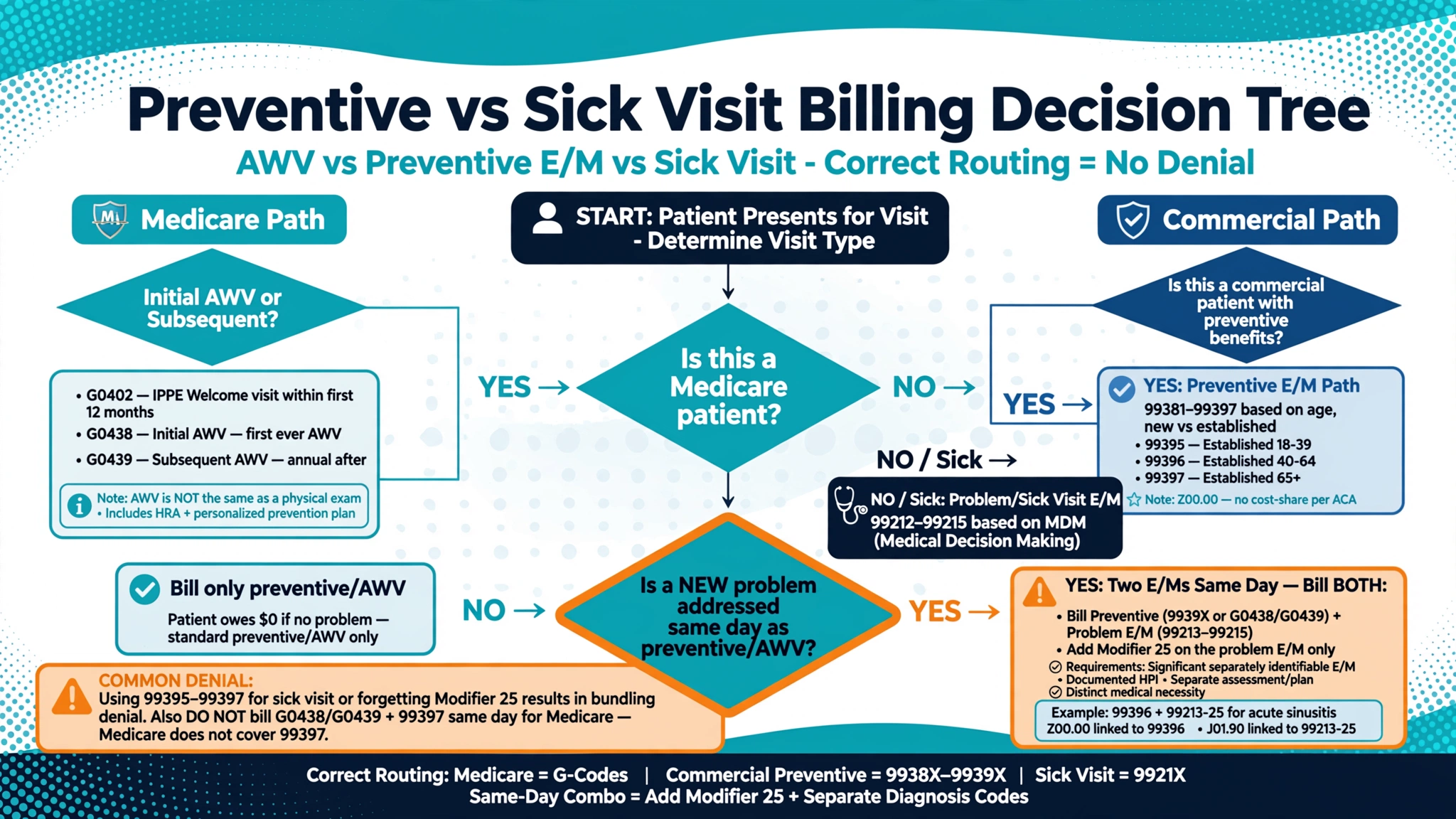
No billing issue generates more confusion and more denied claims in family practice than the rules governing preventive and diagnostic services when billed on the same date. The critical distinction is between preventive E/M visits (annual physicals), Medicare Annual Wellness Visits (AWV), and diagnostic/sick visit E/M codes. Each has different CPT codes, different documentation requirements, and different patient cost-sharing obligations. Billing them incorrectly costs your family practice money and creates confusion for patients.
| CPT Code | Description | Patient Age | 2026 Commercial Rate (Approx.) |
|---|---|---|---|
| 99381 | Initial preventive E/M — infant (under 1 year) | < 1 year | $135–$175 |
| 99382 | Initial preventive E/M — early childhood (1–4 years) | 1–4 years | $145–$185 |
| 99383 | Initial preventive E/M — late childhood (5–11 years) | 5–11 years | $150–$190 |
| 99384 | Initial preventive E/M — adolescent (12–17 years) | 12–17 years | $160–$200 |
| 99385 | Initial preventive E/M — young adult (18–39 years) | 18–39 years | $170–$215 |
| 99386 | Initial preventive E/M — adult (40–64 years) | 40–64 years | $185–$235 |
| 99387 | Initial preventive E/M — older adult (65+ years) | 65+ | $195–$245 |
| 99391 | Periodic preventive E/M — infant | < 1 year | $120–$155 |
| 99392 | Periodic preventive E/M — early childhood | 1–4 years | $125–$165 |
| 99393 | Periodic preventive E/M — late childhood | 5–11 years | $130–$175 |
| 99394 | Periodic preventive E/M — adolescent | 12–17 years | $140–$185 |
| 99395 | Periodic preventive E/M — young adult | 18–39 years | $155–$200 |
| 99396 | Periodic preventive E/M — adult | 40–64 years | $165–$210 |
| 99397 | Periodic preventive E/M — older adult | 65+ | $175–$225 |
| CPT/HCPCS Code | Description | Required Elements | 2026 Medicare Rate (Approx.) |
|---|---|---|---|
| G0402 | Welcome to Medicare Preventive Visit (IPPE) — one-time | Review of medical/social history, full Health Risk Assessment (HRA), measurement of height/weight/BMI/blood pressure, visual acuity screening, cognitive/depression assessment, safety review, and counseling on preventive screenings. Must be performed within the first 12 months of Medicare Part B enrollment. | $168.40 |
| G0438 | Annual Wellness Visit — initial (first AWV after IPPE or first Medicare AWV) | Administration of an HRA, establishment of a personalized prevention plan, collection of current medical providers/suppliers list, measurement of vital signs, cognitive impairment review, screening for depression, and creation of a 5–10 year screening schedule. Patient must have been enrolled in Part B for more than 12 months and not received an IPPE or AWV within the past year. | $174.10 |
| G0439 | Annual Wellness Visit — subsequent (every year after initial) | Updated HRA, review/update of medical and family history, update to the list of current providers/medications, measurement of weight and blood pressure, ongoing review of cognitive impairment, and modifications to the personalized prevention plan schedule. Eligible once every 12 months (11 full months must pass after the last AWV). | $118.50 |
Tip: AWV Revenue Optimization
The Medicare Annual Wellness Visit is one of the most consistently underutilized revenue opportunities in family medicine. A practice with 800 Medicare patients that completes AWVs for only 40% of its panel (320 patients) at $130 average (G0439) generates $41,600 annually. Increasing AWV completion to 70% (560 patients) adds $26,000 in annual revenue from the same patient panel. The AWV also serves as the ideal entry point for advance care planning (99497 — $90 additional), cognitive assessment follow-up (CPT 96450-type codes), depression screening, and CCM enrollment. Build proactive AWV scheduling into your annual patient outreach workflow.
Family medicine practices sit at the center of chronic disease management in the US and CMS created CCM and TCM specifically to reimburse the care coordination work that primary care physicians have long provided without compensation. These codes represent the largest single category of unbilled revenue in the average family medicine practice. Most family physicians already perform the activities that qualify, they just haven’t built the documentation and billing infrastructure to capture payment for them.
| CPT Code | Description | Key Requirements | 2026 Medicare Rate |
|---|---|---|---|
| 99490 | CCM — clinical staff, first 20 min/month | Management of 2+ chronic conditions expected to last 12+ months or until death; clinical staff time under direct supervision; comprehensive care plan established, implemented, revised, or monitored. | $66.13 |
| 99439 | CCM — additional 20 min/month (add-on) | List separately in addition to 99490 for each additional 20-minute block of clinical staff care coordination time within the calendar month. Max 2 units per month. | $50.44 |
| 99491 | CCM — physician personally performs, first 30 min | Personally provided by a physician or other qualified healthcare professional (QHP) for at least 30 minutes in a calendar month; cannot delegate this time tracking to clinical staff. | $89.18 |
| 99487 | Complex CCM — first 60 min/month | Requires moderate- or high-complexity medical decision making (MDM); establishment or substantial revision of a comprehensive care plan; 60 minutes of clinical staff time. | $144.29 |
| 99489 | Complex CCM — each additional 30 min (add-on) | List separately in addition to 99487 for each additional 30-minute block of clinical staff time managing complex chronic care. | $78.16 |
| CPT Code | Contact Requirement | Face-to-Face Visit Required | MDM Level | 2026 Medicare Rate |
|---|---|---|---|---|
| 99495 | Interactive contact (phone, email, portal) within 2 business days of inpatient/facility discharge | Within 14 calendar days of discharge | Moderate complexity medical decision making during the post-discharge period | $198.40 |
| 99496 | Interactive contact (phone, email, portal) within 2 business days of inpatient/facility discharge | Within 7 calendar days of discharge | High complexity medical decision making during the post-discharge period | $264.15 |
Family physicians perform a wide range of in-office procedures and preventive services that generate separate billable revenue from E/M visits. These services are frequently underbilled, either missed entirely or bundled incorrectly into the E/M when they should be coded separately.
| CPT Code | Description | Key Rule |
|---|---|---|
| 90460 | Immunization admin — through age 18 — first vaccine/toxoid component | Requires face-to-face vaccine counseling by a physician or QHP; billed per single product component. |
| +90461 | Immunization admin — through age 18 — each additional component | Add-on code used for combination vaccines (e.g., MMR, Tdap); billed per each additional antigen component within the same vaccine. |
| 90471 | Immunization admin — age 19 and older — first percussion or injection | Standard percutaneous, intradermal, subcutaneous, or intramuscular injection code; used when no provider clinical counseling is performed or documented. |
| +90472 | Immunization admin — age 19 and older — each additional injection | Add-on code listed in addition to 90471 or 90473 for each subsequent injection administered during the same clinical encounter. |
| 90473 | Immunization admin — age 19 and older — intranasal or oral, first vaccine | Used for the initial administration of an oral or nasal vaccine (e.g., rotavirus, live-attenuated influenza) when no counseling is billed. |
| +90474 | Immunization admin — age 19 and older — intranasal or oral, each additional | Add-on code listed in addition to 90471 or 90473 for each subsequent oral or nasal vaccine component administered. |
Tip: Vaccine + E/M Same Day — Modifier 25 Required
When a vaccine is administered during an E/M visit where the physician also evaluates and manages a medical problem, modifier 25 must be appended to the E/M code. However, when a patient presents ONLY for a preventive visit and receives immunizations as part of that preventive visit, modifier 25 is generally NOT required , the preventive E/M and immunization administration are naturally billed together. The distinction matters: preventive visit + vaccines (no modifier needed) vs. sick/diagnostic E/M + vaccines (modifier 25 on the E/M). Getting this wrong is one of the most common family practice billing errors
| CPT Code | Service | Coverage | Documentation Required |
|---|---|---|---|
| 96160 | Health risk assessment — patient-focused | Commercial and Medicare (within AWV) | Completed questionnaire instrument; physician review and risk profile integration documented in chart. |
| 96161 | Health risk assessment — caregiver-focused | Commercial and Medicare (pediatric well visits) | Caregiver completed assessment; provider reviewed for patient risk factors (e.g., maternal depression screen). |
| 96156 | Health behavior assessment — initial | Commercial; some Medicare Advantage | Face-to-face individual assessment of health behavior factors affecting a physical health problem. |
| 96158 | Health behavior intervention — individual, 30 min | Commercial and some Medicare Advantage | 30-minute face-to-face counseling session; clear behavioral modification target and technique documented. |
| 99406 | Tobacco counseling — 3–10 minutes | Medicare covers 2 attempts/year, 4 sessions each | Document tobacco use status, exact counseling duration (3–10 minutes), and cessation strategies. |
| 99407 | Tobacco counseling — > 10 minutes | Medicare covers with documentation | Document duration exceeding 10 minutes, specific therapeutic interventions, and a personalized cessation plan. |
| 99497 | Advance Care Planning — first 30 min | Medicare covers; no frequency limit | Document voluntary conversation regarding future healthcare wishes; patient or surrogate participation, and time (min 16 min). |
| +99498 | Advance Care Planning — each additional 30 min | Add-on to 99497 | Cumulative face-to-face time documentation with the patient/surrogate. Billed in addition to 99497. |
| G0442 | Annual alcohol misuse screening | Medicare covers once/year | Administer an approved structured screening tool (e.g., AUDIT or AUDIT-C) with a documented score [1]. |
| G0443 | Brief behavioral counseling for alcohol misuse — 15 min | Medicare covers up to 4 times/year for positive screens | Face-to-face intervention following a positive screening result; document specific counseling interventions. |
| G0444 | Annual depression screening | Medicare covers once/year | Standardized tool (e.g., PHQ-2 or PHQ-9) administered, scored, and documented with a follow-up plan if positive. |
| G0101 | Cervical or vaginal cancer screening — pelvic exam | Medicare covers every 24 months (12 months if high risk) | Document a minimum of 7 out of the 11 physical elements of a complete breast and pelvic examination. |
| CPT Code | Procedure | Key Billing Rule |
|---|---|---|
| 11200 | Skin tag removal — up to 15 | One code for first 15 tags; use add-on code +11201 for each additional 10 lesions beyond the first 15. |
| 17000 | Destruction of premalignant lesion (AK) — first | Applies to the first actinic keratosis; append Modifier 25 to the accompanying E/M code if a separate, significant medical issue is addressed. |
| +17003 | Destruction of premalignant — 2nd–14th lesion | Add-on code to 17000; bill per individual lesion up to 14 total. For 15 or more lesions, bypass both codes and use 17004 globally. |
| 10060 | I&D abscess — simple | Incision and drainage of a single, simple skin abscess. Must document exact anatomical location, depth, and incision complexity. |
| 36415 | Routine venipuncture | Separately billable under Medicare and standard NCCI guidelines when blood is drawn for processing; do not append Modifier 25 to the draw code itself. |
| 93000 | ECG with interpretation | Comprehensive global service code (includes tracing, professional interpretation, and report) when using practice-owned equipment. |
| 93010 | ECG interpretation only | Professional component (26) only; use when interpreting a tracing generated at an outside facility or hospital layout. |
| 49010 | Spirometry | Includes maximal expiratory flow and timed expiratory volumes; document clinical indication. Note: use 94060 if a pre/post-bronchodilator assessment is performed. |
| 99173 | Visual acuity screening | Billed primarily in pediatric screening environments using standardized charts (e.g., Snellen); often bundled or excluded by mature adult commercial benefits. |
| 96372 | Therapeutic injection — subcut/IM | Administration code for therapeutic, prophylactic, or diagnostic injections. The specific therapeutic drug layout (J-code) must be billed on a separate line. |
| 20610 | Arthrocentesis — major joint | Applies to large joints (bursa, knee, hip, shoulder); fluid analysis code is separate. Append Modifier LT/RT for laterality tracking. |
| 20600 | Arthrocentesis — small joint | Applies to small joints or bursae (fingers, toes); must document needle gauge, entry site, and technique. |
| J3301 | Triamcinolone acetonide — per 10mg | HCPCS Level II drug code; bill accurate units based on total mg injected (e.g., 40mg administered = 4 billing units). |
Telehealth has become a permanent and growing service line in family medicine. Since the COVID-19 PHE flexibilities, CMS and most commercial payers have expanded and in many cases made permanent the telehealth coverage that was temporarily broadened.
| Telehealth Element | 2026 Rule/Code | Family Practice Application |
|---|---|---|
| Synchronous audio-video | Modifier 95 + POS 02 or POS 10 | Standard video E/M visits; uses the exact same CPT codes (99202–99215) as in-person encounters. |
| Patient at home | POS 10 | Applied to the majority of family medicine telehealth claims where the patient resides in their home environment. |
| Patient at other site | POS 02 | Used when the patient is located at a traditional telehealth originating site (e.g., a rural clinic or hospital facility). |
| Audio-only (telephone) | 99441–99443 or G2252 (with Modifier FQ for behavioral health only) | Coverage varies heavily by commercial plan. Medical audio-only visits must be billed using time-specific telephone codes rather than standard E/M codes [1]. |
| Medicare telehealth extension | Permanent geographic waivers for MH; medical extensions maintained | Maintains the elimination of strict rural originating site boundaries; AWV subsequent visits (G0439) remain accessible under expanded telehealth provisions. |
| Virtual check-in | G2012 | Brief non-face-to-face communication (5–10 minutes) to determine if an office visit is necessary; requires documented patient consent. |
| Remote evaluation (e-visit) | 99421–99423 | Asynchronous, patient-initiated digital communications via a secure patient portal; calculated cumulatively over a 7-day period. |
| CCM via telehealth | 99490 / 99439 / 99491 | Chronic Care Management services are inherently non-face-to-face; billed using standard codes without requiring telehealth modifiers. |
| TCM with telehealth visit | 99495 / 99496 + Modifier 95 | The required face-to-face component of Transitional Care Management can be conducted via synchronous audio-video under active expansion rules. |
Tip: Telehealth Payer Verification Protocol
For each of your top commercial payers, maintain a current reference document covering:
(1) Which CPT codes are covered via telehealth (audio-video vs. audio-only).
(2) Whether modifier 95 or GT is required.
(3) POS code requirement (10 vs. 02).
(4) Whether telehealth is reimbursed at the same rate as in-person visits.
(5) Any frequency limits on telehealth visits. Update this document every six months and whenever you receive a payer bulletin. Telehealth billing errors from using the wrong modifier or POS code are among the most common and most preventable denial causes in family medicine.
Patient Scheduling and Visit Type Identification: At scheduling, our experts identify the visit type of patients, preventive/wellness (AWV, annual physical, well-child), acute/sick visit, chronic disease follow-up, procedure, or telehealth. Pre-loading the encounter type prevents the most common preventive-vs-diagnostic billing confusion at charge entry.
Insurance Eligibility Verification: Our experts will verify active coverage, copay, deductible, and critically for family medicine the preventive care benefit. Confirm whether the patient’s plan covers the specific preventive services planned (AWV, immunizations, screenings). For Medicare patients, verify Part B status and AWV eligibility (one AWV per calendar year).
Prior Authorization: we also verify PA requirements for any planned procedures, specialist referrals, or medications. In family medicine, PA is commonly required for: specialist referrals, imaging, sleep studies, controlled substances in some states, and certain immunizations for specific patient populations.
Clinical Documentation: Our experts will document each visit with the elements that support the planned service codes. For E/M visits: document MDM elements (problems, data reviewed, risk) explicitly, or document total time.
Preventive vs. Sick Visit Determination: Before charge entry, determine whether today’s visit was preventive, diagnostic, or both. If both: code the preventive visit AND the E/M with modifier 25, but only if the physician performed a separately identifiable E/M beyond the preventive visit elements, documented in a distinct section of the note.
E/M Level Selection: Select the E/M code based on documented MDM or total time, never by habit, never by the old three-key-component method. When time-based billing would support a higher level than MDM, use time and document total time and activities.
Procedure and Preventive Service Charge Capture: We capture all separately billable services, immunizations (vaccine code + administration code), ECG, spirometry, screenings (PHQ-9, tobacco counseling), advance care planning (99497), minor procedures (I&D, skin tag removal). Link each service to the appropriate ICD-10 diagnosis or preventive indication code.
CCM and TCM Monthly Billing: We review the CCM patient list, verify minimum 20 minutes of documented coordination services, and submit 99490/99439. For recent hospital discharges: verify the 2-business-day contact was made, the face-to-face visit occurred within 7 or 14 days, and medication reconciliation is documented. Submit TCM within the 30-day post-discharge billing window.
Claims Scrubbing: Pre-submission edits check, modifier 25 on same-day preventive + sick visit, immunization administration code paired with vaccine code, AWV + E/M same-day modifier 25 compliance, telehealth modifier 95 and POS code, CCM time documentation, TCM contact and visit documentation.
Claim Submission: Submit electronically within each payer’s timely filing window. Medicare: 12 months. Most commercial: 90-180 days. Track submission confirmation and follow up on unacknowledged claims within 5 business days.
Payment Posting and Underpayment Review: Post payments and reconcile against contracted rates. Flag systematic underpayments, particularly on preventive visits where payers may incorrectly apply cost-sharing, and on AWV where Medicare should pay at 100% with no cost-sharing.
Denial Management and Patient Collections: Our specialists will categorize denials by type and root cause. Appeal preventive visit denials that incorrectly apply cost-sharing. Appeal E/M level downcodes with supporting MDM documentation. Collect patient balances at time of service when possible; implement automated statement workflows for post-visit collections.
The single most common billing confusion in family medicine and the most frequent source of patient complaints is incorrect billing when both a preventive and diagnostic service are provided on the same date. When a patient expects no cost-sharing for their annual physical but receives a bill because a new problem was also addressed, the practice faces both a patient relations problem and a potential billing dispute.
Family medicine’s undercoding rate of 12-18% (MGMA/AAFP data) represents one of the most significant and most fixable revenue gaps in primary care. The 2021 AMA E/M guideline change was designed to make high-complexity family medicine visits more accurately compensated, but practices that haven’t updated their documentation habits and coding workflows haven’t captured the benefit.
Most family practices already provide the care coordination services that qualify for CCM and TCM billing, they just don’t have the documentation and billing infrastructure to capture payment. This is the largest single category of unbilled revenue in the average family medicine practice, estimated at $100,000-$300,000 annually for practices with 400+ Medicare patients.
Family medicine manages the broadest payer mix in medicine, commercial insurance, Medicare, Medicaid, CHIP, self-pay, and increasingly, direct primary care and concierge arrangements. According to MGMA 2024 analysis, 40% of family medicine clinics experienced reimbursement delays from changing insurance policies. Each payer has different coverage rules, different fee schedules, and different documentation requirements for the same services.
Family medicine practitioners have among the highest prior authorization burdens in medicine because they manage the broadest range of services, they must manage the broadest range of PA requirements. Specialist referrals, imaging studies, controlled substances, certain medications, and some preventive services all require PA from various payers. Managing this volume without dedicated staff and automated systems creates systematic approval gaps and care delays.
Family medicine sees the full spectrum of patient financial situations, and the shift to high-deductible health plans has significantly increased patient payment responsibility. 72% of patients now prefer digital payment options (project data), and practices that implemented automated payment reminders saw a 30% improvement in collections. Yet many family practices still rely on paper statements and manual follow-up, the least efficient collection model for a high-volume primary care practice.
Family medicine is affected by more annual coding changes than almost any other specialty, E/M guidelines, preventive care codes, vaccine codes, CCM/TCM rules, MIPS quality measures, telehealth billing rules, and Medicare fee schedule updates all touch family medicine billing. Staying current requires ongoing investment in staff education and systems maintenance that many practices underestimate.
Poor communication between front-desk staff and billing teams often results in missing patient information, coding errors, and delayed claim submissions. Establishing clear workflows and regular coordination helps reduce denials and improves reimbursement efficiency, below we have mentioned important points that cause big mistakes for your practice growth.
Coding 99213 habitually when 99214 is documented: It is the most costly systematic error in your family practice; costs $325,000 per physician annually for busy practices.
Billing a preventive visit without modifier 25 when a sick visit was also performed: E/M denied; patient billed for cost-sharing they weren’t expecting; billing dispute created.
Confusing the Medicare AWV with an annual physical: AWV (G0438/G0439) is not a physical exam; billing as a physical or billing a physical when an AWV was performed creates compliance and reimbursement problems.
Not billing immunization administration codes alongside vaccine codes: Vaccine code alone (e.g., 90686 for flu vaccine) doesn’t include the administration; missing 90471 loses $20-35 per vaccine administered.
Billing vaccine administration 90460/90461 for adults without documenting physician counseling: 90460 requires physician or QHP counseling; adults 18+ should generally be billed with 90471/90472.
Not billing CCM for qualifying patients: Leaving $60,000-$300,000+ annually in legitimate recurring revenue unbilled for care already being delivered.
Missing TCM after hospital discharges: At $200 average per TCM claim, missing 50% of eligible discharges on a practice with 10 monthly discharges costs $12,000 annually.
Not billing advance care planning (99497) after AWV conversations: An AWV almost always triggers an ACP discussion; 99497 ($90 additional) is separately billable and consistently missed.
Not using time-based billing when time exceeds MDM-supported level: When counseling or care coordination extended the visit, time-based billing often supports a higher E/M level.
Telehealth claims without modifier 95 or wrong POS code: Systematic telehealth billing errors from incorrect modifiers or POS codes result in automatic denials.
The following statistics highlight key performance trends, reimbursement benchmarks, and operational challenges will shape your family practice revenue cycle management in 2026.
| Metric | Industry Data | Source |
|---|---|---|
| US RCM market size (2024) | $172.24 billion | Grand View Research |
| US RCM market projected (2030) | $272.78 billion | Market research data |
| Family medicine clinics with reimbursement delays | 40% | MGMA 2024 Analysis |
| Average claim denial rate (US) | 12% — family medicine often higher | MGMA 2024 |
| Revenue recovery with active denial management | Up to 35% more vs. non-tracking practices | Project data / MGMA |
| Revenue loss per year (denials/inefficiencies) | 3–5% of annual revenue | Family medicine billing benchmarks |
| Reduction in AR days with automated RCM tools | 20% reduction | MGMA Survey 2024 |
| Denial reduction with analytics-driven RCM | 18% reduction | 2024 industry study |
| Patients preferring digital payment options | 72% | Patient billing survey 2024 |
| Collection increase with text-based reminders | 30% improvement | Practice management data |
| Practices planning to outsource billing/coding | 36% | MGMA Survey late 2024 |
| E/M undercoding rate — family medicine | 12–18% of visits | MGMA / AAFP |
| Annual revenue loss from 99213 vs. 99214 (per physician) | ~$30,000–$45,000/year (based on 15% undercoding rate) | Family medicine revenue integrity metrics |
| Cost of a reworked denied claim | $25–$118 per claim | CAQH Research |
Tracking key revenue cycle performance metrics helps your family practice to evaluate billing efficiency, identify revenue leakage, and improve financial outcomes. Monitoring these below KPIs regularly enables faster collections, fewer claim denials, and stronger overall practice profitability of your practice.
| KPI | What It Measures | Target for Family Practices |
|---|---|---|
| Clean Claim Rate | % of claims accepted on first submission | ≥95% |
| Denial Rate | % of submitted claims denied | <8% (industry avg 12%) |
| E/M Level Distribution | % breakdown of 99212–99215 for established patients | Should show 99214 predominance for complex chronic disease management |
| AWV Completion Rate | % of Medicare patients completing annual wellness visits | 60–80% of Medicare panel annually |
| CCM Enrollment Rate | % of qualifying patients enrolled in CCM billing | 15–25% year 1; 30–40% by year 3 |
| TCM Capture Rate | % of hospital discharges resulting in billed TCM | 60–75% of all discharges |
| Days in Accounts Receivable | Average time from service to payment | <30 days |
| Net Collection Rate | % of collectible revenue actually collected | ≥96% |
| Patient Collection Rate at TOS | % of patient responsibility collected at time of service | ≥80% |
| Immunization Admin Code Capture | % of vaccine visits where administration code is billed | ≥99% — common revenue leak |
| AR Aging > 90 Days | % of total AR outstanding over 90 days | <15% |
| Charge Lag | Days from service to claim submission | <3 days |
According to our experience an effective denial management strategy helps your family practice reduce revenue loss by identifying the root causes of rejected claims and resolving them quickly. Regular claim audits, staff training, and proactive follow-up improve reimbursement rates while minimizing future denials.
| Denial Category | Root Cause in Family Medicine | Prevention Strategy |
|---|---|---|
| E/M level downcode | Payer reduces 99214 to 99213; documentation perceived as insufficient | MDM documentation training; structured note templates for each level; appeal with supporting documentation |
| Preventive + sick visit — no modifier 25 | E/M bundled into preventive visit payment | Pre-submission check for same-day preventive + diagnostic encounter; modifier 25 protocol |
| AWV elements incomplete | Required AWV components not all documented; billed as AWV when it was a physical | AWV-specific structured documentation template in EHR; AWV vs. physical protocol training |
| CCM — insufficient time documentation | Monthly time not reaching 20-minute threshold; documentation incomplete | Monthly CCM time tracking tool; staff training on qualifying activities |
| TCM — missed 2-day contact | Patient not reached within 2 business days of discharge | ADT discharge notification system; TCM contact workflow with same-day escalation |
| Immunization admin code missing | Vaccine CPT billed without administration code | Charge capture protocol pairing vaccine and admin codes; EHR charge template |
| Telehealth — wrong modifier or POS | Modifier GT instead of 95; wrong POS code for patient location | Payer-specific telehealth reference document; automated modifier check at claim scrubbing |
| Advance care planning not billed | 99497 not captured after AWV or discussion | EHR prompt after AWV completion; 99497 included in AWV charge template as reminder |
| Prior authorization missing | Referral or imaging ordered without required PA | Pre-visit PA verification for all scheduled referrals and imaging; PA tracking dashboard |
| Timely filing missed | Claim submitted after payer deadline | Charge lag monitoring; escalation alerts for encounters not coded within 3 days |
Choosing between in-house and outsourced revenue cycle management depends on your practice’s budget, staffing, and operational goals. Comparing both approaches helps you to determine the most cost-effective solution for maximizing collections, improving efficiency, and reducing administrative burden.
| Factor | In-House Family Medicine Billing | Outsourced Family Practice Revenue Cycle Management Services |
|---|---|---|
| E/M coding accuracy | Systematic undercoding common without specialty training; 12-18% undercoding rate | E/M documentation training and coding accuracy protocol; level selection based on documented MDM |
| Preventive vs. sick visit compliance | Modifier 25 errors and AWV/physical confusion common | Pre-submission preventive vs. diagnostic check; AWV element documentation review |
| CCM billing implementation | Often not implemented; billing team lacks workflow and training | Turnkey CCM billing workflow; monthly billing compliance; patient enrollment tracking |
| TCM capture rate | Below 60% benchmark typical without discharge notification system | ADT feed and TCM workflow management; 60-75% capture rate target |
| Immunization admin code capture | Frequently missed — administrative or training gap | Immunization charge capture protocol; vaccine + admin code pair verification |
| Telehealth billing accuracy | Modifier and POS errors common with payer variability | Payer-specific telehealth protocol; updated quarterly |
| MIPS quality reporting | Often managed by separate staff without billing integration | Integrated MIPS reporting support aligned with billing documentation |
| Patient collections | Manual statement workflows; below-average digital payment adoption | Automated payment reminders; digital payment options; 80%+ TOS collection target |
| Denial management | Reactive; 65% of denials never worked | Systematic denial resolution within 72 hours; all denials worked |
| Best for | Large practices with dedicated specialty billing staff and compliance infrastructure | Most family practices of all sizes — solo to large group |
At House of Outsourcing, we understand that family medicine billing isn’t general medical billing. It’s a specialty that requires mastery across E/M level optimization, preventive vs. sick visit compliance, Medicare AWV element documentation, CCM and TCM billing infrastructure, telehealth modifier accuracy, and the full spectrum of preventive and minor procedure coding. Our family practice revenue cycle management services are built specifically for how family medicine actually works.
Certified Family Medicine Billing Specialist: Our AAPC-credentialed coders with specific expertise in the full family medicine CPT library, E/M codes, preventive care, AWV, CCM/TCM, immunizations, minor procedures, and telehealth, under the 2021 AMA E/M guidelines.
Preventive vs. Sick Visit Compliance: Our pre-submission review flags every same-day preventive + diagnostic encounter and verifies correct modifier 25 application, correct code pairing, and separate documentation protecting both revenue and compliance.
CCM Billing Implementation: We implement end-to-end CCM billing from patient eligibility identification through monthly care plan management, time tracking, and claim submission.
TCM Capture Workflow: Discharge notification management and TCM workflow coordination targeting 60-75% capture rate every eligible discharge tracked, 2-day contact documented, and TCM visit coded accurately.
Immunization Charge Capture Protocol: Every vaccine administration captured with both the vaccine code and the correct administration code eliminating the most consistently missed revenue in family medicine preventive care.
Telehealth Billing Accuracy: Payer-specific telehealth protocol maintained and updated quarterly, correct modifier, correct POS, correct code combination for every telehealth encounter by payer.
Transparent Monthly Reporting: Clear KPI dashboard every month: clean claim rate, E/M level distribution, AWV completion rate, CCM enrollment and billing performance, TCM capture rate, denial rate by category, and net collections.
Dedicated Family Medicine Account Manager: One specialist who knows your practice, your patient demographics, your payer mix, and your clinical workflows, accountable to your financial results every month.
Below mentioned reliable industry resources help your family practice stay updated on billing regulations, coding changes, payer policies, and compliance requirements. Using trusted references supports accurate claim submission, reduces audit risks, and strengthens overall revenue cycle performance.
| Resource | What It Covers | Link |
|---|---|---|
| CMS Physician Fee Schedule | Family medicine CPT reimbursement rates and RVU breakdowns | cms.gov/medicare/physician-fee-schedule/search |
| CMS Medicare AWV Guidance | Annual Wellness Visit definitions, required documentation elements, and frequency parameters | cms.gov/medicare-coverage-database |
| CMS CCM Billing Guidance | Chronic Care Management billing rules, time-tracking mandates, and patient enrollment parameters | cms.gov/outreach-and-education/medicare-learning-network-mln/mlnproducts/mln-publications-items/icn909188 |
| CMS TCM Billing Guidance | Transitional Care Management communication criteria, interactive 2-day windows, and face-to-face deadlines | cms.gov/outreach-and-education/medicare-learning-network-mln/mlnproducts/mln-publications-items/icn908628 |
| AAFP Practice Management | Family medicine clinical billing guidance, E/M templates, and documentation advocacy toolkits | aafp.org/family-physicians/practice-and-career/managing-your-practice.html |
| CMS MIPS/QPP | Merit-based Incentive Payment System quality measures, reporting pathways, and penalty adjustments | qpp.cms.gov |
| OIG Work Plan | Active primary care auditing priorities, upfront modifier enforcement targets, and diagnostic compliance updates | oig.hhs.gov/reports-and-publications/workplan |
| AMA CPT Code Resources | Official definitions for longitudinal, preventative, evaluation, and management code adjustments | ama-assn.org/practice-management/cpt |
| AAPC Family Practice Coding | Primary care certification tracks, specialty documentation coursework, and ongoing modifier definitions | aapc.com |
| MGMA DataDive | Family medicine practice operational benchmarks, expected undercoding margins, and target days in AR | mgma.com/data |
| HHS HIPAA Resources | Privacy compliance frameworks for remote data transmission, secure email outreach, and digital patient communication | hhs.gov/hipaa |
| CMS Telehealth Resources | Current telehealth extensions, audio-only billing rules, and rural/non-rural place of service parameters | cms.gov/medicare/coverage/telehealth |
Family physicians primarily bill established patient codes 99212-99215 and new patient codes 99202-99205. Under the 2021 AMA E/M guidelines, code selection is based on Medical Decision Making (MDM) or total physician time, not the three-component history/exam/MDM framework. Preventive visits use separate codes: 99381-99387 (initial preventive) and 99391-99397 (periodic preventive) for non-Medicare patients. Medicare patients receive Annual Wellness Visits billed with G0438 (initial) or G0439 (subsequent).
A Medicare Annual Wellness Visit (AWV, billed as G0438 or G0439) is a preventive planning service, not a physical examination. Its purpose is to create or update a personalized prevention plan, assess health risks, and screen for cognitive impairment and depression. It does not include a comprehensive physical examination. Medicare pays 100% with no patient cost-sharing. An annual physical examination is not covered by traditional Medicare. If a physician performs both an AWV and addresses a medical problem on the same date, both G0439 and a separate E/M code with modifier 25 can be billed, with distinct documentation for each.
Modifier 25 indicates that a significant, separately identifiable Evaluation and Management service was performed on the same day as a preventive visit or procedure. In family medicine, modifier 25 is required when:
(1) A patient comes in for an annual physical or AWV AND a new medical problem is evaluated and managed during the same encounter.
(2) A patient comes in for a sick visit AND a procedure (e.g., skin tag removal) is also performed. The E/M must be documented as distinct from the preventive or procedure visit — with separate clinical documentation supporting the additional service.
CCM is a CMS program that reimburses family physicians for the non-face-to-face care coordination services they provide to patients with two or more chronic conditions. The primary CCM code, 99490, generates approximately $42-58 per patient per month in Medicare reimbursement. For a family practice with 300 qualifying patients enrolled in CCM, that is $12,600-$17,400 per month — $151,200-$208,800 annually — in recurring revenue from care coordination activities the team is likely already performing. CCM requires: a comprehensive care plan, patient consent, 24/7 access to the care team, and documentation of at least 20 minutes of monthly non-face-to-face care coordination services.
Get a free assessment from our billing experts