
Our General Surgery RCM services help surgical practices optimize revenue through accurate coding, documentation review, claim management, and denial prevention. We streamline billing workflows to improve reimbursements, reduce administrative challenges, and support consistent financial performance.

General surgery is one of the highest-value and most billing-complex specialties in US medicine. A general surgeon’s practice spans an enormous range of procedures: laparoscopic cholecystectomies, appendectomies, hernia repairs, bowel resections, breast surgeries, thyroid and parathyroid procedures, colorectal operations, bariatric procedures, and trauma surgery. Each service line has its own CPT codes, global period rules, modifier requirements, prior authorization thresholds, and documentation standards.
According to the American College of Surgeons (ACS), general surgery practices lose significant revenue annually to global period mismanagement, missed modifier applications, and post-operative service billing errors. The MGMA 2025 data reports average clean claim rates in surgical specialties trailing the healthcare industry average driven largely by the complexity of surgical modifier frameworks and global period compliance.
Need support with your billing workflow? Explore our medical billing and revenue cycle services or request a free consultation.
General Surgery Revenue Cycle Management (RCM) covers the complete financial process from patient registration and insurance verification to coding, claim submission, payment posting, and follow-up. It helps surgical practices reduce billing errors, prevent denials, and maintain a steady flow of reimbursements.
With our effective general surgery RCM, your practice can stay focused on patient care while our experienced billing professionals manage payer requirements, documentation, claims, and outstanding A/R. A streamlined process improves collections, strengthens cash flow, and gives you better visibility into your practice’s financial performance.
It is distinguished by its procedure-heavy revenue model, the complex coding rules governing the screening vs. diagnostic colonoscopy distinction, and the NCCI bundling challenges unique to multi-procedure endoscopy encounters.
Every surgical procedure billed under the CMS global surgery policy carries a global period, a defined window of time during which most related post-operative services are included in the surgical payment. Understanding the global period framework is not optional in general surgery billing, it governs virtually every post-operative visit, complication, and follow-up encounter.
| Global Period | Duration | What's Included | What Can Be Billed Separately |
|---|---|---|---|
| 0-Day Global | Day of the procedure only (ends at midnight of the procedure date) | Pre-operative evaluation immediately preceding the procedure; the intra-operative work; and immediate recovery room post-operative care on the date of the procedure. | Any E/M or procedure performed on the day after the surgery; a distinct, separately identifiable E/M on the same day as the procedure (requires **Modifier 25**). |
| 10-Day Global | Day of the procedure + 10 subsequent calendar days | All standard post-operative care directly related to the surgical recovery within the 10-day window; uncomplicated routine follow-up care and suture removal. | E/M for an unrelated clinical condition (**Modifier 24**); return to the operating room for a related complication (**Modifier 78**); an entirely unrelated procedure performed within the window (**Modifier 79**). |
| 90-Day Global | 1 day prior to the procedure + day of the procedure + 90 subsequent calendar days | Pre-operative visits in or out of the hospital on the day before surgery; all intra-operative work; all routine post-operative care and uncomplicated follow-ups within the 90 days. | Unrelated E/M (**Modifier 24**); a planned or staged secondary procedure (**Modifier 58**); a complication requiring a return to the operating room (**Modifier 78**); an unrelated surgical procedure (**Modifier 79**). |
| XXX — Global not applicable | N/A | No global concept applies to the code tier (standard for the majority of medicine, radiology, and laboratory codes). Each individual service is evaluated independently. | All services billed during the same encounter or on subsequent days are adjudicated independently based on standard NCCI bundling edits. |
| YYY — Global concept does not apply | N/A | Assigned primarily to unlisted surgical procedures. Payer review determines the boundaries on a case-by-case basis. | All related services should be submitted with exhaustive documentation; unlisted claims are manually scrutinized rather than auto-processed. |
| ZZZ — Code related to another service | N/A | Applied strictly to CPT add-on codes (designated with a `+`). The global rules are entirely dictated by the primary parent code to which it is attached. | Must always be billed on the same claim layout alongside a qualifying primary parent code; cannot be billed as a standalone line item under any modifier configuration. |
General surgery CPT codes span dozens of subspecialty procedure families. The AMA CPT code system assigns each surgical procedure a code, a description, a global period, and an RVU value. Here is the comprehensive reference across the major general surgery service lines.
| CPT Code | Procedure | Global Period | Key Documentation Requirement |
|---|---|---|---|
| 44950 | Appendectomy — open | 90 days | Appendicitis diagnosis; operative report detailing cecal dissection and stump ligation with pathology confirmation. |
| 44960 | Appendectomy — open, with abscess/perforation | 90 days | Explicitly document ruptured appendix, generalized peritonitis, extensive peritoneal irrigation, and drainage technique. |
| 44970 | Appendectomy — laparoscopic | 90 days | Laparoscopic approach details (trocar placement, camera visualization); document clinical reasons if converted to open. |
| 47562 | Cholecystectomy — laparoscopic | 90 days | Clear surgical indication (e.g., cholelithiasis, acute cholecystitis); identification of Calot's triangle; clip/cut of cystic duct/artery. |
| 47563 | Cholecystectomy — laparoscopic with cholangiography | 90 days | Must explicitly document the execution and professional interpretation of intraoperative radiologic cholangiogram films. |
| 47564 | Cholecystectomy — laparoscopic with exploration CBD | 90 days | High complexity; document exploration of the common bile duct, stone extraction methods, or T-tube placement details. |
| 47600 | Cholecystectomy — open | 90 days | Document specific clinical justification for an open approach (e.g., severe adhesions, anatomical distortion) vs. laparoscopic. |
| 49320 | Laparoscopy, abdomen — diagnostic | 0 days | Exploratory intent; document structural entry, thorough inspection of all abdominal quadrants, and pathological findings. |
| 49321 | Laparoscopy — with biopsy | 0 days | Document the exact anatomical location of the biopsy, method (forceps vs. brush), and specimen delivery for pathology alignment. |
| 49322 | Laparoscopy — with aspiration of cyst or lesion | 0 days | Detail the cyst or fluid collection characteristics, needle puncture approach, total volume aspirated, and fluid appearance. |
| 49999 | Unlisted laparoscopic procedure | YYY (Payer review) | Full operative report required. Must provide a cover letter comparing the work intensity to a similar listed CPT code for pricing benchmark calculations. |
| CPT Code | Procedure | Anatomical / Coding Criteria | Global Period |
|---|---|---|---|
| 49505 | Inguinal hernia repair — initial, age 5+, open | Age 5 and older; reducible groin presentation. Requires direct inguinal canal incision. | 90 days |
| 49507 | Inguinal hernia repair — initial, age 5+, incarcerated | Groin hernia trapped or strangulated; requires clear documentation of manual or surgical reduction. | 90 days |
| 49520 | Inguinal hernia repair — recurrent, open | Recurrent groin hernia of any age; reducible presentation. Document prior surgical entry history. | 90 days |
| 49521 | Inguinal hernia repair — recurrent, incarcerated | Recurrent groin hernia; incarcerated or strangulated presentation regardless of patient age. | 90 days |
| 49650 | Laparoscopic inguinal hernia repair — initial | Groin approach using minimally invasive techniques. Prosthetic mesh placement is bundled into the code. | 90 days |
| 49651 | Laparoscopic inguinal hernia repair — recurrent | Recurrent groin hernia treated via laparoscopic approach. Mesh placement is structurally included. | 90 days |
| 49591 | Anterior abdominal hernia repair (ventral/umbilical) | Initial repair; total defect size less than 3 cm; reducible presentation. Replaces codes 49560/49585. | 0 days |
| 49592 | Anterior abdominal hernia repair (ventral/umbilical) | Initial repair; total defect size less than 3 cm; incarcerated or strangulated presentation. | 0 days |
| 49593 | Anterior abdominal hernia repair (ventral/incisional) | Initial repair; total defect size 3 to 10 cm; reducible presentation. Any approach (open/lap/robotic). | 0 days |
| 49594 | Anterior abdominal hernia repair (ventral/incisional) | Initial repair; total defect size 3 to 10 cm; incarcerated or strangulated presentation. | 0 days |
| 49613 | Recurrent anterior abdominal hernia repair | Recurrent presentation; total defect size less than 3 cm; reducible. Document prior abdominal repair. | 0 days |
| 49614 | Recurrent anterior abdominal hernia repair | Recurrent presentation; total defect size less than 3 cm; incarcerated or strangulated. | 0 days |
| 49615 | Recurrent anterior abdominal hernia repair | Recurrent presentation; total defect size 3 to 10 cm; reducible. Replaces old lap code 49654 series. | 0 days |
| CPT Code | Procedure | Global Period | Key Note | 2026 Medicare Rate (Approx.) |
|---|---|---|---|---|
| 44140 | Colectomy — partial, open, with anastomosis | 90 days | Requires mobilization and resection of a colonic segment followed by primary anastomosis. Document leak test parameters. | $1,185.30 |
| 44141 | Colectomy — partial, open, with skin-level cecostomy or colostomy | 90 days | Resection of a colonic segment paired with proximal colostomy exteriorization. Document ostomy site viability. | $1,264.80 |
| 44143 | Colectomy — partial, open, with end colostomy and closure of distal segment | 90 days | Classic Hartmann procedure for diverticulitis or perforation. Explicitly document distal pouch creation and stoma parameters. | $1,348.50 |
| 44145 | Colectomy — partial, open, low anterior resection with coloproctostomy | 90 days | LAR technique for rectosigmoid tumors. Document strict level of pelvic dissection and use of EEA stapler line updates. | $1,422.10 |
| 44204 | Laparoscopic colectomy — partial, with anastomosis | 90 days | Minimally invasive approach. Includes laparoscopic mobilization, mesenteric division, and intracorporeal/extracorporeal anastomosis. | $1,298.40 |
| 44205 | Laparoscopic colectomy — with cecostomy or colostomy | 90 days | Laparoscopic segmental resection with exteriorization of a functional stoma array. Document portal placements. | $1,364.15 |
| +44210 | Laparoscopic colectomy — total, with proctectomy (add-on) | ZZZ (Parent code global) | Add-on code. Never bill standalone. Must append to primary base codes tracking total abdominal colectomies. Document pelvic floor margins. | $345.60 |
| 44720 | Biological splinting / vascularization of intestinal tract | 90 days | Highly complex open microvascular reconstruction or tissue transfer step. Inter-operative vessel patency tracking mandatory. | $985.40 |
| 45110 | Proctectomy — abdominoperineal resection | 90 days | APR for low rectal cancer. Requires two distinct entry paths. Document separate abdominal and perineal operating segments. | $1,684.20 |
| 45120 | Proctectomy — complete, combined abdominoperineal; pull-through procedure | 90 days | Total proctectomy with coloanal pull-through execution. Clear documentation of autonomic nerve preservation strategies expected. | $1,892.65 |
| 45160 | Excision of rectal tumor — transanal approach | 90 days | Applies to full-thickness transanal endoscopic microsurgery (TEM/TAMIS). Document exact tumor size, distance from dentate line, and depth boundaries. | $912.40 |
| CPT Code | Procedure | Global Period | Key Documentation Requirement |
|---|---|---|---|
| 19100 | Biopsy of breast — percutaneous, needle core, not imaging-guided | 0 days | Clinical indication (e.g., palpable mass); document needle gauge, number of core passes, and post-biopsy pathology tracking. |
| 19101 | Biopsy of breast — open incisional | 90 days | Surgical incisional approach into a mass for tissue sampling; document hemostasis and layered closure details. |
| 19110 | Nipple exploration, with or without excision of solitary lactiferous duct lesion | 90 days | Indicated for pathology like intraductal papilloma; document specific duct cannulation, exploration extent, and tissue excised. |
| 19120 | Excision of cyst, fibroadenoma, or other benign/malignant tumor — open, single lesion | 90 days | Open excision of a distinct mass. Must explicitly document lesion dimensions, anatomical site, clear margins, and pathology delivery. |
| 19301 | Mastectomy — partial (lumpectomy) | 90 days | Excision of breast tissue with macroscopic margins. Document specimen orientation; add-on sentinel node mapping codes if performed. |
| 19302 | Mastectomy — partial, with axillary lymphadenectomy | 90 days | Lumpectomy combined with an axillary lymph node dissection (ALND) through a separate or continuous incision; document node levels removed. |
| 19303 | Mastectomy — simple, total | 90 days | Excision of all breast tissue, pectoralis fascia, and skin/nipple complex. Document flap creation and drain placements. |
| 19305 | Mastectomy — radical | 90 days | Extensive resection including breast tissue, axillary lymph nodes, and both pectoralis major and minor muscles; document chest wall exposure. |
| 19307 | Mastectomy — modified radical, with axillary lymph node dissection | 90 days | Excision of breast tissue and axillary lymph nodes while preserving the pectoralis muscles; document specific boundaries of the ALND. |
| CPT Code | Procedure | Global Period | Key Documentation Requirement | 2026 Medicare Rate (Approx.) |
|---|---|---|---|---|
| 60100 | Biopsy of thyroid — percutaneous core needle | 0 days | Clinical indication (e.g., cold nodule); document gauge and core passes. Image guidance is coded on a separate claim line. | $115.60 |
| 60200 | Excision of thyroid cyst or adenoma | 90 days | Excision of a distinct cyst or adenoma mass. Must detail lesion size, localization, and parathyroid tissue separation. | $685.20 |
| 60210 | Partial thyroid lobectomy — unilateral | 90 days | Document the specific lobe resected, isolation of the inferior thyroid artery, and recurrent laryngeal nerve monitoring data. | $740.15 |
| 60212 | Partial thyroid lobectomy — with contralateral subtotal lobectomy | 90 days | Bilateral approach. Document the subtotal mass reduction parameters on the opposing lobe to verify code selection. | $862.90 |
| 60220 | Total thyroid lobectomy — unilateral | 90 days | Complete excision of one single lobe. Explicitly document identification and preservation of adjacent parathyroid glands. | $780.40 |
| 60225 | Total thyroid lobectomy — with contralateral subtotal lobectomy | 90 days | Complete removal of one lobe paired with subtotal resection of the opposite side. Log recurrent laryngeal nerve margins. | $915.80 |
| 60240 | Thyroidectomy — total | 90 days | Resection of all thyroid tissue. Document recurrent laryngeal nerve functional checks and auto-transplantation of parathyroids if performed. | $980.50 |
| 60252 | Thyroidectomy — total, with limited neck dissection | 90 days | Thyroidectomy for malignancy paired with a limited central neck dissection. Must explicitly log the specific lymph node levels removed. | $1,265.30 |
| 60270 | Thyroidectomy with mediastinal exploration (transsternal) | 90 days | Extended approach into the thoracic cavity via partial or total sternotomy. Detail mediastinal dissection and mass boundaries. | $1,395.10 |
| 60500 | Parathyroidectomy — initial | 90 days | Exploratory track for hyperparathyroidism. Document total glands inspected, specific tissue removed, and intraoperative PTH kinetics. | $942.80 |
| 60502 | Parathyroidectomy — re-exploration | 90 days | High-complexity revision procedure. Must document dense scar tissue mobilization, previous surgical tracks, and localization scan review. | $1,120.45 |
| CPT Code | Procedure | PA Required? | Key Documentation | 2026 Medicare Rate (Approx.) |
|---|---|---|---|---|
| 43644 | Laparoscopic Roux-en-Y gastric bypass — with small intestine reconstruction | Yes — virtually all payers | Documented BMI criteria; multi-month failed conservative/supervised weight loss trials; exhaustive psychological evaluation; comprehensive multidisciplinary bariatric program compliance notes. | $1,385.40 |
| 43645 | Laparoscopic Roux-en-Y gastric bypass — with small intestine > 150 cm | Yes | Extended limb tracking. Must explicitly document the measurement and clinical indication/justification for a longer Roux limb (malabsorptive optimization). | $1,492.15 |
| 43770 | Laparoscopic gastric restrictive procedure — banding | Yes | Adjustable band placement parameters. Document band kit size, meticulous wrap technique, and subcutaneous port localization. | $924.80 |
| 43772 | Laparoscopic banding — revision of adjustment | Yes (Payer-dependent) | Document revision indications (e.g., erosion, slip, pouch dilation) and the specific surgical band component modification technique. | $815.60 |
| 43775 | Laparoscopic gastric restrictive procedure — sleeve gastrectomy | Yes | Sleeve gastrectomy profiling. Log strict BMI metrics, comorbidities (e.g., severe sleep apnea, T2D), bougie caliber size utilized, and staple line reinforcement verification. | $1,148.90 |
| 43843 | Gastric restrictive procedure — open | Yes | Open restrictive approach. Must document explicit clinical justification for utilizing an open laparotomy pathway over standard laparoscopy. | $1,210.35 |
| 43845 | Gastric restrictive procedure — with gastric bypass | Yes | Combined restrictive and bypass mechanism. Meticulously document both components, structural measurements, and double-anastomosis construction. | $1,364.50 |
| 43848 | Revision of gastric restrictive procedure | Yes | High-complexity revision track. Detail the prior bariatric technique anatomy, strict structural complications, and dense adhesion mobilization metrics. | $1,540.80 |
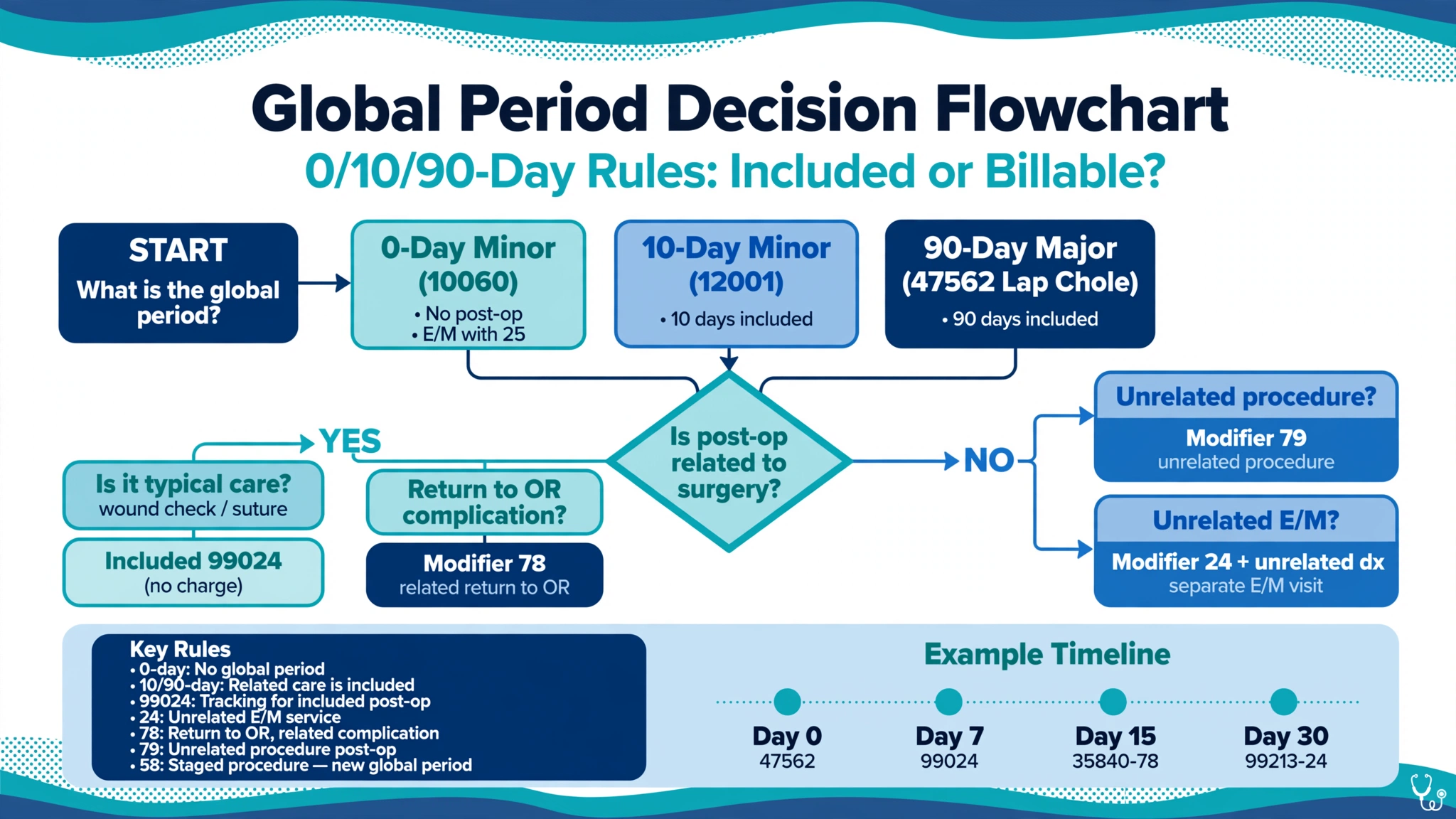
Modifier accuracy is where general surgery billing is most vulnerable to systematic error, both over-billing (compliance exposure) and under-billing (revenue loss). The surgical modifier framework is more complex than any other specialty, with modifiers for assistant surgeons, bilateral procedures, multiple procedures, discontinued procedures, staged procedures, global period exceptions, and complications.
| Modifier | Meaning | When to Use in General Surgery | Revenue/Compliance Impact |
|---|---|---|---|
| 22 | Increased procedural services | When a procedure is substantially more complex than typical — e.g., dense scar tissue requiring 2+ hours of lysis of adhesions, massive hemorrhage, or abnormal anatomy. | Requires an attached operative report and a cover letter detailing why the case exceeded standard thresholds. Missing it drops significant revenue; over-applying it triggers extensive manual reviews. |
| 47 | Anesthesia by surgeon | When the operating surgeon personally administers regional or general anesthesia for the procedure. | Rarely used in general surgery; local infiltration is bundled into the surgical code. Billed incorrectly, it results in an immediate double-billing compliance violation. |
| 50 | Bilateral procedure | When identical procedures are performed on both sides of the body — e.g., bilateral inguinal hernia repairs. **Do not use on anterior wall hernia codes (49591–49618)**. | Triggers a 150% contractual reimbursement adjustment. Missing it leaves 50% of the secondary side unbilled; applying it to unilateral-only codes results in an outright claim denial. |
| 51 | Multiple procedures | When multiple surgical procedures that are *not* add-on codes are performed in the same operative session. Applied to secondary and subsequent codes. | Often auto-applied by clearinghouses to cut lines by 50% under multiple procedure reductions. Miscalculating sequencing line entries can suppress primary line value. |
| 52 | Reduced services | When a procedure is partially performed or scaled back due to anatomical findings or physician discretion, without a direct threat to patient safety. | Prevents a post-payment audit recoupment by declaring a lower level of completed work upfront, mitigating systemic compliance liabilities. |
| 53 | Discontinued procedure | When a surgical procedure is abruptly terminated due to an immediate threat to the patient's well-being (e.g., severe intraoperative bronchospasm or anesthesia collapse). | Allows the practice to capture partial surgical fee credit for an uncompleted attempt. Must log exact resuscitation or termination criteria in the note. |
| 54 | Surgical care only | When a surgeon performs the complete intraoperative procedure but relinquishes all post-operative global management to an outside provider. | Slashes the surgical package collection to the intraoperative fee slice only (typically ~70-80% of global). Requires explicit split-care contract alignment. |
| 55 | Postoperative management only | When a secondary physician takes over the comprehensive post-operative management of a surgical patient during their global window. | Billed with the exact date range tracking when the transfer of care became active; allows accurate split-fee percentage allocation. |
| 56 | Preoperative management only | When a physician provides the localized pre-operative clearance evaluation and transfers the physical intraoperative work to a different surgeon. | Less common in acute general surgery; segregates the initial assessment value from the macro surgical global fee layout. |
| 57 | Decision for surgery — E/M same/prior day | When an E/M visit on the day before or day of surgery directly yields the decision to perform a major procedure (90-day global). | Bypasses the global surgery bundling filter to pay for the initial consultative work. Missing it results in the E/M code being denied as inclusive to the surgery. |
| 58 | Staged/related procedure during global period | When a secondary planned procedure is performed during the global window of the first surgery (e.g., delayed closure or staged debridement). | Indicates the procedure was anticipated in the original operative plan. Bypasses the global exclusion and yields full contractual payment rates. |
| 59 | Distinct procedural service | When two procedures performed on the same day are normally bundled by NCCI but were executed on distinct lesions or separate surgical fields. | Consistently targeted by RAC audits. Use only if no specific anatomical modifier fits; missing it causes secondary lines to drop into bundling denials. |
| 62 | Two surgeons — co-surgery | When two distinct surgical specialists work together to complete a complex procedure (e.g., general surgeon performing a laparotomy exposure for an ortho spine case). | Both surgeons must bill the exact same CPT code with modifier 62. Each receives 62.5% of the total negotiated global contract rate. |
| 78 | Return to OR — related complication during global period | When an emergency return to the operating room is required to address a complication directly stemming from the initial surgery (e.g., post-op hematoma evacuation). | Paid at a reduced rate tracking the intraoperative work value only; does not reset the clock on the original 90-day surgical global period. |
| 79 | Unrelated procedure during global period | When a completely unrelated surgical operation must be performed on a patient who is currently within an active, open global window from a prior surgery. | Documents that the new surgical intervention is pathologically independent, clearing the code line for full, unreduced fee schedule payment. |
| 80 | Assistant surgeon | When a secondary qualified physician acts as an intraoperative assistant for a highly complex surgical case. | Pays approximately 16% of the global fee schedule value. The procedure code must be explicitly listed on the payer's approved assistant-at-surgery index. |
| AS | PA, NP, or CNS assistant at surgery | When a non-physician qualified practitioner (PA, NP, or Clinical Nurse Specialist) provides the primary intraoperative assistance. | Pays a discounted rate (typically 85% of the standard physician assistant allowance, or ~13.6% total value). Required for clear compliance tracking. |
TIP: The 58 vs. 78 Modifier Decision
Modifier 58 and modifier 78 are the most commonly confused surgical modifiers — and the consequences of using the wrong one are significant. Modifier 58 (staged procedure during global) is used when a second surgical procedure was planned at the time of the original surgery as part of a staged approach. Modifier 78 (return to OR for complication) is used when the patient must return to the operating room during the global period due to a complication of the original surgery, not a planned staging. The key test was the second procedure anticipated and planned at the time of the original surgery? If yes, use modifier 58. If no — if it was an unplanned return for a complication use modifier 78. Getting this wrong either over-states a planned approach (compliance risk) or under-states a complication return (revenue loss).
General surgeons practicing in hospital-based settings or ambulatory surgery centers generate two separate billing streams from a single surgical procedure: the professional fee bill (the surgeon’s claim for their professional services) and the facility fee bill (the hospital’s or ASC’s claim for the operating room, nursing staff, equipment, and supplies). It is important for your practice growth that you must understand how these two streams work, and how they interact is essential for any general surgery practice or ASC billing team.
| Billing Element | Professional Fee (Physician Billing) | Facility Fee (ASC or Hospital Billing) |
|---|---|---|
| Who bills it | The operating surgeon, assistant surgeon, or specialized surgical group practice. | The hospital (outpatient/inpatient department) or the independent Ambulatory Surgery Center (ASC). |
| What it covers | The surgeon’s clinical time, intraoperative skill, pre-operative decision-making, and post-operative global management. | The physical operating room space, nursing staff, surgical equipment, single-use supplies, recovery bays, and facility-administered pharmaceuticals. |
| Claim form | CMS-1500 (standard professional claim layout). | UB-04 (CMS-1450 standard institutional claim layout). |
| CPT code used | Surgical CPT codes representing the professional work performance. | The **exact same CPT/HCPCS codes** as the surgeon, mapped to an **APC** (for outpatient hospital/ASC) or a **DRG** (for hospital inpatient stays) via integrated revenue codes [2]. |
| Global period applies to | **Yes**. The physician is strictly bound to the 0, 10, or 90-day global surgery package constraints. | **No**. The facility fee is billed strictly on a per-service/per-day operational model. No global period concept exists for institutional claims. |
| Place of service code | Requires explicit coding: **21** (Inpatient Hospital), **22** (On-Campus Outpatient Hospital), or **24** (Ambulatory Surgery Center). | N/A for institutional forms. The UB-04 utilizes distinct 3-digit **Type of Bill (TOB) codes** and 4-digit **Revenue Codes** instead. |
| Modifier 26 relevant? | **Yes**. Appended by the physician when performing interpretation-only diagnostic services (e.g., intraoperative x-rays or ultrasounds) using facility equipment. | **Yes (as the technical inverse)**. While the doctor appends modifier 26, the facility bills the same code with **Modifier TC** (Technical Component) or leaves it global to capture the overhead. |
| Common error | Itemizing surgical trays, mesh supplies, or recovery room hours on a professional claim line. | Attempting to embed the physician’s or independent assistant surgeon's work under institutional revenue code lines. |
In general surgery, the operative report is simultaneously a clinical record, a legal document, and a billing justification. Every CPT code billed must be supported by the operative report. A claim that is not supported by the operative note or is supported only partially is at risk of denial, underpayment, or, on audit, recoupment.
Pre-operative diagnosis: The clinical indication for the surgery; must match the ICD-10 diagnosis code on the claim.
Post-operative diagnosis: What was actually found at surgery; may differ from pre-op diagnosis and drives the final ICD-10 code selection.
Indication for procedure: Brief narrative of why surgery was necessary: failed conservative treatment, acute presentation, imaging findings, or other clinical indication that supports medical necessity.
Surgeon(s) of record: Attending surgeon; any assistant surgeon; co-surgeon (for modifier 62 billing); document each surgeon’s role.
Anesthesia type: General, regional, local, MAC documents coordination with anesthesia billing.
Detailed procedure description: Each surgical step described in CPT-alignable language. Document: approach (laparoscopic vs. open), anatomy encountered, specific interventions performed (e.g., ‘laparoscopic cholecystectomy with intraoperative cholangiography’), implants or mesh used, drain placement, closure technique.
Findings: What was found at surgery: adhesions, inflammation, tumor size, hernia defect size, lymph node involvement, etc. These findings support the specific CPT code complexity selection and ICD-10 diagnosis codes.
Specimens sent to pathology: List all specimens sent; pathology report coordination for final diagnosis code.
Complications: Document any intraoperative complications and how they were managed.
Surgeon’s attestation and signature: Authenticated, dated, and signed by the operating surgeon.
Prior authorization requirements in general surgery have expanded significantly, particularly from Medicare Advantage plans. According to ACS advocacy data, 94% of surgeons report that prior authorization requirements delay surgical care. A missed authorization for an elective surgery is a direct denial of the procedure claim with limited appeal recourse once the procedure has been performed.
| General Surgery Procedure Category | PA Typically Required? | Documentation Required | Notes |
|---|---|---|---|
| Emergency surgery (appendectomy, perforated viscus) | No — emergency procedures exempt | Clinical documentation supports emergency designation; intraoperative findings of acute pathology. | EMTALA protections apply in hospital settings; post-stabilization clinical documentation reviews are common. |
| Elective cholecystectomy (symptomatic cholelithiasis) | Often yes (commercial/MA plans) | Symptoms documented (e.g., biliary colic); right upper quadrant ultrasound report showing gallstones or sludge; conservative management failure. | Traditional Medicare generally does not require PA; Medicare Advantage plans frequently utilize clinical management guidelines (e.g., InterQual). |
| Hernia repair — elective, reducible | Often yes | Physical symptoms (pain, swelling); clinical exam documentation; conservative treatment duration (e.g., truss failure, activity limits). | Emergency hernia operations (incarcerated or strangulated) are exempt from upfront PA but require coding to indicate severity. |
| Bariatric surgery | Yes — all payers | BMI criteria; failed multi-month medically supervised diet trials; multidisciplinary psychological evaluation; program participation data. | Most intensive PA process in general surgery; missing any single criteria component triggers immediate payer denial. |
| Bowel resection — elective | Often yes (commercial/MA) | Pathology report (biopsy/malignancy); severe symptoms; prior medical treatment trials; colonoscopy or advanced cross-sectional imaging findings. | Urgent or emergent resections are exempt; elective surgical cases require strict sequencing of diagnostic indications. |
| Thyroid surgery | Often yes | Diagnosis confirmation (nodule sizing, malignancy, refractory hyperthyroidism); FNA biopsy results; comprehensive endocrinology workup. | PA is required by most commercial and MA plans; concurrent code lines (like laryngeal nerve tracking) must align with the primary authorization. |
| Breast cancer surgery | Variable | Pathology report confirming cancer; staging workup parameters; comprehensive surgical oncology consultation notes. | Immediate oncological resections rarely face barriers, but concurrent or delayed immediate reconstructions require separate tracking lines. |
| Colon cancer surgery | Often yes (commercial/MA) | Pathology confirmation; tumor staging notes; diagnostic colonoscopy tracking data; multidisciplinary oncology treatment plans. | Emergent presentation formats bypass upfront authorization thresholds; elective cases must be structured carefully around the global surgical envelope. |
| Ventral/incisional hernia repair with mesh | Often yes (larger mesh repairs) | Hernia defect dimensions; comprehensive prior abdominal surgery repair history; documentation of chronic incarceration risk. | Complex repairs involving myofascial component separations require specific operative intent staging to clear medical necessity reviews. |
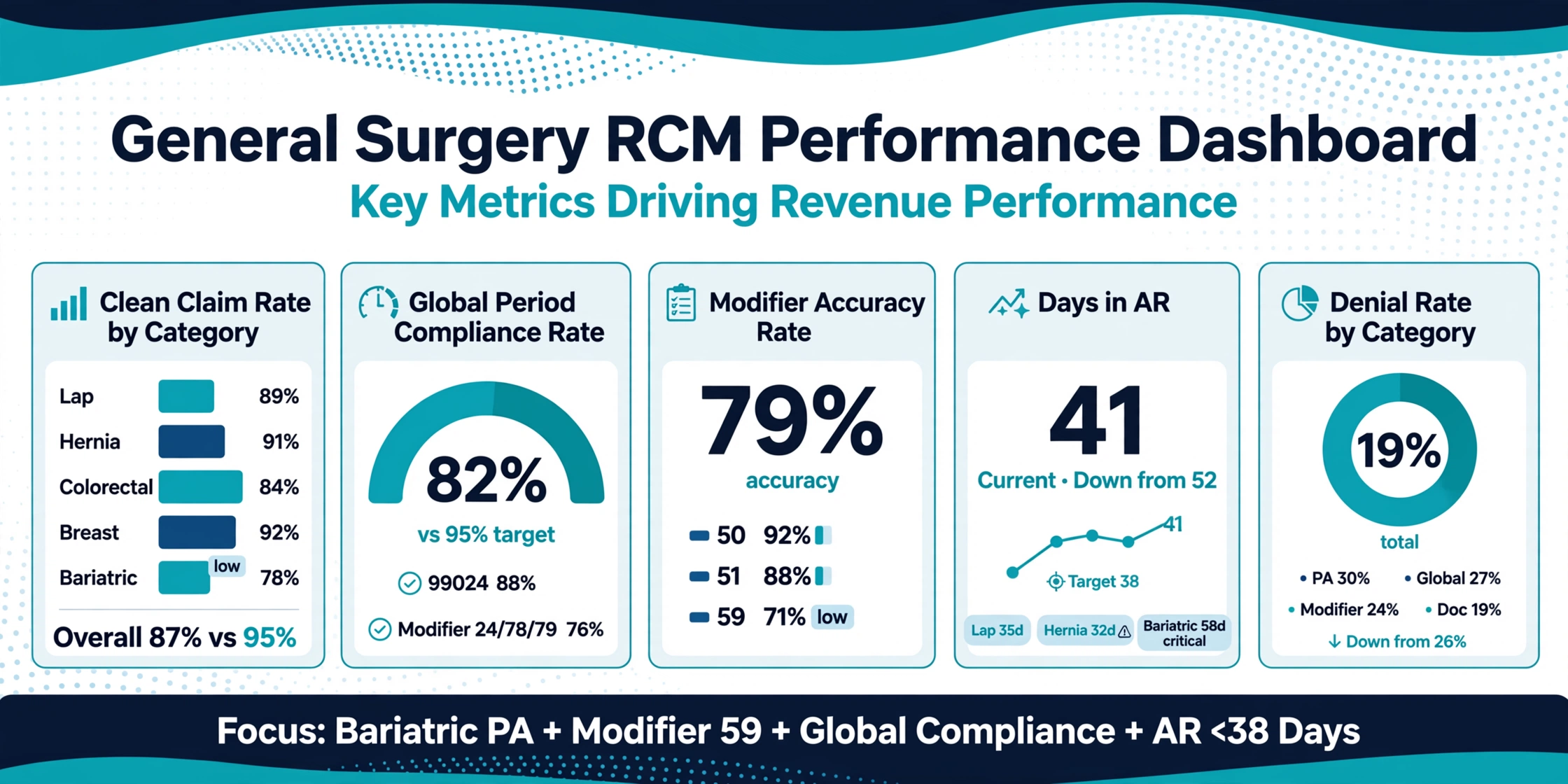
Patient Scheduling and Procedure Classification: Our experts will identify the specific procedure, CPT code, and global period. Classify as emergency (no PA needed) or elective (PA workflow required). Identify professional vs. facility fee billing responsibilities.
Insurance Eligibility and Benefit Verification: We will verify active coverage, deductible status, and surgical benefit coverage. For ASC procedures, verify ASC-specific coverage (some plans require HOPD). Identify any prior authorization requirements per payer.
Prior Authorization Submission: For elective procedures requiring PA: submit with complete documentation package at least 72 hours before scheduled date. Track authorization numbers, approval dates, and approved CPT codes.
Pre-operative H&P and Medical Clearance: We ensure pre-operative evaluation documentation is complete. For 90-day global procedures, the pre-op evaluation the day before surgery is included in the global package document thoroughly as it establishes medical necessity for the procedure.
Operative Documentation: Complete a comprehensive operative report documenting all required elements: pre-op and post-op diagnosis, indication, procedure steps, findings, specimens, and surgeon attestation. Document any conversion from laparoscopic to open approach.
Charge Capture — CPT Code Selection: Select the CPT code(s) for all procedures performed. Verify that the codes match the operative report. For multi-procedure cases, determine the primary procedure and apply appropriate modifiers (51 for multiple procedures). For laparoscopic conversions, bill only the final approach.
Modifier Application: We apply the appropriate modifier for every special circumstance: 22 for increased complexity, 50 for bilateral, 62 for co-surgery, 80 for assistant surgeon, 78 for complication return to OR. Verify each modifier is clinically documented in the operative report.
Global Period Management: At charge entry, activate the global period tracker for all procedures with 10-day or 90-day global periods. Flag all subsequent encounters involving this patient for global period evaluation: is the service included in the global, or is it separately billable with modifier 24, 58, 78, or 79?
Professional vs. Facility Fee Coordination: We confirm that professional fee claims (CMS-1500) are coded for the surgeon’s services only, not for facility charges. Coordinate with the ASC or hospital for their separate facility claim. Avoid duplicate billing of services that belong to the facility.
Claims Scrubbing: Pre-submission edits: global period conflict checks, modifier compliance (58 vs. 78 validation), laparoscopic conversion single-code rule, bariatric PA documentation, bilateral procedure modifier accuracy, NCCI bundling compliance.
Claim Submission: Submit electronically within each payer’s timely filing window. Medicare: 12 months. Most commercial: 90-180 days. Confirm clearinghouse acknowledgment.
Post-op Service Billing During Global Period: For each post-op encounter during an active global period, determine billing classification: included (no claim), unrelated (modifier 24), staged (modifier 58), complication return (modifier 78), or unrelated new procedure (modifier 79). Document each classification decision in the billing record.
Payment Posting and Denial Management: Post payments; reconcile against contracted rates. Categorize denials: PA denial, global period violation, modifier error, documentation insufficient, medical necessity. Appeal within payer’s appeal window with supporting operative documentation.
Managing global surgery periods across a high-volume surgical practice is one of the most operationally demanding challenges in general surgery billing. Every active 90-day global period represents a compliance window where every subsequent encounter must be classified correctly. Missing modifier 24 on an unrelated visit costs revenue. Billing a routine post-op without a required modifier creates compliance exposure. Multiplied across dozens of active global periods simultaneously, this requires systematic tracking that manual processes cannot reliably provide.
The increasing prevalence of laparoscopic and robotic-assisted surgery creates systematic coding challenges. Many surgeons document procedures in both laparoscopic and open terminology when conversion occurs and both codes appear on the charge sheet. Billing both codes is upcoding. Only the final, completed procedure should be billed. Billing teams must understand laparoscopic-to-open conversion rules and have a pre-submission verification protocol.
Assistant surgeon (modifier 80) and co-surgeon (modifier 62) billing require specific documentation and are subject to payer-specific payment policies. Not all procedures allow assistant surgeon billing. Co-surgery requires both surgeons to independently document their distinct contributions to the procedure.
General surgeons frequently perform multiple procedures in a single operative session. NCCI bundling edits govern which combinations can be billed separately and which are bundled. Modifier 51 (multiple procedures) rules determine payment for secondary procedures. Modifier 59 (distinct procedural service) must only be used when procedures are genuinely clinically distinct. Managing these rules consistently across high-volume surgical schedules requires systematic pre-submission review.
Common General Surgery Revenue Cycle Management mistakes can quietly reduces your practice revenue, from inaccurate coding and incomplete documentation to delayed claim submission and poor denial follow-up. Identifying these issues early helps surgical practices improve cash flow, reduce payment delays, and maintain a smoother billing process.
Current CMS and Medicare general surgery billing guidelines require practices to stay aligned with updated coding rules, documentation standards, coverage requirements, and reimbursement policies. Following these guidelines helps your team to submit accurate claims, avoid preventable denials, and receive timely Medicare payments.
| General Surgery Topic | CMS/Medicare Rule (2026) |
|---|---|
| Global surgery package | CMS defines standard surgical packages inclusive of pre-op work (1 day prior for major cases), intra-operative performance, and routine post-op recovery. Applied as 0-day, 10-day, or 90-day global windows. Post-op complications not requiring a return to the operating room are bundled. |
| Multiple procedures (modifier 51) | Secondary and subsequent non-add-on procedures performed in the same surgical session are subject to a Multiple Procedure Payment Reduction (MPPR), typically reimbursed at 50% of the standard fee schedule rate. The highest-valued procedure is paid at 100%. |
| Bilateral procedures (modifier 50) | CMS adjusts contractual pricing to 150% of the unilateral fee schedule allocation for validated bilateral adjustments (100% for the primary side, 50% for the secondary). Strictly contraindicated on single midline structural repairs like anterior wall hernias. |
| Assistant surgeon (modifier 80) | Reimbursed at a baseline of 16% of the primary surgeon's fee layout. The CPT code must be explicitly validated on the CMS Assistant-at-Surgery allowable directory to bypass automated clearinghouse rejections. |
| Co-surgery (modifier 62) | Applicable when two surgeons of distinct specialties act as co-primary operators. Each surgeon must submit an independent claim with modifier 62, yielding a total allocation of 125% of the standard global rate split equally (62.5% each). |
| Modifier 22 — increased complexity | Requires an attached comprehensive operative report and a direct clinical cover letter. If approved upon manual administrative review, it typically yields a 20% to 30% payment increase over the baseline fee schedule. Application is never auto-adjudicated. |
| Staged procedures (modifier 58) | Allows full, unreduced fee schedule payment for a subsequent planned or staged surgical intervention performed within an active global window. Resets the surgical tracking timeline, triggering an entirely new global period from the subsequent date. |
| Complication return to OR (modifier 78) | Reimburses the intraoperative surgical value slice only (typically ~70-80% of the procedure fee) for treating an acute complication requiring an immediate return to the operating or procedure room. Does *not* reset or extend the original global surgery clock. |
| Unrelated procedure during global (modifier 79) | Clears the claim filter for an entirely independent surgical intervention performed within a current global window. Yields 100% standard contract rates and initiates a standalone, brand-new global period for the unrelated code. |
| Teaching surgeon billing | The attending physician must be personally present for all critical or key portions of the procedure and immediately available throughout the entire operation. Detailed documentation of physical presence and direct training interaction is an absolute audit mandate. |
| Pre-operative clearance visits | The operating surgeon can bill a pre-op consult on the day before or day of surgery *only* if it represents the initial decision to operate (requires **Modifier 57**). External physicians performing medical clearances bill standard E/M codes normally without global filters. |
General surgery revenue cycle management statistics for 2026 highlight the growing importance of accurate coding, denial prevention, reimbursement tracking, and global surgical package management. With Medicare payment policies and surgical billing requirements continuing to evolve, practices can use key RCM benchmarks to identify revenue leakage, strengthen collections, and improve overall financial performance.
| Metric | Industry Data | Source |
|---|---|---|
| Surgeons reporting PA delays in surgical care | 94% | American College of Surgeons (ACS) Survey |
| Revenue increase possible with optimized surgical RCM | Up to 20% | Surgical RCM partner metrics |
| Clean claim rate improvement with specialized billing partner | ~15% | Surgical billing benchmarks |
| Target clean claim rate — general surgery | ≥95% | AAPC Best Practices |
| Global surgery package compliance violations — top audit finding | Routinely identified in federal reviews (e.g., misapplied modifiers 24, 58, 78) | OIG Work Plan and active audit reports |
| Target Days in AR — surgical practices | <35 days | MGMA surgical benchmarks |
| Cost to collect — surgical specialty (efficient range) | 3–4% of revenue | Industry billing data |
| Net collection rate target — surgical practices | ≥95% | AAPC / MGMA |
| Bariatric surgery average claim value | $15,000–$25,000+ (global combined tracking parameters) | Surgical billing data |
| Laparoscopic cholecystectomy — average Medicare rate | $650.40–$720.15 (professional component fee range) | CMS PFS 2026 |
| Major bowel resection — average Medicare rate | $1,298.40–$1,422.10 (professional component base codes) | CMS PFS 2026 |
| Cost of a reworked denied claim | $25–$118 per claim | CAQH Research |
| % denied claims never reworked | ~65% | MGMA / Change Healthcare |
Key performance metrics for your general surgery revenue cycle management help your practice measure claim accuracy, denial rates, days in A/R, clean claim performance, and collection efficiency. Tracking these metrics regularly gives surgical practice a clearer view of revenue performance, highlights billing issues early, and supports stronger financial outcomes.
| KPI | What It Measures | Target for General Surgery Practices |
|---|---|---|
| Clean Claim Rate | % of claims accepted on first submission | ≥95% |
| Denial Rate | % of submitted claims denied | <8% |
| Days in AR | Average time from service to payment | <35 days |
| Net Collection Rate | % of collectible revenue actually collected | ≥95% |
| Global Period Compliance Rate | % of post-op encounters correctly classified (global vs. separately billable) | 100% — compliance requirement |
| Modifier Accuracy Rate | % of surgical claims with correctly applied modifiers (58, 78, 79, 22) | ≥99% |
| Operative Report Completion Rate | % of op reports completed within 48 hours | ≥98% |
| PA Approval Rate | % of elective surgery PAs approved first submission | ≥85% |
| Laparoscopic Conversion Coding Accuracy | % of laparoscopic-to-open cases with single open code + conversion diagnosis | 100% — compliance requirement |
| AR Aging > 90 Days | % of total AR outstanding over 90 days | <15% |
| Charge Lag — Operative | Days from procedure to professional fee submission | <3 days |
| Patient Collection Rate at TOS | % of estimated patient responsibility collected pre-service | ≥80% |
Our denial management strategies for your general surgery practice focus on identifying why claims are rejected and resolving issues before they impact cash flow. Your team’s strong eligibility checks, accurate coding, complete documentation, timely appeals, and consistent denial tracking can help reduce repeat denials and improve reimbursement.
| Denial Category | Root Cause in General Surgery | Prevention Strategy |
|---|---|---|
| Global period violation | Post-op E/M billed during 90-day global without modifier 24 | Global period tracking system; pre-submission check for all post-op encounters during active globals |
| PA denial — elective surgery | Authorization missing or incomplete documentation | 72-hour PA SLA with complete documentation package; procedure-specific PA checklists |
| Laparoscopic + open upcoding | Both codes billed after laparoscopic-to-open conversion | Pre-submission rule: single code only for laparoscopic conversions; charge sheet review protocol |
| Modifier error (58 vs. 78) | Wrong modifier on second OR visit during global period | Modifier 58/78 decision protocol based on planned vs. unplanned return; documentation requirement |
| Medical necessity insufficient | Operative report doesn't support CPT code complexity | Pre-billing op report review; documentation templates aligned with each CPT code's requirements |
| Assistant surgeon not on approved list | Modifier 80 applied to procedure not qualifying for assistant billing | Assistant-at-surgery list verification per payer before scheduling assistant |
| NCCI bundling error — modifier 59 misuse | Modifier 59 applied to legitimately bundled procedures | NCCI edit review at charge entry; clinical justification required for modifier 59 applications |
| Timely filing missed — operative | Op report completed late; claim submission delayed past payer deadline | Operative report completion monitoring; escalation for late reports; charge lag KPI tracking |
| Bariatric PA incomplete documentation | BMI, program records, or psych evaluation missing from PA submission | Bariatric PA checklist with mandatory completion verification before procedure scheduling |
| Co-surgery documentation insufficient | 62 modifier billed without both surgeons' independent documentation | Co-surgery documentation protocol: each surgeon documents their distinct portion independently |
Below are given resources for helps your practice verify Medicare rules, coding requirements, coverage policies, and reimbursement updates directly from trusted sources. Using reliable resources such as CMS, Medicare Administrative Contractors, and official payer guidelines supports accurate billing, compliance, and informed revenue cycle decisions.
| Resource | What It Covers | Link |
|---|---|---|
| CMS Physician Fee Schedule | Surgical CPT reimbursement rates, facility vs. non-facility price indexing, and relative value units (RVUs). | cms.gov/medicare/physician-fee-schedule/search |
| CMS Global Surgery Booklet | Complete CMS global surgery package policies, split-care modifier splits, and multi-day check guidelines (MLN907166). | cms.gov/outreach-and-education/medicare-learning-network-mln/mlnproducts |
| CMS NCCI Policy Manual | Bundling constraints, mutually exclusive surgical code pairs, and modifier indicators for multi-procedure encounters. | cms.gov/medicare/coding-billing/national-correct-coding-initiative-edits |
| ACS (American College of Surgeons) | Surgical-specific practice regulations, multi-specialty coding toolkits, and proactive clinical administrative advocacy. | facs.org |
| OIG Work Plan | Surgical upcoding enforcement parameters, misapplied modifier audits, and active healthcare billing tracking priorities. | oig.hhs.gov/reports-and-publications/workplan |
| PEPPER Report | Comparative institutional and professional surgical data to evaluate outlier risk profiling against medical standards. | ://bravadohealth.com |
| AMA CPT Code Resources | Official CPT code structural hierarchies, text definitions, and annual updates for surgical subspecialties. | ama-assn.org/practice-management/cpt |
| AAPC General Surgery Coding | Specialized general surgery credential tracks (CGSC), multi-lesion compliance lessons, and modifier execution rules. | aapc.com |
| MGMA DataDive | Operating expense margins, cost-to-collect averages, and performance metrics for specialty surgical clinics. | mgma.com/data |
| CMS No Surprises Act | Good Faith Estimate (GFE) guidelines for elective self-pay operations and out-of-network facility fee disclosures. | cms.gov/nosurprises |
| HHS HIPAA Resources | Privacy compliance metrics governing intraoperative clinical media storage, data logs, and electronic tracking layouts. | hhs.gov/hipaa |
| CMS ASC Coverage | Ambulatory Surgical Center prospective payment adjustments, approved procedure codes, and wage-index calculators. | cms.gov/medicare/payment/ambulatory-surgical-centers |
The global surgery package is CMS’s definition of what services are included in a surgical procedure’s reimbursement. Most major surgical procedures have a 90-day global period, meaning that routine pre-operative evaluation (day before), the surgical procedure itself, and all related post-operative care for 90 days are included in the single surgical fee. A 10-day global covers minor procedures. A 0-day global covers the day of the procedure only. Services included in the global cannot be billed separately without the appropriate modifier (24, 58, 78, or 79). Failure to understand and comply with the global surgery package is the leading cause of both compliance violations and revenue loss in general surgery billing.
The most critical general surgery modifiers are: 22 (increased complexity — when procedure was substantially more difficult than typical), 58 (staged procedure during global — planned second-stage procedure), 78 (complication return to OR during global — unplanned return for complication), 79 (unrelated procedure during global period — new, unrelated surgery), 24 (unrelated E/M during global period — office visit for unrelated condition), 51 (multiple procedures — secondary procedures in same session), 62 (co-surgery — two surgeons performing distinct portions), 80 (assistant surgeon), and 50 (bilateral procedure).
When a laparoscopic procedure is converted to an open approach during the same operative session, bill ONLY the open procedure code — not both the laparoscopic and the open code. The laparoscopic portion was part of the same operative procedure; it is not a separate service. The conversion should be documented in the operative report with the reason for conversion. Bill the code that corresponds to the final, completed procedure (e.g., 47600 open cholecystectomy, not both 47562 laparoscopic + 47600 open). Billing both codes is upcoding.
Emergency surgery (appendectomy, perforation repair, incarcerated hernia) generally does not require prior authorization under EMTALA and medical necessity exemptions. Elective procedures typically requiring PA include: cholecystectomy, elective hernia repair, bariatric surgery, elective bowel resection, thyroid surgery, and breast cancer surgery. Bariatric surgery has the most intensive PA requirements: BMI documentation, 6-month medically supervised weight loss program, dietary counseling, psychological evaluation, and comorbidity documentation. Traditional Medicare generally does not require PA for most surgical procedures, but Medicare Advantage plans frequently do.
Get a free assessment from our billing experts