
Discover the latest Medicare home health billing guidelines, compliance standards, and best practices that help your agency maximize reimbursement while maintaining CMS compliance.

Medicare Home Health billing in 2026 is no longer about how many visits you provide—it’s about how accurately you capture patient data, document care, and align with PDGM rules. Every step, from intake to final claim, directly affects how much you get paid.
If your process is even slightly misaligned, you may still get paid—but not what you truly deserve. That’s why understanding the system deeply is essential for financial stability and growth.
Need support with your billing workflow? Explore our medical billing and revenue cycle services or request a free consultation.
PDGM works like a classification engine. It assigns patients into payment groups based on clinical and functional data—not services. If this classification is wrong at the start, the entire episode gets underpaid.
Many agencies assume billing errors happen later, but in reality, the biggest revenue loss happens at admission when patient data is misinterpreted or incomplete.
Solution:
Introduce a structured intake review where clinical and billing teams validate patient classification before care begins.
OASIS is more than just an assessment—it directly determines how much Medicare will reimburse for a patient. Functional scores, risk levels, and overall patient condition are all derived from this data.
If clinicians under-document patient limitations, even unintentionally, the system assigns a lower payment category. This means less revenue for the same level of care.
Solution:
Train clinicians to document the full picture of patient needs, not just surface-level observations.
The Notice of Admission (NOA) must be submitted within a strict timeframe. Even a small delay can result in penalties or reduced payments.
This often happens due to internal delays—like incomplete documentation or slow intake processes—not because of billing mistakes.
Solution:
Create a fast, coordinated workflow where intake, documentation, and billing happen simultaneously instead of waiting on each other.
The primary diagnosis determines the patient’s clinical category, while secondary diagnoses can increase payment through comorbidity adjustments.
If coding is vague or incomplete, the patient may be placed in a lower-paying group—even if their condition is complex.
| Coding Element | Financial Impact | Common Gap | Strategic Fix |
|---|---|---|---|
| Primary Diagnosis | Clinical group assignment | Non-specific coding | Use precise ICD-10 mapping |
| Secondary Diagnoses | Comorbidity adjustment | Missed chronic conditions | Capture all active conditions |
| Diagnosis Sequencing | Payment accuracy | Incorrect prioritization | Align with PDGM grouping logic |
Solution:
Ensure coding is reviewed early and reflects the full clinical picture.
LUPA occurs when visit thresholds are not met, leading to significantly reduced payments. This can happen even when care is appropriate but not properly scheduled.
Many agencies only realize this after the billing period ends—when it’s too late to fix.
Solution:
Monitor visit counts in real time and adjust schedules proactively to meet thresholds.
Solution:
Align scheduling, provider roles, and billing strategy to maximize appropriate reimbursement levels.

Medicare requires clear proof that the patient is homebound and needs skilled care. Without this, claims can be denied—even if services were provided correctly.
Face-to-face documentation is another critical requirement that must be completed and signed properly.
Solution:
Ensure documentation clearly explains why the patient qualifies and meets Medicare criteria.
Therapy no longer directly increases payment under PDGM, but it still plays a major role in patient outcomes and documentation.
If therapy is not aligned with patient condition and documentation, it may not support reimbursement effectively.
Solution:
Use therapy strategically to improve both patient outcomes and documentation accuracy.
Billing cannot happen until documentation is complete. If visit notes, OASIS, or physician orders are delayed, payments are delayed too.
This creates a chain reaction where small delays turn into major cash flow issues.
Solution:
Track documentation in real time and ensure nothing is pending before billing cycles begin.
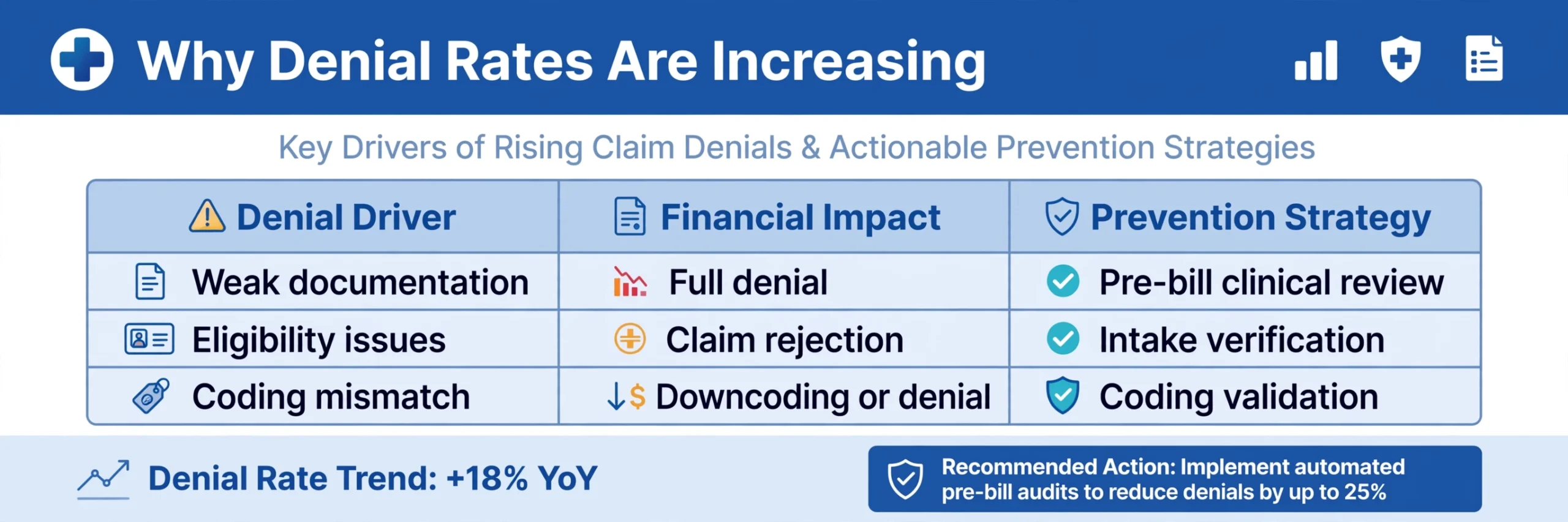
Medicare is focusing more on whether services are truly necessary—not just whether they are coded correctly.
If documentation doesn’t clearly justify care, claims can be denied or flagged for review.
| Denial Driver | Financial Impact | Prevention Strategy |
|---|---|---|
| Weak documentation | Full denial | Pre-bill clinical review |
| Eligibility issues | Claim rejection | Intake verification |
| Coding mismatch | Downcoding or denial | Coding validation |
Solution:
Shift from reactive billing to proactive validation before claim submission.
Without a structured workflow, claims get delayed, follow-ups are missed, and payments take longer to arrive.
This increases accounts receivable (AR) days and reduces overall financial performance.
Solution:
Track key metrics like AR days, denial rates, and case-mix index to improve efficiency.
PDGM requires deep expertise in coding, compliance, and workflow management. Many in-house teams struggle to keep up with these complexities.
Outsourcing provides access to specialists who understand the system and can optimize performance.
Solution:
Consider outsourcing to improve accuracy, reduce denials, and speed up reimbursements.
When teams work in silos, information gets lost. This leads to incomplete documentation, coding errors, and missed revenue opportunities.
Coordination is essential for ensuring every part of the process supports accurate billing.
Solution:
Create an integrated workflow where all teams communicate and align from start to finish.
Many revenue losses are not visible without detailed analysis. Audits help identify issues like undercoding, missed diagnoses, and incorrect groupings.
Regular reviews ensure that your billing process is both accurate and optimized.
Solution:
Conduct periodic audits to track performance and improve financial outcomes.
By simplifying complex billing requirements and improving revenue cycle performance, we help your home health agency expand services with confidence while maintaining financial stability.
Get a free assessment from our billing experts