
Here you will discover the latest Medicare hospital billing guidelines, best coding practices, and complete documentation standards that help your hospital to streamline revenue cycle management.

Medicare hospital billing in 2026 is no longer just about submitting claims—it is a complex financial ecosystem driven by inpatient DRGs, outpatient APCs, compliance rules, and documentation precision. Hospitals operate under multiple payment systems simultaneously, and each has its own logic, risks, and revenue opportunities.
What makes hospital billing unique is scale. A single inpatient claim can be worth thousands of dollars, and even a small documentation or coding gap can result in significant underpayment or audit exposure. That’s why hospitals must shift from basic billing to data-driven revenue optimization and compliance strategy.
Need support with your billing workflow? Explore our medical billing and revenue cycle services or request a free consultation.
One of the most critical decisions in hospital billing is determining whether a patient is inpatient or outpatient. This classification directly affects reimbursement under IPPS (inpatient) or OPPS (outpatient).
Many hospitals struggle with observation status, where patients may stay for extended periods but are still classified as outpatients. Incorrect classification can lead to lost revenue or compliance penalties, especially under Medicare audits.
Deeper Insight:
This is not just a billing issue—it starts with clinical decision-making. If physicians do not clearly justify inpatient admission, billing teams are forced into weaker positions.
Solution:
Implement utilization review protocols that validate patient status in real time and ensure documentation supports admission decisions.
Under IPPS, hospitals are paid based on Diagnosis-Related Groups (DRGs), which are determined by diagnoses, procedures, and severity of illness. DRG assignment is not just coding—it is the core revenue driver for inpatient care.
If complications, comorbidities, or procedures are not fully documented and coded, the DRG may reflect a lower severity level—resulting in underpayment.
| DRG Element | Revenue Impact | Common Gap | Strategic Fix |
|---|---|---|---|
| Primary Diagnosis | Base DRG assignment | Non-specific coding | Improve physician specificity |
| CC/MCC Capture | Increases severity/payment | Missed complications | Clinical documentation improvement |
| Procedures | DRG shift | Underreported procedures | Accurate procedural coding |
Deeper Insight:
Most revenue loss in inpatient billing comes from missed CC/MCC capture, not denied claims.
Solution:
Invest in Clinical Documentation Improvement (CDI) programs that bridge physicians and coders.
Documentation is the foundation of hospital billing. Without detailed notes, coders cannot assign accurate ICD-10 or CPT codes.
But the real issue is not missing documentation—it’s incomplete clinical storytelling. If severity, risk, and medical necessity are not clearly expressed, claims may be downcoded or denied.
Example:
A patient with sepsis documented as “infection” will result in significantly lower reimbursement.
Solution:
Train providers to document:
This transforms documentation from a task into a revenue driver.
The CDM is the hospital’s pricing and billing engine. It connects services to codes, charges, and reimbursement logic.
An outdated or poorly maintained CDM creates system-wide revenue leakage, affecting thousands of claims—not just individual cases.
Deeper Insight:
CDM errors are dangerous because they are repetitive and invisible—they impact every claim until corrected.
Solution:
Perform routine CDM audits and align it with current Medicare coding and reimbursement updates.
Hospitals deliver hundreds of services daily, and each must be captured accurately. Missed charges often occur due to:
Even small missed charges, when multiplied across patients, lead to substantial losses.
Solution:
Implement automated charge capture systems integrated with EHR and departmental workflows.

Medicare does not pay for services simply because they were performed—it pays only if they are medically necessary and properly ordered.
If physician orders are unclear or documentation does not justify the service, claims are denied—even if coding is correct.
Deeper Insight:
Denials are increasingly shifting from coding errors to medical necessity failures.
Solution:
Ensure every service is supported by:
Outpatient services are reimbursed using Ambulatory Payment Classifications (APCs), which group similar services.
Incorrect CPT coding or missing modifiers can result in:
| Component | Revenue Risk | Common Issue | Fix |
|---|---|---|---|
| CPT Coding | Underpayment | Wrong code selection | Coding validation |
| APC Grouping | Misaligned payment | Incorrect mapping | System integration checks |
| Modifiers | Denial or reduced payment | Missing modifiers | Pre-bill audit |
Solution:
Ensure strong alignment between clinical services and billing codes.
Medicare now uses advanced analytics to identify billing patterns. Hospitals are no longer audited randomly—they are selected based on data anomalies.
This includes:
Deeper Insight:
Audits are now predictive, not reactive.
Solution:
Monitor internal data trends and correct anomalies before payers do.
Hospital billing involves multiple steps—registration, coding, billing, and follow-up. If these processes are not aligned, delays occur at every stage.
This leads to:
Solution:
Track performance metrics like:
Use data to continuously optimize workflows.
Hospitals face intense scrutiny because:
Audits focus on:
Solution:
Maintain audit-ready documentation and conduct internal compliance reviews regularly.
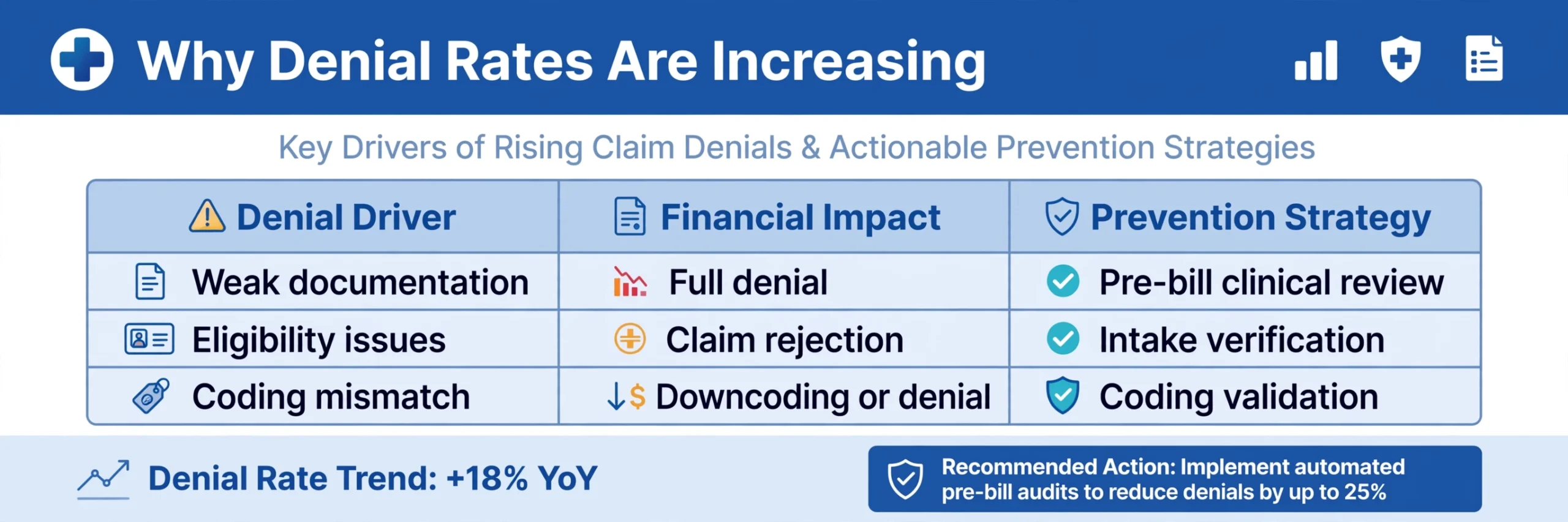
Hospital billing complexity requires expertise across multiple domains. Many hospitals struggle to maintain this level of knowledge internally.
Outsourcing provides:
Solution:
Outsourcing allows hospitals to focus on patient care while improving financial outcomes.
Hospital billing is not a single function—it involves multiple departments. When communication breaks down, errors occur.
This results in:
Solution:
Create integrated workflows where clinical, coding, and billing teams collaborate continuously.
Audits are not just for compliance—they are a powerful tool for revenue improvement.
They help identify:
Solution:
Conduct regular audits and use findings to improve processes and training.
Our specialists optimize every stage of your revenue cycle, helping your hospital recover more revenue while improving billing efficiency.
Get a free assessment from our billing experts