

A definitive billing resource for US plastic surgeons, reconstructive surgeons, practice managers, and surgical billing professionals:
| # | Section Title | Page Focus |
|---|---|---|
| 1 | What Is Plastic Surgery Medical Billing? | Overview, scope & dual-nature of the specialty |
| 2 | Why Plastic Surgery Billing Requires Specialized Expertise | Cosmetic vs. reconstructive, global periods, modifiers |
| 3 | Key CPT Codes in Plastic Surgery Medical Billing | Reconstructive, cosmetic, wound care, E/M codes |
| 4 | Plastic Surgery Medical Billing Services: Full Scope | End-to-end RCM service breakdown |
| 5 | ICD-10 Diagnosis Coding in Plastic Surgery Billing | Reconstructive necessity, trauma, cancer, congenital |
| 6 | Reconstructive vs. Cosmetic: The Most Critical Distinction in Billing | Medical necessity rules, payer coverage, documentation |
| 7 | Global Surgery Periods & Modifier Use in Plastic Surgery Billing | 10-day, 90-day periods, modifiers 57, 58, 79, 78, 59 |
| 8 | Medicare & Insurance Rules for Plastic Surgery Billing Services | CMS coverage, LCD policies, prior authorization |
| 9 | Wound Care & Skin Graft Billing in Plastic Surgery Services | Grafts, flaps, debridement — sq cm-based billing |
| 10 | Common Plastic Surgery Billing Denials & How to Fix Them | Denial management strategies |
| 11 | HIPAA Compliance & Plastic Surgery Billing Regulations | Privacy, audit risks, compliance checklist |
| 12 | Plastic Surgery Billing for Different Practice Settings | Solo, group, hospital, ASC, academic, medspa |
| 13 | KPIs Every Plastic Surgery Practice Should Track | Revenue analytics & benchmarks |
| 14 | Outsourced vs. In-House Plastic Surgery Medical Billing Services | Decision framework |
| 15 | FAQs: Plastic Surgery Billing Services | Top 10 questions answered |
�� IMAGE PLACEHOLDER Hero Image: Plastic surgeon reviewing surgical plan with a billing dashboard overlay showing CPT codes, reconstructive vs. cosmetic claim categories, and reimbursement metrics — connecting surgical excellence to revenue cycle management 1200 x 630 px | Alt text: ‘Plastic surgery medical billing services dashboard showing reconstructive CPT codes, global period tracking, and reimbursement data for US plastic surgery practices’ |
Plastic surgery medical billing is the specialized process of coding, submitting, and collecting payment for the extraordinarily diverse range of surgical and non-surgical services delivered by plastic surgeons and reconstructive surgeons across the United States. The specialty spans two fundamentally different worlds that coexist within the same practice, reconstructive surgery, covered by insurance when medically necessary and cosmetic surgery, which is almost entirely self-pay.
This dual nature makes plastic surgery medical billing uniquely complex among all surgical specialties. A plastic surgeon performing a breast reconstruction after mastectomy and a breast augmentation on the same day must understand two completely different billing pathways, documentation requirements, and financial arrangements. Getting this wrong doesn’t just mean a denied claim, it can mean a False Claims Act exposure if cosmetic procedures are fraudulently billed as reconstructive, or it can mean leaving substantial reconstructive revenue uncollected because the documentation doesn’t support medical necessity.
According to the American Society of Plastic Surgeons (ASPS), there were over 15.6 million surgical and minimally invasive cosmetic procedures performed in the United States in 2020, with reconstructive procedures accounting for an additional 6.8 million.
Plastic surgery billing is among the most technically demanding disciplines in surgical coding. The challenges are structural, regulatory, and documentation-driven. Here is what makes plastic surgery medical billing services a discipline that demands genuine subspecialty knowledge:
The reconstructive vs. cosmetic determination is the most consequential billing decision in the specialty, it determines insurance coverage, documentation requirements, and legal exposure all at once.
Global surgery periods (10-day and 90-day) govern what services are billable separately during the post-operative period, with complex rules for multiple surgeons, staged procedures, and complications.
Multiple modifier usage is the norm in plastic surgery billing; modifiers 57, 58, 59, 78, 79, LT, RT, and bilateral procedure modifier 50 are all commonly required in the same claim.
Wound care and skin graft billing is square-centimeter-based, accurate measurement and documentation of wound and graft dimensions directly determines reimbursement.
Breast reconstruction billing involves CPT code pairs (tissue expander + implant exchange) and requires coordination with oncology, ensuring the Women’s Health and Cancer Rights Act (WHCRA) coverage requirements are met.
Hand surgery CPT codes (26xxx) overlap significantly with orthopedic surgery, bilateral procedures, tendon repairs, and nerve grafts require precise modifier and laterality documentation.
Flap procedures (local, pedicle, free) are among the highest-value CPT codes in plastic surgery and have the most detailed documentation requirements for medical necessity.
Prior authorization requirements for reconstructive procedures vary dramatically by payer and are among the most complex PA workflows in any surgical specialty.
Cosmetic procedure cash-pay management requires clear financial consent documentation to prevent patients from later attempting to submit cosmetic claims to insurance as reconstructive.
Plastic surgery spans more CPT code families than almost any other surgical specialty. Below are the major code categories that drive revenue in plastic surgery medical billing services:
| CPT Code | Description | Reconstructive or Cosmetic | Key Billing Notes |
|---|---|---|---|
| 19316 | Mastopexy (breast lift) | Cosmetic (typically) | May be reconstructive post-weight loss or trauma; document medical necessity if billing insurance |
| 19318 | Reduction mammaplasty | Reconstructive when symptomatic | Payer criteria: minimum resection weight (varies), documented symptoms (neck/back pain, rashes, posture); prior auth required |
| 19325 | Breast augmentation with implant | Cosmetic | Almost never covered by insurance; cash-pay; document in financial consent |
| 19340 | Immediate insertion of breast prosthesis | Reconstructive | Immediate implant at time of mastectomy; must coordinate with general/oncologic surgeon billing |
| 19342 | Delayed insertion of breast prosthesis | Reconstructive | Implant placed after tissue expander; WHCRA requires coverage when mastectomy is covered |
| 19357 | Tissue expander placement, breast | Reconstructive | First stage of 2-stage breast reconstruction; requires mastectomy diagnosis |
| 19366 | Breast reconstruction with other technique | Reconstructive | TRAM flap; document flap type and technique in operative report |
| 19367–19369 | TRAM flap reconstruction variants | Reconstructive | Single vs. bipedicle; muscle-sparing variants have different codes |
| 19380 | Revision of reconstructed breast | Reconstructive | Fat grafting, scar revision, symmetry procedures after reconstruction; WHCRA coverage |
| 19396 | Preparation of moulage for breast prosthesis | Reconstructive | Custom prosthesis fitting; document fitting process |
| CPT Code | Description | Billing Basis | Key Notes |
|---|---|---|---|
| 14000–14302 | Adjacent tissue transfer / rearrangement (local flaps) | Per sq cm of defect | Bill by total sq cm of primary + secondary defect; document dimensions in operative report |
| 15002–15005 | Wound preparation (surgical debridement for grafting) | Per sq cm (first 100 sq cm + additional) | Always document wound dimensions; 15002 first 100 sq cm, 15003 each additional 100 sq cm |
| 15040–15157 | Skin grafts (split thickness, full thickness, composite) | Per sq cm of graft | Specify donor and recipient site; bill donor site closure separately if significant |
| 15200–15261 | Full-thickness skin grafts by location and size | Per sq cm by anatomic region | Face, hands, and other regions have separate CPT codes with different values |
| 15570–15738 | Formation of direct/tubed pedicle flap | Per procedure | Document flap dimensions; pedicle vs. free flap distinction critical |
| 15756–15758 | Free myocutaneous, muscle, fascial flaps | Per procedure | Highest-value plastic surgery CPT codes; document donor site, recipient site, anastomosis |
| 16020–16030 | Burn dressing / debridement | Per size/complexity | Document total body surface area (TBSA) percentage and burn depth |
| 97597–97598 | Debridement — open wound, first 20 sq cm / each additional 20 sq cm | Per sq cm | Active wound care management; document wound size at each visit |
| 97602 | Nonselective debridement, without anesthesia | Per session | Chemical or mechanical; document wound condition and technique |
| CPT Code | Description | Coverage | Key Billing Notes |
|---|---|---|---|
| 21120–21196 | Reconstruction of mandible, maxilla, orbital rim | Reconstructive | Trauma, cancer resection, congenital defect — document etiology |
| 21230–21235 | Rib/ear cartilage graft for reconstruction | Reconstructive | Auricular reconstruction, nasal reconstruction; document donor site |
| 21600–21632 | Excision of rib, sternum, ribs — chest wall reconstruction | Reconstructive | Post-oncologic or traumatic; document defect size and reconstruction method |
| 30400–30462 | Rhinoplasty (nasal reconstruction) | Reconstructive or Cosmetic | Reconstructive when post-trauma, post-tumor, or for functional airway obstruction; cosmetic for aesthetic purposes only |
| 40490–40799 | Lip and mouth reconstruction | Reconstructive | Cleft lip repair, post-cancer reconstruction; document etiology |
| 67900–67924 | Eyelid repair (blepharoplasty for ptosis/ectropion) | Reconstructive | Upper lid ptosis repair covered when visual field impairment documented; lower lid cosmetic blepharoplasty is NOT covered |
| 69300 | Otoplasty | Reconstructive or Cosmetic | Reconstructive for congenital ear deformity (microtia); cosmetic for protruding ears — coverage varies by payer |
| CPT Code | Description | Key Billing Notes |
|---|---|---|
| 26020–26045 | Tendon sheath incision, drainage, tenosynovectomy | Specify flexor vs. extensor; document joint level |
| 26350–26392 | Repair or advancement, tendon (flexor/extensor) | Specify primary vs. secondary repair; zone of injury documentation |
| 26410–26449 | Repair, extensor tendon by anatomic zone | Zone I–VII; distinct codes per zone — document zone in operative note |
| 26480–26489 | Transfer/transplant of tendon (hand) | Document donor tendon and recipient attachment |
| 26530–26536 | Arthroplasty, interphalangeal joint | Specify implant type; document joint level and laterality |
| 26600–26700 | Fracture treatment (metacarpal, phalangeal) | Closed vs. open vs. percutaneous; specify bone and type |
| 64719–64721 | Neuroplasty / carpal tunnel release | 64721 = carpal tunnel; document open vs. endoscopic approach |
| 26116–26121 | Excision of ganglion cyst, hand/wrist | Document location (dorsal vs. volar, wrist vs. digit); specify size |
Tip: Square Centimeter Documentation for Skin Grafts & Flaps |
Skin graft and wound care CPT codes are billed by square centimeters, and the dimensions in your operative report ARE your billing documentation. Surgeons must record exact wound measurements (length x width) in the operative note. Vague descriptions like ‘large wound’ or ‘significant defect’ are not sufficient and will result in downcoding or denial. |
For adjacent tissue transfers (local flaps, 14000–14302), bill the total square centimeters of the primary defect plus the secondary defect combined. This is a common underbilling error, many practices only bill the primary defect. |
When billing multiple skin grafts on the same date, each graft site is billed separately with its specific dimensions and CPT code. Do not aggregate all graft areas under a single code, this loses the specificity needed for accurate reimbursement. |
We provide best-in-class plastic surgery billing services that cover the full revenue cycle across both your reconstructive and cosmetic service lines. Here is what a comprehensive plastic surgery billing services partner should deliver:
| Service Component | What It Includes | Why It Matters for Plastic Surgery |
|---|---|---|
| Reconstructive vs. Cosmetic Determination | Pre-billing review of each procedure for coverage classification | Prevents false claims exposure and ensures no reconstructive revenue is lost to misclassification |
| Charge Capture & Code Review | CPT assignment with sq cm verification, modifier review, laterality coding | Graft/flap underbilling and modifier errors are the top revenue gaps in plastic surgery |
| Prior Authorization Management | PA for reconstructive procedures: breast reconstruction, rhinoplasty, blepharoplasty, reduction mammaplasty, flaps | PA failure is the leading cause of reconstructive claim denials; proactive auth is essential |
| Global Period Tracking | 90-day and 10-day global period monitoring per surgeon per procedure | Prevents unbundling errors and ensures separately billable staged procedures are correctly coded |
| Claims Submission | Electronic CMS-1500 submission; ASC facility claims (UB-04) when applicable | Rapid submission; correct form per setting |
| WHCRA Compliance Review | Breast reconstruction claim audit for WHCRA coverage mandates | Insurers must cover reconstruction after mastectomy — WHCRA violations are federally actionable |
| Cosmetic Patient Financial Management | Cash-pay consent documentation, financial agreement tracking, payment plan management | Prevents cosmetic patients from later submitting procedures to insurance as reconstructive |
| Denial Management | Root-cause analysis, medical necessity appeals, peer-to-peer facilitation | Reconstructive denials have high appeal success rates when clinical documentation is strong |
| Payment Posting & Underpayment Review | EOB reconciliation, contracted rate verification, underpayment recovery | Plastic surgery procedures have high per-claim values — underpayments cost significant revenue |
| Compliance Monitoring | OIG work plan monitoring, LCD review, cosmetic vs. reconstructive audit readiness | Cosmetic-as-reconstructive fraud is a top OIG target in plastic surgery |
| Reporting & Analytics | Monthly denial trends by CPT, payer performance, global period status reports | Data-driven practice management for both revenue streams |
ICD-10-CM diagnosis codes in plastic surgery billing are the primary evidence of medical necessity, and the difference between a covered reconstructive claim and a denied cosmetic claim often comes down to the specificity and accuracy of the diagnosis code documented. Here are the most clinically significant ICD-10 code families in plastic surgery billing services:
| ICD-10-CM Code(s) | Diagnosis | Plastic Surgery Billing Context |
|---|---|---|
| C50.x | Malignant neoplasm of breast | Post-mastectomy breast reconstruction; WHCRA coverage trigger; document laterality |
| Z42.1 | Encounter for breast reconstruction following mastectomy | Post-mastectomy reconstruction encounter; distinguishes reconstructive from cosmetic |
| N64.4 | Mastodynia (breast pain) | Reduction mammaplasty when symptomatic; pair with M54.x (back pain) for stronger medical necessity |
| M54.2 / M54.5 | Cervicalgia / Low back pain | Supporting diagnosis for reduction mammaplasty; payer criteria often require documented musculoskeletal symptoms |
| L29.x / L30.x | Pruritus / Dermatitis under breast | Submammary intertrigo — supporting reduction mammaplasty medical necessity |
| S00–S99 (Trauma) | Open wounds, fractures, crush injuries, burns | Post-traumatic reconstruction — specify body region, laterality, and encounter type (initial/subsequent/sequela) |
| T20–T32 | Burns by body region and TBSA | Burn reconstruction; specify degree and percentage TBSA — drives graft sq cm billing |
| Q17.x / Q18.x | Congenital malformations of ear and face | Microtia, cleft lip/palate reconstruction; congenital defect is reconstructive by definition |
| Q35.x–Q37.x | Cleft palate and cleft lip | Reconstructive pediatric plastic surgery; no prior auth controversy — clearly reconstructive |
| H02.40–H02.43 | Ptosis of eyelid (mechanical, neurogenic, etc.) | Reconstructive blepharoplasty; visual field test (VFT) documentation required for upper lid coverage |
| H02.30–H02.35 | Blepharochalasis / Dermatochalasis | Excess eyelid skin; coverage requires documented visual field impairment — cosmetic without VFT |
| M72.0 / M65.3 | Palmar fascial fibromatosis (Dupuytren) / Trigger finger | Hand surgery — Dupuytren contracture release (26040/26045); trigger finger release (26055) |
| S62.x / S52.x | Fracture of hand/finger / Fracture of forearm | Acute hand fracture management; specify open vs. closed, displaced vs. non-displaced |
| L98.4 / L97.x | Chronic skin ulcer / Non-pressure chronic ulcer | Wound care and skin grafting; document ulcer location, depth, and size for sq cm billing |
No other specialty has a billing distinction as legally and financially consequential as plastic surgery’s reconstructive versus cosmetic divide. As a surgeon you need to understand this distinction, and document it correctly, is the foundation of every plastic surgery billing.
The distinction between reconstructive and cosmetic surgery is defined by federal and payer guidelines. Reconstructive surgery is performed on abnormal structures of the body caused by congenital defects, developmental abnormalities, trauma, infection, tumors, or disease. Cosmetic surgery is performed to reshape normal structures of the body in order to improve appearance. These are not clinical judgments, they are legal and billing classifications with significant consequences.
| Procedure | Reconstructive Context (Covered) | Cosmetic Context (Not Covered) | Key Documentation for Reconstructive |
|---|---|---|---|
| Rhinoplasty | Post-traumatic nasal deformity; documented septal deviation with functional obstruction | Aesthetic reshaping of a normal nose | Nasal obstruction symptoms, failed medical management, objective airflow testing |
| Blepharoplasty | Upper lid ptosis with documented visual field loss (>30% in superior field) | Aesthetic eye rejuvenation | Visual field testing (Humphrey or Goldmann), MRD measurements, photos |
| Breast reduction | Symptomatic macromastia: documented back/neck/shoulder pain, skin rashes, nerve symptoms, functional limitations | Aesthetic breast reshaping | Conservative treatment failure documentation, BMI, minimum resection weight meeting payer criteria |
| Abdominoplasty | Panniculectomy for symptomatic pannus overhang: skin infections, intertrigo, functional limitations | Aesthetic abdominal contouring | Photos of pannus, documented infections/rashes, functional impairment, dermatology consultation |
| Scar revision | Post-traumatic or post-surgical scar causing functional impairment or symptomatic contracture | Aesthetic improvement of an asymptomatic scar | Functional limitation documentation, range-of-motion restriction, patient symptoms |
| Otoplasty | Congenital ear deformity (microtia, prominent ear in pediatric patients per payer policy) | Aesthetic ear pin-back in adults without deformity | Congenital deformity documentation, age of patient, payer-specific criteria |
| Gynecomastia excision | Pathologic gynecomastia causing functional/symptomatic problems | Aesthetic chest contouring | Hormonal workup, duration, degree of glandular tissue, symptoms |
Global surgery periods and surgical modifiers are among the most misunderstood, and most frequently misapplied, elements of plastic surgery medical billing. Getting them wrong costs revenue in both directions: overbilling within the global period creates audit risk; underbilling separately billable services leaves legitimate revenue uncollected.
| Global Period | Duration | What Is Included (Cannot Bill Separately) | What Can Be Billed Separately |
|---|---|---|---|
| 90-Day Global | Day of surgery + 90 days post-op | Routine E/M visits, suture removal, routine post-op care, minor complications treated in office | Unrelated medical conditions, staged procedures (modifier 58), complications requiring return to OR (modifier 78), unrelated procedures (modifier 79) |
| 10-Day Global | Day of surgery + 10 days | Same-day pre-op E/M (unless decision made same day — modifier 57), post-op care for 10 days | Unrelated E/M visits, new problems arising after surgery |
| 0-Day Global | Day of procedure only (endoscopy, some minor procedures) | Nothing beyond the day of surgery | All E/M visits before and after are separately billable |
| XXX Global (No Period) | No global period applies | N/A | Each service billed independently — applies to many plastic surgery minor procedures |
| Modifier | Meaning | When to Use in Plastic Surgery | Documentation Required |
|---|---|---|---|
| -57 | Decision for surgery made at this E/M visit | E/M visit on the day before or day of a major (90-day global) surgery when decision was made at that visit | Document the decision-making process and that surgery was decided at this visit |
| -58 | Staged or related procedure during post-op period | Planned second stage of breast reconstruction (expander to implant); staged flap division | Operative report must reference staged nature; planned from the outset |
| -78 | Unplanned return to OR for complication during global | Hematoma evacuation, wound dehiscence repair, flap exploration for vascular compromise | Document unplanned complication nature; emergency return to OR |
| -79 | Unrelated procedure during post-op period | Unrelated surgery on a different anatomic site during 90-day global of a breast reconstruction | Document that procedures are anatomically and clinically unrelated |
| -59 | Distinct procedural service | Multiple graft sites on same day; separate procedures on different anatomic regions | Document distinct sites/indications — required when NCCI edit bundles would otherwise apply |
| -50 | Bilateral procedure | Bilateral blepharoplasty, bilateral TRAM flap, bilateral hand procedures | Document bilateral nature; reimbursed at 150% of single procedure by most payers |
| -LT / -RT | Left / Right side laterality | When bilateral modifier not appropriate; single-side procedures on paired structures | Specify side in operative report and claim |
| -22 | Increased procedural services | Exceptionally complex reconstruction significantly beyond typical of the CPT code | Detailed operative report justifying increased complexity; expect payer scrutiny |
| -51 | Multiple procedures | When billing multiple surgical procedures in same operative session | Most payers reduce payment for secondary procedures — know your payer's multi-procedure reduction rules |
Tip: Global Period Management in Plastic Surgery |
Staged breast reconstruction (tissue expander placement, then implant exchange) is one of the most common global period billing scenarios in plastic surgery. The implant exchange (19342) should be billed with modifier -58 (staged procedure), not modifier -79, because it was planned from the outset of the initial reconstruction. |
When a plastic surgeon is asked to see a patient for an unrelated problem during another surgeon’s global period, the claim should include the original surgeon’s NPI and modifier -54 (surgical care only) or appropriate co-surgeon arrangement documentation. |
Track your 90-day global periods by patient in your billing system. A post-op visit for a wound complication at day 45 that requires a return to the OR for hematoma evacuation should be billed with modifier -78 — the procedure is separately billable, but at a reduced global package rate reflecting that pre/post-op care is already included. |
�� IMAGE PLACEHOLDER Infographic: Plastic Surgery Global Period Timeline — showing 90-day post-op period with color-coded zones for included services, modifier -58 staged procedures, modifier -78 complication returns to OR, and modifier -79 unrelated procedures 1200 x 800 px | Alt text: ‘Plastic surgery billing global period infographic showing 90-day timeline, surgical modifiers and separately billable services for US plastic surgery practices’ |
Medicare and commercial insurance coverage for plastic surgery is among the most restricted and condition-specific in all of medicine. As a surgeon you need to understand coverage rules are not optional, it is the difference between successful reconstructive claims and systematic revenue loss.
Medicare explicitly excludes cosmetic surgery from coverage, procedures performed solely for aesthetic reasons are never covered, and billing them as reconstructive is fraud.
The Women’s Health and Cancer Rights Act (WHCRA) requires that any health plan covering mastectomy MUST also cover all stages of breast reconstruction, surgery on the contralateral breast to produce symmetry, prostheses, and treatment of physical complications including lymphedema.
Upper eyelid blepharoplasty is covered by Medicare when visual field testing documents ≥30% superior visual field loss due to ptosis without this documentation, it is cosmetic and not covered.
Reduction mammaplasty is not covered by Medicare as a standard benefit it may be covered by some Medicare Advantage plans with their own criteria.
Panniculectomy is covered by Medicare when documented medical necessity exists (recurrent skin infections, intertrigo, functional impairment) — abdominoplasty for cosmetic contouring is never covered.
Rhinoplasty is covered when performed for a documented functional impairment (nasal obstruction, post-traumatic deformity) with objective supporting evidence — not for aesthetic reshaping.
| Procedure | Medicare Coverage Status | Coverage Requirement | Documentation Must-Have |
|---|---|---|---|
| Breast reconstruction after mastectomy | Covered (WHCRA mandate) | Mastectomy for cancer treatment; WHCRA applies to all health plans covering mastectomy | Mastectomy operative report; oncology records; WHCRA notice to patient |
| Upper lid blepharoplasty for ptosis | Covered when medically necessary | Visual field loss ≥30% superior field documented by VFT | Humphrey/Goldmann visual field test; MRD measurements; clinical photos |
| Panniculectomy | Covered when medically necessary | Recurrent skin infections; documented intertrigo; functional impairment | Dermatology records; photo documentation; treatment history |
| Rhinoplasty for functional obstruction | Covered when medically necessary | Documented nasal obstruction with objective testing; failed conservative treatment | Nasal airflow testing; ENT evaluation; operative plan focused on function |
| Scar revision for contracture | Covered when medically necessary | Functional impairment; range-of-motion restriction; symptomatic contracture | Physical therapy records; range-of-motion measurements; functional assessment |
| Breast augmentation | NOT covered | Cosmetic only | Do not bill to Medicare; cash-pay with signed financial consent |
| Facelift, brow lift, abdominoplasty (cosmetic) | NOT covered | Cosmetic only | Do not bill to Medicare or any insurance; clear financial consent required |
Wound care and skin graft billing is one of the most financially significant and most frequently underbilled service areas in plastic surgery. Because reimbursement is directly tied to the size of the wound and graft area measured in square centimeters, precise surgical documentation is the foundation of accurate billing.
| CPT Code Category | Billing Unit | First Increment | Additional Increments | Key Documentation |
|---|---|---|---|---|
| Wound preparation for grafting (15002–15005) | Sq cm | 15002: first 100 sq cm or 1% TBSA | 15003: each additional 100 sq cm or 1% TBSA | Wound location, dimensions, debridement technique, tissue removed |
| Split-thickness skin graft (15100–15101) | Sq cm | 15100: first 100 sq cm | 15101: each additional 100 sq cm | Donor site location; graft dimensions; recipient site; meshing ratio |
| Full-thickness skin graft (15200–15261) | Sq cm by region | Varies by body region | Separate codes for face, hands, extremities, trunk | Specify body region; donor site closure documented separately |
| Adjacent tissue transfer (14000–14302) | Sq cm of total defect | 14000: first 10 sq cm or less | 14001: 10.1–30 sq cm; 14020/14021 for scalp/arm/leg; 14040/14041 forehead/cheeks | Primary + secondary defect dimensions combined; flap design documented |
| Free skin graft, legs/arms (15120–15121) | Sq cm | 15120: first 100 sq cm | 15121: each additional 100 sq cm | Laterality; donor site; graft dimensions; fixation method |
| Debridement, active wound (97597–97598) | Sq cm | 97597: first 20 sq cm | 97598: each additional 20 sq cm | Wound dimensions at each visit; debridement method; tissue removed |
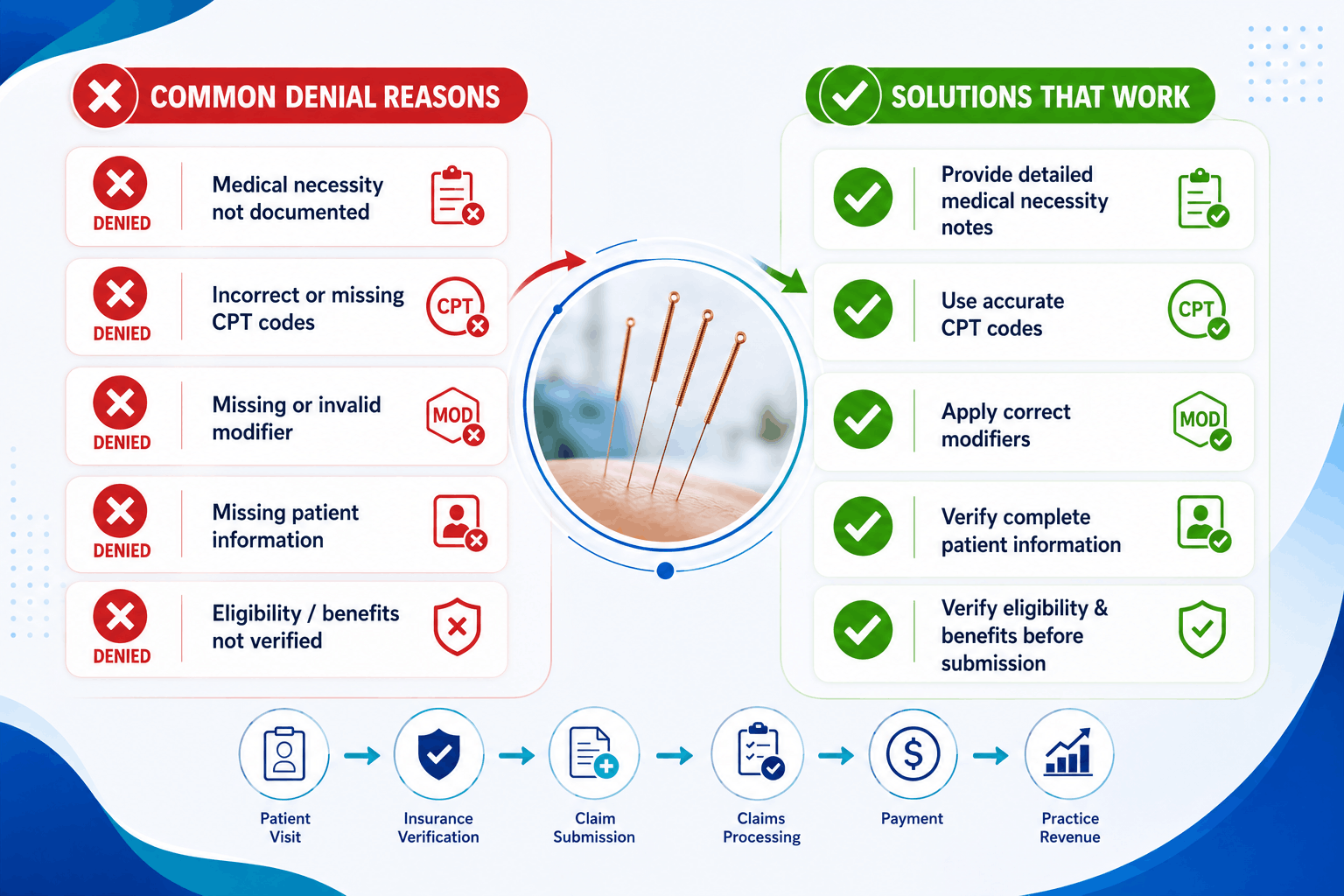
Denial management is where your plastic surgery practice recovers the most preventable lost revenue. Here are the most impactful denial categories in our plastic surgery medical billing services and proven strategies to resolve and prevent them:
| Denial Type | Root Cause | Fix / Prevention Strategy |
|---|---|---|
| Cosmetic Denial — Reconstructive Procedure | Insufficient medical necessity documentation; ICD-10 codes don't tell the reconstructive story | Strengthen clinical documentation before submission; use multiple supporting diagnosis codes; appeal with clinical records and photographs |
| Prior Authorization Not Obtained | Reconstructive procedure performed without payer pre-authorization | Build mandatory PA workflow for all reconstructive procedures; verify auth before scheduling surgery |
| Global Period Bundling Error | E/M or procedure billed during global period without appropriate modifier | Track global periods in billing system; train staff on modifier -58/-78/-79 rules |
| Incorrect Modifier on Staged Procedure | Modifier -79 used instead of -58 for planned staged reconstruction | Distinguish planned (-58) from unplanned (-78/-79) at the time of original surgery; document staging plan in first operative report |
| WHCRA Denial for Breast Reconstruction | Payer denying breast reconstruction despite WHCRA mandate | File formal WHCRA appeal citing federal law; report violations to DOL; engage payer relations team |
| Blepharoplasty Denied Without Visual Field Test | Upper lid blepharoplasty submitted without VFT documentation | Obtain VFT before surgery for every Medicare/insured upper lid case; include VFT results in PA request |
| Sq Cm Underpayment on Grafts/Flaps | Claim paid for fewer sq cm than documented due to coding or measurement error | Audit graft/flap sq cm documentation monthly; compare billed vs. operative report dimensions |
| Reduction Mammaplasty Weight Criteria Not Met | Payer denies because resection weight documentation missing or below payer threshold | Know each payer's minimum resection weight criteria before surgery; document intraoperative specimen weight in operative report |
| NCCI Edit Bundles Multiple Procedures | Skin graft + wound prep billed without modifier -59 for distinct sites | Run all multi-procedure plastic surgery claims through NCCI edit checker; use modifier -59 for truly distinct procedures |
| Timely Filing Exceeded | Complex plastic surgery claims not submitted within payer deadline | Prioritize surgical claims within 48 hours of service; track payer-specific timely filing windows |

Plastic surgery practices handle uniquely sensitive patient information including surgical photographs, cosmetic procedure histories, and reconstructive records often tied to cancer diagnoses or trauma. HIPAA compliance, combined with cosmetic-specific financial consent requirements, creates a dual compliance obligation that must be managed carefully.
✅ HIPAA & Billing Compliance Checklist for Plastic Surgery Practices |
Execute current Business Associate Agreements (BAAs) with all billing vendors, photography storage platforms, and surgical centers accessing PHI. |
You need to obtain written financial consent for all cosmetic procedures, document that the patient understands the procedure is not covered by insurance and that they are responsible for all fees. |
Store surgical photographs in a HIPAA-compliant system with access controls, photos are PHI and must be protected accordingly. |
You need to conduct annual internal billing compliance audits focused on: reconstructive vs. cosmetic classification accuracy, global period management, and WHCRA compliance. |
It is your responsibility to train front desk and billing staff on not disclosing cosmetic procedure histories to third parties without patient authorization, many patients are sensitive about cosmetic work. |
You need to implement ABN process for any Medicare patient receiving a procedure that may be classified as cosmetic, document that the patient understands Medicare will not pay |
Monitor the OIG Work Plan for active plastic surgery audit targets, cosmetic-as-reconstructive billing fraud is a recurring OIG focus |
Plastic surgery medical billing services must be tailored to your specific practice setting. The billing model, payer mix, and revenue streams differ significantly across these environments.
| Practice Setting | Billing Model | Key Plastic Surgery Billing Considerations |
|---|---|---|
| Private / Solo Plastic Surgery Practice | CMS-1500 for reconstructive; cash-pay management for cosmetic | Dual revenue stream management; highest billing complexity; greatest benefit from specialized plastic surgery billing services |
| Plastic Surgery Group Practice | CMS-1500; group NPI; co-surgeon/assistant surgeon billing | Multiple surgeon coordination for complex flap reconstructions; co-surgeon documentation requirements |
| Academic Medical Center | Professional (CMS-1500) + Teaching physician documentation | Attending attestation for resident-performed reconstructive procedures; complex oncologic reconstruction billing |
| Ambulatory Surgery Center (ASC) | Facility billing (CMS-1500 for professional; ASC-specific for facility) | ASC facility billing uses separate fee schedule; reconstructive procedures only (no cosmetic in most ASCs) |
| Hospital Operating Room | Professional (CMS-1500) + Hospital facility (UB-04) | Highest-acuity reconstructive cases; free flap, complex oncologic reconstruction, burns |
| Medical Spa / Cosmetic Practice | Cash-pay only; no insurance billing for cosmetic services | Financial consent management; package pricing; no-surprise billing compliance for self-pay patients |
| Wound Care Center | CMS-1500 + facility billing; Medicare wound care LCD compliance | Sq cm-based billing; wound measurement documentation; LCD compliance for advanced wound care products |
�� IMAGE PLACEHOLDER KPI Dashboard Graphic: Plastic Surgery Billing Performance Dashboard — showing Days in AR, First Pass Rate, Reconstructive vs. Cosmetic Claim Ratio, Prior Auth Approval Rate, Denial Rate by category (cosmetic misclassification, global period, sq cm underpayment), and Collection Rate 1200 x 700 px | Alt text: ‘Plastic surgery medical billing services KPI dashboard showing reconstructive billing metrics, global period tracking and denial rates for US plastic surgery practices’ |
Plastic surgery billing performance management requires tracking metrics specific to both the reconstructive insurance billing stream and the cosmetic cash-pay stream. Here are the KPIs that matter for your medical practice growth.
| KPI | Definition / Formula | Benchmark Target |
|---|---|---|
| Days in AR (Reconstructive) | Reconstructive AR ÷ Average daily reconstructive charges | < 35 days |
| First Pass Resolution Rate | Claims paid on first submission ÷ Total claims submitted | > 95% |
| Reconstructive Denial Rate | Denied reconstructive claims ÷ Total reconstructive claims | < 5% |
| Cosmetic Denial Rate (if any claims submitted) | Denied cosmetic claims ÷ Total cosmetic claims submitted — should be near zero | < 1%; any cosmetic claims submitted to insurance need immediate review |
| Prior Auth Approval Rate | Auths approved ÷ Auth requests submitted | > 90%; track by procedure and payer |
| Global Period Compliance Rate | Correctly billed global period claims ÷ Total post-op claims | > 99%; modifier errors are high audit risk |
| Sq Cm Capture Accuracy | Billed sq cm per graft/flap case ÷ Operative report-documented sq cm | > 98%; gaps indicate underbilling from documentation errors |
| WHCRA Compliance Rate | Breast reconstruction claims meeting WHCRA documentation requirements ÷ Total breast reconstruction claims | 100% — WHCRA is a federal mandate |
| Collection Rate (Reconstructive) | Reconstructive collections ÷ Net adjusted reconstructive charges | > 95% |
| Cosmetic Cash Collection Rate | Cosmetic cash collected ÷ Total cosmetic fees billed | > 98%; pre-surgical payment collection is best practice |
The decision between in-house billing and partnering with House of Outsourcing specialized plastic surgery billing services company is one of the most consequential operational choices your practice makes. Here is the complete, honest comparison:
| Factor | In-House Billing | House of Outsourcing Billing Services |
|---|---|---|
| Startup Cost | High — staff, PM software, reconstructive coding training, compliance program | Low percentage of collections or flat fee; no hiring or training cost |
| Ongoing Cost | Salaries, benefits, CPT update training, modifier policy monitoring | Predictable % of revenue; no HR overhead |
| Reconstructive vs. Cosmetic Expertise | Requires coders trained in the legal and billing distinction — rare generalist skill | Specialized vendors apply reconstructive vs. cosmetic rules as core competency |
| Global Period Management | Requires robust tracking system and modifier policy documentation | Plastic surgery billing specialists manage global period tracking and modifier assignment |
| WHCRA Compliance | Requires specific training and monitoring of breast reconstruction claims | Reputable vendors have WHCRA compliance built into breast reconstruction billing workflow |
| Sq Cm Billing Accuracy | Requires surgeons to record precise dimensions AND billing staff to translate to CPT correctly | Plastic surgery specialists audit sq cm documentation before submission — closing the revenue gap |
| Prior Auth Management | Complex PA workflows for reconstructive procedures require dedicated staff | PA management for reconstructive procedures included in comprehensive billing service |
| Scalability | Difficult — complex case volume spikes create billing backlogs | Scales immediately with case volume; no revenue dip during staff transitions |
| Revenue Performance | Variable — documentation gaps and cosmetic billing errors undermine both revenue streams | Consistent — SLA accountability and transparent reporting across both revenue streams |
| Best For | Large academic plastic surgery departments with dedicated billing teams | Private plastic surgery practices, group practices, wound care centers with high reconstructive volume |
Tip: Evaluating a Plastic Surgery Billing Services Vendor |
Ask specifically how they handle the reconstructive vs. cosmetic classification, do they have pre-billing procedures for classification before claim submission? |
Request their sq cm documentation audit process, how do they ensure that graft and flap billing matches the operative report dimensions? |
Ask about their WHCRA compliance workflow for breast reconstruction claims, can they cite the specific documentation requirements and demonstrate how they track them? |
Verify they have coders with CPC credentials (AAPC) and documented plastic surgery or general surgery subspecialty experience, not just general surgical billing. |
Request references from plastic surgery practices with a similar mix of reconstructive and cosmetic cases. |
Accurate plastic surgery billing requires proper coding, detailed documentation, and a clear understanding of payer-specific coverage policies for reconstructive and cosmetic procedures. The below authoritative resources provide current guidance on CPT coding, Medicare regulations, reimbursement policies, and compliance best practices to help you reduce claim denials and support accurate billing.
| Resource | Organization | URL |
|---|---|---|
| ASPS Coding & Payment Resources | American Society of Plastic Surgeons | plasticsurgery.org/for-medical-professionals/health-policy/coding-and-payment |
| CMS Physician Fee Schedule Search | CMS (Medicare) | cms.gov/medicare/physician-fee-schedule/search |
| CMS Medicare Coverage Database (LCDs) | CMS (Medicare) | cms.gov/medicare-coverage-database/search.aspx |
| Women's Health and Cancer Rights Act (WHCRA) | Dept. of Labor (EBSA) | dol.gov/agencies/ebsa/laws-and-regulations/laws/whcra |
| NCCI Policy Manual | CMS / NCCI | cms.gov/medicare/coding-billing/national-correct-coding-initiative-edits |
| ICD-10-CM Official Guidelines | CMS / CDC | cms.gov/medicare/coding-billing/icd-10-codes/icd-10-cm-documentation |
| CMS Global Surgery Policy | CMS (Medicare) | cms.gov/medicare/physician-fee-schedule/search |
| OIG Work Plan | HHS Office of Inspector General | oig.hhs.gov/reports-and-publications/workplan/index.asp |
| HIPAA Resources | HHS Office for Civil Rights | hhs.gov/hipaa/index.html |
| Medicaid State Overviews | Medicaid.gov | medicaid.gov/state-overviews/index.html |
| MGMA DataDive Benchmarks | Medical Group Management Assoc. | mgma.com/data/benchmarking-data/mgma-datadive |
| AMA CPT Code Information | American Medical Association | ama-assn.org/practice-management/cpt/cpt-overview-and-code-approval |
| ASPS Statistics on Plastic Surgery | American Society of Plastic Surgeons | plasticsurgery.org/news/plastic-surgery-statistics |
The Women’s Health and Cancer Rights Act (WHCRA) is a federal law that requires any health plan covering mastectomy to also cover: all stages of breast reconstruction on the treated breast, surgery on the contralateral breast to produce symmetry, external breast prostheses, and treatment of physical complications including lymphedema. This is not optional for payers, it is a federal mandate enforced by the Department of Labor and Department of Health and Human Services. For plastic surgery billing, this means every breast reconstruction claim following a covered mastectomy must be billed and fought for aggressively payer denials of WHCRA-mandated services can be appealed as federal law violations. Payers must also provide WHCRA notice to plan members. For more information, visit DOL WHCRA Information
Global surgery periods define the time window during which post-operative care is included in the original surgical fee. For major plastic surgery procedures, this is a 90-day global period, meaning routine follow-up visits, suture removal, and minor wound care during the 90 days post-op are bundled into the surgical payment and cannot be billed separately. However, certain services are separately billable within the global period with the correct modifier: staged procedures (modifier -58), unplanned return to OR for complications (modifier -78), and unrelated procedures at a different anatomic site (modifier -79). The critical error many practices make is either (a) not billing separately for legitimately billable staged procedures like the tissue expander to implant exchange, or (b) billing post-op visits without appropriate modifiers and creating global period bundling violations
Skin graft billing is calculated based on the total square centimeters of the graft area, with different CPT codes for the first increment and each additional increment. For split-thickness skin grafts: 15100 covers the first 100 sq cm (or 1% TBSA in children), and 15101 is billed for each additional 100 sq cm. The dimensions must be documented precisely in the operative report the length and width of each graft site in centimeters. When wound preparation (debridement) is performed immediately before graft application in the same operative session, bill the wound preparation codes (15002/15003) in addition to the graft codes, these are distinct services. Common errors include: estimating rather than measuring wound/graft dimensions, failing to document primary plus secondary defect dimensions for adjacent tissue transfers, and not billing wound preparation codes when they were clearly performed
Prior authorization is required by most payers for virtually all reconstructive plastic surgery procedures that involve the OR. The procedures with the highest PA requirements include: breast reconstruction (all stages), reduction mammaplasty, upper lid blepharoplasty (with visual field test documentation), rhinoplasty for functional obstruction, panniculectomy, complex wound care with grafting, free flap reconstructions, and any procedure involving implants. PA requirements vary significantly by payer and can change annually — what was approved last year by a specific MCO may require additional documentation this year. Building a systematic PA workflow that triggers before scheduling is essential. PA failures are the single most preventable cause of major reconstructive denials in plastic surgery
The highest compliance risks in plastic surgery billing include:
(1) Billing cosmetic procedures as reconstructive, this is healthcare fraud under the False Claims Act;
(2) Incorrect global period billing performing post-op services separately without appropriate modifiers;
(3) Sq cm documentation gaps for grafts and flaps submitting claims for larger areas than documented in the operative report;
(4) WHCRA non-compliance failing to ensure breast reconstruction coverage after mastectomy;
(5) Missing or insufficient visual field testing for upper lid blepharoplasty claims;
(6) Billing for procedures not documented in the operative report or outside the surgeon’s credentialed privileges. The OIG Work Plan regularly targets plastic surgery billing, particularly cosmetic-as-reconstructive misclassification and post-operative care billing. Annual internal audits of your reconstructive vs. cosmetic classification accuracy and global period management are strongly recommended
At House of Outsourcing, we provides end-to-end plastic surgery medical billing services designed specifically for US plastic surgeons and reconstructive surgeons from solo private practices to multi-surgeon groups and academic centers. Our plastic surgery billing specialists have deep expertise in reconstructive vs. cosmetic classification, sq cm-based graft and flap billing, global period management, WHCRA compliance, prior authorization workflows, and modifier accuracy. We consistently deliver first-pass resolution rates above 95% and proactive denial management that prevents the most costly plastic surgery billing errors before they reach the payer
Get a free assessment from our billing experts