
Our Pulmonology Medical Billing services help practices manage complex respiratory care billing, specialty-specific coding, documentation requirements, and payer regulations. We optimize the revenue cycle through accurate claim submission, denial prevention, and A/R management to improve reimbursements and support long-term practice growth.

A definitive resource for US pulmonologists, critical care physicians, practice managers, and respiratory billing professionals.
| # | Section Title | Page Focus |
|---|---|---|
| 1 | What Is Pulmonology Medical Billing? | Overview, scope & revenue context |
| 2 | Why Pulmonology Billing Requires Specialized Expertise | Complexity factors unique to pulmonology |
| 3 | Key CPT Codes in Pulmonology Medical Billing | E/M, pulmonary function, procedures, critical care |
| 4 | Pulmonology Medical Billing Services: Full Scope | End-to-end RCM service breakdown |
| 5 | ICD-10 Diagnosis Coding in Pulmonology Billing | Common respiratory diagnoses & coding rules |
| 6 | Medicare & Medicaid Rules for Pulmonology Billing Services | CMS coverage, LCD policies, OPPS rules |
| 7 | Pulmonary Function Testing (PFT) Billing | Spirometry, diffusion, bronchodilator challenge |
| 8 | Critical Care & ICU Billing in Pulmonology Services | 99291/99292, time documentation, bundling rules |
| 9 | Sleep Medicine Billing in Pulmonology Medical Billing | PSG, CPAP/BiPAP titration, home sleep testing |
| 10 | Common Pulmonology Billing Denials & How to Fix Them | Denial management strategies |
| 11 | HIPAA Compliance & Pulmonology Billing Regulations | Privacy, audit risks, compliance checklist |
| 12 | Pulmonology Billing for Different Practice Settings | Solo, group, hospital, academic, telehealth |
| 13 | KPIs Every Pulmonology Practice Should Track | Revenue analytics & benchmarks |
| 14 | Outsourced vs. In-House Pulmonology Medical Billing Services | Decision framework |
| 15 | FAQs: Pulmonology Billing Services | Top 10 questions answered |
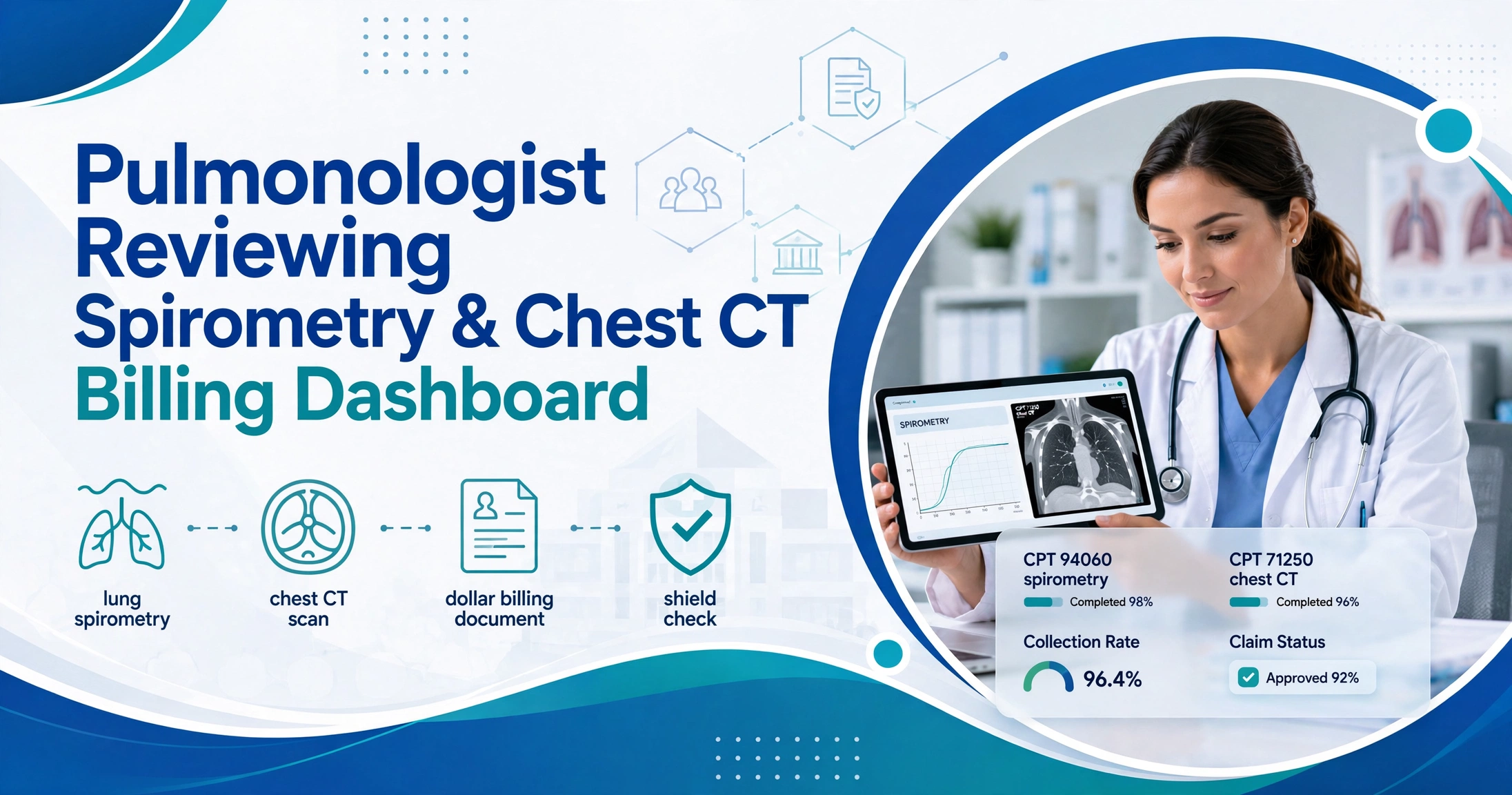
Pulmonology medical billing is the specialized process of coding, submitting, and collecting payment for the full range of respiratory and critical care services delivered by pulmonologists, intensivists, sleep medicine physicians, and respiratory therapists across the United States. It spans everything from an outpatient office visit for asthma management to a complex critical care admission for ARDS, from a simple spirometry test to a comprehensive polysomnography sleep study.
In the USA, pulmonology is one of the most procedure-dense specialties in internal medicine. The combination of diagnostic pulmonary function testing, interventional bronchoscopy, critical care billing, and sleep medicine under one specialty umbrella creates a billing environment that demands deep, subspecialty-specific expertise. According to the American Thoracic Society (ATS), respiratory diseases including COPD, asthma, lung cancer, and pulmonary fibrosis, affect over 35 million Americans, generating an enormous volume of pulmonology billing claims each year.
⚠️ Key Industry Statistic |
The CDC reports that COPD affects approximately 16 million Americans, and asthma affects over 25 million, making pulmonology one of the highest-volume billing specialties in US internal medicine. The American Lung Association estimates the annual economic burden of lung disease at over $150 billion, underscoring the financial significance of accurate pulmonology billing services. |
Pulmonology billing is not simply internal medicine billing with a respiratory filter. The complexity is real, multi-dimensional, and directly tied to revenue outcomes. Here is what makes pulmonology medical billing services a genuinely specialized discipline:
Multiple CPT code families, E/M, pulmonary function testing, bronchoscopy, critical care, sleep medicine, and thoracentesis all have distinct documentation, bundling, and payer rules.
Critical care billing is time-based and has strict start/stop time documentation requirements, with complex bundling rules that exclude many commonly performed services from separate billing.
Pulmonary function testing (PFT) has Technical Component (TC) and Professional Component (PC) billing similar to radiology, requiring correct modifier assignment based on who owns the equipment and who interprets results.
Sleep medicine billing involves facility vs. professional billing splits, home sleep test (HST) vs. polysomnography (PSG) distinctions, and payer-specific prior authorization requirements.
Medicare Local Coverage Determinations (LCDs) for pulmonary function tests, CPAP/BiPAP, and home oxygen are among the most detailed and strictly enforced LCDs in all of Medicare billing.
Bronchoscopy billing requires careful attention to bundled vs. separately billable add-on procedures,NCCI edits are extensive for bronchoscopy code families.
Mechanical ventilation and weaning management billing has specific inpatient rules governing what is bundled into daily critical care charges.
DME billing for home oxygen, CPAP, and BiPAP devices involves a separate Medicare DME fee schedule and accreditation requirements that most physician billing systems don’t handle.
Prior authorization for high-cost pulmonary biologics (dupilumab for asthma, nintedanib/pirfenidone for IPF) requires clinical documentation of step therapy failure.
Accurate CPT code selection across all service categories is the foundation of your pulmonology billing performance. Below are the major CPT code families that drive revenue in pulmonology medical billing:
| CPT Code | Description | Documentation Requirement | Key Notes |
|---|---|---|---|
| 99202–99205 | Office/Outpatient E/M — New Patient | MDM or total physician time | Level driven by MDM complexity or total time per 2021 AMA guidelines |
| 99211–99215 | Office/Outpatient E/M — Established Patient | MDM or total physician time | 99213/99214 are highest-volume pulmonology outpatient codes |
| 99221–99223 | Initial Hospital Care | Comprehensive H&P; MDM or time | Used for pulmonology inpatient admissions and consults accepted as admitting |
| 99231–99233 | Subsequent Hospital Care | Problem-focused to detailed; MDM or time | Daily pulmonology inpatient rounds; level selection per 2021 E/M guidelines |
| 99238–99239 | Hospital Discharge Management | 30 min / 31+ min threshold | Document discharge planning, medication reconciliation, follow-up instructions |
| 99242–99245 | Office Consultation (non-Medicare) | Comprehensive evaluation; request + report required | Medicare does not pay consult codes — use E/M codes for Medicare patients |
| CPT Code | Description | Component | Key Billing Notes |
|---|---|---|---|
| 94010 | Spirometry — including graphic record, total/timed vital capacity, expiratory flow rate | Global / TC / PC | Most common PFT code; -TC for lab, -26 for interpretation only |
| 94060 | Bronchodilation responsiveness — spirometry before and after bronchodilator | Global / TC / PC | Cannot bill 94010 separately on same day as 94060 |
| 94070 | Bronchospasm provocation — multiple spirometric determinations | Global / TC / PC | Methacholine challenge; requires detailed ICD-10 justification |
| 94150 | Vital capacity, total (separate procedure) | Global / TC / PC | Rarely billed separately in modern PFT labs |
| 94200 | Maximum breathing capacity, maximal voluntary ventilation | Global / TC / PC | Often performed as part of comprehensive PFT battery |
| 94375 | Respiratory flow-volume loop | Global / TC / PC | Variable intra-thoracic vs. extra-thoracic obstruction assessment |
| 94640 | Pressurized or nonpressurized inhalation treatment | Global | Nebulizer treatment in office; document indication and response |
| 94660 | CPAP initiation and management — face mask or intranasal interface | Global | In-office CPAP setup; document patient education and compliance monitoring |
| 94664 | Demonstration and/or evaluation of patient utilization of aerosol generator | Global | Inhaler technique instruction; document devices reviewed |
| 94726 | Plethysmography for determination of lung volumes and, when performed, airway resistance | Global / TC / PC | Body box plethysmography; requires physician interpretation for -26 billing |
| 94727 | Gas dilution or washout for determination of lung volumes | Global / TC / PC | He dilution or N2 washout method; medical necessity documentation required |
| 94729 | Diffusing capacity (DLCO) | Global / TC / PC | Critical for IPF, COPD severity, pre-surgical assessment; LCD compliance required |
| 94750 | Pulmonary compliance study | Global / TC / PC | Mechanical ventilation compliance monitoring; less common outpatient |
| CPT Code | Description | Time Requirement | Key Billing Notes |
|---|---|---|---|
| 99291 | Critical care, first 30–74 minutes | 30–74 min documented | Time-based; document start and stop time or total critical care time in note |
| 99292 | Critical care, each additional 30 min | +30 min increments | Add-on to 99291; bill once per additional 30 min block beyond 74 min |
| 94002 | Ventilator management — hospital inpatient/observation, initial day | Per day | Initiation of mechanical ventilation; document settings and clinical rationale |
| 94003 | Ventilator management — hospital inpatient/observation, each subsequent day | Per day | Daily ventilator management note; document PEEP, FiO2, mode, weaning plan |
| 94004 | Ventilator management — nursing facility, per day | Per day | Long-term ventilator patients in SNF; less common for pulmonologists |
| 94005 | Home ventilator management — physician or other qualified health care professional | Per month | Remote management of home ventilator patients; document contacts and adjustments |
| 94660 | CPAP initiation — in-hospital | Per session | Hospital-based CPAP initiation; documentation of settings and response |
| CPT Code | Description | Setting | Key Billing Notes |
|---|---|---|---|
| 31622 | Bronchoscopy, rigid or flexible; diagnostic, with cell washing | Hospital / ASC | Base bronchoscopy code; other procedures billed as add-ons |
| 31623 | Bronchoscopy with brushing | Hospital / ASC | Add-on to base bronchoscopy |
| 31624 | Bronchoscopy with bronchial alveolar lavage (BAL) | Hospital / ASC | BAL for infection, malignancy, ILD evaluation |
| 31625 | Bronchoscopy with bronchial or endobronchial biopsy | Hospital / ASC | Biopsy of visible lesion; document number of biopsies |
| 31628 | Bronchoscopy with transbronchial lung biopsy (TBLB) | Hospital / ASC | Add-on; fluoroscopy guidance separately billable |
| 31629 | Bronchoscopy with transbronchial needle aspiration (TBNA) | Hospital / ASC | Add-on; document lymph node station(s) sampled |
| 31635 | Bronchoscopy with foreign body removal | Hospital / ASC | Document type/location of foreign body |
| 31641 | Bronchoscopy with destruction of tumor | Hospital / ASC | Electrocautery, APC, cryotherapy — document method |
| 31647–31660 | Bronchoscopy with balloon dilation, stent placement, bronchial thermoplasty | Hospital / ASC | Advanced interventional procedures; prior auth almost always required |
| 32557 | Thoracentesis, image-guided | Hospital / Office | Most thoracenteses performed with ultrasound guidance; bill 76942 for imaging separately |
| 32560 | Instillation of agent for pleurodesis | Hospital | Document agent used and technique |
�� Pro Tip: Bronchoscopy Add-On Code Billing |
Bronchoscopy CPT codes are structured as a base code (31622) plus add-on codes for each additional procedure performed during the same bronchoscopic session. You never bill a second base bronchoscopy code for additional procedures, only the add-on codes. |
NCCI edits are extensive for bronchoscopy. Before submitting a bronchoscopy claim with multiple add-on codes, run the combination through an NCCI edit checker. Common edits flag 31623 (brushing) and 31625 (biopsy) when billed together, each requiring documentation of a distinct site or indication. |
When performing EBUS (endobronchial ultrasound) for TBNA (31629 + 31652 or 31653), document the lymph node stations sampled by IASLC map designation and the ultrasound image findings that guided needle placement. |
A comprehensive pulmonology billing services partner delivers end-to-end revenue cycle management, not just claim submission. Here is what best-in-class pulmonology medical billing services include:
| Service Component | What It Includes | Why It Matters for Pulmonology |
|---|---|---|
| Charge Capture & Code Review | Visit-by-visit CPT/ICD-10 assignment, modifier review, TC/PC determination for PFTs | Prevents PFT component billing errors and missed bronchoscopy add-on codes |
| PFT Billing Management | TC/PC modifier assignment, LCD compliance check, frequency verification | PFT LCD non-compliance is a leading cause of Medicare denials in pulmonology |
| Critical Care Time Audit | Review of 99291/99292 time documentation before submission | Time billing errors in critical care are among the highest-dollar audit targets |
| Prior Authorization Management | Pre-auth for bronchoscopy, advanced PFTs, biologics, sleep studies | Reduces denials for high-value interventional procedures |
| Claims Submission | Electronic claims via clearinghouse; UB-04 for facility billing | Rapid submission; correct form per setting |
| Sleep Medicine Billing | HST vs. PSG code selection, CPAP/BiPAP auth and supply billing coordination | Incorrect HST vs. PSG selection is a common and costly error |
| DME Coordination | Home O2, CPAP, BiPAP supply billing referral or management | DME billing requires separate MAC enrollment and DMEPOS accreditation |
| Denial Management | Root-cause analysis, LCD-specific appeals, peer-to-peer facilitation | LCD non-coverage denials require clinical documentation-based appeals |
| Payment Posting & Underpayment Review | EOB reconciliation, contracted rate verification, underpayment recovery | Systematic underpayment is common for PFT and bronchoscopy professional fees |
| Compliance Monitoring | OIG work plan monitoring, LCD/NCD updates, documentation audit support | Pulmonology is a regular OIG audit target for critical care and PFT billing |
| Reporting & Analytics | Monthly KPI dashboards, denial trending by CPT and payer, AR aging reports | Data-driven practice performance management |
Accurate ICD-10-CM diagnosis coding in pulmonology billing directly determines medical necessity, LCD compliance, and payer coverage decisions. The following table covers the most clinically and financially significant diagnosis codes in pulmonology billing services:
| ICD-10-CM Code(s) | Diagnosis | Pulmonology Billing Context |
|---|---|---|
| J44.0 / J44.1 | COPD with acute exacerbation / COPD with acute lower respiratory infection | Specify exacerbation vs. stable; drives E/M level and supports PFT medical necessity |
| J44.9 | COPD, unspecified | Use more specific codes when available; unspecified codes invite medical necessity scrutiny |
| J45.20–J45.51 | Mild/Moderate/Severe/Partly controlled/Uncontrolled asthma | Severity and control status specificity required for biologic prior authorization |
| J84.10–J84.112 | Idiopathic Pulmonary Fibrosis (IPF) and other ILD | Critical for nintedanib/pirfenidone PA; DLCO (94729) and HRCT documentation required |
| C34.10–C34.90 | Malignant neoplasm of bronchus and lung | Lung cancer — drives bronchoscopy, EBUS, navigational bronchoscopy billing |
| J18.9 | Pneumonia, unspecified organism | Inpatient pulmonology consult; specify organism when culture results available |
| J96.00–J96.91 | Acute/Chronic/Acute-on-chronic respiratory failure | Critical care billing driver; specify with/without hypoxia/hypercapnia |
| G47.30–G47.39 | Sleep apnea (obstructive, central, other) | Drives PSG and CPAP/BiPAP billing; must match sleep study findings |
| J38.01–J38.02 | Paralysis of vocal cords and larynx | Unilateral/bilateral; affects bronchoscopy and upper airway evaluation billing |
| J70.2–J70.4 | Acute/Chronic drug-induced interstitial pneumonitis | Drug history documentation critical for ICD-10 specificity |
| Z87.891 | Personal history of nicotine dependence | Smoking cessation counseling billing support (99406/99407) |
| R09.02 | Hypoxemia | Supports home oxygen order and DME authorization |
| J90 | Pleural effusion, not elsewhere classified | Thoracentesis indication; specify transudative vs. exudative when known |
| J93.0–J93.9 | Pneumothorax (spontaneous, tension, other) | Emergency and interventional billing; document type and management |
Medicare is the dominant payer for most pulmonology practices, given the specialty’s heavy patient mix of elderly COPD, lung cancer, and sleep apnea patients. You need to completely understand CMS-specific rules for pulmonology billing is essential for protecting your revenue.
PFT services billed under Medicare must comply with the applicable MAC’s LCD, each MAC (CGS, Novitas, WPS, NGS, etc.) has its own PFT LCD with specific covered diagnoses and frequency limitations.
Medicare does NOT cover consult codes (99241–99245), use the appropriate E/M code (new or established patient) for all Medicare consultations and document referring provider information.
Critical care codes (99291/99292) require documented total critical care time, Medicare reviewers verify time documentation in medical records.
Home oxygen authorization requires specific clinical criteria: PaO2 ≤55 mmHg or SaO2 ≤88% at rest, or qualifying exercise/sleep oximetry, document ABG or oximetry results that meet Medicare’s LCD criteria.
CPAP for OSA requires a qualifying sleep study (PSG or HST) demonstrating AHI ≥5 with symptoms, or AHI ≥15 regardless of symptoms, and a face-to-face clinical evaluation before initiation.
Medicare bundles many ventilator management services into the daily critical care charge, review CMS bundling rules before billing 94002/94003 separately on days with 99291.
| Medicare Rule / Policy | Impact on Pulmonology Billing | Key Resource |
|---|---|---|
| MAC-specific PFT LCDs | Covered diagnoses and frequency limits vary by MAC jurisdiction | cms.gov — search your MAC's LCD for 'pulmonary function' |
| No Consult Codes for Medicare | Use 99202–99215 or 99221–99223 for all Medicare consultations | cms.gov/medicare/physician-fee-schedule |
| Critical Care Time Documentation | Start/stop or total critical care time required in clinical note | CMS Critical Care Billing Guidelines |
| Home Oxygen Coverage (LCD L33797) | ABG or oximetry criteria must be documented before prescribing | cms.gov — LCD L33797 or equivalent MAC LCD |
| CPAP Coverage (LCD L33718) | Qualifying sleep study + face-to-face evaluation required | cms.gov — LCD L33718 or equivalent MAC LCD |
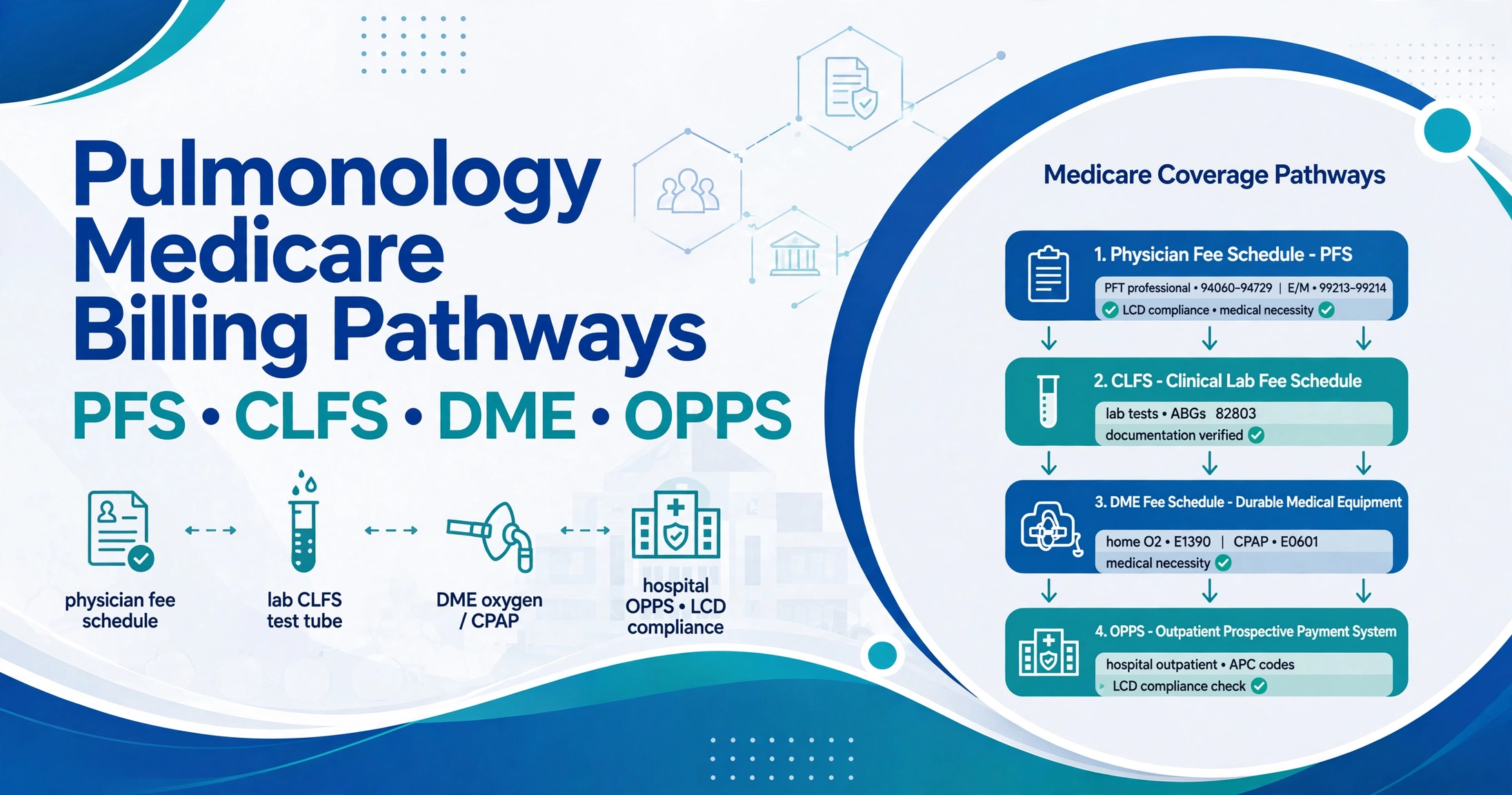
| OPPS Packaging Rules | Many PFTs and bronchoscopy add-ons are packaged in hospital outpatient | cms.gov/medicare/payment/prospective-payment-systems/hospital-outpatient |
| PAMA CLFS for Lab Tests | Pulmonary lab tests (ABG, cultures) paid under Clinical Lab Fee Schedule | cms.gov/medicare/payment/clinical-laboratory-fee-schedule |
�� IMAGE PLACEHOLDER Infographic: Pulmonology Medicare Billing Pathways — showing Physician Fee Schedule (PFT professional, E/M), CLFS (lab tests), DME Fee Schedule (home O2, CPAP), and OPPS (hospital outpatient) flows with key LCD compliance checkpoints 1200 x 800 px | Alt text: ‘Medicare pulmonology billing pathways infographic showing PFS, CLFS, DME and OPPS reimbursement routes for US pulmonology practices’ |
Pulmonary function testing is one of the most financially significant, and most compliance-sensitive, service areas in pulmonology medical billing. PFTs are among the most frequently audited services under Medicare, and LCD non-compliance is a leading cause of claim denials and overpayment demand letters in pulmonology practices.
| Scenario | Correct Billing | Common Error to Avoid |
|---|---|---|
| Pulmonologist owns PFT equipment AND interprets results | Bill globally (no modifier) — 94010, 94726, 94729, etc. | Do not split into TC + PC when billing globally |
| Hospital or independent lab owns PFT equipment | Hospital bills TC (-TC modifier); pulmonologist bills PC (-26 modifier) | Pulmonologist billing globally when hospital owns equipment = overbilling |
| Pulmonologist interprets study performed at another facility | Bill -26 (professional component) only | Do not bill TC for equipment you don't own or operate |
| Pulmonologist performs and interprets in office-owned lab | Bill globally or as appropriate based on employment arrangement | Employed physicians in hospital-owned offices may not be able to bill TC |
✅ Medicare PFT Billing Compliance Requirements |
You need to verify the patient’s ICD-10-CM diagnosis is on the covered diagnoses list in your MAC’s PFT LCD before scheduling. |
Document clinical indication and ordering physician’s request in the chart. |
Ensure PFT equipment is calibrated per manufacturer specifications and document calibration records. |
Record pre- and post-bronchodilator values when billing 94060 — document response to bronchodilator. |
For DLCO (94729): document smoking history, hemoglobin level, and altitude when clinically relevant |
Check frequency limits — most MAC LCDs limit spirometry to a certain number per year for stable COPD; exacerbations may justify additional testing |
Issue an ABN (Advance Beneficiary Notice) when performing a PFT with a diagnosis that may not be covered by the patient’s MAC LCD |
Tip: PFT Bundling Rules |
CPT 94060 (bronchodilation responsiveness) includes spirometry, you cannot bill 94010 (spirometry) separately on the same day as 94060. This is one of the most common NCCI edit violations in pulmonology billing. |
When performing a complete PFT battery (spirometry + lung volumes + DLCO), bill 94010 or 94060, 94726 or 94727, and 94729 separately, these are distinct procedures with distinct CPT codes. Do not bundle them under a single ‘pulmonary function’ charge. |
Body box plethysmography (94726) and gas dilution lung volumes (94727) measure the same parameter (lung volumes) by different methods, do not bill both on the same date without distinct medical justification, as payers will deny one as duplicate. |
Critical care billing is one of the highest-value and highest-audit-risk components of pulmonology medical billing. Pulmonologists and intensivists who bill 99291/99292 correctly can capture substantial revenue; those who bill without rigorous time documentation face significant overpayment exposure.
| Total Critical Care Time | CPT Codes to Bill | Units |
|---|---|---|
| 30–74 minutes | 99291 | 1 unit |
| 75–104 minutes | 99291 + 99292 | 1 + 1 unit |
| 105–134 minutes | 99291 + 99292 x 2 | 1 + 2 units |
| 135–164 minutes | 99291 + 99292 x 3 | 1 + 3 units |
| 165–194 minutes | 99291 + 99292 x 4 | 1 + 4 units |
| < 30 minutes | Bill appropriate E/M code (not critical care) | 99231–99233 or appropriate level |
Sleep medicine is a major revenue stream for many pulmonology practices across the USA and a billing minefield. The combination of facility vs. professional billing splits, home sleep test vs. polysomnography distinctions, and Medicare’s stringent CPAP/BiPAP coverage LCDs creates a billing environment that demands careful, specialized management.
| CPT Code | Description | Setting | Key Billing Notes |
|---|---|---|---|
| 95800 | Home sleep apnea test (HSAT) — unattended, minimum 3 channels | Home | Technical component billed by DME supplier; professional interpretation billed separately |
| 95801 | HSAT — unattended, minimum 7 channels including EEG, EMG, EOG | Home | More comprehensive home study; professional interpretation billed by physician |
| 95805 | Multiple sleep latency test (MSLT) — attended | Sleep lab | Narcolepsy/hypersomnia evaluation; requires prior overnight PSG |
| 95806 | Home sleep apnea test — unattended, type III device minimum 4 channels | Home | Most commonly used HSAT code; no EEG required |
| 95807 | Sleep study — attended, less than full polysomnography | Sleep lab | Limited attended study; less common than 95810 |
| 95808 | Polysomnography (PSG) — age 6+, sleep staging with 1–3 additional parameters | Sleep lab | Full facility-based sleep study; TC billed by lab, PC (-26) billed by interpreting physician |
| 95810 | Polysomnography — age 6+, sleep staging with 4+ additional parameters | Sleep lab | Comprehensive PSG; most commonly used full polysomnography code |
| 95811 | PSG with CPAP titration | Sleep lab | Split-night or full-night CPAP titration; documents optimal CPAP pressure |
| 95782 | PSG — younger than 6 years, 4+ additional parameters | Sleep lab (pediatric) | Pediatric-specific PSG code; requires pediatric sleep lab |
| 94660 | CPAP initiation and management | Office/Hospital | Document CPAP settings, patient education, and compliance monitoring |
�� Pro Tip: Sleep Medicine Billing in Pulmonology |
For Medicare patients, CPAP coverage requires a qualifying PSG or HSAT showing AHI ≥5 with symptoms or AHI ≥15 regardless of symptoms. If the initial titration trial shows compliance ≥4 hours/night for ≥70% of nights in a 30-day period, continued coverage is authorized. Document compliance data from CPAP downloads meticulously for continued coverage. |
When a pulmonologist both reads the home sleep test and manages CPAP, bill the professional interpretation of the HST (95806-26 or appropriate code) AND the CPAP management visit (99213/99214 or 94660) separately. These are distinct services. |
Medicare will not cover an attended PSG if an unattended HSAT was not tried first for straightforward OSA suspects — unless the patient has a comorbidity that makes HSAT unreliable (e.g., CHF, COPD, central apnea). Document the HSAT-first pathway or the clinical reason for going directly to PSG. |
Denial management is where pulmonology your practice recovers the most preventable revenue loss. Here are the most impactful denial categories in pulmonology medical billing and our proven strategies to resolve and prevent them:
| Denial Type | Root Cause | Fix / Prevention Strategy |
|---|---|---|
| PFT LCD Non-Coverage | ICD-10 diagnosis not on covered diagnoses list in MAC's LCD | We will verify diagnosis against MAC LCD before scheduling; issue ABN when coverage uncertain |
| Critical Care Time Not Documented | 99291/99292 billed without documented critical care time in note | We will mandate time documentation in ICU note template; train physicians on time-based billing rules |
| PFT Bundling Violation (NCCI Edit) | 94010 billed same day as 94060; 94726 and 94727 billed same day | We will run all PFT combinations through NCCI edit checker; update charge master to prevent conflicting codes |
| Bronchoscopy Add-On Without Base | Add-on bronchoscopy codes billed without base code 31622 | Build claim scrubbing rule requiring base code before any add-on bronchoscopy code |
| Missing Prior Authorization | Bronchoscopy, advanced PFT, sleep study, or biologic billed without auth | Build PA requirement flag into scheduling for all auth-required procedures |
| TC/PC Modifier Error on PFTs | Pulmonologist billing globally for hospital-owned PFT equipment | Audit employment/ownership arrangement; restrict global billing to office-owned equipment only |
| CPAP/BiPAP LCD Non-Coverage | Sleep study results don't meet Medicare's AHI threshold; documentation gap | Review LCD criteria before ordering CPAP; ensure PSG/HSAT report contains AHI value |
| Consult Code Billed to Medicare | 99241–99245 submitted to Medicare (not covered) | Replace consult codes with appropriate E/M codes for all Medicare claims; document referring provider |
| Ventilator Management Bundled into Critical Care | 94002/94003 billed same day as 99291 by same physician | Do not bill ventilator management codes on critical care days; time is bundled |
| Timely Filing Exceeded | High-volume inpatient billing causes delays beyond payer filing windows | Set 30-day submission alerts for all inpatient pulmonology charges; prioritize critical care claims |
Pulmonology practices handle highly sensitive patient health information respiratory disease diagnoses, sleep disorder records, cancer diagnoses, and critical care records all of which require rigorous HIPAA compliance. Additionally, pulmonology billing is a regular target for Medicare audits, particularly for PFT and critical care services.
✅ HIPAA & Billing Compliance Checklist for Pulmonology Practices |
Execute current Business Associate Agreements (BAAs) with all billing vendors, clearinghouses, and sleep lab partners who access PHI. |
Implement audit log monitoring in your EHR and billing system quarterly at minimum. |
Conduct annual internal billing compliance audits focusing on: PFT LCD compliance, critical care time documentation, and bronchoscopy add-on code accuracy. |
Train billing staff on MAC-specific LCD updates for PFTs, CPAP, and home oxygen, these change annually. |
Maintain ABN documentation for all Medicare PFT services where coverage is uncertain. |
Ensure home oxygen and CPAP referral documentation meets Medicare’s detailed qualifying criteria before prescribing. |
Respond to any MAC Additional Documentation Requests (ADRs) within the stated deadline — non-response results in automatic denial. |
Pulmonology medical billing services must be configured to match your specific practice setting. Reimbursement rules, forms, and billing workflows differ significantly across these environments:
| Practice Setting | Billing Model | Key Pulmonology Billing Considerations |
|---|---|---|
| Private/Independent Pulmonology Group | CMS-1500; mix of Medicare, commercial, Medicaid | Highest billing complexity; TC/PC determination for office PFT lab; most benefit from specialized pulmonology billing services |
| Hospital-Employed Pulmonologist | Professional billing (CMS-1500); hospital bills TC for PFTs and facility fees | No global PFT billing for hospital-owned equipment; employed physicians use -26 modifier only |
| Academic Medical Center | Professional (CMS-1500) + Teaching physician documentation requirements | Attending must document personal key portions of service; resident notes insufficient without attending addendum |
| Hospital-Based Critical Care / Intensivist | CMS-1500 for professional; UB-04 for facility | Critical care time billing most intense here; coordination with hospital coding team essential |
| Sleep Medicine Lab (Independent) | TC for facility PSG; physicians bill -26 for interpretation | Facility must be accredited (AASM); Medicare requires specific equipment and scoring standards |
| Outpatient Pulmonary Rehab | HCPCS G0237–G0239 (therapeutic procedures) or 97110 | Pulmonary rehabilitation coding requires physician supervision documentation |
| Telehealth Pulmonology | Standard CPT + modifier 95 / POS 10 or POS 02 | Cannot perform or bill PFTs, bronchoscopy, or thoracentesis via telehealth; E/M and follow-up visits only |
Effective pulmonology billing performance management requires tracking metrics that reflect the unique revenue dynamics of respiratory care, including PFT LCD compliance rates and critical care documentation accuracy. Here are the KPIs that matter most:
| KPI | Definition / Formula | Benchmark Target |
|---|---|---|
| Days in AR | Total AR ÷ Average daily charges | < 35 days |
| First Pass Resolution Rate | Claims paid on first submission ÷ Total claims submitted | > 95% |
| Overall Denial Rate | Denied claims ÷ Total claims submitted | < 5% |
| PFT LCD Compliance Rate | PFT claims with covered diagnosis ÷ Total PFT claims | > 98%; track by MAC jurisdiction |
| Critical Care Documentation Rate | 99291 claims with time documented ÷ Total 99291 claims submitted | > 99%; non-negotiable for audit protection |
| Clean Claim Rate | Claims accepted without edits ÷ Total submitted | > 97% |
| Collection Rate | Collections ÷ Net adjusted charges | > 95% |
| Bronchoscopy Add-On Capture Rate | Add-on codes billed per bronchoscopy ÷ Procedures documented | Benchmark against your procedure log; gaps indicate missed revenue |
| Prior Auth Approval Rate | Auths obtained ÷ Auth requests submitted | > 90%; track by procedure type |
| Charge Lag | Days from encounter to claim submission | < 48 hours (critical care); < 24 hours ideal |
The decision between in-house billing and partnering with a specialized pulmonology billing services company like House of Outsourcing is one of the most important operational choices your practice makes. Here is the complete, honest comparison:
| Factor | In-House Billing | Outsourced Pulmonology Billing Services |
|---|---|---|
| Startup Cost | High — staff, EHR/PM setup, PFT billing training, compliance infrastructure | Low, percentage of collections or flat fee; no hiring cost |
| Ongoing Cost | Salaries, benefits, training on LCD updates, PFT and critical care rules | Predictable % of revenue; no HR overhead |
| PFT LCD Expertise | Requires staff who monitor each MAC's LCD — changes annually across jurisdictions | Specialized vendors maintain current PFT LCD compliance protocols by MAC |
| Critical Care Time Billing | Requires physician education program and ongoing note auditing | Pulmonology billing specialists audit critical care time documentation before submission |
| Bronchoscopy Code Accuracy | Complex NCCI edit landscape requires trained coders | Interventional pulmonology coding is a core competency of pulmonology billing specialists |
| Sleep Medicine Billing | HST vs. PSG, CPAP LCD, DME coordination require specialized knowledge | Sleep medicine billing integration included with comprehensive pulmonology billing services |
| Scalability | Difficult — hiring lags volume; critical care billing backlogs accumulate quickly | Scales immediately; no revenue dip during staff transitions |
| Revenue Performance | Variable — LCD non-compliance and documentation gaps cost revenue | Consistent — performance tracked via SLA with transparent reporting |
| Best For | Large academic centers with dedicated pulmonology billing teams | Solo pulmonologists, small-medium groups, practices with significant PFT/sleep/critical care volume |
Tip: Evaluating a Pulmonology Billing Services Vendor |
Ask specifically how they manage MAC-specific PFT LCD compliance, do they have a process for verifying covered diagnoses before submission, or do they simply submit and appeal denials? |
Request their critical care billing audit process, how do they verify that 99291/99292 claims have time documented before submission? |
Ask about their bronchoscopy NCCI edit workflow can they demonstrate a bronchoscopy claim with multiple add-on codes that passed clean on first submission? |
Verify they have CPC-certified coders (AAPC) or CCS credentials (AHIMA) with documented pulmonology or internal medicine subspecialty experience. |
Request a sample monthly reporting package that shows denial breakdown by CPT code and denial reason — PFT and critical care denials should be tracked separately. |
Successful pulmonology billing depends on accurate coding, complete documentation, and compliance with current payer guidelines. The following authoritative resources provide up-to-date information on CPT coding, Medicare reimbursement, pulmonary procedures, and billing regulations to help you improve claim accuracy and reduce denials.
| Resource | Organization | URL |
|---|---|---|
| ATS Coding & Billing Resources | American Thoracic Society | thoracic.org/professionals/clinical-resources/coding/ |
| CMS Physician Fee Schedule Search | CMS (Medicare) | cms.gov/medicare/physician-fee-schedule/search |
| CMS Medicare Coverage Database (LCDs) | CMS (Medicare) | cms.gov/medicare-coverage-database/search.aspx |
| NCCI Policy Manual | CMS / NCCI | cms.gov/medicare/coding-billing/national-correct-coding-initiative-edits |
| ICD-10-CM Official Guidelines | CMS / CDC | cms.gov/medicare/coding-billing/icd-10-codes/icd-10-cm-documentation |
| CMS Hospital Outpatient PPS (OPPS) | CMS (Medicare) | cms.gov/medicare/payment/prospective-payment-systems/hospital-outpatient |
| CMS Clinical Laboratory Fee Schedule | CMS (Medicare) | cms.gov/medicare/payment/clinical-laboratory-fee-schedule |
| OIG Work Plan | HHS Office of Inspector General | oig.hhs.gov/reports-and-publications/workplan/index.asp |
| HIPAA Resources for Providers | HHS Office for Civil Rights | hhs.gov/hipaa/index.html |
| Medicaid State Overviews | Medicaid.gov | medicaid.gov/state-overviews/index.html |
| MGMA DataDive Benchmarks | Medical Group Management Assoc. | mgma.com/data/benchmarking-data/mgma-datadive |
| American Lung Association Statistics | American Lung Association | lung.org/research/trends-in-lung-disease |
| AASM Sleep Lab Accreditation | American Academy of Sleep Medicine | aasm.org/resources/factsheets/accreditation.pdf |
The highest-volume CPT codes in pulmonology billing are 99213/99214 (established patient office E/M for COPD and asthma follow-ups), 94010 (spirometry the single most billed pulmonary function test), 99291 (critical care, first 30–74 minutes for pulmonologists with ICU responsibilities), and 94729 (DLCO diffusing capacity, critical for IPF and pre-surgical assessment). Bronchoscopy (31622 + appropriate add-on codes) represents the highest per-claim revenue in pulmonology. Sleep study interpretation codes (95810-26, 95806-26) are increasingly significant as sleep medicine becomes a standard pulmonology service line
Technical Component (TC) billing covers the equipment, supplies, and staff required to perform the PFT billed with modifier -TC. Professional Component (PC) billing covers the physician’s interpretation and written report billed with modifier -26. When a pulmonologist owns the PFT lab equipment and provides the interpretation, they bill globally (no modifier). When the hospital or an independent lab owns the equipment, the facility bills the TC and the pulmonologist bills only the PC (-26). Billing globally when you don’t own the equipment is a false claims exposure. The billing model must match the actual ownership and service arrangement and this should be documented in your practice’s compliance policies
Medicare covers pulmonary function tests when they are medically necessary but medically necessary is defined by your Medicare Administrative Contractor’s (MAC) Local Coverage Determination (LCD) for pulmonary function testing. Each MAC (CGS, Novitas, WPS, NGS, First Coast, etc.) has its own LCD listing covered ICD-10-CM diagnoses and frequency limitations. The most commonly covered diagnoses across all MACs include J44.x (COPD), J45.x (asthma), J84.x (ILD/IPF), J96.x (respiratory failure), and related conditions. To find your MAC’s specific PFT LCD, visit the CMS Medicare Coverage Database and search for ‘pulmonary function’ within your MAC’s jurisdiction. Always issue an Advance Beneficiary Notice (ABN) when you perform a PFT for a diagnosis that may not be covered
Get a free assessment from our billing experts