
Our Allergy & Immunology RCM services help practices optimize revenue through accurate coding, prior authorization, claims management, and denial prevention. We streamline complex allergy billing workflows to improve reimbursements, reduce payment delays, and strengthen financial performance.

Managing revenue for your allergy and immunology practice isn’t as simple as submitting office visit claims to insurances. From allergy testing and immunotherapy to biologic treatments and prior authorizations, every service has unique billing rules from insurances. That’s why our expert have written this guide to helps you understand the entire allergy & immunology revenue cycle management process in a clear and practical way.
Billing errors, payer policy changes, and missed documentation can lead to delayed payments, denials, and lost revenue. With the right revenue cycle management strategy, your practice can improve claim accuracy, reduce rework, and accelerate reimbursements while staying compliant with changing payer requirements.
Need support with your billing workflow? Explore our medical billing and revenue cycle services or request a free consultation.
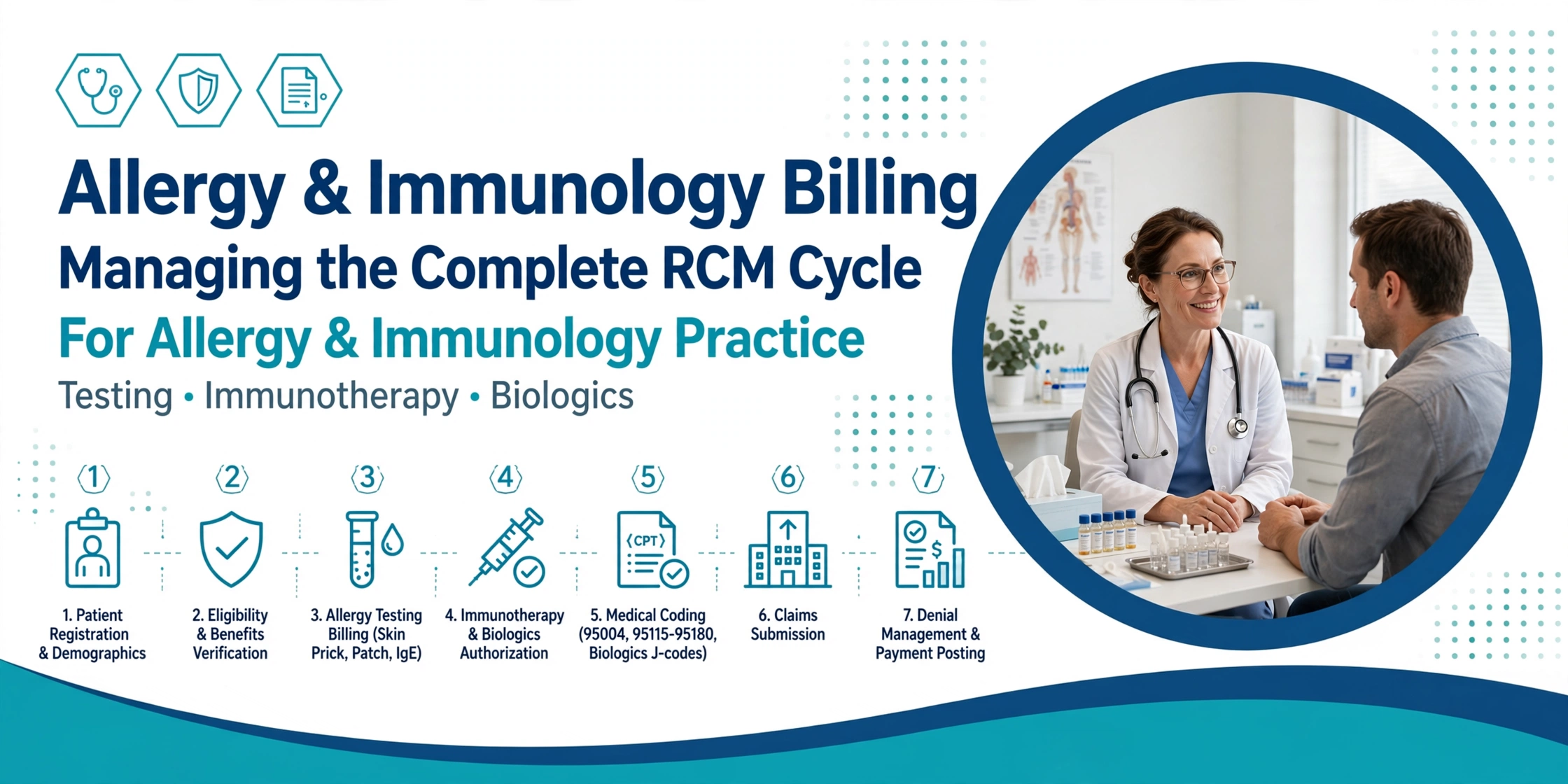
Allergy & immunology revenue cycle management is the end-to-end process of managing patient billing, medical coding, insurance claims submission, payment posting, denial management, and reimbursement optimization for allergy and immunology practices. It spans the full continuum from patient registration and eligibility verification through allergy testing charge capture, immunotherapy vial billing, injection administration coding, biologic infusion reimbursement, and final payment collection.
Unlike primary care or many other healthcare specialties, allergy and immunology billing involves several uniquely complex service lines that each carry their own CPT code families, documentation requirements, frequency limits, and payer-specific rules:
Allergy Testing: As an allergist you know that skin testing, intradermal testing, patch testing, and in-vitro testing each require different codes and have different frequency and bundling rules.
Immunotherapy Vial Preparation: The preparation and mixing of allergen extracts is billed separately from administration and requires precise coding of antigens.
Allergy Injection Administration: In the USA allergy shots (subcutaneous immunotherapy) are billed per injection episode with codes that distinguish single versus multiple antigen injections and whether the physician is present.
Biologic Infusions: Medications such as dupilumab, omalizumab, and mepolizumab require infusion coding, drug HCPCS codes, and often prior authorization from insurance companies.
Evaluation & Management (E/M) Visits: Office visits require appropriate level coding using the 2021 AMA E/M guidelines based on medical decision making or total time.
Pulmonary Function Testing: Spirometry and related testing performed in allergy/immunology offices require their own CPT codes and documentation standards.
An allergy patient might receive an E/M visit, allergy skin testing, and an immunotherapy injection all in the same appointment. Each service you have provided to your patient has its own CPT code, its own documentation requirement, and its own payer rules about whether it can be billed with the others. Getting the bundling right knowing when modifier 25 is needed, when codes can be billed together, and when they trigger NCCI edits, is where your allergy practice lose significant revenue.
Commercial payer policies on allergy testing coverage vary enormously. Some plans cover comprehensive testing panels; others impose strict limits on the number of antigens tested per visit. Some require prior authorization for immunotherapy; others don’t. Without payer-specific knowledge, your medical practice either under-bill, or over-bill (triggering denials and compliance risk).
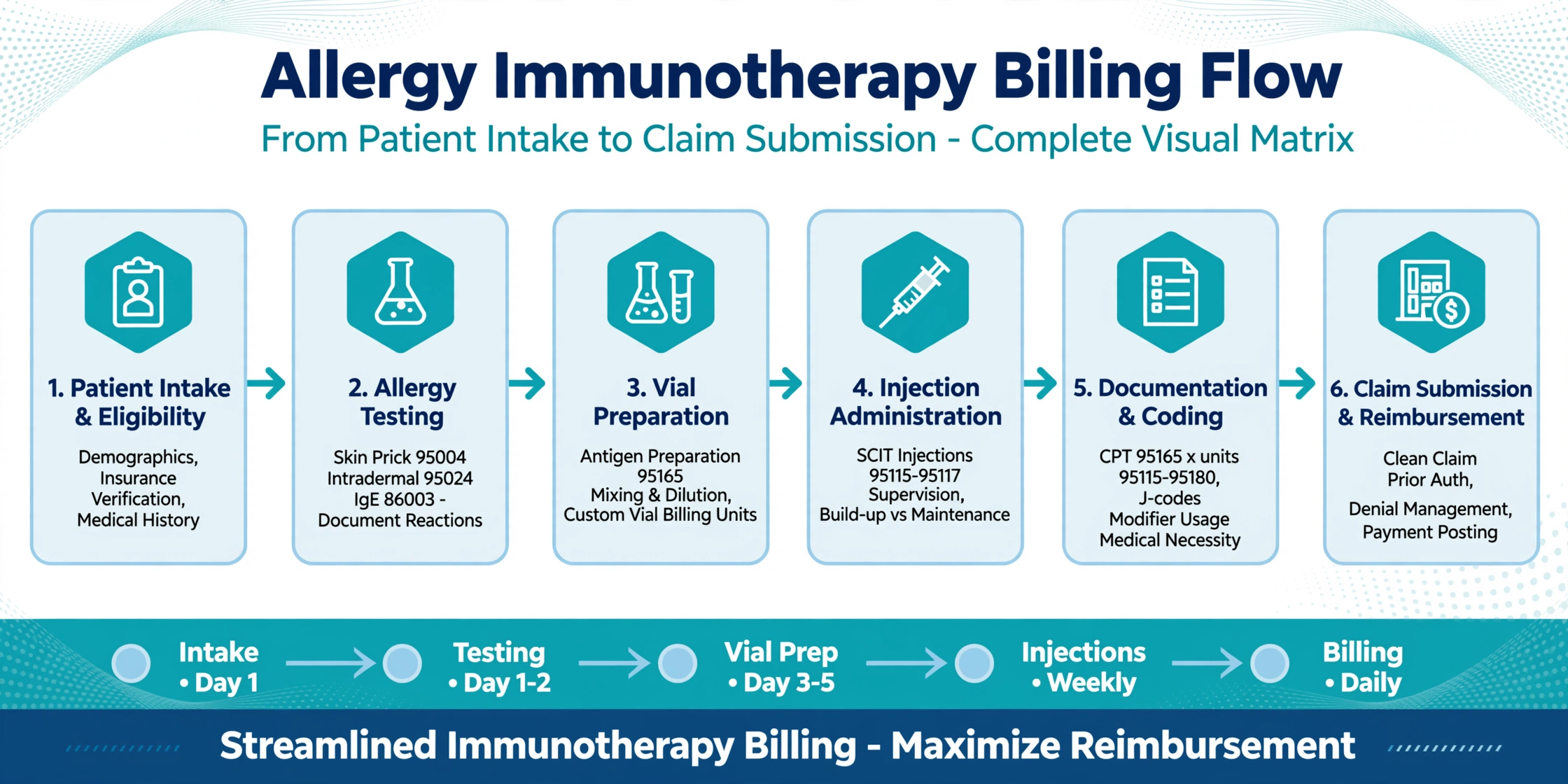
Billing for allergen immunotherapy involves two separate billing streams; vial preparation (the mixing and preparation of allergen extracts) and injection administration (the actual administration of the shot). These must be billed correctly and separately, with accurate documentation of the antigen mixture, concentration, and the number of antigens included.
Biologics like dupilumab (Dupixent), omalizumab (Xolair), mepolizumab (Nucala), and others represent a significant and growing revenue stream for your allergy practice, but they also represent some of the most complex billing in the specialty. Prior authorization is nearly universal, documentation of medical necessity must be ironclad, and drug coding using HCPCS codes must be precise. The JW and JZ modifiers for drug wastage are commonly missed, creating compliance exposure.
The AMA CPT code system is the foundation of every allergy immunology claim. Here’s your comprehensive 2026 reference for the core code families:
| CPT Code | Description | Key Billing Rule |
|---|---|---|
| 95004 | Percutaneous tests (scratch, puncture, prick) with allergenic extracts | Per test — specify number of tests |
| 95024 | Intracutaneous (intradermal) tests, sequential and incremental | Per test — separate from 95004 |
| 95027 | Intracutaneous tests, sequential, incremental, biologics | Per test — biologics specific |
| 95044 | Patch or application tests | Per patch/application |
| 95052 | Photo patch tests | Per test |
| 86003 | Allergen specific IgE (RAST) — each allergen | Per allergen — in-vitro testing |
| 95076 | Ingestion challenge — up to 120 min | Time-based — document start/end time |
| 95079 | Ingestion challenge — each additional 60 min | Add-on to 95076 |
| CPT Code | Description | Key Billing Rule |
|---|---|---|
| 95115 | Professional services for allergen immunotherapy — single injection | No vial preparation included |
| 95117 | Professional services — 2+ injections | No vial preparation included |
| 95120 | Professional services + vial — single injection | Includes antigen preparation |
| 95125 | Professional services + vial — 2+ injections | Includes antigen preparation |
| 95130 | Professional services + vial — single stinging insect venom | Venom specific |
| 95131-95134 | Professional services + multiple stinging insect venoms | 2, 3, 4, or 5 venoms |
| 95144 | Professional services for prepare allergen antigen — single dose vials | Vial prep only — per vial |
| 95145-95149 | Prepare allergen antigen — venoms, 1–5 venoms | Venom vial prep series |
| 95165 | Professional services for allergen immunotherapy — multiple dose vials | Per dose — most common vial prep code |
Tip: Vial Prep vs. Injection Admin
One of the most costly billing errors in allergy and immunology practice is confusing vial preparation codes (95144–95165) with injection administration codes (95115–95117). Vial prep is billed when your medical practice mixes and prepares the allergen extract. Injection admin is billed when the shot is given. They are separate services and must be billed separately, but only when both actually occurred. Billing vial prep without documented preparation is a compliance violation
| Drug | HCPCS Code | Administration CPT | Prior Auth Typically Required? |
|---|---|---|---|
| Omalizumab (Xolair) | J2357 | 96372 (subcut injection) | Yes — most payers |
| Dupilumab (Dupixent) | J0173 | 96372 (subcut injection) | Yes — most payers |
| Mepolizumab (Nucala) | J0222 | 96372 (subcut injection) | Yes — most payers |
| Benralizumab (Fasenra) | J0517 | 96372 (subcut injection) | Yes — most payers |
| Tezepelumab (Tezspire) | J3590 (NOC) / assigned code | 96372 (subcut injection) | Yes — most payers |
The Centers for Medicare & Medicaid Services (CMS) sets the reimbursement framework for Medicare patients and serves as the benchmark most commercial payers reference. Here’s what’s current for allergy immunology billing in 2026:
| Topic | Medicare Rule / Guideline (2026) |
|---|---|
| Allergy Testing Coverage | Covered when medically necessary and documented; payer-specific limits on number of tests per visit apply |
| Immunotherapy Coverage | Covered for allergen immunotherapy (subcutaneous) when medical necessity documented |
| Biologic Coverage | Covered when criteria met — typically requires failure of conventional therapy; PA required |
| E/M Coding Standard | 2021 AMA E/M guidelines — medical decision making (MDM) or total time based |
| Telehealth (Extended through 2025+) | E/M codes 99202–99215 with modifier 95 and POS 10; verify current CMS extensions |
| Prior Authorization | Required for biologics; varies for immunotherapy by plan |
| Timely Filing (Medicare) | One year from date of service |
| Modifier 25 Requirement | Required when E/M billed same day as allergy testing or injection — must be separately identifiable |
| Documentation Standard | Medical record must support medical necessity, service performed, and diagnosis |
Medicare Advantage plans for allergy immunology billing can be significantly more complex than traditional Medicare. Many MA plans require prior authorization for allergy testing that traditional Medicare does not. Biologic PA criteria can vary substantially. Never assume an MA patient has the same benefits as a traditional Medicare patient, always verify per plan.
Tip: Prior Auth Tracking System
Prior authorization for biologics in allergy/immunology is one of the most complex administrative tasks in the specialty. Build a dedicated PA tracking log that includes; the drug name, the authorization number, the approval date, the expiration date, the approved quantity and frequency, and the payer contact for appeals. Biologics PAs often expire every 6–12 months. An expired PA is a denied claim — and often a very large one
A well-structured allergy immunology revenue cycle doesn’t just happen, it’s built step by step, with attention to detail at every stage by your in-house expert team. Here’s the complete process for your understanding:
Patient Registration: Your billing expert needs to collect complete demographic information, insurance ID and group numbers, referring provider information, and primary care physician details. Errors here cascade through every subsequent step.
Insurance Eligibility Verification: Your EA experts need to accurately verify active coverage before every appointment. For allergy patients, specifically confirm, allergy testing benefit coverage, immunotherapy coverage, biologic coverage (if applicable), prior authorization requirements, visit limits, and cost-sharing obligations.
Prior Authorization Management: For biologics and any payer-required services, submit PA requests with full supporting clinical documentation. Track approval status, approval dates, expiration dates, and approved quantities in a dedicated PA tracking system.
Charge Capture — Allergy Testing: It is your team responsibility to document and code each allergy test performed with the correct CPT code and quantity. Your experts can verify bundling rules for tests performed on the same date. Link each test to the supporting ICD-10 diagnosis code.
Charge Capture — Immunotherapy: Bill vial preparation codes (95144–95165) separately from administration codes (95115–95117 or 95120–95125). Document antigen type, concentration, and preparation details for vial prep claims.
Charge Capture — Biologics: You experts need to code the drug using the correct HCPCS code and units. Code administration using the appropriate CPT code (typically 96372 for subcutaneous injection). Apply JW or JZ modifier for drug wastage documentation. Verify the PA is current before every biologic administration.
E/M Visit Coding: Your coding experts need to apply the correct E/M level using MDM or total time under 2021 AMA guidelines. When an E/M is performed on the same day as a procedure (testing or injection), apply modifier 25 to the E/M code.
Claims Submission: When your team submit clean, complete claims electronically through a clearinghouse. Run pre-submission edits to catch errors before they reach the payer. Verify timely filing deadlines per payer.
Payment Posting: Your payment posting experts post payer payments and patient payments accurately. Flag underpayments against contracted rates. Identify contractual adjustments versus write-offs.
Denial Management: Your team needs to categorize denials by reason, payer, and CPT code. Investigate root cause. Appeal within the payer’s appeal window with supporting documentation. Track appeal outcomes.
Patient Collections: Accurately collect copays, coinsurance, and deductibles. Provide clear, itemized billing statements. Implement a patient-friendly collections workflow.
Reporting & Analytics: Review your KPIs on a monthly basis. Track clean claim rate, denial rate by payer and code, days in AR, and net collection rate. Use data to drive continuous improvement.
In the USA allergy testing involves a large number of individual tests that must each be documented and coded separately. Practices relying on manual charge capture frequently miss tests or bundle tests incorrectly, resulting in under-billing. Automated charge capture integrated with your EHR is the most effective solution.
Billing the wrong vial preparation code, or billing vial prep when it wasn’t actually performed, or failing to bill it when it was, is extremely common. The distinction between 95165 (multiple dose vials) and 95144 (single dose vials) is frequently confused. Each code has different documentation requirements and reimbursement rates.
When an allergy specialist you are performing both an E/M visit and a procedure (testing or injection) on the same date, modifier 25 must be appended to the E/M code to indicate it was a separately identifiable service. Missing modifier 25 results in the E/M being denied or bundled into the procedure payment, a consistent and preventable revenue leak.
Biologics are among the most expensive medications in allergy and immunology care. Administering a biologic without a current, valid prior authorization, or without meeting the payer’s step therapy requirements, almost always results in a denial. And with drug costs often exceeding $1,000 per administration, these denials are costly.
When patient records, billing systems, and insurance communication are not integrated, tracking claims in real time becomes difficult. Your allergy practices with siloed systems experience higher error rates, longer AR cycles, and limited visibility into financial performance.
Allergy immunology coding rules change regularly, through CMS updates, NCCI edit revisions, and commercial payer policy bulletins. Practices that don’t invest in ongoing coding education and compliance monitoring are constantly playing catch-up. Regular review of AAPC coding updates and CMS transmittals is essential.
Even your well-managed allergy and immunology practices can lose revenue because of small billing mistakes by your in-house team that add up over time. The most common allergy immunology revenue cycle management errors and they affect your reimbursements, you can find below.
Under-coding allergy tests: Your team is continuously failing to code every test performed, especially in comprehensive testing panels.
Billing vial prep without documentation: Your team is billing 95165 without a documented preparation record for the allergen extract is a compliance violation and an audit trigger.
Missing modifier 25 on same-day E/M and procedure: The most consistent revenue leak in allergy practices.
Using non-specific ICD-10 codes: Your coding team is coding J30.9 (allergic rhinitis, unspecified) when a more specific code (e.g., J30.1 for allergic rhinitis due to pollen) is supported by documentation.
Failing to verify biologic PA before administration: You are administering a biologic on an expired or pending PA is a near-certain denial for a high-dollar claim.
Not applying JW/JZ modifiers for drug wastage: These modifiers are required for accurate drug billing and compliance. Missing them triggers claim issues and audit risk.
Billing 95120–95125 when vial was not prepared by the practice — These codes include vial preparation. If the practice only administered the injection using a patient-supplied vial, use 95115/95117 instead.
Treating allergy testing frequency limits as guidelines: Many payers in the USA impose hard frequency limits on allergy testing (e.g., maximum tests per year). Exceeding these without medical necessity documentation results in denials.
No systematic payer policy tracking: Different payers have dramatically different policies on allergy coverage. Practices without payer-specific reference documents lose money consistently.
�� PRO TIP: Payer Policy Reference Document
For each of your top five payers by volume, build and maintain a one-page reference document covering: covered allergy testing codes and frequency limits, immunotherapy coverage and PA requirements, biologic step therapy criteria, modifier requirements, timely filing deadlines, and appeal addresses and timeframes. Update this document every six months and whenever you receive a payer bulletin. This single investment prevents the majority of common allergy billing errors.
Every insurance payer has its own rules for allergy testing, immunotherapy, biologics, and prior authorizations, making accurate billing more challenging, here you can find the details for your medical practice and it will help you in your billing.
| Payer | Allergy Testing Coverage | Immunotherapy | Biologics PA | Notes |
|---|---|---|---|---|
| Traditional Medicare | Covered with medical necessity documentation | Covered; physician supervision rules apply | Required — specific criteria | Follow LCD/NCD for coverage determinations |
| Medicare Advantage | Varies by plan — verify per patient | Varies by plan | Required — varies by plan | Never assume same as traditional Medicare |
| Aetna | Coverage with plan-specific limits | Covered with documentation | Required — step therapy often required | Check Clinical Policy Bulletins |
| UnitedHealthcare | Coverage with frequency limits | Covered | Required — UHC coverage policies | Review UHC Provider Policies portal |
| Cigna | Coverage with plan-specific rules | Covered | Required | Cigna Coverage Policy portal |
| Anthem/BCBS | Varies by state/plan significantly | Covered | Required | Check state-specific BCBS guidelines |
| Medicaid | Varies by state — many states limited | Varies by state | State-determined | Verify state-specific Medicaid coverage |
It is important for your practice growth to understand the latest industry benchmarks helps you measure your practice’s financial performance and identify opportunities for improvement.
| Metric | Industry Benchmark | Source |
|---|---|---|
| Average AR days — specialty practices | Above 40 days | MGMA 2026 Data Report |
| Denial rate — allergy practices | 8–12% (higher than avg due to complexity) | MGMA / AAAAI |
| Target denial rate — well-managed | <5% | AAPC Best Practices |
| Target days in AR — allergy practices | <35 days | MGMA Allergy Benchmark |
| Net collection rate — strong performers | >95% | MGMA |
| AR over 90 days — target | <15% | HFMA |
| % denied claims never reworked | ~65% | MGMA |
| Cost of a reworked denied claim | $25–$118 per claim | CAQH Research |
| AAAAI-identified top admin challenge | Delays in reimbursement | AAAAI Practice Survey |
| Common revenue leakage causes | Charge capture errors, under-coding injections | AAAAI / MGMA |
Denial management is where allergy immunology revenue cycle management is won or lost. Most practices are reactive, they wait for denials to accumulate, then scramble to work them. The practices that maximize collections are proactive.
Track & Categorize: Log every denial with, date of service, CPT code, payer, denial reason code, and dollar amount. Your team can build a denial log by category, coding errors, PA issues, eligibility problems, documentation gaps, timely filing misses.
Root Cause Analysis: Also look for patterns. If you’re seeing repeated denials for modifier 25 on the same payer, that’s a process fix, not a one-time claim fix. If you’re seeing biologic denials for expired PA, your PA tracking system needs improvement.
Appeal Strategically: For every appealable denial, you need to submit a complete appeal, the denial reason, the corrected information or missing documentation, clinical notes supporting medical necessity, and a clear statement of why the claim should be paid. Know each payer’s appeal timeframe, missing the appeal window means the denial becomes permanent.
Prevent Recurrence: Use denial data to drive upstream process improvements. Every denial category should have a corresponding prevention protocol. Denial management is not a billing team task, it’s a whole-practice performance discipline.
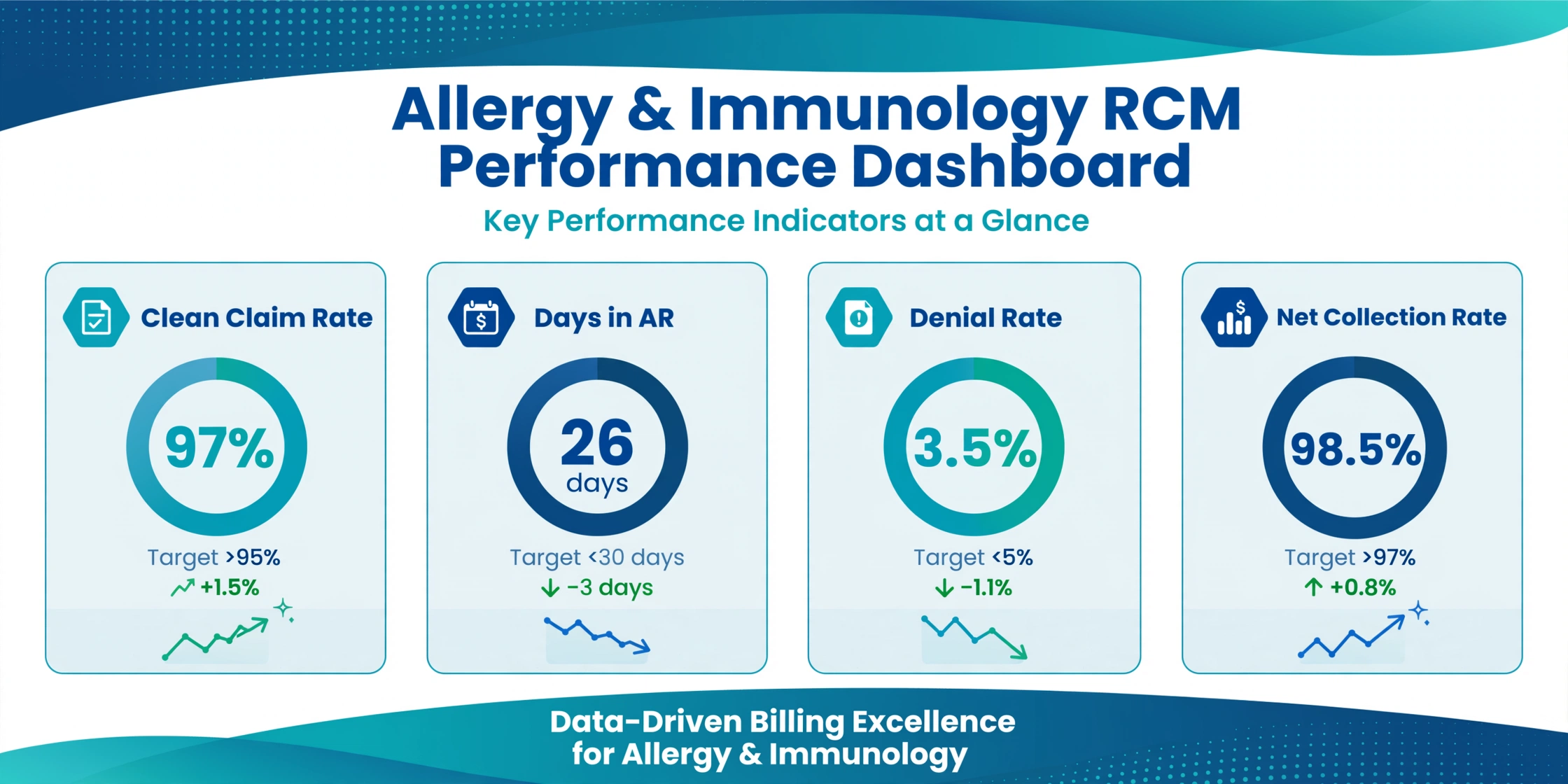
Tracking the right revenue cycle metrics helps you identify billing issues before they affect your practice’s cash flow.
| KPI | What It Measures | Target for Allergy Practices |
|---|---|---|
| Clean Claim Rate | % of claims accepted on first submission | ≥95% |
| Denial Rate | % of submitted claims denied | <5% (industry avg 8–12%) |
| Days in Accounts Receivable | Average time from service to payment | <35 days |
| Net Collection Rate | % of collectible revenue actually collected | ≥95% |
| First Pass Resolution Rate | % of denials resolved on first appeal | ≥75% |
| AR Aging > 90 Days | % of total AR outstanding over 90 days | <15% |
| Charge Lag | Days between service and claim submission | <3 days |
| Biologic PA Approval Rate | % of biologic PAs approved on first submission | ≥85% |
| Cost to Collect | Administrative cost per dollar collected | Minimize continuously |
�� PRO TIP: Monthly KPI Meeting
You can schedule a 30-minute billing performance meeting every month. Bring your KPI dashboard, identify every metric outside target range, and assign one specific corrective action per underperforming metric with an owner and a timeline. Practices that do this consistently, and hold people accountable, see measurable improvement in collection rates within 60–90 days.
Choosing between in-house billing and outsourcing can have a significant impact on your practice’s revenue, efficiency, and administrative workload. This below section compares both approaches to help you decide which allergy immunology revenue cycle management solution best fits your practice’s goals and long-term growth.
| Factor | In-House RCM | Outsourced Allergy Immunology Revenue Cycle Management Services |
|---|---|---|
| Staffing Cost | Full salaries + benefits + training + turnover | Typically % of collections — no overhead |
| Specialty Expertise | General billing staff may lack allergy-specific knowledge | Certified allergy/immunology billing specialists |
| Allergy Testing Coding | Dependent on staff training and currency | Expert-level code selection and bundling knowledge |
| Biologic PA Management | Resource-intensive; often understaffed | Dedicated PA specialists with payer-specific expertise |
| Scalability | Requires hiring as volume grows | Scales immediately with practice |
| Technology | Practice-funded software and updates | Provider includes current billing technology |
| Compliance Monitoring | Requires dedicated program and ongoing training | Built-in compliance auditing and coding updates |
| Denial Management | Often reactive; limited appeal bandwidth | Proactive, systematic denial recovery process |
| Performance Reporting | Manual — time-consuming to produce | Automated KPI dashboards and monthly reports |
| Best For | Very large practices with dedicated specialty billing staff | Most allergy/immunology practices of all sizes |
Outsourcing your practice allergy immunology revenue cycle management allows your team to spend less time on billing and more time caring for patients. We have an expert team and you can find below how we can reduce claim denials, improve reimbursement rates, strengthen your cash flow, and support the long-term financial health of your practice.
Higher Revenue Capture: Specialty billers catch every billable service of your practice, like every test, every vial, every injection, and use accurate modifiers that your in-house experts often miss.
Faster Reimbursement: We optimized clean claim rates and accelerated submission timelines reduce days in AR and improve cash flow predictability.
Expert Biologic PA Management: Our dedicated PA specialists with deep payer-specific knowledge dramatically improve PA approval rates and prevent high-dollar biologic denials.
Compliance Protection — Ongoing coding audits, NCCI compliance monitoring, and documentation review reduce audit risk and recoupment exposure.
Access to Allergy-Specific Expertise: Our allergy immunology billing specialists understand the complexities of immunotherapy coding, testing bundling rules, and biologic reimbursement in ways generalist billers simply don’t.
At House of Outsourcing, we understand that allergy and immunology billing is not general medical billing. It requires deep specialty knowledge of your medical practice, complete compliance systems, and the kind of proactive approach that prevents problems before they become denials. That’s exactly what we deliver.
Certified Allergy & Immunology Billing Specialists: Our AAPC-credentialed coding team has specific training in allergy testing codes, immunotherapy billing, biologic HCPCS coding, and the modifier rules that make or break allergy claims.
Expert Vial Preparation & Injection Billing: We correctly distinguish and bill vial preparation codes (95144–95165) from administration codes (95115–95125), eliminating one of the most common and costly billing errors in the specialty.
Biologic Prior Authorization Management: Our dedicated PA team handles end-to-end prior authorization for biologics, submission, tracking, appeal, and renewal so you never administer a biologic on an expired authorization.
Proactive Denial Management: Our experts don’t wait for denials to pile up. Our real-time denial tracking identifies issues immediately, and our experts resolves them within 48–72 hours with full appeal documentation.
Payer-Specific Policy Management: We maintain current, detailed payer policy reference documents for your top payers by volume, so your claims are always aligned with the latest payer requirements.
Dedicated Account Manager: One expert contact who knows your practice, your payer mix, and your patients — accountable to your financial results every month.
The future of allergy immunology revenue cycle management is being shaped by evolving payer policies, automation, AI-driven billing tools, and stricter documentation requirements.
Expanding Biologic Coverage: New biologic agents for atopic dermatitis, chronic urticaria, eosinophilic esophagitis, and other conditions are expanding the specialty’s biologic revenue stream, with increased PA complexity.
Subcutaneous vs. Sublingual Immunotherapy: Sublingual immunotherapy (SLIT) is gaining coverage from commercial payers. Billing frameworks for SLIT are evolving and require careful attention to payer-specific policies.
Value-Based Care Integration: As VBC models expand in allergy/immunology, your practice may be evaluated on outcomes metrics that affect reimbursement, requiring integrated clinical and financial data systems.
Telehealth Permanence: Allergy follow-ups, medication management, and asthma education lend themselves well to telehealth. Permanent telehealth billing rules for allergy services are expected to evolve post-2025 PHE extensions.
| Resource | What It Covers | Link |
|---|---|---|
| CMS Physician Fee Schedule | Current reimbursement rates by CPT code | cms.gov/medicare/physician-fee-schedule/search |
| CMS LCD/NCD Search | Coverage determinations for allergy services | cms.gov/medicare-coverage-database |
| AAAAI Practice Resources | Allergy/immunology specialty guidance and advocacy | aaaai.org/practice-resources |
| OIG Work Plan | Current enforcement priorities in healthcare billing | oig.hhs.gov/reports-and-publications/workplan |
| AMA CPT Code Information | Official CPT code definitions and updates | ama-assn.org/practice-management/cpt |
| AAPC Allergy Coding | Specialty coding education and credentialing | aapc.com |
| AHIMA RCM Standards | Health information management and coding guidance | ahima.org |
| MGMA Practice Data | Benchmarking data for specialty practices | mgma.com/data |
| HHS HIPAA Resources | Privacy and security compliance guidance | hhs.gov/hipaa |
| CMS NCCI Policy Manual | Bundling rules and correct coding edits | cms.gov/medicare/coding-billing/national-correct-coding-initiative-edits |
| Medicaid Coverage | State-by-state Medicaid allergy coverage | medicaid.gov |
Allergy immunology revenue cycle management is the complete process of managing the financial operations of an allergy and immunology practice, from patient registration and insurance verification through allergy testing charge capture, immunotherapy billing, biologic reimbursement, claims submission, denial management, and final payment collection. It is distinguished from general medical billing by the complexity of its specialty-specific CPT code families, bundling rules, and prior authorization requirements.
Allergy immunology billing involves multiple distinct service lines, allergy testing, immunotherapy vial preparation, injection administration, and biologics, each with its own CPT codes, documentation requirements, frequency limits, and payer policies. A single patient encounter can involve four or more separately billable services, each with its own compliance requirements. This complexity creates more opportunities for billing errors than most other specialties.
The core CPT code families are, allergy testing (95004, 95024, 95044, 86003 series), immunotherapy vial preparation (95144–95165), immunotherapy injection administration (95115–95117, 95120–95125), biologic administration (96372 for subcutaneous injection), and E/M office visits (99202–99215). Each family has specific coding rules, documentation requirements, and bundling considerations.
Yes, Medicare covers allergy testing and allergen immunotherapy when medically necessary and properly documented. Coverage is subject to local coverage determinations (LCDs) issued by Medicare Administrative Contractors (MACs), which specify coverage criteria, frequency limits, and documentation requirements.
The most consistently costly billing error in allergy practices is missing modifier 25 when an Evaluation & Management (E/M) service is billed on the same date as a procedure (allergy testing or injection). Without modifier 25, the E/M is typically denied or bundled into the procedure payment. Other major errors include vial preparation billing without documentation, incorrect ICD-10 code specificity, and biologic administration without valid prior authorization.
Get a free assessment from our billing experts