
Our Acupuncture RCM services help practices improve revenue through accurate coding, insurance verification, claim management, and denial prevention. We streamline acupuncture billing workflows to maximize reimbursements, reduce administrative burdens, and support consistent practice growth.

According to our experience we want to share with you important information that running an acupuncture practice in the USA in 2026 is nothing like it was five years ago. The clinical side? You’ve mastered it. But the billing side? That’s where a lot of great practitioners of the USA are quietly losing thousands of dollars every year, and most of them don’t even know it.
Across the nation Medicare expanded acupuncture coverage for chronic low back pain (cLBP) in 2020, the game changed completely. Major commercial payers like Aetna, UnitedHealthcare, Cigna, and Anthem followed suit, expanding coverage to include migraines, osteoarthritis, and chemotherapy-induced nausea.
According to our two decades billing experience, acupuncture revenue cycle management (RCM) isn’t just about submitting claims. It’s about building a system that protects your revenue from the moment a patient walks in your door to the moment the last dollar hits your bank account. And in today’s environment, that system needs to be airtight.
Need support with your billing workflow? Explore our medical billing and revenue cycle services or request a free consultation.
Acupuncture revenue cycle management is the end-to-end process of managing your patient billing, medical coding, insurance claims submission, payment posting, denial management, and reimbursement optimization specifically for acupuncture practices. It begins before the first needle is placed and ends when the final payment is collected and posted.
Think of acupuncture RCM as the financial nervous system of your practice. Every patient encounter generates a billing event, and every billing event either adds to your revenue or drains it, depending on how well your processes work.
The core components of your acupuncture revenue cycle management are given below:
Patient Registration & Demographics: The accurate intake data is the foundation of every clean claim your team submits to the insurance company.
Insurance Eligibility Verification: It is the main responsibility of your team to confirm active coverage, visit limits, and prior authorization requirements before every session.
Prior Authorization Management:: In the USA many payers require PA for acupuncture. Missing this step is one of the most expensive errors a practice can make.
Medical Coding (CPT & ICD-10): Your team members need to select and apply the correct acupuncture CPT codes and diagnosis codes.
Claims Submission: Your billing team needs to submit clean, complete claims within payer timely filing deadlines.
Payment Posting: By accurately applying payer payments and patient balances to the correct accounts will increase your payments.
Denial Management: Identifying, appealing, and resolving denied claims to recover revenue will increase financial performance of your practice.
Patient Collections: It is your main responsibility to manage copays, coinsurance, and balances in a compliant, patient-friendly way.
Reporting & Analytics: Tracking your KPIs and spotting trends to continuously optimize financial performance.
Acupuncture has moved from the margins of healthcare into the mainstream, and with that shift comes a billing complexity that many practices weren’t designed to handle. Here’s why getting your acupuncture RCM right is non-negotiable in 2026:
Since Medicare’s 2020 landmark decision and subsequent commercial payer expansions, acupuncture claims volume has surged across the USA. More claims means more payer audits. The CMS Medicare coverage policy for acupuncture sets strict documentation and medical necessity standards, and commercial payers are following similar models.
A single documentation gap on an acupuncture claim can trigger a denial, delay payment by 30–60 days, or worse result in a recoupment demand after payment. Multiply that by hundreds of claims per month, and the financial impact becomes very real.
Violations of the False Claims Act can result in fines of thousands of dollars per claim plus treble damages. The OIG Work Plan regularly includes acupuncture billing targets. This isn’t a theoretical risk, it’s an active enforcement priority.
Understanding your CPT codes isn’t optional, it’s the foundation of every acupuncture claim you submit to the insurance company. The American Medical Association (AMA) CPT Code system defines four core acupuncture codes. Using the wrong one is one of the most common, and most expensive, billing errors in the specialty.
| CPT Code | Description | Key Billing Rule | 2026 Medicare Rate (Approx.) |
|---|---|---|---|
| 97810 | Manual acupuncture, initial 15 minutes | Bill only one unit per day. Includes baseline evaluation and initial needle insertion. | $43.39–$46.85 |
| 97811 | Manual acupuncture, each additional 15 minutes | Add-on code to 97810. Requires re-insertion or additional point selection. | $31.00–$34.00 |
| 97813 | Electroacupuncture, initial 15 minutes | Bill only one unit per day. Use if electrical stimulation is applied to any needles. | $46.00–$49.00 |
| 97814 | Electroacupuncture, each additional 15 minutes | Add-on code to 97813. Covers subsequent 15-minute increments with e-stim. | $39.35–$42.12 |
Critical Rule: Never mix 97810/97811 and 97813/97814 on the same date of service. If any electrical stimulation was used during the session, the entire session is billed under the 97813/97814 family. Mixing triggers bundling edits and almost always results in a denial
Tip: Know Your Time Documentation
Because 97810–97814 are time-based codes, you must document the specific start and end time of personal one-on-one contact with the patient not the total appointment time. ‘Personal contact 10:00 AM to 10:45 AM’ is correct. ‘Appointment duration 60 minutes’ is not sufficient and will cost you
The Centers for Medicare & Medicaid Services (CMS) governs acupuncture billing for Medicare beneficiaries, and their guidelines form the baseline that most commercial payers reference. Here’s what every acupuncture provider needs to know for 2026:
Medicare currently covers acupuncture for chronic low back pain (cLBP), defined as low back pain lasting 12 or more weeks that is not attributable to a specific underlying condition such as fracture, tumor, or radiculopathy from disc herniation.
| Medicare Acupuncture Coverage Parameter | Current Rule (2026) |
|---|---|
| Covered Condition | Chronic Low Back Pain (cLBP) only under traditional Medicare |
| Initial Session Limit | Up to 12 sessions in 90 days |
| Extended Session Limit | Up to 20 sessions per year if improvement documented |
| Re-evaluation Requirement | Treating provider must document expected improvement at minimum every 30 days |
| Qualified Providers | Physician, PA, NP, CNS, Clinical Psychologist, or Licensed Acupuncturist under direct supervision |
| Primary CPT Code | 97810 (without e-stim) or 97813 (with e-stim) |
| Geographic Rate Variation | Yes — rates vary by MAC locality |
This is where things get interesting, and where many practices leave money on the table. Many Medicare Advantage plans offer expanded acupuncture benefits beyond traditional Medicare’s cLBP restriction, covering migraines, knee pain, and other conditions. However, each plan has its own documentation requirements, visit limits, and prior authorization rules. Never assume a Medicare Advantage patient has the same benefits as a traditional Medicare patient without verifying first.
Tip: Medicare Advantage Verification
Before treating any Medicare Advantage patient for acupuncture, call the plan’s provider relations line and confirm: (1) Is acupuncture covered for this patient’s specific condition? (2) What is the annual visit limit? (3) Is prior authorization required? (4) What documentation does this plan specifically require? This 10-minute call can save you from writing off hundreds of dollars per patient
Medicaid coverage for acupuncture varies widely by state. Some state Medicaid programs cover acupuncture as part of managed care benefits; many do not. Always verify your Medicaid acupuncture coverage before the first session and document that verification in the patient’s chart.
A well-run acupuncture revenue cycle follows a clear, sequential process. Every step matters — and a weakness at any point in the chain affects everything downstream.
Patient Registration: Your team needs to collect complete, accurate demographic information including full legal name, date of birth, insurance ID, group number, and primary care provider information if required.
Insurance Eligibility Verification: It is your team responsibility to tun real-time eligibility verification before every visit. Confirm active coverage, covered diagnoses, visit limits, deductibles, copays, and prior authorization requirements.
Prior Authorization: For plans requiring PA, submit the authorization request with supporting documentation before the first session start of the patient. You need to track PA expiration dates and visit limits against authorizations.
Clinical Documentation: You need ot document every session with individualized SOAP notes including chief complaint, diagnosis with ICD-10 code, treatment provided (needle points, technique, e-stim use), time of personal contact, and patient response.
Medical Coding: Your coding team needs to apply the correct CPT codes (97810–97814) based on the documented services and time. Select the most specific ICD-10 diagnosis code that matches the clinical record.
Charge Entry: Enter correct charges accurately into the billing system with the correct codes, modifiers, place of service code, and rendering provider NPI.
Claims Submission: Your billing expert needs to submit clean claims electronically within each payer’s timely filing deadline. Run pre-submission edits to catch errors before they reach the payer.
Payment Posting: Post payer payments and patient payments accurately. Identify and flag underpayments, contractual adjustments, and write-offs.
Denial Management: Work denied claims promptly. Your experts need to identify the root cause of each denial, correct the issue, and resubmit or appeal within the payer’s appeal window.
Patient Collections: Your experts must collect patient balances (copays, coinsurance, deductibles) in a compliant, respectful process. Provide clear billing statements.
Reporting & Analytics: You need to track KPIs monthly. Review denial rates by payer, days in AR, clean claim rate, and collection rate. Use data to continuously improve.
If you’re seeing high denial rates on your acupuncture claims, you’re not alone. These are the most common root causes, and knowing them is the first step to fixing them.
Copy-paste SOAP notes are an epidemic in EHR-based practices, and they’re a billing liability. Every note must tell the individual clinical story of that specific patient on that specific date. Payer auditors are not impressed by templates, they’re looking for individualized clinical justification.
Using M54.5 (Low back pain, unspecified) when a more specific code exists is a common trigger for denials, especially with Medicare. Use the most clinically accurate, specific ICD-10 code your documentation supports, and make sure it matches what’s in the chart.
Treating a patient without a required prior authorization, or continuing treatment after a PA has expired, is a direct path to denial. You need to build a PA tracking system into your workflow with automated alerts for expiration dates.
A patient whose benefits lapsed last month didn’t tell you. Real-time eligibility verification before every appointment is not optional in a well-run acupuncture revenue cycle management system.
Many acupuncture practices lose revenue due to preventable revenue cycle management mistakes, including inaccurate documentation, coding errors, missed eligibility verification, and delayed claim follow-up. Identifying and correcting these common issues helps reduce denials, improve cash flow, and maintain a more efficient billing process.
Mixing CPT code families on the same date: When you are billing 97810 and 97813 together on the same day triggers bundling edits.
Billing by needle count instead of time: The number of needles inserted does not change the CPT code. Time of personal contact determines units served during the treatment.
Treating without a valid diagnosis within Medicare’s covered indications: Medicare only covers acupuncture for cLBP under traditional Medicare. Billing for other conditions without proper coverage confirmation is a compliance risk.
Failing to document treatment response: For ongoing Medicare cases, you must document continued improvement to justify continued treatment. No documented improvement = no continued coverage.
Not tracking treatment plan updates: For Medicare patients, the treating provider must document expected improvement at least every 30 days.
Absorbing underpayments silently: If your payer consistently pays less than your contracted rate, appeal. Systematic underpayment is real in acupuncture billing.
Incomplete modifier usage: Modifier 59 (Distinct Procedural Service) is often needed when acupuncture is billed alongside another procedure. Missing it causes denials.
Not maintaining payer-specific reference documents: Each major payer has different covered diagnoses, visit limits, PA thresholds, and documentation requirements. Maintain a one-page payer reference sheet for your top five payers by volume.
�� TIP: Quarterly Audit
Every quarter, pull a random sample of 97810 or 97813 claims and review the complete chart against a documentation checklist. Look for patterns — missing treatment plans, stale SOAP notes, time documentation gaps, diagnosis inconsistencies. Catching a pattern early lets you fix it before it becomes an audit trigger or a large recoupment demand.
Medicare, Medicaid, and commercial insurers each have unique acupuncture billing rules, coverage limitations, documentation standards, and reimbursement policies. Understanding your payer-specific requirements helps you submit compliant claims, minimize denials, and maximize reimbursement across different insurance plans for your specialty.
| Payer Type | Covered Conditions (2026) | Session Limits | PA Required? | Approx. Rate (97810) |
|---|---|---|---|---|
| Traditional Medicare | Chronic low back pain only | 12/90 days, up to 20/year with documented improvement | No (but documentation-heavy) | $27–$32/unit |
| Medicare Advantage | Varies by plan — may include migraines, knee pain, more | Varies by plan | Often yes — verify per plan | Varies by plan |
| Aetna / CVS Health | cLBP, migraines, osteoarthritis (plan dependent) | Typically 20–30/year | Often required | $40–$70/unit |
| UnitedHealthcare | cLBP, migraines, chemotherapy nausea (plan dependent) | Typically 20–30/year | Often required | $40–$70/unit |
| Cigna | cLBP and selected conditions (plan dependent) | Typically 20–30/year | Often required | $40–$70/unit |
| Anthem / BCBS | Varies significantly by state/plan | Varies | Often required | $40–$70/unit |
| VA / Veterans Affairs | Expanded benefits — multiple conditions | Varies by treatment plan | Through VA process | VA fee schedule |
| Medicaid | Varies widely by state — many states do not cover | If covered, state-determined | State-dependent | State fee schedule |
Denial management is where great acupuncture revenue cycle management is won or lost. Our experts use proactive, systematic approach to denials and can recover 10–25% of your revenue that would otherwise be written off.
Numbers don’t lie. Here’s the data behind why optimized acupuncture RCM is so important:
| Metric | Industry Benchmark | Source |
|---|---|---|
| Average medical billing claim denial rate | 5–10% for well-managed practices | MGMA / AAPC |
| Percentage of denied claims never reworked | ~65% | MGMA |
| Revenue lost to claim denials annually (US) | Billions across specialties | AHA / HFMA |
| First-pass acceptance rate (target) | ≥95% | AAPC Best Practices |
| Days in Accounts Receivable (target) | <30 days | MGMA |
| Medicare 97810 reimbursement rate | $27–$32/unit (national avg) | CMS Physician Fee Schedule 2026 |
| Commercial 97810 reimbursement rate | $40–$70/unit | Payer contracts (typical range) |
| Practices reporting improved AR after RCM optimization | >70% | HFMA Survey Data |
| Average cost of a single denied and reworked claim | $25–$118 per claim | CAQH Research |
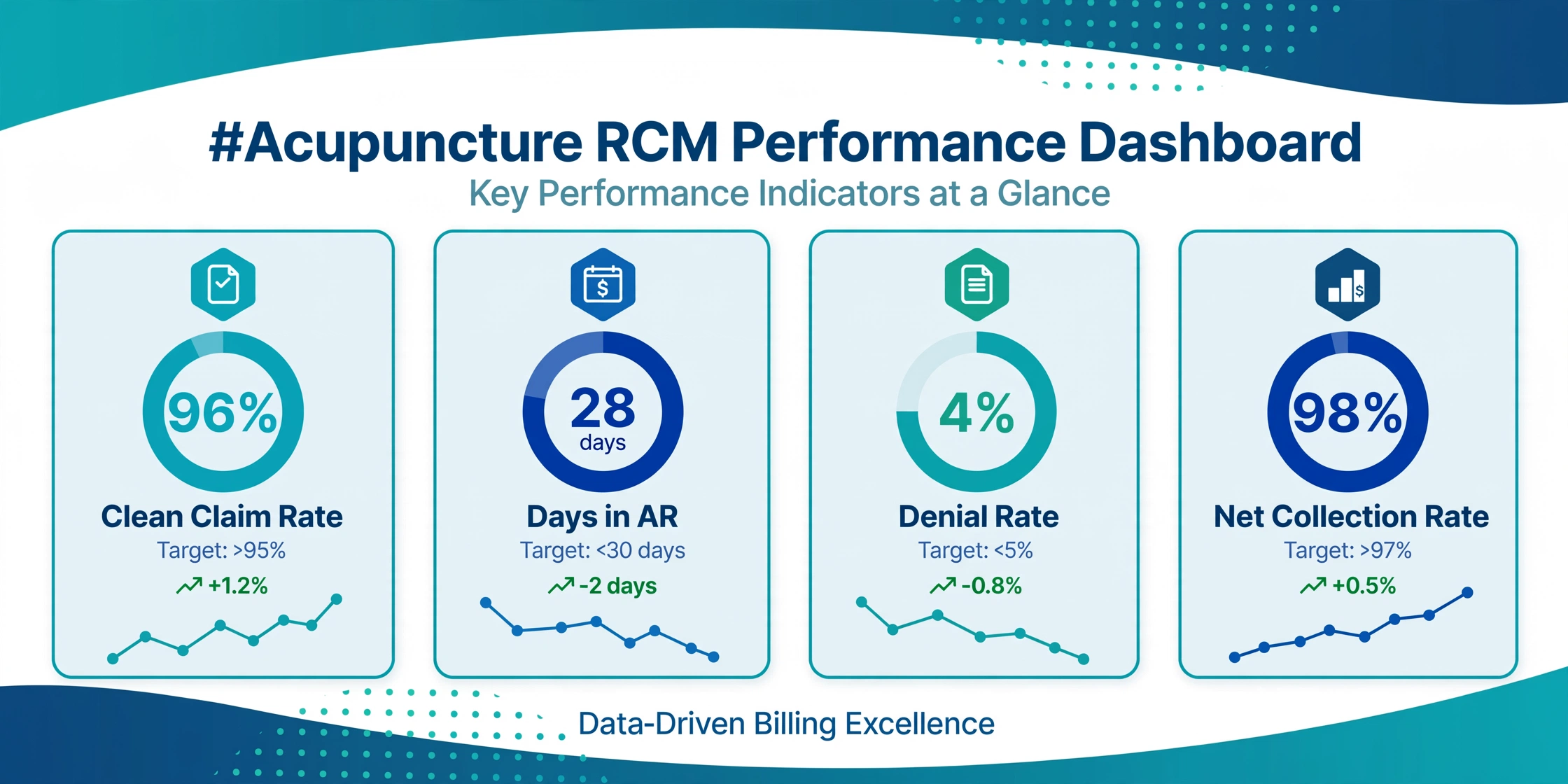
You can’t improve what you don’t measure. These are the KPIs every acupuncture practice should be tracking monthly:
| KPI | What It Measures | Target |
|---|---|---|
| Clean Claim Rate | % of claims accepted on first submission | ≥95% |
| Denial Rate | % of submitted claims denied | <5% |
| Days in AR (Accounts Receivable) | Average time from service to payment | <30 days |
| First Pass Resolution Rate | % of denials resolved on first appeal | ≥75% |
| Net Collection Rate | % of collectible revenue actually collected | ≥96% |
| Cost to Collect | Administrative cost per dollar collected | As low as possible |
| AR Aging > 90 Days | % of AR outstanding more than 90 days | <15% |
| Prior Auth Denial Rate | Denials specifically from PA issues | <2% |
Tip: Monthly KPI Review
Schedule a 30-minute billing review meeting every month with your billing team or your RCM service partner. Bring your KPI dashboard, discuss any metric outside target range, and identify one specific action item to improve it. Practices that do this consistently see measurable improvement in collection rates within 90 days
Compliance is not a department, it’s a daily practice. Here are the key regulatory frameworks governing acupuncture billing compliance:
The False Claims Act (31 U.S.C. § 3729) imposes civil liability for knowingly submitting false claims to federal healthcare programs. Violations can result in fines of up to $27,018 per claim plus treble damages. Most billing violations aren’t intentional, but intent doesn’t protect you under civil liability.
All patient billing data must be handled in accordance with HIPAA Privacy and Security Rules. This includes your billing software, claim transmission processes, and any third-party billing partners.
The OIG’s compliance program guidance recommends that all healthcare practices — including acupuncture providers — maintain a formal compliance program including written policies, employee training, and internal auditing.
The National Correct Coding Initiative (NCCI) contains procedure-to-procedure edit pairs that determine when two codes can or cannot be billed together. Understanding NCCI bundling rules is essential for acupuncture billing compliance.
Tip: Annual Compliance Audit
Conduct a formal internal compliance audit at least annually. Review a random sample of claims across all major payers, check documentation against billing, verify that all credentialing is current, and confirm your team has received billing and compliance training within the past 12 months. Document your audit findings and corrective actions
One of the most consequential decisions an acupuncture practice makes is whether to manage billing in-house or partner with a specialized acupuncture revenue cycle management services provider. Here’s an our comparison for your understanding.
| Factor | In-House RCM | Outsourced Acupuncture Revenue Cycle Management Services |
|---|---|---|
| Staffing Costs | Full-time salaries + benefits + training | Typically % of collections — no overhead |
| Expertise Level | General billing staff — may lack acupuncture specialty knowledge | Specialized acupuncture billing expertise |
| Scalability | Hiring lag when patient volume grows | Scales immediately with practice growth |
| Technology | Practice-funded software and updates | Provider includes current technology |
| Compliance Monitoring | Requires dedicated compliance officer or program | Ongoing compliance built into service |
| Denial Management | Often reactive — limited bandwidth for appeals | Proactive, systematic denial recovery |
| Performance Reporting | Manual reporting — time-consuming | Automated dashboards and monthly reports |
| Coding Updates | Staff must stay current independently | Provider maintains current code training |
| Payer Contract Knowledge | Limited to in-house relationships | Deep multi-payer relationship knowledge |
| Best For | Very high volume practices with dedicated billing staff | Most acupuncture practices of all sizes |
At House of Outsourcing, we specialize in delivering expert acupuncture revenue cycle management services to practices across the United States. We understand that your practice is built on clinical excellence, and we’re here to make sure your billing infrastructure matches that standard.
Ready to optimize your acupuncture revenue cycle? Contact House of Outsourcing today for a complimentary practice billing assessment. We’ll review your current denial rates, days in AR, and clean claim rate — and show you exactly where your revenue is going and how we can get it back. Visit us at houseofoutsourcing.com or call us to speak with an acupuncture billing specialist today
Expanded Medicare Coverage: Legislative proposals continue to push for expanded Medicare acupuncture coverage beyond cLBP. Providers should monitor CMS updates closely.
Value-Based Care Integration: As VBC models expand, acupuncture practices may increasingly be evaluated on outcomes-based metrics that affect reimbursement.
Telehealth-Assisted Acupuncture: While acupuncture remains hands-on, telehealth is being used for initial assessments, follow-ups, and treatment planning. Billing for hybrid care models is an emerging area.
AI-Driven Documentation: Natural language processing tools will increasingly automate clinical documentation review, flagging gaps before claims are submitted.
Interoperability Standards: FHIR-based data sharing requirements will improve eligibility verification and prior authorization workflows across payers.
As an experienced acupuncturist you know that staying informed through trusted industry resources helps you keep pace with changing billing regulations, coding updates, and payer requirements. Using authoritative references supports accurate claim submission, stronger compliance, and more effective revenue cycle management.
| Resource | What It Covers | Link |
|---|---|---|
| CMS Physician Fee Schedule | Current reimbursement rates by CPT code and locality | cms.gov/medicare/physician-fee-schedule |
| CMS NCD for Acupuncture | Official Medicare National Coverage Determination | cms.gov/medicare-coverage-database |
| OIG Work Plan | Current healthcare fraud enforcement priorities | oig.hhs.gov/reports-and-publications/workplan |
| AMA CPT Code Information | Official CPT code definitions and updates | ama-assn.org/practice-management/cpt |
| AAPC Coding Resources | Coding education, credentialing, and compliance tools | aapc.com |
| AHIMA RCM Guidance | Health information management and coding standards | ahima.org |
| MGMA Practice Data | Benchmarking data for practice management and RCM | mgma.com/data |
| HHS HIPAA Resources | Privacy and security compliance guidance | hhs.gov/hipaa |
| Medicaid.gov | State-by-state Medicaid coverage information | medicaid.gov |
| NCCI Policy Manual | Correct coding initiative bundling rules | cms.gov/medicare/coding-billing/national-correct-coding-initiative-edits |
Acupuncture revenue cycle management (RCM) is the complete financial process that acupuncture practices use to capture, manage, and collect patient service revenue. It covers everything from patient registration and insurance verification through medical coding, claims submission, denial management, and final payment posting.
The four primary acupuncture CPT codes are 97810 (acupuncture without e-stim, initial 15 min), 97811 (acupuncture without e-stim, additional 15 min), 97813 (acupuncture with e-stim, initial 15 min), and 97814 (acupuncture with e-stim, additional 15 min). Selecting the correct code requires accurate time documentation and knowledge of whether electrical stimulation was used.
Yes, Medicare covers acupuncture for chronic low back pain (cLBP) lasting 12 or more weeks, up to 12 sessions in 90 days, extendable to 20 sessions per year if the patient demonstrates documented improvement. Medicare Advantage plans may cover additional conditions. Traditional Medicare does not currently cover acupuncture for other conditions.
The most common acupuncture billing errors include are insufficient or copy-paste SOAP note documentation, missing or expired prior authorizations, incorrect or non-specific ICD-10 codes, mixing CPT code families (97810 with 97813) on the same date, missing time documentation, and treating patients whose eligibility or visit limits have been exhausted.
Our optimized acupuncture revenue cycle management process improves your practice collections by increasing clean claim rates (fewer initial denials), accelerating payment through faster claims submission, recovering denied revenue through proactive denial management, and identifying underpayments through fee schedule analysis.
For most acupuncture practices, outsourcing acupuncture revenue cycle management services to our company, delivers higher clean claim rates, faster reimbursement, and lower denial rates than in-house billing particularly for practices that don’t have dedicated, specialty-trained billing staff. The cost is typically a percentage of collections, making it scalable and performance-aligned.
Every 97810 claim requires: date of service and provider identification, the patient’s chief complaint and clinical presentation, the diagnosis with a specific ICD-10 code, the treatment provided (needle points, technique, whether e-stim was used), the time of personal one-on-one contact (start and end time), the patient’s response to treatment, and reference to the treatment plan and progress toward goals.
One unit of 97810 per session, it represents the initial 15-minute block of personal one-on-one contact. Each additional 15 minutes of contact (without e-stim) is billed as one unit of 97811. The number of needles inserted does not affect the number of units billed.
Medicare’s standard timely filing deadline is one year from the date of service. Most commercial payers have shorter deadlines ranging from 90 to 180 days. Always verify the specific timely filing requirement for each payer, and build alerts into your billing workflow to ensure no claim ages past its filing deadline.
Key compliance risks in acupuncture billing include False Claims Act violations (billing for services not rendered as documented), NCCI bundling errors, billing for diagnoses not covered by the payer, missing prior authorizations, and patterns of billing errors that can trigger CMS or OIG investigations. A formal compliance program including regular internal audits is strongly recommended.
Get a free assessment from our billing experts