
Our Cardiology RCM services help practices optimize revenue through specialized coding, documentation compliance, claim management, and denial prevention. We streamline complex cardiology billing workflows to improve reimbursements, reduce administrative burdens, and support sustainable practice growth.

In 2024, the global cardiology market was valued at $3.16 billion. By 2033, experts project it will reach $4.83 billion. The demand for cardiologists is not going away in the USA, and neither is the complexity of getting paid for the care they deliver.
In the USA cardiology practices deal with a billing environment that is fundamentally more demanding than general medicine. Clean claim rates in cardiology run between 78% and 82%, significantly below the healthcare industry average of 85–90%. Prior authorization requirements touch nearly every high-value procedure. Documentation standards for cardiac catheterizations, echocardiograms, EP studies, and PCI are exacting.
According to MGMA, operating costs for cardiologists medical groups rose more than 11% in 2025. In this environment, leaving revenue on the table due to coding errors, missed authorizations, or documentation gaps is simply not sustainable
This guide is the comprehensive 2026 reference for cardiology revenue cycle management, built for cardiologists, interventional cardiology groups, electrophysiology practices, cardiac imaging centers, and the billing professionals who support them.
Need support with your billing workflow? Explore our medical billing and revenue cycle services or request a free consultation.

Cardiology revenue cycle management is the end-to-end process of managing patient registration, insurance eligibility verification, prior authorization, procedure-specific charge capture, cardiology CPT and ICD-10 coding, claims submission, modifier compliance, denial management, payment posting, and reimbursement optimization for cardiology practices. It is distinguished from general medical billing by its high-value procedure codes, complex modifier framework, strict documentation requirements, and elevated payer audit risk.
Unlike primary care billing where a single E/M code covers most encounters, a single cardiology visit can generate multiple CPT codes across diagnostic testing, interventional procedures, imaging interpretation, and office evaluation, each with its own medical necessity documentation, modifier requirements, and payer-specific rules.
| Factor | Cardiology RCM | General Medical RCM |
|---|---|---|
| Clean claim rate | 78–82% (significantly below average) | 85–90% (industry average) |
| Procedure complexity | Multiple codes per visit — diagnostic, interventional, imaging | Typically 1–2 codes per encounter |
| Prior authorization volume | High — echos, stress tests, cath lab, device implants, nuclear imaging | Lower — primarily for referrals and select procedures |
| Modifier complexity | 26, TC, 59, 51, 25 — critical for imaging and bundled procedures | Anatomical modifiers (LT, RT); less frequent |
| Audit risk | Elevated — high reimbursement values attract payer scrutiny | Moderate |
| Coding update frequency | Annual CPT changes affect interventional and diagnostic codes | Annual updates; lower specialty-specific impact |
| Documentation standard | Procedure-specific — cath reports, echo interpretation, EP findings | E/M-level documentation |
| ICD-10 complexity | Cardiovascular ICD-10 codes are highly specific — vessel, laterality, acuity | General diagnosis coding |
| Revenue per encounter | Among highest in outpatient medicine | Moderate |
| Payer contract complexity | High — multiple payer types with different coverage for same procedure | Moderate |
Cardiology CPT coding spans multiple subspecialty service lines in the USa and each with its own code family, documentation requirements, and modifier rules. The AMA CPT code system and the American College of Cardiology Coding & Billing Resource Center are the primary authoritative references for cardiology-specific coding guidance.
| CPT Code | Description | Modifier Rule | Key Documentation |
|---|---|---|---|
| 93306 | Echo transthoracic, complete (with Doppler and color flow) | Global / TC-26 split when applicable | Complete study; all views documented; clinical indication |
| 93307 | Echo transthoracic, complete (no Doppler) | Global / TC-26 split | Complete study without Doppler; document why Doppler not performed |
| 93308 | Echo transthoracic, limited or follow-up | Global / TC-26 split | Must document why limited study only; overuse triggers audit |
| 93312 | Transesophageal echo (TEE), complete | Global / TC-26 split | TEE procedure and interpretation both documented |
| 93350 | Stress echo — complete | Global / TC-26 split | Rest and stress components; all views; exercise or pharmacologic protocol documented |
| 93351 | Stress echo — complete with contrast | Global / TC-26 split | Contrast use clinically justified and documented |
| CPT Code | Description | Key Billing Rule |
|---|---|---|
| 93453 | Combined right and left heart cath with coronary angiography | Includes both right and left heart; most comprehensive cath code |
| 93454 | Coronary angiography without left heart cath | Diagnostic angiography only — no hemodynamics |
| 93455 | Coronary angiography with right heart cath | Documents right-sided hemodynamics with coronary anatomy |
| 93456 | Coronary angiography with right heart cath and PCWP | Includes pulmonary capillary wedge pressure measurement |
| 93457 | Coronary angiography with right heart cath and ventricular sampling | Sampling from right ventricle/pulmonary artery |
| 93458 | Left heart cath with coronary angiography | Most common left-sided diagnostic cath code |
| 93459 | Left heart cath with coronary angio and bypass graft angio | Use for CABG patients requiring graft evaluation |
| 93460 | Right and left heart cath with coronary angio | Combined approach; document both right and left heart pressures |
| 93461 | Right and left heart cath with coronary angio and bypass graft angio | For CABG patients requiring complete evaluation |
| 92920 | PCI — single major coronary artery or branch | Document vessel treated, lesion characteristics, technique |
| 92921 | PCI — each additional branch (add-on to 92920) | Add-on; must document separate vessel/branch treated |
| 92928 | PCI with coronary stenting — single vessel | Stent type and vessel documented; DES vs BMS matters |
| 92929 | PCI with stenting — each additional branch (add-on) | Add-on to 92928; separate vessel documentation required |
Tip: Cath Lab Documentation Essentials
For every cardiac catheterization claim, the procedure report must include:
(1) Clinical indication/medical necessity with supporting diagnosis.
(2) Access site (femoral, radial).
(3) Specific vessels interrogated with angiographic findings for each.
(4) Hemodynamic data collected (pressures, saturations, calculations).
(5) Contrast volume used.
(6) Complications, if any.
(7) Interpreter’s attestation and signature. Missing any of these elements creates a denial or audit flag. The cath report is both a clinical record and a billing document, it must serve both functions
| CPT Code | Description | Key Rule |
|---|---|---|
| 93600 | Bundle of His recording only | Standalone EP study — rarely billed alone; usually component of comprehensive study |
| 93610 | Intra-atrial recording | Document electrode positions and electrogram findings |
| 93620 | Comprehensive EP study | Includes His bundle recording, atrial pacing, ventricular pacing; complete study |
| 93621 | Comprehensive EP with left atrial pacing and recording (add-on) | Add-on to 93620; document left atrial access and recordings |
| 93622 | Comprehensive EP with left ventricular pacing and recording (add-on) | Add-on to 93620; document LV access |
| 93624 | EP follow-up study | Post-ablation or post-implant assessment |
| 93650 | AV node ablation | Document catheter position, energy delivery, complete AV block achieved |
| 93651 | Intracardiac catheter ablation — supraventricular tachycardia | SVT ablation; document arrhythmia mechanism and ablation endpoint |
| 93652 | Intracardiac catheter ablation — ventricular tachycardia | VT ablation; document 3D mapping, lesion sets, endpoints |
| 93653 | Comprehensive EP with ablation of SVT (combined) | Comprehensive EP + ablation in same session |
| 93654 | Comprehensive EP with ablation of VT (combined) | Comprehensive EP + VT ablation in same session |
| 93656 | Atrial fibrillation ablation — pulmonary vein isolation | AFib ablation; most common complex ablation procedure |
| CPT Code | Description | Modifier/Key Rule |
|---|---|---|
| 93015 | Cardiovascular stress test — tracing and interpretation | Global — physician supervises and interprets |
| 93016 | Cardiovascular stress test — physician supervision only | TC component — billing for supervision without interpretation |
| 93017 | Cardiovascular stress test — tracing only | TC component |
| 93018 | Cardiovascular stress test — interpretation and report only | Professional (26) component |
| 78451 | Myocardial perfusion imaging — SPECT, single study | Nuclear cardiology; global includes both TC and 26 components |
| 78452 | Myocardial perfusion imaging — SPECT, multiple studies | Rest and stress perfusion; most common nuclear cardiology code |
| 78453 | Myocardial perfusion imaging — planar, single study | Planar (non-SPECT) format |
| 78454 | Myocardial perfusion imaging — planar, multiple studies | Planar rest and stress |
| 78466 | Myocardial infarct imaging — qualitative | Acute MI imaging |
| 78469 | Myocardial infarct imaging — SPECT | SPECT format for MI imaging |
| CPT Code | Description | Key Billing Rule |
|---|---|---|
| 33206 | Pacemaker insertion — single chamber | Document chamber (atrial or ventricular), lead position, device parameters |
| 33207 | Pacemaker insertion — dual chamber | Document both leads, programming parameters |
| 33208 | Pacemaker insertion — single or dual chamber with atrial and ventricular pacing | Full pacing system documentation |
| 33249 | ICD insertion — dual coil lead | Document ventricular fibrillation induction and defibrillation threshold testing |
| 33270 | ICD insertion — subcutaneous (S-ICD) | Document sensing vector, defibrillation threshold test, lead position |
| 93280 | Programming evaluation — pacemaker, single chamber | Device interrogation findings documented |
| 93285 | Programming evaluation — ICD, single chamber | ICD interrogation; arrhythmia episode review documented |
| 93289 | Remote monitoring interrogation — ICD | Remote transmission date, findings, clinical action documented |
| 33285 | Implantation of cardiac event recorder (loop recorder) | Document insertion site, programming, indication |
| 33286 | Removal of cardiac event recorder | Document removal; final data transmission noted |
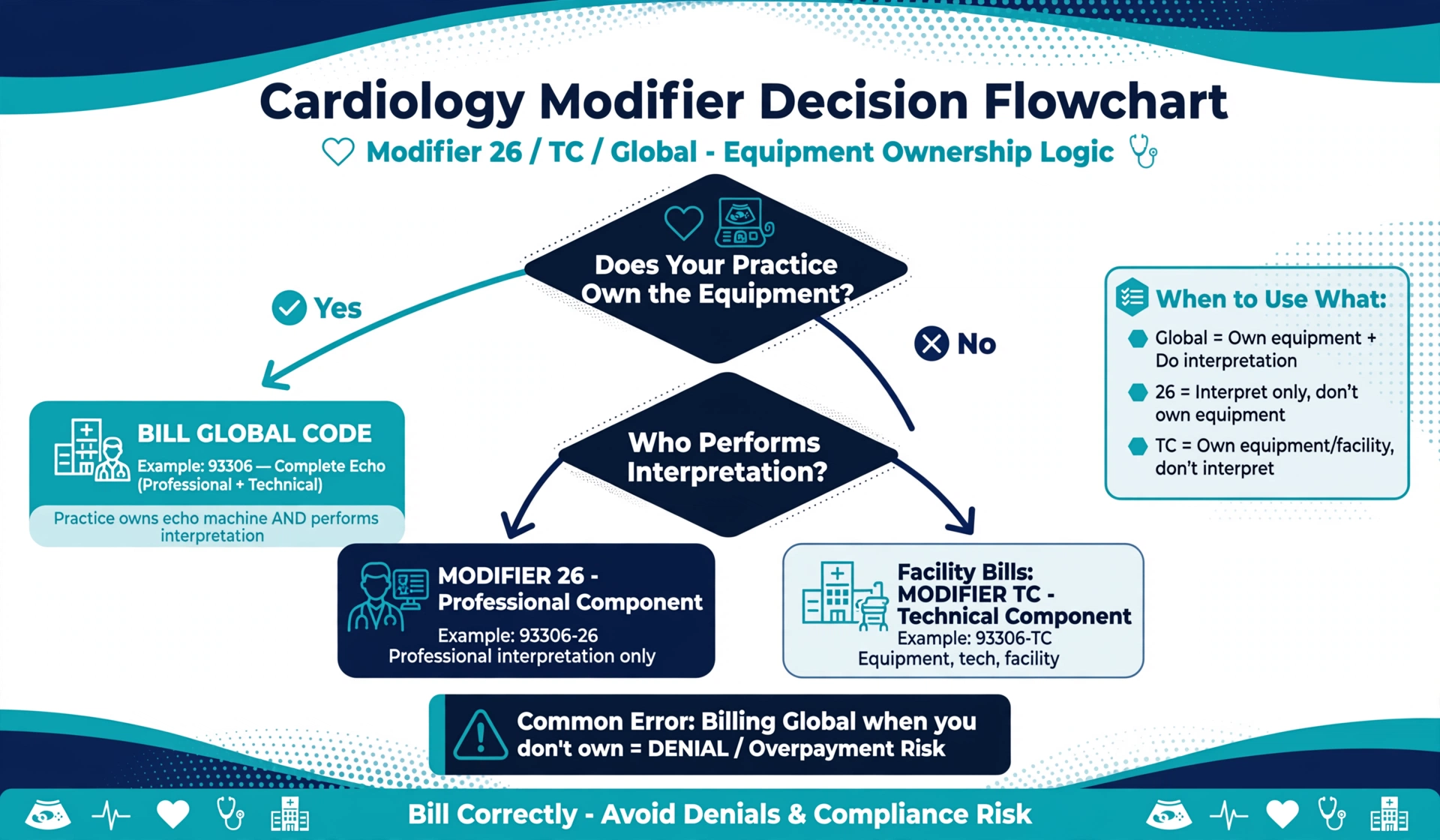
Modifier usage in cardiology billing is one of the most consequential coding decisions your team makes. The wrong modifier, or a missing modifier on a high-value cardiology claim doesn’t just cause a denial. It can result in systematic underpayment or compliance exposure.
| Modifier | What It Means | When to Use in Cardiology | Revenue Impact of Error |
|---|---|---|---|
| 26 | Professional Component (Physician interpretation only) | When cardiologist reads echo/nuclear/stress test from a hospital or outpatient facility that owns the equipment | Missing 26 = claim denied or underpaid; billing global when only 26 applies = compliance violation |
| TC | Technical Component (Equipment and technician only) | When facility bills for performing the test but physician reads elsewhere | Billing TC without providing the technical service = compliance issue |
| 59 | Distinct Procedural Service | When billing multiple cardiology procedures that share NCCI bundling edits — e.g., cath + intervention on same visit | Missing 59 = procedure bundled into primary code payment; revenue lost |
| 51 | Multiple Procedures | Multiple cardiac procedures performed in same session when 59 doesn't apply | Incorrect use creates bundling denials; missing it can affect secondary procedure payment |
| 25 | Separate E/M Service | When cardiologist performs E/M visit AND a procedure (e.g., echo) on same day | Missing 25 = E/M denied or bundled; common revenue leak in outpatient cardiology |
| 52 | Reduced Services | When a study was started but not completed as documented | Prevents denial for incomplete service; documents reduced scope |
| 57 | Decision for Surgery | E/M on day before or day of major cardiac procedure | Required when pre-procedure E/M leads directly to same-day surgery decision |
| LT/RT | Laterality (Left or right side) | When laterality is clinically relevant (e.g., peripheral vascular procedures) | Missing laterality modifier triggers edit-based denial for applicable codes |
The CMS sets the reimbursement framework for Medicare patients and the benchmark most commercial payers reference. Cardiology billing is subject to specific CMS policies, Local Coverage Determinations (LCDs), and National Coverage Determinations (NCDs) that govern which services are covered and under what clinical circumstances.
| Cardiology Service | CMS/Medicare Coverage Rule |
|---|---|
| Echocardiography | Covered with documented clinical indication; limited echo (93308) must be justified — overuse triggers audit |
| Cardiac catheterization | Covered with documented medical necessity; prior auth required for elective cath in many Medicare Advantage plans |
| Percutaneous Coronary Intervention (PCI) | Covered; documentation of vessel, lesion, technique, and medical necessity required; NCCI edits apply to multi-vessel PCI |
| Stress testing — exercise | Covered with documentation of symptoms, risk factors, or monitoring requirement |
| Nuclear cardiology (SPECT) | Covered; Appropriate Use Criteria (AUC) requirements apply for non-emergent advanced imaging orders |
| Electrophysiology studies | Covered with documentation of arrhythmia type, prior treatment, and indication for invasive study |
| Ablation procedures | Covered with documented failure of antiarrhythmic therapy or clinical criteria for primary ablation |
| Device implantation (pacemaker/ICD) | Covered with documented indication per NCD for ICDs (NCD 20.4); pacemaker indications per clinical guidelines |
| Remote cardiac monitoring | CCM and CPCM codes covered; documentation of device type, transmission dates, clinical review required |
| Cardiac CT / CCTA | Covered with clinical indication documentation; AUC consultation required for advanced cardiac imaging |
| Telehealth cardiology | Covered post-2024 extensions; modifier 95 + POS 02/10; verify current CMS telehealth expansion rules |
Tip: AUC Compliance Workflow
It is important for your practice that you will build AUC consultation into your ordering workflow at the point of order entry, not as an afterthought at billing. When an ordering physician requests a CCTA or nuclear stress test, the EHR order should automatically prompt the AUC consultation step and capture the priority rating. Billing for these studies without the required AUC G-code is a Medicare compliance failure that triggers claims denial and potential audit attention
Prior authorization is the single most disruptive RCM process for cardiology practices of the USA, and the consequences of getting it wrong are immediate; a missed authorization means 100% denial for that claim, with limited appeal recourse once the service is performed. According to ACC advocacy data, 94% of cardiologists report prior authorization delays in patient care, and the administrative burden has grown substantially as Medicare Advantage plan penetration increases.
| Cardiology Procedure | Prior Authorization Required? | Typical Documentation Required | Authorization Window |
|---|---|---|---|
| Transthoracic echocardiogram | Often yes (commercial/MA plans) | Clinical indication, symptoms, prior workup | Typically 90 days |
| Stress echocardiogram | Often yes | Symptoms, risk factors, ECG findings | Typically 90 days |
| Nuclear stress test (SPECT) | Often yes + AUC required | Symptoms, CDS consultation result, prior testing | Typically 60–90 days |
| Cardiac catheterization (elective) | Often yes (especially MA plans) | Clinical indication, non-invasive testing results, risk factors | Typically 30–90 days |
| Percutaneous Coronary Intervention | Often yes (elective PCI) | Coronary anatomy, failed medical therapy, functional testing | Case-specific |
| Cardiac CT / CCTA | Often yes + AUC required | AUC consultation, clinical indication, prior workup | Typically 60–90 days |
| ICD implantation | Often yes | EF documentation, QRS duration, prior AAD failure, EP testing | Case-specific |
| Ablation procedures | Often yes | Arrhythmia documentation, prior treatment, EP study results | Case-specific |
| Remote cardiac monitoring devices | Often yes for implantable monitors | Arrhythmia indication, prior monitoring results | Case-specific |
| Medicare traditional | Generally not required for most outpatient cardiac studies | N/A — but documentation of medical necessity still required | N/A |
Tip: Prior Authorization War Room
For a high-volume cardiology practice, consider creating a dedicated PA team, one or two staff members exclusively managing prior authorizations across all payers. You need to give them payer-specific checklists for each common procedure, automated expiration alerts at 7 days, and a 48-hour submission SLA from the order date. Track PA approval rates by payer and by procedure. Practices that dedicate specialized staff to PA management reduce authorization-related denials by 60–70% compared to practices that assign PA work to general front-desk staff alongside other duties.
A well-structured cardiology revenue cycle requires precision at every stage for your medical practice. Here’s the complete process that separates high-performing your cardiology practice from those leaving revenue behind:
Patient Registration & Demographics: It is your team responsibility to collect complete patient information including insurance IDs, group numbers, and secondary insurance. Demographic errors at intake cascade through every downstream billing step.
Insurance Eligibility Verification: Your practice billing experts need to run real-time eligibility verification 48–72 hours before every appointment. They need to confirm active coverage, deductibles, prior authorization requirements, and in-network status. For procedures, confirm whether the specific procedure is covered under the patient’s plan.
Prior Authorization Management: It is also your team responsibility to submit PA requests 72+ hours before scheduled procedures with complete supporting documentation. Track approval status, authorization numbers, and expiration dates. You also need to build automated expiration alerts at 7 days and 2 days before expiration.
Procedure Scheduling & AUC Consultation: For advanced cardiac imaging, you need to ensure AUC consultation is documented at time of order. You need to capture the HCPCS G-code for the CDS consultation before the imaging is performed.
Clinical Documentation: Cardiology-specific procedure reports (cath reports, echo interpretations, EP reports) must meet payer documentation standards. Use procedure-specific templates that capture all required elements for the planned CPT codes.
Charge Capture: You need to capture all charges from every service line, the cath lab, echo lab, EP lab, office, and remote monitoring. Integrated charge capture with procedure-specific workflows prevents missed charges. Your experts need to assign the correct CPT codes, modifiers, and ICD-10 diagnosis codes at charge entry.
Claims Scrubbing: On a regular basis you need to run pre-submission edits against NCCI bundling rules, modifier requirements, payer-specific edits, and AUC documentation requirements. Catch errors before they reach the payer.
Claims Submission: Your submission team needs to submit electronically within each payer’s timely filing window. For Medicare, the standard timely filing deadline is one year from the date of service.
Payment Posting: Your payment posting experts need to post payer payments and reconcile against contracted rates. Flag underpayments immediately. Distinguish contractual adjustments from unexpected write-offs.
Denial Management:: Your denials management experts need to categorize denials by reason code, CPT code, and payer. Investigate root cause. It is the denial management experts responsibility to appeal within the payer’s appeal window with complete documentation. Track denial trends monthly.
Patient Collections: Your team needs to accurately collect copays and deductibles at time of service. For high-deductible plan patients with expensive cardiac procedures, provide cost estimates in advance. Implement a structured patient collections workflow with automated statements and digital payment options.
Reporting & Analytics: Finally you need to review KPIs monthly. Track your practice clean claim rate, denial rate by payer and CPT category, days in AR, and net collection rate. Use data to drive continuous improvement.
A single cardiology patient of your practice encounter can generate charges from echocardiography, stress testing, office E/M, and potentially an interventional procedure, each with its own CPT code family, modifier requirements, and NCCI bundling considerations. Managing this complexity consistently across a high-volume practice is one of the primary drivers of cardiology’s below-average clean claim rate.
If your cardiology clean claim rates of 78–82% mean that roughly 1 in 5 cardiology claims requires rework or follow-up. Your rework costs $25–$118 per claim (CAQH data) and extends the time to payment. Without a proactive denial management strategy that addresses root causes, not just individual claim corrections, your practice remains trapped in a cycle of recurring denials for the same avoidable reasons.
A 2024 ACC survey found that 94% of cardiologists experienced care delays due to prior authorization requirements. For a practice scheduling 20+ cardiac procedures weekly, managing prior authorizations across multiple payers with different documentation requirements, turnaround times, and appeal processes is a significant administrative challenge that requires dedicated resources.
CMS updates cardiology reimbursement annually, affecting imaging, device procedures, chronic care management, and remote monitoring codes. Commercial payers release their own Local Coverage Determinations throughout the year. A policy change that went unnoticed at week one can result in dozens of denied claims by week four. Systematic payer policy monitoring is a revenue protection requirement, not an optional process improvement.
The CMS Appropriate Use Criteria program for advanced cardiac imaging adds a pre-order compliance requirement that many practices in the USA still haven’t fully integrated into their workflows. Claims for non-urgent CCTA, cardiac MRI, and nuclear cardiology studies that lack the required AUC G-code documentation face denial, even when the study itself was clinically appropriate.
Cardiac procedures carry some of the highest patient cost-sharing obligations in outpatient medicine. A patient undergoing elective cardiac catheterization may owe $1,500 to $3,000 or more at the time of service. Without pre-service cost estimates, a card-on-file policy, and structured collection workflows, these high-dollar patient balances age rapidly into difficult collections situations.
Remote cardiac monitoring including external cardiac monitors, implantable loop recorders, and device remote interrogations, has become a significant revenue stream for cardiology practices. Billing for remote monitoring correctly requires understanding the distinct CPT codes for device interrogation, remote transmission, and clinical review.
In the USA some common cardiology revenue cycle management mistakes often include inaccurate coding, incomplete documentation, missed payer-specific requirements, delayed charge entry, and insufficient follow-up on denied claims, by avoiding these mistakes you can increase your revenue.
Billing global echo code when only modifier 26 applies: Compliance violation; billing for technical services not provided by your practice.
Missing modifier 59 on multi-procedure cath lab encounters: Bundling causes the secondary procedure to be included in the primary code payment without additional reimbursement.
Billing 93308 (limited echo) habitually when 93306 (complete) is documented: Under-coding; 93308 is significantly lower reimbursement than 93306 for a complete study.
Using non-specific ICD-10 codes: Coding I25.10 (atherosclerotic heart disease, unspecified) when a more specific code (I25.110 — with unstable angina) is documented.
Missing prior authorization before elective cardiac procedures: Immediate, typically non-appealable denial for the procedure.
Not capturing AUC G-codes for advanced cardiac imaging orders: Medicare compliance failure; study claim denied.
Missed charges from cath lab or EP lab: Complex procedure charges require integrated charge capture workflows; manual processes frequently miss ancillary charges.
Failing to appeal underpayments from commercial payers: Systematic underpayment at $50–$200 per claim multiplied across hundreds of procedures is a significant annual revenue leak.
Over-reliance on 93308 for follow-up studies without documentation: Limited echo code requires documented justification for why a complete study wasn’t performed; overuse is a common audit trigger.
Not verifying Medicare Advantage plan PA requirements separately from traditional Medicare: MA plans frequently require PA for procedures traditional Medicare does not; applying traditional Medicare rules to MA plans causes systematic denials.
Tip: Quarterly Cardiology Coding Audit
For your medical practice growth you need to pull a sample of 25 claims per month across your top 5 cardiology CPT codes including echos, stress tests, cath codes, and EP codes. For each claim verify you need to verify
(1) Correct CPT code matches documented service.
(2) Modifier applied correctly for 26, TC, 59, 25.
(3) ICD-10 code is the most specific supported by documentation.
(4) Prior authorization was obtained and is referenced on the claim.
(5) AUC G-code present if advanced imaging. Practices that conduct regular coding audits identify modifier errors an average of 6–8 weeks earlier than those that rely on denial feedback alone.
The cardiology revenue cycle management market continues to evolve as your practice faces increasing claim complexity, value-based reimbursement models, and stricter payer requirements. Tracking key industry statistics such as clean claim rates, denial rates, days in accounts receivable (A/R), and first-pass resolution rates helps you to increase your financial strategy for your practice.
| Metric | Industry Data | Source |
|---|---|---|
| Global cardiology market value (2024) | $3.16 billion | Industry market research |
| Projected cardiology market (2033) | $4.83 billion | Industry market research |
| Cardiology clean claim rate | 78–82% | MGMA / Industry benchmarks |
| Healthcare industry average clean claim rate | 85–90% | MGMA |
| Medical group operating cost increase (2025) | >11% | MGMA 2025 Report |
| Cardiologists reporting PA delays in patient care | 94% | ACC Prior Authorization Survey 2024 |
| Target clean claim rate with optimized RCM | ≥95% | AAPC Best Practices |
| Target days in AR — cardiology | <35 days | MGMA Cardiology Benchmark |
| Cost of a reworked denied claim | $25–$118 per claim | CAQH Research |
| Revenue impact of missed modifier 59 (multi-procedure) | $100–$500+ per encounter | Cardiology billing analysis |
| Revenue impact of 26 vs global error | Varies; compliance risk on overpayment | CMS/OIG guidance |
| Percentage denied claims never reworked | ~65% | Change Healthcare / MGMA |
Monitoring key performance metrics helps you measure the efficiency of your revenue cycle and quickly identify areas affecting cash flow. Metrics such as clean claim rate, denial rate, days in accounts receivable (A/R), net collection rate, and first-pass claim acceptance provide valuable insights for improving your reimbursement and long-term financial performance, of your practice.
| KPI | What It Measures | Target for Cardiology Practices |
|---|---|---|
| Clean Claim Rate | % of claims accepted on first submission | ≥95% (industry avg 78–82%) |
| Denial Rate | % of submitted claims denied | <8% |
| Days in Accounts Receivable | Average time from service to payment | <35 days |
| Net Collection Rate | % of collectible revenue actually collected | ≥96% |
| Prior Auth Approval Rate | % of PA requests approved on first submission | ≥90% |
| First Pass Resolution Rate | % of denials resolved on first appeal | ≥75% |
| AR Aging > 90 Days | % of total AR outstanding over 90 days | <15% |
| Charge Capture Rate | % of performed procedures that generate a charge | ≥99% — critical for cath lab & EP lab |
| Modifier Accuracy Rate | % of claims with correct modifier applied | ≥99% |
| AUC Compliance Rate | % of advanced imaging orders with AUC G-code | 100% — Medicare compliance requirement |
| Charge Lag | Days from procedure to claim submission | <3 days |
| Patient Collection Rate | % of patient responsibility collected | ≥80% at time of service |
Tip: Cath Lab Charge Capture Audit
The cath lab and EP lab are the highest-revenue, and highest charge-capture-risk, service lines in cardiology. Implement a monthly reconciliation between the OR schedule (or cath lab log) and posted charges. Every scheduled procedure should have a corresponding charge. Any discrepancy in a procedure that was scheduled and performed but doesn’t appear in billing is a missed charge. For high-value cardiac procedures, even 2–3 missed charges per month can represent $10,000–$30,000 in lost monthly revenue.
Denial management in cardiology requires a more systematic approach than most other specialties, because the denial categories are more varied, the dollar values per claim are higher, and the root causes are more technically complex.
| Denial Category | Common Root Cause in Cardiology | Prevention Strategy |
|---|---|---|
| Medical necessity | Documentation doesn't support procedure indication | Procedure-specific documentation templates; pre-submission clinical note review |
| Prior authorization | Auth missing, expired, or wrong procedure authorized | Dedicated PA specialist; automated expiration alerts; pre-service auth verification |
| Coding error | Wrong CPT, wrong modifier, bundling issue | Cardiology-specific claim scrubber; quarterly coding audit; modifier decision tool |
| AUC non-compliance | Missing G-code for advanced cardiac imaging | AUC consultation integrated at order entry; billing system checks for G-code |
| Eligibility | Patient coverage lapsed or procedure not covered | Real-time eligibility verification 48–72 hrs pre-visit; benefit-specific verification |
| Timely filing | Claim not submitted within payer's deadline | Charge lag monitoring; automated filing deadline alerts per payer |
| Duplicate claim | Claim submitted twice; system or staff error | Clearinghouse duplicate detection; regular AR aging review |
| Payer policy change | Coverage rule changed since last time procedure billed | Monthly payer policy monitoring; denial trend analysis by CPT code |
Choosing between in-house and outsourced cardiology revenue cycle management depends on your practice’s resources, claim volume, and reimbursement goals. Comparing costs, expertise, technology, scalability, and collections can help you determine which approach delivers better financial performance, reduces administrative burden, and supports long-term growth.
| Factor | In-House Cardiology Billing | Outsourced Cardiology Revenue Cycle Management Services |
|---|---|---|
| Specialty coding expertise | Requires dedicated cardiology-trained coders — not interchangeable with general billing | Certified cardiology billing specialists with ACC/AMA CPT mastery |
| Modifier compliance (26/TC/59/25) | Frequently misapplied without cardiology-specific training | Modifier decision framework built into every claim review |
| Prior authorization management | Resource-intensive; often understaffed for high-volume cardiology PA workload | Dedicated PA specialists with cardiology procedure expertise |
| AUC compliance | Often missed without integrated workflow; denial risk | AUC G-code compliance built into pre-submission checklist |
| Cath lab/EP lab charge capture | Prone to missed charges without integrated procedure-specific workflows | Procedure-specific charge capture protocols; monthly reconciliation |
| Payer policy monitoring | Dependent on staff awareness; often reactive | Proactive payer policy tracking; denial trend analysis by CPT |
| Clean claim rate | 78–82% (industry avg for in-house cardiology) | ≥95% target with specialized cardiology RCM partner |
| Denial management | Reactive; ~65% of denials never worked | Systematic denial resolution; all denials worked within 72 hours |
| Compliance protection | Higher exposure without specialty compliance program | Ongoing coding audits; OIG work plan monitoring |
| Best for | Large cardiology health system practices with dedicated specialty billing teams | Most cardiology practices and groups of all sizes |
Outsourcing your cardiology revenue cycle management to House of Outsourcing gives your practice access to experienced billing specialists, specialty-specific coding expertise, and proactive denial management. Our team helps maximize reimbursements, reduce administrative workload, improve cash flow, and ensure compliance so your providers can focus on delivering exceptional cardiovascular care.
Higher Clean Claim Rates: We have specialty-trained cardiology billers produce cleaner claims from the start, targeting ≥95% vs. the 78–82% industry average for in-house cardiology billing.
Modifier Compliance Protection: Our systematic 26/TC/59/25 modifier review on every claim prevents the compliance exposure and revenue loss from modifier errors.
Expert Prior Authorization Management: Our dedicated PA specialists with cardiology procedure expertise reduce your practice authorization-related denials and care delays.
AUC Compliance Assurance: Our integrated AUC compliance monitoring ensures advanced cardiac imaging claims meet Medicare requirements on every submission.
Proactive Denial Prevention: Our experts identify the root-cause denial analysis with systematic prevention protocols, not just individual claim fixes.
Faster Reimbursement: Accelerated clean claim submission reduces days in AR and improves cash flow predictability.
Compliance Risk Reduction: Our ongoing coding audits, OIG Work Plan monitoring, and documentation review reduce your audit exposure for high-value cardiology claims.
The future of cardiology revenue cycle management is being shaped by AI-powered automation, predictive analytics, value-based reimbursement, and increasingly complex payer requirements. Practices that embrace advanced billing technology, data-driven decision-making, and proactive compliance strategies will be better positioned to reduce denials, improve collections, and strengthen financial performance.
Medicare Advantage Penetration: As MA plan enrollment grows, more cardiology patients will be subject to MA-specific PA requirements, prior auth for procedures traditional Medicare doesn’t require it for, and MA-specific fee schedules. Managing this payer mix shift requires increasingly sophisticated payer-specific billing rules.
Value-Based Cardiology Care: CMS is expanding value-based payment models in cardiology, including episode-based payment models for PCI and cardiac surgery. These models require your RCM team to track episodes of care, not just individual claims, and manage quality metrics that affect reimbursement.
Remote Cardiac Monitoring Expansion: Implantable loop recorders, wearable cardiac monitors, and connected device data are creating new billing opportunities, and new compliance requirements, for cardiology practices. This service line will grow significantly through 2030.
AI-Powered Clinical Decision Support: You need to use integrated CDS tools for AUC compliance, diagnostic pathway guidance, and evidence-based treatment selection will become standard in cardiology EHRs, with direct billing implications as reimbursement ties to documented decision support consultation.
Staying informed with trusted industry resources helps you understand the changing billing regulations, coding updates, reimbursement policies, and compliance requirements. The following authoritative organizations and government agencies provide reliable guidance to support accurate cardiology billing and effective revenue cycle management of your practice.
| Resource | What It Covers | Link |
|---|---|---|
| CMS Physician Fee Schedule | Current cardiology CPT reimbursement rates | cms.gov/medicare/physician-fee-schedule/search |
| ACC Coding & Billing Resource Center | Cardiology-specific coding guidance and updates | acc.org/practice-management/coding-and-billing |
| CMS AUC Program | Appropriate Use Criteria for advanced cardiac imaging | cms.gov/medicare/coverage/appropriate-use-criteria-program |
| CMS NCD for ICDs (NCD 20.4) | ICD implantation Medicare coverage criteria | cms.gov/medicare-coverage-database |
| CMS LCD Search | Local Coverage Determinations for cardiology | cms.gov/medicare-coverage-database/search.aspx |
| OIG Work Plan | Cardiology billing enforcement priorities | oig.hhs.gov/reports-and-publications/workplan |
| CMS NCCI Policy Manual | Bundling and modifier rules for cardiology codes | cms.gov/medicare/coding-billing/national-correct-coding-initiative-edits |
| AMA CPT Code Resources | Official CPT code definitions and annual updates | ama-assn.org/practice-management/cpt |
| AHA — Clinical Practice Guidelines | Cardiology clinical guidelines supporting medical necessity | heart.org |
| MGMA DataDive | Cardiology practice management benchmarking | mgma.com/data |
| AAPC Cardiology Coding | Specialty coding education and certification | aapc.com |
| HHS HIPAA Resources | Privacy and security compliance | hhs.gov/hipaa |
Cardiology revenue cycle management is the complete financial process of managing patient registration, insurance eligibility, prior authorization, procedure-specific charge capture, cardiology CPT and ICD-10 coding, modifier compliance, claims submission, denial management, payment posting, and revenue optimization for cardiology practices. It is distinguished from general medical billing by higher procedure complexity, a more demanding modifier framework, elevated payer audit risk, and lower industry-average clean claim rates (78–82% vs. 85–90% for general medicine).
Key cardiology CPT code you can use in your billing are echocardiography (93306 complete with Doppler, 93307 without Doppler, 93308 limited, 93312 TEE, 93350/93351 stress echo), cardiac catheterization (93454–93461 diagnostic; 92920–92929 PCI), electrophysiology (93620–93656, including 93656 AFib ablation), stress testing (93015–93018), nuclear cardiology (78451–78454 SPECT perfusion imaging), and device management (33206–33249 implantation; 93280–93289 device interrogation).
You need to use the global code when your practice both performs the technical component (owns the equipment, employs the technician), and the physician interprets the study. Use modifier 26 (professional component) when the physician only interprets a study performed at a facility your practice does not own. Use modifier TC (technical component) when your facility performs the study but the physician reads it elsewhere. Billing the global code when only one component was provided by your practice is a compliance violation.
Common cardiology procedures requiring prior authorization include echocardiograms, stress echocardiograms, nuclear stress tests, elective cardiac catheterizations, PCI, cardiac CT/CCTA, ICD implantation, ablation procedures, and implantable cardiac monitors. Medicare Advantage plans frequently require prior authorization for procedures that traditional Medicare does not. Always verify PA requirements per plan — never assume traditional Medicare rules apply to Medicare Advantage patients.
CMS requires that ordering physicians consult an approved Clinical Decision Support (CDS) mechanism for non-urgent advanced cardiac imaging orders, including cardiac CT, cardiac MRI, and nuclear cardiology studies. Claims for these services must include the appropriate HCPCS G-code documenting the AUC consultation. Missing this G-code results in Medicare claim denial. The AUC consultation must be integrated into the ordering workflow — not added as a billing afterthought.
Get a free assessment from our billing experts