
Our Anesthesia RCM services help providers optimize revenue through accurate coding, time-unit calculations, modifier management, and denial prevention. We streamline anesthesia billing workflows to improve reimbursements, reduce payment delays, and maintain consistent cash flow.

Anesthesia revenue cycle management is more complex than most medical specialties because payments depend on procedure complexity, anesthesia time, patient condition, and provider type. Even a small documentation or coding mistake can lead to denied claims and significant revenue loss.
Managing in-house anesthesia revenue cycle management requires accurate time tracking, use of correct modifiers, proper documentation, and compliance with Medicare and commercial payer rules. Getting these details right is essential for faster reimbursements and fewer billing errors.
Our this guide explains the complete anesthesia revenue cycle management process in simple terms, helping your billing team to improve collections and reduce denials. If you want expert support, our specialized anesthesia RCM services help maximize revenue.
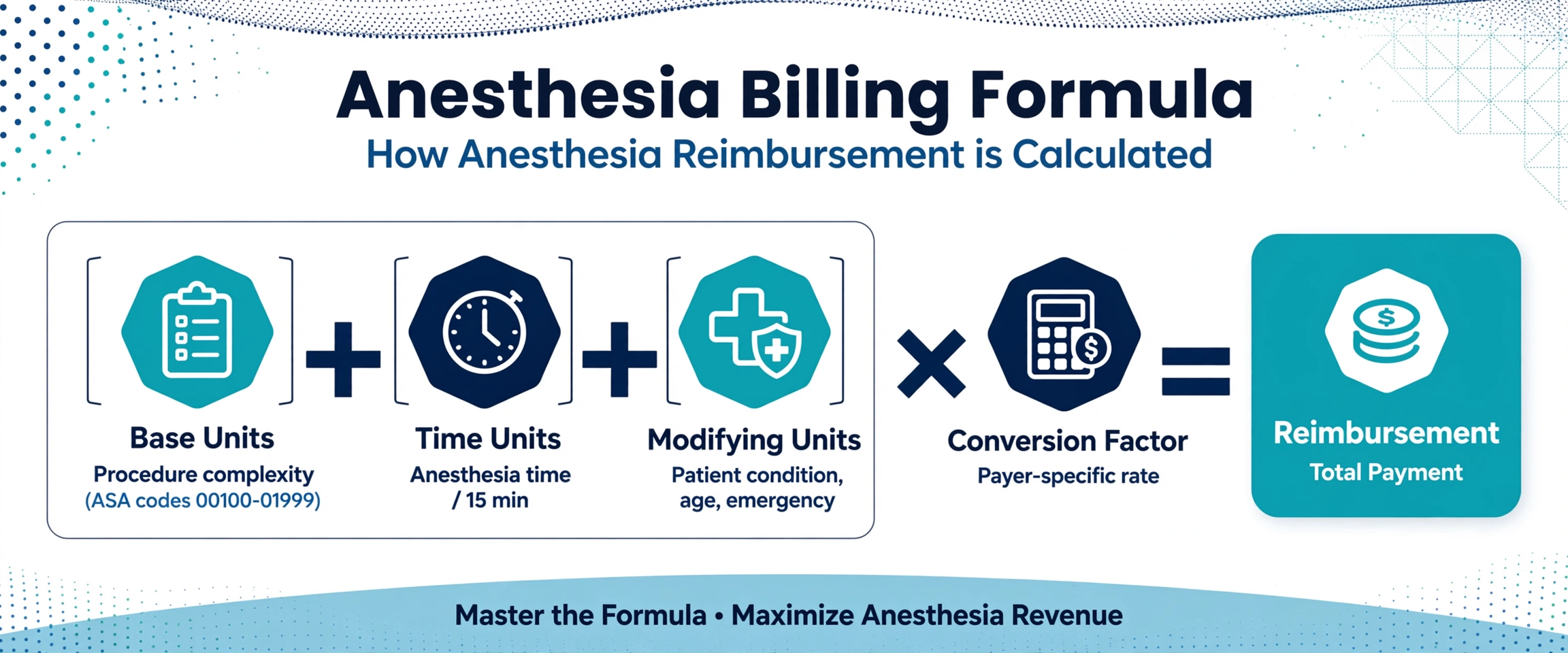
Anesthesia revenue cycle management is the end-to-end process of managing your patient billing, anesthesia-specific unit calculation, medical coding, claims submission, modifier compliance, credentialing, denial management, and reimbursement optimization for anesthesiologists, CRNAs, anesthesiologist assistants, and anesthesia groups. Unlike all other medical specialties, anesthesia billing is built around a unique unit-based payment formula rather than fixed RVU-based fee schedules.
Every other physician specialty bills by selecting a CPT code that carries a fixed dollar value tied to Relative Value Units (RVUs), but anesthesia billing is fundamentally different. Reimbursement is calculated dynamically on every single case, based on a formula that combines four distinct components, each of which requires accurate documentation to produce accurate payment.
THE ANESTHESIA BILLING FORMULA
( Base Units + Time Units + Modifying Units ) × Conversion Factor = Reimbursement
This formula drives every anesthesia claim billed under CPT codes 00100–01999
This formula applies to every anesthesia claim billed under CPT codes 00100–01999. Each component is a separate billing variable that must be correctly documented, calculated, and coded. A deficiency in any one component directly reduces the reimbursement for that case and there is typically no retroactive correction once the claim is paid.
Base units are assigned by CMS and the American Society of Anesthesiologists (ASA) to every surgical or procedural CPT code. They reflect the inherent complexity, skill requirement, and clinical risk associated with providing anesthesia for that specific procedure. Base units are fixed, they do not change based on how long the case takes or how sick the patient is.
| Anesthesia CPT | Surgical Procedure | ASA Base Units | Complexity Level |
|---|---|---|---|
| 00100 | Head / intracranial — excluding neurosurgery | 5 | Moderate |
| 00300 | Thorax — not heart, including esophagus | 5 | Moderate |
| 00500 | Heart procedures — not pacemaker | 20 | Very High |
| 00520 | Thoracotomy with cardiac arrest | 15 | High |
| 00600 | Spine and spinal cord — cervical, not prone | 10 | High |
| 00630 | Lumbar and sacral — not prone | 8 | Moderate-High |
| 00670 | Extensive spine with instrumentation | 13 | High |
| 00700 | Abdomen — upper, not liver | 7 | Moderate |
| 00840 | Intraperitoneal — lower abdomen | 7 | Moderate |
| 01200 | Hip and femur — not pelvis | 8 | Moderate-High |
| 01400 | Knee and popliteal area — general | 5 | Moderate |
| 01402 | Total knee arthroplasty | 7 | Moderate-High |
| 01610 | Shoulder — complex procedures | 5 | Moderate |
| 01967 | Neuraxial labor analgesia (vaginal delivery) | 5 | Moderate |
| 01968 | Cesarean delivery following neuraxial labor | 3 | Moderate |
| 01969 | Cesarean delivery — not following neuraxial | 7 | Moderate-High |
Most payers calculate one time unit per 15 minutes of anesthesia, though rounding rules vary by payer. Medicare requires time to be documented to one decimal place (e.g., 63 minutes = 4.2 time units).
| Anesthesia Duration | Time Units (15-min basis) | Medicare Decimal | Example Procedure |
|---|---|---|---|
| 30 minutes | 2 units | 2.0 | Simple extremity procedure |
| 45 minutes | 3 units | 3.0 | Knee arthroscopy |
| 60 minutes | 4 units | 4.0 | Laparoscopic cholecystectomy |
| 75 minutes | 5 units | 5.0 | Spinal laminectomy |
| 90 minutes | 6 units | 6.0 | Total hip arthroplasty |
| 112 minutes | 7 units | 7.5 → round to 7 | Total knee replacement |
| 120 minutes | 8 units | 8.0 | Major abdominal surgery |
| 180 minutes | 12 units | 12.0 | Complex spinal fusion |
| 240 minutes | 16 units | 16.0 | Open heart procedure |
Tip: Time Documentation Protocol
You need to implement a non-negotiable protocol in your anesthetic record: (1) Document the exact anesthesia start time when you begin preparing the patient. (2) Document the exact end time when continuous care concludes. (3) Verify start/stop times match OR records before the claim is submitted. A systematic 5-minute documentation error across 2,000 annual cases equals roughly 167 unbilled time units — at $78/unit commercial rate, that is $13,000 in lost annual revenue from a single, fixable error.
The conversion factor is the dollar value applied to each billable unit. It varies significantly between Medicare and commercial payers, and between geographic regions even within Medicare. According to the ASA Commercial Conversion Factor Survey, the Medicare vs. commercial gap is enormous, and anesthesia practices that don’t manage commercial contracts aggressively leave substantial revenue on the table.
| Payer Type | 2025/2026 Conversion Factor | Notes |
|---|---|---|
| Medicare (National — 2025) | ~$21.56/unit (regional variation) | Updated via American Relief Act; varies by MAC jurisdiction |
| Medicare (National — 2026) | $21.71/unit (national avg) | CMS released December 2025; effective January 1, 2026 |
| Medicaid | State-specific — often lower than Medicare | States set own anesthesia conversion factors |
| Commercial — Median (ASA Survey) | $78.00+/unit | ASA Commercial CF Survey; varies widely by geography |
| Best Commercial Contracts | $100–$130+/unit | High-value commercial contracts in major metro markets |
Physical status modifiers reflect the patient’s pre-existing medical condition and its impact on anesthesia complexity. This is where Medicare and commercial payers diverge significantly, and where commercial practices leave substantial revenue unclaimed.
| Physical Status | ASA Definition | Additional Units (ASA) | Medicare? | Commercial Plans |
|---|---|---|---|---|
| P1 | Normal healthy patient | 0 units | Not billable | Not applicable |
| P2 | Mild systemic disease | 0 units | Not billable | Not applicable |
| P3 | Severe systemic disease | 1 unit | Informational only — NOT paid | Most commercial plans pay 1 unit |
| P4 | Severe disease — constant threat to life | 2 units | Informational only — NOT paid | Most commercial plans pay 2 units |
| P5 | Moribund — not expected to survive without surgery | 3 units | Informational only — NOT paid | Most commercial plans pay 3 units |
| P6 | Brain-dead donor | N/A | Not applicable | Not applicable |
⚠️ Revenue Alert: Applying physical status modifiers only for Medicare claims and not for commercial claims is a systematic, practice-wide revenue leak. If your anesthesia group performs 1,500 annual cases involving P3–P5 patients on commercial plans, and you average 1.5 additional units per case at $78/unit, that is $175,500 in annual revenue that is being missed simply by not applying the correct modifier to commercial claims
No area of anesthesia billing has more direct impact on reimbursement, and more compliance risk than staffing modifiers. These two-character codes tell Medicare and commercial payers exactly who delivered anesthesia, whether medical direction was involved, how many concurrent cases were running, and what percentage of the fee schedule to apply. A wrong modifier choice doesn’t just cause a denial, it can result in systematic underpayment or, worse, overpayment that triggers recoupment.
| Modifier | Who Bills It | What It Means | Medicare Payment | Key Documentation |
|---|---|---|---|---|
| AA | Anesthesiologist | Personally performed entire anesthesia service alone | 100% of allowable | MD continuous personal involvement documented throughout |
| QZ | CRNA | CRNA without medical direction by any physician | 100% of allowable | No physician oversight; CRNA independent service documented |
| QY | Anesthesiologist (MD) + CRNA bills QX | Medical direction of ONE CRNA — 1:1 direction | 100% of allowable | All 7 medical direction requirements documented by MD |
| QK | Anesthesiologist | Medical direction of TWO to FOUR concurrent cases | 50% of allowable per case | All 7 requirements met & documented for EACH concurrent case |
| QX | CRNA or AA | Service under medical direction by a physician | 50–100% (payer-specific) | Must pair with directing MD's QK or QY; coordination documented |
| AD | Anesthesiologist | Medical SUPERVISION — more than 4 concurrent cases | 3 base units + 1 if present for induction; NO time units | Major revenue reduction; supervision level reflected in documentation |
| GC | Teaching Anesthesiologist | Resident service under teaching MD direction | 100% if ≤2-room; 50% (QK) if 3–4 rooms | Teaching physician criteria met; present for critical portions |
| QS | Any provider | Monitored Anesthesia Care (MAC) services | Time-based; payer-specific | Medical necessity for MAC documented; not simply lighter sedation |
| G8 | Any provider | MAC for high-risk or complex procedures | Payer-specific | High-risk criteria met and documented in the record |
This is one of the most financially consequential distinctions in your practice anesthesia billing. Get it wrong, in either direction and the financial and compliance consequences are serious.
| Scenario | Modifier | Payment | Key Rule |
|---|---|---|---|
| MD personally performs alone | AA | 100% of allowable | No direction; MD alone throughout entire case |
| MD directs 1 CRNA (1:1) | QY (MD) + QX (CRNA) | 100% of allowable | Both providers bill; all 7 medical direction requirements met |
| MD directs 2–4 concurrent cases | QK (MD) + QX (CRNA) | 50% of allowable per case | All 7 requirements met for EACH case; MD cannot be in all ORs simultaneously |
| MD supervises 5+ cases | AD (MD) + QZ (CRNA) | 3 base units + 1 at induction only; NO time units | Major revenue reduction; CRNA becomes independently billing (QZ = 100%) |
Qualifying circumstance codes are CPT add-on codes that capture additional complexity or risk beyond what the base unit value reflects. They translate directly into additional reimbursement units, but they are frequently under-documented, mis-applied, or skipped entirely by practices that aren’t confident in the rules.
| CPT Code | Qualifying Circumstance | Additional Units | Medicare? | Commercial Plans |
|---|---|---|---|---|
| 99100 | Anesthesia for patient under 1 year or over 70 years | 1 unit | NOT payable — informational only | Most plans pay — verify per payer |
| 99116 | Utilization of controlled hypotension during anesthesia | 5 units | NOT payable — informational only | Most plans pay — verify per payer |
| 99135 | Deliberate hypothermia during anesthesia | 5 units | NOT payable — informational only | Most plans pay — verify per payer |
| 99140 | Emergency conditions — complicating case | 2 units | NOT payable — informational only | Most plans pay — verify per payer |
Monitored Anesthesia Care is a specific anesthesia service in which an anesthesia provider monitors a patient undergoing a diagnostic or therapeutic procedure. MAC is not simply light sedation, it is a complete anesthesia service that requires the same standard of care as general anesthesia. Billing MAC incorrectly or without adequate medical necessity documentation is one of the top compliance risk areas in anesthesia billing.
Medical necessity must be documented: MAC is not billable simply because a lighter anesthetic approach was chosen. The record must demonstrate that the patient’s condition required the presence of an anesthesia provider.
Monitored Anesthesia Care is billed using modifier QS: Your billing team needs to append to the appropriate anesthesia CPT code.
Modifier G8: It is used when MAC is provided for a patient who is a high-risk or complex patient additional documentation of the high-risk criteria is required.
Time documentation requirements are the same as all anesthesia: The start time, end time, and continuous monitoring documentation are required.
CRNA and anesthesiologist billing rules apply to MAC: The modifier selection (QZ, AA, QK, etc.) follows the same framework as surgical anesthesia.
Obstetric anesthesia has its own code family and its own set of billing rules that differ from standard surgical anesthesia. Getting OB anesthesia coding right is essential for any anesthesia group that provides labor and delivery services.
| Scenario | CPT Code | Base Units | Key Billing Rule |
|---|---|---|---|
| Neuraxial labor analgesia — vaginal delivery | 01967 | 5 | Bill per delivery — not per hour of labor epidural |
| Cesarean delivery following neuraxial labor analgesia | 01968 | 3 (add-on) | 01968 is ADD-ON to 01967 — bill both for C-section after labor epidural |
| Cesarean delivery — not following neuraxial analgesia | 01969 | 7 | Standalone code when no prior labor epidural |
| Anesthesia for amniocentesis | 00952 | 3 | Use when amniocentesis requires anesthesia |
| Anesthesia for postpartum procedures (vaginal) | 01960 | 5 | Post-delivery procedures requiring anesthesia |
| Anesthesia for postpartum D&C | 00952 or 00940 | Varies | Verify payer-specific coverage for post-partum procedures |
Your practice every perfectly-coded, perfectly-documented anesthesia claim is worthless if you are not credentialed with the paying payer. Credentialing is the enrollment infrastructure that enables anesthesia billing, and it is one of the most expensive areas when neglected, because credentialing gaps mean days of unbillable service that cannot be retroactively recovered.
| Credentialing Element | What Anesthesia Groups Must Know |
|---|---|
| CAQH ProView | Maintain active profiles for every anesthesiologist, CRNA, and AA. Update every 120 days minimum — outdated profiles cause automatic enrollment suspension with many payers. |
| Individual vs. Group NPI | Type 1 (individual) and Type 2 (group) NPIs must both be enrolled and linked. Claims require both the rendering provider NPI and billing group NPI to match enrolled records. |
| CRNA Credentialing Differences | CRNAs are credentialed separately from anesthesiologists. Some commercial payers have different panel structures for CRNAs — verify CRNAs are enrolled everywhere anesthesiologists are enrolled. |
| AA (Anesthesiologist Assistant) Enrollment | AAs are licensed in most states but Medicare enrollment rules for AAs differ from CRNAs. Verify AA enrollment eligibility with your MAC before billing Medicare for AA-directed services. |
| Hospital Privileging | Anesthesia providers must maintain current hospital privileges at every facility where they practice. Expired privileges = denied claims. |
| Re-Credentialing Cycle | Every 2–3 years. Missing deadlines causes retroactive claim denial — often discovered months after the lapse, creating complex reversal situations. |
| Medicare PECOS Enrollment | Active enrollment via PECOS for all providers. Any change in practice location, group affiliation, or ownership requires immediate PECOS update or Medicare claims are denied retroactively. |
| Malpractice Coverage | Most payers require minimum coverage amounts for anesthesiologists and CRNAs. Verify coverage requirements before enrollment and at re-credentialing. |
One of the most error-prone areas in anesthesia billing is applying Medicare rules universally, to commercial payers who have different and often more favorable policies, and vice versa. Here’s where the rules meaningfully differ:
| Billing Element | Medicare Rule | Commercial Payer Rule | Revenue Impact |
|---|---|---|---|
| Physical status modifiers | Informational only — NO additional units paid | 80%+ of contracts pay additional units for P3–P5 | Missed units on every commercial P3+ case if not applied |
| Qualifying circumstances (99100–99140) | NOT payable — never bill to Medicare | Most commercial plans cover at least some codes | Denied on Medicare; missed revenue on commercial |
| CRNA reimbursement (QZ) | 100% of Medicare allowable | Often 50–85% depending on contract | Verify CRNA rates per commercial contract |
| Medical direction (QK) rate | 50% of allowable per concurrent case | Varies — some pay higher than Medicare rates | Know your commercial contracts — QK rate may be negotiable |
| Conversion factor | $21.71/unit (national avg 2026) | Median $78.00+/unit — varies widely | Enormous gap — commercial contract management is critical |
| Time unit rounding | To nearest 0.1 unit (decimal) | Usually rounds DOWN to nearest whole unit | Different rounding = different unit count for same case |
| MAC documentation | Strict medical necessity required | Often less prescriptive — but document for all payers | Don't assume commercial is lenient; document consistently |
| Concurrent case limit for direction | 4 cases max for QK; 5+ = supervision (AD) | Most commercial follow Medicare rules — verify contract | Crossing into AD territory is costly for any payer |
A well-structured anesthesia revenue cycle requires precision at every stage. Here’s the complete workflow that separates high-performing anesthesia groups from those that consistently leave revenue on the table.
| RCM Stage | Key Activities | Anesthesia-Specific Focus |
|---|---|---|
| Pre-Service | Demographics, insurance verification, pre-auth | Verify anesthesia benefit, MAC coverage, and qualifying circumstance coverage per payer |
| Day of Surgery | Provider assignment, concurrency tracking | Monitor concurrent case count in real time; flag approaching AD threshold |
| Clinical Documentation | Anesthetic record, start/stop times, ASA status | Verify all 7 medical direction requirements documented; exact start/stop times; physical status |
| Charge Capture | CPT selection, time calculation, ASA crosswalk, modifier application | Crosswalk every surgical CPT; calculate units using exact times; apply payer-specific rules |
| Claim Scrubbing | Pre-submission review for errors and compliance | Flag: missing times, crosswalk mismatches, qualifying circumstances on Medicare, concurrency issues |
| Claim Submission | Electronic submission within timely filing window | Submit within 24–48 hours of DOS; track timely filing by payer |
| Payment Posting | ERA/EOB reconciliation, conversion factor audit | Compare paid CF to contracted rate; flag underpayments immediately |
| Denial Management | Root cause analysis, appeal workflow, trend tracking | Track by modifier, time error, MAC documentation, and crosswalk mismatch separately |
| Patient Collections | Cost estimates, balance billing, financial counseling | Good-faith estimates for elective cases; verify balance billing rules by state |
| Analytics | KPI monitoring, time accuracy rate, units per case | Monitor avg units per case by CPT; flag cases where time seems low vs. OR records |
The most pervasive and costly challenge in your anesthesia billing. Missing start or end times, inconsistent time recording between the anesthetic record and the OR log, and systematic rounding errors all translate directly into lost revenue.
Applying the wrong staffing modifier, billing AA when QK was the correct modifier, or billing QK when the concurrency count pushed the case into AD territory, causes either underpayment or overpayment that creates recoupment risk. Modifier selection must be based on the actual facts of each case, not habit.
Failing to document all 7 medical direction requirements for QK/QY cases is an extremely common and costly error. If even one of the seven requirements is undocumented, the case must technically be billed as supervision, with dramatically reduced reimbursement.
Practices that apply physical status modifiers only for informational purposes (as required for Medicare) and fail to pursue additional units for P3–P5 patients on commercial plans are systematically under-collecting on every high-acuity commercial case.
As an experienced anesthesiologist you know that even small mistakes in your anesthesia billing can lead to denied claims, delayed payments, and lost revenue, the most common anesthesia revenue cycle management errors are:.
Missing anesthesia start or end time in the anesthetic record: The single most common anesthesia billing error.
Applying P3–P5 physical status modifiers only on Medicare claims: Commercial plans pay additional units; most practices miss this entirely.
Billing qualifying circumstance codes (99100–99140) on Medicare claims: These codes are NOT payable to Medicare and result in denials.
Using AD modifier when QK was appropriate: Crossing into supervision territory unknowingly due to poor concurrency tracking.
Missing one of the 7 medical direction requirements: Billing QK/QY without complete documentation of all seven requirements creates audit exposure.
OB code 01969 vs. 01967+01968 confusion — A consistently misapplied code family in labor and delivery settings.
Not crosswalking surgical CPT to anesthesia CPT: It results in wrong base unit assignment and incorrect reimbursement.
Absorbing underpayments from commercial payers silently: When your practice doesn’t audit paid conversion factors against contracted rates lose money every month.
Tip: Pre-Claim Submission Checklist
Before any anesthesia claim leaves your billing system, It is your billing team responsibility to verify:
(1) Start and end times are documented and match OR records.
(2) ASA physical status is documented in the record.
(3) The modifier reflects the actual staffing arrangement.
(4) Anesthesia CPT was crosswalked from the surgical CPT.
(5) All 7 medical direction requirements are documented if QK/QY billed.
(6) Qualifying circumstance codes are suppressed for Medicare claims.
(7) MAC medical necessity is documented if QS billed. A pre-claim checklist turns billing into a quality assurance process and quality-assured claims clear at 95%+ rates
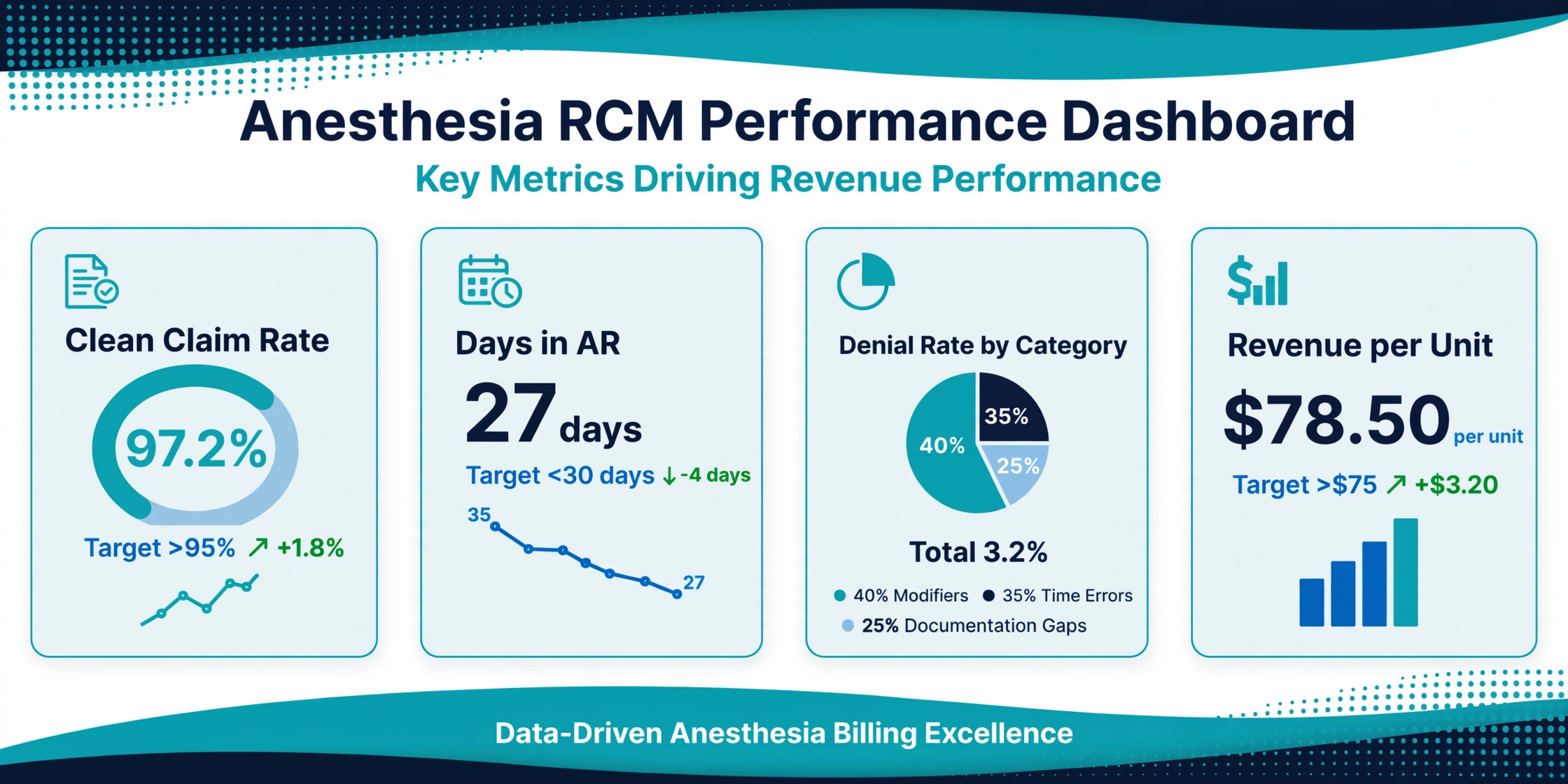
Keeping up with industry benchmarks helps your anesthesia practice understand where they stand and where improvements are needed. The latest anesthesia revenue cycle management statistics, including denial rates, reimbursement trends, and key performance metrics that impact revenue and long-term financial success.
| Metric | Industry Benchmark | Source |
|---|---|---|
| Medicare anesthesia conversion factor (2026) | $21.71/unit (national avg) | CMS PFS 2026 |
| Median commercial conversion factor | $78.00+/unit | ASA Commercial CF Survey 2022 |
| Medicare as % of median commercial rate | < 28% | ASA Survey Analysis |
| In-house anesthesia group collection rate | 60–72% (industry avg) | Anesthesia billing industry benchmarks |
| Outsourced anesthesia RCM collection rate | 85–96%+ | HOO/Industry data — experienced RCM partners |
| Target clean claim rate | ≥95% | AAPC Best Practices |
| Target denial rate | <5% | AAPC / Anesthesia billing benchmarks |
| Target days in AR | <30 days | MGMA |
| Typical concurrency limit before supervision | 5+ cases = AD billing (no time units) | CMS Medical Direction Rules |
| Revenue loss — missed P3 physical status (commercial) | $78–$156/case at median CF | ASA / Contract analysis |
| Revenue loss — missing 5 min time per case × 2,000 cases | ~$13,000–$26,000/year | HOO revenue modeling |
| Cost of a reworked denied claim | $25–$118 per claim | CAQH Research |
Monitoring the right performance metrics is essential for maintaining a healthy anesthesia revenue cycle, key anesthesia revenue cycle management KPIs that helps yo reduce denials, improve collections, speed up reimbursements, and measure the overall financial performance of your practice.
| KPI | What It Measures | Target for Anesthesia Groups |
|---|---|---|
| Clean Claim Rate | % of claims accepted on first submission | ≥95% |
| Denial Rate | % of submitted claims denied | <5% |
| Days in Accounts Receivable | Average time from DOS to payment | <30 days |
| Net Collection Rate | % of collectible revenue actually collected | ≥96% |
| Average Revenue per Unit | Actual collection divided by total billed units | Benchmark against contracted CF |
| Time Accuracy Rate | % of cases where documented time matches OR records | ≥99% |
| Modifier Error Rate | % of claims with incorrect modifier applied | <1% |
| Medical Direction Documentation Rate | % of QK/QY cases with all 7 requirements documented | 100% |
| Credentialing Currency Rate | % of active providers with current credentials | 100% |
| AR Aging > 90 Days | % of total AR outstanding over 90 days | <15% |
Tip: Monthly KPI Review
It is in your responsibility to implement a monthly anesthesia billing performance review that covers every metric above plus a case-level sample audit. Pull 20 random cases each month and verify time documentation accuracy, crosswalk correctness, modifier selection, and medical direction documentation completeness. Practices that conduct monthly case-level audits identify systemic errors an average of 8–12 weeks earlier than those that review only aggregate metrics.
The authoritative Medicare anesthesia billing and payment manual. This is the primary reference for anesthesia billing rules including unit calculation, modifier requirements, medical direction criteria, and MAC billing. Every anesthesia billing professional should reference it directly: CMS IOM Pub. 100-04, Chapter 12
Violations of the False Claims Act (31 U.S.C. § 3729), including billing QK when medical direction criteria weren’t met, billing time that wasn’t documented, or upcoding physical status , can result in civil fines up to $27,018 per claim plus treble damages. Anesthesia billing, with its mathematical precision requirements, is a consistent RAC and OIG audit target.
The OIG Work Plan regularly includes anesthesia billing as an audit focus area — particularly medical direction documentation, concurrency compliance, and MAC medical necessity. Monitor the Work Plan annually and ensure your billing practices are defensible for every line item.
The National Correct Coding Initiative contains bundling edits relevant to anesthesia — including rules about which anesthesia codes can be billed with surgical CPTs, and how qualifying circumstance codes interact with anesthesia codes. NCCI compliance is a pre-submission requirement, not a post-denial fix.
All anesthesia billing data must be handled in compliance with HIPAA Privacy and Security Rules. This applies to your billing system, data transmission, and any third-party billing partners with access to protected health information.
Anesthesia groups face this decision with more urgency than most specialties, because the unit-based billing system, complex modifier rules, and concurrency documentation requirements demand genuine expertise that generalist billing staff rarely have.
| Factor | In-House Anesthesia Billing | Outsourced Anesthesia Revenue Cycle Management Services |
|---|---|---|
| Specialty expertise | Requires specific training — not interchangeable with general billing | We have dedicated anesthesia billing specialists with ASA crosswalk mastery |
| Time unit accuracy | Prone to systematic rounding errors and missing start/stop times | Rigorous time audit process; automated variance detection vs. OR records |
| Modifier compliance | Medical direction and concurrency rules frequently misapplied | We use decision-based modifier selection built into every claim workflow |
| Physical status (commercial) | Often not applied on commercial — major revenue miss | Payer-specific physical status billing applied per contract |
| MAC documentation compliance | Often under-verified before submission | Pre-submission MAC documentation review standard in workflow |
| OB anesthesia coding | 01967/01968/01969 mix-ups common | OB-specific coding protocols; quarterly OB claim audits |
| Denial management depth | Reactive; appeals limited by staff bandwidth | Dedicated AR follow-up; appeal success rates tracked and optimized |
| Average collection rate | 60–72% (industry avg for in-house groups) | 85–96%+ with experienced anesthesia RCM partner |
| Compliance risk | Higher — modifier errors and Medicare rule violations common | Reduced through systematic compliance protocols and regular auditing |
| Best for | Very large groups with dedicated specialist anesthesia billing staff | Most anesthesia practices and groups of all sizes |
At House of Outsourcing, we understand that your anesthesia billing is not general billing, it’s a precision discipline that demands specialist expertise, complete documentation review, and an intimate knowledge of the Medicare rules, modifier framework, and commercial contract landscape that governs every anesthesia claim. That’s exactly what we deliver.
Certified Anesthesia Billing Specialists: Our AAPC-credentialed coders specialize in anesthesia, ASA crosswalk mastery, unit calculation precision, modifier decision workflows, and Medicare medical direction compliance.
Modifier Decision Framework: Our pre-submission modifier review workflow flags every QK, QY, QZ, AA, and AD case for verification against the clinical facts, preventing both underpayment and the compliance exposure of overpayment.
Medical Direction Documentation Review: We verify all 7 Medicare medical direction requirements are present before any QK/QY claim is submitted. If documentation is incomplete, we flag it before the claim, not after the denial.
Commercial Physical Status Optimization: Our experts apply P3–P5 physical status modifiers on all applicable commercial claims per your payer contracts capturing the additional units most in-house billing teams leave on the table.
OB Anesthesia Coding Accuracy: Our dedicated OB anesthesia coding protocol and quarterly OB claim audits ensure 01967/01968/01969 and related codes are always applied correctly.
Credentialing Management Support — We track credentialing renewal dates, PECOS enrollment status, and CAQH profile currency for your entire anesthesia provider roster — proactively, before gaps create billing problems.
Dedicated Anesthesia Account Manager: One experienced specialist who knows your group, your payer mix, your OR volume, and your financial goals, accountable to your results every month.
The future of anesthesia revenue cycle management is being shaped by AI-powered automation, evolving payer requirements, and stricter documentation standards. You can explore the emerging trends that will help your anesthesia practice improve efficiency, reduce denials, and maximize reimbursements in the years ahead.
Medicare Conversion Factor Advocacy — The ASA and AANA are actively advocating for reversal of the cumulative Medicare CF cuts since 2019. Legislative outcomes in 2026–2027 could meaningfully affect anesthesia reimbursement rates.
AI-Driven Time Capture: Automated time capture systems integrated with OR management platforms are reducing time documentation errors and improving unit calculation accuracy without human intervention.
Real-Time Concurrency Monitoring: Emerging OR management tools automatically track concurrent case counts and alert anesthesiologists before they exceed medical direction thresholds.
| Resource | What It Covers | Link |
|---|---|---|
| CMS Anesthesiologist Center | Conversion factors, base units, fee schedule | cms.gov/medicare/payment/fee-schedules/physician/anesthesiologists-center |
| CMS Medicare Claims Processing Manual Ch. 12 | Authoritative Medicare anesthesia billing rules | cms.gov/regulations-and-guidance/guidance/manuals |
| ASA Relative Value Guide (RVG) | ASA base units and anesthesia CPT crosswalk | asahq.org/quality-and-practice-management |
| AANA — Nurse Anesthesiology | CRNA billing guidance and Medicare policy | aana.com |
| OIG Work Plan | Current anesthesia billing enforcement priorities | oig.hhs.gov/reports-and-publications/workplan |
| CMS NCCI Policy Manual | Bundling rules for anesthesia codes | cms.gov/medicare/coding-billing/national-correct-coding-initiative-edits |
| AMA CPT Code Database | Official CPT codes 00100–01999 | ama-assn.org/practice-management/cpt |
| CMS PECOS | Medicare provider enrollment and maintenance | pecos.cms.hhs.gov |
| CAQH ProView | Credentialing data management | caqh.org/solutions/caqh-proview |
| MGMA DataDive | Practice management benchmarking data | mgma.com/data |
| HHS HIPAA Resources | Privacy and security compliance | hhs.gov/hipaa |
Anesthesia revenue cycle management is the complete process of managing the financial operations of your anesthesia practice from provider credentialing and patient registration through anesthesia-specific unit calculation, CPT coding, modifier selection, claims submission, denial management, and final payment collection.
Unlike all other physician specialties that bill fixed-value CPT codes based on RVUs, anesthesia billing calculates reimbursement dynamically for every case using a mathematical formula that combines procedure-specific base units, time-based units, physical status modifying units, and a payer-specific conversion factor. This unit-based system, combined with complex staffing modifiers and Medicare medical direction rules, makes anesthesia one of the most specialized and highest-risk billing disciplines in US healthcare.
The primary anesthesia staffing modifiers are: AA (anesthesiologist personally performs — 100% of allowable), QZ (CRNA independently — 100%), QY (MD directs 1 CRNA — 100%), QK (MD directs 2–4 concurrent cases — 50% per case), QX (CRNA under medical direction — 50–100% payer-specific), AD (MD supervises 5+ cases — 3 base units only, no time units), QS (Monitored Anesthesia Care), and GC (teaching anesthesiologist with resident). Selecting the wrong modifier directly changes how much — and whether — you get paid.
Time units are calculated at one unit per 15 minutes of continuous anesthesia care. Because anesthesia reimbursement is directly tied to time, undocumented minutes translate directly into lost revenue permanently, since claims cannot be retroactively corrected once paid. Time begins when the anesthesiologist starts preparing the patient (not at surgical incision) and ends when continuous care concludes. Medicare requires time documented to one decimal place. A systematic 5-minute documentation error across 2,000 annual cases can cost $13,000+ annually at commercial rates.
Get a free assessment from our billing experts