
Our Chiropractic RCM services help practices improve revenue through accurate coding, documentation review, claim management, and denial prevention. We streamline chiropractic billing workflows to maximize reimbursements, reduce errors, and support long-term practice growth.

Chiropractic care is one of the most sought-after healthcare services in the United States, with tens of millions of Americans visiting chiropractors annually for musculoskeletal conditions, spinal pain, and wellness care. But running a financially healthy chiropractic practice is a different skill set entirely from delivering excellent clinical care.
According to our two decades billing experience we know that chiropractic revenue cycle management is more complex than it appears on the surface. Initially chiropractic billing seems straightforward, a handful of spinal manipulation codes, some physical therapy modalities, and office visits. But look closer and you find a billing environment that simultaneously manages insurance patients, cash-pay patients, personal injury (PI) cases, and workers’ compensation (WC) claims, each with completely different billing rules, documentation standards, collection timelines, and legal frameworks. Managing all four correctly, at the same time, in your high-volume practice, is a genuine challenge for your practice.
Need support with your billing workflow? Explore our medical billing and revenue cycle services or request a free consultation.
Chiropractic revenue cycle management is the end-to-end process of converting chiropractic clinical services into collected revenue, from patient scheduling and insurance eligibility verification through SOAP note documentation, spinal manipulation coding (CPT 98940–98942), modifier application, multi-payer claim submission, personal injury lien management, workers’ compensation billing, denial management, and final payment collection. What makes it uniquely complex is the simultaneous management of four distinct payment channels, each with different rules, timelines, and compliance requirements.
Most medical practices manage one or two payer types. A chiropractic practice routinely manages four simultaneously, sometimes for the same patient across different episodes of care acorss the USA
| Payment Channel | Key Characteristics | Unique Billing Challenge |
|---|---|---|
| Commercial Insurance | Standard EOB-based reimbursement; annual benefit limits; visit caps | Visit limit tracking; eligibility verification before every visit; prior auth for some plans |
| Medicare | Only covers 'active/corrective' manipulation; requires AT modifier; maintenance care NOT covered | AT modifier compliance; medical necessity documentation; frequent audits; subluxation documentation |
| Personal Injury (PI) | Liens against settlement; third-party liability; attorney coordination | Lien management; narrative reports; settlement tracking; no set timely filing deadline |
| Workers' Compensation (WC) | State-specific rules; employer liability; case management coordination | State WC fee schedules; treatment authorization; case manager coordination; modified billing forms |
| Cash Pay / Self-Pay | No insurance billing; direct patient payment | Transparent pricing; payment plans; financial policy enforcement |
The AMA CPT code system defines the billing codes chiropractors use for spinal manipulation, extremity adjustments, physical therapy modalities, and evaluation and management services. Understanding the correct code for each service, and the documentation required to support it is the foundation of clean chiropractic billing.
| CPT Code | Description | Spinal Regions | Key Documentation Requirement |
|---|---|---|---|
| 98940 | Spinal manipulation — cervicothoracic region | 1–2 spinal regions | Document subluxation or neuromusculoskeletal condition; specify regions treated |
| 98941 | Spinal manipulation — 3–4 spinal regions | 3–4 spinal regions | Document each region; clinical findings support multiple region treatment |
| 98942 | Spinal manipulation — 5 regions | 5 spinal regions | All five regions: cervical, thoracic, lumbar, sacral, pelvic; document each |
| CPT Code | Description | Key Rule |
|---|---|---|
| 98943 | Extraspinal manipulation — 1 or more extraspinal regions | Covers extremity adjustments (shoulder, knee, ankle, wrist, etc.); document specific joint(s) treated and clinical indication |
| CPT Code | Description | Time Requirement | Key Rule |
|---|---|---|---|
| 97010 | Hot/cold pack application | No time requirement | Cannot be billed alone — must accompany another service |
| 97012 | Mechanical traction | 15 min personal contact | Document time; provider must be in constant attendance |
| 97014 | Electric stimulation (unattended) | No time requirement | Unattended; document duration and area |
| 97016 | Vasopneumatic compression device | No time requirement | Document duration and clinical indication |
| 97018 | Paraffin bath | No time requirement | Document body part and duration |
| 97022 | Whirlpool | 15 min personal contact | Document time; most payers require medical necessity |
| 97024 | Diathermy | No time requirement | Document duration; verify payer coverage |
| 97026 | Infrared (IR) therapy | No time requirement | Verify payer coverage; some plans exclude |
| 97028 | Ultraviolet therapy | No time requirement | Verify payer coverage; rarely covered |
| 97032 | Electric stimulation (attended) | 15 min personal contact | Document time; constant attendance required |
| 97033 | Iontophoresis | 15 min personal contact | Document drug used, body part, and time |
| 97035 | Ultrasound | 15 min personal contact | Document time, MHz, body part, and watts/cm2 |
| 97110 | Therapeutic exercise | 15 min personal contact | Document time, exercises performed, and therapeutic goals |
| 97530 | Therapeutic activities | 15 min personal contact | Document time and specific activities; functional focus |
| 97140 | Manual therapy techniques | 15 min personal contact | Covers soft tissue mobilization, joint mobilization; document time and technique |
| 97150 | Therapeutic exercises — group | No individual time requirement | Group must be ≤4 patients; document attendance |
| CPT Code | Description | When Billable in Chiropractic |
|---|---|---|
| 99202–99205 | New patient office visits (4 complexity levels) | Initial evaluation with history, examination, and medical decision making — when a separate, significant evaluation is performed beyond the spinal exam inherent in manipulation |
| 99212–99215 | Established patient office visits | Established patient encounters requiring significant, separately identifiable evaluation beyond routine chiropractic visit — document separately |
| 99243–99245 | Office consultation codes | Where still covered — for formal consultations; verify payer acceptance (Medicare eliminated consult codes) |
Tip: E/M + Manipulation on the Same Day
When a chiropractor performs both an E/M service and spinal manipulation on the same date, modifier 25 must be appended to the E/M code to indicate it was a separate, significant, and identifiable service. The documentation must clearly support a distinct evaluation beyond the standard pre-manipulation assessment. Without modifier 25, the E/M will be bundled into the manipulation payment and denied separately. Without separate documentation supporting the distinct E/M service, the modifier is not compliant. Both are required.
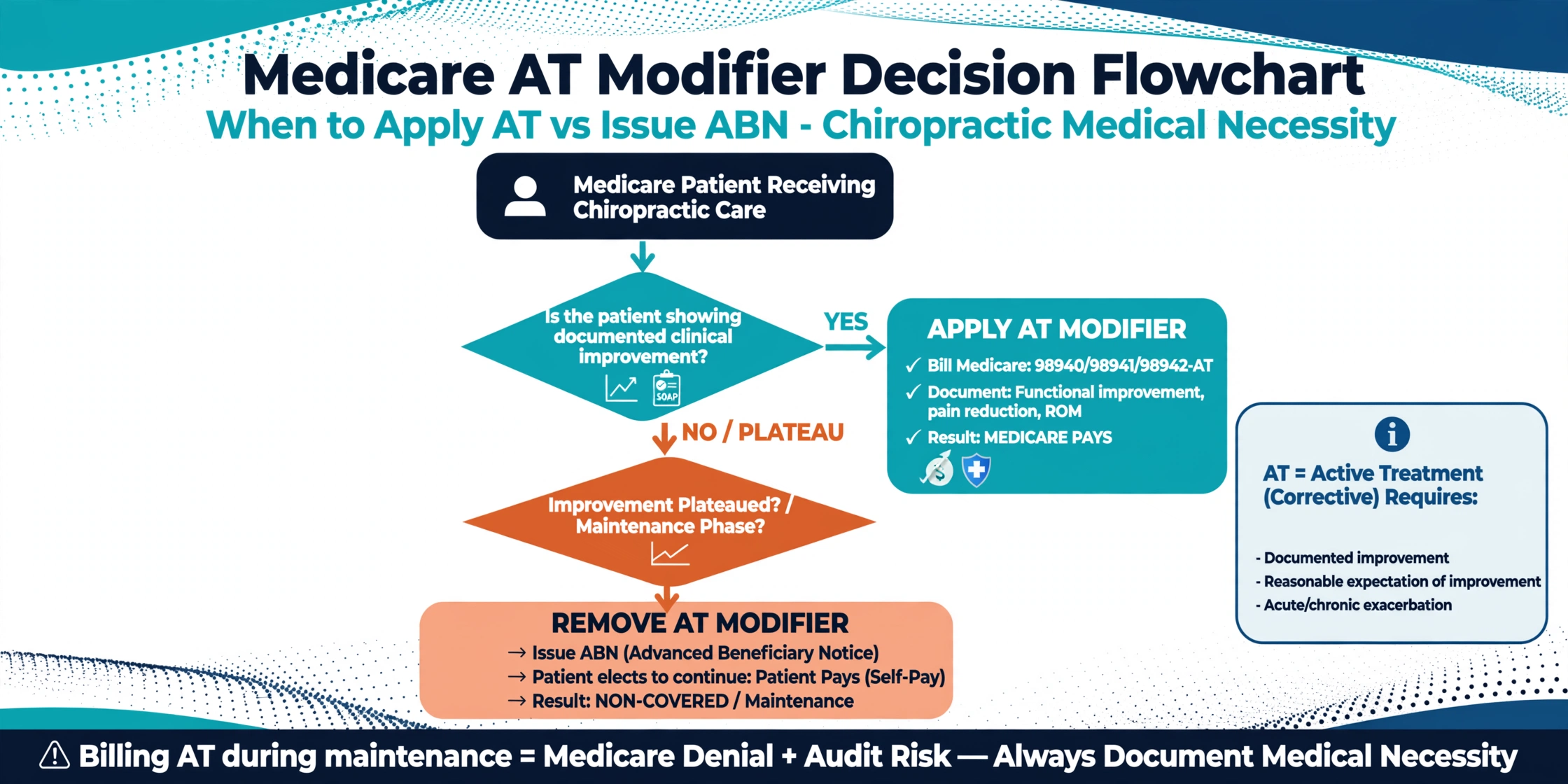
No compliance rule in chiropractic billing carries more financial and legal weight than the Medicare AT modifier. Getting this wrong in either direction, creates serious consequences. Yet it remains one of the most misunderstood and misapplied rules in chiropractic practice medical billing.
| Scenario | Modifier | Medicare Coverage? | Documentation Required |
|---|---|---|---|
| Active/corrective chiropractic care — patient improving | AT | YES — covered | Document: subluxation (x-ray or physical exam), clinical findings, functional improvement, treatment goals, expectation of improvement |
| Maintenance chiropractic care — patient at plateau | No AT modifier (or GA modifier) | NO — not covered; patient pays | Document: plateau of improvement; advance beneficiary notice (ABN) signed by patient before service |
| Active care followed by maintenance in same episode | AT for active visits; switch to GA when plateau reached | Covered for AT visits; not covered for maintenance visits | Clear documentation of when active care phase ended and maintenance began |
| Service | Medicare Coverage Status | Notes |
|---|---|---|
| Spinal manipulation (98940/98941/98942) — active care | Covered with AT modifier | Subluxation must be documented; improvement expected and occurring |
| Spinal manipulation — maintenance care | NOT covered | Patient must sign ABN; patient responsibility |
| Physical therapy modalities (97010, 97014, etc.) | NOT covered when billed by chiropractor | Medicare excludes PT modalities billed under chiropractic provider number |
| X-rays ordered by chiropractor | NOT covered by Medicare Part B | Medicare does not cover x-rays ordered by chiropractors |
| E/M visits by chiropractor | NOT covered separately for chiropractic NPI | Medicare does not cover E/M codes billed by chiropractors under their DC NPI |
| Massage therapy | NOT covered | Medicare exclusion |
Two of the most financially significant, and most operationally complex revenue streams in your chiropractic practice are personal injury and workers’ compensation billing. Both require fundamentally different workflows from standard insurance billing.
Personal injury cases arise when a patient seeks chiropractic care following a motor vehicle accident (MVA), slip and fall, or other third-party liability event. The billing complexity is substantial:
| PI Billing Element | How It Works in Chiropractic |
|---|---|
| Lien-based billing | Provider agrees to await payment from settlement rather than billing patient immediately; lien filed against settlement proceeds |
| Letter of Protection (LOP) | Attorney-issued document guaranteeing payment from settlement; practice treats patient in exchange for payment from future settlement |
| Third-party liability | At-fault party's insurance (auto liability or PIP) is the primary payer — NOT the patient's health insurance in most PI cases |
| PIP (Personal Injury Protection) | No-fault auto insurance covering medical costs regardless of fault; state-specific limits (e.g., Florida: $10,000 PIP); bill PIP first before health insurance or lien |
| Documentation standard | Detailed narrative reports required — initial exam findings, mechanism of injury, treatment plan, progress reports, final narrative at case close |
| Timely filing | No standard insurance timely filing deadline — but lien recording deadlines vary by state; know your state's lien laws |
| Settlement coordination | Must coordinate with patient's attorney for settlement notification; payment comes from settlement proceeds through attorney trust account |
| Balance billing | PI liens allow billing for full charges regardless of contracted rates — often significantly higher than insurance reimbursement |
Tip: PI Documentation Protocol
For every PI patient, create a dedicated case file containing:
(1) Initial examination report with mechanism of injury documentation.
(2) Signed lien/LOP agreement.
(3) Attorney contact information.
(4) PIP insurance verification and coverage limit.
(5) At-fault carrier information.
(6) Progress reports at 4-6 week intervals.
(7) Final narrative report at case closure. PI cases can take 12–36 months to settle — organized documentation from day one prevents revenue from being lost in administrative chaos two years later
Workers’ compensation billing for chiropractic care is governed by state law, and every state has different rules for fee schedules, treatment authorization, billing forms, and appeals processes.
| WC Billing Element | Key Rules for Chiropractic |
|---|---|
| State-specific fee schedules | WC pays according to a state-mandated fee schedule — not your usual and customary rates; know your state's chiropractic WC fee schedule |
| Treatment authorization | Most WC payers require authorization for chiropractic treatment beyond the initial emergency visits; get auth before treatment |
| Billing forms | WC typically uses HCFA-1500 or state-specific forms; some states require specific WC billing forms |
| Case manager coordination | WC case managers may conduct utilization reviews; maintain communication and provide requested documentation promptly |
| Independent Medical Examinations (IME) | WC insurers may require IMEs to evaluate treatment necessity; documentation quality determines IME outcome |
| Return-to-work documentation | WC requires work status documentation — full duty, modified duty, or off work; document clearly at each visit |
| Employer notification | Some states require notification of employer and WC insurer about treatment; know your state's requirements |
| Dispute resolution | WC claim disputes go through state workers' compensation boards — not standard insurance appeals; know your state's WC dispute process |
Medicare chiropractic billing is governed by specific CMS rules that make it more restrictive than commercial insurance. It is important for your practice growth that you should completely understand these rules for every chiropractic practice that treats Medicare patients. Reference: CMS Medicare Benefit Policy Manual, Chapter 15
| Medicare Chiropractic Rule | Current Guideline (2026) |
|---|---|
| Covered services | Spinal manipulation (98940, 98941, 98942) for subluxation ONLY — with AT modifier for active/corrective care |
| Covered condition | Subluxation of the spine — must be documented by x-ray or physical examination |
| AT modifier requirement | Mandatory for all covered chiropractic manipulation claims; certifies active/corrective care |
| Maintenance care | NOT covered; requires ABN signed by patient before service |
| Physical therapy modalities | NOT covered when billed by chiropractor under DC NPI |
| X-rays | NOT covered (ordered by chiropractor) |
| E/M services | NOT covered separately under DC NPI for Medicare |
| Documentation minimum | SOAP notes at every visit documenting subluxation, treatment, and patient response |
| Medicare billing form | CMS-1500 with NPI, AT modifier, and appropriate ICD-10 diagnosis codes |
| Timely filing deadline | 12 months from date of service |
| Medicare Advantage | May have additional coverage beyond traditional Medicare; verify per plan |
| Telehealth for chiropractic | Limited coverage; manipulation itself cannot be delivered via telehealth |
| ICD-10 Code Range | Description | Use in Chiropractic |
|---|---|---|
| M99.00–M99.09 | Segmental and somatic dysfunction — by spinal region | Primary diagnosis for subluxation-based chiropractic care; most specific chiropractic-aligned diagnosis codes |
| M54.2 | Cervicalgia | Neck pain; commonly paired with manipulation of cervical spine |
| M54.5 / M54.50–M54.59 | Low back pain — various specifications | Common supporting diagnosis; use most specific code (M54.51 vertebrogenic, M54.59 other) |
| M54.4 | Lumbago with sciatica | Document laterality (M54.41 right, M54.42 left); relevant for lumbar/sacral manipulation |
| M47.816–M47.819 | Spondylosis with radiculopathy — cervical/thoracic/lumbar | Use when spondylosis with nerve root involvement documented |
| S13.4XXA / S33.5XXA | Cervical/lumbar sprain — acute | Use for PI/WC acute injury cases; document mechanism of injury |
| G54.2 | Cervical root disorders | Cervical radiculopathy; pair with appropriate spinal manipulation code |
| M53.3 | Sacrococcygeal disorders | Sacral and coccygeal dysfunction |
Tip: ICD-10 Specificity and Medical Necessity
When you are using M54.5 (low back pain, unspecified) as your only diagnosis on every claim is a red flag for payers and a medical necessity audit risk. Document and code the most specific diagnosis your clinical findings support. M99.03 (segmental somatic dysfunction, lumbar region) is far more specific and more clinically appropriate for a patient receiving lumbar spinal manipulation than a generic pain code
In your chiropractic billing, documentation quality is the single most important determinant of claim outcomes. Your practice every chiropractic claim is essentially a story told in clinical language about why this patient needed this treatment on this date. When the story is complete and compelling, claims pay. When the story is thin or inconsistent, claims are denied.
Subjective (S): Chief complaint with pain level (0-10 scale), location, quality, duration, and aggravating/relieving factors. What the patient reports since the last visit.
Objective (O): Vital signs (if applicable), range of motion measurements, orthopedic/neurological test results, posture assessment, palpation findings identifying specific subluxation levels, muscle tone and spasm, and sensory/motor findings if relevant.
Assessment (A): Clinical impression, specific diagnosis with ICD-10 codes. Document which spinal regions have active subluxation requiring treatment. For Medicare patients, document subluxation by physical exam finding (segmental pain, motion loss, muscle spasm, or asymmetry).
Plan (P): Treatment provided specific CPT codes for manipulation (document which spinal regions were treated), any modalities (with time if time-based), patient education, home exercise program, and plan for next visit.
Clinical Indicators of Improvement (for Medicare AT): Document functional improvement, increased ROM, decreased pain scale, improved activities of daily living. This is the documentation foundation for the AT modifier.
Date, Time, and Signature: Every note must be dated, include the visit time, and be signed (or authenticated) by the treating chiropractor.
Diagnosis: Specific ICD-10 code(s) identifying the condition being treated and the spinal segments involved.
Subluxation Evidence: For Medicare, subluxation must be documented by x-ray OR by two of the following physical examination findings: pain/tenderness, decreased range of motion, muscle spasm, or asymmetry.
Necessity: Clinical rationale for why manipulation is the appropriate treatment for this patient’s condition at this stage of care.
Regions Treated: Specific spinal regions manipulated, documented to support the CPT code billed (98940 = 1-2 regions, 98941 = 3-4 regions, 98942 = 5 regions).
Response to Treatment: Documented patient response, changes in pain level, range of motion, or function since last treatment.
Progress Toward Goals: For ongoing care, document progress toward specific functional goals and the continued need for active treatment.
Patient Scheduling & Registration: Your billing team needs to collect complete demographic information, all insurance cards (health, auto PIP, WC if applicable), referring provider, and attorney information for PI cases. Identify the payment channel (insurance, Medicare, PI, WC, or self-pay) at registration.
Insurance Eligibility Verification: It is the responsibility of your practice billing team to verify active coverage before every visit, not just at the first visit. Confirm chiropractic benefit inclusion, annual visit limits, remaining benefit balance, deductible status, copay/coinsurance amounts, and prior authorization requirements. For Medicare patients, confirm Part B eligibility and track visit utilization.
Prior Authorization: Your practice PA experts need to obtain authorization as required by commercial payers. Some plans require PA for chiropractic visits beyond an initial number (often 6-12). Track authorization numbers, approved visit quantities, and authorization expiration dates. Build automated expiration alerts.
Clinical Documentation: It is also your main responsibility to complete individualized SOAP notes at every visit with all required elements. For Medicare, ensure subluxation documentation and AT modifier eligibility is supported. For PI/WC, document mechanism of injury and functional limitations.
Charge Capture: You need to select the correct CPT codes based on documented services and spinal regions treated. Count regions from the SOAP note, not from habit. Apply appropriate modifiers. Link each CPT code to the most specific ICD-10 diagnosis code.
Claims Scrubbing: Your team members need to run pre-submission edits checking for: missing AT modifier on Medicare claims, correct region count for manipulation code, required modifiers for same-day E/M, covered vs. non-covered services per payer, and diagnosis-procedure alignment.
Claim Submission: When your team submits electronically within each payer’s timely filing deadline. WC and PI have different submission processes, WC goes to the employer’s WC carrier; PI billing varies by state and case type.
Payment Posting: It is also the main responsibility of your team to post all payments accurately — insurance EOBs, WC remittances, patient copays, and (for PI) settlement proceeds through attorney coordination. Reconcile against contracted rates and flag underpayments.
Denial Management: You need to categorize denials by type (medical necessity, AT modifier, visit limit exceeded, etc.). Investigate root cause. Appeal within each payer’s appeal window. Track denial trends monthly by payer and CPT code.
Patient Collections: You need to collect copays at time of service. For high-deductible plans, collect deductible amounts. For maintenance care Medicare patients with signed ABN, collect the full charge. Implement a card-on-file policy and automated statement workflows.
Reporting & Analytics: Review monthly KPIs. Track collections by payer type (insurance, Medicare, PI, WC, self-pay) separately to identify which channels are underperforming.
The AT modifier requirement is simultaneously the most important compliance rule and the most frequently mishandled element in chiropractic Medicare billing. Many practices like your apply the AT modifier habitually without verifying that the clinical documentation actually supports active/corrective care, creating significant audit risk.
Managing insurance, Medicare, PI, WC, and cash-pay patients simultaneously, each with different billing rules, forms, timelines, and collections processes is operationally challenging for any practice like yours. Without separate workflows for each payment channel, errors and revenue losses accumulate across all of them.
Many commercial insurance plans impose annual visit limits on your chiropractic care, commonly 20 to 30 visits per year. Treating a patient who has exhausted their benefit without verifying remaining visits results in an immediate, non-payable claim. Real-time visit utilization tracking before every appointment is essential.
Copy-paste SOAP notes, missing subluxation documentation, and notes that don’t match billed CPT codes are the primary causes of medical necessity denials and audit exposure in chiropractic. Documentation quality is a billing function, not just a clinical one.
PI cases can take 12 to 36 months to settle. Without a systematic lien tracking workflow, practices lose track of outstanding cases, fail to update liens as charges accumulate, miss state lien recording deadlines, or find themselves unable to collect because documentation was lost or incomplete at the time of settlement.
Every state has a different workers’ compensation fee schedule, different authorization requirements, different billing forms, and different dispute resolution processes. A WC billing error that would be fixable in a commercial claim appeal can be permanently unrecoverable in WC if the wrong process is followed.
Physical therapy modalities billed in chiropractic settings are covered differently by every payer, and excluded entirely by Medicare when billed under a DC provider number. Billing non-covered modalities is both a denial risk and, if done systematically, a compliance issue.
Chiropractic documentation is the foundation of accurate billing, timely reimbursement, and regulatory compliance. It is your main responsibility that you have complete, detailed records, it will help you to support medical necessity, reduce claim denials, and prepare your practice for payer audits with confidence.
Applying the Medicare AT modifier habitually without documentation support: The #1 chiropractic Medicare audit trigger; creates False Claims Act exposure.
Not issuing ABN before maintenance care visits for Medicare patients: Without a signed ABN, you cannot collect from the patient for non-covered maintenance care.
Upcoding spinal manipulation by billing 98942 when only 3-4 regions are documented: Region count must match SOAP note documentation, not clinical intent.
Copy-paste SOAP notes across multiple visits: Creates audit vulnerability and may suggest services weren’t individually documented.
Not verifying visit limits before every appointment : Treating a patient whose benefit has been exhausted without notification results in a non-payable claim.
Billing Medicare-excluded services under the DC NPI: Modalities, x-rays, and E/M codes are not covered by Medicare for chiropractic providers; billing them creates compliance exposure.
Missing modifier 25 when billing E/M and manipulation on the same day: E/M is bundled into the manipulation payment without modifier 25.
Poor PI lien documentation and case tracking: Disorganized PI cases frequently result in uncollected revenue at settlement.
Not knowing state-specific WC rules: By applying your commercial billing processes to WC claims results in systematic denials.
Non-specific ICD-10 diagnosis codes: M54.5 (unspecified low back pain) as the only diagnosis code on every claim is a medical necessity red flag.
Tip: Pre-Visit Checklist for Every Patient
Before every chiropractic appointment, your front desk should verify:
(1) Insurance coverage is active.
(2) Visit limit has not been exceeded.
(3) Prior authorization is current (if required).
(4) For Medicare patients: is this visit active/corrective care or maintenance care?
(5) For PI patients: is the lien/LOP signed and on file?
(6) For WC patients: is treatment authorization current? This 5-minute pre-visit check prevents the most common and most expensive chiropractic billing errors before they happen
The chiropractic revenue cycle management landscape continues to evolve when your practice focuses on improving claim accuracy, reducing denials, and adapting to changing payer requirements. You need to accurately understand current industry statistics that will help to identify revenue opportunities, and strengthen long-term financial outcomes of your practice.
| Metric | Industry Data | Source |
|---|---|---|
| Americans visiting chiropractors annually | 35–40 million | ACA Practice Data |
| Chiropractors in the US | ~70,000 licensed DCs | BLS / ACA |
| Chiropractic care satisfaction rate | >80% of patients report satisfaction | ACA Patient Survey |
| Target clean claim rate | ≥95% | AAPC Best Practices |
| Industry average denial rate | 10–15% for chiropractic practices | Chiropractic billing benchmarks |
| Most common denial reason — Medicare | AT modifier non-compliance / medical necessity | OIG Chiropractic Audit Data |
| OIG chiropractic audit recovery (historical) | $Millions annually recovered from chiropractic claims | OIG Work Plan / Annual Reports |
| Cost of a reworked denied claim | $25–$118 per claim | CAQH Research |
| Target days in AR — chiropractic | <35 days (insurance); PI 12–36 months | Chiropractic billing benchmarks |
| % of denied claims never reworked | ~65% | MGMA / Change Healthcare |
| Average PI case settlement timeline | 12–36 months | Personal injury legal benchmarks |
| Revenue impact of AT modifier audit | Tens of thousands to hundreds of thousands in recoupment | OIG Chiropractic Enforcement Actions |
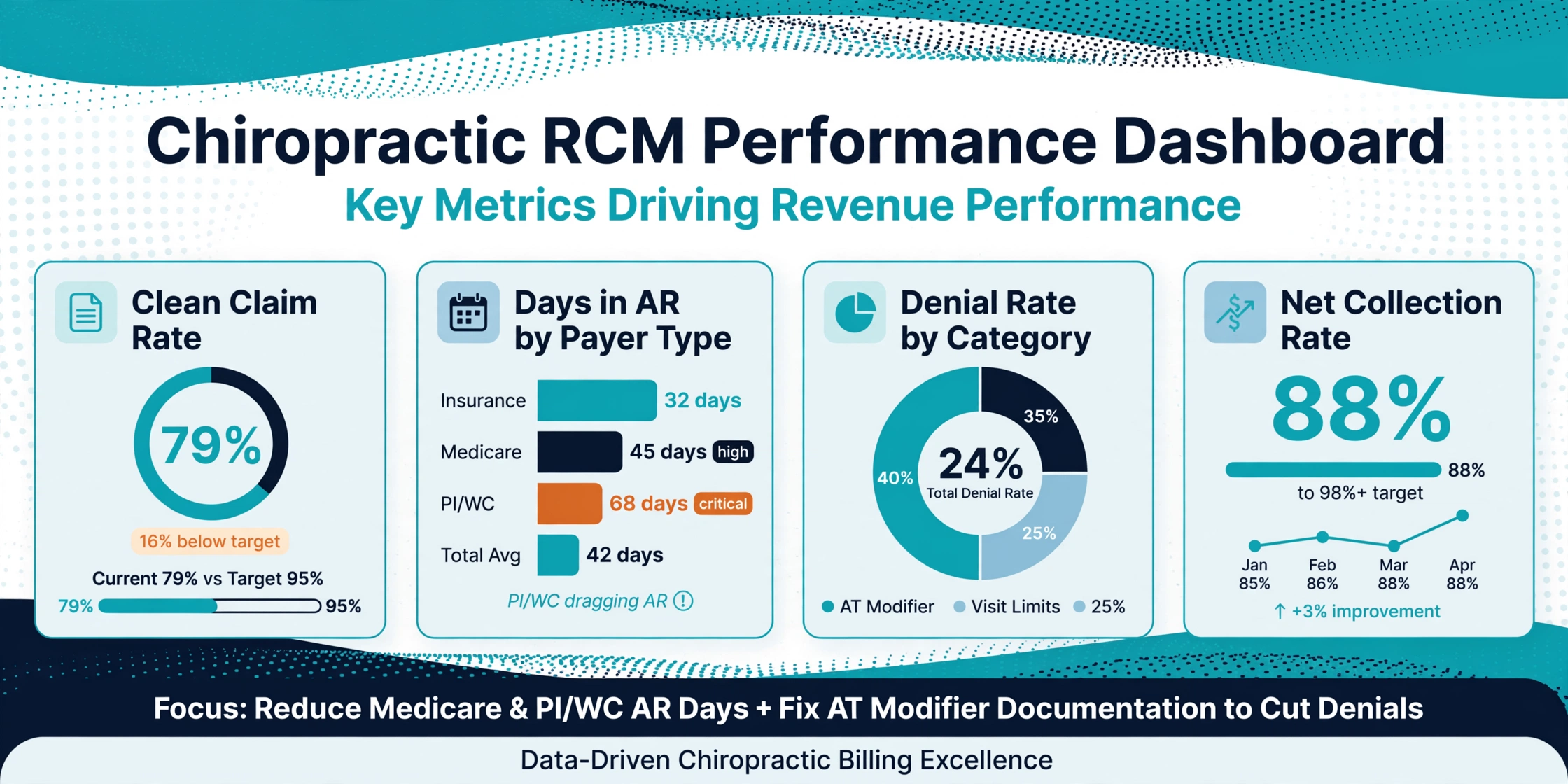
Tracking key revenue cycle management metrics help you to measure financial performance, identify operational gaps, and improve reimbursement outcomes. Monitoring KPIs such as clean claim rate, denial rate, days in A/R, and collection rate supports informed decisions and long-term revenue growth.
| KPI | What It Measures | Target for Chiropractic Practices |
|---|---|---|
| Clean Claim Rate | % of claims accepted on first submission | ≥95% |
| Denial Rate — Insurance | % of insurance claims denied | <8% |
| AT Modifier Compliance Rate | % of Medicare AT claims with supporting documentation | 100% — non-negotiable |
| ABN Issuance Rate | % of maintenance care Medicare visits with signed ABN | 100% — compliance requirement |
| Days in AR — Insurance | Average time from service to insurance payment | <35 days |
| PI Case Tracking Accuracy | % of active PI cases with current lien on file | ≥99% |
| Visit Limit Accuracy | % of patients where benefit limits are verified before each visit | 100% |
| Net Collection Rate | % of collectible revenue actually collected | ≥95% |
| First Pass Resolution Rate | % of denials resolved on first appeal | ≥75% |
| AR Aging > 90 Days (Insurance) | % of insurance AR outstanding over 90 days | <15% |
| Patient Collection Rate | % of patient responsibility collected at time of service | ≥80% |
| Charge Lag | Days from service to claim submission | <3 days |
Tip: Separate KPI Tracking by Payer Type
Standard RCM metrics apply to insurance and Medicare billing. But PI and WC require separate financial metrics that most practice management systems don’t track automatically. You need to build a supplementary tracking spreadsheet for:
(1) Active PI cases by attorney with expected settlement date range.
(2) Outstanding lien amounts by case.
(3) WC cases by employer/carrier with authorization status and remaining approved visits.
(4) Monthly PI settlement receipts as a separate revenue line. Practices that track PI and WC revenue separately from insurance revenue consistently collect a higher percentage of their total outstanding AR
Chiropractic denial management requires a different framework than general medical billing, because the denial categories are highly specialty-specific, and the most dangerous denials (Medicare AT modifier) carry compliance exposure beyond simple revenue loss.
| Denial Category | Common Root Cause | Prevention Strategy |
|---|---|---|
| Medical necessity — Medicare AT | Documentation doesn't demonstrate active/corrective care; AT modifier applied to maintenance visits | Individual SOAP notes at every visit; subluxation documentation; functional improvement tracked; AT modifier eligibility reviewed each visit |
| Medical necessity — commercial | SOAP notes too generic; no functional outcome tracking; diagnosis codes not specific | Individualized notes; outcome measures (VAS, ROM); specific ICD-10 codes; narrative supporting ongoing need |
| Visit limit exceeded | Front desk didn't verify remaining benefit balance before visit | Real-time eligibility verification; visit counter in practice management system; alert at X visits remaining |
| Non-covered service — Medicare | Billing modalities, x-rays, or E/M under DC NPI for Medicare patients | Medicare-specific payer rules built into billing system; training on Medicare chiropractic exclusions |
| Missing AT modifier — Medicare | Claim submitted without required AT modifier on manipulation code | Pre-submission Medicare claim edit checking for AT modifier presence |
| Upcoding — manipulation regions | CPT code doesn't match region count in SOAP note | Region count verification at charge entry; coding based on documented regions |
| Duplicate claim | Claim submitted twice | Clearinghouse duplicate detection; AR review before resubmission |
| Prior authorization | Service performed without required authorization | Pre-visit PA verification; authorization tracking per payer |
The False Claims Act (31 U.S.C. § 3729) is the primary compliance risk in chiropractic Medicare billing. When you are applying the AT modifier to maintenance care visits, or submitting claims for spinal manipulation without documentation supporting active/corrective care, constitutes a false claim.
When chiropractic services are expected to be denied by Medicare (maintenance care, non-covered modalities, or services beyond what documentation supports), a signed Advance Beneficiary Notice (ABN) must be obtained from the patient before the service.
All chiropractic billing data, including PI case files, WC records, and standard insurance claims must be handled in compliance with HIPAA Privacy and Security Rules. PI and WC records often involve coordination with attorneys and insurance adjusters, ensure all disclosures are covered by appropriate patient authorizations.
At House of Outsourcing, we understand that your chiropractic billing isn’t general medical billing. It requires expertise across four distinct payment channels, rigorous Medicare AT modifier compliance, specialized personal injury and workers’ compensation workflows, and the kind of documentation-billing alignment that prevents audits before they happen. That’s exactly what our chiropractic revenue cycle management services deliver.
Certified Chiropractic Billing Specialists: Our team specializes in chiropractic CPT codes, spinal manipulation region coding, modality billing rules, and the Medicare compliance framework that governs every DC practice treating Medicare patients.
Medicare AT Modifier Compliance Protocol: Every Medicare chiropractic claim goes through our AT modifier eligibility review before submission, confirming that SOAP note documentation supports active/corrective care. We flag maintenance care transitions and initiate the ABN workflow proactively.
Personal Injury Lien Management: We maintain a dedicated PI case tracking workflow for every patient case — lien documentation, attorney coordination, charge accumulation, and settlement disbursement support, so your PI revenue doesn’t get lost in a 24-month backlog.
Workers’ Compensation Billing Expertise: Our WC billing specialists understand state-specific fee schedules, authorization requirements, and billing form requirements, ensuring your WC claims are processed correctly in every state your practice operates.
Real-Time Eligibility & Visit Limit Verification: Automated pre-visit verification confirms active coverage and remaining benefit balance before every appointment, eliminating the visit limit errors that cost practices thousands of dollars monthly.
SOAP Note Compliance Review: Our quarterly documentation audits identify coding-documentation mismatches, AT modifier risk patterns, and generic note issues before they become audit triggers.
Proactive Denial Management: Real-time denial tracking with 48–72 hour resolution target; systematic root-cause analysis drives upstream process improvements, not just individual claim corrections.
Dedicated Chiropractic Account Manager: One experienced specialist who knows your practice, your patient mix, and your four payment channels — accountable to your financial results every month.
Staying informed with trusted industry resources help you remain compliant with changing billing regulations, coding updates, and payer requirements. The following authoritative organizations and references provide reliable guidance for improving your billing accuracy, reimbursement, and revenue cycle performance.
| Resource | What It Covers | Link |
|---|---|---|
| CMS Physician Fee Schedule | Chiropractic CPT reimbursement rates (98940–98942) | cms.gov/medicare/physician-fee-schedule/search |
| CMS Medicare Benefit Policy Manual Ch. 15 | Medicare chiropractic coverage rules, AT modifier, subluxation | cms.gov/regulations-and-guidance/guidance/manuals |
| CMS ABN Requirements | Advance Beneficiary Notice requirements and forms | cms.gov/medicare/regulations-guidance/advance-beneficiary-notice-noncoverage |
| ACA (American Chiropractic Association) | Chiropractic practice guidance, coding resources, advocacy | acatoday.org |
| ICA (International Chiropractors Association) | Chiropractic professional resources | chiropractic.org |
| OIG Work Plan | Chiropractic billing enforcement priorities | oig.hhs.gov/reports-and-publications/workplan |
| False Claims Act Resources | FCA guidance for healthcare providers | oig.hhs.gov/fraud/false-claims-act |
| CMS NCCI Policy Manual | Bundling and modifier rules | cms.gov/medicare/coding-billing/national-correct-coding-initiative-edits |
| AMA CPT Code Resources | Official CPT code definitions and updates | ama-assn.org/practice-management/cpt |
| AAPC Chiropractic Coding | Specialty coding education and certification | aapc.com |
| HHS HIPAA Resources | Privacy and security compliance guidance | hhs.gov/hipaa |
| Medicaid.gov | State Medicaid chiropractic coverage policies | medicaid.gov |
The three primary spinal manipulation CPT codes are 98940 (spinal manipulation, 1–2 regions), 98941 (spinal manipulation, 3–4 regions), and 98942 (spinal manipulation, 5 regions). The correct code is determined by the number of spinal regions documented as treated in the SOAP note, not by clinical intent or habit. The five spinal regions are cervical, thoracic, lumbar, sacral, and pelvic. CPT 98943 covers extraspinal (extremity) manipulation.
The AT modifier is a required modifier on Medicare chiropractic spinal manipulation claims that certifies the service is ‘active/corrective’ care, meaning the patient is improving and the treatment is expected to produce further improvement. Medicare only covers chiropractic spinal manipulation for active/corrective care.
An Advance Beneficiary Notice of Noncoverage (ABN) is a CMS-required document that informs a Medicare patient that a specific service is likely not covered by Medicare, and that the patient will be financially responsible for the cost. In chiropractic, an ABN is required before providing maintenance care to Medicare patients, before providing services that Medicare excludes from chiropractic coverage (modalities, x-rays, E/M codes), and whenever there is reason to believe Medicare will deny a claim.
Personal injury chiropractic billing involves providing care to patients injured in auto accidents, slips and falls, or other third-party liability events. The practice typically files a lien against the patient’s anticipated settlement, agreeing to defer payment until the case resolves.
Workers’ compensation chiropractic billing is governed by state law, each state has its own WC fee schedule, authorization requirements, billing forms, and dispute resolution process. WC pays according to a state-mandated fee schedule rather than contracted commercial rates.
Get a free assessment from our billing experts