
Apply current Medicare chiropractic billing guidelines to submit clean claims, avoid common coding mistakes, and receive faster, more accurate payments.

Medicare chiropractic billing is highly specific and limited compared to other specialties. Under Medicare Part B, chiropractors are only reimbursed for manual spinal manipulation (CMT) to correct subluxation, not for exams, X-rays (if ordered by chiropractor), or therapies.
This makes accurate coding and documentation absolutely critical, because even minor errors can result in full claim denials. Providers must clearly demonstrate medical necessity and active treatment rather than maintenance care.
Need support with your billing workflow? Explore our medical billing and revenue cycle services or request a free consultation.
| Aspect | Medicare Rule | Financial Impact | Risk Area |
|---|---|---|---|
| Covered Service | Spinal manipulation only | Limited revenue scope | Misbilling |
| Coverage Type | Active treatment only | Reimbursable care | Maintenance denial |
| Documentation | Must prove subluxation | Claim approval | Audit risk |
| Frequency | Based on necessity | Variable payment | Overutilization |
Unlike most medical billing scenarios, chiropractic billing under Medicare excludes many common services. This forces providers to operate within a very narrow reimbursement framework.
The complexity increases because Medicare frequently audits chiropractic claims due to high misuse rates. Practices must carefully differentiate between active corrective care and maintenance therapy, which Medicare does not cover.
| Factor | Complexity Level | Impact on Practice | Solution |
|---|---|---|---|
| Limited Coverage | High | Reduced billable services | Focus on CMT |
| Audit Frequency | Very High | Recoupment risk | Strong documentation |
| Coding Precision | Critical | Denials | Staff training |
| Medical Necessity | Strict | Claim rejection | Clear records |
Medicare reimburses chiropractors only for specific CMT codes based on the number of spinal regions treated. Selecting the correct code is essential for proper payment.
Incorrect region counting or upcoding is one of the most common triggers for Medicare audits.
| CPT Code | Regions Treated | Description | Avg Medicare Payment |
|---|---|---|---|
| 98940 | 1–2 regions | Low complexity | $25–$35 |
| 98941 | 3–4 regions | Moderate complexity | $35–$50 |
| 98942 | 5 regions | Full spine | $50–$70 |
Medicare has strict limitations, it only covers spinal manipulation when it is medically necessary to correct a subluxation. All other services are considered non-covered.
Providers must ensure that treatment plans clearly demonstrate improvement, otherwise claims may be denied as maintenance care.
| Rule | Requirement | Covered | Billing Impact |
|---|---|---|---|
| Subluxation | Must be documented | Yes | Required |
| X-rays | Chiropractor-ordered | No | Non-covered |
| Exams | Initial/ongoing | No | Patient pays |
| Therapies | Massage, PT | No | ABN required |
Diagnosis coding must support the presence of spinal subluxation and medical necessity. Medicare expects specific codes tied to spinal regions. Generic or vague diagnoses often result in denials or audits.
| ICD-10 Code | Condition | Region | Billing Strength |
|---|---|---|---|
| M99.01 | Cervical subluxation | Neck | Strong |
| M99.02 | Thoracic subluxation | Upper back | Strong |
| M99.03 | Lumbar subluxation | Lower back | Strong |
| M54.5 | Low back pain | Symptom | Supportive only |
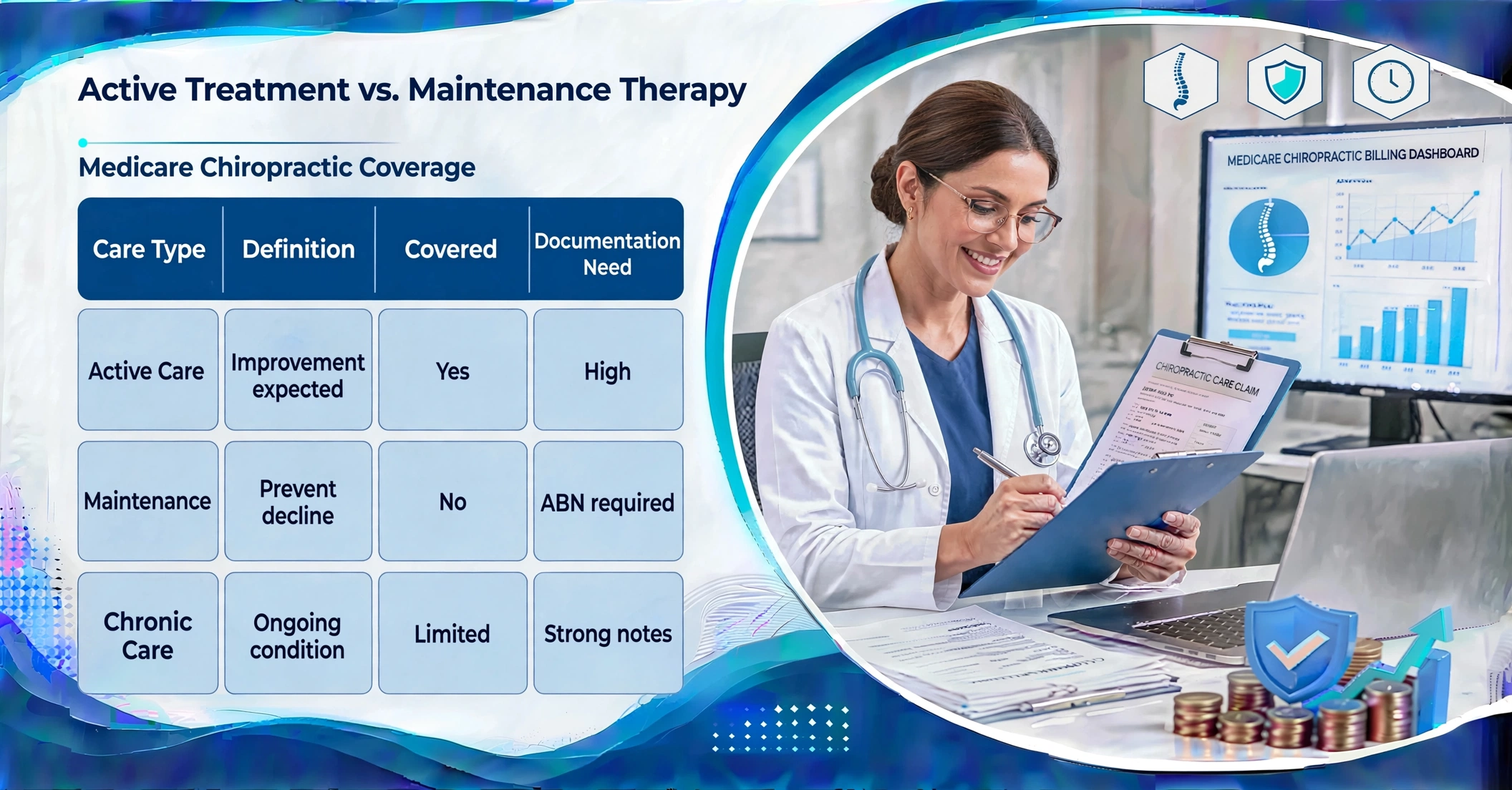
One of the most critical distinctions in Medicare chiropractic billing is between active and maintenance care. Medicare only pays for treatment aimed at improving a condition.
If documentation shows the patient has reached maximum improvement, further care is considered maintenance and is not reimbursable.
| Care Type | Definition | Covered | Documentation Need |
|---|---|---|---|
| Active Care | Improvement expected | Yes | High |
| Maintenance | Prevent decline | No | ABN required |
| Chronic Care | Ongoing condition | Limited | Strong notes |

The AT modifier is mandatory when billing Medicare for active treatment. It signals that the service is medically necessary and not maintenance care. Failure to include the AT modifier results in automatic claim denial.
| Modifier | Meaning | When to Use | Impact |
|---|---|---|---|
| AT | Active treatment | Every covered visit | Required for payment |
| GA | ABN on file | Non-covered service | Patient liability |
| GZ | No ABN | Likely denial | Financial risk |
Documentation must clearly establish subluxation, treatment goals, and progress. Medicare requires detailed notes for every visit. Incomplete or repetitive documentation is a major red flag during audits.
| Requirement | Details | Purpose | Risk if Missing |
|---|---|---|---|
| Initial Exam | History + diagnosis | Establish necessity | Denial |
| Treatment Plan | Goals + duration | Track progress | Audit risk |
| Progress Notes | Each visit update | Show improvement | Recoupment |
| Subluxation Proof | PART system | Compliance | Rejection |
Medicare requires chiropractors to document subluxation using the PART system: Pain, Asymmetry, Range of motion, Tissue changes. At least two of these must be documented, with one being either asymmetry or range of motion.
| Component | Meaning | Required | Billing Importance |
|---|---|---|---|
| Pain | Patient complaint | Yes | Supports diagnosis |
| Asymmetry | Misalignment | Critical | Required |
| ROM | Limited motion | Critical | Required |
| Tissue | Muscle changes | Optional | Supportive |
Medicare does not define a strict visit limit but expects treatment frequency to align with medical necessity. Excessive visits can trigger audits. Providers must justify ongoing care with clear improvement metrics.
| Factor | Expectation | Risk | Strategy |
|---|---|---|---|
| Visit Frequency | Based on condition | Overuse audit | Justify visits |
| Duration | Short-term focus | Maintenance denial | Track progress |
| Re-evaluation | Periodic | Required | Update plan |
According to our two decades of experience chiropractic billing errors are among the most audited by Medicare. Many denials stem from missing modifiers or poor documentation.
Identifying these issues early can significantly improve reimbursement rates.
| Error | Cause | Impact | Fix |
|---|---|---|---|
| Missing AT | Oversight | Denial | Add modifier |
| No subluxation | Poor documentation | Rejection | Use PART |
| Maintenance billing | Misclassification | Non-payment | Use ABN |
| Upcoding | Wrong CPT | Audit | Verify regions |
Denied claims should be reviewed carefully to identify the root cause. Most chiropractic denials are documentation-related, and a structured appeal process can recover your significant portion of lost revenue.
| Step | Action | Outcome | Tip |
|---|---|---|---|
| Review | Check denial reason | Identify issue | Read EOB |
| Correct | Update claim | Clean submission | Fix codes |
| Appeal | Submit evidence | Payment recovery | Add notes |
Medicare reimbursement for chiropractic services remains relatively stable but limited due to service restrictions. As a provider you must focus on efficiency and compliance to maintain profitability for your medical practice.
| Factor | Trend | Impact | Strategy |
|---|---|---|---|
| Payment Rates | Stable | Predictable income | Optimize volume |
| Coverage Limits | Strict | Limited revenue | Diversify services |
| Audits | Increasing | Risk | Strong compliance |
An ABN informs patients when a service is likely not covered by Medicare. It protects providers from financial loss. Failing to issue an ABN means the provider cannot bill the patient for non-covered services.
| Scenario | ABN Needed | Benefit | Risk if Not Used |
|---|---|---|---|
| Maintenance care | Yes | Patient pays | Revenue loss |
| Non-covered service | Yes | Legal protection | Write-off |
| Covered service | No | Not required | None |
Since Medicare coverage is limited, as a provider you must focus on optimizing every reimbursable service.Your practice strong documentation, correct coding, and workflow efficiency are key to financial success.
| Practice | Strategy | Benefit | Outcome |
|---|---|---|---|
| Accurate Coding | Use correct CPT | Fewer denials | More revenue |
| Documentation | Detailed notes | Audit safety | Compliance |
| Workflow | Streamlined billing | Faster claims | Cash flow |
| Training | Staff education | Fewer errors | Efficiency |
Compliance will remain a major focus for Medicare chiropractic billing in 2026. Audits are expected to increase, especially for high-volume practices. As an experienced provider you must stay updated with CMS guidelines and maintain strict documentation standards.
| Tip | Action | Benefit | Risk Avoided |
|---|---|---|---|
| Stay Updated | Follow CMS | Compliance | Denials |
| Audit Internally | Review claims | Accuracy | Recoupment |
| Train Staff | Regular updates | Efficiency | Errors |
| Track Outcomes | Measure progress | Justification | Audit flags |
A stronger billing strategy improves financial stability, increases collections, and gives your practice room to expand with confidence.
Get a free assessment from our billing experts