
Our allergy and immunology medical billing services help practices streamline complex billing processes, improve claim accuracy, and maximize reimbursements. We manage specialty-specific coding, immunotherapy billing, payer requirements, and denial resolution to support a more efficient and profitable revenue cycle.

Walk into any busy allergy and immunology practice in the United States, and you’ll find allergists doing things that would make most billing teams sweat, running skin tests, preparing allergen extracts, administering immunotherapy injections, and conducting food challenges, sometimes all in the same patient visit. Each one of those services has its own CPT code. Each one has documentation requirements. And each one needs to be billed just right, or the claim gets denied by the payer, so you have all this information, and as an allergist when you treat your patients in the USA.
This is exactly why allergy and immunology medical billing has one of the highest denial and complexity rates of any outpatient specialty in the USA. Up to 22% of same-day allergy billing claims face rejection by insurance companies due to coding errors or documentation gaps.
Whether you run a solo allergy practice, a multi-provider immunology group, or you’re the billing director of a large health system’s allergy department, we have written this guide for your practice and it will give you everything you need.
Allergy and immunology practices of the USA treat conditions ranging from allergic rhinitis and asthma to food allergies, drug hypersensitivity, and primary immunodeficiency disorders. The American College of Allergy, Asthma & Immunology (ACAAI) estimates that over 100 million Americans suffer from various types of allergies, making this specialty both clinically critical and financially significant for healthcare providers. What separates allergy immunology billing from cardiology medical billing or dermatology billing? Several compounding factors:
Multi-service encounters: A single allergy patient visit of your clinic, can legitimately include an E/M service, skin testing, extract preparation, and an immunotherapy injection, each with its own code, documentation requirement, and bundling rule to get maximum reimbursement.
Unit-based billing complexity: As Allergen you need exact preparation codes (especially CPT 95165) are billed in units representing 1 cc aliquots, miscounting units is one of the most common and costly coding errors in allergy billing.
Same-day testing and treatment restrictions: CMS explicitly states that allergy testing is not typically performed on the same day as allergy immunotherapy in standard medical practice, flagged same-day claims require strong documentation justification.
Medicare-specific dose limits: Medicare caps CPT 95165 at 10 doses per multi-dose vial, regardless of how many aliquots the vial physically yields. Billing beyond this triggers denial and potential recoupment.
Payer variation: Commercial payer rules for allergy and immunology billing services vary dramatically, what Aetna allows, UnitedHealthcare may deny, and BCBS plans differ state by state.
2025 conversion factor reduction: CMS reduced the 2025 Medicare conversion factor to $32.35 — a 2.83% cut from 2024, directly reducing reimbursement for CPT 95165 and all allergy-related codes.
Why Your Allergy Practice Accurate Billing Matters So Much
Over 100 million Americans suffer from allergies. Allergy practices process thousands of immunotherapy injections annually. Studies show 22% of same-day allergy claims face rejection due to coding or documentation errors. With the 2025 Medicare conversion factor at $32.35 (down from $33.29 in 2024), every miscoded unit represents real, measurable revenue loss. Source: ACAAI, CMS 2025 PFS Final Rule, Healthcare Finance Journal
If you want to increase your practice revenue, getting allergy immunology billing right starts with knowing your codes. Below is a comprehensive reference of all major CPT code categories used in allergy and immunology billing services by providers, organized by service type for fast, accurate code selection.
| CPT Code | Service Description | Units Basis | Key Billing Notes |
|---|---|---|---|
| 95004 | Percutaneous tests (scratch, puncture, prick) — allergenic extracts | Per test | Report number of separate tests performed; not reportable with 95017/95018 for same allergen |
| 95017 | Allergy testing, any combination — sequential & incremental w/ drugs | Per test | Different allergens = can bill with 95004 on same day |
| 95018 | Allergy testing — sequential & incremental w/ stinging insect venoms | Per test | Same-day with 95004 allowed if different allergens or dilutions |
| 95024 | Intracutaneous (intradermal) test — single — without allergenic extract | Per test | Separate code from extract-based intradermal tests |
| 95027 | Intracutaneous tests — sequential/incremental w/ allergenic extracts | Per test | For progressive dose testing; do not duplicate with 95004 |
| 95028 | Intracutaneous tests — sequential/incremental w/ biological allergens | Per test | Biological allergen-specific; not combinable with same-allergen codes |
| 95044 | Patch or application test(s) | Per test | For contact dermatitis evaluation; typically commercial/Medicaid coverage |
| 95052 | Photo patch test(s) | Per test | Requires photosensitization testing protocol documentation |
| 95056 | Photo tests | Per test | UV exposure tests; document wavelength and exposure time |
| 95060 | Ophthalmic mucous membrane test(s) | Per test | Office setting (POS 11) required |
| 95065 | Nasal mucous membrane test | Per test | Office or outpatient; clinical justification in notes |
| 95070 | Bronchial challenge test — not using drugs or antigens | Per test | Methacholine, histamine challenge; document FEV1 pre/post |
| 95071 | Bronchial challenge test — using antigens or drugs | Per test | Requires physician supervision; significant documentation |
| 95076 | Ingestion challenge test — first 120 minutes | Per session | Oral food challenge (OFC); medical necessity documentation essential |
| 95079 | Ingestion challenge test — each additional 60 minutes | Add-on | Pairs with 95076; document total challenge time precisely |
⚠️ Critical CMS Rule: Allergy Testing and Immunotherapy on the Same Day
CMS explicitly states in NCCI Policy Manual Chapter 11 that allergy testing is not performed on the same day as allergy immunotherapy in standard medical practice. These codes ‘should not be reported together.’ Same-day billing triggers payer scrutiny. If genuinely clinically justified, document the medical necessity extensively, and be prepared for medical review or audit.
| CPT Code | Service Description | When to Use | Critical Rule |
|---|---|---|---|
| 95115 | Professional services for allergy immunotherapy — single injection | Injection only; allergist does NOT provide the antigen | Use when patient brings extract prepared elsewhere — e.g., another allergist's extract |
| 95117 | Professional services — two or more injections | Multiple injections; allergist does NOT provide the antigen | Same-day multiple injections from externally prepared antigen |
| CPT Code | Description | Medicare? | Key Billing Rule |
|---|---|---|---|
| 95144 | Provision of antigens for allergy immunotherapy — single dose vials (excl. stinging insects) | Yes | Only bill if physician preparing extract intends another provider to inject; NOT combinable with 95115/95117 |
| 95145 | Stinging insect venom — 1 venom | Yes | Each venom in separate vial; do not mix (except 3-vespid mix) |
| 95146 | Stinging insect venom — 2 venoms | Yes | Both venoms must be present in preparation to bill this code |
| 95147 | Stinging insect venom — 3 venoms | Yes | Includes 3-vespid mix as one option |
| 95148 | Stinging insect venom — 4 venoms | Yes | Bill only when all 4 venoms are prepared |
| 95149 | Stinging insect venom — 5 venoms | Yes | Maximum venom code; all 5 must be present |
| 95165 | Multi-dose vial preparation — professional services per dose | Yes | 1 cc aliquot = 1 dose; Medicare max 10 doses/vial; 2025 rate impacted by $32.35 conversion factor |
| 95170 | Whole body extract — 1 or more venoms — single dose vial | Yes | Whole body extract; separate code from purified venom (95145–95149) |
| 95180 | Rapid desensitization — per hour | Yes | Bill in hours; requires frequent monitoring and skin testing documentation |
| 95199 | Unlisted allergy/clinical immunology procedure | Payer-specific | Use with detailed description; prior approval recommended |
�� 2025 Medicare Fee Schedule Alert: CPT 95165 Reimbursement
The 2025 CMS conversion factor decreased to $32.35 (a 2.83% reduction from 2024’s $33.29). This directly lowers reimbursement for CPT 95165 the most billed allergy extract preparation code. For practices billing hundreds of 95165 units monthly, this translates to meaningful annual revenue reduction. Combat this with accurate unit counting, clean claim rates, and prompt follow-up on underpayments. Source: CMS 2025 Physician Fee Schedule Final Rule.
Tip #1: Master the CPT 95165 Dose Calculation — Every Unit Counts
CPT 95165 is billed per 1 cc aliquot (dose) from a single multi-dose vial. Medicare caps this at 10 doses per vial maximum, even if you physically extract more than 10 aliquots. When preparing a 10 cc maintenance vial, bill exactly the number of 1 cc doses prepared, never exceeding 10. Keep a dosing log for every vial with patient name, preparation date, concentration, number of doses billed, and vial ID. This log is your audit shield
One of the most misunderstood aspects of allergy immunology medical billing especially for practices transitioning from commercial to Medicare-heavy patient panels is the component code system. Medicare requires allergy immunotherapy to be billed using component codes, not the complete service codes (95120–95134). Getting this wrong leads to systematic denials that can cost your medical practice thousands of dollars per month.
Per CMS, the official Medicare acupuncture coverage rule is available at the CMS National Coverage Determination 30.3.3. Here is what it actually requires:
| Billing Scenario | Codes to Use | What NOT to Do | Why It Matters |
|---|---|---|---|
| Injection ONLY (no antigen provided by this practice) | 95115 (single) or 95117 (multiple) | Do NOT use complete service codes 95120–95134 | Patient's antigen comes from elsewhere — you only bill for the injection service |
| Antigen Preparation ONLY (extract prepared, another provider injects) | 95144–95170 (antigen codes) | Do NOT add 95115/95117 | You prepared the extract; a different provider administers the injection |
| Both Injection AND Antigen (complete service by your practice) | 95115 or 95117 PLUS 95145–95170 | Never use 95120–95134 for Medicare | Use component codes together — NOT complete service codes — for Medicare claims |
⚠️ Never Bill Complete Service Codes (95120–95134) to Medicare
CMS’s Billing and Coding Article A57472 explicitly requires the use of component codes for Medicare allergy immunotherapy. Billing CPT 95120–95134 to Medicare will result in claim denial. These complete service codes may be usable for some commercial payers, always verifying payer-specific rules. Using the wrong code set for Medicare is not just a billing error; it can constitute a compliance violation if systematic.
No CPT code stands alone, every claim submitted in allergy and immunology billing services must be linked to a specific, medically appropriate ICD-10 diagnosis code that supports the medical necessity of the service. Using a vague or non-specific ICD-10 code is one of the fastest paths to a denied or flagged claim. Here’s your comprehensive allergy ICD-10 reference:
| ICD-10 Code | Description | Best Used For |
|---|---|---|
| J30.1 | Allergic rhinitis due to pollen | Seasonal allergy patients — grass, tree, weed pollen immunotherapy |
| J30.2 | Other seasonal allergic rhinitis | Seasonal triggers not specifically pollen |
| J30.5 | Allergic rhinitis due to food | Food-induced rhinitis — distinct from anaphylaxis coding |
| J30.81 | Allergic rhinitis due to animal (cat) hair and dander | Cat allergy immunotherapy patients |
| J30.89 | Other allergic rhinitis | Perennial non-seasonal triggers — dust mite, mold, cockroach |
| J30.9 | Allergic rhinitis, unspecified | Use only when specific trigger not yet established — avoid routinely |
| ICD-10 Code | Description | Severity / Notes |
|---|---|---|
| J45.20 | Mild intermittent asthma, uncomplicated | Step 1 asthma — document spirometry and triggers |
| J45.21 | Mild intermittent asthma with acute exacerbation | Spirometry + exacerbation note required |
| J45.30 | Mild persistent asthma, uncomplicated | Step 2 — daily symptom documentation |
| J45.40 | Moderate persistent asthma, uncomplicated | Step 3-4 — controller medication documentation |
| J45.50 | Severe persistent asthma, uncomplicated | Step 5-6 — biologic therapy candidates |
| J45.901 | Unspecified asthma with acute exacerbation | Use when severity not yet determined; document assessment plan |
| J45.909 | Unspecified asthma, uncomplicated | Last resort; specify severity when documentation permits |
| ICD-10 Code | Description | Billing Consideration |
|---|---|---|
| Z91.010 | Allergy to peanuts | Food allergy history code — use with T78 for active reaction |
| Z91.011 | Allergy to milk products | Document reaction type and severity in chart |
| Z91.012 | Allergy to eggs | Document IgE status if immunotherapy or OIT planned |
| Z91.013 | Allergy to seafood | Covers shellfish and fish allergy |
| T78.00XA | Anaphylactic reaction to unspecified food — initial encounter | 7th character 'A' for initial encounter; 'D' for subsequent |
| T78.40XA | Allergy, unspecified — initial encounter | Use only when specific allergen unknown — document workup plan |
| T78.1XXA | Other adverse food reactions — initial encounter | Non-anaphylactic food reactions |
| Z88.0 | Allergy status to penicillin | Drug allergy history — document reaction history carefully |
| Z88.8 | Allergy status to other antimicrobial drugs | For drug desensitization billing justification |
| L50.0 | Allergic urticaria | Hives — document triggers, chronicity, and IgE testing results |
| L50.1 | Idiopathic urticaria | No identified trigger — document diagnostic workup |
| ICD-10 Code | Description | Service Implication |
|---|---|---|
| D83.9 | Common variable immunodeficiency, unspecified | IVIG/SCIG therapy billing — high-value immunology services |
| D80.0 | Hereditary hypogammaglobulinemia | Immunoglobulin replacement billing |
| D80.1 | Nonfamilial hypogammaglobulinemia | Evaluate IVIG/SCIG candidacy — document IgG levels |
| D84.9 | Immunodeficiency, unspecified | Use only after workup — specify when possible |
| J98.11 | Atelectasis | Pulmonary complication in immunocompromised — linked to immunology billing |
�� Pro Coding Rule: You Must Link Every CPT to a Specific, Billable ICD-10
Per CMS NCCI guidelines, the diagnosis code must directly correspond to the condition being treated by the specific allergy service billed. Billing CPT 95117 for grass pollen immunotherapy injections must link to J30.1 (allergic rhinitis due to pollen) not J30.9 (unspecified). Specific diagnosis codes reduce medical necessity denials, survive audits, and satisfy payer LCD requirements. Make diagnosis specificity a training priority for your entire clinical and billing team.
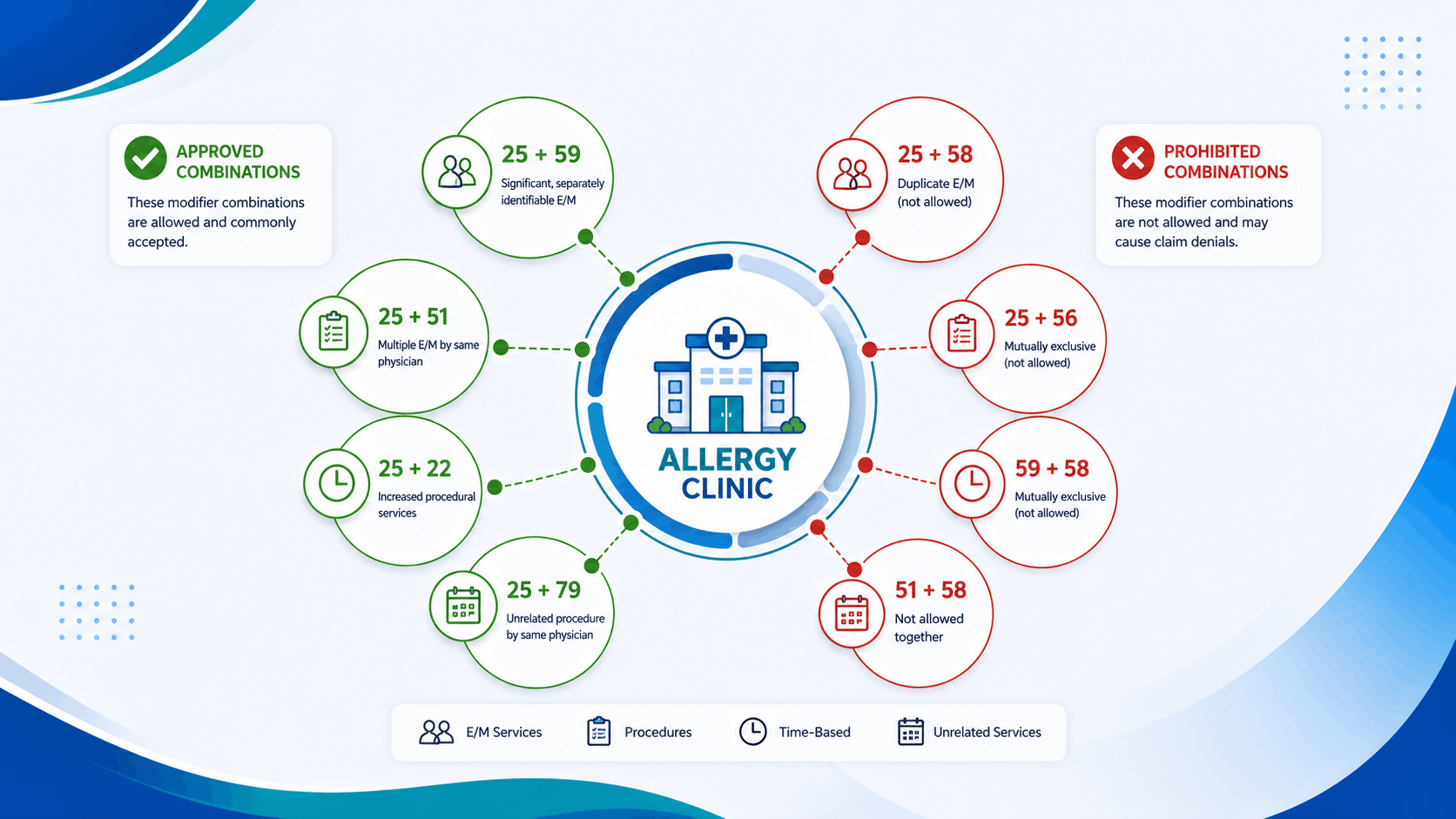
Modifiers are the fine print of allergy immunology billing services, and getting them wrong is the difference between a paid claim and a denied one by an insurance company for your medical practice. These two-digit codes communicate critical context to payers about your services. Here’s everything your billing team needs to know about modifiers.
| Modifier | Full Name | When to Apply in Allergy Billing | Critical Watch-Out |
|---|---|---|---|
| 25 | Significant, Separately Identifiable E/M | When a distinct, medically necessary E/M service is performed on the same day as allergy testing or immunotherapy — must be truly separate and documented independently | CMS states that obtaining informed consent is INCLUDED in immunotherapy and does NOT qualify as a separate E/M. Documentation must prove the E/M addressed a distinct clinical issue beyond the allergy service. |
| 59 | Distinct Procedural Service | When billing skin testing and immunotherapy as separate, distinct procedures that would otherwise be bundled by NCCI edits | Use when both services are genuinely distinct clinical encounters within the same visit — strong documentation required to avoid upcoding allegations |
| 76 | Repeat Procedure by Same Physician | If a testing procedure is repeated on the same date due to a clinical reason — e.g., a skin test repeated after a reaction resolved | Document the clinical reason for repetition explicitly in the chart note |
| 77 | Repeat Procedure by Another Physician | When a second provider within the same group repeats a procedure on the same date | Group practice scenarios — not common in allergy; use carefully |
| TC | Technical Component | When billing the technical component only — lab/facility performing the test while physician is elsewhere | Typically used in split-billing arrangements; professional component billed by the reading physician |
| 26 | Professional Component | When billing the professional component only — the physician's interpretation and report, not the technical service | Common in hospital-based or reference lab allergy testing arrangements |
| GY | Statutory Medicare Exclusion | For services not covered by Medicare (e.g., allergy testing for conditions not meeting medical necessity under the LCD) | Does not create coverage — informs Medicare that no payment is expected; patient can be billed |
| GA | Waiver of Liability on File | When a service is likely to be denied by Medicare but an ABN has been signed by the patient | ABN must be signed BEFORE the service; without it, GZ applies and provider cannot collect from patient |
Tip #2: Modifier 25 in Allergy Billing: Document the Distinctness or Don’t Bill It
Modifier 25 is the most audited modifier in allergy billing. The rule is clear: the E/M service must be significant, separately identifiable, and above and beyond the pre-service evaluation that’s already bundled into the allergy procedure code. Before adding Modifier 25, ask: Does this note document a clinical decision that would stand alone as a billable visit if no allergy service had been performed? If the answer is yes and your documentation proves it, bill it. If not, the E/M is included in the procedure.
Stinging insect venom immunotherapy (VIT) is one of the most clinically impactful, and billing-complex services in allergy immunology medical billing. Misapplication of venom CPT codes (95145–95149 and 95170) is extremely common and represents significant revenue loss or compliance risk. Here’s how to do it right:
| CPT Code | Venoms Covered | Key Billing Requirement |
|---|---|---|
| 95145 | Single stinging insect venom | 1 venom prepared — honeybee, yellow jacket, yellow hornet, white-faced hornet, OR wasp |
| 95146 | Two stinging insect venoms | Both venoms must be present in preparation — not partially prepared |
| 95147 | Three stinging insect venoms | Includes 3-vespid mix option (white/yellow hornets + yellow jackets) |
| 95148 | Four stinging insect venoms | All 4 venoms must be prepared to bill this code — no exceptions |
| 95149 | Five stinging insect venoms | Maximum — all 5 venoms present; bill 95149 as highest applicable code |
| 95170 | Whole body extract (one or more venoms) | Whole body extract only — NOT purified venom; separate code from 95145–95149 |
Same-day testing and treatment is the highest-risk billing scenario in all of allergy immunology billing services. Up to 22% of denials in allergy practices stem from same-day encounter coding errors. Getting it right requires understanding exactly what CMS says, and what your commercial payers allow, before you submit a single claim.
�� Official CMS Rule (NCCI Policy Manual, Chapter 11, Section K)
CMS states that allergy testing is NOT performed on the same day as allergy immunotherapy in standard medical practice. These codes should therefore NOT be reported together. Additionally, testing becomes an integral part of rapid desensitization and would not be reported separately from CPT 95180. This is a hard rule, same-day submission of both testing and immunotherapy codes triggers NCCI edit review.
A structured pre-encounter checklist ensures accurate same-day allergy billing by verifying coverage, authorization, and proper documentation in advance. It minimizes denials by aligning CPT–ICD-10 linkages, confirming modifier use, and clearly justifying the clinical need for same-day services.
| Preparation Step | Purpose | Action Required |
|---|---|---|
| Verify insurance coverage for both services | Prevent payer-specific denials | Call payer or use real-time eligibility tool confirm both testing and immunotherapy are covered |
| Obtain pre-authorization for testing if required | Ensure compliance | Request PA documentation; track approval reference number and expiry date |
| Review patient's EMR for prior testing | Avoid duplicate billing | Confirm testing is not duplicative; document clinical justification for repeat testing |
| Confirm modifier applicability | Prevent modifier misuse | Determine whether Modifier 25 or 59 is genuinely supported by documentation |
| Align CPT-ICD-10 linkages before encounter | Reduce unrelated service denials | Map every planned procedure to its supporting diagnosis before the patient arrives |
| Document clinical justification for same-day exception | Reduce NCCI edit denials | Note in chart why same-day testing and treatment was clinically necessary in this case |
Denial management is where allergy immunology billing either makes or breaks a practice’s revenue cycle. Every denied claim that isn’t worked promptly becomes a write-off. Here’s a systematic breakdown of the most common denial triggers in allergy billing and the proven fixes that stop them from recurring:
| Denial Reason | Root Cause | Proven Fix |
|---|---|---|
| Medical necessity denied | Diagnosis doesn't support the service; no documentation of failed conservative treatment | Document specific allergy history, test results, and treatment rationale in every claim. Link specific ICD-10 codes to each CPT code billed. |
| Same-day testing + immunotherapy denied | NCCI edit triggered by same-day submission of testing and treatment codes | Only bill same-day when clinically justified; document extensively; verify payer-specific exceptions before billing. |
| CPT 95165 units denied or reduced | Exceeded Medicare's 10-dose-per-vial maximum; documentation doesn't support units billed | Implement dose counting protocol; maintain vial logs; never bill more than 10 units per Medicare vial. |
| Component code violation | Complete service codes (95120–95134) billed to Medicare instead of component codes | Train coding team on Medicare component code requirement; build CMS-specific billing rules in your PMS. |
| Modifier 25 denied | E/M billed same-day without documented separately identifiable service | Strengthen documentation; E/M note must stand alone as a billable visit independent of allergy procedure. |
| Wrong antigen code billed | Venom code lower than patient's regimen without catch-up documentation | Maintain venom dosing logs; document catch-up rationale; audit venom code selection quarterly. |
| Stinging insect venom code mismatch | Code billed reflects more venoms than were actually prepared | Verify all venoms are present before billing higher venom codes; document preparation in clinical notes. |
| Authorization not obtained | Prior auth required by payer but skipped; or authorization expired mid-treatment | Build PA tracking into scheduling workflow; set expiry alerts; track authorized visit counts per patient. |
| Provider not credentialed | Rendering provider not contracted with payer; group and individual NPI mismatch | Verify credentialing status for every active payer before treating; track re-credentialing deadlines. |
| Timely filing exceeded | Claim not submitted within payer's filing window (typically 90–365 days from DOS) | Automate submission; run aging reports daily; flag claims approaching filing deadlines immediately. |
| CPT-ICD mismatch / unrelated service denial | Diagnosis code doesn't support the specific allergy service billed | Map CPT to ICD-10 with specificity; avoid unspecified codes; use payer-specific covered diagnosis lists. |
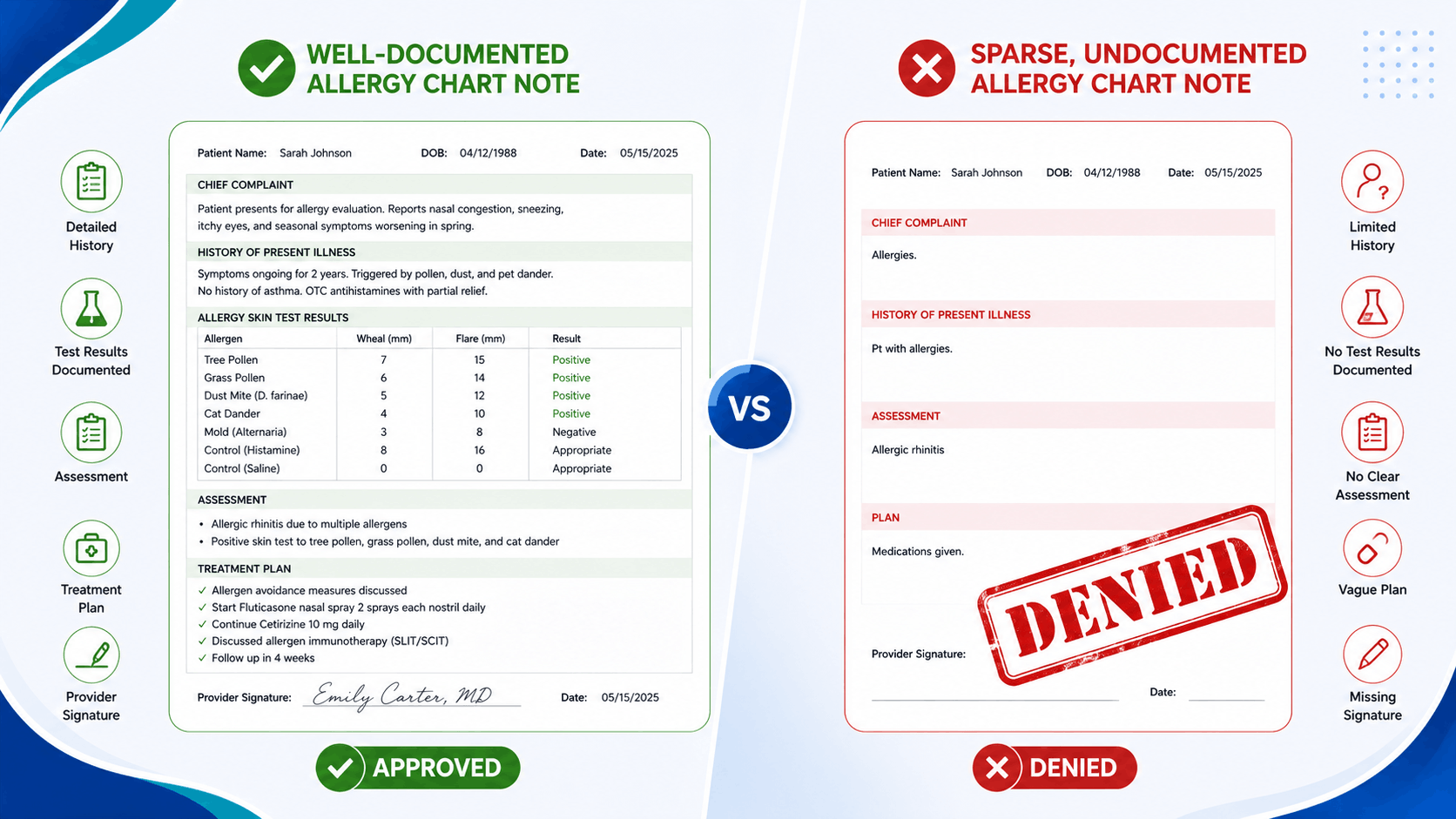
‘If it’s not documented, it’s not billable.’ That’s not just a billing cliche, in allergy and immunology, it’s the difference between a clean claim and an audit-triggered recoupment demand. Here’s what every allergy and immunology practice note must include to support compliant allergy immunology billing services:
Number and type of allergens tested: Every skin test code (95004–95078) is billed per test unit, your note must document the specific number of tests performed and which allergens.
Testing method: Prick/puncture vs. intradermal vs. patch each uses different CPT codes; mismatching method to code is a coding error and audit risk.
Test results: Positive/negative results with wheal and flare measurements for skin tests; must be in the chart to support medical necessity of treatment.
Patient symptoms and history: Current allergic symptoms, duration, severity, and prior treatments supports medical necessity of testing.
Clinical interpretation: Provider’s interpretation of test results and plan this is the professional component of the service
Our experts ensure your allergen immunotherapy claims meet strict compliance standards by precisely auditing mixing logs, extract composition, and dose escalation schedules. We protect your practice from audits by verifying that injection administration records cleanly support component coding for single or multiple injections.
Extract type and specific allergens: Exact composition of the allergen extract being administered, antigen type, formulation, concentration
Dose and dosing schedule: Current dose level, volume, frequency especially important for CPT 95165 unit documentation (1 cc = 1 dose)
Injection site and adverse reactions: Site of administration, observation period, any local or systemic reactions, required for safety and billing compliance
Lot number and extract preparation date: Extract traceability documentation essential for compliance and patient safety
Informed consent: CMS specifies consent is included in the immunotherapy service document it, but do not use it as the basis for an additional E/M charge
Number of vials and doses prepared: For CPT 95165 document the number of 1 cc aliquots prepared from each vial; this directly determines units billed
✅ The Golden Documentation Rule for Allergy Immunology Billing
Every coded service must be independently supportable by the clinical note. Before any claim goes out, your billing team should be able to answer yes to all of these:
(1) Does the note document what was done?
(2) Does it document why it was done?
(3) Does it document how many tests/doses/injections?
(4) Does it document the provider’s interpretation and plan?
(5) Is there a dated signature? If any answer is no, do not submit the claim until the documentation is corrected by the treating provider.
Tip #4: Run a Monthly Allergy Billing Documentation Audit Before the Payer Does
Designate one hour per week for your billing coordinator to pull 10 random allergy claims and verify documentation completeness. Check:
Do the chart notes support the units billed for 95165?
Does the antigen type match the venom code used?
Are the number of skin tests documented?
Is Modifier 25 supported by a distinct E/M note?
Identifying gaps internally, before a claim is submitted or audited, costs nothing. Recovering from a RAC audit costs significantly more.
Oral immunotherapy for food allergies, including FDA-approved Palforzia (peanut OIT) and provider-developed protocols for milk, egg, and tree nuts represents one of the most rapidly growing and least understood areas of allergy immunology billing. Billing rules are still evolving, but here’s the current landscape:
| CPT Code | Service | Time Requirement | Payer Coverage |
|---|---|---|---|
| 95076 | Ingestion challenge test — initial 120 minutes | First 2 hours of supervised oral food challenge | Commercial (varies); Medicaid (state-specific); Medicare (limited LCD coverage) |
| 95079 | Ingestion challenge — each additional 60 minutes | Add-on for each hour beyond first 2 hours | Add-on to 95076; document total challenge time precisely |
| 99214–99215 | E/M service for complex OFC management | When a separately identifiable E/M occurs | Must document distinct medical decision-making with Modifier 25 |
Our certified billing specialists optimize your Oral Immunotherapy (OIT) revenue by mastering the complex separation of initial ingestion challenges from bi-weekly up-dosing phases. We protect your practice against denials by accurately documenting face-to-face physician time and validating payer-specific guidelines for high-level E/M and prolonged service codes.
No dedicated OIT CPT code exists yet
OIT does not have its own specific CPT codes as of 2025. Billing is done through E/M codes (99213–99215) and, for subcutaneous OIT protocols, through existing immunotherapy injection codes
Physician supervision coding
Document the level of physician supervision during each OIT session, this determines the E/M level and directly impacts reimbursement
Palforzia (FDA-approved peanut OIT)
Covered by many commercial insurers with prior authorization; Medicaid coverage varies by state; Medicare coverage is limited. Document IgE peanut sensitization and failed avoidance strategy
Updosing visits
Bill as E/M visits with detailed documentation of dose level, patient response, and escalation protocol
�� OIT Coverage Is Rapidly Evolving Verify Before Every Claim
Commercial coverage for OIT is expanding rapidly as clinical evidence grows. ACAAI actively advocates for broader OIT coverage with major payers. Before billing for any OIT service, call the payer, confirm the specific covered codes, obtain prior authorization, and document clinical necessity thoroughly. Visit acaai.org for the latest advocacy updates on OIT reimbursement
Medicare and Medicaid account for a significant portion of allergy immunology patients, particularly elderly patients with chronic allergic conditions, asthma, and immunodeficiency disorders. Understanding the payer-specific rules that govern allergy immunology billing services for government programs is non-negotiable for compliance and revenue protection.
Understanding Medicare’s allergy immunology billing rules is essential for accurate reimbursement and compliance with CMS requirements. Following guidelines for component coding, dose limits, modifier usage, and same-day services helps reduce denials, prevent audits, and maximize payment accuracy.
| Medicare Rule | What It Means | Billing Impact |
|---|---|---|
| Component codes only (95115/95117 + 95144–95170) | Never use complete service codes 95120–95134 for Medicare | Systematic denial if complete codes used; may trigger compliance review |
| CPT 95165 maximum 10 doses per vial | Even if more than 10 aliquots are prepared, Medicare pays for maximum 10 doses | Document exact doses; never bill more than 10 units per vial |
| Diluted vial preparation NOT separately billable | Medicare does not pay for diluted preparations that exceed the 10-dose cap | Only bill the original 10-dose preparation; dilutions do not generate additional billable units |
| E/M with immunotherapy requires Modifier 25 | Informed consent for immunotherapy is included — NOT a standalone E/M | Document distinctly identifiable medical service beyond consent and immunotherapy prep |
| 2025 Conversion Factor: $32.35 | 2.83% reduction from 2024 reduces payment for all allergy codes | Optimize clean claim rates and unit accuracy to offset reimbursement reduction |
| Allergy testing on same day as immunotherapy — scrutinized | CMS's NCCI edits flag same-day testing and treatment as non-standard | Avoid same-day submission without extensive documentation; verify with MAC |
For complete Medicare allergy billing guidance, access the official CMS Billing and Coding Article A57472 and your regional MAC’s LCD for allergy and immunology services.
You can have flawless CPT coding and airtight documentation but if you aren’t credentialed with the right payers, none of it matters. Credentialing is the revenue foundation of every successful allergy immunology billing strategy, and it’s consistently one of the most neglected areas in allergy practice management.
| Credentialing Element | What Allergists and Immunologists Must Know |
|---|---|
| CAQH ProView Profile | Maintain an active, updated CAQH profile most commercial payers pull from it. Update every 120 days or risk automatic deactivation. |
| Individual vs. Group NPI | Both Type 1 (individual) and Type 2 (group) NPIs must be correctly registered and linked in payer enrollment. NPI mismatches cause systematic claim denials. |
| ABAI Board Certification | The American Board of Allergy and Immunology (ABAI) certification is required for credentialing with most payers. Track MOC (Maintenance of Certification) deadlines proactively. |
| State Medical License | Must be current and clean in every state where services are provided. License expiry = claims denied; disciplinary action = credentialing suspension. |
| Subspecialty Scope | Some payers credential allergists and immunologists under different panel types — ensure your enrollment captures your full scope including immunotherapy, biologic therapy administration, and challenge testing. |
| Biologic Therapy Credentialing | Practices administering biologics (Dupixent, Xolair, Fasenra, Nucala) may need additional credentialing with specialty pharmacy benefits and infusion networks. |
| Re-credentialing Cycle | Every 2–3 years for most payers. Missing re-credentialing deadlines causes claims to be denied retroactively — a nightmare to resolve. |
| Medicare Enrollment (PECOS) | Maintain active Medicare enrollment via PECOS. Changes in practice location, group affiliation, or ownership require timely updates — or Medicare claims will be denied. |
Effective allergy immunology billing services aren’t an isolated back-office function, they are a comprehensive Revenue Cycle Management (RCM) system that spans every patient touchpoint from scheduling to final payment. Here’s what a fully optimized allergy immunology RCM framework looks like:
| RCM Stage | Key Activities | Allergy-Specific Focus Points |
|---|---|---|
| Patient Scheduling | Demographic collection, insurance capture, appointment type coordination | Identify if visit includes both testing and immunotherapy — flag for pre-authorization review |
| Insurance Verification & Benefits | Verify allergy/immunotherapy benefit, covered diagnoses, visit limits, prior auth requirement | Check for allergy benefit carve-outs; verify both testing and immunotherapy coverage separately |
| Prior Authorization | Submit PA for testing, immunotherapy, biologics, or OIT as required | Track PA by allergen type, venom code level, and authorized visit count |
| Clinical Documentation | SOAP notes, allergen test results, dosing logs, patient response tracking | Dose logs for 95165 unit accuracy; venom type documentation; testing method specificity |
| Charge Capture & Coding | CPT/ICD-10 selection, modifier application, unit calculation | Verify component vs. complete code selection; 95165 dose count; venom code accuracy |
| Claim Submission | Clean claim scrubbing, electronic submission, timely filing compliance | Flag same-day testing+immunotherapy encounters for extra review before submission |
| Payment Posting | ERA/EOB reconciliation, underpayment identification, adjustment review | Compare 95165 reimbursement to contracted rates; flag parity issues |
| Denial Management | Root cause analysis, appeal submission, trend tracking | Track venom code denials, modifier 25 denials, and same-day testing denials separately |
| Patient Collections | Copay collection, patient balance statements, payment plan management | ABN documentation for non-covered Medicare allergy services |
| Analytics & Reporting | Clean claim rate, days in AR, denial rate by payer/code, collection rate | Monitor 95165 unit billing accuracy; track same-day denial rates as KPIs |
Every allergy practice reaches this decision point. Here’s what the data actually shows:
| Factor | In-House Billing | House of Outsourcing Allergy & Immunology Billing Services |
|---|---|---|
| Upfront cost | Staff + software + ongoing training investment | Typically % of collections; no capital outlay |
| Allergy-specific expertise | Requires dedicated training on venom codes, 95165 rules, NCCI edits | Specialists with deep allergy billing focus — already trained |
| Same-day claim management | Prone to NCCI edit failures without specialized training | Dedicated review protocols for high-risk same-day encounters |
| Medicare component code compliance | Frequently missed — complete service codes used in error | Built-in Medicare-specific billing rules; systematic compliance |
| Venom code accuracy | Venom downcode errors common without specialized tracking | Venom dosing logs and code selection audits built into workflow |
| Denial management depth | Reactive; limited appeal resources for complex allergy denials | Dedicated AR teams with specialty-specific appeal strategies |
| Average collection rate | 60–75% for in-house allergy practices (industry avg) | 85–96%+ with experienced specialty billing partner |
| Revenue recovery speed | Slower; manual follow-up cycles | Faster; automated aging and proactive follow-up |
| Scalability | Hire as volume grows; training lag on new providers | Scales instantly; no hiring or training overhead |
The Office of Inspector General (OIG) and Medicare Recovery Audit Contractors (RACs) actively target allergy and immunology practices for billing irregularities. The most common audit triggers in allergy immunology medical billing include:
CPT 95165 unit overbilling
Billing more than 10 doses per multi-dose vial to Medicare is one of the most common allergy billing overpayment scenarios identified in RAC audits
Use of complete service codes (95120–95134) for Medicare
Systematic use of prohibited codes for Medicare immunotherapy triggers medical review
Inappropriate same-day testing and immunotherapy billing
Consistent same-day billing of testing and treatment codes without adequate documentation justification
Unsupported Modifier 25
E/M services billed same-day without a documented, separately identifiable clinical service
Venom code level mismatches
Billing higher venom codes than the number of venoms actually prepared, a documentation and coding error
✅ Your Compliance Checklist for Allergy Immunology Billing
Run these checks quarterly:
(1) Pull 20 random 95165 claims and verify unit count matches vial dosing logs.
(2) Review all same-day testing+immunotherapy claims for NCCI compliance.
(3) Audit Modifier 25 usage against chart documentation.
(4) Verify all venom codes against extraction records.
(5) Confirm complete service codes are not being used for Medicare.
(6) Review all provider credentials for current enrollment status. Quarterly internal audits are your best defense against OIG and RAC scrutiny
Need support with your billing workflow? Explore our medical billing and revenue cycle services or request a free consultation.
Get a free assessment from our billing experts