
Our chiropractic medical billing services help practices streamline claims management, improve reimbursement accuracy, and reduce billing complexities. We handle chiropractic-specific coding, documentation requirements, and payer guidelines to maximize revenue while allowing providers to focus on patient care.

Our medical billing experts have 2 decades of experience in chiropractic medical billing, and according to our knowledge and experience it is one of the most misunderstood and underestimated revenue challenges in the entire healthcare ecosystem of the USA. We know that you have spent years mastering spinal adjustments, soft tissue therapy, and rehabilitation protocols. But when it comes to getting paid correctly and on time? That’s where many practices like your quietly hemorrhage thousands of dollars every single month, and that is one the biggest problems for acupuncturists are facing in the USA.
Whether you’re a solo chiropractor running a small community clinic in your area or managing a multi-provider chiropractic group, understanding the ins and outs of chiropractic medical billing guidelines is important for the success of your practice across the USA. Medicare audits are getting more complex and stricter for practices like yours. Payer policies are getting more complex in the USA for chiropractors.
Our expert has written this guide specifically for US healthcare professionals. We’re going to walk you through everything from CPT codes and documentation requirements to Medicare rules, modifier usage, and how to stop leaving money on the table.
Chiropractic medical billing is the process of submitting insurance claims and collecting reimbursement for chiropractic services, primarily spinal manipulation, soft tissue therapies, and related diagnostic and rehabilitative care. Unlike many other specialties, chiropractic billing operates under a very narrow set of covered services, especially under Medicare, which makes precision in coding and documentation absolutely critical.
The billing process in chiropractic runs from patient intake and insurance eligibility verification, all the way through claim submission, payment posting, denial management, and patient collections. Every step has its own landmines, and missing just one can mean a denied claim or, worse, a payer audit.
Here’s something that surprises many practitioners when they first dig into chiropractic medical billing services, the largest insurance Medicare only covers one chiropractic service, spinal manipulation, and only when it’s medically necessary for the correction of a subluxation. That’s it. No x-rays. No physical therapy add-ons. No massage billed under Medicare. Nothing else. That one restriction alone creates enormous complexity for billing teams because:
.
If you’re in chiropractic medical billing, these CPT codes are your daily language. Let’s break them down clearly.
Our expert masters CMT coding mechanics by precisely mapping the four primary spinal manipulation CPT codes—98940 through 98943—based on the exact number of regions treated. We prevent costly payer downcoding and audit triggers by verifying that your documentation flawlessly aligns clinical findings with the specific regional complexities required for each code, the four primary CPT codes in chiropractic medical billing services for spinal manipulation are:
| CPT Code | Description | Spinal Regions Involved |
|---|---|---|
| 98940 | Chiropractic manipulative treatment (CMT) — Spinal | 1–2 regions |
| 98941 | Chiropractic manipulative treatment (CMT) — Spinal | 3–4 regions |
| 98942 | Chiropractic manipulative treatment (CMT) — Spinal | 5 regions |
| 98943 | Chiropractic manipulative treatment (CMT) — Extraspinal | 1 or more extraspinal regions |
The five spinal regions recognized for billing purposes are: cervical, thoracic, lumbar, sacral, and pelvic. The extraspinal regions include areas like the extremities, ribs, and head.
💡 Tip #1: Always document every spinal region treated. Many chiropractors treat 3 regions but only document 2, leading to undercoding — which means you’re leaving money on the table. Document each region explicitly in your SOAP notes.
As a chiropractor you can bill E/M services in addition to manipulation when a significant, separately identifiable service is provided. Common codes include:
| CPT Code | Description |
|---|---|
| 99202–99205 | New patient office visit (Level 1–5) |
| 99211–99215 | Established patient office visit (Level 1–5) |
| 99241–99245 | Office consultation (where payer allows) |
Many chiropractic practices also bill for adjunct therapies. These must be carefully checked against each payer’s coverage policy:
| CPT Code | Service |
|---|---|
| 97010 | Hot/Cold Pack Application |
| 97012 | Mechanical Traction |
| 97014 | Electrical Stimulation (Unattended) |
| 97016 | Vasopneumatic Devices |
| 97018 | Paraffin Bath |
| 97022 | Whirlpool |
| 97026 | Infrared |
| 97032 | Electrical Stimulation (Attended) |
| 97035 | Ultrasound |
| 97110 | Therapeutic Exercise |
| 97530 | Therapeutic Activities |
| 97140 | Manual Therapy |
📣 Callout: Medicare Does NOT Cover Adjunct Therapies A critical compliance point: Medicare does not reimburse for physical medicine codes when billed by chiropractors. If you provide these services to Medicare patients, you must issue an ABN and collect directly from the patient. Billing these to Medicare is a compliance violation. Reference CMS Medicare Benefit Policy Manual, Chapter 15.
Diagnosis coding is the backbone of medical necessity in chiropractic medical billing. Without the right ICD-10 codes, even perfect procedural coding leads to denials. Here are the most commonly used ICD-10 codes in chiropractic:
| ICD-10 Code | Description |
|---|---|
| M54.5 | Low back pain |
| M54.50 | Low back pain, unspecified |
| M54.51 | Vertebrogenic low back pain |
| M54.59 | Other low back pain |
| M54.2 | Cervicalgia (neck pain) |
| M54.6 | Pain in thoracic spine |
| M54.3 | Sciatica |
| M54.4 | Lumbago with sciatica |
| M47.816 | Spondylosis with radiculopathy, lumbar |
| M47.812 | Spondylosis with radiculopathy, cervical |
| S13.4 | Sprain of ligaments of cervical spine |
| S33.5 | Sprain of ligaments of lumbar spine |
| M99.01 | Segmental and somatic dysfunction, cervical |
| M99.02 | Segmental and somatic dysfunction, thoracic |
| M99.03 | Segmental and somatic dysfunction, lumbar |
| M99.04 | Segmental and somatic dysfunction, sacral |
💡 Tip #2: Match Your ICD-10 Code Specificity to Your Documentation. Payers are increasingly scrutinizing unspecified codes (like M54.50) when more specific codes are available based on documented findings. Using the most specific, clinically appropriate ICD-10 code improves your clean claim rate and reduces audit risk.
Let’s spend extra time here because Medicare is where chiropractic practices most often get into trouble. Understanding these rules isn’t just about getting paid, it’s about staying compliant.
According to Medicare.gov, Medicare Part B covers chiropractic services only when:
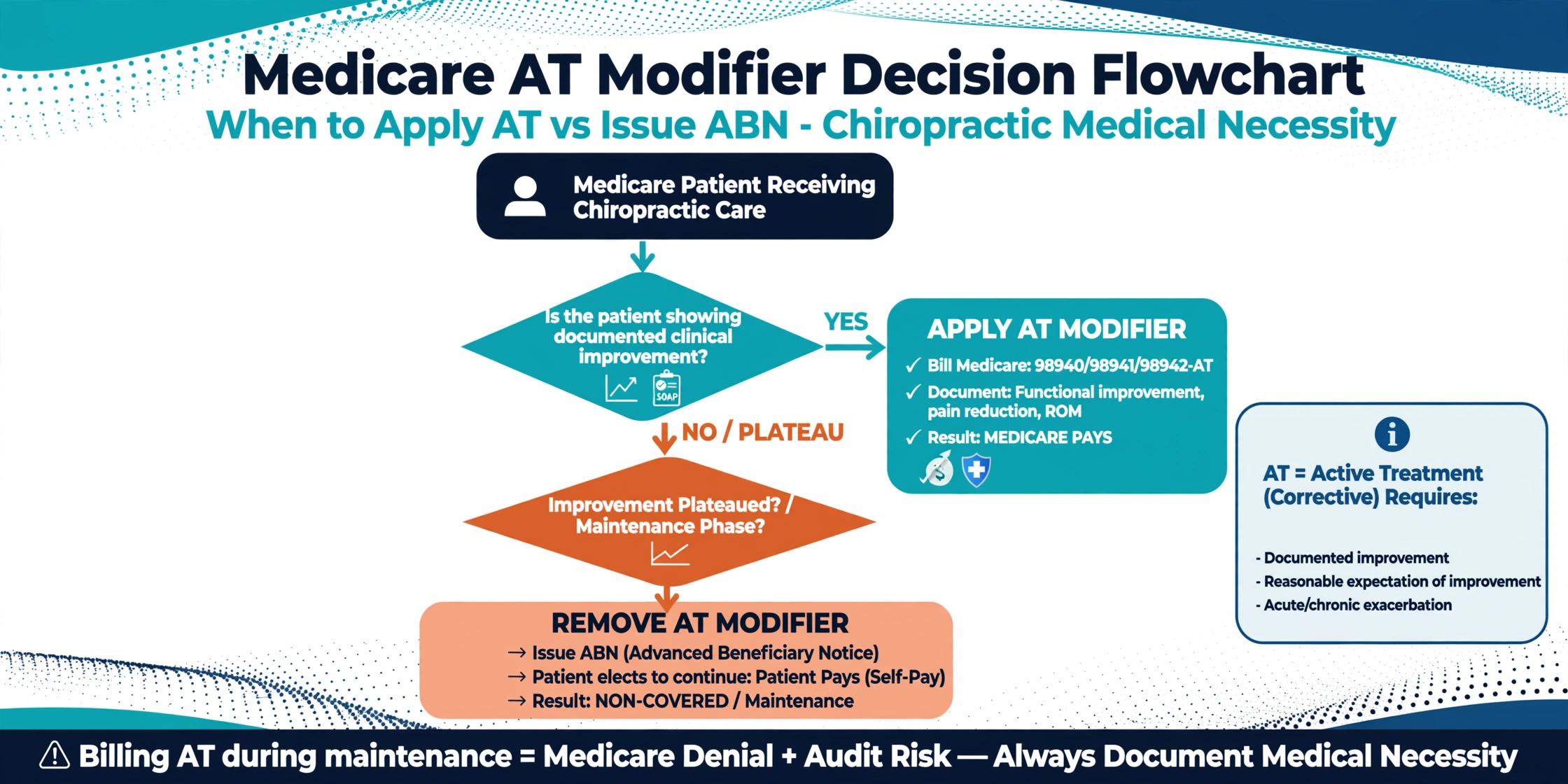
This is absolutely critical for chiropractic medical billing services. Medicare only covers active/curative care, treatment where improvement is still expected. Once a patient reaches maximum therapeutic benefit and is receiving only maintenance care to prevent deterioration, Medicare stops covering it.
| Treatment Phase | Medicare Coverage | Action Required |
|---|---|---|
| Active/Curative Care | Covered (with AT modifier) | Bill with AT modifier |
| Maintenance Care | NOT Covered | Issue ABN, collect from patient |
| Acute Exacerbation of Chronic Condition | Covered | Document the exacerbation clearly |
Medicaid coverage for chiropractic services varies significantly by state since it’s a state-administered program with federal funding. This creates real complexity for chiropractic medical billing teams. Here’s a general breakdown of how states approach chiropractic Medicaid coverage:
| Coverage Category | States/Scenarios |
|---|---|
| Full chiropractic coverage | Select states including California, Illinois, Wisconsin |
| Limited coverage (e.g., adults only, or specific diagnoses) | Several mid-Atlantic and Southern states |
| No chiropractic coverage | Several states, particularly for adult Medicaid populations |
| CHIP coverage for pediatric chiropractic | Varies by state |
Here’s something every chiropractor needs to hear, your documentation is your billing. Without accurate, complete, contemporaneous documentation, even the most technically perfect coding will fail when audited. This is where chiropractic medical billing services live or die.
Medicare and most private payers use the PART criteria for subluxation documentation:
You must document at least 2 of these 4 criteria for each region treated.
| Documentation Element | Required? | Notes |
|---|---|---|
| Chief complaint | Yes | Patient's presenting condition |
| History of present illness | Yes | Onset, mechanism, duration |
| Physical examination findings (PART criteria) | Yes | At least 2 of 4 per region |
| Subluxation level(s) | Yes | Specific vertebral level(s) |
| Treatment provided | Yes | CPT codes must match documentation |
| Number of spinal regions treated | Yes | Drives code selection 98940–98942 |
| Treatment response | Yes | Progress toward goals |
| Plan/next visit | Yes | Active vs. maintenance distinction |
Modifiers are one of the most misused elements in chiropractic medical billing by practices across the USA. If you use them correctly, they ensure proper reimbursement. If you use them incorrectly, they trigger denials, payer flags, and potential fraud investigations.
| Modifier | When to Use |
|---|---|
| AT | Active treatment for Medicare — REQUIRED on all Medicare CMT claims that are covered |
| GA | Advance Beneficiary Notice issued for service expected to be denied (maintenance care) |
| GX | Notice given — voluntary ABN, service not covered by Medicare |
| GY | Item/service statutorily excluded or does not meet definition of benefit |
| 25 | Significant, separately identifiable E/M on same day as procedure |
| 59 | Distinct procedural service (used to bypass NCCI bundling edits) |
| KX | Requirements specified in payer LCD have been met (used by some MACs) |
It is also important for your practice growth that you need to accurately understand why your claims get denied is just as important as knowing how to code correctly. In chiropractic medical billing, denial patterns are very predictable and very fixable.
| Denial Reason | Root Cause | Fix |
|---|---|---|
| Missing AT modifier | Medicare claims submitted without AT modifier | Add AT modifier to all active treatment Medicare claims |
| Lack of medical necessity | Insufficient subluxation documentation | Ensure PART criteria are met and documented |
| Maintenance care denial | Active/maintenance distinction not clear | Document improvement or issue ABN |
| Non-covered service | Physical therapy codes billed to Medicare | Issue ABN; collect from patient |
| Incorrect number of regions | Mismatch between documentation and CPT code | Count and document every region treated |
| No prior authorization | PA not obtained before treatment | Verify PA requirements before first visit |
| Eligibility issue | Patient's coverage lapsed or changed | Verify eligibility before every visit |
| Unbundling errors | Separate billing of services that should be bundled | Review NCCI edits regularly |
| Untimely filing | Claim submitted after payer deadline | Know each payer's timely filing window |
Prior authorization (PA) requirements for chiropractic care have expanded significantly across commercial payers in recent years. Ignoring PA is one of the fastest paths to claim denial in chiropractic medical billing.
Here’s a practical workflow for PA management in chiropractic medical billing services:
Verify PA requirements at intake: You need to check the patient’s specific plan, not just the payer name (a Blue Cross plan in one state may have very different PA rules than in another)
Submit PA requests with clinical documentation: It includes the diagnosis, treatment plan, frequency, duration, and initial examination findings.
Track authorization numbers: The document the PA number, approved dates, and approved visit count in your practice management system.
Monitor remaining authorized visits: Alert providers when patients are approaching their authorized visit limit
Request extensions before authorization expires: Don’t wait until the last visit; request extension 2–3 visits before the limit
💡 Tip: Build a PA Tracking Log. Maintain a real-time spreadsheet or utilize your billing software’s PA tracking feature. Log every authorization number, approval date, expiration date, and number of approved visits. Review this log daily as part of your front-desk workflow.
We’ve mentioned the AT modifier multiple times because it deserves its own deep-dive section. This single modifier is the gatekeeper to Medicare reimbursement in chiropractic medical billing.
Using the AT modifier when a patient is actually receiving maintenance care is considered a billing compliance violation. According to CMS’s Office of Inspector General (OIG), improper use of the AT modifier in chiropractic has been a consistent target of Medicare fraud investigations and recovery audits.
The OIG’s Work Plan has repeatedly included chiropractic services, specifically around maintenance care billed as active care, as a high-risk area. If you’re not confident about the active vs. maintenance distinction for each patient, this is exactly where professional chiropractic medical billing services add measurable value.
One nuance that often trips up chiropractic medical billing teams is the correct handling of new versus established patient visits, especially when E/M services are involved.
For a new patient, the initial chiropractic examination supports medical necessity and establishes the baseline for treatment. Proper coding for this encounter typically includes:
When an established patient presents with a significant change in condition, a re-evaluation E/M may be appropriate:
| Scenario | Appropriate E/M? | Modifier Needed? |
|---|---|---|
| First ever visit, new patient | Yes (99202–99205) | 25 if manipulation also done |
| Established patient, new complaint | Yes (99211–99215) | 25 if manipulation also done |
| Established patient, routine follow-up | No | N/A |
| Annual re-examination | Yes (99211–99215) | 25 if manipulation also done |
Spinal manipulation billing is the heart of chiropractic medical billing services, and getting it right means understanding both the clinical and administrative sides of the equation.
CPT codes 98940, 98941, and 98942 are differentiated solely by the number of spinal regions treated, not by the technique, time, or complexity of the manipulation.
The 5 Spinal Regions:
Example: If a chiropractor treats the cervical and lumbar regions in a single visit, that’s 2 regions = CPT 98940. If the thoracic is also treated, it becomes 3 regions = CPT 98941
💡 Tip: Perform a Weekly Coding Audi:. Have your billing team or a certified professional coder pull 10–15 random chiropractic claims per week and compare the documented regions treated against the CPT code billed. This simple audit catches undercoding and overcoding before claims go out the door.
When a chiropractor manipulates extremity joints (shoulder, knee, ankle, wrist, etc.) or other extraspinal regions, CPT 98943 applies. This code can be billed in addition to spinal manipulation codes, but:
Chiropractic is one of the most audited healthcare specialties in the US. Between Medicare’s Recovery Audit Contractors (RACs), Unified Program Integrity Contractors (UPICs), and private payer auditors, the audit risk in chiropractic medical billing is very real.
High-Risk Areas Identified by OIG:
📣 Callout: The Cost of Non-Compliance Medicare RAC audits have recovered hundreds of millions of dollars from chiropractic providers over the past decade primarily for maintenance care billed as active care. A single audit can result in repayment demands for years of claims, plus potential Civil Monetary Penalties. The best investment you can make in chiropractic medical billing services is proactive compliance, not reactive damage control.
Chiropractic medical billing doesn’t exist in isolation, it’s one component of your practice’s entire revenue cycle. Optimizing your revenue cycle means looking at every touchpoint from patient scheduling to final payment.
| Phase | Key Activities | Common Pitfalls |
|---|---|---|
| Pre-Visit | Eligibility verification, PA check, copay collection | Skipping eligibility check = post-claim surprises |
| At Visit | Accurate documentation, charge capture | Incomplete SOAP notes, missed charges |
| Coding | CPT/ICD-10 selection, modifier assignment | Region miscounting, missing AT modifier |
| Claim Submission | Scrubbing, electronic submission, timely filing | Errors passed through, missed deadlines |
| Payment Posting | ERA/EOB reconciliation, patient balance | Underpayments not identified |
| Denial Management | Appeal filing, payer communication | Denials written off without appeal |
| Patient Collections | Statements, payment plans, follow-up | Aged AR ignored |
| Reporting | KPI tracking, payer performance analysis | No visibility into revenue leakage |
Track these metrics monthly to gauge the health of your chiropractic billing operation:
| KPI | Benchmark Target |
|---|---|
| Clean Claim Rate | ≥ 95% |
| First Pass Acceptance Rate | ≥ 95% |
| Days in AR | < 30 days |
| Denial Rate | < 5% |
| Collection Rate | ≥ 97% of net collectibles |
| Accounts Receivable > 90 Days | < 15% of total AR |
| Appeal Success Rate | ≥ 70% |
If your numbers are falling short of these benchmarks, it’s a strong signal that your chiropractic medical billing process needs attention — whether that’s staff training, technology upgrades, or professional chiropractic medical billing services.
Here’s the truth, most chiropractic practices are excellent at patient care and significantly underpowered at billing. And that’s not a criticism, it’s just the reality of how healthcare is structured. Chiropractic medical billing is a full-time specialty in itself.
At House of Outsourcing, we’ve spent years refining chiropractic medical billing services specifically for US chiropractic practices. Our team includes certified professional coders (CPCs) and revenue cycle specialists who live and breathe chiropractic billing compliance, documentation standards, and payer-specific rules.
At House of Outsourcing, we’ve spent years refining chiropractic medical billing services specifically for US chiropractic practices. Our team includes certified professional coders (CPCs) and revenue cycle specialists who live and breathe chiropractic billing compliance, documentation standards, and payer-specific rules.
Outsourcing your chiropractic billing eliminates the overhead of in-house administrative turnover and billing software licensing fees. Our specialized team accelerates your cash flow by drastically reducing aging A/R and using expert CMT coding strategies to ensure every spinal region treated is fully reimbursed without costly denials.
| Factor | In-House Billing | House of Outsourcing |
|---|---|---|
| Specialized chiropractic coding expertise | Inconsistent | Consistent, certified |
| Denial management | Often under-resourced | Systematic, aggressive |
| Medicare compliance oversight | Variable | Built-in |
| Cost | Salary + benefits + training + software | Transparent % of collections |
| Scalability | Limited by staff capacity | Scales with your volume |
| Reporting visibility | Often limited | Full RCM dashboard |
Medicare only covers spinal manipulation (CPT 98940, 98941, 98942) when it is medically necessary for the correction of a subluxation. X-rays, physical therapy modalities, massage, and extraspinal manipulation are not covered by Medicare for chiropractors.
Medicare only covers spinal manipulation (CPT 98940, 98941, 98942) when it is medically necessary for the correction of a subluxation. X-rays, physical therapy modalities, massage, and extraspinal manipulation are not covered by Medicare for chiropractors.
An ABN (Advance Beneficiary Notice) must be issued when you have reason to believe Medicare will not cover a service, specifically when a patient has reached maintenance care status, or when you are providing a service that Medicare excludes (like physical therapy modalities). The ABN must be signed before the service is provided.
Yes, when a significant, separately identifiable evaluation and management service is provided on the same day as manipulation. You must append modifier -25 to the E/M code and ensure your documentation clearly supports both the E/M and the manipulation as distinct services.
The difference is the number of spinal regions treated. 98940 = 1–2 regions; 98941 = 3–4 regions; 98942 = 5 regions. The selection must match the number of regions documented in your SOAP notes.
Need support with your billing workflow? Explore our medical billing and revenue cycle services or request a free consultation.
Get a free assessment from our billing experts