
Our anesthesia medical billing services help practices manage complex coding, modifiers, and payer requirements while improving reimbursement outcomes. We ensure accurate claim submission, reduce denials, and optimize the revenue cycle so anesthesia providers can focus on delivering quality patient care.

There is no medical billing system quite like anesthesia. No other specialty ties reimbursement to a mathematical formula that blends procedure complexity, clock time, patient risk, and provider credentials into a single dollar figure. And no other specialty carries the same penalty for documentation errors, in anesthesia billing, a single missed minute or a wrong modifier can translate directly into hundreds of dollars of lost revenue, multiplied across thousands of cases per year for your medical practice.
For anesthesiologists, CRNAs, anesthesiologist assistants (AAs), and the billing teams that support them, mastering anesthesia medical billing means understanding a unique unit-based payment system, a complex web of staffing modifiers, Medicare’s strict medical direction rules, and MAC billing requirements, all while making sure your practice every claim holds up under complex audit..
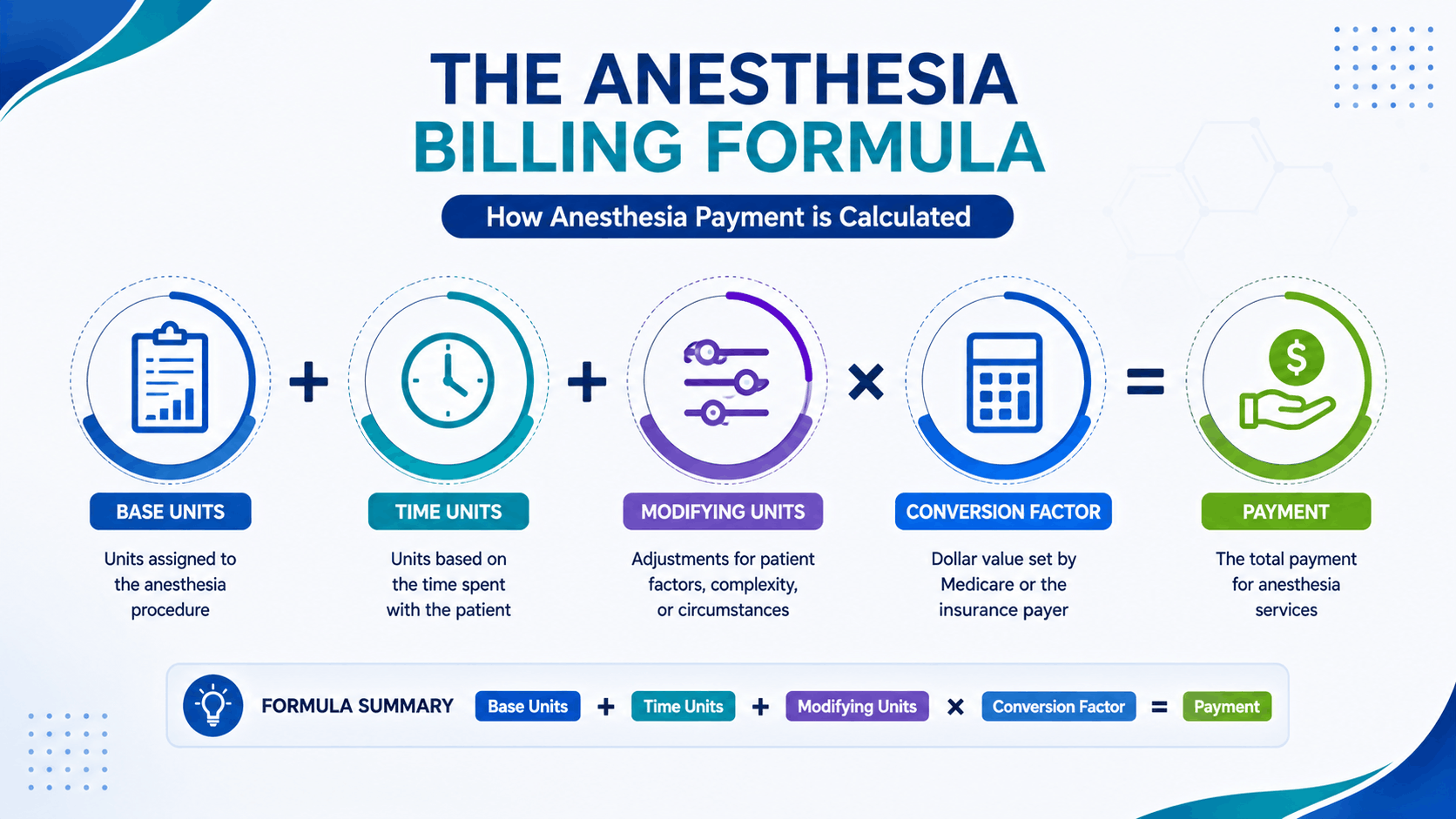
Every other specialty bills by selecting an anesthesia CPT code that carries a fixed dollar value tied to Relative Value Units (RVUs). Anesthesia is fundamentally different. Anesthesia billing uses a unit-based system where reimbursement is calculated dynamically every single case, based on four components that must all be documented and coded precisely.
�� The Anesthesia Billing Formula The Foundation of Every Claim
(Base Units + Time Units + Modifying Units) × Anesthesia Conversion Factor = Reimbursement This formula applies to every anesthesia claim billed under CPT codes 00100–01999. Each component is a separate billing variable and each one requires accurate documentation to produce accurate payment
Base units are assigned by CMS and the ASA to every surgical or procedural CPT code. They reflect the inherent complexity, skill requirement, and clinical risk associated with providing anesthesia for that specific procedure. Base units are fixed, they do not change based on how long the case takes or how sick the patient is.
| Anesthesia CPT | Corresponding Surgical Procedure | ASA Base Units | Complexity Level |
|---|---|---|---|
| 00100 | Head, excluding eyes, neurosurgery — intracranial | 5 | Moderate |
| 00160 | Nose and accessory sinuses — complex | 3 | Low-Moderate |
| 00300 | Thorax (not heart) including esophagus | 5 | Moderate |
| 00400 | Upper extremity and shoulder — not elbow | 3 | Low |
| 00402 | Reconstructive procedures on breast | 3 | Low |
| 00500 | Heart procedures — not pacemaker | 20 | Very High |
| 00520 | Thoracotomy with cardiac arrest | 15 | High |
| 00600 | Spine and spinal cord — cervical, not prone | 10 | High |
| 00620 | Thoracic — prone position | 10 | High |
| 00630 | Lumbar and sacral — not prone | 8 | Moderate-High |
| 00670 | Extensive spine — instrumentation | 13 | High |
| 00700 | Abdomen — upper, not liver | 7 | Moderate |
| 00790 | Intraperitoneal — complex | 7 | Moderate |
| 00840 | Intraperitoneal — lower abdomen | 7 | Moderate |
| 00810 | Lower intestinal endoscopic procedures | 5 | Low-Moderate |
| 00900 | Perineum | 5 | Low-Moderate |
| 01200 | Hip and femur — not pelvis | 8 | Moderate-High |
| 01400 | Knee and popliteal area — general | 5 | Moderate |
| 01402 | Total knee arthroplasty | 7 | Moderate-High |
| 01610 | Shoulder — complex procedures | 5 | Moderate |
| 01810 | Forearm, wrist, and hand | 3 | Low |
| 01830 | Ankle and foot | 3 | Low |
| 01967 | Neuraxial labor analgesia (vaginal delivery) | 5 | Moderate |
| 01968 | Cesarean delivery following neuraxial labor | 3 | Moderate |
| 01969 | Cesarean delivery — not following neuraxial | 7 | Moderate-High |
Time units represent the duration of continuous anesthesia care. Most payers calculate one time unit per 15 minutes of anesthesia, though rounding rules vary by payer. Medicare requires time to be documented to one decimal place (e.g., 63 minutes = 4.2 time units).
| Anesthesia Duration | Time Units (15-min basis) | Medicare Decimal | Example Procedure |
|---|---|---|---|
| 30 minutes | 2 units | 2.0 | Simple extremity procedure |
| 45 minutes | 3 units | 3.0 | Knee arthroscopy |
| 60 minutes | 4 units | 4.0 | Laparoscopic procedure |
| 75 minutes | 5 units | 5.0 | Spinal laminectomy |
| 90 minutes | 6 units | 6.0 | Total hip arthroplasty |
| 112 minutes | 7 units | 7.5 (round down to 7) | Total knee replacement |
| 120 minutes | 8 units | 8.0 | Major abdominal surgery |
| 180 minutes | 12 units | 12.0 | Complex spinal fusion |
| 240 minutes | 16 units | 16.0 | Open heart procedure |
⚠️ Time Documentation Is the #1 Source of Anesthesia Revenue Loss
Time units begin the moment the anesthesiologist begins preparing the patient for anesthesia, not when the surgical incision is made and end when continuous personal involvement concludes. This is frequently misunderstood, causing systematic underbilling. Every minute not documented is a minute not reimbursed. Missing start or end times in the anesthetic record reduces payable units immediately and permanently there is no retroactive correction once the claim is paid
The conversion factor is the dollar value applied to each billable unit. It varies significantly between Medicare and commercial payers, and between geographic regions even within Medicare.
| Payer Type | 2025/2026 Conversion Factor | Notes |
|---|---|---|
| Medicare (National — 2025) | ~$21.56 (regional variation) | Updated via American Relief Act, 2025; varies by MAC jurisdiction |
| Medicare (National — 2026) | $21.71 (national avg) | CMS released December 2025; effective January 1, 2026 |
| Medicaid | State-specific (often lower) | States set own anesthesia conversion factors |
| Commercial Payers (2022 Median) | $78.00 per unit | ASA Commercial Conversion Factor Survey — varies widely |
| Best Commercial Contracts | $100–$130+ per unit | High-value commercial contracts in major markets |
�� The Medicare vs. Commercial Gap Is Enormous — And Getting Wider
In 2022, Medicare paid anesthesia at $21.56 per unit while the median commercial rate was $78.00 per unit, meaning Medicare paid less than 28% of median commercial rates. By 2023, Medicare reimbursement for anesthesia had declined further (from $22.27/unit in 2019 to $21.12/unit in 2023). The 2025 Medicare Physician Fee Schedule included an additional 2.2% reduction. Practices with heavy Medicare patient panels must optimize clean claim rates and commercial contract management to offset these reductions
Physical status modifiers (P1–P6) reflect the clinical complexity and risk associated with the patient being anesthetized, not the procedure itself. While Medicare does not reimburse additional units for physical status modifiers, the majority of commercial payers do, and over 80% of commercial contracts include physical status coverage, according to the ASA’s annual survey. For practices with significant commercial payer volume, accurate physical status assignment can add meaningful revenue per case.
Per CMS, the official Medicare acupuncture coverage rule is available at the CMS National Coverage Determination 30.3.3. Here is what it actually requires:
| Physical Status | Description | Additional Units (Commercial) | Medicare Payment? | Documentation Requirement |
|---|---|---|---|---|
| P1 | Normal healthy patient | 0 units | None | Standard documentation |
| P2 | Patient with mild systemic disease | 0 units | None | Document mild systemic condition (e.g., controlled HTN) |
| P3 | Patient with severe systemic disease | 1 unit (many payers) | None (informational only) | Document severity — e.g., poorly controlled DM, COPD on O2 |
| P4 | Severe systemic disease — constant threat to life | 2 units (many payers) | None (informational only) | Document life-threatening comorbidities — e.g., end-stage renal disease |
| P5 | Moribund — not expected to survive without surgery | 3 units (many payers) | None (informational only) | Document moribund status and emergency nature of procedure |
| P6 | Brain-dead — organ donor | N/A | None | Document brain death and organ procurement context |
⚠️ Medicare and Increasingly Some Commercial Payers Treat Physical Status as Informational Only
Medicare does not assign additional reimbursement units for P1–P6 modifiers. Additionally, some commercial payers including certain UnitedHealthcare plans as of 2025 have updated policies to treat physical status modifiers as informational only, without adding units. Before billing physical status units to any payer, verify current contract terms. Using payer-specific physical status billing tables in your practice management system prevents systematic overbilling or compliance violations
No CPT code stands alone, every claim submitted in allergy and immunology billing services must be linked to a specific, medically appropriate ICD-10 diagnosis code that supports the medical necessity of the service. Using a vague or non-specific ICD-10 code is one of the fastest paths to a denied or flagged claim. Here’s your comprehensive allergy ICD-10 reference:
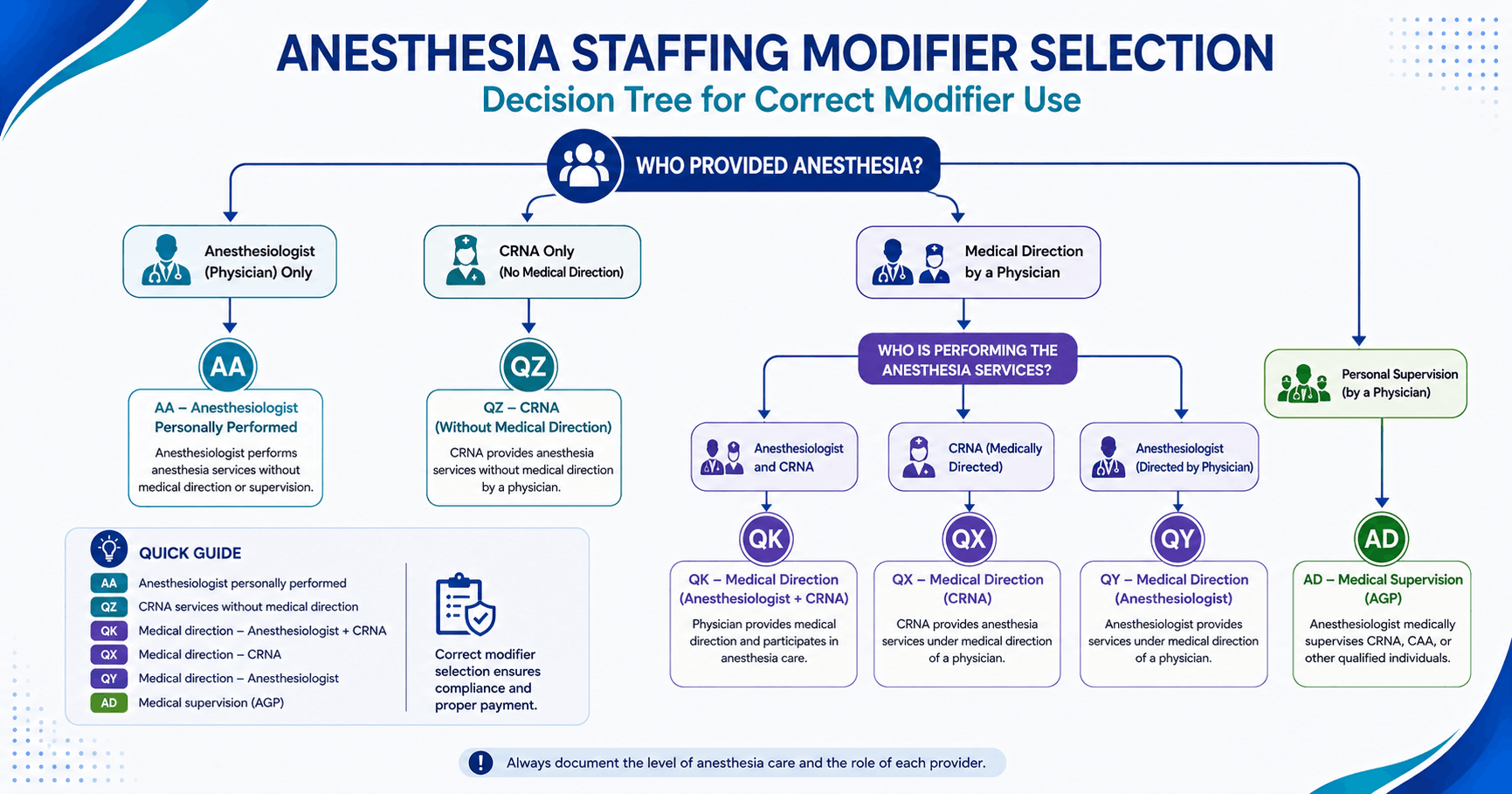
| Modifier | Who Bills It | What It Means | Medicare Payment | Key Documentation Requirement |
|---|---|---|---|---|
| AA | Anesthesiologist | Personally performed the entire anesthesia service alone | 100% of allowable | Anesthesiologist's continuous personal involvement documented throughout |
| QZ | CRNA | CRNA service without medical direction by any physician | 100% of allowable | No physician involvement in oversight; CRNA's independent service documented |
| QY | Anesthesiologist (+ CRNA bills QX) | Medical direction of ONE CRNA — 1:1 direction | 100% of allowable (with medical necessity documented) | All 7 medical direction requirements documented personally by the MD |
| QK | Anesthesiologist | Medical direction of TWO to FOUR concurrent CRNA/AA cases | 50% of allowable per case | All 7 medical direction requirements met and documented for EACH concurrent case |
| QX | CRNA or AA | Service under medical direction by a physician | 50–100% (payer-specific) | Must pair with the directing MD's QK or QY modifier; coordination documented |
| AD | Anesthesiologist | Medical SUPERVISION — more than 4 concurrent cases | 3 base units + 1 unit if present for induction (NOT time-based) | Minimal oversight only; no time units payable — major revenue reduction |
| GC | Teaching Anesthesiologist | Resident service under teaching anesthesiologist's direction | 100% if 2-room max concurrency; 50% (QK) if 3–4 rooms | Teaching physician criteria met; must be present for critical portions |
| QS | Any provider | Monitored Anesthesia Care (MAC) services | Time-based; payer-specific | Medical necessity for MAC must be documented; not simply lighter sedation |
| G8 | Any provider | MAC for high-risk or complex procedures | Payer-specific | High-risk criteria must be met and documented in the record |
| G9 | Any provider | MAC for high-risk or complex procedures — additional | Payer-specific | Pairs with G8 for enhanced documentation scenarios |
This is one of the most financially consequential distinctions in all of anesthesia billing. Medical direction (QK/QY) pays anesthesiologists 50–100% of the Medicare allowable per concurrent case. Medical supervision (AD) pays only 3 base units total plus 1 unit if present for induction, with no time units payable. If your practice is billing AD when QK is clinically and documentatively supportable, you could be forfeiting thousands of dollars per provider per year.
To qualify for medical direction (and bill QK or QY), the anesthesiologist must personally document fulfillment of all seven of the following requirements in the anesthetic record:
Pre-anesthetic examination and evaluation
The MD personally reviews the patient’s history, examines the patient, and documents the findings before anesthesia begins.
Prescribes the anesthetic plan
The MD formulates and documents the individualized anesthetic plan for the patient
Personally participates in the most demanding procedures
Including induction and emergence, the MD must be physically present and active during these critical phases.
Ensures qualified personnel perform other plan elements
The MD verifies that any parts of the plan they don’t personally perform are carried out by qualified individuals.
Monitors anesthesia administration at frequent intervals
The MD personally monitors the course of each case, not just on-call availability.
Remains physically present and immediately available
The MD must be reachable within the suite for immediate diagnosis and treatment of emergencies.
Provides indicated post-anesthesia care: The MD participates in post-anesthesia management and documents this involvement.
⚠️ All 7 Requirements Must Be Personally Documented by the Anesthesiologist Not the CRNA
CMS requires that the anesthesiologist personally document each of the seven medical direction requirements in the anesthetic record. Documentation by the CRNA alone does not qualify the case for medical direction billing. If even one of the seven requirements is absent from the MD’s documentation, the case must be billed as supervision (AD), resulting in significant reimbursement reduction. This is a frequent RAC and OIG audit finding
Qualifying circumstance codes are CPT add-on codes that capture additional complexity or risk beyond what the base unit value reflects. They translate directly into additional reimbursement units, but they are frequently under-documented, mis-applied, or avoided entirely by practices unsure of the rules. Here’s how to use them correctly in your anesthesia billing services:
| CPT Code | Circumstance | Additional Units | Medicare? | Billing Rule |
|---|---|---|---|---|
| +99100 | Anesthesia for patient under 1 year or over 70 years | 1 unit | NOT payable by Medicare or Medicaid | Most commercial payers cover; verify contract; do NOT bill to Medicare |
| +99116 | Anesthesia with utilization of total body hypothermia | 5 units | NOT payable by Medicare or Medicaid | Document hypothermia protocol in anesthetic record; confirm commercial payer coverage |
| +99135 | Anesthesia with controlled hypotension | 5 units | NOT payable by Medicare or Medicaid | Document induced hypotension with clinical rationale in anesthetic record |
| +99140 | Anesthesia complicated by emergency conditions | 2 units | NOT payable by Medicare or Medicaid | Emergency = 'delay in treatment would lead to significant increase in threat to life or body part'; document this explicitly |
�� Critical Rule: Never Bill Qualifying Circumstance Codes to Medicare or Medicaid
CMS explicitly does not pay for qualifying circumstance add-on codes (99100, 99116, 99135, 99140) under Medicare or Medicaid. Billing these codes to government payers results in denial and potential compliance risk. These codes should only appear on claims submitted to commercial payers who specifically cover them under their contracts. Always build payer-specific billing rules into your practice management system to automatically suppress these codes for government payer claims.
Monitored Anesthesia Care represents a significant and growing portion of anesthesia billing services in ambulatory surgery centers, GI suites, and office-based procedure settings. But MAC billing is also one of the most scrutinized areas in anesthesia, because payers know that ‘light sedation’ or routine nurse-administered sedation can masquerade as physician-billed MAC without proper documentation. Getting this right protects both revenue and compliance.
What MAC IS: A physician-directed anesthesia service that includes pre-procedure assessment, intra-procedure monitoring, readiness to convert to general anesthesia if needed, and post-procedure oversight, billed by a qualified anesthesia provider.
What MAC is NOT: Routine conscious sedation administered by a nurse under a surgeon’s direction; nurse-administered propofol without qualified anesthesia provider oversight; or ‘light anesthesia’ billed simply because the procedure was minor.
| Service | CPT Code | Modifier Required | Documentation Trigger |
|---|---|---|---|
| MAC — standard monitored anesthesia care | 00840, 00810, or procedure-specific code | QS | Medical necessity for MAC presence; pre/intra/post documentation |
| MAC for high-risk or complex procedures | Procedure-specific anesthesia code | G8 | High-risk criteria must be met and documented |
| Additional MAC complexity | Procedure-specific anesthesia code | G9 | Used in conjunction with G8 for enhanced documentation |
Pre-procedure assessment: Anesthesiologist’s evaluation of patient history, current medications, allergies, and anesthesia risk, completed personally before the procedure.
Medical necessity for MAC over sedation: Why this patient required a qualified anesthesia provider rather than nurse-administered sedation, document patient risk factors, procedure complexity, or history of anesthesia complications.
Intra-procedure monitoring: Continuous monitoring data (vital signs, oxygen saturation, level of consciousness) documented at appropriate intervals throughout the procedure.
Readiness for general anesthesia: Evidence that the provider was prepared and equipped to convert to general anesthesia if clinically required.
Post-procedure care: Anesthesiologist’s post-procedure assessment and hand-off documentation.
Accurate time recording: Start time (beginning of preparation/assessment) through end time (patient sufficiently recovered and handed off).
One of the most technically demanding aspects of anesthesia medical billing is the ASA-to-CPT crosswalk, accurately mapping each surgical CPT code to the appropriate anesthesia CPT code (00100–01999). A crosswalk error creates a CPT-to-anesthesia mismatch that payers flag immediately, triggering claim holds or denials. Here’s a practical reference for common surgical specialties:
| Surgical Specialty | Common Surgical CPT | Anesthesia CPT | Base Units | Notes |
|---|---|---|---|---|
| Orthopedics | 27447 (Total Knee Arthroplasty) | 01402 | 7 | High-volume; document time precisely — case length varies significantly |
| Orthopedics | 27130 (Total Hip Arthroplasty) | 01214 | 8 | Positioning and blood loss complexity; document any induced hypotension |
| Orthopedics | 29827 (Shoulder Rotator Cuff Repair) | 01630 | 4 | Beach chair or lateral — position must be documented |
| Spine | 63030 (Lumbar Discectomy) | 00630 | 8 | Prone — document positioning; add 00670 if instrumentation |
| Spine | 22840 (Instrumentation) | 00670 | 13 | Use when instrumentation is the primary or most complex element |
| General Surgery | 47563 (Laparoscopic Cholecystectomy) | 00790 | 7 | Laparoscopic; document CO2 insufflation timing as part of anesthesia |
| GI | 45378 (Colonoscopy) | 00810 | 5 | High-volume MAC setting; medical necessity for anesthesia must be documented |
| GI | 43239 (EGD with biopsy) | 00740 | 7 | Upper GI — airway management risk higher; document |
| Cardiac | 33533 (CABG — arterial) | 00566 | 25 | Highest complexity; bypass time, hypothermia — all must be documented |
| OB | 01967 (Neuraxial labor) | 01967 | 5 | Continuous epidural service; time tracking rules differ — see OB section |
| OB | 59510 (C-Section) | 01969 | 7 | Or 01968 (3 units) if epidural was already placed for labor |
| Urology | 52601 (TURP) | 00910 | 5 | Spinal often used; document type of anesthesia delivered |
| ENT | 42820 (Tonsillectomy) | 00170 | 5 | Pediatric — consider 99100 for commercial payers if under 1 year |
| Neurosurgery | 61510 (Craniotomy for brain tumor) | 00214 | 15 | Complex; long duration — time documentation critical |
| Ophthalmology | 66984 (Cataract extraction) | 00142 | 5 | High-volume MAC; medical necessity documentation essential |
�� Use the Official ASA CROSSWALK — Not Memory or Shortcuts
The ASA Relative Value Guide (RVG) and CROSSWALK are updated annually and are the authoritative source for anesthesia CPT code selection and base unit values. Using outdated crosswalk tables or relying on billing staff memory for code mapping creates systematic errors that compound across thousands of cases. Build the current year’s ASA crosswalk into your practice management system and update it every January.
Time units represent the most dynamic and most vulnerable revenue variable in anesthesia billing services. Unlike base units (fixed) and modifiers (binary), time is measured continuously across every case. Systematic errors in time documentation, rounded times, missing start or end times, misunderstanding of when the clock starts and stops silently erode revenue across every case a practice bills.
| Time Point | Standard Rule | What Not to Use | Revenue Impact |
|---|---|---|---|
| Start Time | When the anesthesiologist begins preparation of the patient for anesthesia (positioning, monitoring setup, IV placement under anesthesia care) | Surgical incision time; patient arrival in pre-op | May be 10–30 minutes before surgical start — missed start time = missed units |
| End Time | When the anesthesiologist's continuous personal involvement concludes — typically when the patient is safely transferred to recovery | Surgical closure; extubation if continued monitoring follows | Premature end time = missed units for emergence and transfer |
| MAC Start Time | Beginning of physician-directed monitoring and preparation | Surgeon's sedation order time | Document physician presence and active monitoring initiation |
| Interrupted Time | Documented blocks of anesthesia time can be added for brief interruptions if continuous care resumes | Arbitrary time rounding | Document each interruption with clinical reason; add blocks for total billable time |
Medicare: Requires time documented to one decimal place. Example: 63 minutes ÷ 15 = 4.2 time units. Medicare rounds to the nearest tenth not down to the whole unit.
Most commercial payers: Round DOWN to the nearest whole 15-minute unit. Example: 63 minutes = 4 full units (the extra 3 minutes are not reimbursed). Know your contract terms.
Some commercial payers: Round to nearest 15-minute block, either up or down. Verify with each payer contract.
The key practice: Document the actual start and stop times in minutes, let your billing system or formula apply the rounding rule. Never round before documenting.
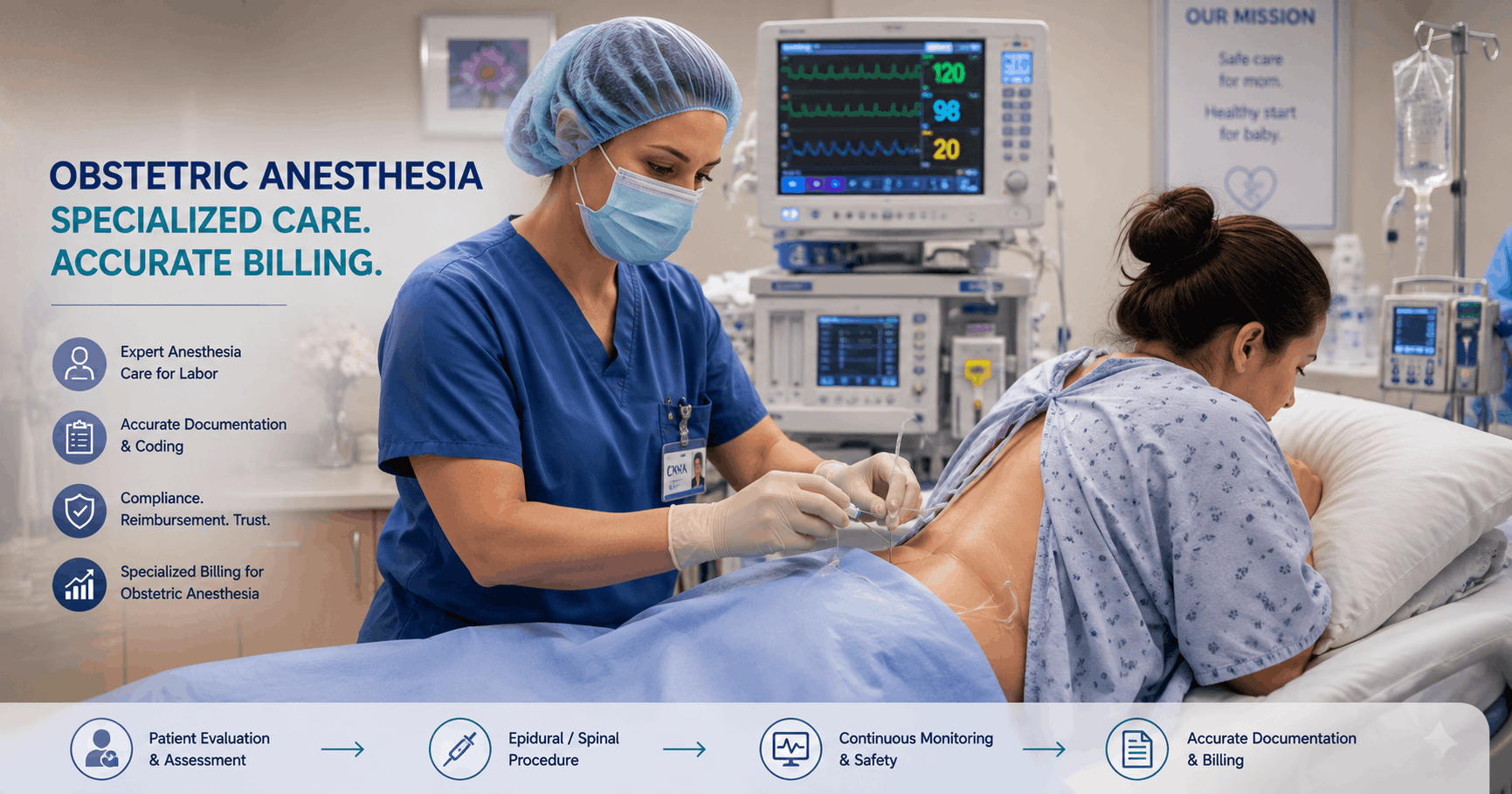
Neuraxial labor analgesia time tracking: Unlike operative anesthesia, there is no single accepted time tracking method for labor epidural services. Some payers reimburse on a per-day or per-delivery basis rather than per-15-minute time unit. Know your payer contracts for OB.
01968 vs. 01969: The choice between these two codes depends entirely on whether an epidural was already in place from labor. Using 01969 (7 base units) when 01968 (3 base units) is appropriate overstates the service and creates compliance risk.
Do NOT separately bill 62319 with 01967: CMS has explicitly stated that catheter placement is included in 01967, billing both constitutes unbundling.
Documentation for OB: Document initiation time of neuraxial analgesia, catheter placement, all top-up doses, monitoring throughout labor, and conclusion of anesthesia involvement (delivery, transfer to PACU, or catheter removal).
While anesthesia is primarily billed using anesthesia-specific CPT codes (00100–01999), accurate ICD-10 diagnosis coding is still essential for anesthesia billing compliance. The diagnosis codes in your anesthesia claim must align with the surgical diagnosis and any comorbidities that affect anesthetic risk, particularly when billing MAC, qualifying circumstances, or complex physical status scenarios.
| ICD-10 Category | Common Codes | Relevance to Anesthesia Billing |
|---|---|---|
| Anesthetic Complications | T41.0XXA–T41.5XXA | Document adverse effects of anesthesia; required for complication-related billing |
| Cardiovascular Comorbidity | I10 (HTN), I25.10 (CAD), I50.9 (CHF) | Supports ASA P2/P3 physical status; documents cardiac risk for MAC necessity |
| Respiratory Comorbidity | J44.1 (COPD acute), J45.50 (severe asthma) | Supports elevated ASA status; MAC medical necessity documentation |
| Diabetes | E11.65 (T2DM with hyperglycemia) | Supports ASA P2/P3; glycemic management during anesthesia documentation |
| Obesity | E66.01 (Morbid obesity), E66.09 (Obesity) | Supports MAC necessity; airway complexity documentation |
| Substance Use | F10.20 (Alcohol dep), F11.20 (Opioid dep) | Affects anesthetic requirements; documents complexity |
| Surgical Procedures | System-specific | Must match the operative CPT — code specificity prevents CPT-ICD mismatch denials |
| Emergency Status | Z87.xx (personal history) | Emergency cases (99140) — document acute nature and timeline |
| Extreme Age | Z00.110 (infant exam), Z00.121 (child) | Supports qualifying circumstance 99100 for commercial payers |
Most anesthesia claim denials do not stem from coding errors, they stem from documentation failures that happen in the OR before billing ever begins. Here are the ten most common documentation-driven denial scenarios in anesthesia billing services, and exactly how to fix them:
| Documentation Failure | Why It Causes Denial | Precision Fix |
|---|---|---|
| Missing or estimated anesthesia start time | No billable time beginning — units cannot be calculated accurately | Require providers to enter exact start time at anesthesia induction in EHR; do not accept 'approx.' |
| Missing anesthesia end time | Cannot calculate total time units | Document exact time when continuous personal involvement concluded; not OR close time |
| ASA physical status not documented | Cannot support P3+ physical status for commercial payer billing | Include ASA status as required field in anesthesia record; document supporting comorbidities |
| Medical direction requirements incomplete | Case billed as QK but MD cannot document all 7 requirements | Implement MD-specific attestation checklist in anesthetic record; bill AD if requirements unmet |
| MAC billed without medical necessity documentation | Payer cannot determine why anesthesia provider was needed vs. nurse sedation | Add MAC medical necessity field to anesthesia record; document specific patient risk factors |
| Surgical CPT and anesthesia CPT mismatch | Claim flagged as inconsistent — anatomical mismatch or procedure mismatch | Use current ASA crosswalk; build automated crosswalk validation in PM system |
| Qualifying circumstance coded for Medicare/Medicaid | 99100/99116/99135/99140 denied by government payers | Suppress qualifying circumstance codes for all Medicare/Medicaid claims at PM system level |
| Concurrent case count exceeds 4 — billed as QK, not AD | Overpayment; potential recoupment or compliance finding | Real-time concurrency tracking; auto-flag when 5th concurrent case begins |
| Post-anesthesia care not documented | Payer questions whether full service was rendered | Document PACU hand-off time, patient status, and any post-anesthesia interventions |
| Wrong provider NPI on claim | Payment goes to wrong provider or claim is rejected | Verify rendering provider NPI matches credentialed provider; update after any staffing changes |
One of the most error-prone areas in anesthesia medical billing services is applying Medicare rules universally, to commercial payers who have different (often more favorable) coverage policies, and vice versa. Here’s a side-by-side comparison of where Medicare and commercial anesthesia billing rules meaningfully differ:
| Billing Element | Medicare Rule | Commercial Payer Rule | Revenue Impact of Confusion |
|---|---|---|---|
| Physical status modifiers | Informational only — NO additional units paid | 80%+ of contracts pay additional units for P3–P5 | Missed units for every commercial P3+ case if not applied |
| Qualifying circumstances (99100–99140) | NOT payable — never bill to Medicare | Most commercial plans cover at least some codes | Denied claims to Medicare; missed revenue on commercial |
| CRNA reimbursement (QZ) | 100% of allowable | Often 50–85% depending on contract (some cap at 85% PFS) | Verify CRNA rates per commercial contract; don't assume parity |
| Medical direction (QK) rate | 50% of allowable per concurrent case | Varies by contract — some pay higher than Medicare rates | Know your commercial contracts; QK rate may be negotiable |
| Anesthesia conversion factor | $21.56–$21.71 (national; 2025–2026) | Median $78.00+; varies widely by geography and contract | Significant difference — Medicare contract management is critical |
| Time unit rounding | To nearest 0.1 unit (decimal) | Usually rounds DOWN to nearest whole unit (15-min) | Different rounding = different unit count for same case length |
| MAC documentation | Strict medical necessity documentation required | Often less prescriptive — but document for all payers | Don't assume commercial is lenient; document for all payers |
| Concurrent case limit for direction | 4 cases max for QK; 5+ = supervision (AD) | Most commercial follow Medicare rules — verify contract | Crossing into AD territory is costly for any payer |
Every perfectly-coded, perfectly-documented anesthesia claim is worthless if the rendering provider isn’t credentialed with the paying payer. Credentialing is the enrollment infrastructure that enables anesthesia billing services, and it is one of the most expensive areas when neglected, because credentialing gaps mean days of unbillable service that cannot be retroactively recovered.
| Credentialing Element | What Anesthesia Groups Must Know |
|---|---|
| CAQH ProView | Maintain active profiles for every anesthesiologist, CRNA, and AA. Update every 120 days minimum — outdated profiles cause automatic enrollment suspension with many payers. |
| Individual vs. Group NPI | Type 1 (individual) and Type 2 (group) NPIs must both be enrolled and linked. Anesthesia claims require both the rendering provider NPI and the billing group NPI to match enrolled records. |
| CRNA Credentialing Differences | CRNAs are credentialed separately from anesthesiologists. Some commercial payers have different panel structures for CRNAs — verify that your CRNAs are enrolled where your anesthesiologists are enrolled. |
| AA (Anesthesiologist Assistant) Enrollment | AAs are licensed in most states but Medicare enrollment rules for AAs differ from CRNAs. Verify AA enrollment eligibility with your MAC before billing Medicare for AA-directed services. |
| Hospital Privileging | Anesthesia providers must maintain current hospital privileges at every facility where they practice. Expired privileges = claims denied. |
| Malpractice Coverage | Most payers require minimum coverage amounts for anesthesiologists and CRNAs. Verify coverage amount requirements before enrollment and at re-credentialing. |
| Re-Credentialing Cycle | Every 2–3 years. Missing deadlines causes retroactive claim denial — often discovered months after the lapse, creating a complex reversal process. |
| Medicare PECOS Enrollment | Active enrollment via PECOS for all providers. Any change in practice location, group affiliation, or ownership requires immediate PECOS update — or Medicare claims are denied retroactively. |
Effective anesthesia billing services require a complete Revenue Cycle Management (RCM) system, not just a claim submission process. Each stage of the anesthesia RCM cycle has specific vulnerabilities that, if unaddressed, compound into significant revenue leakage. Here’s the end-to-end framework:
| RCM Stage | Key Activities | Anesthesia-Specific Focus |
|---|---|---|
| Pre-Service | Patient demographics, insurance verification, pre-auth | Verify anesthesia benefit, MAC coverage, and qualifying circumstance coverage per payer |
| Day-of-Surgery | Provider assignment, concurrency tracking, case scheduling | Monitor concurrent case count in real time; flag approaching AD threshold |
| Clinical Documentation | Anesthetic record, start/stop times, ASA status, modifiers | Verify all 7 medical direction requirements documented; MAC necessity; exact times |
| Charge Capture | CPT selection, time calculation, ASA crosswalk, modifier application | Crosswalk every surgical CPT; calculate units using exact times; apply payer-specific rules |
| Claim Scrubbing | Pre-submission claim review for errors and compliance | Flag: missing times, crosswalk mismatches, qualifying circumstances on Medicare, concurrency issues |
| Claim Submission | Electronic submission within timely filing window | Submit within 24–48 hours of DOS; track timely filing deadlines by payer |
| Payment Posting | ERA/EOB reconciliation, conversion factor audit | Compare paid conversion factor to contracted rate; flag underpayments immediately |
| Denial Management | Root cause analysis, appeal workflow, trend tracking | Track by modifier, time error, MAC documentation, and crosswalk mismatch separately |
| Patient Collections | Cost estimates, balance billing, financial counseling | Good-faith estimates for elective/cosmetic anesthesia; balance billing rules by state |
| Analytics | Clean claim rate, denial rate, collection rate, time accuracy rate | Monitor average units per case by CPT; flag cases where time seems low vs. OR records |
Anesthesia groups face this decision with more urgency than most specialties, because the unit-based billing system, complex modifier rules, and concurrency documentation requirements demand genuine expertise. Here’s an honest comparison for anesthesia group leaders:
Need support with your billing workflow? Explore our medical billing and revenue cycle services or request a free consultation.
| Factor | In-House Anesthesia Billing | Outsourced Anesthesia Billing Services |
|---|---|---|
| Anesthesia-specific expertise | Requires specialized training — not interchangeable with general billing | Dedicated anesthesia billing specialists with ASA crosswalk mastery |
| Time unit accuracy | Prone to systematic rounding errors and missing start/stop times | Rigorous time audit process; automated variance detection against OR records |
| Modifier compliance | Medical direction, concurrency rules frequently misapplied | Decision-based modifier selection workflow built into billing process |
| Medicare vs. commercial differentiation | Qualifying circumstance and physical status errors common | Payer-specific billing rules applied automatically per claim |
| MAC documentation compliance | Often under-verified before submission | Pre-submission MAC documentation review built into workflow |
| OB anesthesia coding | 01967/01968/01969 mix-ups are common | OB-specific coding protocols; quarterly OB claim audits |
| Denial management depth | Reactive; appeals limited by staff bandwidth | Dedicated AR follow-up; appeal success rates tracked and optimized |
| Average collection rate | 60–72% for in-house anesthesia groups (industry avg) | 85–96%+ with experienced anesthesia billing partner |
| Revenue per unit | Often lower due to underdocumented time and missed physical status | Higher revenue per case through accurate time capture and modifier optimization |
| Compliance risk | Higher — modifier errors and Medicare rule violations common | Reduced through systematic compliance protocols and regular auditing |
Get a free assessment from our billing experts