
Our Hematology Medical Billing services help practices manage complex blood disorder care billing, specialty coding requirements, documentation standards, and payer guidelines. We optimize claims, reduce denials, and improve reimbursements through efficient revenue cycle management.

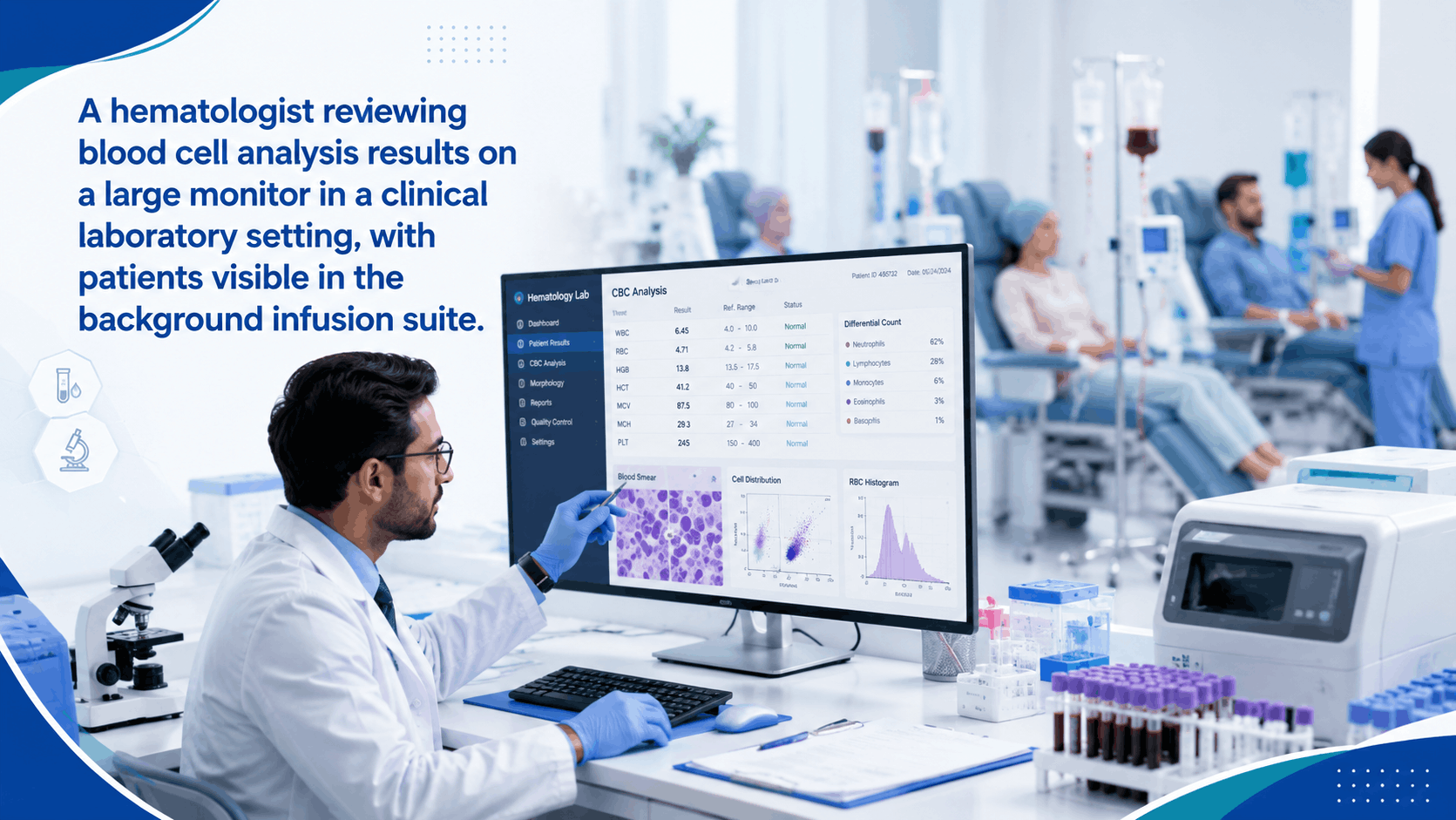
Hematology is a specialty where the science is complex, the stakes are high, and the billing, if done incorrectly, costs your medical practice far more than most you realize. Whether your practice manages iron deficiency anemia, sickle cell disease, myelodysplastic syndromes, clotting disorders, or hematologic malignancies like leukemia and lymphoma, every patient encounter carries a dense web of CPT codes, ICD-10 diagnoses, HCPCS drug codes, infusion timing requirements, and prior authorization obligations.
We have written this guide for US hematologists, hematology-oncology physicians, practice managers, and administrators who want a clear, authoritative, and immediately actionable resource on hematology billing services.
And at the end, we will show you why House of Outsourcing is the trusted billing partner that hematology practices across the United States turn to when they need results.
Hematology medical billing sits at the intersection of diagnostic medicine, procedural care, and high-cost drug administration, and each of those three areas comes with its own set of coding rules, payer requirements, and compliance obligations. No other non-surgical specialty demands the same breadth of coding expertise in a single practice setting.
Here are the key factors that makes our hematology billing services a genuine specialty within medical billing:
As an experienced healthcare professional you know that in hematology, the ICD-10-CM diagnosis code is not a formality, it is the clinical justification that determines whether payers will authorize and reimburse every procedure, drug, and service your practice provides. Using unspecified or incorrect diagnosis codes in hematology billing is one of the leading causes of medical necessity denials.
| ICD-10 Range | Category | Examples in Hematology Practice |
|---|---|---|
| D50–D53 | Nutritional Anemias | D50.0 Iron deficiency anemia due to blood loss (chronic); D52.0 Dietary folate deficiency anemia; D53.9 Unspecified nutritional anemia |
| D55–D58 | Hemolytic Anemias | D57.1 Sickle-cell disease without crisis; D57.00 Hb-SS with crisis, unspecified; D58.0 Hereditary spherocytosis |
| D59 | Acquired Hemolytic Anemias | D59.0 Drug-induced autoimmune hemolytic anemia; D59.11 Warm antibody autoimmune hemolytic anemia (WAIHA) |
| D60–D64 | Aplastic & Other Anemias | D61.1 Drug-induced aplastic anemia; D61.3 Idiopathic aplastic anemia; D64.9 Anemia, unspecified |
| D65–D69 | Coagulation Defects | D66 Hereditary factor VIII deficiency (hemophilia A); D68.0 Von Willebrand disease; D68.311 Acquired hemophilia |
| D70–D77 | Other Blood Disorders | D70.0 Congenital agranulocytosis; D72.829 Lymphocytosis; D75.0 Familial erythrocytosis |
| D80–D89 | Immune Disorders | D83.9 Common variable immunodeficiency; D84.9 Immunodeficiency, unspecified; D89.810 GVHD |
| C81–C86 | Lymphomas | C81.90 Hodgkin lymphoma, unspecified; C83.30 Diffuse large B-cell lymphoma; C85.90 Non-Hodgkin lymphoma, unspecified |
| C91–C95 | Leukemias | C91.00 Acute lymphoblastic leukemia; C92.00 Acute myeloid leukemia; C95.90 Leukemia, unspecified |
| C88–C90 | Plasma Cell Neoplasms | C90.00 Multiple myeloma, not in remission; C90.10 Plasma cell leukemia; C88.2 Heavy chain disease |
| D46 | Myelodysplastic Syndromes | D46.0 Refractory anemia without RS; D46.20 Refractory anemia with excess blasts; D46.9 MDS, unspecified |
| D47 | Neoplasms of Uncertain Behavior | D47.1 Chronic myeloproliferative disease; D47.3 Essential thrombocythemia; D47.4 Osteomyelofibrosis |
�� Tip: Code to the Highest Specificity Available in Hematology
Hematology diagnosis codes demand the highest possible specificity. For example, sickle cell disease has dozens of ICD-10 sub-codes based on genotype (Hb-SS, Hb-SC, sickle-beta thalassemia) and crisis type (with crisis, without crisis, with acute chest syndrome). Payers use these distinctions to determine medical necessity for high-cost treatments like hydroxyurea, voxelotor, or crizanlizumab infusions. Using D57.1 (‘Sickle-cell disease without crisis’) when the patient is in crisis (D57.00) is both clinically inaccurate and a compliance risk. Always code from the clinical documentation — not the superbill checkbox.
CPT code selection in hematology billing covers three main categories: procedural codes for bone marrow and other hematologic procedures, infusion and administration codes, and evaluation and management codes. Each category has its own coding rules and documentation requirements.
Bone marrow aspiration and biopsy are among the highest-volume and highest-value procedures in hematology. Correct coding depends on what was performed, aspiration alone, biopsy alone, or both, and whether the physician also interpreted the specimen.
| CPT Code | Procedure Description | Critical Billing Notes |
|---|---|---|
| 38220 | Bone marrow aspiration | Aspiration alone; document site (iliac crest, sternum), technique, and yield |
| 38221 | Bone marrow biopsy, needle or trocar | Biopsy alone (core biopsy); document site and number of cores obtained |
| 38222 | Bone marrow biopsy and aspiration | Both performed; bill 38222 rather than 38220 + 38221 when both done at same session |
| 38230 | Bone marrow harvesting for transplant — allogeneic | Document donor type, collection volume, and transplant indication |
| 38232 | Bone marrow harvesting for transplant — autologous | Document autologous collection; often requires separate facility billing |
| 38240 | Hematopoietic progenitor cell (HPC) transplant — allogeneic | High-cost procedure; requires PA and transplant center documentation |
| 38241 | HPC transplant — autologous | Document mobilization, collection, and infusion dates separately |
| 38242 | Allogeneic lymphocyte infusions | Document donor, lymphocyte dose (cells/kg), and clinical indication |
| 85097 | Bone marrow interpretation and report | Professional component — bill when physician interprets BM specimen |
| 88182 | Flow cytometry, each cell surface marker (technical) | Bill per marker analyzed; professional interpretation billed separately |
| 88184 | Flow cytometry, first marker — professional | Professional component of flow cytometry interpretation |
�� Tip: Bill 38222 — Not 38220 + 38221 — When Both Are Performed
When a physician performs both a bone marrow aspiration and a needle biopsy at the same session, the correct code is 38222 — not a combination of 38220 and 38221. Billing 38220 and 38221 separately when 38222 applies is a CCI bundling violation. However, if the aspiration and biopsy are performed at different anatomical sites during the same session, separate billing may be appropriate with modifier -59 or -XS and thorough documentation.
| CPT Code | Test Description | Billing Note |
|---|---|---|
| 85025 | Complete Blood Count (CBC) with automated differential | Most common hematology lab; document clinical indication |
| 85027 | CBC without automated differential | Use 85027 only when differential not performed or ordered |
| 85610 | Prothrombin time (PT) | Coagulation monitoring; frequent in anticoagulation management |
| 85730 | Partial thromboplastin time (PTT/APTT) | Key coagulation test; document indication (monitoring vs. diagnosis) |
| 85651 | Erythrocyte sedimentation rate (ESR), non-automated | Inflammation marker; code 85652 for automated method |
| 83615 | Lactate dehydrogenase (LDH) | Elevated in hemolysis, lymphoma, and leukemia — document clinical context |
| 86367 | Stem cell enumeration — each antibody | CD34+ cell counting for transplant planning |
| 86355 | B cells, total count | Lymphocyte subset panel — document immunodeficiency or malignancy indication |
| 86356 | MHC class II antigen testing | HLA typing for transplant compatibility — requires separate PA |
| 81219 | CALR (calreticulin) gene analysis | Molecular test for myeloproliferative neoplasms |
| 81270 | JAK2 gene analysis (V617F variant) | Essential for polycythemia vera diagnosis; document testing indication |
| 81245 | FLT3 gene analysis | AML molecular testing; required for targeted therapy selection |
| CPT Code | Visit Type | MDM Complexity | Common Hematology Use |
|---|---|---|---|
| 99213 | Established patient — office | Low | Routine CBC follow-up, simple anemia monitoring |
| 99214 | Established patient — office | Moderate | Chronic ITP management, anticoagulation follow-up |
| 99215 | Established patient — office | High | Complex MDS, leukemia management, multiple medications |
| 99204 | New patient — office | Moderate | New referral for anemia workup or clotting disorder |
| 99205 | New patient — office | High | Complex new patient: MDS, lymphoma, hemophilia |
| 99221-99223 | Initial hospital care | Low/Mod/High | Inpatient admission for hematologic emergency or transplant |
| 99231-99233 | Subsequent hospital care | Low/Mod/High | Daily inpatient management during transplant or acute leukemia |
For most hematology practices, infusion billing represents the largest single component of revenue, and the highest-risk area for billing errors, denials, and compliance investigations. High-cost biologic therapies, blood factors, and supportive medications administered in your infusion suite carry reimbursements that dwarf most office-based services, which is exactly why payers scrutinize every unit billed.
Infusion administration codes are time-based and hierarchical. They must be billed in a specific order, with start and stop times documented for every drug and every infusion session. There is no flexibility here missing time documentation means a non-compliant claim.
| CPT Code | Administration Description | Key Hematology Billing Rule |
|---|---|---|
| 96413 | Chemotherapy infusion — initial, up to 1 hour | Use for antineoplastic agents; document drug name, dose, route, start/stop times |
| 96415 | Chemotherapy infusion — each additional hour | Add-on to 96413; bill per additional hour; must document extended time |
| 96401 | Chemotherapy injection — non-infusion, non-hormonal | Subcutaneous or intramuscular; not time-based; document route and drug |
| 96402 | Hormonal antineoplastic agent injection | Leuprolide, degarelix, fulvestrant; document drug, dose, and indication |
| 96365 | Non-chemo therapeutic infusion — initial, up to 1 hour | Immunoglobulin (IVIG), iron infusion, zoledronic acid, rituximab (non-chemo use) |
| 96366 | Non-chemo therapeutic infusion — each additional hour | Add-on; time-based; document extended infusion time |
| 96367 | Therapeutic infusion — additional sequential drug | Second drug, infused sequentially; document sequence and time |
| 96368 | Therapeutic infusion — concurrent | Same IV line, concurrent with primary infusion; limited to once per encounter |
| 96360 | Hydration infusion — initial, 31 min to 1 hour | Pre- or post-chemo hydration; cannot be reported alone if only hydration |
| 96361 | Hydration infusion — each additional hour | Add-on; document medical necessity for extended hydration |
| 96372 | Therapeutic, prophylactic or diagnostic injection — SC or IM | Non-antineoplastic SC/IM injections; includes epo-stimulating agents, G-CSF |
J-codes are HCPCS Level II codes used to bill for the actual drugs administered in your hematology practice. In a specialty where a single infusion of a biologic agent can cost $15,000 to $50,000 or more, J-code accuracy is not a coding exercise, it is a financial imperative.
| J-Code | Drug / Agent | Critical Billing Notes |
|---|---|---|
| J0881 | Darbepoetin alfa (Aranesp) — 1 mcg | Report actual mcg administered; NOT dose ordered. PA required for non-dialysis patients |
| J0885 | Epoetin alfa (Epogen/Procrit) — 1000 units | Report actual units given; round to nearest 100 units administered |
| J0897 | Denosumab (Xgeva) — 1 mg | Used in multiple myeloma bone protection; document oncology indication |
| J9034 | Bendamustine HCl (Treanda) — 1 mg | Chemotherapy; document dose in mg/m2 and total mg administered |
| J9055 | Bortezomib (Velcade) — 0.1 mg | Multiple myeloma; SC injection; document BSA-based dosing |
| J9145 | Daratumumab (Darzalex) — 10 mg | Myeloma biologic; very high cost; always verify PA before administration |
| J9229 | Ibrutinib (Imbruvica) — 140 mg | Oral oncolytic — billed per actual capsule dispensed; Medicare Part D consideration |
| J9306 | Rituximab (Rituxan) — 100 mg | Lymphoma and autoimmune; bill per 100 mg units; PA required |
| J1459 | IVIG — immune globulin, 500 mg | Used in ITP, AIHA, CIDP; PA required; bill actual grams administered |
| J0897 | Factor VIII (antihemophilic) — 1 IU | Hemophilia A; extremely high cost; units billed must match infusion record exactly |
| J7195 | Factor IX complex — 1 IU | Hemophilia B; document IU administered; PA required from all payers |
| J0217 | Atezolizumab (Tecentriq) — 10 mg | Immunotherapy; document indication (hematologic vs. solid tumor) |
| Q2049 | Infliximab biosimilar — per 10 mg | Biosimilar of Remicade; ensure correct biosimilar J-code — do not use J1745 if biosimilar dispensed |
�� Biosimilar Billing Alert
Biosimilar drugs have their own separate J-codes that are different from the reference biologic J-code. Billing J9306 (Rituximab-Rituxan) when you actually administered a rituximab biosimilar (e.g., Ruxience – Q5119 or Truxima – Q5115) is a J-code error that can result in claim denial, incorrect reimbursement, and audit exposure. As biosimilars become standard of care in hematology, keeping your J-code formulary current is a monthly responsibility — not an annual one. Review HCPCS biosimilar code updates quarterly.
Blood transfusions are a high-frequency procedure in hematology practices, particularly for patients with aplastic anemia, MDS, sickle cell disease, and chemotherapy-induced anemia. Transfusion billing involves both the administration codes and, in some settings, the blood product codes themselves.
| CPT Code | Transfusion Service | Billing Notes |
|---|---|---|
| 36430 | Transfusion, blood or blood components | Base transfusion administration code; document product type, volume, and clinical indication |
| 36440 | Push transfusion, blood, 2 years or under | Pediatric transfusion; document patient age and weight |
| 36450 | Exchange transfusion, newborn | Neonatal; highly specific — document as exchange vs. simple transfusion |
| 36455 | Exchange transfusion, other than newborn | Adult exchange; common in sickle cell disease (automated exchange) |
| 86950 | Leukocyte transfusion | Granulocyte transfusion; document donor, product, and irradiation status |
| 86960 | Volume reduction of blood or blood product | Document processing details; often performed for neonatal or pediatric patients |
| P9010 | Blood (whole) — per unit | Blood product HCPCS code; hospital/facility typically bills product codes; verify payer rules |
| P9016 | Red blood cells (RBCs) — per unit | Packed RBCs; document irradiated, leukoreduced, CMV-negative status as applicable |
| P9019 | Platelets — each unit | Platelet transfusion; document pool vs. single donor platelets |
| P9017 | Fresh frozen plasma (FFP) — donor retested | Document coagulation deficiency indication; verify patient consent and adverse reaction monitoring |
�� Tip: Transfusion Adverse Reaction Documentation Protects Your Claim
Payers in the USA increasingly require documentation that transfusion adverse reactions were monitored and managed. In addition to the product and administration documentation, your infusion nursing notes should capture pre-transfusion vital signs, monitoring during transfusion (at 15-minute intervals), and post-transfusion vital signs. This documentation not only protects patient safety — it protects your claim from medical necessity challenges and supports any additional E/M codes billed on transfusion encounter days.
In hematology, prior authorization is not an occasional administrative task, it is a constant, high-stakes workflow that governs access to some of the most expensive medications in medicine. A missed PA for a biologic infusion costing $20,000 is not just a billing problem; it is potentially a $20,000 write-off with no recourse to bill the patient.
| Hematology Service / Drug | Medicare FFS | Commercial / Medicare Advantage |
|---|---|---|
| IVIG (immune globulin infusion) | LCD applies — clinical criteria required | Almost always PA required |
| Erythropoiesis-stimulating agents (ESAs) | PA required — strict criteria | PA required; step therapy often required |
| Rituximab for hematologic conditions | PA required | Always required |
| Daratumumab (Darzalex) for myeloma | PA required | Always required |
| Blood factor concentrates (hemophilia) | PA required; high-cost review | Always required; quantity limits enforced |
| CAR T-cell therapy | PA required; site-of-care review | Always required; significant payer review |
| Bone marrow / stem cell transplant | PA required; transplant center criteria | Always required; committee review |
| Oral oncolytics (ibrutinib, venetoclax) | Part D coverage — formulary PA | Always required; step therapy common |
| Hydroxyurea for sickle cell disease | Generally no PA (Medicare FFS) | Often PA required — document SCD diagnosis |
| Genetic/molecular testing (NGS panels) | LCD applies — diagnosis-specific criteria | PA or prior notification required by most plans |
| Bone marrow aspiration and biopsy | No PA (Medicare FFS) | PA often required for elective biopsies |
In hematology, documentation is the foundation of every claim, and the shield that protects your practice in the event of an audit. Complex diagnoses, high-cost drug administrations, and expensive procedures like bone marrow biopsies all attract payer scrutiny. Your documentation must leave no room for doubt.
ℹ️ Documentation for Erythropoiesis-Stimulating Agents (ESAs) — CMS Requirements
CMS has specific Local Coverage Determinations (LCDs) governing ESA use (darbepoetin, epoetin alfa) in hematology patients. Documentation must establish: the specific anemia diagnosis (with ICD-10 code), the hemoglobin/hematocrit level at the time of initiation (must be below CMS threshold), the patient is not iron-deficient before initiation, and the target hemoglobin does not exceed CMS limits. Billing ESAs without this documentation is one of the top compliance risks in hematology and a frequent OIG audit target. Source: cms.gov/medicare-coverage-database (search ESA LCD)
Medicare is the dominant payer for many hematology practices, especially those serving older adults with myeloid malignancies, MDS, and age-related blood disorders. Medicare’s billing rules for hematology are among the most detailed and most frequently audited in all of medicine.
In hematology, denied claims are not just administrative inconveniences, they represent real revenue on high-value services. A denial for a daratumumab infusion, a bone marrow transplant, or a factor VIII administration can represent tens of thousands of dollars per claim. Systematic denial management is not optional, it is a financial survival strategy.
| Denial Reason | Denial Code | Root Cause in Hematology Billing | Corrective Action |
|---|---|---|---|
| Missing Prior Authorization | CO-15 | PA not obtained before infusion; PA number omitted from claim | Build PA workflow into infusion scheduling; include auth number on claim |
| Medical Necessity Not Met | CO-50 | ICD-10 code too vague; LCD criteria not met in documentation | Use most specific ICD-10; document all LCD required elements before billing |
| J-Code Unit Error | CO-11 | Units billed do not match dose administered or vial size used | Reconcile J-code units against infusion administration record daily |
| Drug Not Covered — Part D vs. Part B | CO-50 | Oral oncolytic billed on Part B claim | Verify coverage tier before billing; use Part D pathway for oral agents |
| ESA Exceeds Hemoglobin Threshold | CO-50 | Hgb above CMS threshold at time of ESA administration | Verify hemoglobin level before each ESA dose; document in nursing record |
| Infusion Time Not Documented | CO-16 | Start/stop times missing from nursing infusion record | Implement infusion flow sheet with mandatory time documentation |
| Step Therapy Not Met | CO-50 | Payer requires proof of prior treatment failure for biologic | Document all prior therapies in PA request; appeal with clinical evidence |
| Incident-to Violation | CO-97 | NPP administered infusion without supervising physician present | Ensure physician presence during all incident-to billed services |
| Bundling Error — Bone Marrow | CO-97 | 38220 + 38221 billed instead of 38222 when both performed | Implement CCI check; use 38222 when aspiration and biopsy both performed |
| Timely Filing Exceeded | CO-29 | High-cost claims not submitted within payer deadline | Monitor claim submission lag; set 72-hour submission target for all encounters |
�� Tip: Create a Monthly Hematology Denial Scorecard
Tracking total denial rate is not enough in hematology — you need to track denials by drug, by procedure, by payer, and by root cause. Build a monthly denial scorecard that shows: (1) total denials by dollar value, (2) top five denial reasons by frequency AND by dollar impact, (3) PA-related denials as a percentage of total infusion revenue, and (4) recovery rate on appealed claims. This data tells you exactly where your billing process is leaking revenue — and gives you the evidence to fix it systematically rather than claim by claim.
A high-performing hematology revenue cycle does not happen by accident, it is built through deliberate process design at every stage from patient scheduling to final collections. Here is what the end-to-end process should look like in a well-managed hematology practice.
| RCM Stage | Key Hematology Billing Actions | Common Failure Points |
|---|---|---|
| 1. Scheduling | Initiate PA for infusions; verify insurance; flag high-cost drugs | PA not started; wrong insurance captured |
| 2. Eligibility Verification | Confirm Part B vs. Part D coverage; verify infusion benefit | Oral agent incorrectly flagged as Part B infusion |
| 3. Prior Authorization | Submit PA with complete clinical documentation; track approval | Incomplete PA; expired PA used for infusion |
| 4. Drug Order & Verification | Confirm PA covers exact drug, dose, frequency ordered | PA obtained for reference biologic — biosimilar substituted without re-authorization |
| 5. Clinical Documentation | Complete infusion record with start/stop times; document adverse reactions | Missing infusion times; incomplete nursing record |
| 6. Charge Capture & Coding | Assign J-codes with exact units; select correct admin codes; link ICD-10 | J-code unit error; wrong admin code for drug type |
| 7. Claim Scrubbing | Check J-code units, PA number, admin code hierarchy, bundling edits | Bundled infusion codes not caught before submission |
| 8. Claim Submission | Submit within 48-72 hours; verify clearinghouse acceptance | Late submission; claim rejected at clearinghouse without follow-up |
| 9. Payment Posting | Post EOB; check ASP reimbursement vs. contracted rate | Underpayments accepted without challenge; ASP variance not flagged |
| 10. Denial Management | Appeal within payer deadlines; conduct root-cause analysis | Appeals submitted without clinical documentation; missed appeal windows |
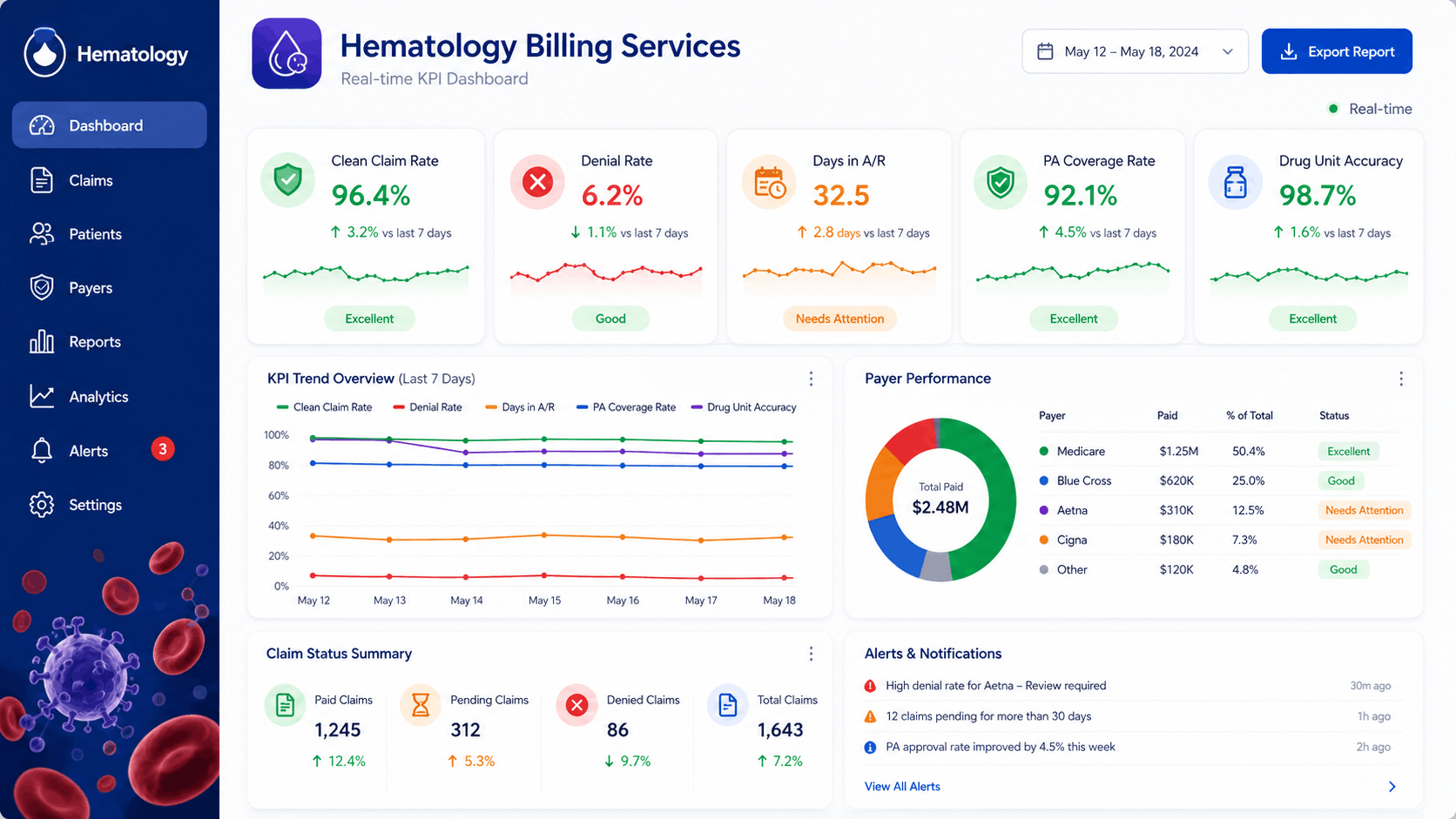
Without clear performance metrics, a hematology revenue cycle operates in the dark. These are the KPIs that define a high-performing hematology billing operation and the benchmarks that separate practices with healthy cash flow from those constantly chasing denials.
| KPI Metric | Hematology Benchmark | What It Signals |
|---|---|---|
| Clean Claim Rate | > 95% | % of claims accepted first-pass; below 90% = systematic coding problem |
| Denial Rate | < 5% | 41% of practices exceed 10%; active management targets below 5% |
| Days in A/R | < 35 days | Critical for cash flow given high-cost drug float |
| Net Collection Rate | > 97% | High-value practice — should be near 97-99% for infusion-heavy practices |
| Drug Unit Accuracy Rate | > 99% | J-code unit errors measured as % of infusion claims |
| PA Denial Rate | < 2% | PA-related denials should be near zero with proper workflow |
| Authorization Coverage Rate | > 98% | % of scheduled infusions with confirmed PA before administration |
| A/R > 90 Days | < 10% | High-value aging claims signal systemic follow-up failure |
| Appeal Success Rate | > 60% | % of appealed denials overturned; hematology should achieve 60-75% |
| Claim Submission Lag | < 48 hours | Days from infusion to claim submission; high-value claims must move fast |
According to our experience modifiers in hematology billing serve a different function than in surgical billing, here they primarily clarify billing for same-day services, professional vs. technical components, and split/shared visit rules. Using them incorrectly is a common source of preventable denials.
| Modifier | Name | When to Use in Hematology Billing |
|---|---|---|
| -25 | Separate E/M on Same Day as Procedure | When a significant, separately identifiable E/M is provided on the same day as a bone marrow biopsy or infusion. Document E/M separately with its own MDM justification. |
| -26 | Professional Component | When the physician interprets but does not perform the technical component — e.g., interpreting bone marrow pathology or flow cytometry performed by a reference lab. |
| -TC | Technical Component | When facility or laboratory provides the technical service but the physician professional interpretation is billed separately. |
| -59 | Distinct Procedural Service | When two procedures that CCI bundles were performed at separate sites or separate sessions — e.g., bone marrow aspiration at a different site than the biopsy. |
| -76 | Repeat Procedure by Same Physician | When the same procedure is repeated by the same physician on the same day — e.g., second bone marrow aspiration due to dry tap. |
| -91 | Repeat Clinical Diagnostic Lab Test | When the same lab test is repeated on the same day for clinical monitoring — e.g., repeat CBC after transfusion reaction. |
| -JW | Drug Amount Discarded | When a portion of a single-dose vial is unused and discarded. Required by many payers for high-cost J-code drugs to document waste. |
| -JZ | Zero Drug Waste (No Discarded Drug) | Indicates no drug was wasted. Required by some payers as an alternative to JW; confirm payer requirement before applying. |
| -GY | Not Covered by Medicare (Non-Covered Service) | Used when billing a non-covered service; allows secondary insurance or patient billing. |
| -GZ | Expected Denial — No ABN | Non-covered service billed to Medicare without an Advance Beneficiary Notice (ABN) on file. |
| -EJ | Subsequent Drug (Sequential Administration) | Used when the same drug is administered in sequential doses; applied to second and subsequent doses in the same session. |
�� Tip: Modifier -JW and -JZ Are Critical for High-Cost Drug Vial Billing
When you use only part of a single-dose vial of a high-cost drug and discard the remainder, you must report the discarded portion with modifier -JW appended to the J-code. This is not optional — CMS requires it to document vial waste, and many commercial payers have adopted the same requirement. If you fail to report waste, you are either over-billing (if you bill for the full vial) or under-billing (if you only bill for the portion used without documenting the rest). For multi-dose vials, the rules differ — consult your specific J-code coverage policy. Source: CMS transmittals on J-code waste reporting.
The decision to manage hematology billing in-house or outsource to a specialized billing partner is one of the highest-impact financial decisions for your practice to make. The complexity of hematology billing, infusion J-codes, bone marrow coding, PA management, LCD compliance, makes this a specialty where generic billing solutions consistently underperform.
| Factor | In-House Hematology Billing | Outsourced Hematology Billing Services |
|---|---|---|
| J-Code Accuracy | Errors common — high-cost drug unit mistakes go undetected | Specialized coders reconcile J-code units against infusion records |
| Biosimilar Updates | Formulary updates often lag; wrong J-codes billed | Monthly formulary review; correct biosimilar codes applied |
| PA Management | Often reactive; PAs missed or expired before infusion | Proactive PA workflow integrated into scheduling |
| LCD Compliance | Team must self-educate; LCD changes missed | Partner monitors MAC LCD updates and implements changes |
| Infusion Time Documentation | Inconsistent; missing times cause widespread denials | Workflow built around mandatory time capture; pre-claim audit |
| ESA Hemoglobin Monitoring | Hgb threshold checks often informal | Systematic Hgb threshold check before each ESA billing cycle |
| Bone Marrow Code Accuracy | 38220 + 38221 errors common; CCI violations frequent | CCI check built into charge capture workflow |
| Denial Recovery | Reactive; high-value appeals often missed | Systematic appeals with clinical documentation within 10 days of denial |
| Cost Model | Fixed: salary, benefits, software, training — high fixed cost | Percentage-based (5-9%); scales with practice volume |
| Compliance Risk | Practice bears full audit exposure | Experienced partner shares responsibility; reduces audit risk |
ℹ️ The Financial Case for Specialized Hematology Billing
Consider a hematology practice administering 200 infusion encounters per month, averaging $8,000 per infusion encounter (a conservative estimate for biologic-heavy practices). Monthly revenue of $1.6 million means a 10% denial rate leaves $160,000 in at-risk revenue every month. Specialized hematology billing services that reduce the denial rate to 4% recover approximately $96,000 per month in additional net collections — roughly $1.15 million annually. Even after billing service fees, the ROI is clear. Source: CMS ASP drug pricing data; MGMA practice benchmarking.
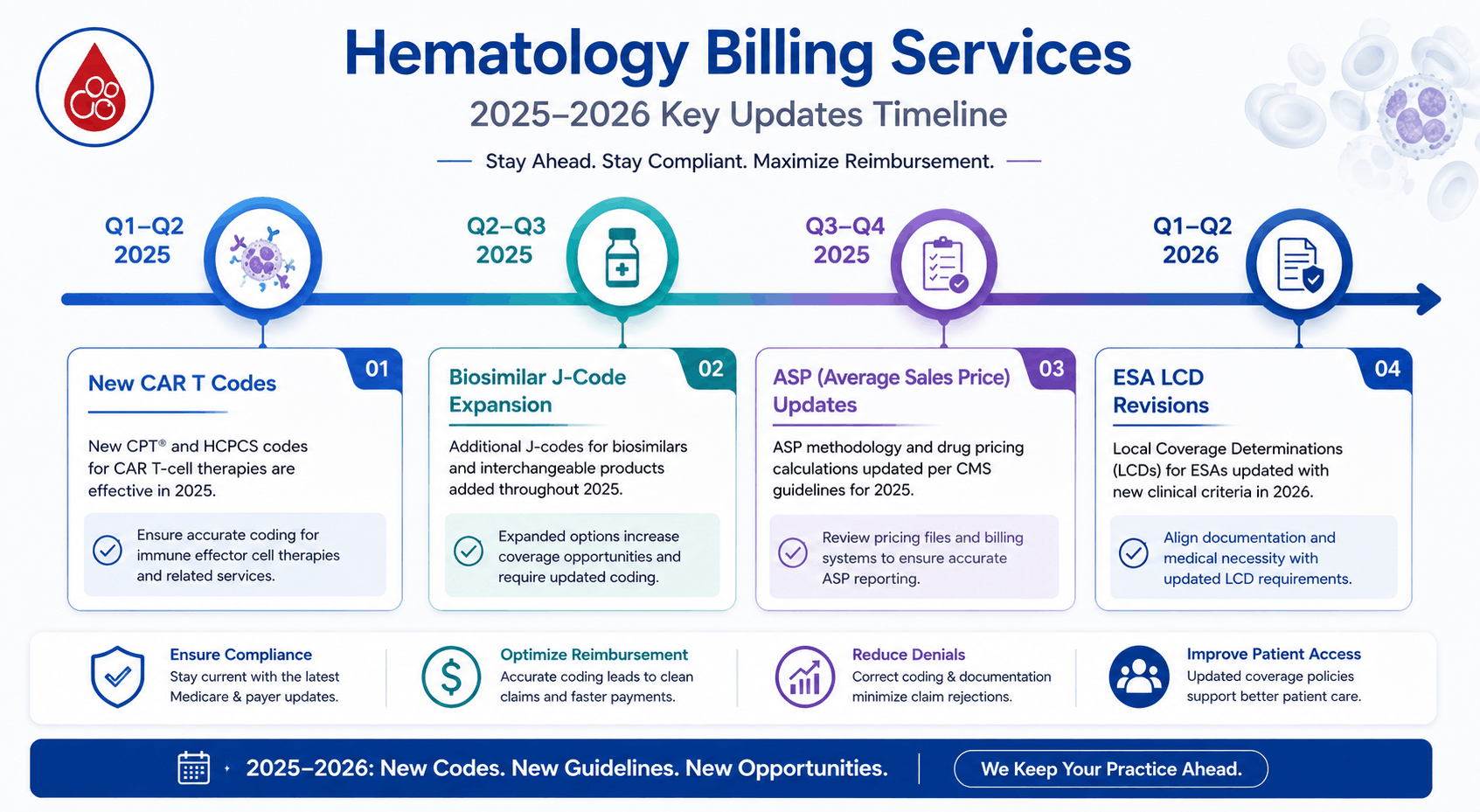
Hematology billing is one of the fastest-moving areas in medical billing, driven by new drug approvals, biosimilar market evolution, and CMS policy changes. Staying current is not optional it is a revenue protection strategy.
�� Tip: Audit Your J-Code Formulary Every Quarter
New drug approvals, biosimilar launches, and J-code updates happen throughout the year. Build a quarterly J-code audit into your practice calendar: pull your top 20 billed J-codes, compare them against the current CMS HCPCS active code list, verify that each drug in your infusion formulary has its correct corresponding J-code, and confirm biosimilar codes are current. This 2-hour quarterly exercise prevents the kind of systematic J-code miscoding that is one of hematology’s highest-risk compliance areas.
The most financially significant billing error in hematology is incorrect J-code unit reporting, billing units that do not match the dose actually administered. In a specialty where a single infusion can cost tens of thousands of dollars, even a small unit variance produces a major claim discrepancy. The second most common error is missing prior authorization for biologic infusions, particularly for IVIG, ESAs, and rituximab.
Medicare Part B covers drugs administered by infusion in a physician office or outpatient setting these are billed using J-codes on a Part B claim. Medicare Part D covers drugs dispensed at a pharmacy, including most oral oncolytics like ibrutinib, venetoclax, and lenalidomide. Billing an oral drug on a Part B claim, or failing to guide patients to their Part D plan for oral agents, is a coverage mismatch with significant compliance implications.
Modifier -JW is appended to a J-code to indicate that a portion of a single-dose drug vial was discarded and wasted. For example, if a patient requires 350 mg of a drug that comes in 400 mg single-dose vials, you bill for 400 mg total — 350 mg administered (the J-code) and 50 mg discarded (the J-code with -JW). CMS and many commercial payers require -JW documentation for high-cost single-dose vial drugs. Failure to report waste correctly is one of the top hematology drug billing audit triggers.
Get a free assessment from our billing experts