
Our Hospital Medical Billing services help healthcare organizations manage complex billing workflows, coding requirements, payer regulations, and reimbursement challenges. We optimize claims, reduce denials, and improve revenue performance through efficient revenue cycle management.
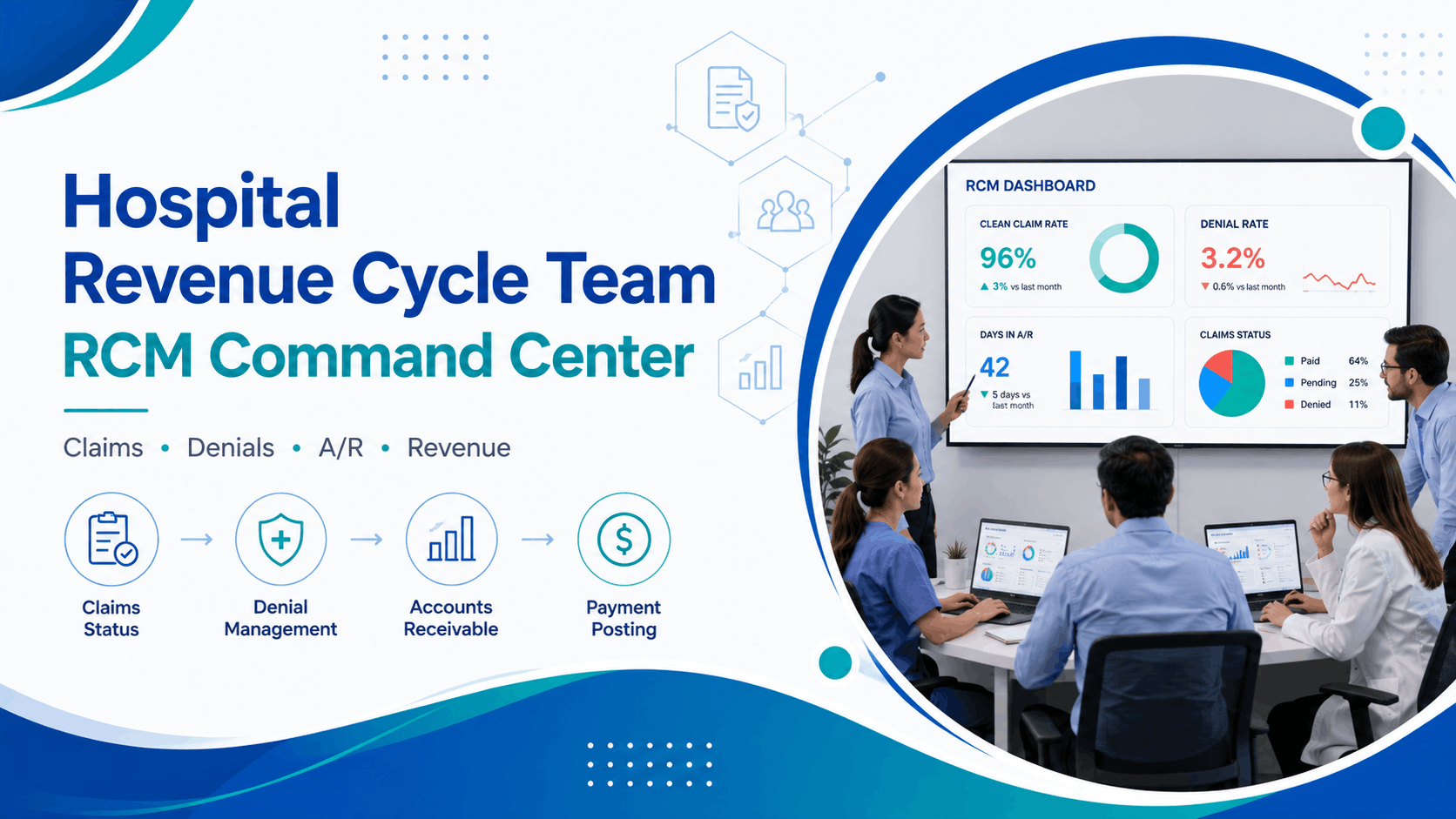
Every hospital in America is fighting two battles simultaneously, the clinical battle to deliver excellent patient care, and the financial battle to get paid for that care from insurance companies of the USA. In 2026, the financial battle has become harder, more complex, and more expensive than at any point in the last two decades.
In 2025, US hospitals spent $43 billion trying to collect payments that insurers already owed them, a figure that reflects the full administrative cost of a revenue cycle under pressure from every direction. Initial claim denial rates hit 11.8% in 2024, up from 10.2% just two years earlier, driven by payers deploying AI systems to deny and downgrade claims at machine speed. Nearly three-quarters of healthcare providers reported increases in prior authorization delays. And 20% of providers reported that it costs them more than 10% of the total bill just to collect payment.
Meanwhile, the tools available to revenue cycle professionals have transformed. Artificial intelligence, robotic process automation, real-time analytics, and clinical documentation improvement technology now make it possible for hospitals to fight back — if they know how to deploy them.
A 2025 McKinsey survey found that 57% of healthcare leaders identified improving denial management and appeals as their top RCM priority, and 51% named AI and advanced technology as focus areas, up from just 33% the prior year.
Hospital revenue cycle management (RCM) is the complete administrative and financial process that begins the moment a patient contacts a hospital for care and ends only when every dollar owed for that care has been collected. It encompasses patient access, eligibility verification, clinical documentation, medical coding, charge capture, claim submission, payment posting, denial management, and patient collections, across every department, every payer, every care setting that a hospital operates.
What makes your hospital RCM fundamentally different from physician practice billing, and why it demands a different level of expertise from your hospital including technology, and organizational discipline, comes down to five core distinctions:
| Billing Element | Hospital (Institutional) Billing | Physician (Professional) Billing |
|---|---|---|
| Claim Form | UB-04 (CMS-1450) / 837I electronic | CMS-1500 / 837P electronic |
| Inpatient Payment System | IPPS — MS-DRG based reimbursement | Physician Fee Schedule — RVU-based |
| Outpatient Payment System | OPPS — APC-based reimbursement | Physician Fee Schedule — CPT-based |
| Primary Code Sets | ICD-10-CM/PCS, CPT, HCPCS, Revenue Codes | ICD-10-CM, CPT, HCPCS |
| Code System for Inpatient | ICD-10-PCS for procedures (hospital) | CPT codes for physician services |
| Payment Drivers | DRG weight, case mix index, MCC/CC | RVU levels, E/M MDM complexity |
| Price List | Charge Description Master (CDM) | Fee schedule / contracted rates |
| Regulatory Framework | IPPS, OPPS, CoPs, Two-Midnight Rule | PFS, NCCI, Global Surgery |
| Compliance Risk Level | Extremely high — RAC audits, OIG, CMS | High — OIG, payer audits |
Excellent hospital revenue cycle management in the USA requires mastery of every stage in the cycle, not just billing and coding. A weakness at any single stage creates downstream revenue losses that compound through the entire system. Here is how the complete hospital revenue cycle should function,
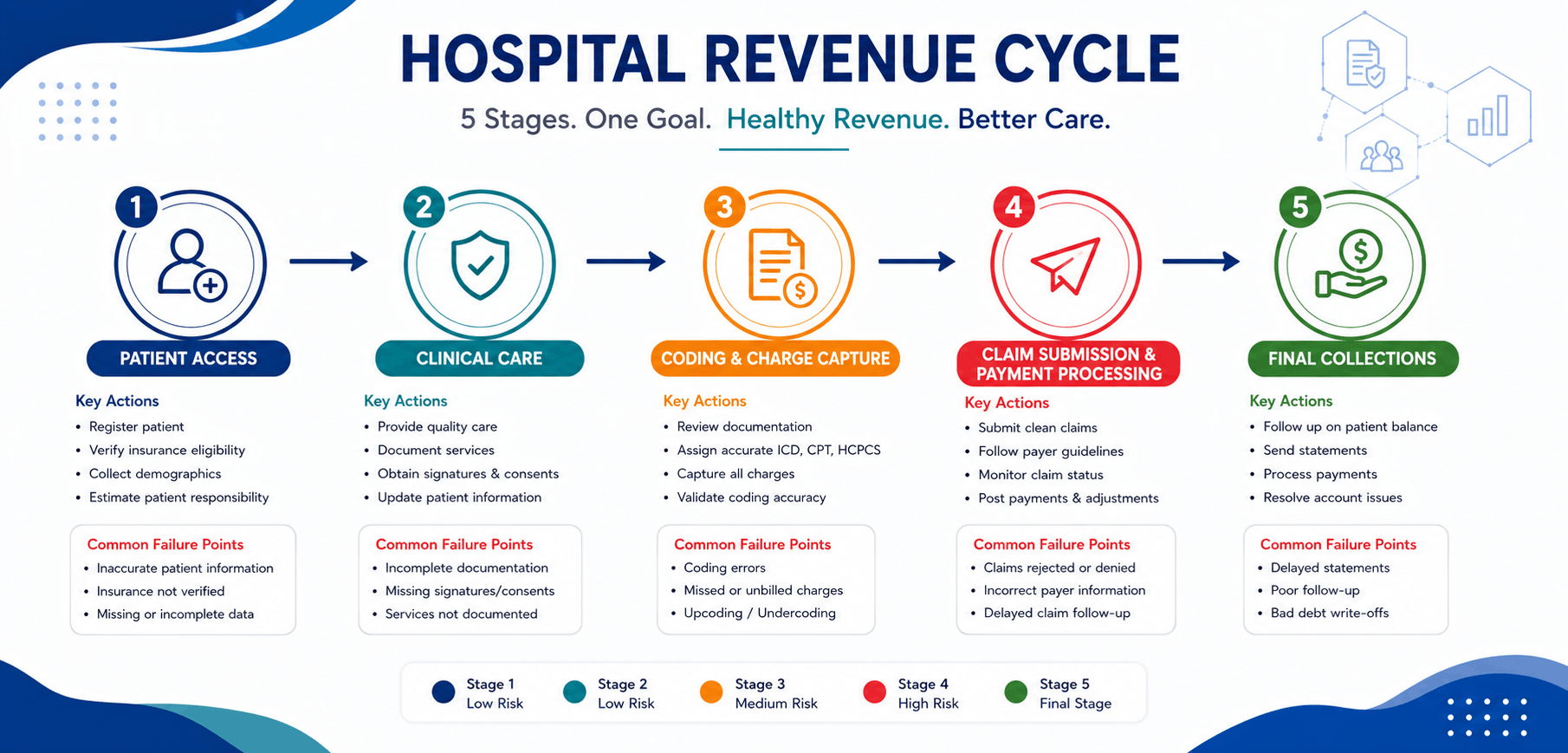
| RCM Stage | Key Hospital Actions | Revenue Risk If Done Wrong |
|---|---|---|
| 1. Patient Access & Scheduling | Demographic capture; insurance collection; scheduling flag for PA requirements | Wrong insurance = zero payment; missing demographics = claim rejection |
| 2. Insurance Eligibility Verification | Real-time eligibility check; benefit verification; co-pay/deductible confirmation | Billing terminated insurance = denied claim; unknown deductible = bad debt |
| 3. Prior Authorization | Obtain PA for required procedures, admissions, and high-cost drugs before service | No PA = zero reimbursement on entire admission in many cases |
| 4. Registration & Financial Clearance | Collect co-pays at registration; financial screening; ABN for Medicare patients | Missing co-pays = increased bad debt; no ABN = cannot bill patient |
| 5. Clinical Documentation | Physician and nursing documentation of diagnosis, treatment, and medical necessity | Vague documentation = DRG downcoding; denied inpatient admission |
| 6. Charge Capture & CDM Management | Accurate charge capture for all services; CDM maintenance and auditing | Missing charges = lost revenue; CDM errors replicate across all claims |
| 7. Medical Coding (ICD-10/PCS, CPT, HCPCS) | Assign accurate codes; DRG optimization; POA indicators; APCs for outpatient | Miscoding = wrong DRG; medical necessity denials; compliance risk |
| 8. Claim Scrubbing & Submission | Claim edits; eligibility check; payer-specific validation; electronic submission | Unscrubbed errors = claim rejections; delayed payment |
| 9. Payment Posting & Reconciliation | Post payments; identify underpayments; reconcile against contracts | Underpayments accepted without challenge; wrong write-offs |
| 10. Denial Management & Collections | Categorize denials; appeal timely; patient billing; bad debt management | Unworked denials = write-offs; patient bad debt grows unchecked |
Tip: The Front End of Your Revenue Cycle Determines 70% of Your Outcomes
Most hospital revenue cycle problems are denials, write-offs, bad debt are traceable back to errors made in the first three stages: patient access, eligibility verification, and prior authorization. Studies consistently show that 70-80% of claim denials are preventable, and the vast majority are caused by front-end failures. If you are investing exclusively in back-end denial management and ignoring front-end process improvement, you are treating the symptom and not the disease. The most financially impactful hospital RCM investments are in patient access technology, real-time eligibility tools, and automated prior authorization workflows.
Patient access is the front door of the hospital revenue cycle in the USA, and every error made here costs significantly more to fix downstream. The patient access team is responsible for capturing accurate demographics, verifying insurance, collecting co-payments, and flagging prior authorization requirements before care is delivered. When this work is done well, the entire revenue cycle downstream runs more smoothly.
Pre-registration:
Your billing team needs to collect all insurance information, verify demographics of patients, and flag co-pays, deductibles, and authorization requirements. Pre-registration is the most cost-effective eligibility verification point for financial success.
Insurance eligibility verification:
Real-time eligibility checking for every patient at every encounter, not just at registration. A patient’s insurance can change between scheduling and service date. Verify both primary and secondary payer status.Your in-house team need to identify Medicare primary vs. Medicare secondary payer (MSP) situations, incorrect MSP sequencing is a significant denial cause in hospital billing so handle it properly.
Financial clearance:
It is the responsibility of your billing experts to determine the patient’s financial responsibility before service, co-pay amounts, deductibles, out-of-pocket maximums, and coinsurance. You need to collect co-payments at the point of service. Offer payment plans for patients with high expected balances. Screen for Medicaid eligibility or charity care qualification for uninsured or underinsured patients.
Advance Beneficiary Notice (ABN) management:
For Medicare patients receiving services that may not meet medical necessity criteria, an ABN must be signed before the service. Without an ABN, hospitals cannot bill the patient if Medicare denies the claim. Train patient access staff to identify ABN-required situations,, especially for outpatient services.
Prior authorization initiation:
Patient access must flag and initiate prior authorization for all required procedures before scheduling. Elective inpatient admissions, major outpatient procedures, imaging studies, and specific therapies all require PA from most commercial and Medicare Advantage payers. Missing PA is the single largest preventable denial cause in hospital billing.
Prior authorization has become one of the defining revenue cycle challenges of the 2026s. According to HFMA survey data, 74% of healthcare providers reported increases in prior authorization delays in 2025, and 88% said disagreements over claims are preventing their organizations from getting paid. For hospitals, a failed PA on an inpatient admission or major outpatient procedure does not just delay a payment, it can eliminate it entirely.
| Hospital Service Type | Medicare FFS | Commercial / Medicare Advantage |
|---|---|---|
| Elective inpatient admission | Generally no PA required | Almost always required |
| Inpatient surgical procedures | No PA (Medicare FFS) — medical necessity applies | Almost always required |
| Emergency admission | No PA required; document emergency nature | Usually exempt if documented emergency |
| Observation status | No PA (Medicare FFS) | Often requires PA or concurrent review |
| MRI, CT scan, PET imaging | No PA (Medicare FFS); LCD applies | PA required for most advanced imaging |
| Joint replacement (elective) | No PA (Medicare FFS) | Almost always PA required |
| Bariatric surgery | CMS criteria apply; facility certification required | PA required; committee review common |
| Cardiac catheterization | No PA (Medicare FFS) | PA commonly required |
| Inpatient rehabilitation | Medicare InterQual criteria; PA via contractor | PA required; functional criteria apply |
| Skilled nursing facility transfer | Medicare criteria (3-midnight rule applies) | PA required; level-of-care criteria |
| Long-term acute care (LTACH) | Criteria-based — patient classification rules apply | PA required; intensive clinical review |
| Home health agency (HHA) | Face-to-face encounter required; certification | PA often required from commercial payers |
| High-cost pharmaceuticals (inpatient) | Covered under DRG — facility cost | Some agents require case-by-case review |
Every hospital institutional claim inpatient or outpatient is submitted on the UB-04 (CMS-1450) form electronically transmitted as the 837I transaction. It is main responsibility of yor billing to completely understand the UB-04 is the foundation to your hospital revenue cycle management, because errors on this form are the direct cause of most hospital claim rejections in the USA.
| Form Locator | Name | Hospital RCM Significance |
|---|---|---|
| FL 4 | Type of Bill (TOB) Code | 3-digit code: facility type + bill classification + frequency. Determines whether claim is inpatient/outpatient. Wrong TOB = claim processed incorrectly or rejected. Example: 111 = hospital inpatient admit-through-discharge. |
| FL 14 | Admission Type | Required for inpatient: 1=Emergency, 2=Urgent, 3=Elective, 4=Newborn, 5=Trauma. Impacts medical necessity review. |
| FL 17 | Patient Discharge Status | Where patient went after discharge: 01=home, 02=SNF, 07=AMA, 20=Expired. Critical for DRG assignment and post-acute transfer payment rules. |
| FL 42 | Revenue Codes | 4-digit codes identifying the service category (e.g., 0250=pharmacy, 0360=OR services, 0450=ED). Required on every charge line. Triggers HCPCS code requirements on many service lines. |
| FL 43 | Revenue Code Description | Written description matching the revenue code. Must be consistent with revenue code assigned. |
| FL 44 | HCPCS/CPT Codes | Procedure codes on outpatient claims. Under OPPS, these drive APC assignment and reimbursement. Required for most revenue code lines. |
| FL 47 | Total Charges | Sum of all charges on the claim. Must reconcile with individual charge line entries. |
| FL 67 | Principal Diagnosis (ICD-10-CM) | Primary reason for admission. DRIVES MS-DRG assignment for inpatient claims. A single documentation gap here can shift DRG assignment by thousands of dollars. |
| FL 67A-Q | Other Diagnoses (Secondary) | Comorbidities and complications (CC/MCC). Secondary diagnoses significantly impact MS-DRG assignment and DRG weight. POA indicators required. |
| FL 74 | Principal Procedure (ICD-10-PCS) | For inpatient claims: the main procedure performed. ICD-10-PCS (not CPT) is used for inpatient hospital procedure coding. |
| FL 76 | Attending Physician NPI | Required for all Medicare inpatient claims. Missing NPI causes claim-level rejection under HIPAA 837I validation rules. |
| FL 81 | Condition/Occurrence/Value Codes | Capture special circumstances: MSP situations, accident dates, qualifying stays, ESRD status. Wrong or missing codes trigger payer denials. |
Tip: POA Indicators on Secondary Diagnoses Are a Hidden Revenue Driver
The Present on Admission (POA) indicator attached to every ICD-10-CM code on inpatient claims tells Medicare whether the condition existed when the patient was admitted or developed during the hospital stay. Conditions that are NOT present on admission (POA = N) are hospital-acquired conditions (HACs), and CMS does not pay higher DRG rates for HACs. But when a secondary diagnosis IS documented as present on admission (POA = Y), it can qualify as a Major Complication or Comorbidity (MCC) and significantly increase the DRG weight and the payment. Accurate POA documentation and coding is one of the highest-ROI activities in hospital CDI. Source: cms.gov/medicare/payment/prospective-payment-systems/acute-inpatient-pps
For hospitals billing Medicare for inpatient stays, understanding the Inpatient Prospective Payment System (IPPS) and its MS-DRG payment methodology is not optional, it is the core financial literacy requirement for every hospital revenue cycle leader.
Under IPPS, Medicare pays hospitals a predetermined rate for each inpatient stay based on the Medicare Severity Diagnosis-Related Group (MS-DRG) assigned to that case. The MS-DRG is determined by the principal diagnosis (the condition chiefly responsible for admission), secondary diagnoses (especially complications and comorbidities), principal procedure performed (using ICD-10-PCS codes), patient discharge status, and patient age and sex.
| MS-DRG Tier | Example: Heart Failure | Approximate Reimbursement Impact |
|---|---|---|
| No CC/MCC (No complication) | DRG 293: Heart Failure & Shock, w/o MCC | Lowest DRG weight — lowest payment |
| CC (Complication/comorbidity) | DRG 292: Heart Failure & Shock, w/ CC | Moderate DRG weight — higher payment |
| MCC (Major complication/comorbidity) | DRG 291: Heart Failure & Shock, w/ MCC | Highest DRG weight — highest payment |
| Revenue difference between tiers | DRG 291 vs. DRG 293 | Can represent $3,000-$8,000 difference per case |
The Hospital Outpatient Prospective Payment System (OPPS) governs Medicare reimbursement for services provided in hospital outpatient departments (HOPDs). OPPS is arguably more complex than IPPS because outpatient encounters involve a wider variety of services, a larger number of codes, and more intricate bundling and packaging rules.
Under OPPS, each outpatient service is assigned an Ambulatory Payment Classification (APC) based on the HCPCS/CPT code billed. APCs are CMS’s outpatient equivalent of DRGs, a predetermined payment rate for each service category. Multiple services may be performed in a single outpatient visit, and each generates its own APC payment, subject to packaging and bundling rules.
| OPPS APC Category | Examples | Key Billing Rule |
|---|---|---|
| Significant Procedure APCs | Surgical procedures, endoscopy, complex imaging | Full APC payment; subject to multiple procedure discounting |
| Radiology APCs | CT, MRI, X-ray, nuclear medicine | Professional vs. technical component split billing |
| Drug Administration APCs | Chemotherapy infusion, therapeutic infusion | Drug cost packaged into APC or separately billed |
| E/M APCs (Type A/B/C) | ED visits (99281-99285), clinic visits | Level-based APCs; documentation drives APC assignment |
| Packaged APCs | Lab, ancillary services, low-cost procedures | Payment bundled into the primary service APC — cannot bill separately |
| Pass-Through Drugs/Devices | High-cost new drugs, devices within 3 years of approval | Separate APC payment; limited-time pass-through status |
| Comprehensive APCs (C-APCs) | Complex OR procedures, cardiac cath | Single APC covers all related services — extensive bundling |
Revenue codes on the UB-04 identify the service category for each charge line in the outpatient setting. Under OPPS, the revenue code triggers whether a CPT/HCPCS code is required and how the service will be processed for APC assignment. Getting revenue code assignments right in the CDM is essential.
| Revenue Code | Service Category | OPPS Billing Notes |
|---|---|---|
| 0250 | Pharmacy | Drug charges; specific HCPCS J-code required for most drugs; package into APC or bill separately per OPPS drug status |
| 0360 | Operating Room Services | Surgical procedure; CPT code required; drives primary APC assignment |
| 0450 | Emergency Room | ED E/M visits (99281-99285) plus ancillary services; E/M level drives APC |
| 0490 | Ambulatory Surgical Care | ASC-equivalent services; CPT code required |
| 0320-0324 | Radiology | Imaging services; CPT code required; professional component billed separately by radiologist |
| 0300-0305 | Laboratory | Clinical lab; generally packaged under OPPS; HCPCS code required |
| 0260-0264 | IV Therapy | Infusion services; CPT 96365 series; time documentation required |
| 0510 | Clinic Visit | Hospital clinic E/M; HCPCS G0463 used for most clinic visits under OPPS |
| 0762 | Observation Services | Hourly billing for observation; HCPCS G0378/G0379; minimum 8 hours required for billing |
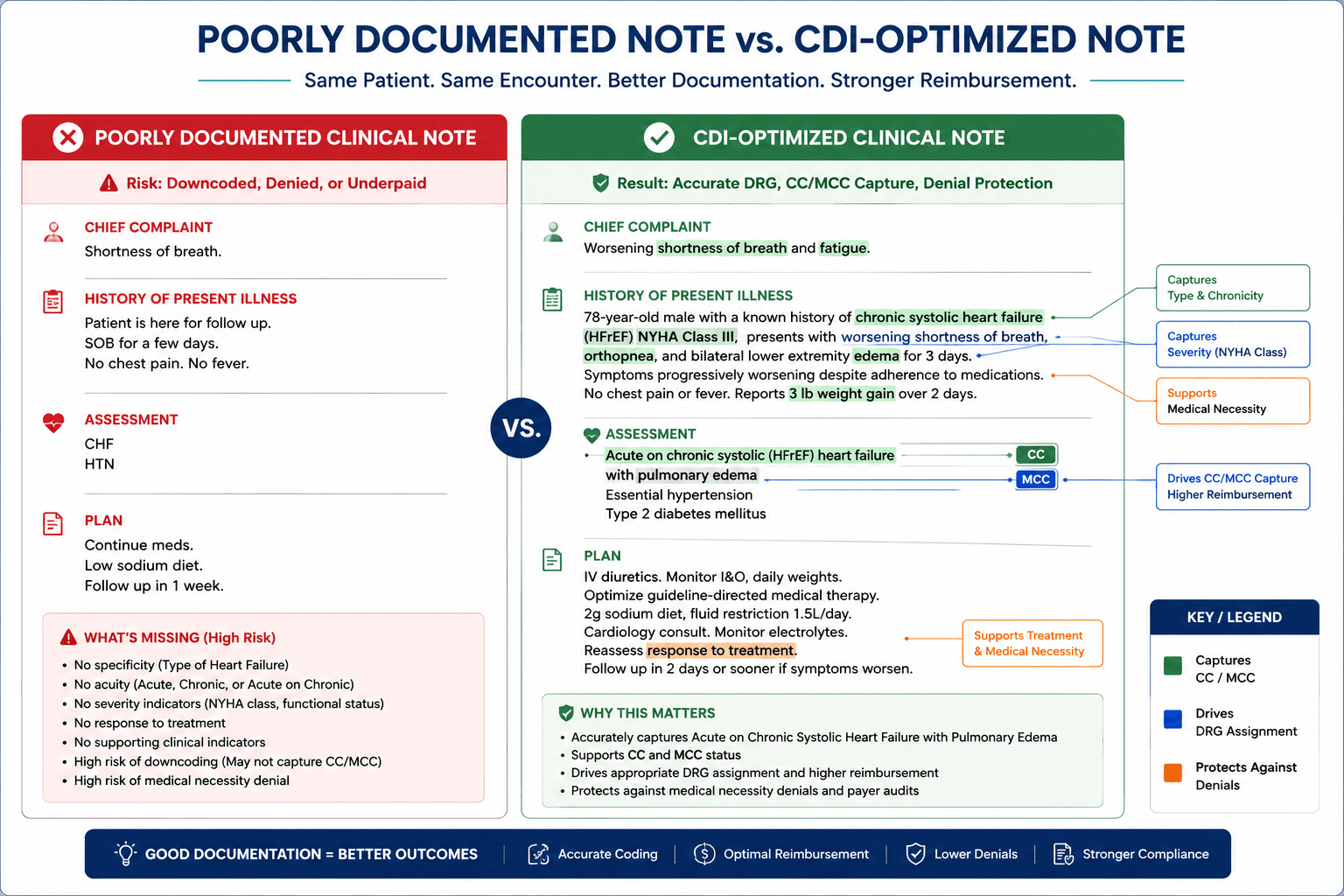
Clinical Documentation Improvement (CDI) is the single most impactful investment a hospital can make in its revenue cycle. CDI programs work at the intersection of clinical care and revenue integrity ensuring that physician documentation completely and accurately reflects the true severity of illness, complexity of care, and resources consumed for every patient stay.
| Clinical Condition | Documentation Challenge | CDI Revenue Impact |
|---|---|---|
| Sepsis / Septic Shock | Vague terms like 'SIRS' or 'infection' may not capture sepsis | Correct sepsis coding can upgrade DRG weight significantly |
| Acute Kidney Injury (AKI) | AKI often underdocumented in chart even when labs confirm it | AKI is an MCC — capturing it elevates DRG tier |
| Malnutrition | Nutritional status rarely explicitly documented | Moderate/severe malnutrition is an MCC — high DRG impact |
| Respiratory Failure | Documentation of 'hypoxia' vs. 'acute hypoxic respiratory failure' is code-determinative | Respiratory failure as MCC significantly increases DRG weight |
| Heart Failure Type | 'CHF' is insufficient — systolic vs. diastolic, acute vs. chronic required | Specificity drives MCC vs. CC vs. no CC/MCC assignment |
| Encephalopathy | Often documented as 'confusion' or 'altered mental status' | Metabolic encephalopathy is an MCC; 'confusion' typically is not |
| Chronic Kidney Disease Stage | Stage not always documented even when present | CKD stage impacts CC/MCC status and MS-DRG |
| Pressure Injury Staging | Stage not always documented despite clinical evidence | Stage 3-4 pressure injuries affect HAC reporting and payment |
| Diabetes with Complications | 'DM' without specifying complication type | DM with complications is CC/MCC vs. DM alone |
| Substance Use Disorders | Often underdocumented despite clinical relevance | Alcohol use disorder with complications is an MCC |
Tip: CDI ROI Is Measurable — Start With Your Case Mix Index
The Case Mix Index (CMI) is the simplest measure of CDI program effectiveness. Your CMI is the average MS-DRG weight across all inpatient cases — a higher CMI means more complex cases (or more completely documented cases), which means higher Medicare reimbursements. Tracking your CMI monthly against regional and national benchmarks reveals whether your documentation is capturing the true complexity of care your hospital delivers. A CMI improvement of even 0.05 points across 5,000 annual Medicare admissions — assuming an average base rate of $6,000 — represents $1.5 million in additional annual revenue that was always earned but never captured.
Hospital coding is divided between two fundamentally different coding systems depending on the care setting: ICD-10-PCS procedure codes for inpatient hospital coding, and CPT/HCPCS codes for outpatient hospital coding. This distinction is one of the most commonly misunderstood aspects of hospital revenue cycle management, and one of the most consequential.
For inpatient hospital billing under IPPS, procedures are coded using ICD-10-PCS (International Classification of Diseases, 10th Revision, Procedure Coding System). Not CPT codes. The physician bills their professional service with CPT codes on the CMS-1500. The hospital bills the procedure as performed at the facility using ICD-10-PCS on the UB-04.
| Coding Element | Inpatient Hospital (Facility Claim) | Physician / Outpatient (Professional) |
|---|---|---|
| Procedure Code System | ICD-10-PCS (7-character alphanumeric) | CPT codes (5-digit) |
| Diagnosis Code System | ICD-10-CM | ICD-10-CM |
| Number of Procedure Codes | Can report multiple ICD-10-PCS codes | CPT codes limited by CCI edits and multiple procedure rules |
| Payment Driver | MS-DRG (determined by ICD-10-CM/PCS) | Physician Fee Schedule RVUs |
| Claim Form | UB-04 / 837I | CMS-1500 / 837P |
| Code Specificity | ICD-10-PCS is extraordinarily specific — 7-character codes describe approach, body part, device, qualifier | CPT codes describe procedure type but with less anatomical specificity |
| Annual Updates | Updated annually by CMS (October 1) | Updated annually by AMA (January 1) |
For outpatient hospital billing under OPPS, services are coded using CPT and HCPCS codes that drive APC assignment. The outpatient coder must understand not just which code to assign, but also how each code interacts with OPPS packaging rules, NCCI bundling edits, and status indicators that determine whether a service receives full payment, packaged payment, or no separate payment.
CMS assigns a Status Indicator to every HCPCS/CPT code under OPPS that tells the hospital billing system how the service is paid. The most important status indicators:
| Status Indicator | Payment Category | Examples |
|---|---|---|
| S | Significant Procedure — Full APC | Surgery, complex endoscopy, cardiac procedures |
| T | Significant Procedure — Multiple Procedure Discounting | Second surgical procedure receives 50% APC payment |
| Q1 | Packaged if in combination with S/T | Lab, low-cost radiology — packaged into primary APC |
| N | Incidental — Packaged | Minor ancillary services — no separate APC payment |
| A | Separately Payable | Pass-through drugs, brachytherapy sources |
| R | Blood and Blood Products | Paid per APC; blood products have separate payment |
| E1 | Not Paid by Medicare OPPS | Services covered under other benefit categories |
| G | Drug/Biological Requiring Pass-Through | High-cost new drugs within 3-year pass-through period |
Tip: Outpatient Coders Must Understand Status Indicators — Not Just CPT Codes
An outpatient hospital coder who only knows which CPT code to assign without understanding the OPPS status indicator and packaging implications is only doing half the job. The status indicator determines whether a service generates additional revenue or is packaged into a primary APC. Regularly audit your outpatient claims to confirm that packaged services are not being billed separately (creates overpayment liability) and that separately payable services are always captured (revenue leakage). Annual OPPS status indicator training for all outpatient coding staff is an essential component of hospital revenue cycle management.
Denial management is where the financial health of your hospital revenue cycle is most visibly tested, and most commonly failed. In 2025, initial claim denial rates averaged 11.8% across the US hospital sector, up from 10.2% two years prior. Payers are deploying AI systems to review claims and deny or downgrade payments at speeds and scales that traditional manual denial management processes simply cannot match.
| Denial Category | Prevalence | Root Cause | Corrective Action |
|---|---|---|---|
| Missing/Invalid Prior Authorization | #1 cause | PA not obtained or auth number missing from claim | Build PA into scheduling workflow; auth number = required claim field |
| Medical Necessity — Inpatient Status | #2 cause (RAC target) | Two-midnight rule not met; documentation insufficient | Utilization review concurrently; CDI queries before claim submission |
| Coding Errors (DRG/APC) | Major revenue impact | Wrong principal diagnosis; ICD-10-PCS inaccuracy; wrong APC | Concurrent coding audit; CDI query workflow; coder education |
| Patient Eligibility Failure | High frequency | Wrong insurance; terminated coverage billed | Real-time eligibility at scheduling and day-of-service |
| MSP / COB Violations | Compliance risk | Medicare billed primary when another payer is primary | Robust MSP questionnaire and verification at registration |
| Bundling/NCCI Violations | Coding compliance | Services billed separately that CCI requires bundled | NCCI edit check in claim scrubber; coder training on edits |
| Duplicate Claims | Administrative | Same claim submitted twice without reason | Clearinghouse duplicate detection; submission tracking |
| Timely Filing | Revenue loss | Claim not submitted within payer window | 72-hour claim submission target; real-time tracking |
| Clinical Documentation Insufficient | Growing in 2025 | Payers using AI to identify documentation gaps post-service | CDI program; structured physician query process |
| No Surprises Act Violations | Regulatory | Out-of-network billing without required notices | Train patient access on NSA requirements; verify network status |
Tip: Build a Denial Prevention Scorecard — Not Just a Denial Tracking Report
Most hospital denial management programs track denials after they happen. The hospitals with the best financial performance build denial prevention scorecards, tracking leading indicators like PA completion rates before service, eligibility verification rates, real-time coding accuracy rates, and CDI query response times. These leading indicators predict denial volumes 30-60 days before they hit your accounts receivable. If your PA completion rate drops from 98% to 92% this month, expect a surge in authorization denials next month unless you act now.
Accounts receivable management is the ongoing discipline of monitoring, following up on, and collecting every dollar owed to the hospital for services already rendered. In hospital billing, where average charges per encounter can be in the tens of thousands of dollars, AR management is a critical cash flow function, not just an administrative one.
| AR Metric | Hospital Benchmark | What It Tells You |
|---|---|---|
| Days in Accounts Receivable (DAR) | < 40 days (best practice); avg 45-55 days | Average time from service to payment; longer = systemic problem |
| AR > 90 Days (as % of total) | < 15-20% (best practice); top performers 22.5% | Aging AR signals denial backlogs or follow-up failures |
| Clean Claim Rate | > 95% | % of claims accepted on first submission; below 90% = critical |
| Denial Rate | < 5% (best practice); national avg 8-12% | % of claims denied; each percentage point = significant revenue at hospital scale |
| Net Collection Rate | > 96% | % of collectible revenue actually received |
| Initial Denial Rate | < 5% | % denied on first submission; tracks coding and eligibility accuracy |
| Cost to Collect | < 3-5% of net revenue | Total RCM operational cost as % of collected revenue |
| Patient Collection Rate | 50-70% (hospital setting) | % of patient-responsible balances collected; rising deductibles make this harder |
| Claim Submission Lag | < 48-72 hours | Days from discharge/service to claim submission |
| Bad Debt Rate | < 2-4% of gross charges | % of revenue written off as uncollectable |
Medicare and Medicaid together account for more than 50% of inpatient hospital revenue for most US hospitals. The compliance requirements attached to these programs are among the most detailed and most strictly enforced in American healthcare. Non-compliance is not just a financial risk, it is an existential operational risk for hospital organizations.
Conditions of Participation (CoPs):
CMS CoPs establish the minimum health and safety standards that your hospital must meet to participate in Medicare and Medicaid. CoP compliance is evaluated through your hospital survey conducted by state survey agencies or accreditation organizations
Medicare Secondary Payer (MSP):
In the USA your hospital must correctly identify and sequence primary and secondary payers for every patient. MSP violations are false claims act violations. CMS has MSP questionnaire completion requirements for all Medicare beneficiaries at registration.
Notice Compliance:
The Notice of Observation Treatment and Implication for Care Eligibility Act requires your hospital to provide written notice to Medicare beneficiaries placed in observation status within 36 hours of beginning observation care. Non-compliance carries civil monetary penalties.
Hospital Acquired Condition (HAC) Reduction Program:
CMS reduces payments by 1% for hospitals in the worst-performing quartile for HAC rates. HACs include never events, healthcare-associated infections, falls, pressure injuries, and catheter-associated infections. Proper POA indicator documentation is essential to correctly identify which conditions are HACs vs. conditions present at admission.
Value-Based Purchasing (VBP):
The Hospital VBP Program adjusts Medicare payments based on quality and efficiency measures, clinical outcomes, patient experience (HCAHPS scores), safety domain measures, and cost efficiency. VBP adjustments can be positive or negative, affecting each hospital’s base DRG payments by up to ±2%.
Readmission Reduction Program:
CMS reduces inpatient payments for hospitals with excess readmissions (within 30 days of discharge) for select conditions including AMI, heart failure, pneumonia, COPD, hip/knee replacement, and CABG. Hospitals with high readmission rates receive a payment penalty on all Medicare discharges, not just readmissions.
340B Drug Pricing Program Compliance:
Hospitals participating in the 340B program must maintain separate drug purchase accounts, accurate dispense records, and prevent drug diversion or duplicate discounts. CMS has audited 340B program integrity aggressively since 2020.
The technology landscape for hospital revenue cycle management is changing faster than at any point in healthcare history. In 2025, both payers and providers are deploying AI systems at scale and the hospitals that are not investing in RCM technology are falling further behind in the revenue collection race.
| Technology Application | Function in Hospital RCM | Reported Benefit |
|---|---|---|
| AI-Powered Eligibility Verification | Real-time eligibility and benefit verification at scheduling and registration | Reduces eligibility-based denials by 40-60% |
| Automated Prior Authorization | Electronic PA submission and real-time status tracking; auto-approval for routine services | Reduces PA turnaround from days to hours for eligible requests |
| Autonomous Medical Coding (AI Coding) | Translates clinical notes into ICD-10 and CPT codes without human intervention | Reduces coding labor costs 20-35%; improves coding speed significantly |
| AI Clinical Documentation Improvement | Real-time documentation prompts for physicians; automated query generation | Improves physician query response rates; increases CDI efficiency per FTE |
| Predictive Denial Prevention | Scores claims before submission for denial probability; flags high-risk claims for review | Reduces initial denial rates by 15-25% in early implementations |
| Robotic Process Automation (RPA) | Automates repetitive tasks: claim status checks, payment posting, eligibility calls | Reduces manual follow-up labor 40-60%; 24/7 operations capability |
| Natural Language Processing (NLP) | Extracts structured clinical data from unstructured physician notes for CDI and coding | Enables computer-assisted coding and concurrent CDI review |
| AI Denial Appeals | Automated appeal letter generation using clinical documentation and denial reason code | Reduces appeal preparation time; improves consistency of appeal arguments |
| Patient Payment Prediction | AI scoring of patient payment likelihood; segmented collection strategies | Improves patient collection rates; reduces collection agency referrals |
| Real-Time Revenue Cycle Analytics | Live KPI dashboards tracking denial rates, AR aging, CMI, collection rates by payer | Enables proactive management rather than monthly reactive reporting |
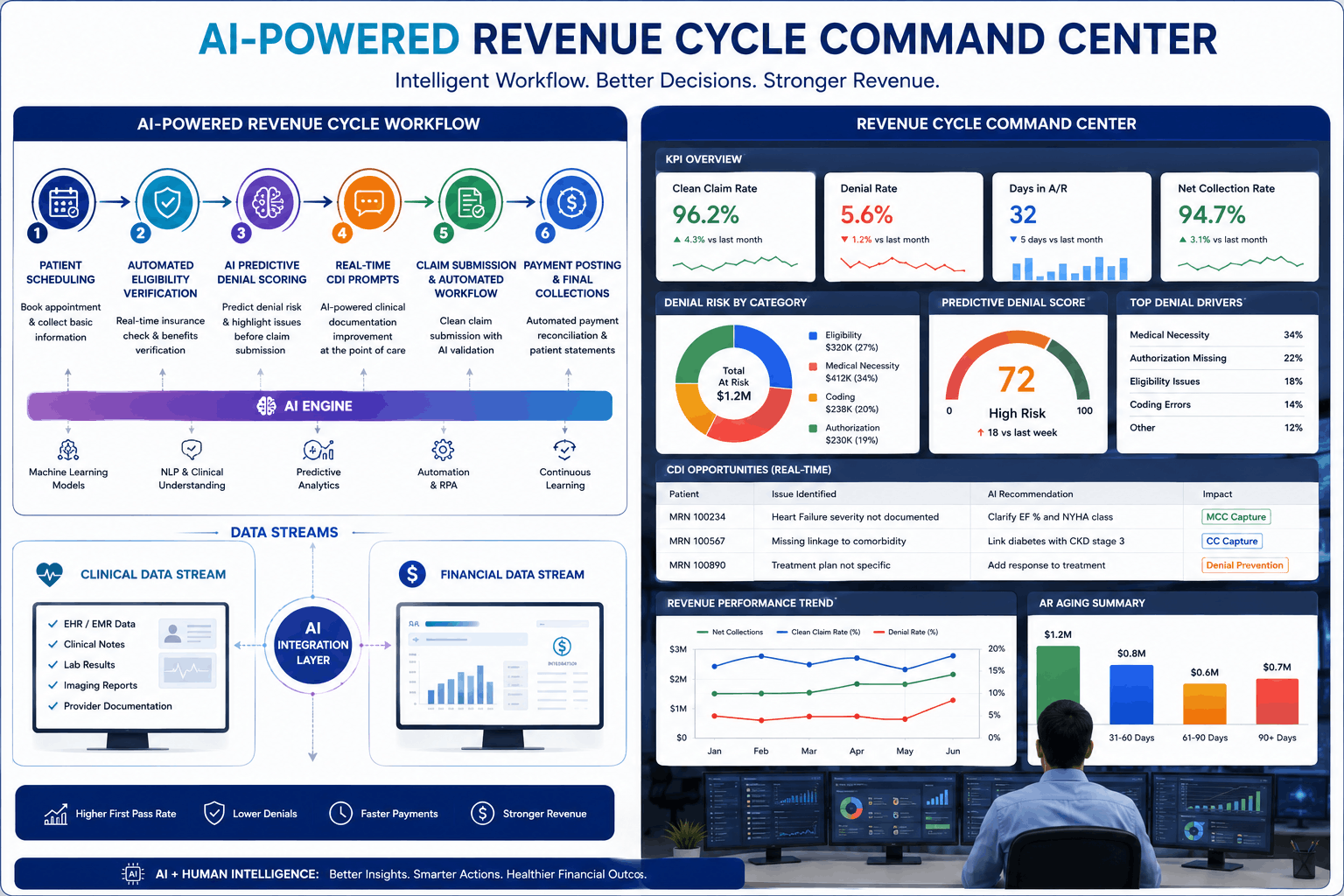
You cannot manage what you do not measure. For your hospital revenue cycle leadership, a comprehensive KPI dashboard that tracks performance across every stage of the cycle, from front-end eligibility through back-end collections, is the operational foundation of financial accountability.
| KPI | Benchmark | Stage | Management Action if Missed |
|---|---|---|---|
| Days in AR (Net) | < 40 days | AR Management | Audit payer follow-up; check claim submission lag |
| AR > 90 Days (% total) | < 15% | AR Management | Intensive outreach on aged buckets; escalate high-dollar claims |
| Clean Claim Rate | > 95% | Billing | Claims analysis; coder education; CDM review |
| Initial Denial Rate | < 5% | Denial Mgmt | Root-cause analysis by denial type; front-end process review |
| Net Denial Rate | < 3% | Denial Mgmt | Appeal success tracking; workflow improvement |
| Net Collection Rate | > 96% | Collections | Payer underpayment audit; contract renegotiation flag |
| Case Mix Index (CMI) | Regional benchmark +/- 0.05 | CDI / Coding | CDI query rate review; coder accuracy audit |
| Eligibility Verification Rate | > 99% | Patient Access | Patient access workflow audit; technology upgrade |
| PA Authorization Rate | > 98% | Patient Access | PA workflow audit; scheduling process review |
| CDI Query Rate | 10-15% of eligible cases | CDI | CDI staffing review; physician education |
| CDI Query Response Rate | > 85% | CDI | Physician engagement; query format review |
| Claim Submission Lag | < 48-72 hours | Billing | Discharge coding TAT; CDM and charge workflow |
| Appeal Success Rate | > 60% (clinical) | Denial Mgmt | Appeal letter quality; physician peer-to-peer participation |
| Cost to Collect | 3-5% of net revenue | Operations | Staffing model; technology investment ROI analysis |
| Bad Debt Rate | < 2-4% | Patient Financial | Financial counseling effectiveness; charity care screening |
| Patient Collection Rate | 50-70% (hospital) | Patient Financial | Point-of-service collection; payment portal adoption |
Tip: Report KPIs at Three Levels — Department, Payer, and Provider
A single hospital-wide denial rate of 9% tells you almost nothing actionable. A denial rate broken down by department (ED 6%, Surgical 12%, Inpatient 8%), by payer (Medicare 4%, UnitedHealthcare 15%, Medicaid 18%), and by physician or service line tells you exactly where to intervene and what to fix. Build your KPI reporting structure to support root-cause analysis, not just scorecard reporting. The goal is not to report numbers, it is to identify improvement opportunities and hold the right people accountable for closing performance gaps.
At House of Outsourcing, we bring deep, specialized hospital revenue cycle management expertise to healthcare organizations across the United States. We understand that your hospital RCM is not physician billing at scale, it is a fundamentally different discipline that requires mastery of IPPS, OPPS, MS-DRG coding, CDI, the Chargemaster, two-midnight rule compliance, RAC audit defense, prior authorization management, and the AI-powered payer environment of 2025.
Comprehensive hospital revenue cycle assessment:
Our experts identify your highest-impact improvement opportunities across all 10 RCM stages.
Front-end optimization:
Patient access workflow improvement, real-time eligibility tools, and prior authorization management that reduces authorization denials to near zero.
Clinical Documentation Improvement (CDI) program management:
We perform concurrent review, physician query programs, MCC/CC optimization, and Case Mix Index improvement.
Hospital coding expertise:
ICD-10-CM/PCS inpatient coding, OPPS/APC outpatient coding, CDM review and updates, and DRG validation.
Charge Capture and Chargemaster audit services:
Our experts will identify missed charges, resolve CDM errors, and implementing quarterly HCPCS/CPT updates
Two-midnight rule compliance review and utilization management support:
Our experts will accurately protect your inpatient admissions from RAC audit and concurrent review denials.
Advanced denial management:
With root-cause analysis, clinical appeal documentation, and physician peer-to-peer coordination on a regular basis by an expert team.
AR management and follow-up
Our dedicated payer specialists who know how to navigate the specific rules and systems of your top payers.
Real-time RCM analytics and dashboards
complete visibility into your denial rate, days in AR, CMI, clean claim rate, and collection performance
RAC audit defense preparation and response
We are regularly protecting your hospital’s reimbursement during Recovery Audit Contractor reviews.
Hospital billing uses the UB-04 (CMS-1450) claim form for institutional charges, including facility fees, nursing care, room and board, ancillary services, and supplies. Physician billing uses the CMS-1500 form for the physician’s professional services. Inpatient hospital procedures are coded using ICD-10-PCS (not CPT), and inpatient reimbursement is determined by the MS-DRG assigned to the case under IPPS. Outpatient hospital services are coded with CPT/HCPCS and reimbursed under OPPS by APC. These two systems run in parallel for every hospital patient and must be coordinated.
The two-midnight rule is CMS’s guideline for appropriate inpatient hospital admission. CMS considers inpatient admission appropriate when the treating physician expects the patient to require medically necessary hospital services spanning two or more midnights in the USA.
CDI is the process of improving physician documentation to accurately reflect the full complexity and severity of patient illness. Under the MS-DRG system, the same principal diagnosis can generate dramatically different payments depending on which secondary diagnoses (comorbidities and complications) are documented and coded. A well-run CDI program captures documented conditions that qualify as Major Complications or Comorbidities (MCCs) — which can increase DRG reimbursement by $3,000-$8,000 per case. CDI also protects hospitals from medical necessity denials by ensuring documentation supports the appropriateness of the admission level.
The CDM (Chargemaster) is the hospital’s master price list mapping every service to its standard charge, revenue code, CPT/HCPCS code, and billing description. Because every patient bill flows through the CDM, errors replicate across thousands of claims. The CDM should be reviewed annually for a complete compliance audit, quarterly for HCPCS code updates (CMS updates codes four times per year), and immediately whenever a new service line, drug, or supply is added. CDM errors are one of the highest-volume systematic revenue leakage sources in hospital billing.
CMS’s Hospital Price Transparency Rule (effective January 1, 2021) requires hospitals to publish standard charge information including CDM charges, payer-specific negotiated rates, discounted cash prices, and de-identified minimum and maximum negotiated charges, in a machine-readable format. Enforcement is active: CMS issued over $11 million in civil monetary penalties in 2024 for non-compliance.
Observation status is an outpatient designation even when a patient spends multiple days in the hospital. Medicare Part A covers inpatient admissions (with Part A deductible). Observation is covered under Medicare Part B (with different cost-sharing rules and no qualification for SNF benefit). Crucially, Medicare does not count observation days toward the 3-day qualifying hospital stay required for SNF coverage, so a patient in observation for 4 days cannot go to SNF under Medicare.
Need support with your billing workflow? Explore our medical billing and revenue cycle services or request a free consultation.
Get a free assessment from our billing experts