
Discover the latest Medicare ambulance billing guidelines, HCPCS coding practices, and documentation standards that improve claim accuracy and maintain compliance.
Before anything else, let’s make sure we’re clear on what Medicare actually pays for, because not every transport is billable in the USA.
Medicare Part B covers ambulance services only when transportation by any other means would endanger the patient’s health. That means medical necessity is not optional, it’s required by Medicare to pay your practice for ambulance services.
You need to understand that If the transport could have been done safely by car, wheelchair van, or taxi, Medicare will deny the claim.
Need support with your billing workflow? Explore our medical billing and revenue cycle services or request a free consultation.
In the USA the Medicare ambulance billing is the process of submitting claims to Medicare for emergency and non-emergency transportation services provided to eligible patients in the USA. It involves accurate coding, proper documentation of medical necessity, and to follow Medicare guidelines to ensure compliance and timely reimbursement. Effective ambulance billing helps you to reduce claim denials, improve cash flow, and maintain regulatory compliance.
Understanding service levels is key, because billing the wrong level can lead to audits or denials. Medicare defines ambulance services based on the level of care provided:
| Level | Description | Use Case |
|---|---|---|
| BLS | Basic Life Support | Non-emergency transport |
| ALS1 | Advanced Life Support Level 1 | Emergency with interventions |
| ALS2 | Advanced Life Support Level 2 | Advanced procedures |
| SCT | Specialty Care Transport | Critical care transfer |
Choosing the correct level depends on what was actually done during transport, not just patient condition.
In the USA the ambulance billing uses HCPCS Level II codes, and accuracy here is critical for reimbursement.
| HCPCS Code | Description | Level |
|---|---|---|
| A0428 | BLS non-emergency | Basic |
| A0429 | BLS emergency | Basic |
| A0426 | ALS non-emergency | Advanced |
| A0427 | ALS emergency | Advanced |
| A0433 | ALS2 | High-level care |
Ambulance billing isn’t just about the service, it also includes distance traveled, which directly impacts reimbursement.
| Code | Description | Billing Method |
|---|---|---|
| A0425 | Ground mileage | Per mile |
| A0435 | Fixed-wing mileage | Per mile |
| A0436 | Rotary-wing mileage | Per mile |
Mileage must be documented accurately, from pickup to destination. Overestimating mileage is a common audit trigger.
This is unique to ambulance billing, and often overlooked. These modifiers tell Medicare where the patient was picked up and transported.
| Modifier | Meaning |
|---|---|
| R | Residence |
| H | Hospital |
| N | Skilled Nursing Facility |
| D | Diagnostic/Therapeutic site |
Example: RH = Residence to Hospital
If your practice uses incorrect origin/destination modifiers, your claim can be rejected instantly.

Let’s be clear, this is the most important rule in ambulance billing. Without medical necessity, nothing else matters.
Under Medicare rules, you must prove that any other form of transport would have endangered the patient’s health. This must be clearly documented, not assumed.
Think of documentation as your safety net, because ambulance claims are heavily audited. You need to must include:
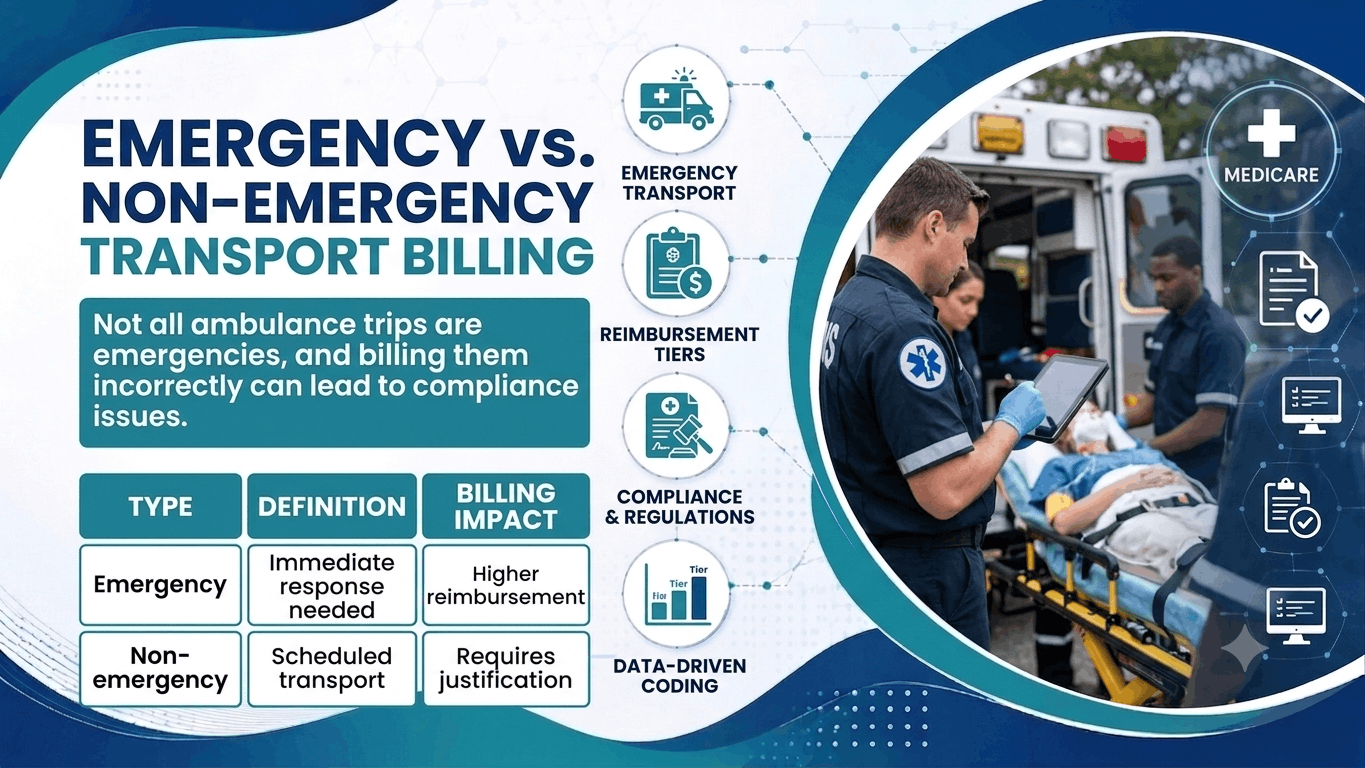
Not all ambulance trips are emergencies, and billing them incorrectly can lead to compliance issues.
| Type | Definition | Billing Impact |
|---|---|---|
| Emergency | Immediate response needed | Higher reimbursement |
| Non-emergency | Scheduled transport | Requires justification |
Non-emergency transports often require physician certification statements (PCS).
For non-emergency ambulance transports, PCS is essential, and often missed. PCS confirms that ambulance transport is medically necessary and must be signed by a physician. Without PCS (when required), Medicare will deny the claim, no exceptions.
Ambulance billing focuses more on origin and destination than traditional POS codes, but location still matters.
Where the patient is picked up and transported to determine ambulance billing accuracy and compliance. Incorrect location data can lead to claim rejections.
Ambulance services are reimbursed under the Ambulance Fee Schedule (AFS). In 2026, trends include:
| Area Type | Adjustment | Impact |
|---|---|---|
| Urban | Lower add-on | Standard rates |
| Rural | Higher add-on | Better reimbursement |
| Super-rural | Highest add-on | Maximum support |
Understanding your region helps you forecast revenue.
Let’s talk about the real problems providers face, because fixing these can improve your collections quickly. Some common mistakes include:
Solution: verify every claim before submission with a checklist.
Denials are frequent in ambulance billing, but most are preventable. You need always fix the cause, not just the claim.
| Denial Reason | Cause | Fix |
|---|---|---|
| CO-50 | No necessity | Improve documentation |
| CO-16 | Missing info | Resubmit with details |
| CO-96 | Non-covered service | Verify eligibility |
Ambulance billing is under heavy audit scrutiny, especially for high utilization providers. Your ambulance billing audits mainly focus on:
The False Claims Act (FCA) applies, so errors can be costly.
Even though Medicare is federal, local MACs interpret rules differently, and this affects your billing. You need to always follow your local contractor guidelines.
Regular audits help you stay ahead of Medicare reviews. Think of it as protecting your revenue of your practice.
Catching issues early prevents bigger problems later.
If billing complexity is slowing you down, outsourcing might be the right step for your practice to increase your revenue. Our experts in ambulance billing understand modifiers, documentation, and compliance rules, we help you to reduce denials and speed up payments.
FromOur dedicated billing team helps your ambulance service improve reimbursement, increase profitability, and achieve long-term financial success.
Get a free assessment from our billing experts