
Keep your practice aligned with current Medicare requirements while improving claim accuracy, accelerating payments, and strengthening your revenue cycle.

Medicare palliative care billing is often misunderstood because it overlaps with multiple service categories such as E/M visits, care coordination, and advance care planning. Unlike hospice, palliative care is not limited to end-of-life and can be provided alongside curative treatment.
This makes your practice billing more flexible, but also more complex. As a provider you must select the correct service category (e.g., office visit, home visit, or ACP) and ensure documentation reflects symptom management and care planning.
Need support with your billing workflow? Explore our medical billing and revenue cycle services or request a free consultation.
| Component | Billing Category | Medicare Expectation | Revenue Opportunity |
|---|---|---|---|
| Visits | E/M Codes | Based on MDM/time | Core billing |
| Care Planning | ACP Codes | Time-based | Additional revenue |
| Setting | Office/Home/Facility | POS accuracy | Payment variation |
| Coordination | CCM/TCM (if eligible) | Strict criteria | Expanded billing |
Palliative care involves managing complex, chronic conditions, often requiring longer visits and detailed discussions with patients and families. This creates multiple billing opportunities, but only if properly captured.
Unlike routine care, palliative billing must reflect complex decision-making, symptom burden, and care goals, which directly influence reimbursement levels.
| Factor | Clinical Reality | Billing Challenge | Strategic Solution |
|---|---|---|---|
| Complex Conditions | Multiple comorbidities | Under-coding risk | Use higher E/M levels |
| Time-Intensive Visits | Long discussions | Missed billing | Use time-based coding |
| Family Involvement | Care coordination | Not documented | Include in notes |
| Multiple Services | ACP, CCM | Missed revenue | Bundle correctly |
Palliative care providers frequently bill higher-level E/M codes due to the complexity of cases. Proper documentation of MDM or total time is essential. Failure to capture the true complexity often results in significant underbilling.
| CPT Code | Patient Type | Complexity Level | Avg Medicare Payment |
|---|---|---|---|
| 99213 | Established | Low | $70–$100 |
| 99214 | Established | Moderate | $100–$150 |
| 99215 | Established | High | $150–$220 |
| 99344 | Home Visit | Moderate | $130–$180 |
Advance Care Planning is a key component of palliative care and is separately reimbursable under Medicare. It includes discussions about goals of care, treatment preferences, and end-of-life decisions. These conversations are time-based and can significantly increase revenue if properly documented.
| CPT Code | Time Requirement | Service Description | Avg Payment |
|---|---|---|---|
| 99497 | First 30 minutes | ACP discussion | $80–$100 |
| 99498 | Each additional 30 min | Extended ACP | $70–$90 |
| Add-on | Requires 99497 | Cannot bill alone | Incremental |
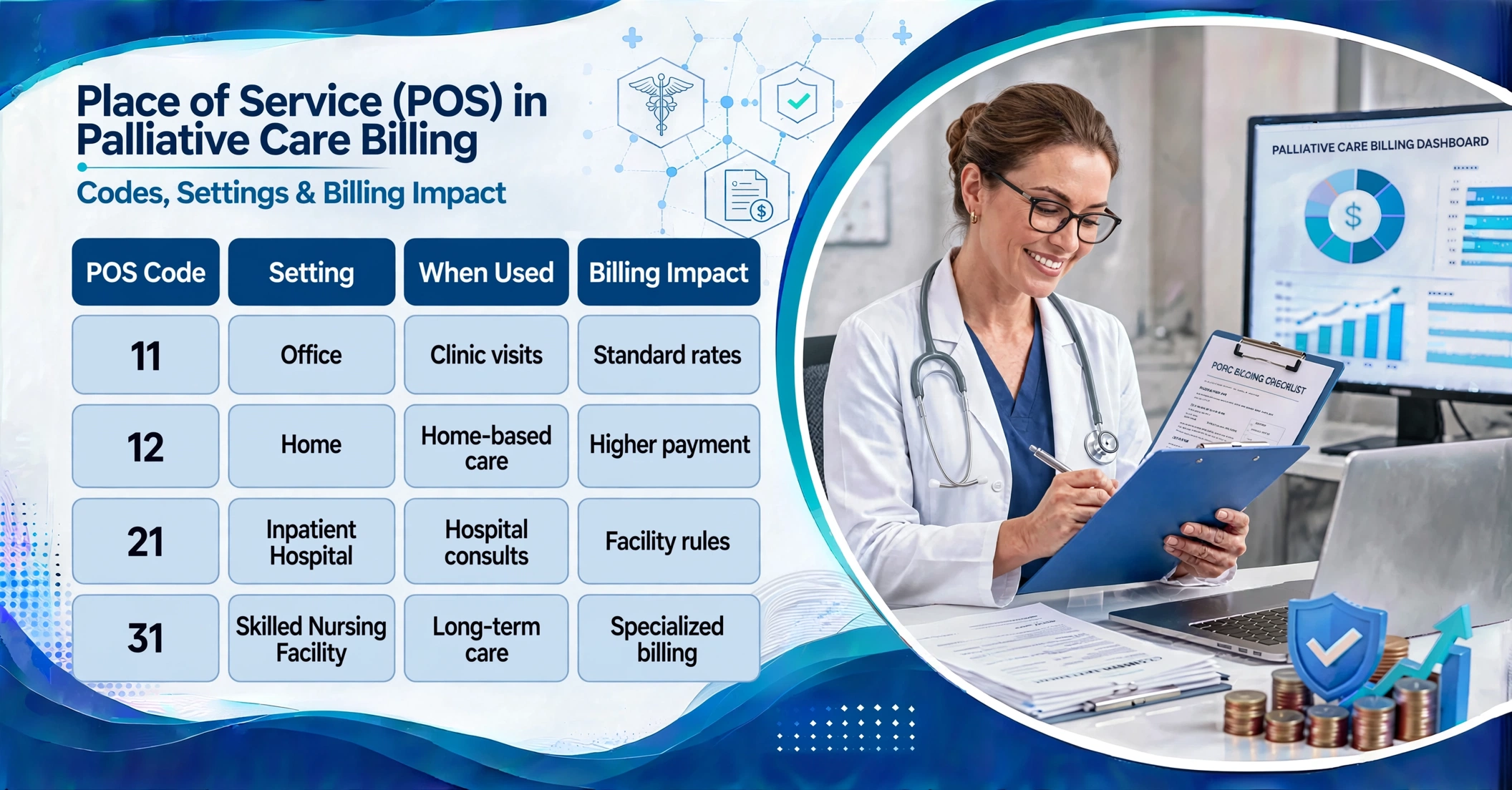
Palliative care can be delivered in multiple settings, including outpatient clinics, patient homes, hospitals, or nursing facilities. Each setting affects reimbursement rates. Accurate POS coding ensures proper payment and avoids claim rejection.
| POS Code | Setting | When Used | Billing Impact |
|---|---|---|---|
| 11 | Office | Clinic visits | Standard rates |
| 12 | Home | Home-based care | Higher payment |
| 21 | Inpatient Hospital | Hospital consults | Facility rules |
| 31 | Skilled Nursing Facility | Long-term care | Specialized billing |
Diagnosis coding must reflect both the underlying condition and the need for palliative care services. Using appropriate ICD-10 codes strengthens medical necessity and supports higher-level billing.
| ICD-10 Code | Condition | Use Case | Billing Strength |
|---|---|---|---|
| Z51.5 | Palliative care encounter | Core code | Strong |
| C34.90 | Lung cancer | Oncology palliative | High |
| I50.9 | Heart failure | Chronic condition | High |
| G30.9 | Alzheimer’s disease | Neurodegenerative | High |
As a provider you know that palliative care often involves extended face-to-face time with patients and families. Medicare allows time-based billing when time dominates the encounter.
This is especially useful for complex discussions and care planning sessions.
| Time Factor | Requirement | Billing Use | Benefit |
|---|---|---|---|
| Total Time | Documented minutes | E/M selection | Higher level coding |
| Counseling | >50% of visit | Justifies time billing | Increased payment |
| ACP Time | Separate tracking | Additional codes | Extra revenue |
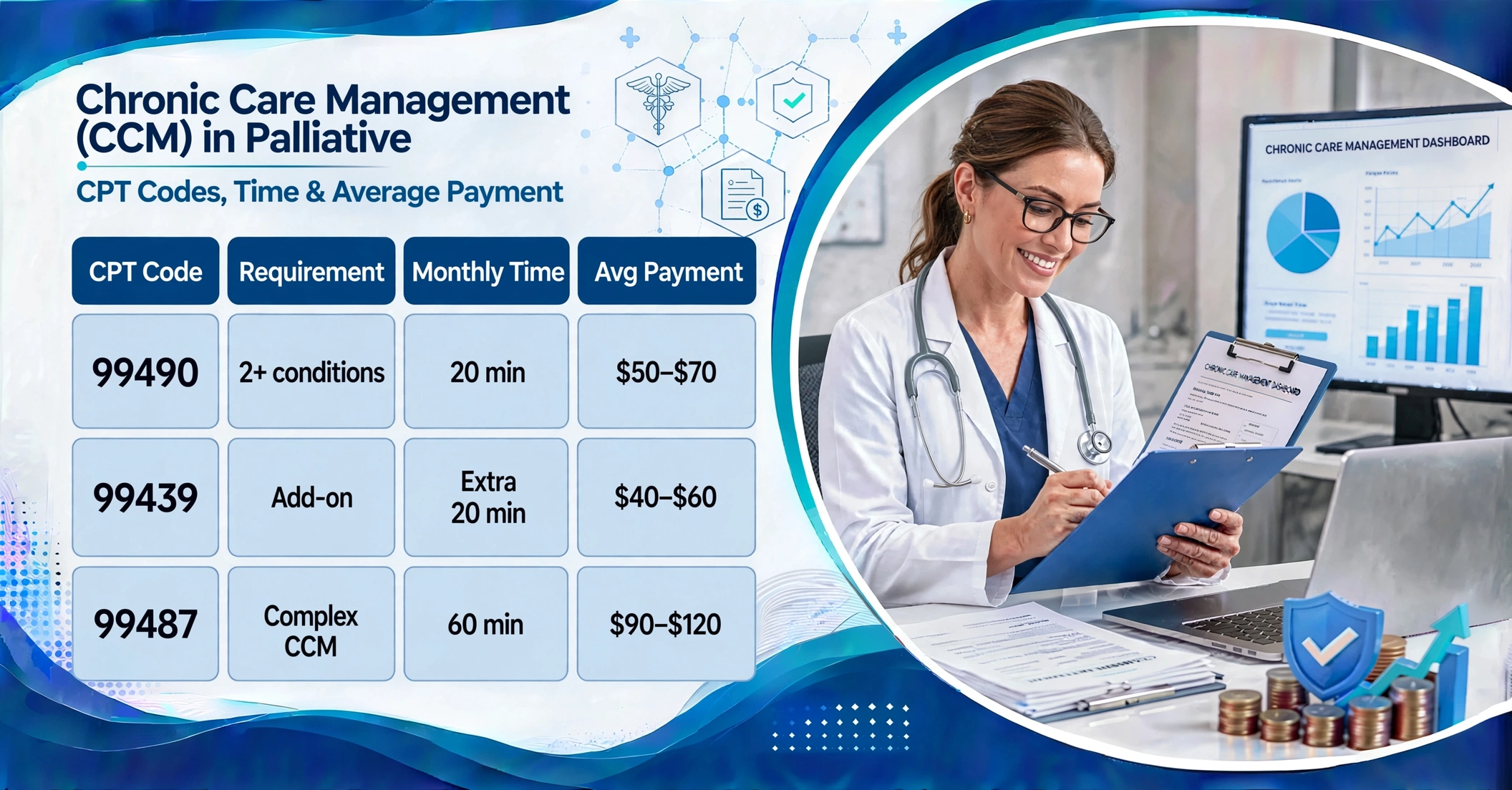
Many palliative care patients qualify for CCM services due to multiple chronic conditions. This provides recurring monthly revenue. However, strict documentation and consent requirements must be met.
| CPT Code | Requirement | Monthly Time | Avg Payment |
|---|---|---|---|
| 99490 | 2+ conditions | 20 min | $50–$70 |
| 99439 | Add-on | Extra 20 min | $40–$60 |
| 99487 | Complex CCM | 60 min | $90–$120 |
Documentation must clearly reflect symptom burden, treatment goals, and care coordination efforts. Medicare expects detailed and patient-specific notes. Generic or template-based documentation increases audit risk.
| Element | Requirement | Purpose | Risk if Missing |
|---|---|---|---|
| Symptom Assessment | Pain, distress | Justifies care | Denial |
| Care Plan | Goals, interventions | Treatment tracking | Audit risk |
| Family Discussion | Documented | ACP support | Missed billing |
| Time Spent | Exact minutes | Time-based billing | Rejection |
MDM is central to selecting E/M levels in palliative care. It reflects the complexity of managing serious illnesses. Higher MDM levels often justify higher reimbursement.
| MDM Level | Condition Complexity | Risk | Billing Level |
|---|---|---|---|
| Low | Stable chronic illness | Minimal | 99213 |
| Moderate | Multiple conditions | Moderate | 99214 |
| High | Life-threatening illness | High | 99215 |
Due to overlapping services, palliative care billing is prone to missed opportunities and errors.
Identifying these issues can significantly improve revenue capture.
| Error | Cause | Impact | Fix |
|---|---|---|---|
| Missing ACP billing | Not tracking time | Lost revenue | Document time |
| Undercoding E/M | Poor MDM capture | Lower payment | Improve notes |
| Incorrect POS | Wrong setting | Denial | Verify location |
Denials often occur due to insufficient documentation or incorrect coding. A structured response process is essential. Appeals with detailed clinical justification can recover payments.
| Step | Action | Outcome | Tip |
|---|---|---|---|
| Identify | Review denial | Root cause | Check notes |
| Correct | Update coding | Clean claim | Add details |
| Appeal | Submit documentation | Payment recovery | Include MDM |
Palliative care offers multiple billing opportunities beyond standard visits. Providers must capture all eligible services. Strategic billing can significantly improve financial performance.
| Strategy | Action | Benefit | Result |
|---|---|---|---|
| Use ACP Codes | Bill discussions | Extra revenue | Higher earnings |
| Time-Based Coding | Track minutes | Higher E/M | Better payment |
| CCM Enrollment | Monthly billing | Recurring income | Stability |
Medicare closely monitors palliative care due to its overlap with hospice and chronic care services. Providers must ensure clear differentiation and proper documentation.
| Risk Area | Audit Focus | Impact | Prevention |
|---|---|---|---|
| Overlapping Services | Double billing | Recoupment | Separate codes |
| Documentation | Insufficient detail | Denial | Detailed notes |
| Time Reporting | Inaccurate | Audit flags | Track precisely |
Understanding the distinction between palliative care and hospice is critical for Medicare billing.
Hospice has a completely different payment structure and eligibility criteria.
| Feature | Palliative Care | Hospice | Billing Impact |
|---|---|---|---|
| Eligibility | Any stage illness | Terminal (6 months) | Coverage difference |
| Treatment | Curative + comfort | Comfort only | Billing flexibility |
| Payment | Fee-for-service | Per diem | Revenue model |
Palliative care is gaining importance as healthcare shifts toward value-based care. Medicare is expanding support for care coordination and patient-centered services. Providers who adapt to these trends can improve both outcomes and revenue.
| Trend | Change | Impact | Opportunity |
|---|---|---|---|
| Value-Based Care | Outcome focus | Payment shifts | Quality metrics |
| Telehealth | Expanded access | New billing options | Remote care |
| Integrated Care | Team-based | Complex billing | Higher reimbursement |
We help your practice simplify complex billing requirements, recover missed revenue opportunities, and build a healthier, more predictable cash flow.
Get a free assessment from our billing experts