
Understanding coverage limits, medical necessity, and billing requirements helps providers deliver care confidently while getting reimbursed correctly.

Medicare Part B billing in 2026 is more complex, more regulated, and more closely monitored than ever before by Medicare in all states of the USA for all healthcare specialties. With frequent CMS updates and complex audit activity, even small mistakes by your practice billing team can lead to denied claims or delayed reimbursements.
Recent industry estimates suggest that 5–10% of Medicare claims are denied, and a large portion of those are tied to coding or documentation errors. That’s a significant revenue risk for any practice of any specialty.
Understanding how Medicare Part B billing works for your practice and how to do it correctly by your billing team is necessary if you want to maintain steady cash flow and avoid compliance issues. Talk to Medicare Billing Expert
Need support with your billing workflow? Explore our medical billing and revenue cycle services or request a free consultation.
In the USA the Medicare Part B billing refers to the process of submitting claims for outpatient medical services covered under Medicare. This includes physician visits, preventive care, diagnostic testing, and certain medical equipment provided by your practice to Medicare members.
In simple terms, it’s how your healthcare practice gets paid for services delivered outside of hospital inpatient settings. But it’s not just about submitting claims to Medicare, it’s about doing it accurately, compliantly, and efficiently by your in-house team.
Studies show that up to 30% of medical claims contain coding errors, which means understanding Part B billing is more important to avoid unnecessary revenue loss of your practice.
Medicare Part B is the portion of Medicare that covers outpatient medical services and certain preventive care services.
It plays a major role in everyday healthcare delivery, covering everything from routine checkups to diagnostic testing. For many practices, Part B represents a large percentage of total revenue.
| Category | Services Included | Examples | Key Billing & Coverage Notes |
|---|---|---|---|
| Physician Services | Office visits, consultations, follow-ups, specialist care | CPT 99213 (established patient visit) | Billed via CMS-1500; must meet medical necessity and proper E/M documentation guidelines |
| Preventive Services | Screenings, annual wellness visits, immunizations | Flu shots, mammograms, colon cancer screening | Many services covered at 100% if guidelines met; use correct preventive codes/modifiers |
| Diagnostic Services | Laboratory tests, imaging, diagnostic procedures | Blood tests, X-rays, MRIs | Requires physician order; must support diagnosis (ICD-10) for medical necessity |
| Durable Medical Equipment (DME) | Medically necessary equipment for home use | Wheelchairs, walkers, oxygen equipment | Billed using HCPCS codes; subject to rental/purchase rules and documentation requirements |
| Outpatient Hospital Services | Same-day procedures, emergency visits, observation care | Minor surgeries, ER visits | Often billed under hospital outpatient (UB-04); may involve facility + professional fees |
| Therapy Services | Physical, occupational, and speech therapy | PT sessions (97110, 97530) | Subject to therapy thresholds; requires Plan of Care and ongoing documentation |
Understanding these categories helps ensure, your practice services are billed under the correct guidelines because it will reduce the risk of denials or underpayments.
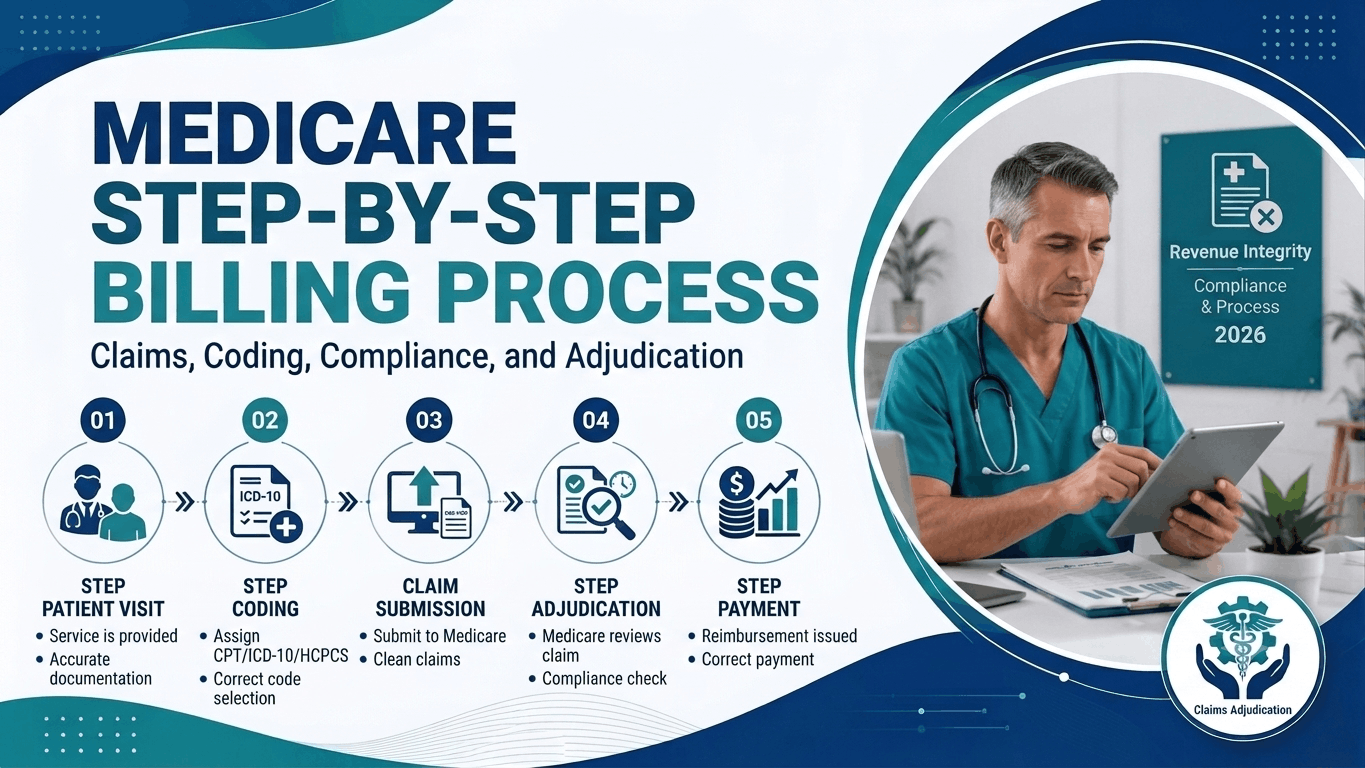
Medicare Part B billing follows a structured workflow from patient care to reimbursement. Each step must be completed accurately to ensure successful claim processing. Even a small issue, like a missing modifier or incorrect code used by your team can cause delays or rejections.
| Step | Description | Key Focus |
|---|---|---|
| Patient Visit | Service is provided | Accurate documentation |
| Coding | Assign CPT/ICD-10/HCPCS | Correct code selection |
| Claim Submission | Submit to Medicare | Clean claims |
| Adjudication | Medicare reviews claim | Compliance check |
| Payment | Reimbursement issued | Correct payment |
CPT codes are at the core of Medicare Part B billing. They define the services you have provided and directly determine how much you get paid for your healthcare services. Using incorrect CPT codes is one of the most common reasons for claim denials and underpayments.
| CPT Code | Service Description | Use Case | Key Billing & Compliance Notes |
|---|---|---|---|
| 99213 | Established patient office visit (low–moderate complexity) | Routine follow-up, stable conditions | Must meet E/M documentation (history, exam, MDM or time); commonly billed code |
| 99214 | Established patient visit (moderate complexity) | Chronic condition management, multiple issues | Higher reimbursement; requires detailed documentation of medical decision-making |
| 93000 | Electrocardiogram (ECG) with interpretation and report | Cardiac evaluation | Includes both test and interpretation; ensure medical necessity is documented |
| 71046 | Chest X-ray (2 views) | Diagnostic imaging for respiratory/cardiac issues | Requires physician order and supporting diagnosis (ICD-10) |
| 36415 | Collection of venous blood (venipuncture) | Lab testing services | Often bundled with other services; check payer rules to avoid denials |
| 80053 | Comprehensive metabolic panel (CMP) | Routine lab diagnostics | Must be linked to appropriate diagnosis; subject to frequency limits |
HCPCS codes are essential for billing services and supplies not included in CPT codes, especially in Medicare-specific scenarios. They are heavily used in areas like DME, injections, and preventive services.
| HCPCS Code | Description | Category | Key Billing & Compliance Notes |
|---|---|---|---|
| A0428 | Ambulance service (basic life support, non-emergency transport) | Transport | Requires medical necessity documentation; origin/destination modifiers must be included |
| E0114 | Crutches (underarm) | DME | Requires physician order and proof of medical necessity; billed under DMEPOS rules |
| J3490 | Unclassified drugs | Medication | Used when no specific HCPCS code exists; requires detailed drug description, dosage, and invoice |
| G0008 | Administration of influenza vaccine | Preventive Services | Often covered at 100% under Medicare; must be billed with corresponding vaccine code |
| Q0091 | Screening Pap smear collection | Preventive/Screening | Covered at defined intervals; must meet Medicare screening eligibility guidelines |
| J1100 | Injection, dexamethasone sodium phosphate | Medication | Units must match dosage administered; link with appropriate diagnosis for medical necessity |
Medicare billing is governed by strict regulations designed to ensure accuracy and prevent fraud. In 2026, these rules are being enforced more aggressively than ever in the USA to avoid claims denials. Healthcare providers must stay updated, as outdated knowledge is one of the biggest compliance risks. Talk to Medicare B Billing Expert
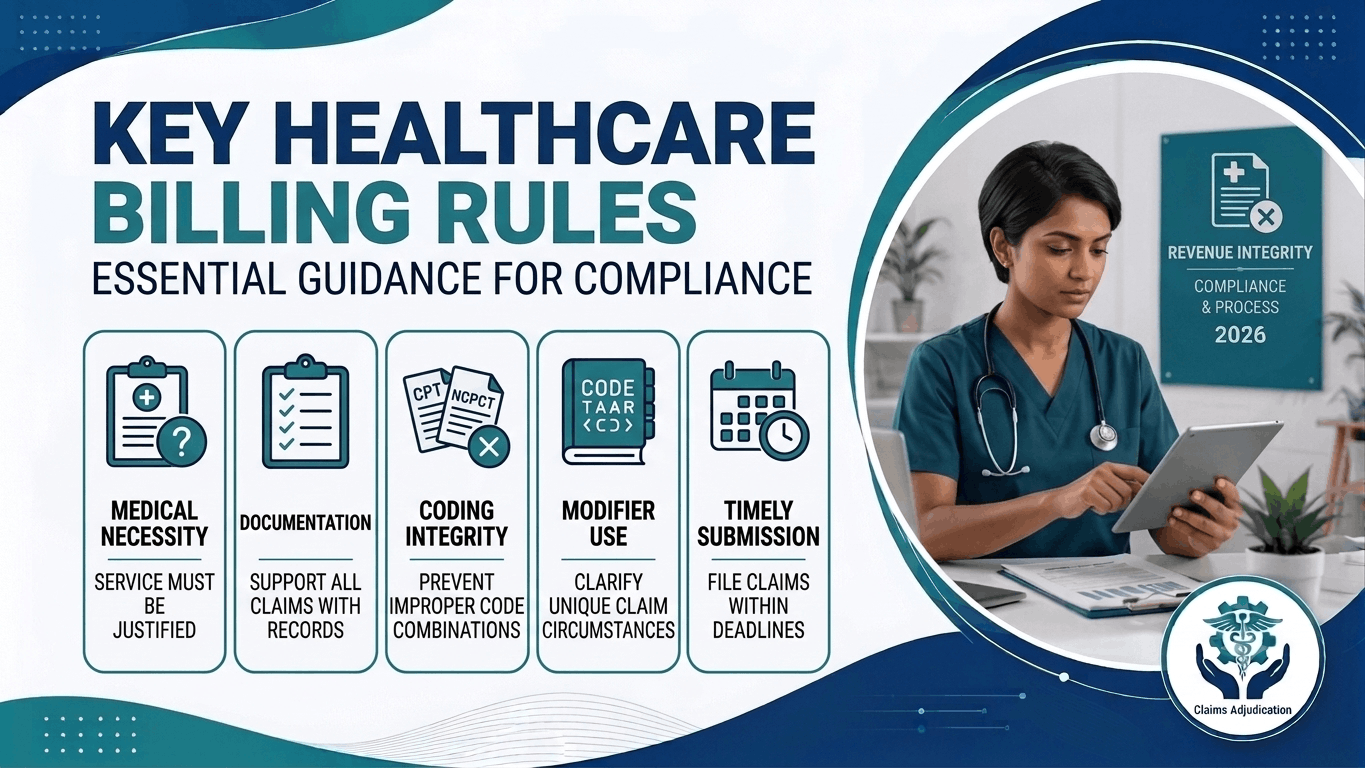
| Rule | Description | Impact |
|---|---|---|
| Medical Necessity | Service must be justified | Prevents denials |
| Documentation | Must support codes billed | Required for audits |
| NCCI Edits | Prevent improper coding | Ensures compliance |
| Modifier Usage | Clarifies services | Avoids underpayment |
| Timely Filing | Claims within deadlines | Prevents rejections |
Medicare uses a structured payment system called the Physician Fee Schedule (PFS) to determine reimbursement rates.
Understanding how payments are calculated helps you to avoid underpayments and optimize revenue.
| Component | Description | Example |
|---|---|---|
| RVU (Relative Value Unit) | Value of service | Based on complexity |
| Conversion Factor | Dollar multiplier | Updated yearly |
| Geographic Adjustment | Location-based pay | Regional variation |
Even small changes in these factors can significantly impact overall revenue, especially for high-volume practices.
Billing errors remain one of the biggest challenges for healthcare providers in the USA. Many of these mistakes are preventable with proper systems and expertise.
In fact, studies suggest that coding-related errors contribute to nearly 30% of denied claims.
| Error | Root Cause | Impact on Practice | How to Prevent It |
|---|---|---|---|
| Incorrect CPT Code | Lack of coding knowledge or outdated guidelines | Claim denial or underpayment | Use certified coders, regular training, and coding audits |
| Missing Documentation | Incomplete or unclear clinical records | Payment delays or denial due to lack of medical necessity | Ensure complete, detailed documentation for every service |
| Modifier Errors | Incorrect, missing, or misused modifiers | Reduced payment or claim rejection | Apply correct modifiers based on payer rules and documentation |
| Duplicate Billing | System errors or resubmitting claims without tracking | Claim rejection and compliance flags | Track claim status and implement billing software checks |
| Upcoding | Intentional or accidental overcoding of service level | Audit risk, penalties, and possible legal action | Match codes strictly with documentation and service provided |
| Unbundling | Billing services separately that should be bundled | Denials and compliance issues | Follow NCCI (National Correct Coding Initiative) edits and bundling rules |
Medicare billing is closely monitored under federal laws to prevent fraud and abuse. As a healthcare provider you must ensure compliance not just in coding, but in overall billing practices. All physicians in the USA knows that activity has increased significantly in recent years, making compliance a top priority.
| Law / Regulation | Purpose | Risk if Violated | Key Compliance Actions for Providers |
|---|---|---|---|
| False Claims Act (FCA) | Prevents fraud, including false or unnecessary billing to Medicare | Heavy penalties, fines, and possible exclusion from Medicare | Bill only for medically necessary services; ensure accurate coding and documentation |
| Anti-Kickback Statute (AKS) | Prohibits offering or receiving incentives for patient referrals | Criminal charges, fines, and imprisonment | Avoid financial incentives tied to referrals; maintain transparent arrangements |
| Stark Law | Limits physician self-referrals for designated health services | Denials, penalties, and compliance violations | Follow strict referral rules and avoid prohibited financial relationships |
| HIPAA (Health Insurance Portability and Accountability Act) | Protects patient health information and ensures data privacy | Data breaches, fines, and legal consequences | Use secure systems, protect patient data, and train staff on privacy |
Data clearly shows how critical billing accuracy is for financial success. Even small inefficiencies can lead to significant revenue loss over time.
| Metric | Statistic | Meaning |
|---|---|---|
| Claim Denial Rate | 5–10% average | Revenue loss risk |
| Coding Errors | Up to 30% of claims | Major issue |
| Audit Increase | Rising yearly | Higher scrutiny |
| Revenue Loss | Thousands/month | Due to errors |
These numbers highlight why investing in accurate billing processes is essential.
Outsourcing has become a strategic decision for many practices looking to improve efficiency and reduce costs. It allows providers to access expert-level support without the burden of managing in-house teams.
| Benefit | Explanation | Outcome |
|---|---|---|
| Expertise | Certified billers | Fewer errors |
| Cost Savings | No in-house team | Lower expenses |
| Efficiency | Faster processing | Better cash flow |
| Compliance | Updated knowledge | Reduced risk |
At House of Outsourcing, we specialize in handling complex Medicare Part B billing with precision and compliance. We focus on reducing errors, improving reimbursements, and simplifying your entire billing process.
| Feature | Our Approach | Benefit |
|---|---|---|
| Expert Team | Certified professionals | High accuracy |
| Compliance Focus | Updated with CMS rules | Audit protection |
| Denial Reduction | Proactive checks | Faster payments |
| Full RCM Support | End-to-end services | Seamless workflow |
We act as a true partner in your revenue growth, not just a service provider.
Our customized billing strategies help your practice recover more revenue while improving operational efficiency.
Get a free assessment from our billing experts