
Our OB/GYN Medical Billing services help practices manage complex women’s health billing, specialty-specific coding, global billing requirements, and payer guidelines. We optimize the revenue cycle through accurate claim submission, eligibility verification, denial management, and A/R follow-up to improve reimbursements, reduce administrative burdens, and support practice growth.

If you run an OB/GYN medical practice in the United States, you already know one undeniable truth, the obstetrics and gynecology billing services are among the most complex in all of healthcare. You also know that the ever-changing CPT and ICD-10 codes, prior authorization battles with insurers, and a denial rate sitting close to 22%, it can feel like you spend more time fighting for revenue than actually caring for your practice patients.
And you’re not alone. According to the American College of Obstetricians and Gynecologists (ACOG), nearly 75% of OB/GYN professionals report significant administrative burden that directly impacts patient care time. With approximately 46,600 active OB/GYN practitioners across the U.S., the financial stakes are enormous, and billing mistakes silently drain 10–12% of annual revenue from practices every single year.
This guide is designed specifically for US OB/GYN physicians, practice managers, and billing teams who want to get it right. We will walk you through every critical aspect of obstetrics and gynecology medical billing.
�� According to CMS data, OB/GYN practices have one of the highest initial claim denial rates in healthcare — approximately 22.42% — leading to 11–12% annual revenue loss if denials are not properly managed. (Source: CMS.gov)
OB/GYN medical billing is the specialized process of converting the clinical services provided by obstetricians and gynecologists into standardized codes, CPT, ICD-10, and HCPCS, and submitting those codes to insurance companies for reimbursement. It sounds straightforward, but in practice, obstetrics and gynecology billing involves layers of complexity that most other specialties simply don’t face.
Consider what a typical OB/GYN practice handles; routine prenatal visits, high-risk pregnancy management, vaginal deliveries, cesarean sections, laparoscopic surgeries, hysterectomies, colposcopies, infertility treatments, IUD insertions, and postpartum care; each with its own set of codes, modifiers, bundling rules, and payer-specific requirements. Getting this wrong doesn’t just mean delayed payment; it means audits, compliance violations, and long-term revenue loss.
Most medical specialties deal with either procedural billing or evaluation and management (E/M) billing. OB/GYN practices deal with both simultaneously, across nine months of a patient’s pregnancy and beyond. Here is what makes obstetrics and gynecology billing services so distinctively demanding:
Tip #1 — Know Your Payer Mix
Before you can optimize your OB/GYN medical billing, you need to understand your payer landscape.
Medicaid often covers 40–50% of deliveries in many US states. Commercial payers have different
global package definitions. Medicare has its own ‘MMM’ indicator for obstetric global billing.
Map your top 5 payers and document their specific OB/GYN billing rules in your internal SOPs
If there is one concept at the heart of obstetrics billing, it’s the global maternity care package. It is necessary for your medical practice growth that you have complete understanding of it, and applying it correctly is the difference between a clean claim and a denial that costs your practice thousands of dollars.
The global obstetric package is a bundled payment that covers the entire continuum of routine pregnancy care: all prenatal visits, the delivery itself (vaginal or cesarean), and postpartum care through six weeks after delivery. Instead of billing each prenatal visit, each ultrasound, and the delivery separately, a single comprehensive CPT code covers it all.
This differs from surgical global periods (which are counted in 10-day or 90-day increments). The OB global package essentially covers the full pregnancy journey, a 37-week pregnancy and a 42-week pregnancy receive the same global code.
| CPT Code | Delivery Type | What's Included | When to Use |
|---|---|---|---|
| 59400 | Vaginal Delivery | All prenatal visits + vaginal delivery + postpartum care | Full pregnancy managed by your practice |
| 59510 | Cesarean Delivery | All prenatal visits + C-section delivery + postpartum care | Full pregnancy with planned or emergency C-section |
| 59610 | VBAC | Prenatal + vaginal delivery after prior C-section + postpartum | Patient attempts vaginal birth after C-section |
| 59618 | Repeat C-Section | Prenatal + C-section after failed VBAC attempt + postpartum | Failed VBAC that converts to C-section |
Not every OB/GYN practice manages the full global package. Patients transfer care mid-pregnancy, different physicians cover deliveries, and hospitalists sometimes handle delivery only. In these scenarios, you use component codes rather than global codes:
| CPT Code | Service Description | When to Apply |
|---|---|---|
| 59409 | Vaginal delivery only (no prenatal/postpartum) | You only delivered the baby; another provider did prenatal care |
| 59514 | Cesarean delivery only | You only performed the C-section |
| 59425 | Antepartum care — 4 to 6 visits | You managed prenatal care for 4–6 visits only |
| 59426 | Antepartum care — 7 or more visits | You managed prenatal care for 7+ visits but did not deliver |
| 59430 | Postpartum care only | You handled postpartum follow-up; another provider delivered |
�� Callout: The single most expensive OB/GYN billing mistake we see is practices using global package codes (59400, 59510) when they only handled part of the pregnancy — OR using component codes when they provided the full package. Either mistake triggers denials and audits. Always document the full scope of care before selecting your code.
Accurate obgyn CPT coding is the foundation of successful obstetrics and gynecology billing services. The AMA’s CPT editorial panel updates codes annually, and 2025 brought several noteworthy changes, including new telehealth-specific codes that partially replace legacy HCPCS codes. Below is your comprehensive 2025 OB/GYN CPT code reference.
| CPT Code | Procedure Description | Notes |
|---|---|---|
| 76801–76828 | Obstetric ultrasounds (1st, 2nd, 3rd trimester) | Billed separately from global package |
| 76830 | Transvaginal ultrasound | Common in early pregnancy; billable separately |
| 59025 | Non-stress test (NST) | High-risk pregnancies; outside global package |
| 57452 | Colposcopy of the cervix | Diagnostic — billed per visit |
| 58100 | Endometrial biopsy | Gynecology diagnostic service |
| 88175 | Pap smear / cervical cytology | Preventive; covered under ACA preventive services |
| CPT Code | Procedure Description | Notes |
|---|---|---|
| 58140 | Myomectomy — 1 to 4 fibroids via abdominal incision | Requires prior auth from most payers |
| 58150 | Total abdominal hysterectomy | 90-day surgical global period applies |
| 58570 | Laparoscopic hysterectomy (uterus ≤250g) | Minimally invasive; separate modifier rules |
| 58700 | Salpingectomy | Often performed with hysterectomy; use -51 modifier |
| 58660 | Laparoscopic tubal ligation | Sterilization; Medicaid coverage varies by state |
| 58956 | Cancer surgery (uterus, cervix, ovaries, omentum) | Oncology surgical coding rules apply |
| 59812 | D&C for incomplete miscarriage | Document indication clearly in clinical notes |
| 59300 | Episiotomy or repair of lacerations | Billed separately from delivery code |
| CPT Code | Procedure Description | Notes |
|---|---|---|
| 58300 | IUD insertion | Coverage varies widely by plan; verify eligibility |
| 58301 | IUD removal | Often requires separate billing from insertion |
| 58970 | Egg retrieval for IVF | Often not covered by commercial plans |
| 58974 | Embryo transfer in IVF | State mandates for infertility coverage vary |
| 58976 | GIFT — gametes/zygote transfer | Rare; verify payer policy before billing |
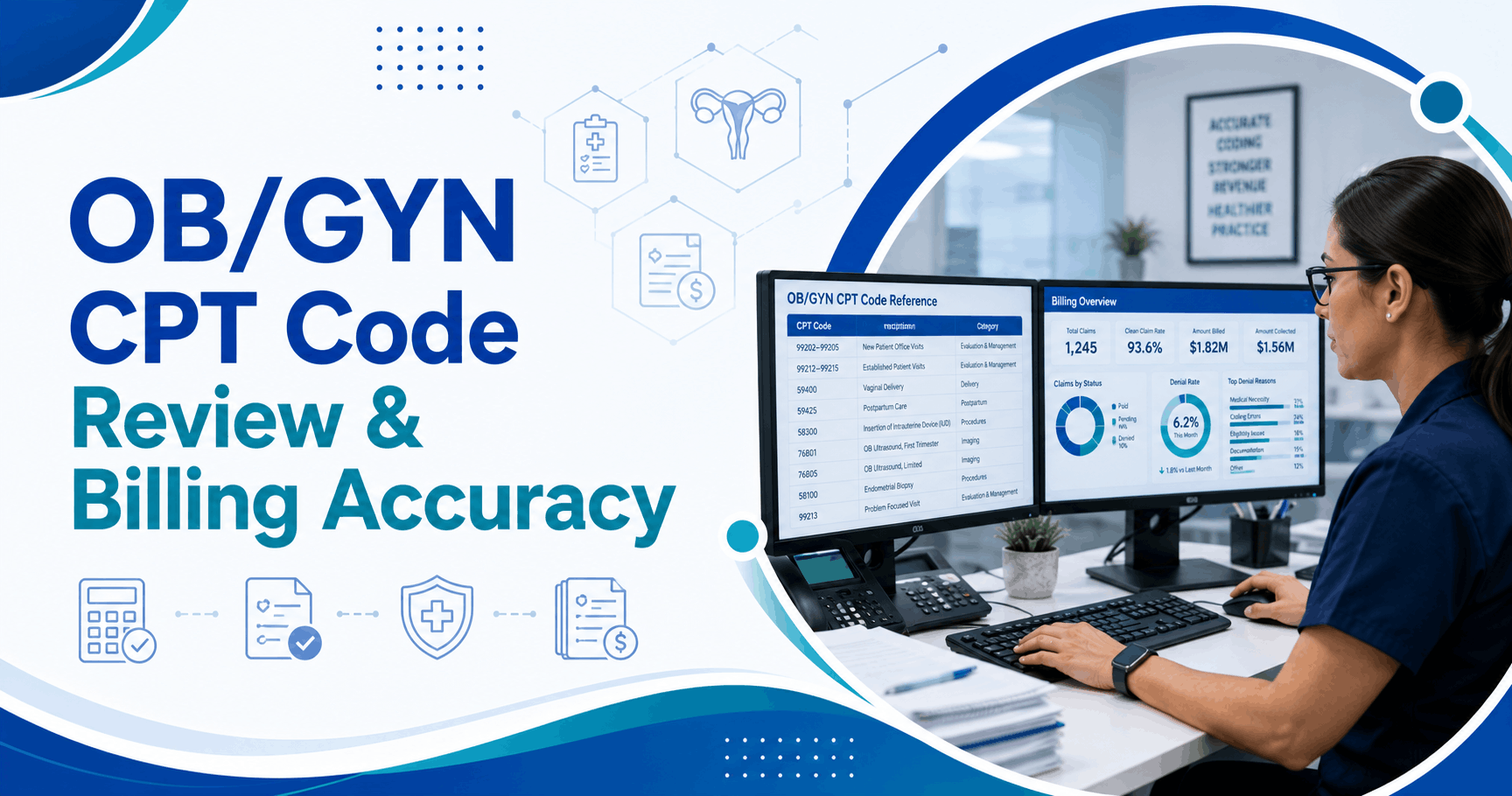
CPT codes tell the insurance company what was done. ICD-10 codes tell them why. Without the correct ICD-10 diagnosis code, even a perfectly coded CPT claim will be denied. Here are the most critical ICD-10 codes used in obstetrics and gynecology medical billing:
| ICD-10 Code | Category | Description |
|---|---|---|
| Z34.00–Z34.93 | Routine Prenatal Care | Encounter for supervision of normal pregnancy — trimester-specific |
| O09.0 | High-Risk Pregnancy | Supervision of pregnancy in elderly primigravida |
| O24.419 | Gestational Diabetes | Unspecified gestational diabetes in pregnancy |
| O14.90 | Preeclampsia | Preeclampsia, unspecified, unspecified trimester |
| O80 | Normal Delivery | Encounter for full-term uncomplicated delivery |
| O82 | Cesarean Delivery | Encounter for cesarean delivery without indication |
| N80.0–N80.9 | Endometriosis | Endometriosis of uterus through other sites |
| D25.0–D25.9 | Uterine Fibroids | Submucous, intramural, subserosal leiomyoma |
| N97.0–N97.9 | Infertility | Female infertility associated with anovulation and others |
| Z30.430 | Contraception | Encounter for insertion of intrauterine contraceptive device |
| N39.0 | UTI | Urinary tract infection, site not specified |
| C53.0–C55 | Gynecologic Cancers | Cervical, uterine, and ovarian malignancies |
Tip #2 — ICD-10 Specificity Matters
Never use unspecified ICD-10 codes when a more specific code exists. For example, using O14.90
(preeclampsia, unspecified) when clinical notes clearly indicate severe preeclampsia (O14.10) can
result in underpayment or denial. Train your coders to mine physician documentation for the most
specific diagnosis code available, this directly impacts your reimbursement rate.
Modifiers are two-digit codes appended to CPT codes that provide additional context about a service. In obstetrics and OBGYN medical billing, using the wrong modifier, or forgetting one entirely is one of the top causes of claim denials and payment undercalculation. Here’s what every OB/GYN billing team needs to know.
| Modifier | Name | When to Use in OB/GYN Billing | Common Mistake |
|---|---|---|---|
| -22 | Increased Procedural Services | Complicated deliveries — prolonged labor, excessive hemorrhage | Forgetting to attach supporting documentation |
| -25 | Separate E/M on Same Day | E/M visit performed same day as a minor procedure | Overuse without separate documentation |
| -51 | Multiple Procedures | Bilateral procedures or multiple surgeries same session | Not applying when performing salpingectomy with hysterectomy |
| -54 | Surgical Care Only | Surgeon performs procedure but not postoperative care | Failing to split billing with covering provider |
| -55 | Postoperative Care Only | Different provider manages post-op/postpartum care | Missing when patient transfers postpartum care |
| -57 | Decision for Surgery | E/M service where decision for major surgery was made the day before | Applying to same-day minor procedures |
| -59 | Distinct Procedural Service | Services not typically billed together are clinically separate | Using -59 as a catch-all instead of XE/XS/XP/XU |
| -95 | Telehealth via Audio-Video | Synchronous telemedicine visits using traditional E/M codes | Not needed for new 2025 telehealth CPT codes 98000–98016 |
| FS | Split/Shared Visit | Split visits in facility settings (2025 update) | Applying to office visits — facility only |
Even your practice experienced billing teams hit roadblocks in obstetrics and gynecology billing services. Understanding the root causes of revenue leakage is the first step toward fixing them. Here are the five most critical challenges, and actionable solutions for each.
The global maternity care package is the most misused billing concept in OB/GYN. Common errors include; billing global codes when the practice only handled part of the pregnancy, separately billing prenatal visits that are included in the global package, and failing to use component codes when multiple providers split care.
Solution: You need to implement a case-level tracking system that flags the patient’s care pathway from first prenatal visit through postpartum discharge. Document which provider handled which component and match the code accordingly.
Many OB/GYN practices under-document and under-code high-risk pregnancies, leaving significant reimbursement on the table. Conditions like gestational diabetes (O24.419), preeclampsia (O14.10), preterm labor (O60), and multiple gestations require specific ICD-10 codes and additional CPT codes for services that fall outside the global package.
Solution: As a practice owner you need to develop a high-risk pregnancy checklist that prompts providers to document every complication at every visit. Additional services like non-stress tests (CPT 59025), biophysical profiles (CPT 76818–76819), and extra ultrasounds are separately billable when clinically justified.
Procedures like hysterectomies, laparoscopies, LEEPs (Loop Electrosurgical Excision Procedures), and infertility treatments almost always require prior authorization from commercial insurers and Medicaid. Missing or incomplete prior authorizations are one of the top five causes of obstetrics and gynecology billing denials.
Solution: As an experienced healthcare physician and practice owner you need to build a prior authorization trigger list for your top procedures. Assign dedicated staff to manage PA requests and follow up within 48 hours. Document all PA approvals and reference numbers on the claim form.
The postpartum period is consistently under-billed in OB/GYN practices. While routine postpartum care within six weeks is included in the global package, complications outside the global period, such as postpartum depression management, wound care, or extended follow-up, are separately billable. Many practices simply miss these charges.
Solution: Train your billing team to flag postpartum visits that fall outside the global period or involve services not bundled in standard postpartum care. These additional services represent recoverable revenue that is currently being left uncollected.
Medicaid covers approximately 42% of births in the United States according to KFF (Kaiser Family Foundation) data. Yet Medicaid billing rules for OB/GYN services vary significantly by state, and they differ dramatically from commercial payer policies. What’s covered, how it’s coded, and what documentation is required can all differ by state Medicaid program.
Solution: You need to maintain a payer-specific policy reference guide for your top Medicaid and commercial plans. Subscribe to payer policy update bulletins and review your state Medicaid guidelines at least quarterly.
Tip #3 — Track Your Denial Trends Weekly
Most OB/GYN practices review denial data monthly or quarterly by then, the same mistakes
have cost you thousands of dollars in rework. You need to set up a weekly denial tracking dashboard that categorizes denials by payer, code, and denial reason. This lets your billing team identify patterns in real-time and correct documentation or coding issues before they become
systemic revenue leaks.
Whether you manage billing in-house or work with an obstetrics and gynecology billing services partner, understanding the end-to-end workflow is essential for identifying where revenue is being lost. Here’s how best-practice OB/GYN billing works:
Insurance Eligibility Verification:
Before the first prenatal visit, it is necessary for your billing team to verify active insurance coverage, confirm global package or individual service coverage, and check for any prior authorization requirements.
Clinical Documentation:
As a provider it is your responsibility to document the full clinical encounter: chief complaint, history, examination findings, diagnosis, and medical decision-making. This documentation is the foundation for all coding decisions.
Medical Coding:
You need to inform your certified OB/GYN coders to translate clinical documentation into accurate CPT, ICD-10, and HCPCS codes with appropriate modifiers. This step requires specialty-specific expertise.
Charge Entry and Claim Scrubbing:
The main responsibility of your coding team is to code charges and enter into the billing system. Claims are scrubbed against payer-specific rules to catch errors before submission.
Clean Claim Submission:
Main responsibility of your billing team is to electronically submit claims to the payer or clearinghouse. A clean first-pass submission rate above 95% is the benchmark for high-performing OB/GYN billing services.
Payment Posting:
Your practice insurance payments are posted via ERA (Electronic Remittance Advice) or EOB (Explanation of Benefits). Underpayments, adjustments, and patient balances are identified.
Denial Management and Appeals:
Your practice denied claims are analyzed, corrected, and resubmitted within payer timely filing deadlines. Complex denials are escalated to appeals with supporting clinical documentation.
Patient Billing and Collections
Remaining patient responsibility (co-pays, deductibles, non-covered services) is billed with clear, patient-friendly statements and follow-up protocols.
One of the most significant developments in obstetrics and gynecology billing services for 2025 is the introduction of new telehealth-specific CPT codes. While these changes are smaller in scope than early rumors suggested, they are critical for any OB/GYN practice offering virtual care.
| CPT Code Range | Service Type | Key Notes |
|---|---|---|
| 98000–98007 | Audio-video telehealth visit | These codes inherently denote telehealth — modifier 95 NOT required |
| 98008–98015 | Audio-only telehealth visit | For patients without video access; limited commercial coverage |
| 98016 | Brief telehealth communication | Replaces HCPCS G2012 for brief patient communications |
While obstetrics billing gets most of the attention, the gynecology side of OB/GYN medical billing is equally complex and carries its own unique reimbursement challenges. From preventive screenings to major surgical procedures, gynecology billing requires a different set of skills and knowledge.
The Affordable Care Act (ACA) mandates that most health plans cover preventive gynecology services without cost-sharing when coded correctly as preventive care. This includes:
Annual well-woman visits (CPT 99385–99387 for new patients, 99395–99397 for established patients)
Cervical cancer screening / Pap smear (CPT 88175)
STI screening (gonorrhea, chlamydia, HIV, hepatitis B and C)
Contraception counseling and methods (IUD insertion CPT 58300 may be covered 100%)
BRCA counseling for women with family history of hereditary breast/ovarian cancer
Gynecological surgeries — hysterectomies, myomectomies, laparoscopies, and ovarian surgeries — carry 90-day global surgical periods. During this period, routine postoperative care is bundled into the procedure code. However, complications, unrelated conditions, and additional surgeries within the global period may be billed separately with appropriate modifiers.
Tip #4 — Gynecology Billing Compliance Alert
The OIG (Office of Inspector General) consistently flags OB/GYN practices for:
You need to conduct an internal coding audit at least twice per year to catch and correct
these issues proactively. Reference the OIG Work Plan at oig.hhs.gov.
Compliance in obstetrics and gynecology medical billing is not optional, it’s a legal and financial imperative. CMS, the OIG, and state Medicaid programs actively audit OB/GYN practices for billing irregularities. For your understanding the compliance landscape protects your practice from audits, recoupment demands, and reputational damage.
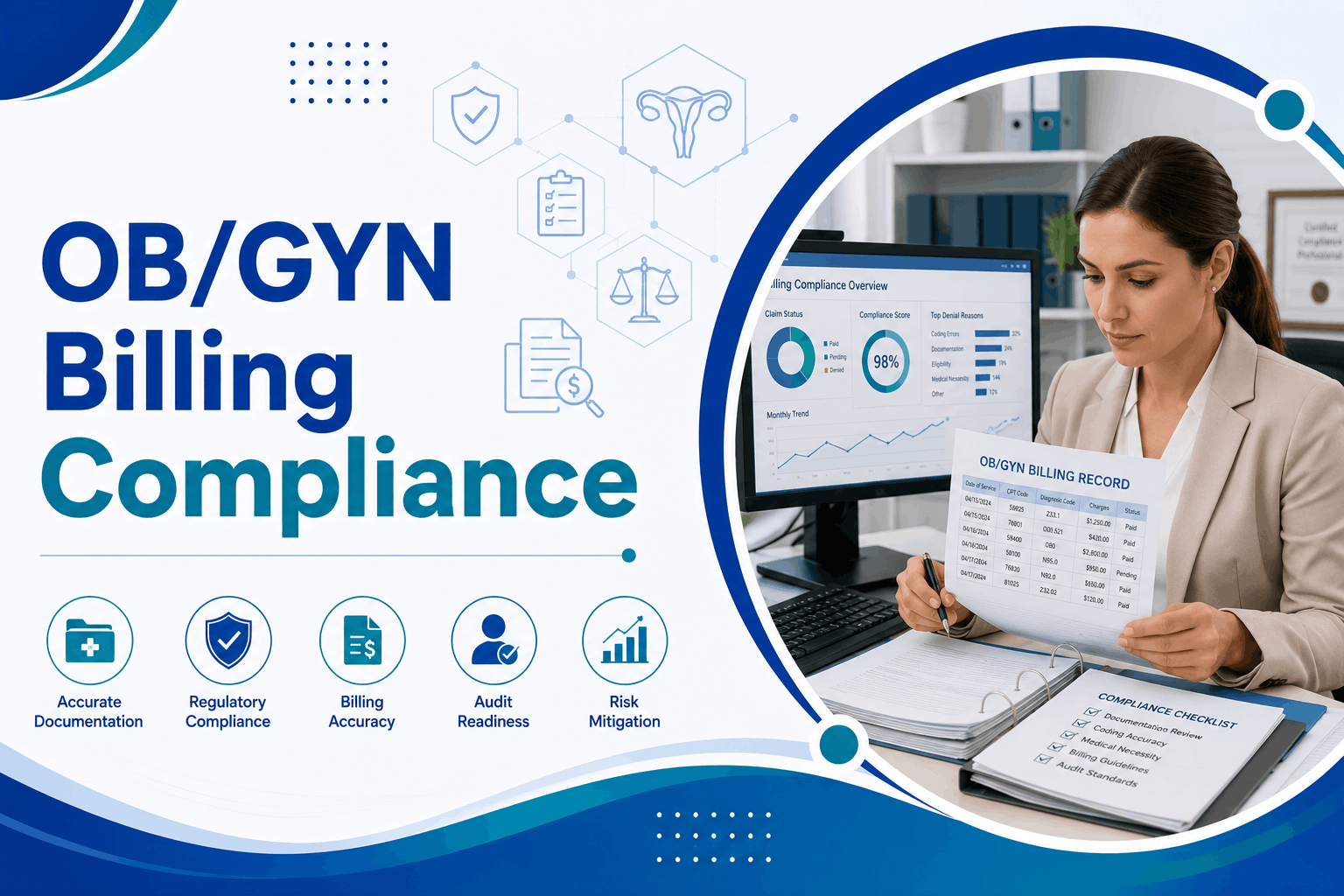
In obstetrics and gynecology billing services, denial management is not just damage control, it’s active revenue recovery. With initial denial rates around 17–22%, a systematic denial management process can recover tens of thousands of dollars per month for mid-sized OB/GYN practices.
| Denial Reason | Root Cause | Solution |
|---|---|---|
| Missing prior authorization | PA not obtained before procedure | Build PA checklist for high-auth procedures |
| Incorrect global vs. component code | Provider did not document scope of care | Implement care-tracking per patient per provider |
| Outdated CPT code used | Coder not updated on annual changes | Annual AMA CPT training for all coders |
| Modifier -25 not supported | E/M not documented as separate encounter | Provider-specific documentation training |
| Bundling/unbundling errors | Incorrect use of -59 modifier | NCCI edit review before submission |
| Eligibility/coverage not verified | Insurance lapsed or plan changed | Verify eligibility at every visit |
| Timely filing limit exceeded | Claim not submitted within payer deadline | Track submission deadlines by payer |
Tip #5 — The 48-Hour Denial Rule
In our experience managing OB/GYN medical billing services, the single biggest predictor of
denial recovery success is speed. Appeals submitted within 48 hours of receiving a denial
have a significantly higher overturn rate than appeals submitted weeks later, because the
clinical context is fresh, documentation is easier to gather, and payer representatives are
more receptive to timely responses. Build a 48-hour denial acknowledgment protocol into
your billing workflow today
Managing OB/GYN medical billing in-house is becoming increasingly untenable for most practices in the USA. The complexity of obstetrics and gynecology billing, combined with constant regulatory changes, staffing challenges, and rising technology costs, is pushing more and more OB/GYN practices toward outsourcing.
And the results speak for themselves. OB/GYN practices that outsource their billing to specialized obstetrics and gynecology billing services providers consistently report:
| Criterion | What to Look For |
|---|---|
| Specialty Experience | Proven track record specifically with OB/GYN — not just general medical billing |
| Coding Expertise | Certified coders (CPC, COBGC) with OB/GYN specialty credentials |
| Technology | Integration with your EHR (Epic, NextGen, Athena) and real-time dashboards |
| Denial Management | Dedicated denial management team with <48hr appeal turnaround |
| Transparency | Monthly reporting with KPIs: first-pass rate, collection rate, days in AR, denial rate |
| Compliance | HIPAA-compliant, regular audits, OIG and CMS update monitoring |
| Pricing | Fee typically 4–10% of collected revenue; no hidden fees |
How do you know if your OB/GYN medical billing services are actually performing? By measuring the right KPIs (Key Performance Indicators) and benchmarking them against industry standards. Here are the metrics every OB/GYN practice manager should track:
| KPI | Industry Benchmark | Why It Matters |
|---|---|---|
| First-Pass Claim Acceptance Rate | ≥ 95% | Lower rates mean more rework, slower payment |
| Net Collection Rate | ≥ 95–98% | Measures what % of collectible revenue you actually collect |
| Days in Accounts Receivable (AR) | < 35 days | Longer cycles indicate billing workflow bottlenecks |
| Denial Rate | < 5% | OB/GYN average is 22%; high performers achieve < 5% |
| Denial Overturn Rate | > 70% | Measures effectiveness of your denial management process |
| AR > 90 Days (% of total AR) | < 15% | High % indicates systemic billing or follow-up issues |
| Coding Accuracy Rate | > 97% | Benchmark from internal or external coding audits |
Global OB billing (CPT 59400, 59510, etc.) is used when your practice provides the full continuum of care, prenatal through postpartum. Component billing uses individual codes (59425, 59426, 59409, 59430) when different providers handle different parts of the pregnancy care.
In the USA mostly obstetrics and gynecology billing services providers charge between 4% and 10% of collected revenue. The exact rate depends on practice size, specialty complexity, and service scope. This fee is typically offset by increased collections and eliminated in-house billing overhead.
Yes. Obstetric ultrasounds (CPT 76801–76828, 76830) are billed separately from the global maternity care package because they are diagnostic services not bundled in the global period. However, verify payer-specific policies as some plans have different bundling rules.
The timely filing limits vary by payer. Medicare requires claims to be filed within 12 months of the date of service. Medicaid limits vary by state (typically 90–365 days). Commercial plans range from 90 days to 24 months. Always track timely filing deadlines by payer in your billing system.
Medicaid covers most pregnancy-related services, well-woman visits, and preventive gynecology under federal mandates. However, coverage for elective procedures, infertility treatments, and certain surgeries varies significantly by state. Visit your state Medicaid program’s provider portal for specialty-specific coverage policies.
Get a free assessment from our billing experts