
Learn how to handle emergency visits, observation services, trauma care, and urgent treatment claims more efficiently while staying compliant with TRICARE billing requirements.
As an experienced provider you know that precision in TRICARE emergency room billing is more important than ever in 2026, where even minor errors can lead to reduced reimbursements or outright denials. ER claims often involve complex coding, strict medical necessity requirements, and time-sensitive documentation. If details like modifiers, diagnosis codes, or service timelines are even slightly off, it can significantly impact how quickly and how fully you get paid.
At House of Outsourcing, we’ve seen how accurate ER billing directly improves revenue outcomes and reduces rework. When our billing teams focus on precision from the start, claims move through the system faster, with fewer interruptions and higher approval rates. In a high-pressure ER environment, having a reliable, detail-driven billing process isn’t just helpful it’s essential for consistent financial performance.
Need support with your billing workflow? Explore our medical billing and revenue cycle services or request a free consultation.
TRICARE emergency care billing follows unique rules that differ from standard workflows, especially around authorization waivers, point-of-service decisions, and post-care reporting. If these differences aren’t handled correctly, providers may face unexpected denials or delayed reimbursements, even when the care was medically necessary.
| Aspect | TRICARE Emergency Billing | Standard Billing |
|---|---|---|
| Authorization | Often not required at time of service | Usually required in advance |
| Documentation Timing | Must be completed and justified after care | Typically completed before or during service |
| Medical Necessity | Strictly reviewed for ER criteria | More predictable guidelines |
| Claim Risk | Higher if rules are misunderstood | Lower with routine processes |
| Billing Complexity | High due to special rules | Moderate and consistent |
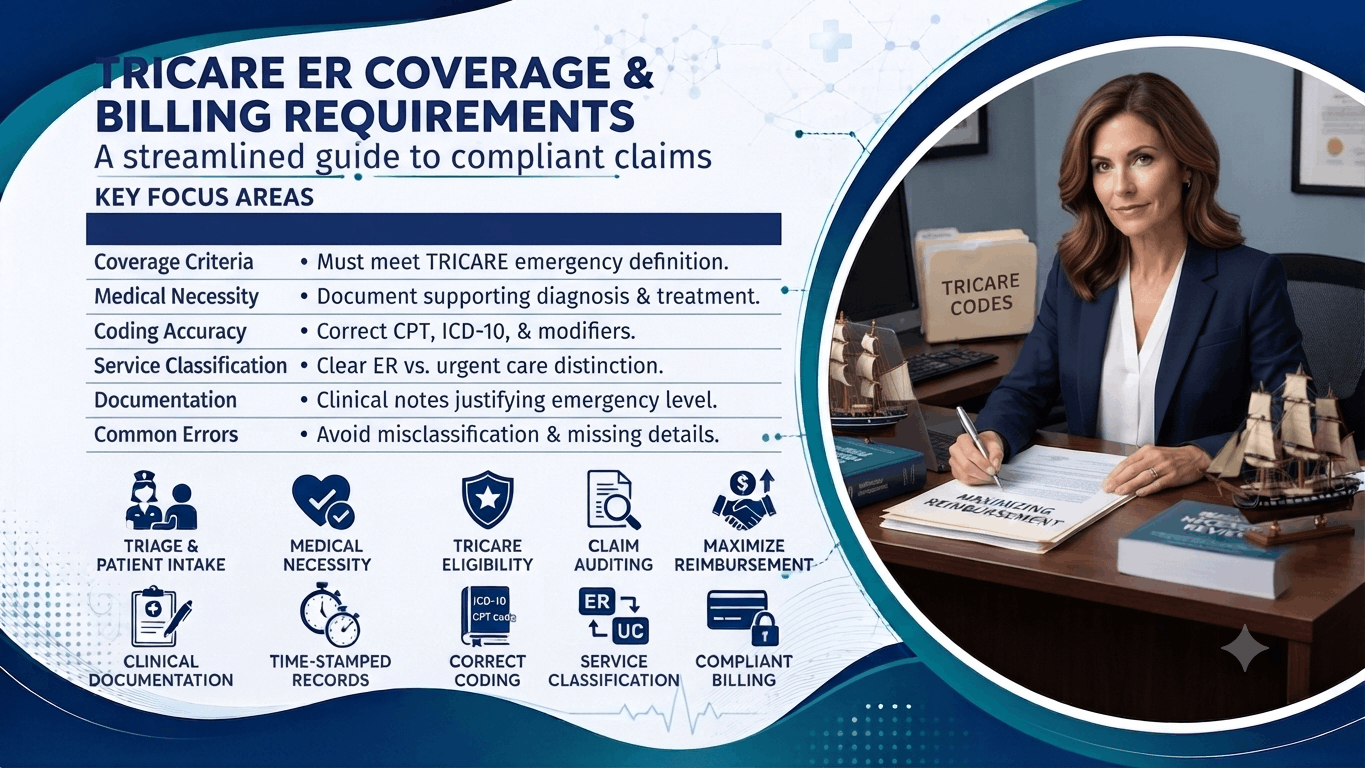
Across the nation, TRICARE covers emergency room services when they meet the definition of true emergency care, but billing must accurately reflect medical necessity, correct coding, and proper service classification. If ER visits are misclassified or lack supporting documentation, claims can be reduced or denied, even when care was appropriate.
| Aspect | Requirement | Coverage Criteria |
|---|---|---|
| Must meet TRICARE definition of emergency care | Medical Necessity | Clearly documented with supporting diagnosis |
| Coding Accuracy | Correct CPT, ICD-10, and modifiers required | Service Classification |
| ER vs urgent care must be properly identified | Documentation | Complete clinical notes to justify emergency level |
| Common Errors | Misclassification, missing details, incorrect coding | — |
Medical necessity documentation is the backbone of ER billing approval, as it proves that the care provided truly qualifies as an emergency under TRICARE guidelines. If the documentation doesn’t clearly support the severity and urgency of the visit, even correctly coded claims can be denied or downcoded.
| Aspect | Importance | Primary Requirement |
|---|---|---|
| Justifies why ER-level care was needed | Documentation Detail | Must reflect symptoms, severity, and clinical decision-making |
| Impact on Claims | Directly affects approval, denial, or downcoding | Common Gaps |
| Vague notes, missing severity indicators | Audit Risk | High if documentation doesn’t support billed services |
| Best Practice | Ensure thorough, real-time clinical documentation | — |
Provider type and ER facility status play a major role in how TRICARE reimburses claims, as payment rates vary based on whether services are billed by a hospital ER, freestanding facility, or individual provider. If these classifications aren’t accurately reported, it can lead to underpayments, claim reprocessing, or compliance concerns.
| Aspect | Impact on Reimbursement | Provider Type |
|---|---|---|
| Physician vs facility billing affects payment structure | Facility Status | Hospital ER vs freestanding ER has different rate models |
| Billing Components | Separate professional and facility charges must be correct | Reimbursement Rates |
| Vary based on classification and contracts | Common Errors | Misidentifying provider or facility type |
| Financial Risk | Underpayments or delayed claims due to incorrect setup | — |
It is important for your medical practice that properly distinguishing between emergency and non-emergency services is critical in TRICARE billing, as it directly affects whether a claim is approved, reduced, or denied. If a visit is classified incorrectly or lacks clear supporting documentation, even valid services can face reimbursement issues or downcoding.
| Aspect | Emergency Classification | Non-Emergency Classification |
|---|---|---|
| Coverage Approval | Higher likelihood if criteria met | May be limited or denied |
| Medical Necessity | Must meet strict ER definition | Evaluated under routine care rules |
| Reimbursement Level | Typically higher | Lower or adjusted |
| Documentation Need | Detailed severity and urgency required | Standard documentation sufficient |
| Common Errors | Misclassification without proof of emergency | Incorrect ER billing for routine cases |
| Claim Outcome Risk | Denial if not justified | Downcoding or rejection |
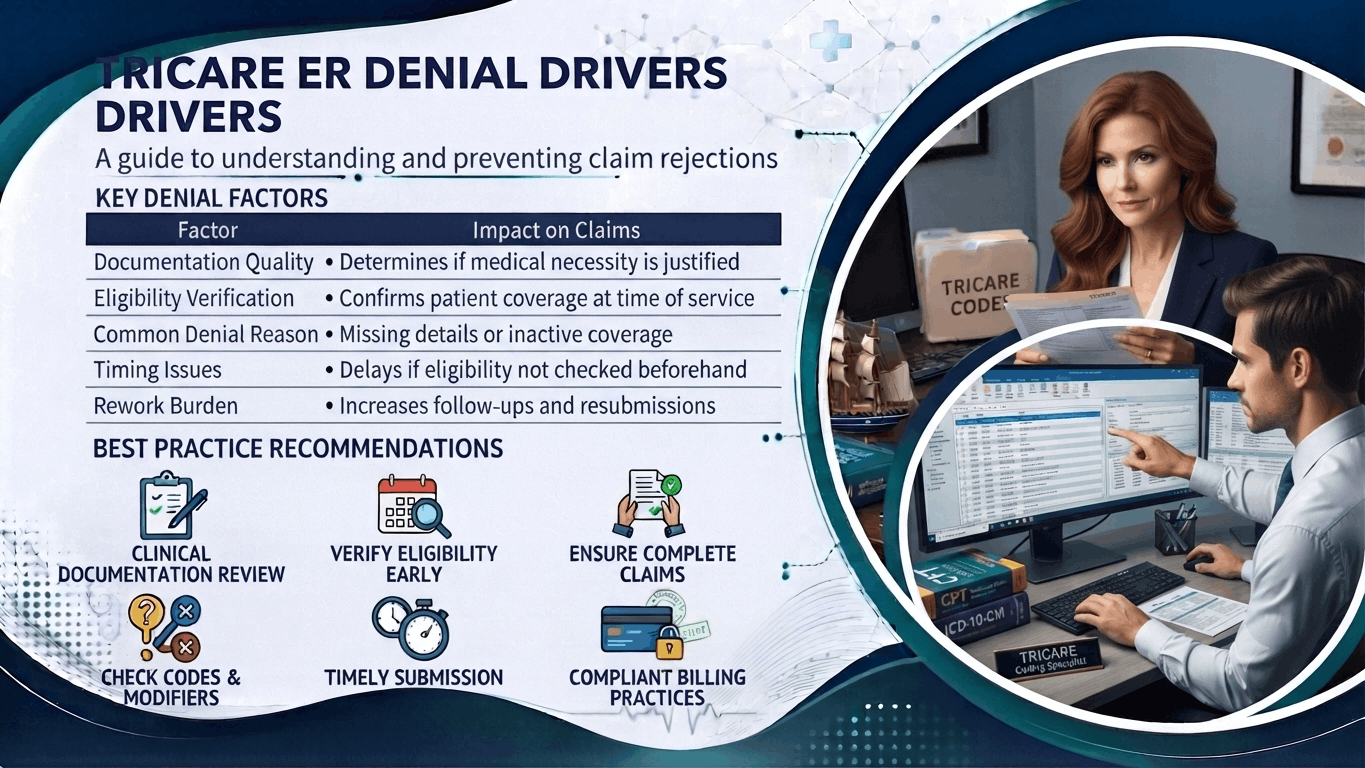
It is our experience that in TRICARE ER billing, most denials can be traced back to two core issues: incomplete documentation and unverified eligibility. Even when services are valid, missing clinical detail or outdated eligibility information can cause claims to be rejected or delayed, making these two areas critical for clean claim success.
| Factor | Impact on Claims |
|---|---|
| Documentation Quality | Determines if medical necessity is justified |
| Eligibility Verification | Confirms patient coverage at time of service |
| Common Denial Reason | Missing details or inactive coverage |
| Timing Issues | Delays if eligibility not checked beforehand |
| Rework Burden | Increases follow-ups and resubmissions |
| Best Practice | Verify eligibility and ensure complete documentation before submission |
Inefficient ER billing workflows don’t just slow things down, they create a chain reaction of delays, errors, and extra work for your team. When processes lack structure or consistency, claims take longer to submit, follow-ups increase, and staff spend more time fixing issues instead of preventing them.
| Aspect | Impact |
|---|---|
| Claim Submission Speed | Slower due to disorganized processes |
| Error Rate | Higher from manual or inconsistent workflows |
| Payment Timeline | Delayed reimbursements |
| Administrative Burden | Increased workload and staff burnout |
| Follow-Ups Required | More frequent due to rework |
| Revenue Impact | Cash flow disruptions and potential losses |
Outsourcing TRICARE ER billing gives your practice access to specialized expertise that’s difficult to maintain in-house, especially with the complexity of emergency care requirements. At House of Outsourcing our expert-driven workflows, precise coding, and proactive claim monitoring significantly reduce errors and prevent denials.
| Aspect | In-House Billing | House of Outsourcing |
|---|---|---|
| Accuracy Level | Varies based on staff training | High with specialized ER billing experts |
| Denial Rate | Higher due to complexity | Reduced through proactive checks |
| Coding Precision | Inconsistent at times | Consistent and guideline-driven |
| Claim Monitoring | Reactive follow-ups | Proactive tracking and management |
| Turnaround Time | Slower processing | Faster claim submission and payment |
| Revenue Performance | Potential leakage | Optimized collections and cash flow |
From eligibility verification to payment posting, our end-to-end billing services help your practice collect more revenue while your team focuses on emergency patient care.
Get a free assessment from our billing experts